169
A Strong and Robust Baseline for Text-Image Matching
Fangyu Liu
University of Waterloo [email protected]
Rongtian Ye
Aalto University [email protected]
Abstract
We review the current schemes of text-image matching models and propose improvements for both training and inference. First, we em-pirically show limitations of two popular loss (sum and max-margin loss) widely used in training text-image embeddings and propose a trade-off: a kNN-margin loss which 1) uti-lizes information from hard negatives and 2) is robust to noise as allK-most hardest sam-ples are taken into account, toleratingpseudo negatives and outliers. Second, we advocate the use of Inverted Softmax (IS) and Cross-modal Local Scaling (CSLS) during inference to mitigate the so-called hubness problem in high-dimensional embedding space, enhanc-ing scores of all metrics by a large margin.
1 Introduction
In recent years, deep eural models have gained a significant edge over shallow1 models in cross-modal matching tasks. Text-image matching has been one of the most popular ones among them. Most methods involve two phases: 1) training: two neural networks (one image encoder and one text encoder) are learned end-to-end, mapping texts and images into a joint space, where vectors (either texts or images) with similar meanings are close to each other; 2) inference: for a query in modality A, after being encoded into a vector, a nearest neighbor search is performed to match the vector against all vector representations of items2
in modality B. As the embedding space is learned through jointly modeling vision and language, it is often referred to as Visual Semantic Embeddings (VSE).
While the state-of-the-art architectures being consistently advanced (Nam et al., 2017; You
1
shallowmeans non-neural methods.
2In this paper, we refer to vectors used for searching as
“queries” and vectors in the searched space as “items”.
et al., 2018; Wehrmann et al., 2018; Wu et al., 2019), few works have focused on the more fun-damental problem of text-image matching - that is, the optimization objectives during training and inference. And that is what this paper focuses on. In the following of the paper, we will dis-cuss 1) the optimization objective during training, i.e., loss function, and 2) the objective used in in-ference (how should a text-image correspondence graph be predicted).
would perform (and max-margin would fail). In this paper, we propose the use of a trade-off: a kNN-margin loss that sums over thek hard-est sample within a mini-batch. It 1) makes suf-ficient use of hard samples and also 2) is robust across different model architectures and datasets. In experiments, the kNN-margin loss prevails in (almost) all data and model configurations.
Inference. During text-image matching infer-ence, a nearest-neighbor search is usually per-formed to obtain a ranking for each of the queries. It has been pointed out by previous works (Radovanovi´c et al., 2010; Dinu et al., 2015;Zhang et al.,2017) thathubswill emerge in such high-dimensional space and nearest neighbor search can be problematic for this need. Qualita-tively, the hubness problem means a small portion of queries becoming “popular” nearest neighbor in the search space. Hubs harm model’s performance as we already know that the predicted text-image correspondence should be a bipartite matching3. In experiments, we show that the hubness prob-lem is the primary source of error for inference. Though has not attracted enough attention in text-image matching, hubness problem has been ex-tensively studied in Bilingual Lexicon Induction (BLI) which aims to find a matching between two sets of bilingual word vectors. We thus propose to use similar tools during the inference phase of text-image matching. Specifically, we experiment with Inverted Softmax (IS) (Smith et al., 2017)
and Cross-modal Local Scaling (CSLS) (Lample et al., 2018) to mitigate the hubness problem in text-image embeddings.
Contributions. The major contributions of this work are
• analyzing the shortcomings of sum and max-margin loss, proposing a kNN-max-margin loss as a trade-off (for training);
• proposing the use of Inverted Softmax and Cross-modal Local Scaling to replace naive nearest neighbor search (for inference).
2 Method
We first introduce the basic formulation of text-image matching model and sum/max-margin loss in2.1. Then we propose our intended kNN-margin
3In Graph Theory, a set of edges is said to be amatching
if none of the edges share a common endpoint.
loss in Section2.2and the use of ISand CSLSfor inference in Section2.3.
2.1 Basic Formulation
The bidirectional text-image retrieval framework consists of a text encoder and an image en-coder. The text encoder is composed of word embeddings, a GRU (Chung et al., 2014) or LSTM (Hochreiter and Schmidhuber,1997) layer and a temporal pooling layer. The image encoder is a VGG19 (Simonyan and Zisserman, 2014) or ResNet152 (He et al.,2016) pre-trained on Ima-geNet (Deng et al.,2009) and a linear layer. We denote them as functionsf andgwhich map text and image to two vectors of sizedrespectively.
For a text-image pair (t, i), the similarity oft
andiis measured by cosine similarity of their nor-malized encodings:
s(i, t) =
f(t)
kf(t)k2
, g(i)
kg(i)k2
:Rd×Rd→R.
(1)
During training, a margin based triplet ranking loss is adopted to cluster positive pairs and push negative pairs away from each other. We list the both the sum-margin loss used in Frome et al. (2013);Kiros et al.(2015);Nam et al.(2017);You et al.(2018);Wehrmann et al.(2018):
min θ
X
i∈I
X
¯
t∈T\{t}
[α−s(i, t) +s(i,¯t)]+
+X t∈T
X
¯i∈I\{i}
[α−s(t, i) +s(t,¯i)]+; (2)
and the max-margin loss used byEngilberge et al. (2018);Faghri et al.(2018);Lee et al.(2018);Wu et al.(2019):
min θ
X
i∈I max
¯
t∈T\{t}[α−s(i, t) +s(i,
¯ t)]+
+X t∈T
max
¯i∈I\{i}[α
−s(t, i) +s(t,¯i)]+, (3)
where[·]+ = max(0,·);αis a preset margin (we useα = 0.2); T andI are all text and image en-codings in a mini-batch;tis the descriptive text for imageiand vice versa;t¯denotes non-descriptive texts foriwhile¯idenotes non-descriptive images fort.
2.2 kNN-margin Loss
(Eq.2) or hardest (Eq.3) sample in a mini-batch, we take the k-hardest samples. We first define a function kNN(x, M, k) to return the k closest points in point setM tox. Then the kNN-margin loss is formulated as:
min θ
X
i∈I
X
¯
t∈K1
[α−s(i, t) +s(i,¯t))]+
+X t∈T
X
¯i∈K2
[α−s(t, i) +s(t,¯i))]+ (4)
where
K1 =kNN(i, T\{t}, k), K2=kNN(t, I\{i}, k).
In max-margin loss, when the hardest sample is misleading or incorrectly labeled, the wrong gradient would be imposed on the network. We call it a pseudo hard negative. In kNN-margin loss, though some pseudo hard negatives might still generate false gradients, they are likely to be canceled out by the negative samples with cor-rect information. As only thekhardest negatives are considered, the selected samples are still hard enough to provide meaningful supervision to the model. In experiments, we show that kNN-margin loss indeed demonstrates such characteristics.
2.3 Hubness Problem During Inference
The standard procedure for inference is perform-ing a naive nearest neighbor search. This, how-ever, leads to the hubness problem which is the primary source or error as we will show in Sec-tion 3.5. We thus leverage the prior that “one query should not be the nearest neighbor for mul-tiple items” to improve the text-image matching. Specifically, we use two tools introduced in BLI: Inverted Softmax (IS) (Smith et al., 2017) and Cross-modal Local Scaling (CSLS) (Lample et al., 2018).
2.3.1 Inverted Softmax (IS)
The main idea of ISis to estimate the confidence of a predictioni → tnot merely by similarity score
s(i, t), but the score reweighted by t’s similarity with other queries:
s0(i, t) = e βs(i,t)
P
¯i∈I\{i}eβs(¯i,t)
(5)
whereβ is a temperature (we useβ = 30). Intu-itively, it scales down the similarity iftis also very close to other queries.
2.3.2 Cross-modal Local Scaling (CSLS)
CSLSaims to decrease a query vector’s similarity to item vectors lying indenseareas while increase similarity toisolated4item vectors. It punishes the occurrences of an item being the nearest neighbor to multiple queries. Specifically, we update the similarity scores with the formula:
s0(i, t) = 2s(i, t)−1
k
X
it∈K1
s(it, t)
−1
k
X
ti∈K2
s(i, ti)
(6)
whereK1 =kNN(t, I, k)andK2 =kNN(i, T, k) (we usek= 10).
3 Experiments
In this section we introduce our experimental se-tups (Section3.1,3.2,3.3) and quantitative results (Section3.4,3.5).
3.1 Dataset
dataset # train # validation # test
Flickr30k 30,000 1,000 1,000
MS-COCO 1k 113,287 5,000 1,000
MS-COCO 5k 113,287 5,000 5,000
Table 3: Train-validation-test splits of used datasets.
We use Flickr30k (Young et al., 2014) and MS-COCO (Lin et al., 2014) as our experimental datasets. We list their splitting protocols in Ta-ble3. For MS-COCO, there has been several dif-ferent splits used by the research community. In convenience of comparing to a wide range of re-sults reported by other works, we use two proto-cols and they are referred as MS-COCO 1k and 5k where 1k and 5k differs only in the test set used (1k’s test set is a subset of 5k’s). Notice that MS-COCO 5k computes the average of 5 folds of 1k images. Also, in both Flickr30k and MS-COCO,
1image has5captions - so5(text,image) pairs are used for every image.
3.2 Evaluation Metrics
We use R@Ks (recall atK), Med r and Mean r to evaluate the results:
image→text text→image
# architecture loss R@1 R@5 R@10 Med r Mean r R@1 R@5 R@10 Med r Mean r
1.1
GRU+VGG19
sum-margin 30.2 58.7 70.4 4.0 33.0 22.9 50.6 61.4 5.0 49.5 1.2 max-margin 30.7 58.7 69.6 4.0 30.3 22.4 48.4 59.3 6.0 39.0 1.3 kNN-margin (k= 3) 34.1 61.7 69.9 3.0 24.7 25.1 52.5 64.6 5.0 34.3 1.4 kNN-margin (k= 5) 33.4 61.6 71.1 3.0 26.7 24.2 51.8 64.8 5.0 32.7
[image:4.595.82.518.66.150.2]1.5 kNN-margin (k= 10) 33.3 59.4 69.4 3.0 28.4 23.4 50.6 63.5 5.0 33.8
Table 1: Quantitative results on Flickr30k (Young et al.,2014).
image→text text→image
# architecture loss R@1 R@5 R@10 Med r Mean r R@1 R@5 R@10 Med r Mean r
2.1
GRU+VGG19
sum-margin 48.9 79.9 89.0 1.8 5.6 38.3 73.5 85.3 2.0 8.4
2.2 max-margin 51.8 81.1 90.5 1.0 5.5 39.0 73.9 84.7 2.0 12.0 2.3 kNN-margin 50.6 81.1 90.6 1.4 5.5 38.7 74.0 85.5 2.0 11.8
2.4
GRU+ResNet152
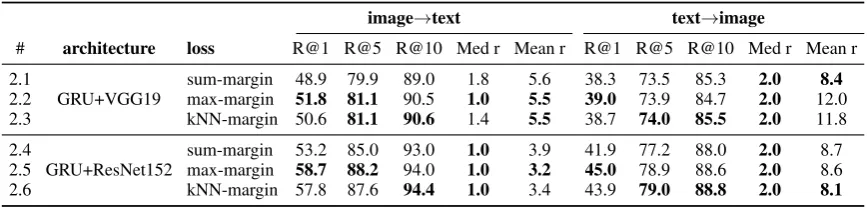
sum-margin 53.2 85.0 93.0 1.0 3.9 41.9 77.2 88.0 2.0 8.7 2.5 max-margin 58.7 88.2 94.0 1.0 3.2 45.0 78.9 88.6 2.0 8.6 2.6 kNN-margin 57.8 87.6 94.4 1.0 3.4 43.9 79.0 88.8 2.0 8.1
Table 2: Quantitative results on MS-COCO (Lin et al.,2014). Using the 5k test set.
• R@K: the ratio of “# of queries that the ground-truth item is ranked in topK” to “to-tal # of queries” (we useK ={1,5,10}; the higher the better);
• Med r: the median of the ground-truth rank-ing (the lower the better);
• Mean r: the mean of the ground-truth ranking (the lower the better).
We compute all metrics for both text→image retrieval and image→text matching. We follow the convention of taking the model with maximum R@Ks sum (both text→image and image→text) on the validation set as the best model for testing.
3.3 Hyperparameters
Training. For max-margin models, we follow the configuration specified inFaghri et al.(2018). For all other models, we start with a learning rate of 0.001 and decay it by 10 times after every 10 epochs. We train all models for 30 epochs with a batch size of128. All models are optimized using an Adam optimizer (Kingma and Ba,2015).
Model. We use 300-d word embeddings and
1024 internal states for GRU text encoders (all randomly initialized with Xavier init. (Glorot and Bengio,2010);d= 1024for both text and image embeddings. All image encoders are fixed (with no finetuning) for fair comparison.
3.4 Loss Function Performance
Table 1 and 2 show quantitative results on Flickr30k and MS-COCO respectively.
Flickr30k. kNN-margin loss achieves signifi-cantly better performance on all metrics than all other loss. It is worth noticing that max-margin loss fails on this dataset (even much worse than sum-margin). kNN-margin loss with k = {3,5} get the highest scores. We usek = 3for the fol-lowing experiments unless explicitly specified.
MS-COCO. Max-margin loss performs much better on MS-COCO, especially on R@1- it has the best R@1 across both configurations. kNN-margin is comparable to max-kNN-margin. Specifi-cally, it produces slightly worse R@1s, almost identical R@5s, and slightly better R@10s. Sum-margin, however, performs poorly on MS-COCO. It is worth noting that here we are using the 5k test set, which is a superset of the widely adopted 1k test set. We will compare with quantitative results reported on the 1k test set in the next section.
3.5 Hubs during Inference
To show hubness is indeed a major source of er-ror, we select one of the text-image embeddings to do statistics. We use the model on Table 2 line 2.1 to generate embeddings on MS-COCO’s test set. Among the 25,000(query, item) pairs, only1,027(4.1%) items are the nearest neighbor (NN) of solely1query; there are, however,19,805
(79.2%) items that are NN to0 query and3,007
[image:4.595.82.516.183.287.2]image→text text→image
# dataset model inference R@1 R@5 R@10 Med r Mean r R@1 R@5 R@10 Med r Mean r
3.1
Flickr30k GRU+VGG19 kNN-margin
naive 34.1 61.7 69.9 3.0 24.7 25.1 52.5 64.6 5.0 34.3 3.2 IS 36.0 64.5 72.9 3.0 20.1 25.2 52.6 64.4 5.0 31.1 3.3 CSLS 36.0 64.4 72.5 3.0 20.3 26.7 54.3 65.7 4.0 30.8
3.4
MS-COCO 5k
GRU+ResNet152 kNN-margin
naive 57.8 87.6 94.4 1.0 3.4 43.9 79.0 88.8 2.0 8.1 3.5 IS 64.2 89.4 95.0 1.0 3.2 46.7 80.1 89.3 2.0 7.8 3.6 CSLS 62.4 89.3 95.4 1.0 3.0 47.2 80.7 89.9 2.0 7.7
3.7
MS-COCO 1k
(Kiros et al.,2015) (ours5) 49.9 79.4 90.1 2.0 5.2 37.3 74.3 85.9 2.0 10.8
3.8 (Vendrov et al.,2016) 46.7 - 88.9 2.0 5.7 37.9 - 85.9 2.0 8.1
3.9 (Huang et al.,2017) 53.2 83.1 91.5 1.0 - 40.7 75.8 87.4 2.0
-3.10 (Liu et al.,2017) 56.4 85.3 91.5 - - 43.9 78.1 88.6 -
-3.11 (You et al.,2018) 56.3 84.4 92.2 1.0 - 45.7 81.2 90.6 2.0
-3.12 (Faghri et al.,2018) 58.3 86.1 93.3 1.0 - 43.6 77.6 87.8 2.0
3.13 (Faghri et al.,2018) (ours) 60.5 89.6 94.9 1.0 3.1 46.1 79.5 88.7 2.0 8.5
3.14 (Wu et al.,2019) 64.3 89.2 94.8 1.0 - 48.3 81.7 91.2 2.0
-3.15
GRU+ResNet152 kNN-margin
[image:5.595.75.524.63.280.2]naive 58.3 89.2 95.4 1.0 3.1 45.0 80.4 89.6 2.0 7.2 3.16 IS 66.4 91.8 96.1 1.0 2.7 48.6 81.5 90.3 2.0 7.3 3.17 CSLS 65.4 91.9 97.1 1.0 2.5 49.6 82.7 91.2 2.0 6.5
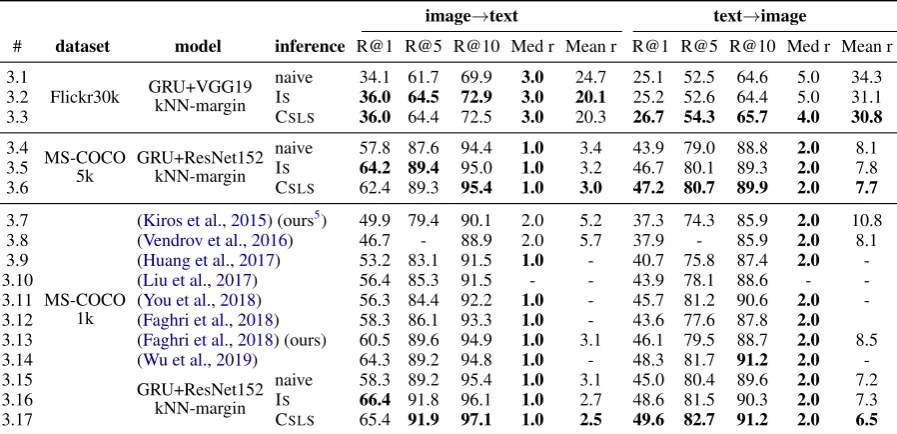
Table 4: Quantitative results of different inference methods across different datasets and models. Line 3.1-3.3 are using the model from Table1line 1.3 and line 3.4-3.6, 3.15-3.17 are using the model from Table2line 2.9. Line 3.7-3.14 are results reported by previous works which all adopted naive nearest neighbor search for inference.
in the ground-truth query-item matching. So, we can spot errors even before ground-truth labels are revealed - for instance, the most “popular” item with51NNs must be thefalseNN for at least50
queries. Table5shows the brief statistics.
k= 0 k= 1 k≥2 k≥5 k≥10
# 19,805 1,026 4,169 3,007 500 percentage 79.2% 4.1% 16.7% 12.0% 2.0%
Table 5: Statistics of # items being NN tok queries in the embeddings of Table 2, line 2.1, text→image. There are in total 25,000 (text,image) paris in this em-bedding.
Both ISand CSLSdemonstrate compelling em-pirical performance in mitigating the hubness problem. Table 4 shows the quantitative results. R@Ks and also Med r, Mean r are improved by a large margin with both methods. In most con-figurations, CSLSis slightly better than IS on im-proving text→image inference while IS is better
at image→text. The best results (line 3.8, 3.9) are even better than the recently reported state-of-the-art (Wu et al., 2019) (Table 4 line 3.14), which performs a naive nearest neighbor search. This suggests that the hubness problem deserves much more attention and careful selection of inference methods is vital for text-image matching.
5“ours” means our implementation.
4 Limitations and Future Work
This paper brings up a baseline with excellent empirical performance. We plan to contribute more theoretical and technical novelty in follow up works for both the training and inference phase of text-image matching models.
Loss function. Though the kNN-margin loss has superior empirical performance, it is leveraging the prior knowledge we hardcoded in it -it relies on a su-itable k to maximize its power. Flickr30k and MS-COCO are relatively clean and high-quality datasets while the real world data is usually not. With the kNN-margin loss being a strong baseline, we plan to bring a certain form of self-adaptiveness into the loss function to help it automatically decide what to learn based on the distribution of data points.
dataset (Elliott and Kleppe, 2016; Biten et al., 2019).
Inference. Both IS and CSLS aresoftcriteria. If we do have the strong prior that the final text-image correspondence is a bipartite matching, we might as well make use of that information and im-pose ahardconstraint on it. The task of text-image matching, after all, is also a form of assignment problem in Combinatorial Optimization (CO). We thus plan to investigate tools from the CO lit-erature such as the Hungarian Algorithm (Kuhn, 1955), which is the best-known algorithm for pro-ducing a maximum weight bipartite matching; the Murty’s Algorithm (Murty,1968), which general-izes the Hungarian Algorithm into producing the
K-best matching - so that rankings are available for computing R@Kscores.
5 Related Work
In this section, we introduce works from two fields which are highly-related to our work: 1) text-image matching and VSE; 2) Bilingual Lexi-con Induction (BLI) in the Lexi-context of cross-modal matching.
5.1 Text-image Matching
Since the dawn of deep learning, works have emerged using a two-branch structure to connect both language and vision. Frome et al. (2013) brought up the idea of VSE, which is to embed pairs of (text, image) data and compare them in a joint space. Later works extended VSE for the task of text-image matching (Hodosh et al.,2013; Kiros et al., 2015; Gong et al., 2014; Vendrov et al.,2016;Hubert Tsai et al.,2017;Faghri et al., 2018;Wang et al.,2019), which is also our task of interest. It is worth noting that there are other lines of works which also jointly model language and vision. The closest one might be image captioning (Lebret et al.,2015;Karpathy and Fei-Fei,2015). But image captioning aims to generate novel cap-tions while text-image matching retrieves existing descriptive texts or images in a database.
5.2 Bilingual Lexicon Induction (BLI)
We specifically talk about BLI as the tools we used to improve inference performance come from this literature. BLI is the task of inducing word translations from monolingual corpora in two lan-guages (Irvine and Callison-Burch,2017). Words are usually represented by vectors trained from
Distributional Semantics, eg. Mikolov et al. (2013). So, the word translation problem converts to finding the appropriate matching among two sets of vectors which makes it similar to our task of interest. Smith et al.(2017);Lample et al.(2018) proposed to first conduct a direct Procrustes Anal-ysis (Sch¨onemann,1966) between two sets of vec-tors, then use criteria that heavily punish hubs dur-ing inference to avoid the hubness problem. We experimented with both methods in our task.
6 Conclusion
We discuss the pros and cons of prevalent loss functions used in text-image matching and pro-pose a kNN-margin loss as a trade-off which yields strong and robust performance across dif-ferent model architectures and datasets. Instead of using naive nearest neighbor search, we advocate to adopt more polished inference strategies such as Inverted Softmax (IS) and Cross-modal Local Scaling (CSLS), which can significantly improve scores of all metrics.
We also analyze the limitations of this work and indicate the next step for improving both the loss function and the inference method.
7 Acknowledgement
We thank the reviewers for their careful and in-sightful comments. We thank our family mem-bers who have both spiritually and financially supported our independent research. The author Fangyu Liu thanks R´emi Lebret for introducing him this interesting problem and many of the re-lated works.
References
Ali Furkan Biten, Lluis Gomez, Marc¸al Rusi˜nol, and Dimosthenis Karatzas. 2019. Good news, everyone! context driven entity-aware captioning for news im-ages. CVPR.
Junyoung Chung, Caglar Gulcehre, KyungHyun Cho, and Yoshua Bengio. 2014. Empirical evaluation of gated recurrent neural networks on sequence model-ing.arXiv preprint arXiv:1412.3555.
J. Deng, W. Dong, R. Socher, L.-J. Li, K. Li, and L. Fei-Fei. 2009. Imagenet: A large-scale hierar-chical image database. InProceedings of the IEEE conference on computer vision and pattern recogni-tion (CVPR), pages 248–255. IEEE.
Desmond Elliott and Martijn Kleppe. 2016. 1 million captioned dutch newspaper images.
Martin Engilberge, Louis Chevallier, Patrick P´erez, and Matthieu Cord. 2018. Finding beans in burgers: Deep semantic-visual embedding with localization. In Proceedings of the IEEE Conference on Com-puter Vision and Pattern Recognition, pages 3984– 3993.
F. Faghri, D. J. Fleet, J. R. Kiros, and S. Fidler. 2018. Vse++: Improving visual-semantic embed-dings with hard negatives.
A. Frome, G. S. Corrado, J. Shlens, S. Bengio, J. Dean, and T. Mikolov. 2013. Devise: A deep visual-semantic embedding model. InNIPS, pages 2121– 2129.
Xavier Glorot and Yoshua Bengio. 2010. Understand-ing the difficulty of trainUnderstand-ing deep feedforward neu-ral networks. In Proceedings of the thirteenth in-ternational conference on artificial intelligence and statistics, pages 249–256.
Yunchao Gong, Liwei Wang, Micah Hodosh, Julia Hockenmaier, and Svetlana Lazebnik. 2014. Im-proving image-sentence embeddings using large weakly annotated photo collections. In European Conference on Computer Vision (ECCV), pages 529–545. Springer.
Kaiming He, Xiangyu Zhang, Shaoqing Ren, and Jian Sun. 2016. Deep residual learning for image recog-nition. In Proceedings of the IEEE conference on computer vision and pattern recognition, pages 770– 778.
S. Hochreiter and J. Schmidhuber. 1997. Long short-term memory. Neural computation, 9(8):1735– 1780.
Micah Hodosh, Peter Young, and Julia Hockenmaier. 2013. Framing image description as a ranking task: Data, models and evaluation metrics. Journal of Ar-tificial Intelligence Research, 47:853–899.
Yan Huang, Wei Wang, and Liang Wang. 2017. Instance-aware image and sentence matching with selective multimodal lstm. In Proceedings of the IEEE Conference on Computer Vision and Pattern Recognition, pages 2310–2318.
Yao-Hung Hubert Tsai, Liang-Kang Huang, and Rus-lan Salakhutdinov. 2017. Learning robust visual-semantic embeddings. In Proceedings of the IEEE International Conference on Computer Vision (ICCV), pages 3571–3580.
Ann Irvine and Chris Callison-Burch. 2017. A com-prehensive analysis of bilingual lexicon induction. Computational Linguistics, 43(2):273–310.
Andrej Karpathy and Li Fei-Fei. 2015. Deep visual-semantic alignments for generating image descrip-tions. In Proceedings of the IEEE conference
on computer vision and pattern recognition, pages 3128–3137.
Diederik P Kingma and Jimmy Ba. 2015. Adam: A method for stochastic optimization.ICLR.
R. Kiros, R. Salakhutdinov, and R. S. Zemel. 2015. Unifying visual-semantic embeddings with multi-modal neural language models. Transactions of the Association for Computational Linguistics (TACL).
Harold W Kuhn. 1955. The hungarian method for the assignment problem. Naval research logistics quar-terly, 2(1-2):83–97.
Guillaume Lample, Alexis Conneau, Marc’Aurelio Ranzato, Ludovic Denoyer, and Herv Jgou. 2018.
Word translation without parallel data. In Interna-tional Conference on Learning Representations.
R´emi Lebret, Pedro O Pinheiro, and Ronan Collobert. 2015. Phrase-based image captioning. In Proceed-ings of the 32nd International Conference on Inter-national Conference on Machine Learning-Volume 37 (ICML), pages 2085–2094. JMLR. org.
Kuang-Huei Lee, Xi Chen, Gang Hua, Houdong Hu, and Xiaodong He. 2018. Stacked cross attention for image-text matching. In Proceedings of the European Conference on Computer Vision (ECCV), pages 201–216.
T.-Y. Lin, M. Maire, S. Belongie, J. Hays, P. Perona, D. Ramanan, P. Doll´ar, and L. Zitnick. 2014. Mi-crosoft coco: Common objects in context. In Euro-pean conference on computer vision (ECCV), pages 740–755. Springer.
Yu Liu, Yanming Guo, Erwin M Bakker, and Michael S Lew. 2017. Learning a recurrent residual fusion net-work for multimodal matching. InProceedings of the IEEE International Conference on Computer Vi-sion, pages 4107–4116.
Tomas Mikolov, Ilya Sutskever, Kai Chen, Greg S Cor-rado, and Jeff Dean. 2013. Distributed representa-tions of words and phrases and their compositional-ity. InAdvances in neural information processing systems, pages 3111–3119.
Katta G Murty. 1968. Letter to the editoran algorithm for ranking all the assignments in order of increasing cost.Operations research, 16(3):682–687.
Hyeonseob Nam, Jung-Woo Ha, and Jeonghee Kim. 2017. Dual attention networks for multimodal rea-soning and matching. InProceedings of the IEEE Conference on Computer Vision and Pattern Recog-nition, pages 299–307.
Peter H Sch¨onemann. 1966. A generalized solution of the orthogonal procrustes problem. Psychometrika, 31(1):1–10.
Ravi Shekhar, Sandro Pezzelle, Yauhen Klimovich, Aurelie Herbelot, Moin Nabi, Enver Sangineto, and Raffaella Bernardi. 2017. ”foil it! find one mis-match between image and language caption”. In Proceedings of the 55th Annual Meeting of the As-sociation for Computational Linguistics (ACL) (Vol-ume 1: Long Papers), pages 255–265.
Haoyue Shi, Jiayuan Mao, Tete Xiao, Yuning Jiang, and Jian Sun. 2018. Learning visually-grounded semantics from contrastive adversarial samples. In Proceedings of the 27th International Conference on Computational Linguistics, pages 3715–3727.
K. Simonyan and A. Zisserman. 2014. Very deep con-volutional networks for large-scale image recogni-tion. CoRR, abs/1409.1556.
Samuel L Smith, David HP Turban, Steven Hamblin, and Nils Y Hammerla. 2017. Offline bilingual word vectors, orthogonal transformations and the inverted softmax. ICLR.
I. Vendrov, R. Kiros, S. Fidler, and R/ Urtasun. 2016. Order-embeddings of images and language.ICLR.
Liwei Wang, Yin Li, Jing Huang, and Svetlana Lazeb-nik. 2019. Learning two-branch neural networks for image-text matching tasks. IEEE Transac-tions on Pattern Analysis and Machine Intelligence, 41(2):394–407.
Jˆonatas Wehrmann et al. 2018. Bidirectional retrieval made simple. In Proceedings of the IEEE Confer-ence on Computer Vision and Pattern Recognition, pages 7718–7726.
Hao Wu, Jiayuan Mao, Yufeng Zhang, Yuning Jiang, Lei Li, Weiwei Sun, and Wei-Ying Ma. 2019. Uni-fied visual-semantic embeddings: Bridging vision and language with structured meaning representa-tions. InThe IEEE Conference on Computer Vision and Pattern Recognition (CVPR).
Quanzeng You, Zhengyou Zhang, and Jiebo Luo. 2018. End-to-end convolutional semantic embeddings. In The IEEE Conference on Computer Vision and Pat-tern Recognition (CVPR).
Peter Young, Alice Lai, Micah Hodosh, and Julia Hockenmaier. 2014. From image descriptions to visual denotations: New similarity metrics for se-mantic inference over event descriptions. Transac-tions of the Association for Computational Linguis-tics, 2:67–78.