“The red one!”:
On learning to refer to things
based on discriminative properties
Angeliki Lazaridou and Nghia The Pham and Marco Baroni University of Trento
{angeliki.lazaridou|thepham.nghia|marco.baroni}@unitn.it
Abstract
As a first step towards agents learning to communicate about their visual environ-ment, we propose a system that, given vi-sual representations of a referent (CAT) and a context (SOFA), identifies their dis-criminative attributes, i.e., properties that distinguish them (has_tail). More-over, although supervision is only pro-vided in terms of discriminativeness of attributes for pairs, the model learns to assign plausible attributes to specific ob-jects (SOFA-has_cushion). Finally, we present a preliminary experiment con-firming the referential success of the pre-dicted discriminative attributes.
1 Introduction
There has recently been renewed interest in devel-oping systems capable of genuine language under-standing (Hermann et al., 2015; Hill et al., 2015). In this perspective, it is important to think of an appropriate general framework for teaching lan-guage to machines. Since we use lanlan-guage pri-marily for communication, a reasonable approach is to develop systems within a genuine commu-nicative setup (Steels, 2003; Mikolov et al., 2015). Out long-term goal is thus to develop communi-ties of computational agents that learn how to use language efficiently in order to achieve commu-nicative success (Vogel et al., 2013; Foerster et al., 2016).
Within this general picture, one fundamental as-pect of meaning where communication is indeed crucial is the act of reference(Searle, 1969; Ab-bott, 2010), the ability to successfully talk to oth-ers about things in the external world. A specific instantiation of reference studied in this paper is that of referring expression generation (Dale and
is_round is_metal made_of_wood is_green
Figure 1: Discriminative attributes predicted by our model. Can you identify the intended refer-ent? See Section 6 for more information
Reiter, 1995; Mitchell et al., 2010; Kazemzadeh et al., 2014). Anecessarycondition for achieving successful reference is that referring expressions (REs) accurately distinguish the intended referent from any other object in the context (Dale and Haddock, 1991). Along these lines, we present here a model that, given an intended referent and a context object, predicts the attributes that discrim-inate between the two. Some examples of the be-haviour of the model are presented in Figure 1.
Importantly, and distinguishing our work from earlier literature on generating REs (Krahmer and Van Deemter, 2012): (i) the input objects are represented by natural images, so that the agent must learn to extract relevant attributes from real-istic data; and (ii) no direct supervision on the at-tributes of a single object is provided: the training signal concerns their discriminativeness for object pairs (that is, during learning, the agent might be told that has_tailis discriminative for hCAT,
SOFAi, but not that it is an attribute of cats). We use this “pragmatic” signal since it could later be replaced by a measure of success in actual com-munication between two agents (e.g., whether a second agent was able to pick the correct referent given a RE).
2 Discriminative Attribute Dataset
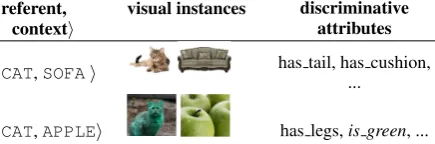
We generated the Discriminative Attribute Dataset, consisting of pairs of (intended)referents
andcontexts, with respect to which the referents should be identified by their distinctive attributes.
hreferent, visual instances discriminative
contexti attributes
hCAT,SOFAi has tail, has cushion,...
[image:2.595.75.293.64.136.2]hCAT,APPLEi has legs,is green, ...
Table 1: Example training data
Our starting point is the Visual Attributes for Concepts Dataset (ViSA) (Silberer et al., 2013), which contains per-concept (as opposed to per-image) attributes for 500 concrete concepts (CAT,
SOFA,MILK) spanning across different categories
(MAMMALS, FURNITURE), annotated with 636
general attributes. We disregarded ambiguous concepts (e.g.,bat), thus reducing our working set of conceptsC to 462 and the number of attributes
V to 573, as we eliminated any attribute that did not occur with concepts in C. We extracted on average 100 images annotated with each of these concepts from ImageNet (Deng et al., 2009). Fi-nally, each image i of concept c was associated to a visual instance vector, by feeding the image to the VGG-19 ConvNet (Simonyan and Zisser-man, 2014), as implemented in the MatConvNet toolkit (Vedaldi and Lenc, 2015), and extracting the second-to-last fully-connected (fc) layer as its 4096-dimensional visual representationvci.
We split the target concepts into training, val-idation and test sets, containing 80%, 10% and 10% of the concepts in each category, respec-tively. This ensures that (i) the intersection be-tween train and test concepts is empty, thus al-lowing us to test the generalization of the model across different objects, but (ii) there are instances of all categories in each set, so that it is possible to generalize across training and testing objects. Finally we build all possible combinations of con-cepts in the training split to form pairs of refer-ents and contextshcr, cciand obtain their (binary)
attribute vectors pcr andpcc from ViSA,
result-ing in 70K trainresult-ing pairs. From the latter, we de-rive, for each pair, a concept-level “discriminative-ness” vector by computing the symmetric differ-ence dcr,cc = (pcr −pcc)∪ (pcc −pcr). The
latter will contain 1s for discriminative attributes, 0s elsewhere. On average, each pair is associ-ated with 20 discriminative attributes. The final training data are triples of the formhcr, cc,dcr,cci
(the modelneverobserves the attribute vectors of specific concepts), to be associated with visual
in-stances of the two concepts. Table 1 presents some examples.
Note that ViSA contain concept-level attributes, but images contain specific instances of concepts for which a general attribute might not hold. This introduces a small amount of noise. For example,
is_greenwould in general be a discriminative
attribute for apples and cats, but it is not for the second sample in Table 1. Using datasets with per-imageattribute annotations would solve this issue. However, those currently available only cover spe-cific classes of concepts (e.g., only clothes, or ani-mals, or scenes, etc.). Thus, taken separately, they are not general enough for our purposes, and we cannot merge them, since their concepts live in dif-ferent attribute spaces.
3 Discriminative Attribute Network
The proposed Discriminative Attribute Network
(DAN) learns to predict the discriminative at-tributes of referent objectcrand contextccwithout
direct supervision at the attribute level, but relying only on discriminativeness information (e.g., for the objects in the first row of Table 1, the gold vec-tor would contain 1 forhas_tail, but 0 for both
is_greenandhas_legs). Still, the model is
implicitly encouraged to embed objects into a con-sistent attribute space, to generalize across the dis-criminativeness vectors of different training pairs, so it also effectively learns to annotate objects with visual attributes.
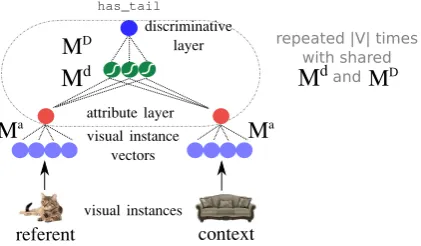
Figure 2 presents a schematic view of DAN, focusing on a single attribute. The model is pre-sented with two conceptshCAT,SOFAi, and ran-domly samples a visual instance of each. The in-stance visual vectorsv (i.e., ConvNet second-to-last fc layers) are mapped intoattributevectors of dimensionality|V|(cardinality of all available at-tributes), using weightsMa ∈ R4096×|V| shared
between the two concepts. Intuitively, this layer should learn whether an attribute is active for a specific object, as this is crucial for determining whether the attribute is discriminative for an ob-ject pair. In Section 5, we present experimental evidence corroborating this hypothesis.
In order to capture thepairwiseinteractions be-tween attribute vectors, the model proceeds by concatenating the two units associated with the
M
MdD
has_tail
attribute layer visual instance
vectors
visual instances discriminative
layer
referent context
Ma Ma
[image:3.595.77.288.62.185.2] [image:3.595.308.525.63.114.2]MD
repeated |V| times with shared
and
M
dFigure 2: Schematic representation of DAN. For simplicity, the prediction process is only illus-trated forhas_tail
The discriminative layer processes the two units by applying a linear transformation with weights
Md ∈ R2×h, followed by a sigmoid activation
function, finally deriving a single value by another linear transformation with weightsMD ∈ Rh×1.
The output dˆv encodes the predicted degree of
discriminativeness of attribute v for the specific reference-context pair. The same process is ap-plied to all attributes v ∈ V, to derive the esti-mated discriminativeness vectorˆd, using the same shared weightsMdandMDfor each attribute.
To learn the parametersθof the model (i.e.Ma,
MdandMD), given training datahc
r, cc,dcr,cci,
we minimize MSE between the gold vectordcr,cc
and model-estimatedˆdcr,cc. We trained the model
with rmsprop and with a batch size of 32. All hy-perparameters (including the hidden sizehwhich was set to 60) were tuned to maximize perfor-mance on the validation set.
4 Predicting Discriminativeness
We evaluate the ability of the model to predict attributes that discriminate the intended referent from the context. Precisely, we ask the model to return all discriminative attributes for a pair, in-dependently of whether they are positive for the referent or for the context (given images of a cat and a building, both+is_furryand−made_ of_bricksare discriminative of the cat).
Test stimuli We derive our test stimuli from the VisA test split (see Section 2), containing 2000 pairs. Unlike in training, where the model was presented with specificvisual instances (i.e., sin-gle images), for evaluation we usevisual concepts
(CAT, BED), which we derive by averaging the vectors of all images associated to an object (i.e., derivingCATfrom all images of cats), due to lack
Model Precision Recall F1
DAN 0.66 0.49 0.56
attribute+sym. difference 0.64 0.48 0.55 no attribute layer 0.63 0.33 0.43 Random baseline 0.16 0.16 0.16
Table 2: Predicting discriminative features
of gold information onper-imageattributes.
Results We compare DAN against a random baseline based on per-attribute discriminativeness probabilities estimated from the training data and an ablation model without attribute layer. We test moreover a model that is trained with supervi-sion to predict attributes and then deterministically computes the discriminative attributes. Specifi-cally, we implemented a neural network with one hidden layer, which takes as input a visual in-stance, and it is trained to predict its gold attribute vector, casting the problem as logistic regression, thus relying on supervision at the attribute level. Then, given two paired images, we let the model generate their predicted attribute vectors and com-pute the discriminative attributes by taking the symmetric difference of the predicted attribute vectors as we do for DAN. For the DAN and its ab-lation, we use a 0.5 threshold to deem an attribute discriminative, without tuning.
The results in Table 2 confirm that, with ap-propriate supervision, DAN performs discrimina-tiveness prediction reasonably well – indeed, as well as the model with similar parameter capac-ity requiring direct supervision on an attribute-by-attribute basis, followed by the symmetric differ-ence calculation. Interestingly, allowing the model to embed visual representations into an interme-diate attribute space has a strong positive effect on performance. Intuitively, since DAN is eval-uated on novel concepts, the mediating attribute layer provides more high-level semantic informa-tion helping generalizainforma-tion, at the expense of extra parameters compared to the ablation without at-tribute layer.
5 Predicting Attributes
Attribute learning is typically studied in su-pervised setups (Ferrari and Zisserman, 2007; Farhadi et al., 2009; Russakovsky and Fei-Fei, 2010). Our model learns to embed visual ob-jects in an attribute space through indirect supervi-sion about attribute discriminativeness for specific
explicitly associated to a specific concept during training. The question arises of whether discrim-inativeness pushes the model to learn plausible concept attributes. Note that the idea that the se-mantics of attributes arises from their distinctive function within a communication system is fully in line with the classic structuralist view of linguistic meaning (Geeraerts, 2009).
To test our hypothesis, we feed DAN the same test stimuli (visual concept vectors) as in the pre-vious experiment, but now look at activations in the attribute layer. Since these activations are real numbers whereas gold values (i.e., the visual at-tributes in the ViSA dataset) are binary, we use the validation set to learn the threshold to deem an attribute active, and set it to 0.5 without tun-ing. Note that no further training and no extra su-pervision other than the discriminativeness signal are needed to perform attribute prediction. The re-sulting binary attribute vector ˆpc for conceptcis
compared against the corresponding gold attribute vectorpc.
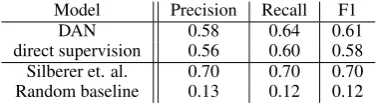
Results We compare DAN to the random base-line and to an explicit attribute classifier similar to the one used in the previous experiment, i.e., a one-hidden-layer neural network trained with lo-gistic regression to predict the attributes. We re-port moreover the best F1 score of Silberer et al. (2013), who learn a SVM for each visual at-tribute based on HOG visual features. Unlike in our setup, in theirs, images for the same con-cept are used both for training and to derive vi-sual attributes (our setup is “zero-shot” at the con-cept level, i.e., we predict attributes of concon-cepts not seen in training). Thus, despite the fact that they used presumably less accurate pre-CNN vi-sual features, the setup is much easier for them, and we take their performance to be an upper bound on ours.
DAN reaches, and indeed surpasses, the perfor-mance of the model with direct supervision at the attribute level, confirming the power of discrimi-nativeness as a driving force in building semantic representations. The comparison with Silberer’s model suggests that there is room for improve-ment, although the noise inherent in concept-level annotation imposes a relatively low bound on re-alistic performance.
Model Precision Recall F1
DAN 0.58 0.64 0.61
[image:4.595.322.511.62.114.2]direct supervision 0.56 0.60 0.58 Silberer et. al. 0.70 0.70 0.70 Random baseline 0.13 0.12 0.12
Table 3: Predicting concept attributes
6 Evaluating Referential Success
We finally ran a pilot study testing whether DAN’s ability to predict discriminative attributes at the concept level translates into producing features that would be useful in constructing successful ref-erential expressions for specific object instances.
Test stimuli Our starting point is the ReferIt dataset (Kazemzadeh et al., 2014), consisting of REs denoting objects (delimited by bounding boxes) in natural images. We filter out anyhRE, bounding boxi pair whose RE does not overlap with our attribute setV and annotate the remaining ones with the overlapping attribute, deriving data of the form hRE, bounding box, attributei. For each intended referent of this type, we sample as context another hRE, bounding boxi pair such that (i) the context RE does not contain the ref-erent attribute, so that the latter is a likely discriminative feature; (ii) referent and context come from different images, so that their bound-ing boxes do not accidentally overlap; (iii) there is maximum word overlap between referent and contexts REs, creating a realistic referential ambi-guity setup (e.g., two cars, two objects in similar environments). Finally we sample maximally 20
hreferent, contexti pairs perattribute, result-ing in 790 test items. For each referent and context we extract CNN visual vectors from their bound-ing boxes, and feed them to DAN to obtain their discriminative attributes. Note that we used the ViSA-trained DAN for this experiment as well.
Results For 12% of the test hreferent, contexti
pairs, the discriminative attribute is con-tained in the set of discriminative attributes pre-dicted by DAN. A random baseline estimated from the distribution of attributes in the ViSA dataset would score 15% recall. This baseline however on average predicts 20 discriminative attributes, whereas DAN activates, only 4. Thus, the base-line has a trivial recall advantage.
subset of 100 hreferent, contexti test pairs. We presented them separately to two subjects (one a co-author of this study) together with the at-tribute that the model activated with the largest score (see Figure 1 for examples). Subjects were asked to identify the intended referent based on the attribute. If both agreed on the same referent, we achieved referential success, since the model-predicted attribute sufficed to coherently discrim-inate between the two images. Encouragingly, the subjects agreed on 78% of the pairs (p<0.001 when comparing against chance guessing, accord-ing to a 2-tailed binomial test). In cases of dis-agreement, the predicted attribute was either too generic or very salient in both objects, a behaviour observed especially in same-category pairs (e.g.,
is_roundin Figure 1).
7 Concusion
We presented DAN, a model that, given a ref-erent and a context, learns to predict their dis-criminative features, while also inferring visual at-tributes of concepts as a by-product of its train-ing regime. While the predicted discriminative attributes can result in referential success, DAN is currently lacking all other properties of refer-ence (Grice, 1975) (salirefer-ence, linguistic and prag-matic felicity, etc). We are currently working to-wards adding communication (thus simulating a speaker-listener scenario (Golland et al., 2010)) and natural language to the picture.
Acknowledgments
This work was supported by ERC 2011 Starting Independent Research Grant n. 283554 (COM-POSES). We gratefully acknowledge the support of NVIDIA Corporation with the donation of the GPUs used for this research.
References
Barbara Abbott. 2010. Reference. Oxford University Press, Oxford, UK.
Robert Dale and Nicholas Haddock. 1991. Content determination in the generation of referring expres-sions. Computational Intelligence, 7(4):252–265.
Robert Dale and Ehud Reiter. 1995. Computational interpretations of the gricean maxims in the gener-ation of referring expressions. Cognitive science, 19(2):233–263.
Jia Deng, Wei Dong, Richard Socher, Lia-Ji Li, and Li Fei-Fei. 2009. Imagenet: A large-scale hierarchi-cal image database. InProceedings of CVPR, pages 248–255, Miami Beach, FL.
Ali Farhadi, Ian Endres, Derek Hoiem, and David Forsyth. 2009. Describing objects by their at-tributes. In Proceedings of CVPR, pages 1778– 1785, Miami Beach, FL.
Vittorio Ferrari and Andrew Zisserman. 2007. Learn-ing visual attributes. InProceedings of NIPS, pages 433–440, Vancouver, Canada.
Jakob N. Foerster, Yannis M. Assael, Nando de Fre-itas, and Shimon Whiteson. 2016. Learning to communicate to solve riddles with deep dis-tributed recurrent q-networks. Technical Report arXiv:1602.02672.
Dirk Geeraerts. 2009. Theories of lexical semantics. Oxford University Press, Oxford, UK.
Dave Golland, Percy Liang, and Dan Klein. 2010. A game-theoretic approach to generating spatial de-scriptions. In Proceedings of the 2010 conference on empirical methods in natural language process-ing, pages 410–419. Association for Computational Linguistics.
Herbert P Grice. 1975. Logic and conversation. Syn-tax and Semantics.
Karl Moritz Hermann, Tom´aˇs Koˇcisk´y, Edward Grefenstette, Lasse Espeholt, Will Kay, Mustafa Su-leyman, and Phil Blunsom. 2015. Teaching ma-chines to read and comprehend. InAdvances in Neu-ral Information Processing Systems (NIPS). Felix Hill, Antoine Bordes, Sumit Chopra, and Jason
Weston. 2015. The Goldilocks principle: Read-ing children’s books with explicit memory repre-sentations. http://arxiv.org/abs/1511. 02301.
Sahar Kazemzadeh, Vicente Ordonez, Mark Matten, and Tamara L Berg. 2014. Referitgame: Refer-ring to objects in photographs of natural scenes. In
EMNLP, pages 787–798.
Emiel Krahmer and Kees Van Deemter. 2012. Compu-tational generation of referring expressions: A sur-vey. Computational Linguistics, 38(1):173–218. Tomas Mikolov, Armand Joulin, and Marco Baroni.
2015. A roadmap towards machine intelligence.
arXiv preprint arXiv:1511.08130.
Margaret Mitchell, Kees van Deemter, and Ehud Re-iter. 2010. Natural reference to objects in a visual domain. InProceedings of the 6th international nat-ural language generation conference, pages 95–104. Association for Computational Linguistics.
John R. Searle. 1969. Speech Acts: An Essay in the Philosophy of Language. Cambridge University Press.
Carina Silberer, Vittorio Ferrari, and Mirella Lapata. 2013. Models of semantic representation with visual attributes. In Proceedings of ACL, pages 572–582, Sofia, Bulgaria.
Karen Simonyan and Andrew Zisserman. 2014. Very deep convolutional networks for large-scale image recognition. arXiv preprint arXiv:1409.1556. Luc Steels. 2003. Social language learning. In Mario
Tokoro and Luc Steels, editors,The Future of Learn-ing, pages 133–162. IOS, Amsterdam.
Andrea Vedaldi and Karel Lenc. 2015. MatConvNet – Convolutional Neural Networks for MATLAB. Pro-ceeding of the ACM Int. Conf. on Multimedia. Adam Vogel, Max Bodoia, Christopher Potts, and