149
Evaluating Automatic Term Extraction Methods on Individual Documents
Antonio ˇSajatovi´c Maja Buljan Jan ˇSnajder Bojana Dalbelo Baˇsi´c
University of Zagreb, Faculty of Electrical Engineering and Computing, Text Analysis and Knowledge Engineering Lab, Zagreb, Croatia
{antonio.sajatovic,maja.buljan,jan.snajder,bojana.dalbelo}@fer.hr
Abstract
Automatic Term Extraction (ATE) extracts ter-minology from domain-specific corpora. ATE is used in many NLP tasks, including Com-puter Assisted Translation, where it is typi-cally applied to individual documents rather than the entire corpus. While corpus-level ATE has been extensively evaluated, it is not obvious how the results transfer to document-level ATE. To fill this gap, we evaluate 16 state-of-the-art ATE methods on full-length documents from three different domains, on both corpus and document levels. Unlike ex-isting studies, our evaluation is more realistic as we take into account all gold terms. We show that no single method is best in corpus-level ATE, but C-Value and KeyConceptRela-tendess surpass others in document-level ATE.
1 Introduction
The aim of Automatic Term Extraction (or Recog-nition) (ATE) is to extract terms – single words or multiword expressions (MWEs) represent-ing specific concepts – from a domain-specific corpus. ATE is widely used in many NLP tasks, such as information retrieval and ma-chine translation. Moreover, Computer Assisted Translation (CAT) tools often use ATE methods to aid translators in finding and extracting transla-tion equivalent terms in the target language (Costa et al.,2016;Oliver,2017).
While corpus-based approaches to terminology extraction are the norm when building large-scale termbases (Warburton, 2014), a survey we con-ducted1showed that translators are most often in-terested in ATE from individual documents of var-ious lengths, rather than entire corpora, since they typically translate on document at a time.
1Survey results available at http://bit.ly/
2LwrTkv.
A task related to ATE is Automatic Keyword and Keyphrase Extraction (AKE), which deals with the extraction of single words and MWEs from a single document. Unlike ATE, which aims to capture domain-specific terminology, key-words and keyphrases extracted by AKE should capture the main topics of a document. Conse-quently, there will only be a handful of represen-tative keyphrases for a document (Turney,2000). In spite of these differences, several AKE methods were adapted for ATE (Zhang et al.,2016).
While corpus-level ATE methods, as well as AKE methods, have been extensively evaluated in the literature, it is not obvious how the results transfer to document-level ATE, which is how ATE is typically used for CAT. In this paper, we aim to close this gap and present an evaluation study that considers both corpus- and document-level ATE. We evaluate 16 state-of-the-art ATE methods, including modified AKE methods. Fur-thermore, addressing another deficiency in exist-ing evaluations, we evaluate the methods usexist-ing a complete set of gold terms, making the evaluation more realistic.
2 Related Work
on GENIA and ACL RD-TEC (Zadeh and Hand-schuh, 2014) using the “precision at K” metric. A similar toolkit, ATR4S (Astrakhantsev, 2018), which implements 15 ATE methods, was evalu-ated on even more datasets using “average preci-sion at K”. All abovementioned studies were car-ried out corpus-level, and rely on exact match-ing between extracted terms and a subset of gold terms. The latter makes such evaluations unreal-istic because it disregards the contribution of the candidate extraction and filtering step. The subset is selected by considering only the gold terms that appear in the output above the cut off of at level K, which is used to discriminate between real terms and non-terms. A general consensus is that there is no single best method (Zhang et al.,2008; As-trakhantsev,2018;Zhang et al.,2018).
To the best of our knowledge, we are the first to carry out a document-level ATE evaluation, and take into account all gold terms instead of only a subset. To this end, we use a single ATE toolkit, to allow for a direct comparison among different term-ranking methods, by using the same prepro-cessing and filters. Our toolkit of choice is ATR4S, because it has the most diverse set of methods, many of which are state-of-the-art.
3 Term Extraction Methods
ATE methods may be roughly grouped by the type of information used for scoring the term candi-dates (Astrakhantsev, 2018). Due to the sheer number of ATE methods, we only describe the main principle behind each group and list the main methods. In the evaluation, we consider a total of 16 methods from ATR4S, covering all groups.
Frequency. Most methods rests on the assump-tion that a higher term candidate frequency im-plies a higher likelihood that a candidate is an actual term. Among these are AverageTermFre-quency (Zhang et al.,2016), ResidualIDF (Zhang et al., 2016) (adapted from AKE), TotalTF-IDF (Evans and Lefferts,1995), C-Value (Frantzi et al., 2000), Basic (Buitelaar et al.,2013), ComboBasic (Astrakhantsev et al., 2015). Two notable ATE-adapted AKE methods, not provided in ATR4S, are Chi-Square (Matsuo and Ishizuka, 2004) and Rapid Keyword Extraction (Rose et al.,2010).
Context. A handful of methods adopt the dis-tributional hypothesis (Harris,1954) and consider the context in which the term candidate appears,
such as DomainCoherence (Buitelaar et al.,2013) and NC-Value (Frantzi et al.,2000).
Reference corpora. Several methods compare the domain corpus and reference corpus term fre-quencies, assuming that the difference between them can be used to distinguish terms from non-terms. Domain pertinence (DomPertinence) (Mei-jer et al., 2014) is the simplest one, while Rele-vance (Pe˜nas et al.,2001) and Weirdness (Ahmad et al.,1999) can be considered its modifications.
Topic modeling. Topic information can also be used instead of term frequency information, as in NovelTM (Li et al.,2013).
Wikipedia. Several methods use Wikipedia in-stead of term frequency to distinguish between candidate and actual terms, such as LinkProba-bility (Astrakhantsev, 2014) and KeyConceptRe-latedness (Astrakhantsev, 2014). In addition to Wikipedia, KeyConceptRelatedness also relies on keyphrase extraction and semantic relatedness.
Re-ranking. Methods from this group use other ATE methods as features, and attempt to learn the importance of each feature in an unsuper-vised or superunsuper-vised setting. Glossary Extrac-tion (Park et al.,2002) extends Weirdness, while Term Extraction (Sclano and Velardi, 2007) fur-ther extends Glossary Extraction. SemRe-Rank (Zhang et al.,2018) is a generic approach that in-corporates semantic relatedness to re-rank terms. Both da Silva Conrado et al. (2013) and Yuan et al. (2017) use a variety of features in a su-pervised binary term classifier. A weakly super-vised bootstrapping approach called fault tolerant learning (Yang et al.,2010) has been extended for deep learning (Wang et al.,2016). The following methods are the only ones from this group avail-able in ATR4S and therefore the only ones evalu-ated: PostRankDC (Buitelaar et al., 2013) com-bines DomainCoherence with Basic, while both PU-ATR (supervised) (Astrakhantsev, 2014) and Voting (unsupervised) (Zhang et al., 2008) use the same five features as implemented in ATR4S. In our study, we distinguish between the original Voting5 and its variant, Voting3, in which the two
Dataset # Docs # Terms % MWEs Avg terms/doc
Patents 16 1585 86 151
TTCm 37 160 55 51
TTCw 102 190 72 33
Table 1: Full-length document datasets statistics
4 Evaluation
Datasets. There exists a number of ATE datasets compiled using various criteria, comprised of ab-stracts or full-length documents. As our focus is document-level ATE, our criteria were that the dataset has to consist of full-length documents and be manually annotated. This ruled out the two most popular datasets used in most of previous works, GENIA and ACL RD-TEC, as the former consists of abstracts only and the latter is not man-ually annotated. Instead, we were able to find only three datasets that meet both of our require-ments. One is the Patents dataset (Judea et al., 2014), which has the least number of documents, but most terms. It consists of electrical engineer-ing patents manually annotated by three annota-tors. The other two datasets were created under the TTC project.2Both wind (TTCw) and TTC-mobile (TTCm) were compiled by crawling the Web, and then manually filtered. These datasets are listed in Table1. They all cover different do-mains and have a different number of documents and terms per document. Since most of the gold terms in all three datasets are MWEs, there could be a slight bias toward methods designed to extract only the MWEs, such as Basic or ComboBasic.
Extraction setup. ATR4S collects n-grams up to a specified size (4 by default), which are fil-tered through the stop words, noise words, and POS-pattern filters (cf. Astrakhantsev (2018) for details). The collected term candidates are then scored and ranked using one of the 16 methods. In order to evaluate each method’s output, we lem-matize each term candidate and repeat the same procedure for each gold term. We use the same default settings for both extraction levels.3
Metrics. FollowingZhang et al.(2018), we dif-ferentiate between two types of true positives: (1) Actual True Positives (ATP), which are all the terms contained in the gold set, and (2)
Recover-2
http://www.ttc-project.eu/
3https://github.com/ispras/atr4s/tree/
master/configs
able True Positives (RTP), which are the intersec-tion of the extracted candidate terms after filter-ing and the gold set terms. To separate real terms from non-terms based on their scores, a cutoff at rank K has to be set. Setting K equal to|RTP|is the default choice in the majority of previous work (Zhang et al., 2016;Astrakhantsev,2018; Zhang et al., 2018), but any such metric can easily be-come too optimistic because|RTP| ≤ |ATP|, i.e., evaluation becomes oblivious to the candidate ex-traction and filtering step.
To obtain a more realistic score, we calculate ATP for both the corpus- and document-level ATE. In the former, ATP is equal to the entire gold set, while in the latter we build the gold set of each document by checking if the lemma of any term from the gold set is a substring of the entire lem-matized document. FollowingZhang et al.(2018), we use two measures to evaluate the ATR4S out-put: F1 score and average precision (AvP), at
lev-els|RTP|and|ATP|. We define(retrievedi)Ki=1 as the list of ranked extracted terms, up to rank K. The rank-insensitive F1 score is calculated as the
harmonic mean of P@K and R@K:
P@K= |(retrievedi)
K
i=1∩ {relevant}|
|(retrievedi)Ki=1|
(1)
R@K= |(retrievedi)
K
i=1∩ {relevant}|
|{relevant}| (2)
F1@K= 2·
P@K·R@K
P@K+R@K (3)
To evaluate the ranking performance of an ATE method, we use AvP@K, a standard ATE metric:
AvP@K= 1
K
K
X
k=1
P@k (4)
5 Results
Corpus-level extraction. As mentioned above, in corpus-level ATE, the input is a collection of documents. All methods from Section3were de-veloped with the aim of extracting terms from a domain-specific corpus. The F1 and AvP scores
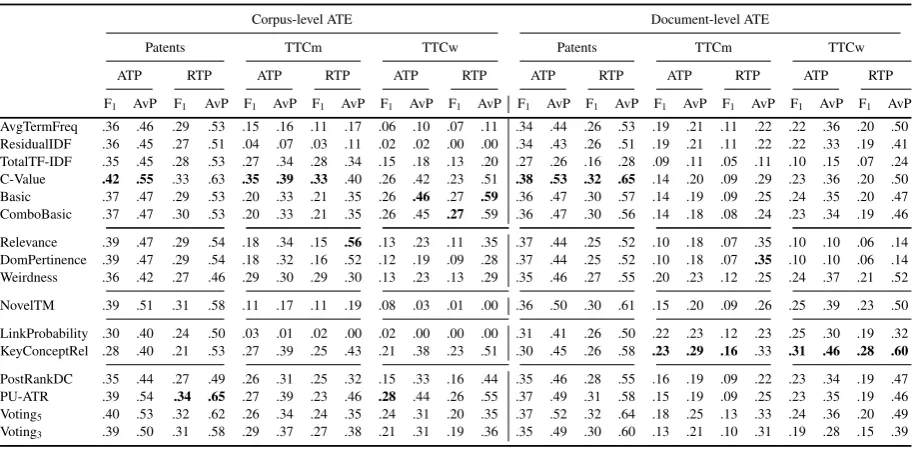
for this level are shown in the left half of Table2. C-Value most often performs best, compared to both frequency-based and all other methods, and thus may be considered a strong baseline. Voting3
has negligibly lower scores than its more feature-rich variant, Voting5. LinkProbability, relying on
Corpus-level ATE Document-level ATE
Patents TTCm TTCw Patents TTCm TTCw
ATP RTP ATP RTP ATP RTP ATP RTP ATP RTP ATP RTP
F1 AvP F1 AvP F1 AvP F1 AvP F1 AvP F1 AvP F1 AvP F1 AvP F1 AvP F1 AvP F1 AvP F1 AvP
AvgTermFreq .36 .46 .29 .53 .15 .16 .11 .17 .06 .10 .07 .11 .34 .44 .26 .53 .19 .21 .11 .22 .22 .36 .20 .50 ResidualIDF .36 .45 .27 .51 .04 .07 .03 .11 .02 .02 .00 .00 .34 .43 .26 .51 .19 .21 .11 .22 .22 .33 .19 .41 TotalTF-IDF .35 .45 .28 .53 .27 .34 .28 .34 .15 .18 .13 .20 .27 .26 .16 .28 .09 .11 .05 .11 .10 .15 .07 .24 C-Value .42 .55 .33 .63 .35 .39 .33 .40 .26 .42 .23 .51 .38 .53 .32 .65 .14 .20 .09 .29 .23 .36 .20 .50 Basic .37 .47 .29 .53 .20 .33 .21 .35 .26 .46 .27 .59 .36 .47 .30 .57 .14 .19 .09 .25 .24 .35 .20 .47 ComboBasic .37 .47 .30 .53 .20 .33 .21 .35 .26 .45 .27 .59 .36 .47 .30 .56 .14 .18 .08 .24 .23 .34 .19 .46 Relevance .39 .47 .29 .54 .18 .34 .15 .56 .13 .23 .11 .35 .37 .44 .25 .52 .10 .18 .07 .35 .10 .10 .06 .14 DomPertinence .39 .47 .29 .54 .18 .32 .16 .52 .12 .19 .09 .28 .37 .44 .25 .52 .10 .18 .07 .35 .10 .10 .06 .14 Weirdness .36 .42 .27 .46 .29 .30 .29 .30 .13 .23 .13 .29 .35 .46 .27 .55 .20 .23 .12 .25 .24 .37 .21 .52
NovelTM .39 .51 .31 .58 .11 .17 .11 .19 .08 .03 .01 .00 .36 .50 .30 .61 .15 .20 .09 .26 .25 .39 .23 .50
LinkProbability .30 .40 .24 .50 .03 .01 .02 .00 .02 .00 .00 .00 .31 .41 .26 .50 .22 .23 .12 .23 .25 .30 .19 .32 KeyConceptRel .28 .40 .21 .53 .27 .39 .25 .43 .21 .38 .23 .51 .30 .45 .26 .58 .23 .29 .16 .33 .31 .46 .28 .60
PostRankDC .35 .44 .27 .49 .26 .31 .25 .32 .15 .33 .16 .44 .35 .46 .28 .55 .16 .19 .09 .22 .23 .34 .19 .47 PU-ATR .39 .54 .34 .65 .27 .39 .23 .46 .28 .44 .26 .55 .37 .49 .31 .58 .15 .19 .09 .25 .23 .35 .19 .46 Voting5 .40 .53 .32 .62 .26 .34 .24 .35 .24 .31 .20 .35 .37 .52 .32 .64 .18 .25 .13 .33 .24 .36 .20 .49
[image:4.595.72.531.62.288.2]Voting3 .39 .50 .31 .58 .29 .37 .27 .38 .21 .31 .19 .36 .35 .49 .30 .60 .13 .21 .10 .31 .19 .28 .15 .39
Table 2: Scores for corpus-level ATE (left half) and mean scores for document-level ATE (right half).
(Astrakhantsev,2018;Zhang et al.,2018) that no single ATE method is consistently the best in a corpus-level setting. A notable trend is that most methods have higher F1scores in the ATP case and
lower AvP scores in the RTP case. Both can be explained by noting that|ATP| ≥ |RTP|and F1is
not rank-sensitive, while AvP is. I.e., the larger the gold term set (ATP), the more likely an actual term will be above the fixed cut-off level K = ATP, while the smaller the gold term set is (RTP), the more likely an actual term will be highly ranked, as there are less terms to rank.
Document-level extraction. In document-level extraction, the input to ATE is a single docu-ment. Document-level scores are shown in the right half of Table 2. C-Value is not the over-all best frequency-based method, as it was on the corpus-level. However, it outperforms all other methods in a highly technical domain (Patents dataset), for which it was originally developed. A clear overall winner is KeyConceptRelatedness. Its good performance may be attributed to its hy-brid nature: using semantic relatedness between keyphrases and candidate terms. Voting with Wikipedia-based features is better overall than the variant without them, especially when considering the more optimistic RTP metrics. TotalTF-IDF is by definition ill-equipped for document-level ATE (log term becomes zero), which is why it is the worst performing method.
Patents TTCm TTCw
AvgTermFreq −.35 −.06 −.42 ResidualIDF −.33 −.03 −.55 TotalTF-IDF −.38 −.12 −.33 C-Value .01 −.11 −.25 Basic −.09 −.25 −.34 ComboBasic −.06 −.24 −.32
Relevance −.06 −.19 −.23 DomPertinence −.06 −.19 −.23 Weirdness −.39 −.08 −.43
NovelTM −.21 −.19 −.35
LinkProbability −.03 −.46 −.56 KeyConceptRel −.44 −.26 −.25
PostRankDC −.17 .02 −.25 PU-ATR .15 −.17 −.29 Voting5 −.09 −.26 −.25
[image:4.595.356.479.333.514.2]Voting3 −.06 −.09 −.09
Table 3: Correlation between ATP AvP and document length for document-level ATE.
For the ATP case, we statistically compared4 C-value, KeyConceptRelatedness, and AvgTermFre-quency (baseline) methods, for both F1 and AvP, on all three datasets. The comparison confirmed that C-value significantly outperform other two methods on Patents dataset and that KeyConcep-tRelatedness significantly outperforms other two methods on TTCm and TTCw dataset, and this holds for both metrics.
4We used the non-parametric Friedman ANOVA for
Patents TTCm TTCw
% MWEs Recall % MWEs Recall % MWEs Recall
C-Value 53 .41 77 .30 78 .30
[image:5.595.79.284.65.115.2]KeyConceptRel 21 .18 31 .28 35 .32
Table 4: Percentage of MWEs and recall for document-level ATE
Given the difference in performance between corpus-level and document-level ATE, document length is another practical consideration when choosing the appropriate ATE method. We calcu-lated the Pearson correlation coefficient between the document lengths and ATP AvP scores for document-level ATE, shown in table 3. Cor-relation coefficients for individual methods vary across datasets – predominantly, as the document length increases, the ATP AvP score decreases, or there is almost no correlation.
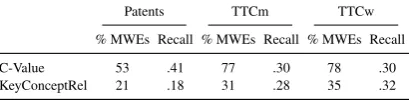
Additionally, we analysed the recall of top-performing document-level ATE methods with re-gards to MWEs, depending on their share in the gold terms for a given document. The percent-age of MWEs in gold terms per dataset is given in Table1. Table4 shows the percentage of MWEs in the output of a given ATE method at ATP cut-off, averaged over all documents of a particular dataset, as well as the per-document recall for MWEs, averaged over all documents. The per-formance varies across datasets, but C-Value – a frequency-based method – modestly outperforms KeyConceptRelatedness in identifying multiword terms.
Taken together, our results clearly show that corpus-level performances do not linearly transfer to document-level performances, the case in point being the KeyConceptRelatedness ATE method.
6 Conclusion
Motivated by the use of ATE in Computer Aided Translation, we evaluated 16 ATE methods in a novel setting: apart from using a corpus as a source of terms, we also consider using individ-ual documents only. Unlike previous ATE work, we use metrics that distinguish between actual and recoverable true positives. Our findings confirm that no single ATE method is consistently the best in corpus-level ATE. We show that for document-level ATE most of the methods perform compa-rable, with two exceptions: (1) C-Value performs exceptionally well in highly technical domains,
and (2) KeyConceptRelatedness outperforms all other methods on two other domains. We thus recommend using C-Value for corpus-level ATE or document-level ATE in a highly technical do-main, and KeyConceptRelatedness for document-level ATE in non-technical domains.
Our work opens up a new line of research, namely an investigation into ATE methods more suitable for single-document input, possibly em-ploying related AKE methods. Another research topic is single-document bilingual ATE.
Acknowledgments
The authors would like to thank Maria Pia di Buono for her support.
References
Khurshid Ahmad, Lee Gillam, and Lena Tostevin. 1999. University of Surrey Participation in TREC 8: Weirdness Indexing for Logical Document Ex-trapolation and Retrieval (WILDER). InThe Eighth Text REtrieval Conference (TREC 8), pages 1–8.
Nikita Astrakhantsev. 2014. Automatic term acquisi-tion from domain-specific text collecacquisi-tion by using Wikipedia. Proceedings of the Institute for System Programming, 26(4):7–20.
Nikita Astrakhantsev. 2018. ATR4S: toolkit with state-of-the-art automatic terms recognition meth-ods in Scala. Language Resources and Evaluation, 52(3):853–872.
Nikita Astrakhantsev, Denis G. Fedorenko, and D. Yu. Turdakov. 2015. Methods for automatic term recog-nition in domain-specific text collections: A survey. Programming and Computer Software, 41(6):336– 349.
Paul Buitelaar, Georgeta Bordea, and Tamara Polajnar. 2013. Domain-independent term extraction through domain modelling. InThe 10th International Con-ference on Terminology and Artificial Intelligence (TIA 2013), Paris, France.
Hernani Costa, Gloria Corpas Pastor, M´ıriam Seghiri Dom´ınguez, and Anna Zaretskaya. 2016. Nine Terminology Extraction Tools: Are they useful for translators? Multilingual, 27(3).
David A. Evans and Robert G. Lefferts. 1995. CLARIT-TREC experiments. In Information Pro-cessing and Management: an International Journal, volume 31, pages 385–395. Pergamon Press, Inc.
Zellig S. Harris. 1954. Distributional structure. WORD, 10(2-3):146–162.
Alex Judea, Hinrich Sch¨utze, and S¨oren Br¨ugmann. 2014. Unsupervised Training Set Generation for Automatic Acquisition of Technical Terminology in Patents. InProceedings of COLING 2014, the 25th international conference on computational linguis-tics: Technical Papers, pages 290–300.
J-D Kim, Tomoko Ohta, Yuka Tateisi, and Junichi Tsujii. 2003. GENIA corpus – a semantically an-notated corpus for bio-textmining. Bioinformatics, 19(suppl 1):i180–i182.
Sujian Li, Jiwei Li, Tao Song, Wenjie Li, and Baobao Chang. 2013. A novel topic model for automatic term extraction. InProceedings of the 36th interna-tional ACM SIGIR conference on Research and de-velopment in information retrieval, pages 885–888. ACM.
Yutaka Matsuo and Mitsuru Ishizuka. 2004. Keyword Extraction from a Single Document using Word Co-occurrence Statistical Information. International Journal on Artificial Intelligence Tools, 13(01):157– 169.
Kevin Meijer, Flavius Frasincar, and Frederik Hogen-boom. 2014. A semantic approach for extracting do-main taxonomies from text. Decision Support Sys-tems, 62:78–93.
Antoni Oliver. 2017. A system for terminology extrac-tion and translaextrac-tion equivalent detecextrac-tion in real time. Machine Translation, 31(3):147–161.
Youngja Park, Roy J. Byrd, and Branimir K. Bogu-raev. 2002. Automatic Glossary Extraction: Be-yond Terminology Identification. InCOLING 2002: The 19th International Conference on Computa-tional Linguistics.
Anselmo Pe˜nas, Felisa Verdejo, Julio Gonzalo, et al. 2001. Corpus-based terminology extraction applied to information access. In Proceedings of Corpus Linguistics, volume 2001, page 458. Citeseer.
Stuart Rose, Dave Engel, Nick Cramer, and Wendy Cowley. 2010. Automatic Keyword Extraction from Individual Documents. Text Mining: Applications and Theory, pages 1–20.
Francesco Sclano and Paola Velardi. 2007. TermEx-tractor: a Web Application to Learn the Shared Ter-minology of Emergent Web Communities. In Enter-prise Interoperability II, pages 287–290. Springer.
Merley da Silva Conrado, Thiago A Salgueiro Pardo, and Solange Oliveira Rezende. 2013. A Machine Learning Approach to Automatic Term Extraction using a Rich Feature Set. InProceedings of the 2013 NAACL HLT Student Research Workshop, pages 16– 23.
Peter D. Turney. 2000. Learning Algorithms for Keyphrase Extraction. Information retrieval, 2(4):303–336.
Rui Wang, Wei Liu, and Chris McDonald. 2016. Featureless Domain-Specific Term Extraction with Minimal Labelled Data. InProceedings of the Aus-tralasian Language Technology Association Work-shop 2016, pages 103–112.
Kara Warburton. 2014. Narrowing the gap between termbases and corpora in commercial environments. InLREC 2014 Proceedings, pages 722–727.
Yuhang Yang, Hao Yu, Yao Meng, Yingliang Lu, and Yingju Xia. 2010. Fault-Tolerant Learning for Term Extraction. InProceedings of the 24th Pacific Asia Conference on Language, Information and Compu-tation.
Yu Yuan, Jie Gao, and Yue Zhang. 2017. Supervised Learning for Robust Term Extraction. In2017 Inter-national Conference on Asian Language Processing (IALP), pages 302–305. IEEE.
Behrang Q. Zadeh and Siegfried Handschuh. 2014. The ACL RD-TEC: A Dataset for Benchmarking Terminology Extraction and Classification in Com-putational Linguistics. InProceedings of the 4th In-ternational Workshop on Computational Terminol-ogy (Computerm), pages 52–63.
Ziqi Zhang, Jie Gao, and Fabio Ciravegna. 2016. JATE 2.0: Java Automatic Term Extraction with Apache Solr. InThe Proceedings of the 10th Language Re-sources and Evaluation Conference.
Ziqi Zhang, Jie Gao, and Fabio Ciravegna. 2018. SemRe-Rank: Improving Automatic Term Extrac-tion by Incorporating Semantic Relatedness with Personalised PageRank. ACM Transactions on Knowledge Discovery from Data (TKDD), 12(5):57.