1275
Document Context Neural Machine Translation with Memory Networks
Sameen Maruf and Gholamreza Haffari
Faculty of Information Technology, Monash University, Australia {firstname.lastname}@monash.edu
Abstract
We present a document-level neural ma-chine translation model which takes both source and target document context into account using memory networks. We model the problem as a structured pre-diction problem with interdependencies among the observed and hidden variables, i.e., the source sentences and their unob-served target translations in the document. The resulting structured prediction prob-lem is tackled with a neural translation model equipped with two memory com-ponents, one each for the source and tar-get side, to capture the documental inter-dependencies. We train the model end-to-end, and propose an iterative decod-ing algorithm based on block coordinate descent. Experimental results of English translations from French, German, and Es-tonian documents show that our model is effective in exploiting both source and tar-get document context, and statistically sig-nificantly outperforms the previous work in terms of BLEU and METEOR.
1 Introduction
Neural machine translation (NMT) has proven to be powerful (Sutskever et al., 2014; Bahdanau et al., 2015). It is on-par, and in some cases, even surpasses the traditional statistical MT ( Lu-ong et al., 2015) while enjoying more flexibil-ity and significantly less manual effort for fea-ture engineering. Despite their flexibility, most neural MT models translate sentences indepen-dently. Discourse phenomenon such as pronomi-nal anaphora and lexical consistency, may depend on long-range dependency going farther than a
few previous sentences, are neglected in sentence-based translation (Bawden et al.,2017).
There are only a handful of attempts to document-wide machine translation in statistical and neural MT camps. Hardmeier and Federico
(2010); Gong et al. (2011); Garcia et al. (2014) propose document translation models based on statistical MT but are restrictive in the way they incorporate the document-level information and fail to gain significant improvements. More re-cently, there have been a few attempts to incorpo-rate source side context into neural MT (Jean et al.,
2017; Wang et al., 2017; Bawden et al., 2017); however, these works only consider a very local context including a few previous source/target sen-tences, ignoring the global source and target docu-mental contexts. The latter two report deteriorated performance when using the target-side context.
In this paper, we present a document-level ma-chine translation model which combines sentence-based NMT (Bahdanau et al., 2015) with mem-ory networks (Sukhbaatar et al.,2015). We cap-ture the global source and target document con-text with two memory components, one each for the source and target side, and incorporate it into the sentence-based NMT by changing the decoder to condition on it as the sentence translation is generated. We conduct experiments on three lan-guage pairs: French-English, German-English and Estonian-English. The experimental results and analysis demonstrate that our model is effective in exploiting both source and target document con-text, and statistically significantly outperforms the previous work in terms of BLEU and METEOR.
2 Background
2.1 Neural Machine Translation (NMT)
2015) which contains an encoder to read the source sentence as well as an attentional decoder togeneratethe target translation.
Encoder It is a bidirectional RNN consisting of two RNNs running in opposite directions over the source sentence:
− →
hi=−−→RNN(−→hi−1,ES[xi]),
←−
hi=
←−−
RNN(←−hi+1,ES[xi])
whereES[xi]is embedding of the wordxi from
the embedding table ES of the source language,
and−→hi and
←−
hi are the hidden states of the
for-ward and backfor-ward RNNs which can be based on the LSTM (Hochreiter and Schmidhuber,1997) or GRU (Cho et al.,2014) units. Each word in the source sentence is then represented by the concate-nation of the corresponding bidirectional hidden states,hi = [
− →
hi;
←− hi].
Decoder The generation of each wordyj is
con-ditioned on all of the previously generated words
y<j via the state of the RNN decodersj, and the
source sentence via adynamiccontext vectorcj:
yj ∼ softmax(Wy·rj+br)
rj = tanh(sj+Wrc·cj+Wrj·ET[yj−1]) sj = tanh(Ws·sj−1+Wsj·ET[yj−1] +Wsc·cj)
where ET[yj]is embedding of the word yj from
the embedding table ET of the target language,
and W matrices and br vector are the
parame-ters. The dynamic context vectorcj is computed
viacj = Piαjihi, where
αj = softmax(aj)
aji = v·tanh(Wae·hi+Wat·sj−1)
This is known as theattention mechanism which dynamically attends to relevant parts of the source necessary for generating the next target word.
2.2 Memory Networks (MemNets)
Memory Networks (Weston et al., 2015) are a class of neural models that use external memo-ries to perform inference based on long-range de-pendencies. A memory is a collection of
vec-tors M = {m1, ..,mK} constituting the
mem-ory cells, where each cell mk may potentially
correspond to a discrete object xk. The
mem-ory is equipped with a read and optionally a
writeoperation. Given a query vectorq, the out-put vector generated by reading from the mem-ory is P|M|
[image:2.595.344.489.63.198.2]i=1 pimi, where pi represents the rele-vance of the query to the i-th memory cell p =
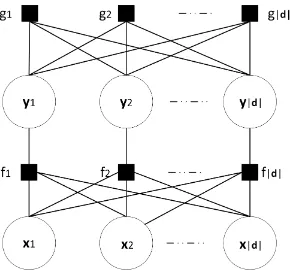
Figure 1: Factor graph for document-level MT
softmax(qT ·M). For the rest of the paper, we denote the read operation by MemNet(M,q).
3 Document NMT as Structured Prediction
We formulate document-wide machine translation
as a structured prediction problem. Given a set
of sentences{x1, . . . ,x|d|}in a source document
d, we are interested in generating the collection of their translations{y1, . . . ,y|d|}taking into ac-countinterdependenciesamong them imposed by the document. We achieve this by the factor graph in Figure1to model the probability of the target document given the source document. Our model has two types of factors:
• fθ(yt;xt,x−t)to capture the
interdependen-cies between the translation yt, the
corre-sponding source sentencextand all the other
sentences in the source documentx−t, and
• gθ(yt;y−t)to capture the interdependencies
between the translationyt and all the other
translations in the documenty−t.
Hence, the probability of a document translation given the source document is
P(y1, . . . ,y|d||x1, . . . ,x|d|)∝
exp X
t
fθ(yt;xt,x−t) +gθ(yt;y−t)
.
The factors fθ andgθ are realised by neural ar-chitectures whose parameters are collectively de-noted byθ.
gθ(yt;y−t) over a large number of translation
variables yt’s (i.e., the number of sentences in
the document) as well as their unbounded domain (i.e., all sentences in the target language). Thus, we resort to maximising the pseudo-likelihood
(Besag,1975) for training the parameters:
arg max
θ
Y
d∈D |d|
Y
t=1
Pθ(yt|xt,y−t,x−t) (1)
whereDis the set of bilingual training documents, and |d| denotes the number of (bilingual) sen-tences in the document d = {(xt,yt)}
|d|
t=1. We directly model the document-conditioned NMT model Pθ(yt|xt,y−t,x−t) using a neural
archi-tecture which subsumes both thefθandgθfactors (covered in the next section).
Decoding To generate the best translation for a document according to our model, we need to solve the following optimisation problem:
arg max
y1,...,y|d| |d|
Y
t=1
Pθ(yt|xt,y−t,x−t)
which is hard (due to similar reasons as mentioned earlier). We hence resort to a block coordinate de-scent optimisation algorithm. More specifically, we initialise the translation of each sentence using the base neural MT modelP(yt|xt). We then
re-peatedly visit each sentence in the document, and update its translation using our document-context dependent NMT modelP(yt|xt,y−t,x−t)while
the translations of other sentences are kept fixed.
4 Context Dependent NMT with MemNets
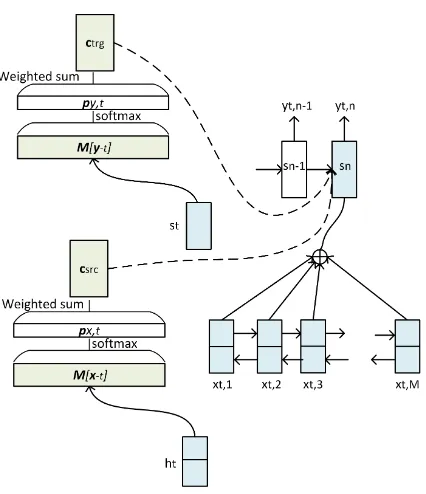
We augment the sentence-level attentional NMT model by incorporating the document context (both source and target) using memory networks when generating the translation of a sentence, as shown in Figure2.
Our model generates the target translation word-by-word from left to right, similar to the vanilla attentional neural translation model. How-ever, it conditions the generation of a target word not only on the previously generated words and the current source sentence (as in the vanilla NMT model), but also on all the other source sentences of the document and their translations. That is, the
generation process is as follows:
Pθ(yt|xt,y−t,x−t) =
|yt|
Y
j=1
Pθ(yt,j|yt,<j,xt,y−t,x−t)
(2)
whereyt,j is the j-th word of thet-th target
sen-tence, yt,<j are the previously generated words,
andx−tandy−tare as introduced previously.
Our model represents the source and target doc-ument contexts as external memories, and
at-tends to relevant parts of these external
memo-ries when generating the translation of a sentence. LetM[x−t]andM[y−t]denote external
memo-ries representing the source and target document context, respectively. These contain memory cells corresponding to all sentences in the document ex-cept thet-th sentence (described shortly). Letht
andst be representations of the t-th source
sen-tence and its current translation, from the encoder and decoder respectively. We make use of ht
as the query to get the relevant context from the source external memory:
csrct =MemNet(M[x−t],ht)
Furthermore, for thet-th sentence, we get the rel-evant information from the target context:
ctrgt =MemNet(M[y−t],st+Wat·ht)
where the query consists of the representation of the translationstfrom the decoder endowed with
that of the source sentence ht from the encoder
to make the query robust to potential noises in the current translation and circumvent error propaga-tion, and Wat projects the source representation
into the hidden state space.
Now that we have representations of the rele-vant source and target document contexts, Eq. 2
can be re-written as:
Pθ(yt|xt,y−t,x−t) =
|yt|
Y
j=1
Pθ(yt,j|yt,<j,xt,ctrgt ,c src t )
(3)
More specifically, the memory contextscsrct and
ctrgt are incorporated into the NMT decoder as:
• Memory-to-Context in which the memory contexts are incorporated when computing the next decoder hidden state:
st,j = tanh(Ws·st,j−1+Wsj·ET[yt,j] +
Figure 2: Our Memory-to-Context document-NMT model consisting of sentence-based document-NMT model with source and target external memories.
• Memory-to-Output in which the memory
contexts are incorporated in the output layer:
yt,j ∼ softmax(Wy·rt,j+Wym·csrct +
Wyt·ctrgt +br)
where Wsm, Wst, Wym, and Wyt are the new
parameter matrices. We use only the source, only the target, or both external memories as the ad-ditional conditioning contexts. Furthermore, we use either the Context or Memory-to-Output architectures for incorporating the docu-ment contexts. In the experidocu-ments, we will explore these different options to investigate the most ef-fective combination. We now turn our attention to the construction of the external memories for the source and target sides of a document.
The Source Memory We make use of a hierar-chical 2-level RNN architecture to construct the external memory of the source document. More specifically, we pass each sentence of the docu-ment through a sentence-level bidirectional RNN to get the representation of the sentence (by con-catenating the last hidden states of the forward and backward RNNs). We then pass the sentence representations through a document-level bidirec-tional RNN to propagate sentences’ information across the document. We take the hidden states
of the document-level bidirectional RNNs as the memory cells of the source external memory.
The source external memory is built once for each minibatch, and does not change through-out the document translation. To be able to fit the computational graph of the document NMT model within GPU memory limits, we pre-train the sentence-level bidirectional RNN using the language modelling training objective. However, the document-level bidirectional RNN is trained together with other parameters of the document NMT model by back-propagating the document translation training objective.
The Target Memory The memory cells of the target external memory represent the current trans-lations of the document. Recall from the previous section that we use coordinate descent iteratively to update these translations. Let{y1, . . . ,y|d|}be the current translations, and let{s|y1|, . . . ,s|y|d||} be the last states of the decoder when these trans-lations were generated. We use these last de-coder states as the cells of the external target mem-ory. We could make use of hierarchical sentence-document RNNs to transform the sentence-document trans-lations into memory cells (similar to what we do for the source memory); however, it would have been computationally expensive and may have re-sulted in error propagation. We will show in the experiments that our efficient target memory con-struction is indeed effective.
5 Experiments and Analysis
Datasets. We conducted experiments on three language pairs: French-English, German-English and Estonian-English. Table 1 shows the statis-tics of the datasets used in our experiments. The French-English dataset is based on the TED Talks corpus1 (Cettolo et al., 2012) where each talk is considered a document. The Estonian-English data comes from the Europarl v7 corpus2 (Koehn, 2005). Following Smith et al. (2013), we split the speeches based on the SPEAKER tag and treat them as documents. The French-English and Estonian-French-English corpora were ran-domly split into train/dev/test sets. For German-English, we use the News Commentary v9 corpus3 for training, news-dev2009 for development,
1
https://wit3.fbk.eu/
2
http://www.statmt.org/europarl/
3
# docs # sents doc len src/tgt vocab Fr-En 10/1.2/1.5 123/15/19 123/128/124 25.1/21 Et-En 150/10/18 209/14/25 14/14/14 48.6/24.9 De-En 49/.9/1.1/1.6 191/2/3/3 39/23/27/19 45.1/34.7
Table 1: Training/dev/test corpora statistics: num-ber of documents (×100) and sentences (×1000), average document length (in sentences) and source/target vocabulary size (×1000). For De-En, we report statistics of the two test sets news-test2011andnews-test2016.
and news-test2011 and news-test2016 as the test sets. The news-commentary corpus has document boundaries already provided.
We pre-processed all corpora to remove very short documents and those with missing trans-lations. Out-of-vocabulary and rare words (fre-quency less than 5) are replaced by the <UNK> token, followingCohn et al.(2016).4
Evaluation Measures We use BLEU (Papineni et al., 2002) and METEOR (Lavie and Agarwal,
2007) scores to measure the quality of the gen-erated translations. We use bootstrap resampling (Clark et al., 2011) to measure statistical signifi-cance,p<0.05, comparing to the baselines.
Implementation and Hyperparameters We
implement our document-level neural machine translation model in C++ using the DyNet li-brary (Neubig et al., 2017), on top of the basic sentence-level NMT implementation inmantis (Cohn et al., 2016). For the source memory, the sentence and document-level bidirectional RNNs use LSTM and GRU units, respectively. The translation model uses GRU units for the bidi-rectional RNN encoder and the 2-layer RNN de-coder. GRUs are used instead of LSTMs to re-duce the number of parameters in the main model. The RNN hidden dimensions and word embed-ding sizes are set to 512 in the translation and memory components, and the alignment dimen-sion is set to 256 in the translation model.
Training We use a stage-wise method to train the variants of our document context NMT model. Firstly, we pre-train the Memory-to-Context/Memory-to-Output models, setting their
readingsfrom the source and target memories to
4We do not split words into subwords using BPE (
Sen-nrich et al.,2016) as that increases sentence lengths resulting
in removing long documents due to GPU memory limitations, which would heavily reduce the amount of data that we have.
the zero vector. This effectively learns parame-ters associated with the underlying sentence-based NMT model, which is then used as initialisation when training all parameters in the second stage (including the ones from the first stage). For the first stage, we make use of stochastic gradient de-scent (SGD)5 with initial learning rate of 0.1 and
a decay factor of 0.5 after the fourth epoch for a total of ten epochs. The convergence occurs in 6-8 epochs. For the second stage, we use SGD with an initial learning rate of 0.08 and a decay factor of 0.9 after the first epoch for a total of 15 epochs6. The best model is picked based on the dev-set perplexity. To avoid overfitting, we em-ploy dropout with the rate 0.2 for the single mem-ory model. For the dual memmem-ory model, we set dropout for Document RNN to 0.2 and for the en-coder and deen-coder to 0.5. Mini-batching is used in both stages to speed up training. For the largest dataset, the document NMT model takes about 4.5 hours per epoch to train on a single P100 GPU, while the sentence-level model takes about 3 hours per epoch for the same settings.
When training the document NMT model in the second stage, we need the target memory. One op-tion would be to use the ground truth translaop-tions for building the memory. However, this may re-sult in inferior training, since at the test time, the decoder iteratively updates the translation of tences based on the noisy translations of other sen-tences (accessed via the target memory). Hence, while training the document NMT model, we con-struct the target memory from the translations gen-erated by the pre-trained sentence-level model7. This effectively exposes the model to its potential test-time mistakes during the training time, result-ing in more robust learned parameters.
5.1 Main Results
We have three variants of our model, using: (i) only the source memory (S-NMT+src mem), (ii) only the target memory (S-NMT+trg mem), or
5In our initial experiments, we found SGD to be more
ef-fective than Adam/Adagrad; an observation also made by
Ba-har et al.(2017).
6
For the document NMT model training, we did some pre-liminary experiments using different learning rates and used the scheme which converged to the best perplexity in the least number of epochs while for sentence-level training we follow
Cohn et al.(2016).
7We report results for two-pass decoding, i.e., we only
Memory-to-Context Memory-to-Output
BLEU METEOR BLEU METEOR
Fr→En De→En Et→En Fr→En De→En Et→En Fr→En De→En Et→En Fr→En De→En Et→En
NC-11 NC-16 NC-11 NC-16 NC-11 NC-16 NC-11 NC-16
S-NMT 20.85 5.24 9.18 20.42 23.27 10.90 14.35 24.65 20.85 5.24 9.18 20.42 23.27 10.90 14.35 24.65
+src 21.91† 6.26†10.20†22.10† 24.04†11.52†15.45† 25.92† 21.80†6.10† 9.98† 21.50† 23.99†11.53†15.29†25.44†
+trg 21.74† 6.24† 9.97† 21.94† 23.98†11.58†15.32† 25.89† 21.76†6.31†10.04†21.82† 24.06†12.10†15.75†25.93†
[image:6.595.76.528.62.148.2]+both22.00† 6.57†10.54†22.32† 24.40†12.24†16.18† 26.34† 21.77†6.20†10.23†22.20† 24.27†11.84†15.82†26.10†
Table 2: BLEU and METEOR scores for the sentence-level baseline (S-NMT) vs. variants of our Docu-ment NMT model.bold: Best performance,†: Statistically significantly better than the baseline.
Memory-to-Context Memory-to-Output Lang. Pair Fr→En De→En Et→En Fr→En De→En Et→En S-NMT 42.5 66.8 58.4 42.5 66.8 58.5
+src mem 48.8 73.1 64.8 68.7 107.1 88.7
+trg mem 43.8 68.1 59.8 53.8 85.1 71.8
[image:6.595.78.285.207.270.2]+both mems 50.1 74.4 66.1 80 125.4 102
Table 3: Number of model parameters (millions).
(iii) both the source and target memories (
S-NMT+both mems). We compare these variants
against the standard sentence-level NMT model
(S-NMT). We also compare the source memory
variants of our model to the local context-NMT models8 of Jean et al. (2017) and Wang et al.
(2017), which use a few previous source sentences as context, added to the decoder hidden state (sim-ilar to our Memory-to-Context model).
Memory-to-Context We consistently observe +1.15/+1.13 BLEU/METEOR score improve-ments across the three language pairs upon com-paring our best model to S-NMT (see Table 2). Overall, our document NMT model with both memories has been the most effective variant for all of the three language pairs.
We further experiment to train the target mem-ory variants using gold translations instead of the generated ones for German-English. This led to −0.16 and −0.25 decrease9 in the BLEU scores for the target-only and both-memory vari-ants, which confirms the intuition of constructing the target memory by exposing the model to its noises during training time.
Memory-to-Output From Table 2, we consis-tently see +.95/+1.00 BLEU/METEOR improve-ments between the best variants of our model and the sentence-level baseline across the three
lan-8We implemented and trained the baseline local context
models using the same hyperparameters and training proce-dure that we used for training our memory models.
9Latter is statistically significant decrease w.r.t. the both
memory model trained on generated target translations.
Smaller Corpus Larger Corpus
10 12 14
10.9
12.12
11.52
12.94
11.58
12.55 12.24
13.56
METEOR
S-NMT S-NMT+src S-NMT+trg S-NMT+both
(a) Memory-to-Context model
Smaller Corpus Larger Corpus
10 12 14
10.9
12.12
11.53
12.48 12.1
13.21
11.84
12.99
METEOR
S-NMT S-NMT+src S-NMT+trg S-NMT+both
(b) Memory-to-Output model
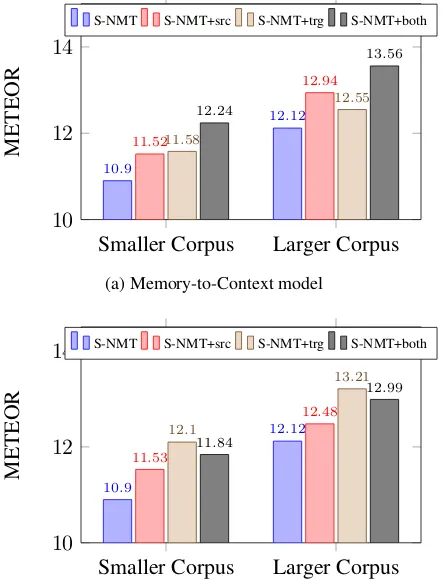
Figure 3: METEOR scores on De→En (NC-11) while training S-NMT with smaller vs. larger cor-pus.
guage pairs. For French→English, all variants of document NMT model show comparable perfor-mance when using BLEU; however, when eval-uated using METEOR, the dual memory model is the best. For German→English, the target memory variants give comparable results, whereas for Estonian→English, the dual memory variant proves to be the best. Overall, the Memory-to-Context model variants perform better than their Memory-to-Output counterparts. We attribute this to the large number of parameters in the latter ar-chitecture (Table3) and limited amount of data.
[image:6.595.313.534.209.502.2]train-BLEU METEOR
Fr→En De→En Et→EnFr→En De→En Et→En
NC-11 NC-16 NC-11 NC-16
Jean et al.(2017) 21.95 6.04 10.26 21.67 24.10 11.61 15.56 25.77
Wang et al.(2017) 21.87 5.49 10.14 22.06 24.13 11.05 15.20 26.00
S-NMT 20.85 5.24 9.18 20.42 23.27 10.90 14.35 24.65
+src mem 21.91†6.26♣ 10.20 22.10♠24.04†11.52♣15.45♣25.92♠
[image:7.595.72.338.62.146.2]+both mems 22.00†6.57♦10.54♣22.32♦24.40♦12.24♦16.18♦26.34♦
Table 4: Our Memory-to-Context Source Memory NMT variants vs. S-NMT and Source context NMT baselines. bold: Best performance, †, ♠, ♣, ♦: Statistically signifi-cantly better than only S-NMT, S-NMT &Jean et al.(2017), S-NMT &Wang et al.(2017), all baselines, respectively.
BLEU-1 Fr→En De→En Et→En
NC-11NC-16
Jean et al.(2017) 52.8 30.6 39.2 51.9
Wang et al.(2017) 52.6 28.2 38.3 52.3
S-NMT 51.4 28.7 36.9 50.4
+src mem 53.0 30.5 39.1 52.6
+both mems 53.5 33.1 41.3 53.2
Table 5: Unigram BLEU for our Memory-to-Context Document NMT models vs. S-NMT and Source con-text NMT baselines. bold: Best per-formance.
ing the sentence-based NMT to investigate the ex-tent to which document context is useful in this setting. We randomly choose an additional 300K German-English sentence pairs from WMT’14 data to train the base NMT model in stage 1. In stage 2, we use the same document corpus as be-fore to train the document-level models. As seen from Figure 3, the document MT variants still benefit from the document context even when the base model is trained on a larger bilingual corpus. For the Memory-to-Context model, we see mas-sive improvements of+0.72and+1.44METEOR scores for the source memory and dual memory model respectively, when compared to the base-line. On the other hand, for the Memory-to-Output model, the target memory model’s METEOR score increases significantly by +1.09 compared to the baseline, slightly differing from the corre-sponding model using the smaller corpus (+1.2).
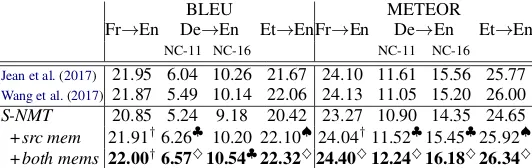
Local Source Context Models Table 4 shows comparison of our Memory-to-Context model variants to local source context-NMT mod-els (Jean et al., 2017; Wang et al., 2017). For French→English, our source memory model is comparable to both baselines. For German→English, ourS-NMT+src memmodel is comparable to Jean et al. (2017) but outperforms
Wang et al. (2017) for one test set according to BLEU, and for both test sets according to METEOR. For Estonian→English, our model outperformsJean et al.(2017). Our global source context model has only surface-level sentence in-formation, and is oblivious to the individual words in the context since we do an offline training to get the sentence representations (as previously mentioned). However, the other two context baselines have access to that information, yet our
model’s performance is either better or quite close to those models. We also look into the unigram BLEU scores to see how much our global source memory variants lead to improvement at the word-level. From Table5, it can be seen that our model’s performance is better than the baselines for majority of the cases. TheS-NMT+both mems
model gives the best results for all three language pairs, showing that leveraging both source and target document context is indeed beneficial for improving MT performance.
5.2 Analysis
Using Global/Local Target Context We first investigate whether using a local target context would have been equally sufficient in comparison to our global target memory model for the three datasets. We condition the decoder on the previ-ous target sentence representation (obtained from the last hidden state of the decoder) by adding it as an additional input to all decoder states (PrevTrg) similar to our Memory-to-Context model. From Table6, we observe that for French→English and Estonian→English, using all sentences in the tar-get context or just the previous tartar-get sentence gives comparable results. We may attribute this to these specific datasets, that is documents from TED talks or European Parliament Proceedings may depend more on the local than on the global context. However, for German→English (NC-11), the target memory model performs the best
show-BLEU METEOR
Lang. PairFr→En De→En Et→En Fr→En De→En Et→En S-NMT 20.85 5.24 20.42 23.27 10.90 24.65
+prev trg 21.75 5.93 22.08 24.03 11.40 25.94
+trg mem21.74 6.24 21.94 23.98 11.58 25.89
[image:7.595.356.508.64.148.2]ing that for documents with richer context (e.g. news articles) we do need the global target doc-ument context to improve MT performance.
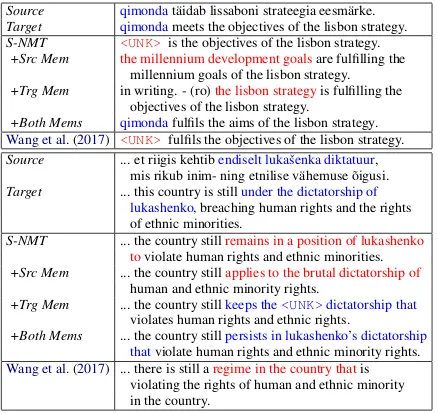
Output Analysis To better understand the dual memory model, we look at the first sentence exam-ple in Table7. It can be seen that the source sen-tence has the noun “Qimonda” but the sensen-tence- sentence-level NMT model fails to attend to it when gener-ating the translation. On the other hand, the single memory models are better in delivering some, if not all, of the underlying information in the source sentence but the dual memory model’s transla-tion quality surpasses them. This is because the word “Qimonda” was being repeated in this spe-cific document, providing a strong contextual sig-nal to our global document context model while the local context model by Wang et al.(2017) is still unable to correctly translate the noun even when it has access to the word-level information of previous sentences.
We resort to manual evaluation as there is no standard metric which evaluates document-level discourse information like consistency or pronom-inal anaphora. By manual inspection, we observe that our models can identify nouns in the source sentence to resolve coreferent pronouns, as shown in the second example of Table7. Here the topic of the sentence is “the country under the
dictator-ship of Lukashenko” and our target and dual
mem-ory models are able to generate the appropriate pronoun/determiner as well as accurately translate the word ‘diktatuur’, hence producing much better translation as compared to both baselines. Apart from these improvements, our models are better in improving the readability of sentences by gener-ating more context appropriate grammatical struc-tures such as verbs and adverbs.
Furthermore, to validate that our model im-proves the consistency of translations, we look at five documents (roughly 70 sentences) from the test set of Estonian-English, each of which had a word being repeated in the gold translation. Our model is able to resolve the consistency in 22 out of 32 cases as compared to the sentence-based model which only accurately translates 16 of those. Following Wang et al. (2017), we also investigate the extent to which our model can cor-rect errors made by the baseline system. We ran-domly choose five documents from the test set. Out of the 20 words/phrases which were incor-rectly translated by the sentence-based model, our
model corrects 85% of them while also generating 10% new errors.
Source qimondat¨aidab lissaboni strateegia eesm¨arke.
Target qimondameets the objectives of the lisbon strategy.
S-NMT <UNK>is the objectives of the lisbon strategy.
+Src Mem the millennium development goalsare fulfilling the millennium goals of the lisbon strategy.
+Trg Mem in writing. - (ro)the lisbon strategyis fulfilling the objectives of the lisbon strategy.
+Both Mems qimondafulfils the aims of the lisbon strategy. Wang et al.(2017) <UNK>fulfils the objectives of the lisbon strategy.
Source ... et riigis kehtibendiselt lukaˇsenka diktatuur, mis rikub inim- ning etnilise v¨ahemuse ˜oigusi.
Target ... this country is stillunder the dictatorship of lukashenko,breaching human rights and the rights of ethnic minorities.
S-NMT ... the country stillremains in a position of lukashenko toviolate human rights and ethnic minorities.
+Src Mem ... the country stillapplies to the brutal dictatorship of human and ethnic minority rights.
+Trg Mem ... the country stillkeeps the<UNK>dictatorship that
violates human rights and ethnic rights.
+Both Mems ... the country stillpersists in lukashenko’s dictatorship thatviolate human rights and ethnic minority rights. Wang et al.(2017) ... there is still aregime in the country thatis
[image:8.595.307.526.99.306.2]violating the rights of human and ethnic minority in the country.
Table 7: Example Et→En sentence translations (Memory-to-Context) from two test documents.
6 Related Work
Document-level Statistical MT There have
been a few SMT-based attempts to document MT, but they are either restrictive or do not lead to sig-nificant improvements. Hardmeier and Federico
(2010) identify links among words in the source document using a word-dependency model to im-prove translation of anaphoric pronouns. Gong et al. (2011) make use of a cache-based sys-tem to save relevant information from the previ-ously generated translations and use that to en-hance document-level translation. Garcia et al.
(2014) propose a two-pass approach to improve the translations already obtained by a sentence-level model.
Docent is an SMT-based document-level de-coder (Hardmeier et al.,2012,2013), which tries to modify the initial translation generated by the Moses decoder (Koehn et al., 2007) through stochastic local search and hill-climbing. Garcia et al.(2015) make use of neural-based continuous word representations to incorporate distributional semantics into Docent. In another work, Garcia et al.(2017) incorporate new word embedding fea-tures into Docent to improve the lexical consis-tency of translations. The proposed methods fail to yield improvements upon automatic evaluation.
extend the vanilla attention-based neural MT model (Bahdanau et al., 2015) by conditioning the decoder on the previous sentence via atten-tion over its words. Extending their model to con-sider the global source document context would be challenging due to the large size of computa-tion graph over all the words in the source docu-ment. Wang et al.(2017) employ a 2-level hier-arichal RNN to summarise three previous source sentences, which is then used as an additional in-put to the decoder hidden state. Bawden et al.
(2017) use multi-encoder NMT models to exploit context from the previous source and target sen-tence. They highlight the importance of target-side context but report deteriorated BLEU scores when using it. All these works consider a very local source/target context and completely ignore the global source and target document contexts.
7 Conclusion
We have proposed a document-level neural MT model that captures global source and target doc-ument context. Our model augments the vanilla sentence-based NMT model with external memo-ries to incorporate documental interdependencies on both source and target sides. We show statis-tically significant improvements of the translation quality on three language pairs. For future work, we intend to investigate models which incorporate specific discourse-level phenomena.
Acknowledgments
The authors are grateful to Andr´e Martins and the anonymous reviewers for their helpful comments and corrections. This work was supported by the Multi-modal Australian ScienceS Imaging and Visualisation Environment (MASSIVE) (www.
massive.org.au), and partially supported by
a Google Faculty Award to GH and the Australian Research Council through DP160102686.
References
Parnia Bahar, Tamer Alkhouli, Jan-Thorsten Peter, Christopher Jan-Steffen Brix, and Hermann Ney. 2017. Empirical investigation of optimization algo-rithms in neural machine translation. InConference of the European Association for Machine Transla-tion, pages 13–26, Prague, Czech Republic.
Dzmitry Bahdanau, Kyunghyun Cho, and Yoshua Ben-gio. 2015. Neural machine translation by jointly learning to align and translate. In Proceedings of
the International Conference on Learning Represen-tations.
Rachel Bawden, Rico Sennrich, Alexandra Birch, and Barry Haddow. 2017. Evaluating discourse phenomena in neural machine translation. In
arXiv:1711.00513.
Julian Besag. 1975. Statistical analysis of non-lattice data. Journal of the Royal Statistical Society. Series D (The Statistician), 24(3):179–195.
Mauro Cettolo, Christian Girardi, and Marcello Fed-erico. 2012. WIT3: Web inventory of transcribed and translated talks. InProceedings of the 16th
Con-ference of the European Association for Machine Translation, pages 261–268.
Kyunghyun Cho, B van Merrienboer, Dzmitry Bah-danau, and Yoshua Bengio. 2014. On the properties of neural machine translation: Encoder-decoder ap-proaches. InEighth Workshop on Syntax, Semantics and Structure in Statistical Translation (SSST-8).
Jonathan H. Clark, Chris Dyer, Alon Lavie, and Noah A. Smith. 2011. Better hypothesis testing for statistical machine translation: Controlling for op-timizer instability. InProceedings of the 49th An-nual Meeting of the Association for Computational Linguistics: Human Language Technologies (Short Papers), pages 176–181. Association for Computa-tional Linguistics.
Trevor Cohn, Cong Duy Vu Hoang, Ekaterina Vy-molova, Kaisheng Yao, Chris Dyer, and Gholamreza Haffari. 2016. Incorporating structural alignment biases into an attentional neural translation model. In Proceedings of the North American Chapter of the Association for Computational Linguistics: Hu-man Language Technologies, pages 876–885. Asso-ciation for Computational Linguistics.
Eva Mart´ınez Garcia, Carles Creus, Cristina Espa˜na-Bonet, and Llu´ıs M`arquez. 2017. Using word em-beddings to enforce document-level lexical consis-tency in machine translation. The Prague Bulletin of Mathematical Linguistics, 108:85–96.
Eva Mart´ınez Garcia, Cristina Espa˜na-Bonet, and Llu´ıs M`arquez. 2014. Document-level machine transla-tion as a re-translatransla-tion process. Procesamiento del Lenguaje Natural, 53:103–110.
Eva Mart´ınez Garcia, Cristina Espa˜na-Bonet, and Llu´ıs M`arquez. 2015. Document-level machine transla-tion with word vector models. In Proceedings of the18th Conference of the European Association for Machine Translation, pages 59–66.
Christian Hardmeier and Marcello Federico. 2010. Modelling pronominal anaphora in statistical ma-chine translation. In International Workshop on Spoken Language Translation, pages 283–289.
Christian Hardmeier, Joakim Nivre, and J¨org Tiede-mann. 2012. Document-wide decoding for phrase-based statistical machine translation. In Proceed-ings of the 2012 Joint Conference on Empiri-cal Methods in Natural Language Processing and Computational Natural Language Learning, pages 1179–1190. Association for Computational Linguis-tics.
Christian Hardmeier, Sara Stymne, J¨org Tiedemann, and Joakim Nivre. 2013. Docent: A document-level decoder for phrase-based statistical machine trans-lation. In Proceedings of the 51st Annual Meet-ing of the Association for Computational LMeet-inguis- Linguis-tics: System Demonstrations, pages 193–198. Asso-ciation for Computational Linguistics.
Sepp Hochreiter and J¨urgen Schmidhuber. 1997. Long short-term memory. Neural Comput., 9(8):1735– 1780.
Sebastien Jean, Stanislas Lauly, Orhan Firat, and Kyunghyun Cho. 2017. Does neural machine translation benefit from larger context? In
arXiv:1704.05135.
Philipp Koehn. 2005. Europarl: A parallel corpus for statistical machine translation. InConference Pro-ceedings: the 10th Machine Translation Summit, pages 79–86. AAMT.
Philipp Koehn, Hieu Hoang, Alexandra Birch, Chris Callison-Burch, Marcello Federico, Nicola Bertoldi, Brooke Cowan, Wade Shen, Christine Moran, Richard Zens, Chris Dyer, Ondˇrej Bojar, Alexandra Constantin, and Evan Herbst. 2007. Moses: Open source toolkit for statistical machine translation. In
Proceedings of the 45th Annual Meeting of the ACL on Interactive Poster and Demonstration Sessions, pages 177–180. Association for Computational Lin-guistics.
Alon Lavie and Abhaya Agarwal. 2007. Meteor: An automatic metric for mt evaluation with high levels of correlation with human judgments. In Proceed-ings of the Second Workshop on Statistical Machine Translation, StatMT ’07, pages 228–231, Strouds-burg, PA, USA. Association for Computational Lin-guistics.
Minh-Thang Luong, Hieu Pham, and Christopher D. Manning. 2015. Effective approaches to attention-based neural machine translation. In Proceedings of the Conference on Empirical Methods in Natu-ral Language Processing, pages 1412–1421. Asso-ciation for Computational Linguistics.
Graham Neubig, Chris Dyer, Yoav Goldberg, Austin Matthews, Waleed Ammar, Antonios Anastasopou-los, Miguel Ballesteros, David Chiang, Daniel
Clothiaux, Trevor Cohn, Kevin Duh, Manaal Faruqui, Cynthia Gan, Dan Garrette, Yangfeng Ji, Lingpeng Kong, Adhiguna Kuncoro, Gaurav Ku-mar, Chaitanya Malaviya, Paul Michel, Yusuke Oda, Matthew Richardson, Naomi Saphra, Swabha Swayamdipta, and Pengcheng Yin. 2017. Dynet: The dynamic neural network toolkit. arXiv preprint arXiv:1701.03980.
Kishore Papineni, Salim Roukos, Todd Ward, and Wei-Jing Zhu. 2002. BLEU: A method for automatic evaluation of machine translation. InProceedings of the 40th Annual Meeting on Association for Com-putational Linguistics, pages 311–318. Association for Computational Linguistics.
Rico Sennrich, Barry Haddow, and Alexandra Birch. 2016.Neural machine translation of rare words with subword units. InProceedings of the 54thAnnual Meeting of the Association for Computational Lin-guistics, pages 1715–1725.
Jason R. Smith, Herve Saint-Amand, Chris Callison-Burch, Magdalena Plamada, and Adam Lopez. 2013. Dirt cheap web-scale parallel text from the common crawl. InProceedings of the Conference of the Association for Computational Linguistics.
Sainbayar Sukhbaatar, Arthur Szlam, Jason Weston, and Rob Fergus. 2015. End-to-end memory net-works. In Proceedings of the 28th International Conference on Neural Information Processing Sys-tems, pages 2440–2448. MIT Press.
Ilya Sutskever, Oriol Vinyals, and Quoc V. Le. 2014. Sequence to sequence learning with neural net-works. In Proceedings of the 27th International Conference on Neural Information Processing Sys-tems, pages 3104–3112. MIT Press.
Longyue Wang, Zhaopeng Tu, Andy Way, and Qun Liu. 2017. Exploiting cross-sentence context for neural machine translation. InProceedings of the Conference on Empirical Methods in Natural Lan-guage Processing, pages 2816–2821. Association for Computational Linguistics.