Environment-Driven Lexicon Induction for High-Level Instructions
Dipendra K. Misra∗ Kejia Tao∗ Percy Liang∗∗ Ashutosh Saxena∗
[email protected] [email protected] [email protected] [email protected]
∗ Department of Computer Science, Cornell University ∗∗Department of Computer Science, Stanford University
Abstract
We focus on the task of interpreting com-plex natural language instructions to a robot, in which we must ground high-level commands such asmicrowave the cup to low-level actions such as grasping. Pre-vious approaches that learn a lexicon dur-ing traindur-ing have inadequate coverage at test time, and pure search strategies can-not handle the exponential search space. We propose a new hybrid approach that leverages the environment to induce new lexical entries at test time, even for new verbs. Our semantic parsing model jointly reasons about the text, logical forms, and environment over multi-stage instruction sequences. We introduce a new dataset and show that our approach is able to suc-cessfully ground new verbs such as dis-tribute, mix, arrange to complex logical forms, each containing up to four predi-cates.
1 Introduction
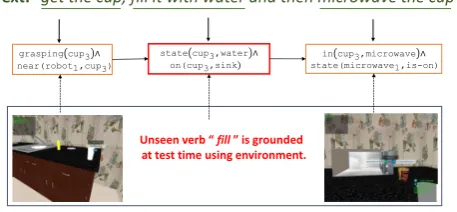
The task of mapping natural language instructions to actions for a robot has been gaining momen-tum in recent years (Artzi and Zettlemoyer, 2013; Tellex et al., 2011; Misra et al., 2014; Bollini et al., 2011; Guadarrama et al., 2013; Matuszek et al., 2012b; Fasola and Mataric, 2013). We are particularly interested in instructions contain-ing verbs such as “microwave” denoting high-level concepts, which correspond to more than 10 low-level symbolic actions such as grasp. In this setting, it is common to find new verbs requiring new concepts at test time. For example, in Fig-ure 1, suppose that we have never seen the verb “fill”. Can we impute the correct interpretation, and moreover seize the opportunity to learn what “fill” means in a way that generalizes to future in-structions?
Text:“get the cup, fill it with water and then microwave the cup”
grasping cup3∧
near(robot1,cup3) in cup3,microwave
∧ state(microwave1,is-on) state cup3,water∧
on(cup3,sink)
[image:1.595.298.527.212.318.2]Unseen verb “ fill ” is grounded at test time using environment.
Figure 1: A lexicon learned on the training data cannot possibly cover all the verb-concept map-pings needed at test time. Our algorithm learns the meaning of new verbs (e.g., “fill”) using the environment context.
Previous work in semantic parsing handles lex-ical coverage in one of two ways. Kwiatkowski et al. (2010) induces a highly constrained CCG lex-icon capable of mapping words to complex log-ical forms, but it would have to skip new words (which in Figure 1 would lead to microwaving an empty cup). Others (Berant and Liang, 2014) take a freer approach by performing a search over log-ical forms, which can handle new words, but the logical forms there are much simpler than the ones we consider.
In this paper, we present an hybrid approach that uses a lexicon to represent complex concepts but also strongly leverages the environment to guide the search space. The environment can pro-vide helpful cues in several ways:
• Only a few environments are likely for a given scenario—e.g., the text is unlikely to ask the robot to microwave an empty cup or put books on the floor.
• The logical form of one segment of text con-strains that of the next segment—e.g., the text is unlikely to ask the robot to pick a cup and then put it back immediately in the same spot.
We show that this environment context provides
𝑐1 𝑐2
z1
e1 e2
planner
𝑎1
simulator
Shallow Parsing (Section 3.2)
x
z2
planner
𝑎2
𝑐𝑘
⋯ ⋯
⋯
Action Sequence:𝑚𝑜𝑣𝑒𝑡𝑜 𝑥𝑏𝑜𝑥1; 𝑔𝑟𝑎𝑠𝑝 𝑥𝑏𝑜𝑥1; 𝑝𝑟𝑒𝑠𝑠 𝑝𝑜𝑤𝑒𝑟_𝑏𝑢𝑡𝑡𝑜𝑛1; 𝑚𝑜𝑣𝑒𝑡𝑜 𝑐𝑑2; 𝑔𝑟𝑎𝑠𝑝 𝑐𝑑2; 𝑖𝑛𝑠𝑒𝑟𝑡(𝑐𝑑2, 𝑥𝑏𝑜𝑥1) ⋯
Environment: Logical Form z = (ℓ, 𝜉)
Frame Node
ℓ: 𝑝𝑢𝑡 ⇒ [𝜆 𝑣.state v1,has-cd ∧ near v1,v2, 𝜉′] 𝜉: {𝑣1→ 𝑥𝑏𝑜𝑥1; 𝑣2→ 𝑟𝑜𝑏𝑜𝑡1} 𝜉′: old mapping
𝑥𝑏𝑜𝑥1
𝑠𝑛𝑎𝑐𝑘𝑡𝑎𝑏𝑙𝑒2
On Power-off
𝜙 𝜙 𝜙
ek zk
planner
𝑎k
Semantic Parsing Model
(Section 5)
zk−1
planner
𝑎k−1
simulator
Text:“Turn on xbox. Take Far Cry Game CD and put in xbox. Throw out beer, coke and sketchy stuff in bowl.⋯”
𝜈:throw,
[image:2.595.76.523.63.217.2]𝜔: [ beer, coke, sketchy stuff, bowl] r: {in: sketchy stuff→bowl}
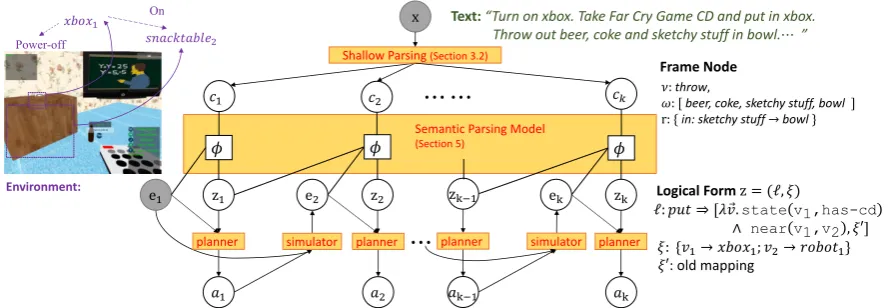
Figure 2: Graphical model overview: we first deterministically shallow parse the textx into a control flow graph consisting of shallow structures{ci}. Given an initial environmente1, our semantic parsing
model maps these frame nodes to logical forms{zi}representing the postconditions. From this, a planner and simulator generate the action sequences{ai}and resulting environments{ei}.
a signal for inducing new lexical entries that map previously unseen verbs to novel concepts. In the example in Figure 1, the algorithm learns that mi-crowaving an empty cup is unlikely and this sug-gests that the verb “fill” must map to actions that end up making the cup not empty.
Another contribution of this paper is using post-conditions as logical forms rather than actions, as in previous work (Artzi and Zettlemoyer, 2013; Misra et al., 2014). Postconditions not only re-duce the search space of logical forms, but are also a more natural representation of verbs. We define a conditional random field (CRF) model over post-conditions, and use a planner to convert postcon-ditions into action sequences and a simulator to generate new environments.
At test time, we use the lexicon induced from the training data, but also perform an environment-guided search over logical forms to induce new lexical entries on-the-fly. If the predicted action sequence uses a new lexical entry generated by the search, it is added to the lexicon, where it can be reused in subsequent test examples.
We evaluate our algorithm on a new corpus con-taining text commands for a household robot. The two key findings of our experiments are: First, the environment and task context contain enough in-formation to allow us to learn lexical entries for new verbs such as “distribute” and “mix” with complex semantics. Second, using both lexical entries generated by a test-time search and those from the lexicon induced by the training data out-performs the two individual approaches. This sug-gests that environment context can help
allevi-ate the problem of having a limited lexicon for grounded language acquisition.
2 Problem Statement
At training time, we are given a set of examples D = {(x(m), e(m), a(m), π(m))}M
m=1, wherex(m)
is a text containing natural language instructions, e(m) is an initial environment, a(m) is a
human-annotated sequence of actions, andπ(m)specifies
a monotonic alignment between segments ofx(m)
and segments ofa(m). For example, given words
x(m) = x1x2 and a(m) = a1a2a3, π(m) might
specify thatx1aligns toa1a2andx2aligns toa3.
At test time, given a sequence of text-environment pairs as input{(x(n), e(n))}N
n=1, we
wish to generate a sequence of actions a(n) for
each input pair. Note that our system is allowed to use information about one test example to improve performance on subsequent ones. We evaluate a system on its ability to recover a human-annotated sequence of actions.
3 Approach Overview
Figure 2 shows our approach for mapping textx to actionsa1:kgiven the initial environmente1.
3.1 Representation
We use the following representation for the differ-ent variables in Figure 2.
Environment. An environment ei is represented by a graph whose nodes are objects and edges represent spatial relations between these objects. We consider five basic spatial relations: near,
instance ID (e.g., book9), a category name (e.g.,
chair, xbox), a set of properties such asgraspable, pourable used for planning and a set of boolean states such as has-water, at-channel3, whose values can be changed by robot actions. The robot is also an object in the environment. For example, the objectsxbox1,snacktable2,are two objects ine1 in Figure 2 with relationonbetween them.
Postconditions. A postcondition is a conjunction of atoms or their negations. Each atom consists of either a spatial relation between two objects (e.g.,
on(book9,shelf3)) or a state and a value (e.g.,
state(cup4,has-water)). Given an environment e, the postcondition evaluates to true or false. Actions. Each action in an action sequence ai consists of an action name with a list of argu-ments (e.g., grasp(xbox1)). The action name is one of 15 values (grasp,moveto,wait, etc.), and each argument is either an object in the envi-ronment (e.g., xbox1), a spatial relation (e.g., in for keep(ramen2,in,kettle1), or a postcondi-tion (e.g., forwait(state(kettle1,boiling))). Logical Forms. The logical form zi is a pair
(`, ξ) containing a lexical entry ` and a map-pingξ. The lexical entry `contains a parameter-ized postcondition such as λ~v.grasping(v1,v2) ∧¬near(v3,v2), andξmaps the variables~vto ob-jects in the environment. Applying the parame-terized postcondition onξ yields a postcondition; note that a postcondition can be represented by different logical forms. A lexical entry contains other information which are used for defining fea-tures, which is detailed in Section 4.
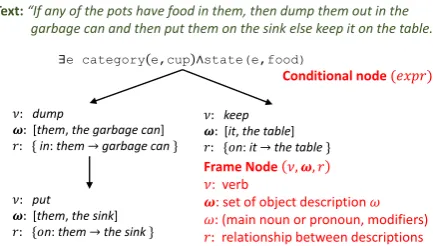
Control Flow Graphs. Following previous work (Tellex et al., 2011; Misra et al., 2014), we convert the text x to a shallow representation. The par-ticular representation we choose is acontrol flow graph, which encodes the sequential relation be-tween atomic segments in the text. Figure 3 shows the control flow graph for an example text. In a
control flow graph, each node is either a frame node or a conditional node. A frame node rep-resents a single clause (e.g., “change the chan-nel to a movie”) and has at most one successor node. Specifically, a frame node consists of a verb ν (e.g., arrange,collect), a set of object descrip-tions {ωi} which are the arguments of the verb (e.g.,the guinness book,movie channel), and spa-tial relations r between the arguments (e.g., be-tween,near). The object descriptionωis either an anaphoric reference (such as “it”) or a tuple con-taining the main noun, associated modifiers, and relative clauses.
Text:“If any of the pots have food in them, then dump them out in the garbage can and then put them on the sink else keep it on the table.”
∃e category e,cup∧state(e,food)
𝜈: dump
𝝎:[them, the garbage can] 𝑟: {in: them→garbage can}
𝜈: put 𝝎:[them, the sink] 𝑟: {𝑜n: them→the sink}
𝜈: keep 𝝎:[it, the table] 𝑟: {𝑜n: it→the table}
Conditional node(𝑒𝑥𝑝𝑟)
Frame Node 𝜈, 𝝎, 𝑟
𝜈: verb
[image:3.595.311.528.61.184.2]𝝎: set of object description 𝜔 𝜔:(main noun or pronoun, modifiers) 𝑟:relationship between descriptions
Figure 3: We deterministically parse text into a shallow structure called a control flow graph.
A conditional node contains a logical postcon-dition with at most one existentially quantified variable (in contrast to a frame node, which con-tains natural language). For example, in Figure 3 the conditional node contains the expression cor-responding to the text“if any of the pots has food”
There are two types of conditional nodes: branch-ing and temporal. A branchbranch-ing conditional node represents an “if” statement and has two succes-sor nodes corresponding to whether the condition evaluates to true or false in the current environ-ment. A temporal conditional node represents an “until” statement and waits until the condition is false in the environment.
3.2 Formal Overview
Shallow Parsing. We deterministically convert the textxinto itscontrol flow graphGusing a set of manual rules applied on its constituency parse tree from the Stanford parser (Klein and Manning, 2003). Conditionals in our dataset are simple and can be converted into postconditions directly using a few rules, unlike the action verbs (e.g., “fill”), which is the focus of this paper. The details of our shallow parsing procedure is described in the appendix.
Given an environmente1,Gis reduced to a
sin-gle sequence of frame nodesc1, . . . , ck, by
evalu-ating all the branch conditionals one1.
Semantic Parsing Model.For each frame nodeci and given the current environmentei, the seman-tic parsing model (Section 5) places a distribution over logical forms zi. This logical form zi rep-resents a postcondition on the environment after executing the instructions inci.
to-gether specify a deterministic mapping from the current environment ei and a logical form zi to a new environment ei+1. Specifically, the
plan-ner takes the current environmentei and a logical form zi and computes the action sequence ai =
planner(ei, zi) for achieving the post condition represented byzi.1 The simulator takes the current environmentei and an action sequenceai and re-turns a new environmentei+1 =simulator(ei, ai).
4 Anchored Verb Lexicons
Like many semantic parsers, we use a lexicon to map words to logical forms. Since the environ-ment plays an central role in our approach, we pro-pose ananchored verb lexicon, in which we store additional information about the environment in which lexical entries were previously used. We focus only on verbs since they have the most com-plex semantics; object references such as “cup” can be mapped easily, as described in Section 5.
More formally, an anchored verb lexiconΛ con-tains lexical entries`of the following form:[ν ⇒
(λ~v.S, ξ)]where,ν is a verb,Sis a postcondition with free variables~v, andξ is a mapping of these variables to objects. An example lexical entry is:
[pour⇒(λv1v2v3.S, ξ)], where:
S=grasping(v1,v2)∧near(v1,v3)∧ ¬state(v2,milk)
∧state(v3,milk)
ξ={v1→robot1,v2→cup1,v3→bowl3}(anchoring)
As Table 1 shows, a single verb will in general have multiple entries due to a combination of pol-ysemy and the fact that language is higher-level than postconditions.
Advantages of Postconditions. In contrast to pre-vious work (Artzi and Zettlemoyer, 2013; Misra et al., 2014), we use postconditions instead of action sequence for two main reasons. First, postcondi-tions generalize better. To illustrate this, consider the action sequence for the simple task of filling a cup with water. At the time of learning the lexi-con, the action sequence might correspond to us-ing a tap for fillus-ing the cup while at test time, the environment may not have a tap but instead have a pot with water. Thus, if the lexicon maps to ac-tion sequence, then it will not be applicable at test time whereas the postconditionstate(z1,water)
is valid in both cases. We thus shift the load of in-ferring environment-specific actions onto planners 1We use the symbolic planner of Rintanen (2012) which
can perform complex planning. For example, to pick up a bottle that is blocked by a stack of books, the planner will first remove the books before grasping the bottle. In contrast, Artzi and Zettlemoyer (2013) use a simple search over im-plicit actions.
Table 1: Some lexical entries for the verb “turn”
Sentence Context Lexical entry[turn⇒(λ~v.S, ξ)]
“turn on the TV” state(v1,is-on)∧near(v2,v1) ξ:v1→tv1,v2→robot1
“turn on the right state(v1,fire3)∧near(v2,v1)
back burner” ξ:v1→stove1,v2→robot1
“turn off the water” ¬state(v1,tap-on) ξ:v1→sink1
“turn the television state(v1,channel6)∧near(v1,v2)
input to xbox” ξ:v1→tv1,v2→xbox1
and use postconditions for representation, which better captures the semantics of verbs.
Second, because postconditions are higher-level, the number of atoms needed to repre-sent a verb is much less than the correspond-ing number of actions. For example, the text “microwave a cup”, maps to action se-quence with 10–15 actions, the postcondition only has two atoms: in(cup2,microwave1) ∧
state(microwave,is-on). This makes search-ing for new logical forms more tractable.
Advantages of Anchoring. Similar to the VEIL templates of Misra et al. (2014), the free variables ~vare associated with a mappingξto concrete ob-jects. This is useful for resolving ellipsis. Suppose the following lexical entry was created at train-ing time based on the text “throw the drinks in the trash bag”:
[`:throw⇒λxyz.S(x, y, z)],where
S=in(x,y)∧ ¬grasping(z,x)∧ ¬state(z,closed) ξ={x→coke1,y→garbageBin1,z→robot1}
Now consider a new text at test time “throw away the chips”, which does not explicitly men-tion where to throw the chips. Our semantic pars-ing algorithm (Section 5) will use the previous mappingy → garbabeBin1 to choose an object most similar to a garbage bin.
5 Semantic Parsing Model
Given a sequence of frame nodesc1:k and an ini-tial environment e1, our semantic parsing model
defines a joint distribution over logical formsz1:k. Specifically, we define a conditional random field (CRF) overz1:k, as shown in Figure 2:
pθ(z1:k|c1:k, e1)∝exp k
X
i=1
φ(ci, zi−1, zi, ei)·θ
!
, (1) whereφ(ci, zi−1, zi, ei)is the feature vector and
θ is the weight vector. Note that the environ-mentse1:kare a deterministic function of the log-ical forms z1:k through the recurrence ei+1 =
Features. The feature vector φ(ci, zi−1, zi, ei) contains 16 features which capture the dependen-cies between text, logical forms, and environment. Recall that zi = ([ν ⇒ (λ~v.S, ξ)], ξi), where ξ is the environment in which the lexical entry was created and ξi is the current environment. Let fi = (λ~v.S)(ξi) be the current postcondition. Here we briefly describe the important features (see the supplemental material for the full list): • Language and logical form: The logical form
zi should generally reference objects mentioned in the text. Assume we have computed a cor-relationρ(ω, o)between each object description ωand objecto, whose construction is described later. We then define two features: precision cor-relation, which encourageszito only use objects referred to in ci; and recall correlation, which encourageszito use all the objects referred to in ci.
• Logical form: The postcondition fi should be based on previously seen environments. For ex-ample, microwaving an empty cup and grasp-ing a couch are unlikely postconditions. We define features corresponding to the average probability (based on the training data) of all conjunctions of at most two atoms in the postcondition (e.g., grasping(robot,cup)}). We do the same with their abstract versions ({grasping(v1,v2)}). In addition, we build the same set of four probability tables conditioned on verbs in the training data. For example, the abstract postcondition state(v1,water) has a higher probability conditioned on the verb “fill”. This gives us a total of 8 features of this type. • Logical form and environment: Recall that
an-choring helps us in dealing with ellipsis and noise. We add a feature based on the average correlation between the objects of the new map-pingξiwith the corresponding objects in the an-chored mappingξ.
The other features are based on the relationship between object descriptions, similarity betweenξ and ξi and transition probabilities between logi-cal formszi−1andzi. These probabilities are also learned from training data.
Mapping Object Descriptions.Our features rely on a mapping from object descriptions ω (e.g., “the red shiny cup”) to objects o (e.g., cup8), which has been addressed in many recent works (Matuszek et al., 2012a; Guadarrama et al., 2014; Fasola and Matari’c, 2014).
One key idea is: instead of computing rigid lex-ical entries such ascup→cup1, we use a
contin-uous correlation scoreρ(ω, o) ∈ [0,1]that mea-sures how wellω describeso. This flexibility al-lows the algorithm to use objects not explicitly mentioned in text. Given “get me a tank of wa-ter”, we might choose an approximate vessel (e.g.,
cup2).
Given an object descriptionω, an objecto, and a set of previously seen objects (used for anaphoric resolution), we define the correlationρ(ω, o)using the following approach:
• Ifωis a pronoun,ρ(ω, o)is the ratio of the posi-tion of the last reference ofoto the length of the action sequence computed so far, thus preferring recent objects.
• Otherwise, we compute the correlation using various sources: the object’s category; the object’s state for handling metonymy (e.g., the description “coffee” correlates well with the object mug1 if mug1 contains coffee—
state(mug1,has-coffee) is true), WordNet (Fellbaum, 1998) for dealing synonymy and hy-ponymy; and word alignments between the ob-jects and text from Giza++ (Och and Ney, 2003) to learn domain-specific references (e.g., “ Guin-ness book” refers tobook1, not book2). More details can be found in the supplemental mate-rial.
6 Lexicon Induction from Training Data In order to map text to logical forms, we first in-duce an initial anchored lexiconΛfrom the train-ing data {(x(m), e(m), a(m), π(m))}M
m=1. At test
time, we add new lexical entries (Section 7) toΛ. Recall that shallow parsingx(m)yields a list of
frame nodesc1:k. For each frame nodeci and its aligned action sequenceai, we take the conjunc-tion of all the atoms (and their negaconjunc-tions) which are false in the current one ei but true in the next environmentei+1. We parametrize this
con-junction by replacing each object with a variable, yielding a postcondition S parametrized by free variables~v and the mapping ξ from~vto objects inei. We then add the lexical entry [verb(ci) ⇒
(λ~v.S, ξ)]toΛ.
model: ξi = arg maxξ0φ(ci, zi−1,(`i, ξ0), ei) ·
θ. For the feature vector φ that we consider, this approximately translates to solving an integer quadratic program with variables [yij] ∈ {0,1}, whereyij = 1only ifvimaps to objectj.
7 Environment-Driven Lexicon Induction at Test Time
Unfortunately, we cannot expect the initial lexicon
Λinduced from the training set to have full cover-age of the required postconditions. Even after us-ing 90% of the data for trainus-ing, we encountered 17% new postconditions on the remaining 10%. We therefore propose generating new lexical en-tries at test time and adding them toΛ.
Formally, for a given environmenteiand frame nodeci, we want to generate likely logical forms. Although the space of all possible logical forms is very large, the environment constrains the pos-sible interpretations. We first compute the set of atoms that are false in ei and that only con-tain objects o that are “referred” to by either ci or ci−1, where “refers” means that there
ex-ists some argument ω in ci for which o ∈
arg maxo0ρ(ω, o0). For example, ifcicorresponds
to the text “distribute pillows among the couches”, we consider the atom on(pillow1,armchair1) but noton(pillow1,snacktable2)since the ob-jectarmchair1 has the highest correlation to the description “couches”.
Next, for each atom, we convert it into a logi-cal formz = (`, ξ)by replacing each object with a variable. While this generalization gives us a mapping ξ, we create a lexical entry`i = [ν ⇒
(λ~v.S,∅)] without it, where S is the parameter-ized atom. Note that the anchored mapping is empty, representing the fact that this lexical en-try was unseen during training time. For example, the atomstate(tv1,mute)would be converted to the logical form (`, ξ), where ` = [verb(ci) ⇒
(λv.state(v,mute),∅]andξ ={v → tv1}. We do not generalize state names (e.g.,mute) because they generally are part of the meaning of the verb. The score φ(ci, zi−1, zi, ei) · θ is computed
for the logical form zi produced by each post-condition. We then take the conjunction of ev-ery pair of postconditions corresponding to the 200 highest-scoring logical forms. This gives us new set of postconditions on which we repeat the generalization-scoring-conjunction cycle. We keep doing this while the scores of the new logi-cal forms is increasing or while there are logilogi-cal forms remaining.
Train Time Anchored Lexicon 𝚲(Sec 6)
ℓ = [𝑣𝑒𝑟𝑏 ⇒ (𝜆 𝑣. 𝑆, 𝜉)]
such that 𝑣𝑒𝑟𝑏 = 𝑣(𝑐𝑖)
Test Time Search for Logical Forms (Sec 7)
Set of Logical Forms for 𝒄𝒊−𝟏𝒄𝒊, 𝒆𝒊, 𝒛𝒊−𝟏
𝑧𝑖= (ℓ, 𝜉𝑖)
𝜉𝑖is the new assignment
𝑧𝑖= ℓ, 𝜉𝑖
where ℓ = [𝑣𝑒𝑟𝑏 ⇒ (𝜆 𝑣. 𝑆 , ∅)]
[image:6.595.312.528.70.133.2]is a test time lexical entry
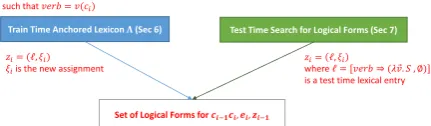
Figure 4: Logical forms for a given clauseci, en-vironment ei, and previous logical form zi−1 are
generated from both a lexicon induced from train-ing data and a test-time search procedure based on the environment.
If a logical form z = ([ν ⇒ (λ~v.S,∅)], ξ) is used by the predicted action sequence, we add the lexical entry [ν ⇒ (λ~v.S, ξ)] to the lexicon Λ. This is different to other lexicon induction proce-dures such as GENLEX (Zettlemoyer and Collins, 2007) which are done at training time only and require more supervision. Moreover, GENLEX does not use the environment context in creating new lexical entries and thus is not appropriate at test time, since it would vastly overgenerate lexi-cal entries compared to our approach. For us, the environment thus provides implicit supervision for lexicon induction.
8 Inference and Parameter Estimation Inference. Given a text x(which is converted to c1:k via Section 3.2) and an initial environment e1, we wish to predict an action sequenceabased
onpθ(a1:k |c1:k, e1), which marginalizes over all
logical formsz1:k(see Figure 2).
To enumerate possible logical forms, semantic parsers typically lean heavily on a lexicon (Artzi and Zettlemoyer, 2013), leading to high preci-sion but lower recall, or search more aggressively (Berant et al., 2013), leading to higher recall but lower precision. We adopt the following hybrid approach: Givenei, ci−1, ciandzi−1, we use both
the lexical entries in Λas explained in Section 6 and the search procedure in Section 7 to generate the set of possible logical forms for zi (see Fig-ure 4). We use beam search, keeping only the highest-scoring logical form with satisfiable post-conditions for each i ∈ {1, . . . , k} and resulting action sequencea1:i.
similar to pseudolikelihood to estimate the param-etersθ. Specifically, we maximize the average log-likelihood over each adjacent pair of logical forms underpθ˜ :
˜
pθ(zi|zi−1, ci, ei)∝exp(φ(ci, zi−1, zi, ei)>θ). (2)
The weights were initialized to 0. We per-formed 300 iterations over the validation set with a learning rate of 0.005
N .
9 Dataset and Experiments 9.1 Dataset
We collected a dataset of 500 examples from 62 people using a crowdsourcing system similar to Misra et al. (2014). We consider two different 3D scenarios: a kitchen and a living room, each con-taining an average of 40 objects. Both of these scenarios have 10 environments consisting of dif-ferent sets of objects in difdif-ferent configurations. We define 10 high-level objectives, 5 per scenario, such asclean the room,make coffee,prepare room for movie night, etc.
One group of users wrote natural language com-mands to achieve the high-level objectives. An-other group controlled a virtual robot to accom-plish the commands given by the first group. The dataset contains considerable variety, consisting of 148 different verbs, an average of 48.7 words per text, and an average of 21.5 actions per action se-quence. Users make spelling and grammar errors in addition to occasionally taking random actions not relevant to the text. The supplementary mate-rial contains more details.
We filtered out 31 examples containing fewer than two action sequences. Of the remaining ex-amples, 378 were used for training and 91 were used for test. Our algorithm is tested on four new environments (two from each scenario).
9.2 Experiments and Results
Evaluation Metrics. We consider two metrics,
IEDandEND, which measure accuracy based on the action sequence and environment, respectively. Specifically, theIEDmetric (Misra et al., 2014) is the edit distance between predicted and true action sequence. TheENDmetric is the Jaccard index of setsA andB, whereA is the set of atoms (e.g.,
on(cup1,table1)) whose truth value changed
due to simulating the predicted action sequence, andBis that of the true action sequence.
Baselines. We compare our algorithm with the following baselines:
Table 3: Results on the metrics and baselines de-scribed in section 9.2. The numbers are normal-ized to 100 with larger values being better.
Algorithm IED END
Chance 0.3 0.5
Manually Defined Templates 2.5 1.8 UBL- Best Parse (Kwiatkowski et al., 2010) 5.3 6.9 VEIL (Misra et al., 2014) 14.8 20.7 Model with only train-time lexicon induction 20.8 26.8 Model with only test-time lexicon induction 21.9 25.9
Full Model 22.3 28.8
1. Chance: Randomly selects a logical form for every frame node from the set of logical forms generated by generalizing all possible postcon-ditions that do not hold in the current environ-ment. These postconditions could contain up to 93 atoms.
2. Manually Defined Templates: Defines a set of postcondition templates for verbs similar to Guadarrama (2013).
3. UBL-Best Parse (Kwiatkowski et al., 2010): UBL algorithm trained on text aligned with post-conditions and a noun-phrase seed lexicon. The planner uses the highest scoring postcondition given by UBL to infer the action sequence.
4. VEIL (Misra et al., 2014): Uses action se-quences as logical forms and does not generate lexical entries at test time.
We also consider two variations of our model: (i) using only lexical entries induced using the traing data, and (ii) ustraing only the logical forms in-duced at test-time by the search procedure.
The results are presented in Table 3. We ob-serve that our full model outperforms the baseline and the two pure search- and lexicon-based varia-tions of our model. We further observe that adding the search procedure (Section 7) improved the ac-curacy by 1.5% on IED and 2% on END. The log-ical forms generated by the search were able to successfully map 48% of the new verbs.
environ-Table 2: New verbs and concepts induced at test time (Section 7).
Text Postcondition represented by the learned logical form # Log. forms explored
“mix it with ice cream and syrup”state(cup2,ice-cream1)∧state(cup2,vanilla) 15
“distribute among the couches” ∧j∈{1,3}on(pillowj,loveseat1)∧on(pillowi+1,armchairi+1)386
“boil it on the stove” state(stove,stovefire1)∧state(kettle,water) 109 “change the channel to a movie” state(tv1,channel4)∧on(book1,loveseat1) 98
ment. The VEIL baseline used actions for repre-sentation and does not generalize as well as the postconditions in our logical forms.
It is also instructive to examine the alternate postconditions that the search procedure consid-ers. For the first example in Table 2, the following postcondition was considered by not selected:
grasping(robot,icecream2)∧grasping(robot,syrup1)
While this postcondition uses all the objects de-scribed in the text, the environment-based features suggest it makes little sense for the task to end with the robot eternally grasping objects. For the sec-ond example, alternate postcsec-onditions considered included:
1.on(pillow1,pillow2)∧on(pillow3,pillow4)
2.∧4
j=1on(pillowj,loveseat1)
3.∧3
j=1near(robot1,armchairj)
The algorithm did not choose options 1 or 3 since the environment-based features recognizes these as unlikely configurations. Option 2 was ruled out since the recall correlation feature real-izes that not all the couches are mentioned in the postcondition.
To test how much features on the environment help, we removed all such features from our full model. We found that the accuracy fell to 16.0% on the IED metric and 16.6% on the END metric, showing that the environment is crucial.
In this work, we relied on a simple deterministic shallow parsing step. We found that shallow pars-ing was able to correctly process the text in only 46% of the test examples, suggesting that improv-ing this initial component or at least modelimprov-ing the uncertainty there would be beneficial.
10 Related Work
Our work uses semantic parsing to map nat-ural language instructions to actions via novel concepts, which brings together several themes: actions, semantic parsing, novel concepts, and robotics.
Mapping Text to Actions.Several works (Brana-van et al., 2009; Brana(Brana-van et al., 2010; Vogel and Jurafsky, 2010) use reinforcement learning to di-rectly map to text to actions, and do not even re-quire an explicit model of the environment.
How-ever, they can only handle simple actions, whereas our planner and simulator allows us to work with postconditions, and thus tackle high-level instruc-tions. Branavan et al. (2012) extract precondi-tion relaprecondi-tions from text, learn to map text to sub-goals (postconditions) for a planner. However, their postconditions are atomic, whereas ours are complex conjunctions.
Other works (Chen and Mooney, 2011; Kim and Mooney, 2012; Kollar et al., 2010; Fasola and Mataric, 2013) have focused only on navigational verbs and spatial relations, but do not handle high-level verbs. Artzi and Zettlemoyer (2013) also fall into the above category and offer a more composi-tional treatment. They focus on how words com-pose; we focus on unraveling single words.
The broader problem of grounded language ac-quisition, involving connecting words to aspects of a situated context has been heavily studied (Duval-let et al., 2014; Yu and Siskind, 2013; Chu et al., 2013; Chen and Mooney, 2008; Mooney, 2008; Fleischman and Roy, 2005; Liang et al., 2009). Semantic Parsing. In semantic parsing, much work has leveraged CCG (Zettlemoyer and Collins, 2005; Zettlemoyer and Collins, 2007; Kwiatkowski et al., 2010). One challenge behind lexically-heavy approaches is ensuring adequate lexical coverage. Kwiatkowski et al. (2011) en-hanced generalization by factoring a lexical entry into a template plus a lexeme, but the rigidity of the template remains. This is satisfactory when words map to one (or two) predicates, which is the case in most existing semantic parsing tasks. For example, in Artzi and Zettlemoyer (2013), verbs are associated with single predicates (“move” to
move, “walk” to walk, etc.) In our setting, verbs contain multi-predicate postconditions, for which these techniques would not be suitable.
from partial environment constraints.
Grounding to Novel Concepts. Guadarrama et al. (2014) map open vocabulary text to objects in an image using a large database. Matuszek et al. (2012a) create new predicates for every new ad-jective at test time. Others (Kirk et al., 2014) ask users for clarification. In contrast, we neither have access to large databases for this problem, nor do we do create new predicates or use explicit super-vision at test time.
Robotic Applications.Our motivation behind this work is to build robotic systems capable of taking commands from users. Other works in this area have considered mapping text to a variety of ma-nipulation actions (Sung et al., 2015). Levine et al. (2015) and Lenz et al. (2015) focus on spe-cific manipulation actions. In order to build a rep-resentation of the environment, Ren et al. (2012) and Wu et al. (2014) present vision algorithms but only output symbolic labels, which could act as inputs to our system. In future work, we also plan to integrate our work with RoboBrain (Saxena et al., 2014) to leverage these existing systems for building a robotic system capable of working with physical world data.
11 Conclusion
We have presented an algorithm for mapping text to actions that induces lexical entries at test time using the environment. Our algorithm couples the lexicon extracted from training data with a test-time search that uses the environment to reduce the space of logical forms. Our results suggest that using the environment to provide lexical coverage of high-level concepts is a promising avenue for further research.
Acknowledgements.This research was supported by the ONR (award N00014-14-1-0156), a Sloan Research Fellowship to the third author, and a Mi-crosoft Research Faculty Fellowship and NSF Ca-reer Award to the fourth author. We thank Aditya Jami and Jaeyong Sung for useful discussions. We also thank Jiaqi Su for her help with data collec-tion and all the people who participated in the user study.
Reproducibility.Code, data, and experiments for this paper are available on the CodaLab platform
at https://www.codalab.org/worksheets/
0x7f9151ec074f4f589e4d4786db7bb6de/.
De-mos can be found athttp://tellmedave.com. Appendix: Parsing Text into Control Flow Graph.
We first decompose the text x into its control
flow graphGusing a simple set of rules:
• The parse tree ofxis generated using the Stan-ford parser (Klein and Manning, 2003) and a frame node is created for each non-auxiliary verb node in the tree.
• Conditional nodes are discovered by look-ing for the keywords until, if, after, when. The associated subtree is then parsed deter-ministically using a set of a rules. For example, a rule parses “for x minutes” to
for(digit:x,unit:minutes). We found that all conditionals can be interpreted against the initial environmente1, since our world is
fully-observable, deterministic, and the user giving the command has full view of the world. • To find objects, we look for anaphoric terminal
nodes or nominals whose parent is not a nominal or which have a PP sibling. These are processed into object descriptionsω.
• Object descriptionsωare attached to the frame node, whose verb is nearest in the parse tree to the main noun ofω.
• Nodes corresponding to {IN,TO,CC,“,”} are added as the relation between the corresponding argument objects.
• If there is a conjunction between two objects in a frame node and if these objects have the same relation to other objects, then we split the frame node into two sequential frame nodes around these objects. For example, a frame node corre-sponding to the text segment “take the cup and bowl from table” is split into two frame nodes corresponding to “take the cup from table” and “take bowl from table”.
• A temporal edge is added between successive frame nodes in the same branch of a condition. A temporal edge is added between a conditional node and head of the true and false branches of the condition. The end of all branches in a sen-tence are joined to the starting node of the suc-cessive sentence.
References
Y. Artzi and L. Zettlemoyer. 2013. Weakly supervised learning of semantic parsers for mapping instruc-tions to acinstruc-tions. Transactions of the Association for Computational Linguistics (TACL), 1:49–62. J. Berant and P. Liang. 2014. Semantic parsing via
paraphrasing. In Association for Computational Linguistics (ACL).
M. Bollini, J. Barry, and D. Rus. 2011. Bakebot: Bak-ing cookies with the PR2. In The PR2 Workshop, IROS.
S. Branavan, H. Chen, L. S. Zettlemoyer, and R. Barzi-lay. 2009. Reinforcement learning for mapping instructions to actions. In Association for Com-putational Linguistics and International Joint Con-ference on Natural Language Processing (ACL-IJCNLP), pages 82–90.
S. Branavan, L. Zettlemoyer, and R. Barzilay. 2010. Reading between the lines: Learning to map high-level instructions to commands. In Association for Computational Linguistics (ACL), pages 1268– 1277.
S. Branavan, N. Kushman, T. Lei, and R. Barzilay. 2012. Learning high-level planning from text. In Association for Computational Linguistics (ACL), pages 126–135.
D. L. Chen and R. J. Mooney. 2008. Learning to sportscast: A test of grounded language acquisition. In International Conference on Machine Learning (ICML), pages 128–135.
D. L. Chen and R. J. Mooney. 2011. Learning to in-terpret natural language navigation instructions from observations. InAssociation for the Advancement of Artificial Intelligence (AAAI), pages 859–865.
V. Chu, I. McMahon, L. Riano, C. McDonald, Q. He, J. Perez-Tejada, M. Arrigo, N. Fitter, J. Nappo, T. Darrell, et al. 2013. Using robotic exploratory procedures to learn the meaning of haptic adjectives. In International Conference on Intelligent Robots and Systems (IROS).
J. Clarke, D. Goldwasser, M. Chang, and D. Roth. 2010. Driving semantic parsing from the world’s re-sponse. InComputational Natural Language Learn-ing (CoNLL), pages 18–27.
F. Duvallet, M. R. Walter, T. Howard, S. Hemachan-dra, J. Oh, S. Teller, N. Roy, and A. Stentz. 2014. Inferring maps and behaviors from natural language instructions. InInternational Symposium on Exper-imental Robotics (ISER).
J. Fasola and M. Mataric. 2013. Using semantic fields to model dynamic spatial relations in a robot archi-tecture for natural language instruction of service robots. In International Conference on Intelligent Robots and Systems (IROS).
J. Fasola and M. J. Matari’c. 2014. Interpreting instruction sequences in spatial language discourse with pragmatics towards natural human-robot inter-action. InInternational Conference on Robotics and Automation (ICRA), pages 6667–6672.
C. Fellbaum. 1998. WordNet: An Electronic Lexical Database. MIT Press.
M. Fleischman and D. Roy. 2005. Intentional context in situated natural language learning. In Computa-tional Natural Language Learning (CoNLL), pages 104–111.
S. Guadarrama, L. Riano, D. Golland, D. Gouhring, Y. Jia, D. Klein, P. Abbeel, and T. Darrell. 2013. Grounding spatial relations for human-robot inter-action. In International Conference on Intelligent Robots and Systems (IROS).
S. Guadarrama, E. Rodner, K. Saenko, N. Zhang, R. Farrell, J. Donahue, and T. Darrell. 2014. Open-vocabulary object retrieval. In Robotics: Science and Systems (RSS).
J. Kim and R. Mooney. 2012. Unsupervised PCFG in-duction for grounded language learning with highly ambiguous supervision. InComputational Natural Language Learning (CoNLL), pages 433–444.
N. H. Kirk, D. Nyga, and M. Beetz. 2014. Con-trolled natural languages for language generation in artificial cognition. InInternational Conference on Robotics and Automation (ICRA), pages 6667–6672. D. Klein and C. Manning. 2003. Accurate unlexical-ized parsing. InAssociation for Computational Lin-guistics (ACL), pages 423–430.
T. Kollar, S. Tellex, D. Roy, and N. Roy. 2010. Grounding verbs of motion in natural language com-mands to robots. InInternational Symposium on Ex-perimental Robotics (ISER).
T. Kwiatkowski, L. Zettlemoyer, S. Goldwater, and M. Steedman. 2010. Inducing probabilistic CCG grammars from logical form with higher-order uni-fication. InEmpirical Methods in Natural Language Processing (EMNLP), pages 1223–1233.
T. Kwiatkowski, L. Zettlemoyer, S. Goldwater, and M. Steedman. 2011. Lexical generalization in CCG grammar induction for semantic parsing. In Empirical Methods in Natural Language Processing (EMNLP), pages 1512–1523.
T. Kwiatkowski, E. Choi, Y. Artzi, and L. Zettlemoyer. 2013. Scaling semantic parsers with the-fly on-tology matching. InEmpirical Methods in Natural Language Processing (EMNLP).
I. Lenz, R. Knepper, and A. Saxena. 2015. Deepmpc: Learning deep latent features for model predictive control. InRobotics Science and Systems (RSS). S. Levine, C. Finn, T. Darrell, and P. Abbeel. 2015.
End-to-end training of deep visuomotor policies. arXiv preprint arXiv:1504.00702.
P. Liang, M. I. Jordan, and D. Klein. 2011. Learn-ing dependency-based compositional semantics. In Association for Computational Linguistics (ACL), pages 590–599.
C. Matuszek, N. FitzGerald, L. Zettlemoyer, L. Bo, and D. Fox. 2012a. A joint model of language and perception for grounded attribute learning. In Inter-national Conference on Machine Learning (ICML), pages 1671–1678.
C. Matuszek, E. Herbst, L. Zettlemoyer, and D. Fox. 2012b. Learning to parse natural language com-mands to a robot control system. In International Symposium on Experimental Robotics (ISER). D. Misra, J. Sung, K. Lee, and A. Saxena. 2014. Tell
Me Dave: Context-sensitive grounding of natural language to mobile manipulation instructions. In Robotics: Science and Systems (RSS).
R. Mooney. 2008. Learning to connect language and perception. InAssociation for the Advancement of Artificial Intelligence (AAAI), pages 1598–1601. F. J. Och and H. Ney. 2003. A systematic comparison
of various statistical alignment models. Computa-tional Linguistics, 29:19–51.
X. Ren, L. Bo, and D. Fox. 2012. Rgb-(d) scene label-ing: Features and algorithms. InComputer Vision and Pattern Recognition (CVPR), pages 2759–2766. J. Rintanen. 2012. Planning as satisfiability:
Heuris-tics. Artificial Intelligence, 193.
A. Saxena, A. Jain, O. Sener, A. Jami, D. K. Misra, and H. S. Koppula. 2014. Robobrain: Large-scale knowledge engine for robots. arXiv preprint arXiv:1412.0691.
J. Sung, S. H. Jin, and A. Saxena. 2015. Robobarista: Object part based transfer of manipulation trajecto-ries from crowd-sourcing in 3d pointclouds. arXiv preprint arXiv:1504.03071.
S. Tellex, T. Kollar, S. Dickerson, M. R. Walter, A. G. Banerjee, S. J. Teller, and N. Roy. 2011. Un-derstanding natural language commands for robotic navigation and mobile manipulation. In Associa-tion for the Advancement of Artificial Intelligence (AAAI).
A. Vogel and D. Jurafsky. 2010. Learning to follow navigational directions. InAssociation for Compu-tational Linguistics (ACL), pages 806–814.
C. Wu, I. Lenz, and A. Saxena. 2014. Hierarchical se-mantic labeling for task-relevant RGB-D perception. InRobotics: Science and Systems (RSS).
H. Yu and J. M. Siskind. 2013. Grounded language learning from video described with sentences. In Association for Computational Linguistics (ACL), pages 53–63.
L. S. Zettlemoyer and M. Collins. 2005. Learning to map sentences to logical form: Structured classifica-tion with probabilistic categorial grammars. In Un-certainty in Artificial Intelligence (UAI), pages 658– 666.