25
Dissecting
Content
and
Context
in Argumentative Relation Analysis
Juri OpitzandAnette Frank Research Training Group AIPHES,
Leibniz ScienceCampus “Empirical Linguistics and Computational Language Modeling” Department for Computational Linguistics
69120 Heidelberg
{opitz,frank}@cl.uni-heidelberg.de
Abstract
When assessing relations between argumenta-tive units (e.g.,support or attack), computa-tional systems often exploit disclosing indica-tors or markers that are not part of elementary argumentative units (EAUs) themselves, but are gained from their context (position in para-graph, preceding tokens, etc.). We show that this dependency is much stronger than previ-ously assumed. In fact, we show that by com-pletely masking the EAU text spans and only feeding information from their context, a com-petitive system may function evenbetter. We argue that an argument analysis system that re-lies more on discourse context than the argu-ment’s content is unsafe, since it can easily be tricked. To alleviate this issue, we separate ar-gumentative units from theircontextsuch that the system is forced to model and rely on an EAU’s content. We show that the resulting classification system is more robust, and argue that such models are better suited for predict-ing argumentative relations across documents.
1 Introduction
In recent years we have witnessed a great surge in activity in the area of computational argument analysis (e.g.Peldszus and Stede(2013);Stab and Gurevych (2014b);Rasooli and Tetreault (2015);
Stab et al.(2018)), and the emergence of dedicated venues such as the ACL Argument Mining work-shop series starting in 2014 (Green et al.,2014).
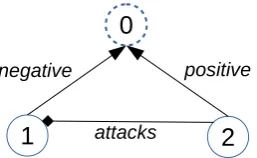
Argumentative relation classification is a sub-task of argument analysis that aims to determine relations between argumentative units A and B, for example, AsupportsB; AattacksB. Consider the following argumentative units (1) and (2), given the topic(0)“Marijuana should be legalized”:
(1) Legalizing marijuana can increase use by teens, with harmful results.
0
2
1
negative
attacks
[image:1.595.354.483.221.300.2]positive
Figure 1: A graph representation of a topic (node w/ dashed line), two argumentative premise units (nodes w/ solid line), premise-topic relations (positive or neg-ative) and premise-premise relations (here:attacks).
(2) Legalization allows the government to set age restrictions on buyers.
This example is modeled in Figure1. It is clear that(1)has a negative stance towards the topic and (2)has a positive stance towards the topic. More-over, we can say that(2)attacks(1). In discourse, such a relation is often made explicit through dis-course markers: (1). However, (2); On the one hand(1), on the other(2); (1), although(2); Ad-mittedly,(2); etc. In the absence of such markers we must determine this relation by assessing the semantics of the individual argumentative units, including (often implicit) world knowledge about how they are related to each other.1
In this work, we show that argumentative rela-tion classifiers – when provided with textual con-text surrounding an argumentative unit’s span – are very prone to neglect the actual textual con-tent of the EAU span. Instead they heavily rely oncontextual markers, such as conjunctions or ad-verbials, as a basis for prediction. We argue that a system’s capacity of predicting the correct relation based on the argumentative units’ content is im-portant in many circumstances, e.g., when an ar-gumentative debate crosses document boundaries.
1In case of(1)and(2): By setting age restrictions on
For example, theprohibition of marijuana debate extends across populations and countries – argu-mentative units for this debate can be recovered from thousands of documents scattered across the world wide web. As a consequence, argumenta-tive relation classification systems should not be (immensely) dependent on contextual clues – in the discussed cross-document setting these clues may even be misleading for such a system, since source and target arguments can be embedded in different textual contexts (e.g., when (1) and(2) stem from different documents it is easy to imag-ine a textual context where(2)is not introduced by
however but instead by an ‘inverse’ form such as e.g.moreover).
Contributions In Section §3 we describe argu-mentative relation classification systems and their features. Then, to assess the systems’ dependency on context, we propose a three-way feature group-ing: (i) features which access only the EAU span; (ii) features which access only the context of an EAU; (iii) features which access both EAU span and its context. Our experimental results (§4) in-dicate that systems, when given the option, tend to focus on thecontextof an EAU, while neglecting its content. On the one hand, this leads to strong performance when EAUs appear sequentially in a rhetorically well structured argumentative mono-logue. Yet, on the other hand, we show that such systems can easily be fooled, e.g., when EAUs are extracted from different documents.
2 Related Work
It is well-known that the rhetorical and argumen-tative structure of texts bear great similarities. For example,Azar(1999);Green(2010);Peldszus and Stede (2013) observe that elementary discourse units (EDUs) in RST (Mann and Thompson,1987) share great similarity with elementary argumen-tative units (EAUs) in argumentation analysis.2
Wachsmuth et al.(2018) experiment with a mod-ified version of the Microtext corpus (Peldszus and Stede, 2016), which is an extensively anno-tated albeit small corpus. Similar to us, they sep-arate argumentative units from discursive contex-tual markers. WhileWachsmuth et al.(2018) con-duct a humanevaluation to investigate the sepa-ration ofLogosandPathos aspects of arguments,
2Throughout this work we often drop “elementary” and
use the phrasesEAU and (elementary) argumentative unitand
argumentative componentinterchangeably.
our work investigates how (de-)contextualization of argumentative units affectsautomatic argumen-tative relation classification models.
Notions of context Various notions of context
are being used in the area of argumentation min-ing. For example, Lippi and Torroni (2016) de-velop a context-independent claim detection sys-tem, where by context-independent they refer to a system which is not tailored to a specific topic (analogously, Levy et al. (2014) aim at context-dependency). Another notion ofcontextconcerns the graph context in which relations and EAUs are embedded (Kuribayashi et al.,2018). On the other hand, we adopt a moretextual notion of context, that is we take a given EAU span as content and text which is not in the EAU span as context. This goes in the same direction asStab and Gurevych
(2014b, 2017); Persing and Ng (2016) and Aker et al. (2017) who incorporate features derived from EAU-surrounding text in their classification systems. However, they do not clearly separate between a word indicator feature extracted from within (or outside) the EAU span. For exam-ple, when computing features for an EAU, they also take into account EAU-preceding tokens. The preceding tokens, often contain shallow discourse markers which highlight the relationship between two EAUs (e.g.,because,however, etc.).
To the best of our knowledge, prior work has not yet thoroughly investigated the impact of fea-tures extracted from the EAU vs. feafea-tures ex-tracted from the EAU-embedding context. Our work fills this gap and shows that the impact of contextual clues from the EAUcontexton classi-fier performance can be much greater than the im-pact of features extracted from the EAUcontent.
Context matters Nguyen and Litman (2016);
Nguyen (2018) extract additional features from the text between source and target EAUs (on the StudentEssay-v01 data (Stab and Gurevych,
2014a)) which results in enhanced predictive per-formance. However, having seen the clear ad-vantages of incorporating context (performance-wise), we find that the downsides of incorporating context remain untold. In this work, we demon-strate that systems which are offered EAUcontext
may be prone to neglect the EAUcontent, an issue that can have undesired effects.
Moens,2011) is the task for which we aim to ex-amine the context-content relationship. It is con-cerned with predicting and analyzing relations be-tween argumentative units such as, for example,
supportorattack. Besides works discussed above (Nguyen and Litman, 2016; Stab and Gurevych,
2014b,2017), this task has also been addressed by
Cocarascu and Toni(2017) who develop a neural model to label the edge between two EAUs with {attack, support,∅}. The task has also been
ap-proached by taking global graph context into ac-count. E.g.,Hou and Jochim(2017) jointly model argument relation classification and stance classi-fication in the DebatePedia3corpus using Markov logic networks (Richardson and Domingos,2006).
Peldszus and Stede (2015) experiment with Mi-crotexts and show that it can be beneficial to model argumentative relations jointly in a network with a minimum spanning tree decoding algorithm. Our work focuses on local relation prediction and la-beling using the well-established StudentEssay-v02 data (Stab and Gurevych,2017)4with 402 ar-gumentative essays and thousands of annotated re-lations between EAUs.
3 Argumentative Relation Prediction: Models and Features
In this section, we describe different formula-tions of the argumentative relation classification task and describe features used by our replicated model. In order to test our hypotheses, we propose to group all features into three distinct types.
Three feature types: based; content-ignorant; full access We categorize features of
Stab and Gurevych(2017) into three types: (i) fea-tures derived from thecontextof the argumentative unit (e.g., leading and trailing tokens surrounding the EAU span), (ii) features derived from the argu-mentative unit’scontent(i.e., the EAU span), and (iii) a joint feature set consisting of the union of features from (i) and (ii). However, in (iii) we ad-ditionally include features that capture discourse structures that overlap the boundaries between an EAU and its surroundings.
Notations Henceforth we denote models that only make use of features of type (i), ignoring any-thing inside the EAU, ascontent-ignorant (CI), and models that are given only features covering
3
http://debatepedia.idebate.org/
4https://tinyurl.com/y269fq3k
the EAU span as content-based (CB). A model that combines both is denoted by full-access (F A). We distinguish these different model types with a type-variableT ∈ {CI,CB,F A}.
3.1 Models
Now, we introduce a classification of three differ-ent prediction models used in the argumdiffer-entative relation prediction literature. We will inspect all of them and show that all can suffer from severe issues when focusing (too much) on the context.
The model h adopts a discourse parsing view on argumentative relation prediction and predicts one outgoing edge for an argumentative unit (one-outgoing edge). Model f assumes a connected graph with argumentative units and is tasked with predicting edge labels for unit tuples (labeling re-lations in a graph). Finally, a modelg is given two (possibly) unrelated argumentative units and is tasked with predicting connections as well as edge labels (joint edge prediction and labeling).
One-outgoing edge Stab and Gurevych (2017) divide the task into relation predictionland rela-tion class assignmenth:
lT :A×A→ {linked,∅} (1)
hT :A→ {attack, support}, (2)
which the authors describe asargumentative re-lation identification (l) and stance detection (h). In their experiments, T = F A, i.e., no distinc-tion is made between features that access only the argument content (EAU span) or only the EAU’s embedding context, and some features also con-sider both (e.g., discourse features). This model adopts a parsing view on argumentative relation classification: every unit is allowed to have only one type of outgoing relation (this follows triv-ially from the fact thathhas only one input). Ap-plying such a model to argumentative attack and support relations might impose unrealistic con-straints on the resulting argumentation graph: A given premise might in fact attack or support sev-eral other premises.5The approach may suffice for the case of student argumentative essays, where EAUs are well-framed in a discourse structure, but seems overly restrictive for many other scenarios.
5E.g.,
Labeling relations in a graph Another way of framing the task, is to learn a function
fT :A×A→ {support, attack}, (3)
Here, an argumentative unit is allowed to be in a attack or support relation to multiple other EAUs. Yet, bothh andf assume that inputs are already linked and only the class of the link is unknown.
Joint edge prediction and labeling Thus, we might also model the task in a three-class classi-fication setting to learn a more general function that performs relation prediction and classification jointly (see also, e.g.,Lippi and Torroni(2016)):
gT :A×A→ {support, attack,∅}. (4)
The model described by Eq.4is the most gen-eral one: not only does it assume a graph view on argumentative units and their relations (as does Eq.3); in model formulation (Eq.4), an argumen-tative unit can have no or multiple support or at-tack relations. It naturally allows for cases where an argumentative unita(supportsb|attacksc| is-unrelated-tod). Given a set of EAUs mined from different documents, this model enables us to con-struct a full-fledged argumentation graph.
3.2 Feature implementation
Our feature implementation follows the feature de-scriptions forStance recognitionandlink identifi-cation inStab and Gurevych (2017). These fea-tures and variations of them have been used suc-cessfully in several successive works (cf.Stab and Gurevych (2014b); Nguyen and Litman (2016);
Aker et al.(2017)).
For any model the features are indexed byI = {1, ..., N}. We create a function Φ : I → T which maps from feature indices to feature types. In other words, Φ tells us, for any given feature, whether it is content-based (CB), content-ignorant (CI) or full access (F A). The features for, e.g., the joint prediction model g of type CI (gCI) can then simply be described as {i ∈ I|Φ(i) = CI}. Recall that features computed on the ba-sis of the EAU span arecontent-based(CB), fea-tures from the EAU-surrounding text are content-ignorant (CI) and features computed from both are denoted by full-access(F A). Details on the extraction of features are provided below.
However, legalization allows the government to set age restrictions on buyers. ADVP
S’
S
[image:4.595.306.524.62.153.2]✂
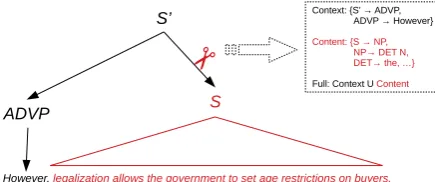
Context: {S’ → ADVP, ADVP → However} Content:{S → NP, NP→ DET N, DET→ the, …} Full: Context U ContentFigure 2: Production rule extraction from constituency parse for two different argumentative units.
Lexical features These consist of boolean val-ues indicating whether a certain word appears in the argumentative source or target EAU or both (and separately, their contexts). More pre-cisely, for any classification instance we extract uni-grams from within the span of the EAU (if T =CB) or solely from the sentence-context sur-rounding the EAUs (ifT =CI). Words which oc-cur in both bags are only visible in the full-access setupT =F Aand are modeled as binary indica-tors.
Syntactic features Such features consist of syntactic production rules extracted from con-stituency trees – they are modelled analogously to the lexical features as a bag of production rules. To make a clear division between features de-rived from the EAU embedding context and fea-tures derived from within the EAU span, we di-vide the constituency tree in two parts, as is il-lustrated in Figure 2. If the EAU is embedded in a covering sentence, we cut the syntax tree at the corresponding edge (
✂
in Figure 2). In this example, the content-ignorant (CI) bag-of-word production rule representation includes the rulesS → ADV P andADV P → however. Analo-gously to the lexical features, the production rules are modeled as binary indicator features.6
Structural These features describe shallow statistics such as the ratio of argumentative unit tokens compared to sentence tokens or the posi-tion of the argumentative unit in the paragraph. We set these features to zero for the content rep-resentation of the argumentative unit and replicate those features that allow us to treat the
argumen-6
tative unit as a black-box. For example, in the content-based (CB) system that has access only to the EAU, we can compute the #tokens in the EAU, but not the #tokens in EAU divided by #tokens in the sentence. The latter feature is only accessible in the full access system variants. Hence, in the content-based (CB) system most of these statistics are set to zero since they cannot be computed by considering only the EAU span.
Discourse For the content-based representation we retrieve only discourse relations that are con-fined within the span of the argumentative unit. In the very frequent case that discourse features cross the boundaries of embedding context and EAU span, we only take them into account forF A.
Embeddings We use the element-wise sum of 300-dimensional pre-trained GloVe vectors ( Pen-nington et al.,2014) corresponding to the words within the EAU span (CB) and the words of the EAU-surrounding context (CI). Additionally, we compute the element-wise subtraction of the source EAU vector from the target EAU vector, with the aim of modelling directions in distribu-tional space, similarly to Mikolov et al. (2013). Words with no corresponding pre-trained word vector and empty sequences (e.g., no preceding context available) are treated as a zero-vector.
Sentiment Tree-based sentiment annotations are sentiment scores assigned to nodes in con-stituency parse trees (Socher et al., 2013). We represent these scores by a one-hot vector of di-mension 5 (5 is very positive, 1 is very negative). We determine the contextual (CI) sentiment by looking at the highest possible node of the con-text which does not contain the EAU (ADVP in Figure2). The sentiment for an EAU span (CB) is assigned to the highest possible node covering the EAU span which does not contain the context sub-tree (S in Figure 2). The full-access (F A) score is assigned to the lowest possible node which cov-ers both the EAU span and its surrounding con-text (S’ in Figure2). Next to the sentiment scores for the selected tree nodes and analogously to the word embeddings, we also calculate the element-wise subtraction of the one-hot sentiment source vectors from the one-hot sentiment target vectors. This results in three additional vectors correspond-ing toCB,CI andF Adifference vectors.
#train #test
model h&f g h&f g
documents 322 322 80 80
support 3820 3820 1021 1021
attack 405 405 92 92
[image:5.595.314.520.63.156.2]∅ - 5474 - 1622
Table 1: Data set statistics.
4 Experiments
Data and pre-processing We use the corpus of 402 persuasive essays which were annotated with argumentative units, their stances towards the topic and argumentative relations (Stab and Gurevych, 2017). The data is suited for our ex-periments because the annotators were explicitly asked to provide annotations on a clausal level. This entails that contextual clues tend not to be contained in the annotated span (e.g., only peo-ple should not smoke is annotated as EAU in the sentenceTherefore, people should not smoke.). In this work, we are concerned with classifying re-lations between argumentative units intosupport
orattack and thus do not consider other annota-tions. For feature extraction, we process all doc-uments with Stanford CoreNLP (Manning et al.,
2014) with the following annotation layers: sen-tence tokenize, word tokenize, constituency parse
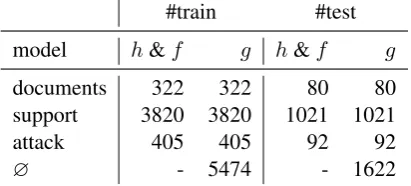
andconstituency-sentiment. For extraction of the discourse-features, we proceed by parsing all doc-uments with the PDTB-parser7 developed by Lin et al.(2014). For the joint task of predicting three link classes (including a non-linked class), we ex-tract as non-linked EAU pairs all EAU pairs which are not linked on a document level. Data set statis-tics are displayed in Table1.
Setup As explained in §3, we are interested in three distinct configurations of the argumentative relation classifier: content-based (CB), content-ignorant (CI) andfull-access (F A). Naturally, we would expect the latter to perform best and perhaps we would also expect CB to outperform CI – a system which has no access to the ar-gumentative unit internals whatsoever should not be able to confidently determine relations between them.Note that some features are only available to F A, which is the case when features cross
con-7https://github.com/WING-NUS/
system F1sup F1att macro F1
S&G16 94.7 41.3 68.0
[image:6.595.78.287.152.335.2]replicated (hF A) 94.7 44.0 69.3
Table 2: Baseline system replication results.
model T F1sup F1att F1∅ macro F1
h mfs 95.7 0 - 47.8
CB 92.9 21.7 - 57.3†
CI 95.0 38.6 - 67.0†‡
F A 94.7 44.0 - 69.3†‡
f mfs 95.7 0 - 47.8
CB 92.3 20.3 - 56.3†
CI 96.1 41.7 - 70.8†‡
F A 94.4 42.4 - 68.5†‡
g mfs 0 0 74.5 8.3
CB 54.3 9.9 65.0 43.4†
CI 63.0 34.8 76.5 59.3†‡
F A 46.6 32.3 73.1 56.1†‡
Table 3: Argumentative relation classification models
h, f, g with different access to content and context;
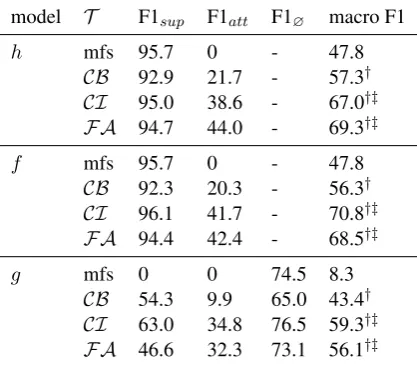
models of typeCI(content-ignorant) have no access to the EAU span.†: significantly better than mfs baseline (p < 0.005); ‡significantly better than content-based (p <0.005).
text and argumentative unit spans (e.g., some of the discourse features), thereby resisting a clear categorization intoCBorCI. Same as most prior work, we use an SVM to learn the feature weights.
4.1 Results
Replication experiments Our first step towards our main experiments is to replicate the compet-itive argumentative relation classifier ofStab and Gurevych(2017, 2014b). Hence, for comparison purposes, we first formulate the task exactly as it was done in this prior work, using the model for-mulation in Eq. 2, which determines the type of outgoing edge from a source (i.e., tree-like view).
The results in Table2confirm the results ofStab and Gurevych(2017) and suggest that we success-fully replicated a large proportion of their features.
Main results The results for all three prediction settings (one outgoing edge: h, support/attack: f
and support/attack/neither: g) across all type vari-ables (CB,CI andF A) are displayed in Table3. All models significantly outperform the majority baseline with respect to macro F1. Intriguingly,
the content-ignorant models (CI) alwaysperform significantly better than the models which only have access to the EAUs’ content (CB,p <0.005). In the most general task formulation (g), we ob-serve that CI even significantly outperforms the model which has maximum access (seeing both EAU spans and surrounding contexts:F A).
At first glance, the results of the purely EAU fo-cused systems (CB) are disappointing, since they fall far behind their competitors. On the other hand, their F1 scores are not devastatingly bad. The strong most-frequent-class baseline is signif-icantly outperformed by the content-based (CB) system, across all three prediction settings.
In summary our findings are as follows: (i) models which see the EAU span (content-based, CB) are significantly outperformed by models that have no access to the span itself (content-ignorant, CI) across all settings; (ii) in two of three predic-tion settings (f andg), the model which only has access to the context even outperforms the model that has access to all information in the input. The fact that using features derived exclusively from the EAU embedding context (CI) can lead to bet-ter results than using a full feature-system (F A) suggests that some information from the EAU can even be harmful. Why this is the case, we can-not answer exactly. A plausible cause might be re-lated to the smaller dimension of the feature space, which makes the SVM less likely to overfit. Still, this finding comes as a surprise and calls for fur-ther investigation in future work.
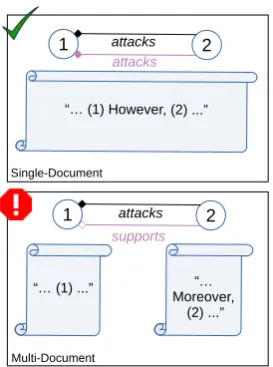
Robustness tests A system for argumentative relation classification can be applied in one of two settings: single-document or cross-document, as illustrated in Figure3: in the first case (top), a sys-tem is tasked to classify EAUs that appear linearly in one document – here contextual clues can of-ten highlight the relationship between two units. This is the setting we have been considering up to now. However, in the second scenario (bot-tom), we have moved away from the closed single-document setting and ask the system to classify two EAUs extracted from different document con-texts. This setting applies, for instance, when we are mining arguments from multiple sources.
justi-2 1
supports
attacks
“… (1) ...” “…
Moreover, (2) ...”
2 1
attacks
“… (1) However, (2) ...” attacks
[image:7.595.114.251.60.244.2]Multi-Document Single-Document
Figure 3: Single-document (top) vs. cross-document (bottom) argumentative relation classification. Black edge: gold label; purple edge: predicted label.
fied by content – and can thus easily be fooled. In the cross-document setting, discourse-based indicators – being inherently defined with respect to their internal document context – do not have a defined rhetorical function with respect to EAUs in a separate document and thus a system that has learned to rely on such markers within a single-document setting can be seriously misled. We believe that the cross-document setting should be an important goal in argumentation analysis, since it generalizes better to many debates of interest, where EAUs can be found scattered across thou-sands of documents. For example, for the topic of
legalizing marijuana, EAUs may be mined from millions of documents and thus their relations may naturally extend across document boundaries. If a system learns to over-proportionally attend to the EAUs’ surrounding contexts it is prone to making many errors.8
In what follows we are simulating the effects that an overly context-sensitive classifier could have in a cross-document setting, by modifying our experimental setting, and study the effects on the different model types: In one setup – we call itrandomized-context – we systematically distort the context of our testing instances by exchang-ing the context in a randomized manner; in the other setting – called no-context, we are delet-ing the context around the ADUs to be classified.
8
In fact, similar considerations also apply when moving from argumentative monologue to dialogue, i.e., in interac-tive debates. Again, systems need to be able to detect rela-tions between EAUs uttered by different speakers and inde-pendently from the speaker-specific utterance context.
Randomized-context simulates an open world de-bate where argumentative units may occur in dif-ferent contexts, sometimes with discourse markers indicating an opposite class. In other words, in this setting we want to examine effects when porting a context-sensitive system to a multi-document set-ting.9 For example, as seen in Figure3, the context
of an argumentative unit may change from “How-ever” to “Moreover” – which can happen naturally in open debates. The results are displayed in Fig-ure4. In the standard setting (Figure4a), the mod-els that have access to the context besides the con-tent (F A) and the models that are only allowed to access the context (CI), always perform better than the content-based models (CB) (bars above zero). However, when we randomly flip contexts of the test instances (Figure4b), or suppress them entirely (Figure4c), the opposite picture emerges: the content-based models always outperform the other models. For some classes (support, ∅) the
difference can exceed 50 F1 percentage points. These two studies, where testing examples are var-ied regarding their context (randomized-contextor
no-context) simulates what can be expected if we apply our systems for relation class assignment to EAUs stemming from heterogeneous sources. While the performances of a purely content-based model naturally stays stable, the performance of the other systems decrease notably – they perform worse than the content-based model.
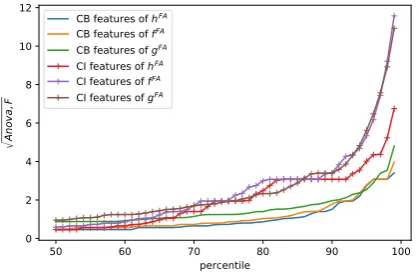
Feature investigation We calculate the ANOVA classification F scores of the features with respect to our three task formulations h, g and f. The F percentiles of features extracted from the EAU surrounding text (CI) and features extracted from the EAU span (CB), are displayed in Figure5.
It clearly stands out that features obtained from the EAU surrounding context (CI) are assigned much higher scores compared to features stem-ming from the EAU span (CB). This holds true for all three task formulations and provides further ev-idence that models – when given the option – put a strong focus on contextual clues while neglecting the information provided by the EAU span itself.
5 Discussion
While competitive systems for argumentative rela-tion classificarela-tion are considered to be robust, our
9We concede that this is an artificial setup, but defer more
sup att
macro
relation class 60
40 20 0 20
F1
vs
. c
on
te
nt
-b
as
ed
(a) Standard setting.
sup att
macro
relation class 60
40 20 0 20
(b) Randomized-context test.
sup att
macro
relation class 60
40 20 0
20 hhCIFA
fCI
fFA
gCI
gFA
[image:8.595.75.527.64.180.2](c) No-context test.
Figure 4: Randomized-contexttest set: models are applied to testing instances with randomly flipped contexts. No-context test set: models can only access the EAU span of a testing instance. A bar below/above zero means that a system that can access context (content-ignorantCI or full-accessF A) is worse/better than the content-based baselineCBthat only has access to the EAU span (its performance is not affected by modified context, cf. Tab.3).
50 60 70 80 90 100 percentile
0 2 4 6 8 10 12
An
ov
a,
F
CB features of hFA
CB features of fFA
CB features of gFA
CI features of hFA
CI features of fFA
CI features of gFA
Figure 5: ANOVA F score percentiles for content-based vs. content-ignorant features in the training data. A higher feature score suggests greater predictive ca-pacity.
experiments have shown that despite confidence-inspiring scores on unseen testing data, such sys-tems can easily be fooled – they can deliver strong performance scores although the classifier does not have access to the content of the EAUs. In this respect, we have provided evidence that there is a danger in case models focus too much on rhetor-ical indicators, in detriment of the context. Thus, the following question arises: How can we pre-vent argumentation models from modeling argu-ments or argumentative units and their relations in overly na¨ıve ways? A simple and intuitive way is to dissect EAUs from their surrounding document context. Models trained on data that is restricted to the EAUs’ content will be forced to focus on the content of EAUs. We believe that this will enhance the robustness of such models and allows them to generalize to cross-document argument relation classification. The corpus of student essays makes such transformations straightforward: only the
EAUs were annotated (e.g., “However, [argA]”).
If annotations extend over the EAUs (e.g., only full sentences are annotated, “[argHowever, A]”),
such transformations could be performed automat-ically after a discourse parsing step. When in-specting the student essays corpus, we further ob-served that an EAU mining step should involve coreference resolution to better capture relations between EAUs that involve anaphors (e.g., “Ex-ercising makes you feel better”and“It[Exercising] increases endorphine levels”).
Thus, in order to conduct real-world end-to-end argumentation relation mining for a given topic, we envision a system that addresses three steps: (i) mining of EAUs and (ii) replacement of pronouns in EAUs with referenced entities (e.g.,
It is healthy →Excercise is healthy). Finally (iii), given the cross product of mined EAUs we can apply a model of type g to construct a full-fledged argumentation graph, possibly spanning multiple documents.10 We have shown that in or-der to properly perform step (iii), we need stronger models that are able to better model EAU contents. Hence, we encourage the argumentation commu-nity to test their systems on a decontextualized version of the student essays, including the pro-posed – and possibly further extended – testing se-tups, to challenge the semantic representation and reasoning capacities of argument analysis models. This will lead to more realistic performance esti-mates and increased robustness of systems when addressing desirable multi-document tasks.
10cf.Peldszus and Stede(2015) for graph prediction within
[image:8.595.77.287.265.403.2]6 Conclusion
We have shown that systems which put too much focus on discourse information may be easily fooled – an issue which has severe implications when systems are applied to cross-document argu-mentative relation classification tasks. The strong reliance on contextual clues is also problematic in single-document contexts, where systems can run a risk of assigning relation labels relying on contextual and rhetorical effects – instead of fo-cusing on content. Hence, we propose that re-searchers test their argumentative relation clas-sification systems on two alternative versions of the StudentEssay data that reflect different access levels. (i) EAU-span only, where systems only see the EAU spans and (ii) context-only, where systems can only see the EAU-surrounding con-text. These complementary settings will (i) chal-lenge the semantic capacities of a system, and (ii) unveil the extent to which a system is focusing on the discourse context when making decisions. We will offer our testing environments to the re-search community through a platform that pro-vides datasets and scripts and a table to trace the results of content-based systems.11
Acknowledgments
This work has been supported by the German Re-search Foundation as part of the ReRe-search Training Group Adaptive Preparation of Information from Heterogeneous Sources (AIPHES) under grant no. GRK 1994/1 and by the Leibniz ScienceCampus “Empirical Linguistics and Computational Lan-guage Modeling”, supported by the Leibniz Asso-ciation under grant no. SAS-2015-IDS-LWC and by the Ministry of Science, Research, and Art of Baden-W¨urttemberg.
References
Ahmet Aker, Alfred Sliwa, Yuan Ma, Ruishen Lui, Niravkumar Borad, Seyedeh Ziyaei, and Mina Ghobadi. 2017. What works and what does not:
Classifier and feature analysis for argument mining.
In Proceedings of the 4th Workshop on Argument Mining, pages 91–96, Copenhagen, Denmark.
M. Azar. 1999. Argumentative text as rhetorical
struc-ture: An application of rhetorical structure theory.
Argumentation, 13(1):97–114.
11http://explain.cl.uni-heidelberg.de/
Oana Cocarascu and Francesca Toni. 2017. Identify-ing attack and support argumentative relations us-ing deep learnus-ing. InProceedings of the 2017 Con-ference on Empirical Methods in Natural Language Processing, pages 1374–1379.
Nancy Green, Kevin Ashley, Diane Litman, Chris Reed, and Vern Walker, editors. 2014. Proceedings of the First Workshop on Argumentation Mining. Association for Computational Linguistics, Balti-more, Maryland.
Nancy L Green. 2010. Representation of argumenta-tion in text with rhetorical structure theory. Argu-mentation, 24(2):181–196.
Yufang Hou and Charles Jochim. 2017. Argument re-lation classification using a joint inference model. In Proceedings of the 4th Workshop on Argument Min-ing, pages 60–66.
Tatsuki Kuribayashi, Paul Reisert, Naoya Inoue, and Kentaro Inui. 2018. Towards exploiting argumenta-tive context for argumentaargumenta-tive relation identification. InProceedings of the Annual Meeting of the Associ-ation for Natural Language Processing NLP, pages 284–287.
Ran Levy, Yonatan Bilu, Daniel Hershcovich, Ehud Aharoni, and Noam Slonim. 2014. Context
depen-dent claim detection. InProceedings of COLING
2014, the 25th International Conference on Compu-tational Linguistics: Technical Papers, pages 1489– 1500, Dublin, Ireland. Dublin City University and Association for Computational Linguistics.
Ziheng Lin, Hwee Tou Ng, and Min-Yen Kan. 2014. A pdtb-styled end-to-end discourse parser. Natural Language Engineering, 20(2):151–184.
Marco Lippi and Paolo Torroni. 2016. Argumenta-tion mining: State of the art and emerging trends. ACM Transactions on Internet Technology (TOIT), 16(2):10.
William C Mann and Sandra A Thompson. 1987. Rhetorical structure theory: Description and con-struction of text structures. In Natural language generation, pages 85–95. Springer.
Christopher Manning, Mihai Surdeanu, John Bauer, Jenny Finkel, Steven Bethard, and David McClosky. 2014. The Stanford CoreNLP natural language
pro-cessing toolkit. In Proceedings of 52nd Annual
Meeting of the Association for Computational Lin-guistics: System Demonstrations, pages 55–60, Bal-timore, Maryland.
Tomas Mikolov, Ilya Sutskever, Kai Chen, Greg S Cor-rado, and Jeff Dean. 2013. Distributed representa-tions of words and phrases and their compositional-ity. InAdvances in neural information processing systems, pages 3111–3119.
Huy Nguyen. 2018. Context-aware Argument Min-ing and Its Applications in Education. Ph.D. thesis, University of Pittsburgh.
Huy Nguyen and Diane Litman. 2016. Context-aware argumentative relation mining. In Proceedings of the 54th Annual Meeting of the Association for Com-putational Linguistics (Volume 1: Long Papers), volume 1, pages 1127–1137.
Andreas Peldszus and Manfred Stede. 2013. From ar-gument diagrams to arar-gumentation mining in texts: A survey. International Journal of Cognitive Infor-matics and Natural Intelligence (IJCINI), 7(1):1–31.
Andreas Peldszus and Manfred Stede. 2015. Joint pre-diction in mst-style discourse parsing for argumen-tation mining. InProceedings of the 2015 Confer-ence on Empirical Methods in Natural Language Processing, pages 938–948.
Andreas Peldszus and Manfred Stede. 2016. An anno-tated corpus of argumentative microtexts. In D. Mo-hammed and M. Lewinski, editors, Argumentation and Reasoned Action - Proc. of the 1st European Conference on Argumentation, Lisbon, 2015. Col-lege Publications, London.
Jeffrey Pennington, Richard Socher, and Christopher Manning. 2014. Glove: Global vectors for word representation. InProceedings of the 2014 confer-ence on Empirical Methods in Natural Language Processing (EMNLP), pages 1532–1543.
Isaac Persing and Vincent Ng. 2016. End-to-end
ar-gumentation mining in student essays. In
Proceed-ings of the 2016 Conference of the North Ameri-can Chapter of the Association for Computational Linguistics: Human Language Technologies, pages 1384–1394, San Diego, California. Association for Computational Linguistics.
Mohammad Sadegh Rasooli and Joel R. Tetreault. 2015. Yara parser: A fast and accurate
depen-dency parser. Computing Research Repository,
arXiv:1503.06733. Version 2.
Matthew Richardson and Pedro Domingos. 2006. Markov logic networks. Machine learning, 62(1-2):107–136.
Richard Socher, Alex Perelygin, Jean Wu, Jason Chuang, Christopher D. Manning, Andrew Ng, and Christopher Potts. 2013. Recursive deep models for semantic compositionality over a sentiment tree-bank. In Proceedings of the 2013 Conference on Empirical Methods in Natural Language Process-ing, pages 1631–1642, Seattle, Washington, USA.
Christian Stab and Iryna Gurevych. 2014a.Annotating argument components and relations in persuasive es-says. InProceedings of COLING 2014, the 25th In-ternational Conference on Computational Linguis-tics: Technical Papers, pages 1501–1510, Dublin, Ireland. Dublin City University and Association for Computational Linguistics.
Christian Stab and Iryna Gurevych. 2014b. Identify-ing argumentative discourse structures in persuasive essays. InProceedings of the 2014 Conference on Empirical Methods in Natural Language Processing (EMNLP), pages 46–56.
Christian Stab and Iryna Gurevych. 2017. Parsing
ar-gumentation structures in persuasive essays.
Com-putational Linguistics, 43(3):619–659.
Christian Stab, Tristan Miller, Benjamin Schiller, Pranav Rai, and Iryna Gurevych. 2018. Cross-topic argument mining from heterogeneous sources. In Proceedings of the 2018 Conference on Empirical Methods in Natural Language Processing, pages 3664–3674.