doi:10.4236/ojst.2011.14023 Published Online December 2011 (http://www.SciRP.org/journal/ojst/).
Comparison of the arch forms and dimensions in various
malocclusions of the Turkish population
Sultan Olmez, Servet Dogan
Ege University, Izmir, Turkey. Email: [email protected]
Received 17 July 2011; revised 27 August 2011; accepted 9 September 2011.
ABSTRACT
Objectives: The aim of this study is to determine the distribution of morphological differences in the cli- nical mandibular arch forms seen in Angle Class I, II and III malocclusions in Turkish population and to examine the effect of gender on arch dimension pa- rameters. Material and methods: This study has been conducted on pretreatment mandibular study models of 600 individuals (362 girls, 238 boys) aged between 14 and 19. On the photocopies derived from these models, 4 linear and 2 proportional measurements have been made. The samples have been evaluated as square, ovoid and tapered (OrthoForm-3M Unitek) arch form templates. Results: The most frequent arch form encountered among all the groups was the ta- pered one (62.5%) followed by the ovoid (27.3%) and the square one (10.2%). Gender difference influences on morphological structure was apparent. Generally, compared with girls, arch width and depth were found to be more in boys. Conclusions: The most fre- quent arch form seen in Angle malocclusion groups was the tapered one, followed by the less frequent ovoid and square ones.
Keywords: Arch Form; Arch Dimension; Sex Differ-ences
1. INTRODUCTION
While a parameter curve displays a perfect conformity with the arches, in 40% - 50% of the patients this accor- dance shows a decrease [1]. It can be accepted that in at least half of the patients the preformed arch wires don’t seem to be functional [2]. Because of these reasons, the routinely used superelastic preformed arch wires have to be in various forms with individual malocclusion adap- tations.
Most of the studies conducted on arch form are fo- cused on finding a single shape in perfect conformity for
the dental arch of a specific sample [3]. Despite individ- ual differences, when the ethnical variations are taken into consideration; the application of a single ideal arch form for every individual could effect the post treatment functional, esthetic and stable arch form outcomes [4].
In 1932 Chuck [5] classified the arch forms as tapered, ovoid and square for the first time. These arch forms can also be expressed as narrow, normal and wide. Especial- ly in determining the arch wire forms utilized at the ini- tial phase of the treatment, he advocates that making a choice between these three forms would be better than using a single arch form [5]. For this reason, in leveling and arrangement phases, the most convenient arch form type according to the ethnical origin and malocclusion of the patients should be chosen from the preformed su- perelastic arch wires [4,6].
There are some studies aimed at determining the arch forms specific to various ethnical groups [4,6-8]. In a study where Kook, Y. A. et al. [4] determined the ethni-cal differences between Korean and North Caucasian groups, arch forms passing through clinical brackets which is appraised as a valuable approach in modern orthodontic technics were used.
Although there have been studies one on the evalua- tion of arch forms in various groups, no such research has been performed on the Turkish population; this fact has urged us to carry out this study. The aim of this study is to determine the differences of clinical mandibular arch forms in Angle Class I, II, and III malocclusions in the Turkish population by identifying its morphological variations and to evaluate gender differences with re- spect to arch dimension parameters.
2. MATERIAL AND METHODS
This study consisted of 600 subjects’ (362 female, 238 male) pretreatment mandibular dental casts between the ages of 14 and 19 years, among whom 200 were Angle Cl- ass I, 200 were Class II and 200 were Class III (Table 1).
Table 1. Distribution of sex, age and arch forms accordig to the Angle classifications.
Samples Number Boys Girls Mean
Age (years)
Standard Deviation
Tapered Arch Form Class I Class II Class III
135 130 110
49 52 42
86 78 68
15.63 15.36 16.17
1.72 1.67 1.79 Ovoid Arch Form
Class I Class II Class III
50 57 57
14 28 21
36 29 36
15.16 15.56 16.35
1.72 1.69 1.77 Square Arch Form
Class I Class II Class III
15 13 33
8 3 21
7 10 12
15.47 16.08 15.61
1.36 1.60 1.64
Total 600 238 362 15.63 1.71
1) Angle Class I, II, and III malocclusions.
2) Permanent dentition without atrision or fractures in the incisal edges or cusp tips in permanent den-tition.
3) No restorations extending to the approximal faces, cusp tips or incisal edges.
4) Arch discrepancies (crowding or diastemas) less than 3 mm.
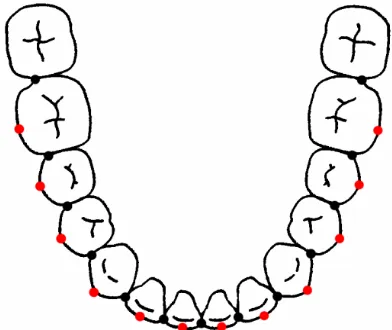
The photocopies (Rex-Rotary DSm635 AficioTM, 2005, Japan) of the occlusal surfaces of the mandibular models and the arrangement of the datas according to the XY coordinate was done as Nojima, K. et al. [6] suggested. On the photocopied images the most facial portions of 13 proximal contact areas were marked to determine the clinical bracket points (Figure 1).
[image:2.595.362.488.284.453.2] [image:2.595.315.536.490.671.2]Figure 1. Black dots; points digitized on occlusal photocopy which represent the most facial portions of 13 proximal contact areas, red dots; clinical bracket points that place in the middle of the proximal points of each teeth.
Figure 2 shows the arch shape differences between the three arch forms; tapered, ovoid and square (Ortho- form, 3M Unitek, Calif) when superimposed as describ- ed by R. P. McLaughlin, J. C. Bennett and H. J. Trevisi [9]. One of the 3 arch forms that best fits with the sam-ple’s arch that consists 8 teeth’s clinical bracket points between 1st premolars were selected.
The following 4 linear and 2 proportional measure-ments of arch dimensions were taken (Figure 3):
Inter-canine width: the distance between the ca-nine clinical bracket points.
Inter-molar width: the distance between the first molar clinical bracket points.
[image:2.595.72.268.496.661.2] Canine depth: the shortest distance from a line connecting the canine clinical bracket points to the origin between the central incisors.
Figure 2. The superimposition of mandibular arch forms.
Table 2. The Dahlberg’s Error of the Method, lower and upper limit values.
Molar depth: the shortest distance from a line connecting the first molar clinical bracket points to the origin between the central incisors.
Measurements Error of the Standard Method (Sm)
Lower Limit
Upper Limit
3-3 width 0.12 0.09 0.17
6-6 width 0.12 0.98 0.76
3-3 depth 0.16 0.12 0.23
6-6 depth 0.14 0.11 0.20
3-3 W/D 0.17 0.13 0.24
6-6 W/D 0.01 0.01 0.02
Canine W/D ratio: the ratio of the inter-canine width and the canine depth.
Molar W/D ratio: the ratio of the inter-molar width and the molar depth.
3. STATISTICAL ANALYSIS
The dental data from Angle classification and arch form groups were statistically assessed by using SPSS 15.00 and MedCalc v.11.2 statistical software programs in Ege University, Faculty of Medicine, Department of Biosta-tistics and Medical Informatics. All analyses were tested at the significance level of 0.05. Dahlberg’s [10] error of method formula was used to calculate the error of meas-ured data. According to this method, 50 mandibular den- tal cast photocopies were randomly selected and all mea- surements were repeated on these models. The differ- ences between the two measurements were determined and used in the following formula to find out the stan- dard error of the method with lower and upper borders (Table 2).
4. RESULTS
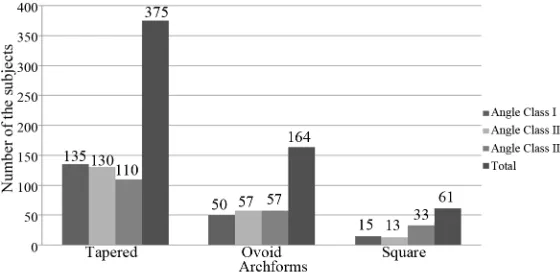
Mandibular arch forms of 600 patients were evaluated according to the Angle classification. In Angle Class I samples, the tapered arch form showed the highest fre-quency as 67.5% whereas ovoid and square arch forms were less frequent (Figure 4). The arch form distribution in Angle Class II malocclusion samples were 65% ta-pered, 28.5% ovoid, and 6.5% square arch forms. In An-gle Class III samples, the tapered arch form showed the highest frequency as 55%, following ovoid (28.5%) and square (16.5%) arch forms. The arch form distribution between Angle Class I and II was statistically insignifi-cant (p = 0.71). The difference within three classification was due to Angle Class III malocclusion.
2 d
2
Sm nx
(Error of the Standard Method)According to the formula, the error of the method is closer to 0 (zero) means the measurement accuracy, as it gets closer to 1 (one) the incidence of the method error rises. Our findings were between 0.01 and 0.17 which indicates accuracy of the method.
Even though the arch form distribution in Angle Class III group was similar to the other two groups, the square arch form showed higher frequency among the groups. This result was statistically significant. After evaluation of the best fitted arch form for each dental cast, a second evaluation was done by the same author (SO) to define the intra-rater agreement and the Kappa value was 0.83 indicating “very good” agreement.
As the arch form classification shows up ordered data, Weighted Kappa statistics were used to evaluate the in- tra-rater agreement. The effect of sex on arch form dis- tribution were evaluated by using chi-square test. Arch dimension measurements in Angle classes and arch form classes were evaluated by using Oneway-ANOVA and Bonferroni Tests which is one of the Post Hoc tests. The effect of sex on arch dimension measurements were eva- luated by using independent samples tests.
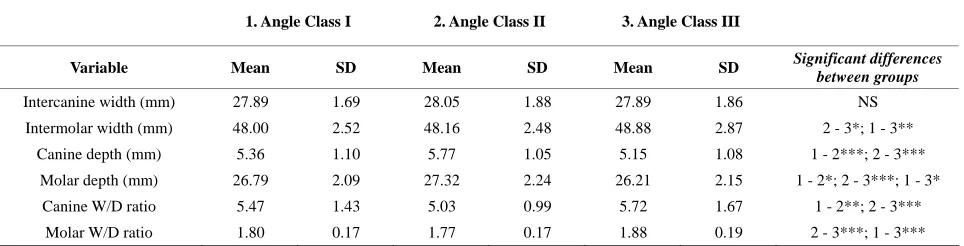
Evaluation of arch dimensions for Angle classifica-tions are shown in Table 3 with no difference in terms of inter-canine width (p = 0.59). Molar width in Class III was higher than Class I and II (p < 0.001 and p < 0.05,
[image:3.595.156.436.558.694.2]respectively). Canine depth showed the least value in Class III assigning flatter anterior portion of the arch where as there was no statistically significant difference between Class I and III regarding canine depth. Molar depth measurements from highest to least were Class II, I and III which was also statistically significant. The canine and molar W/D ratios were increased in Class III as an expected outcome.
Table 4 shows the arch dimension measurements of the regrouped dental cast photocopies according to the square, ovoid and tapered arch forms. Mandibular arch forms showed increasing inter-canine width, inter-molar width, canine W/D ratio, and molar W/D ratio and de-creasing canine depth, and molar depth as the mandibu-lar arches changed in form from tapered to ovoid and ovoid to square.
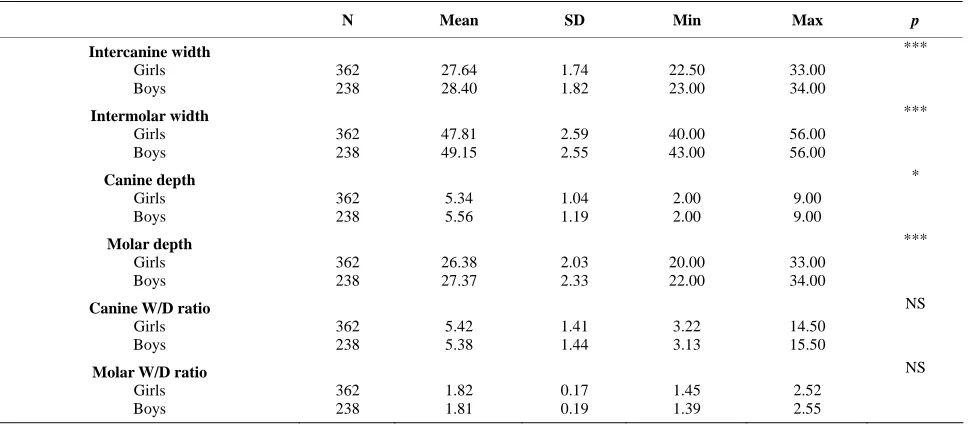
The effect of sex on arch form distribution was evalu-ated by using chi-square test. Although there was no differences between the groups, square arch form was more frequent in boys. The effect of sex on arch dimen- sion measurements were evaluated by using independent samples tests. Measurements concerning these p values are presented in Table 5. Inter-canine width and inter- molar width measurements were higher in boys than in girls (0.76 mm and 1.34 mm, respectively). Similar rela- tionship occurred in arch depth measurements with ca-
nine depth being 0.22 mm (p < 0.05) and molar depth being 0.99 mm (p < 0.001) more in boys. The canine and molar W/D ratios were not effected by sex. Both values were less in boys which was not statistically significant.
5. DISCUSSION
In the present study the age distribution was limited with 14 - 19 in order to eliminate the variations in arch di-mensions related with age. After examining the differ-ences in arch width in relationship with age, Bishara et al. [11] stated that although they had observed a reduc-tion in canine width between 13 - 26 and 26 - 45 in men and women, only the reduction detected in women be-tween 26 - 45 was statistically important. Even though there is an increase in mandibular canine width until 13 years; this increase is found to be statistically important in boys until 8 and in girls until 13 years of age. After 13 years of age, the canine width shows a reduction in 25 and 45 years. In Bishara’s study the inter-molar width didn’t show a significant change between 13 - 26 and 26 - 45 years.
In most of the conventional studies, the tubercule tips and incisal edges are taken as landmarks in determining the arch form. In our study, the clinical bracket points which correspond to bracket slots were used as land- marks for the identification of the mandibular arch forms.
Table 3. Comparison of arch parameters by Angle classifications.
1. Angle Class I 2. Angle Class II 3. Angle Class III
Variable Mean SD Mean SD Mean SD Significant differences
between groups
Intercanine width (mm) 27.89 1.69 28.05 1.88 27.89 1.86 NS
Intermolar width (mm) 48.00 2.52 48.16 2.48 48.88 2.87 2 - 3*; 1 - 3**
Canine depth (mm) 5.36 1.10 5.77 1.05 5.15 1.08 1 - 2***; 2 - 3***
Molar depth (mm) 26.79 2.09 27.32 2.24 26.21 2.15 1 - 2*; 2 - 3***; 1 - 3*
Canine W/D ratio 5.47 1.43 5.03 0.99 5.72 1.67 1 - 2**; 2 - 3***
Molar W/D ratio 1.80 0.17 1.77 0.17 1.88 0.19 2 - 3***; 1 - 3***
[image:4.595.57.539.586.706.2]NS, Not Significant (p > 0.05); *p < 0.05; **0.01 < p < 0.05; ***p < 0.001.
Table 4. Comparison of arch parameters by Arch forms.
1. Tapered Arch Form 2. Ovoid Arch Form 3. Square Arch Form
Variable Mean SD Mean SD Mean SD Significant differences between groups
Intercanine width (mm) 27.52 1.68 28.58 1.87 28.84 1.71 1 - 2***; 1 - 3***
Intermolar width (mm) 47.26 2.30 49.67 2.04 51.47 1.96 1 - 2***;2 - 3***;1 - 3***
Canine depth (mm) 5.72 1.07 5.12 0.95 4.42 0.91 1 - 2***;2 - 3***;1 - 3***
Molar depth (mm) 27.17 2.13 26.48 2.03 25.11 2.20 1 - 2**;2 - 3***;1 - 3***
Canine W/D ratio 4.99 1.18 5.80 1.34 6.84 1.76 1 - 2***;2 - 3***;1 - 3***
Molar W/D ratio 1.75 0.14 1.89 0.14 2.07 0.19 1 - 2***;2 - 3***;1 - 3***
Table 5. Arch parameters in boys and girls.
N Mean SD Min Max p
Intercanine width Girls Boys 362 238 27.64 28.40 1.74 1.82 22.50 23.00 33.00 34.00 *** Intermolar width Girls Boys 362 238 47.81 49.15 2.59 2.55 40.00 43.00 56.00 56.00 *** Canine depth Girls Boys 362 238 5.34 5.56 1.04 1.19 2.00 2.00 9.00 9.00 * Molar depth Girls Boys 362 238 26.38 27.37 2.03 2.33 20.00 22.00 33.00 34.00 ***
Canine W/D ratio Girls Boys 362 238 5.42 5.38 1.41 1.44 3.22 3.13 14.50 15.50 NS
Molar W/D ratio Girls Boys 362 238 1.82 1.81 0.17 0.19 1.45 1.39 2.52 2.55 NS
NS, Not Significant (p > 0.05); *,p < 0.05; ***, p < 0.001.
The aim in specification of the “bracket” arch form was to evaluate the final arch form which will be obtained by the use of fix orthodontic appliances in patients who have referred to our clinic due to orthodontic disorders. In recent studies this arch form which is thought to be more realistic is preferred in determining the individual arch form [4,6-9].
Arch form templates used in the evaluation of photo-copies of mandibular models are the 3 type of (narrow, normal and wide) arch forms specified by Bennett, Mc- Laughlin and Trevisi [9] and used by Chuck [5] for the first time in 1932. The transversal difference produced between the three arch forms by superimposition is spe- cified as 6 mm [9].
According to our study, there was no significant dif- ference with respect to arch form variance between Class I and Class II arches. Tapered arch form was seen in high frequency in both groups whereas the sequence of ovoid arch form was less. Similar results have been ob- tained in studies performed by Felton et al. [12].
In studies aiming at determination and difference of arch forms between races [4,6-8], square arch form is the most frequent one in Class III malocclusion individuals. However, in our study when Class I and II are compared, although the frequency of square arch form was more in Class III arches, the sequence of tapered arch form was higher.
Upon examination of the arch dimension differences between Angle classes, while our study didn’t reveal a statistically significant difference between classes in terms of canine width; molar width in Class III arches were found to be 0.88 mm more with respect to Class I
and 0.72 mm more with respect to Class II. The molar width increase in Class III arches can be explained by lingual tipping of the anterior teeth in Class III devel-opment and flattening of the anterior area besides the lateral growth of the tongue due to the decrease of the molar depth [4,13]. The findings regarding a difference of 1 mm on average were statistically significant and also assumed to be clinically significant since arch form tends to return toward the original or even narrower pre- treatment form after retention period. Therefore minimal treatment changes would be in great significance to pre-vent post treatment relapse tendency [3]. In the report published by Braun et al. [13] on arch dimension differ-ences between Angle classifications, it is also similarly stated that; starting from the premolar area mandibular arches with Class III malocclusion are averagely 2.1 mm wider with respect to Class I mandibular arches. Basaran et al. [14] compared the dental arch widths in Class I, Class II div 1 and Class III groups and found no differ- ence with regard to mandibular canine width in the three groups; which was similar with our results. When man- dibular molar width was considered, while no difference could be detected between Class I and Class III, upon comparison of these groups with Class II div 1; statistic- cally significant differences were observed.
Class II mandibular arches generally show decreased arch width and depth. At the same time, it was shown that the Class III mandibular arches have averagely 3.3 mm less depth with regard to Class I. In their compari-son of Caucasian and Japanese mandibular arch forms Nojima et al. [6] found that the Class I arches are deeper for both of the ethnical groups with regard to Class II arches and this is not consistent with our results. In the same study it was concluded that Class III arches are the shallowest and widest of all.
Apart from this, it was shown that the Class II arches possess the least canine W/D ratio followed by Class I and Class III. Class III arches have the highest molar W/D ratio followed by Class I and Class II arches. In the study of Kook et al. [4] both the canine and the molar W/D ratio is the least in Class II arches followed by Class I and Class III. Similar results have been found in studies reported by Nojima et al. [6]and Gafni et al. [8]. By examining the arch dimensions with regard to gender, it was found that the arch dimension is remarka- bly higher in boys than girls in the permanent dentition. These findings are in accordance with Bishara [13]. In a study where especially arch width, depth and chord measurements were evaluated, Cassidy et al. [16] found that these values are 3% - 5% higher in boys. In Carter and McNamara’s study [17] it was stated that the arch depth decreases in canine, first and second premolar and first molar teeth area in both genders. In Ward et al.’s [18] study the results showed no differences in boys and girls.
In most of the studies, although the values are less in girls, there is a relationship with the gender and arch dimension of the samples. In the study done by Raberin et al. [19] there were significant differences related with gender only in the transversal dimensions. In present study even though there are significant differences with respect to gender and canine/molar width, both of the measurements are found to be higher in boys. Although boys possess a wider arch form than girls, there is an overall agreement that there is no gender variance with respect to arch form [20,21]. As it can be derived from our results, no statistically significant variances were found between gender and arch form.
6. CONCLUSIONS
Due to the lack of studies aimed at dental arch form variances in Turkey, in our study:
1) It was determined that the most frequently seen arch form in the Angle malocclusion groups was the tapered, the least frequent one was the ovoid and the square one, respectively.
2) Arch widths and depths were found to be more in boys when compared with girls.
3) No significant differences were found between gender and arch form variances.
4) In the evaluation of arch dimension measure-ments with regard to Angle malocclusion groups, An-gle Class III had the highest values in molar width and the least values in canine and molar depth meas-urements.
With this study, it is foreseen that the arch form should be determined in relation with each patients’ pre-treatment mandibular dental model and especially in relation with each patients’ ethnic group in order to achieve an esthetic, functional and stable arch form out-come.
REFERENCES
[1] White, L.W. (1978) Individualized ideal arches. Journal of Clinical Orthodontics, 12, 779-787.
[2] Engel, G.A. (1979) Preformed arch wires: Reliability of fit. American Journal of Orthodontics, 76, 497-504. doi:10.1016/0002-9416(79)90254-9
[3] De La Cruz, A.R., Sampson, P., Little, R.M., Årtun, J. and Shapiro, P.A. (1995) Long-term change in arch form after orthodontic treatment and retention. American Jour- nal of Orthodontics and Dentofacial Orthopedics, 107, 518-530. doi:10.1016/S0889-5406(95)70119-2
[4] Kook, Y.A., Nojima, K., Moon, H.B., McLaughlin, R.P. and Sinclair, P.M. (2004) Comparison of arch forms be-tween Korean and North American white populations.
American Journal of Orthodontics and Dentofacial Or-thopedics, 126, 680-686.
doi:10.1016/j.ajodo.2003.10.038
[5] Chuck, G.C. (1932) Ideal arch form. Angle Orthodontist, 4, 312-327.
[6] Nojima, K., McLaughlin, R.P., Isshiki, Y. and Sinclair, P.M. (2001) A comparative study of Caucasion and Japa-nese mandibular clinical arch forms. Angle Orthodontist, 71, 195-200.
[7] Bayome, M., Sameshima, G.T., Nojima, K., Baek, S.H. and Kook, Y.A. (2011) Comparison of arch forms be-tween Egyptian and North American white populations.
American Journal of Orthodontics and Dentofacial Or-thopedics, 139, e245-e252.
doi:10.1016/j.ajodo.2009.11.012
[8] Gafni, Y., Tzur-Gadassi, L., Nojima, K., McLaughlin, R.P., Abed, Y. and Redlich, M. (2011) Comparison of arch forms between Israeli and North American white populations. American Journal of Orthodontics and Dentofacial Orthopedics, 139, 339-344.
doi:10.1016/j.ajodo.2009.03.047
[9] McLaughlin, R.P., Bennett, J.C. and Trevisi, H.J. (2001) Systemized orthodontic treatment mechanics. Mosby, Edinburgh.
[10] Dahlberg, G. (1949) Statitistic methods for medical and biological students. Interscience Publication, New York. [11] Bishara, S.E., Jakobsen, J.R., Treder, J. and Nowak, A.
doi:10.1016/S0889-5406(97)80022-4
[12] Felton, J.M., Sinclair, P.M., Jones, D.L. and Alexander, R.G. (1987) A computerized analysis of the shape and stability of mandibular arch form. American Journal of Orthodontics and Dentofacial Orthopedics, 92, 478-483. doi:10.1016/0889-5406(87)90229-0
[13] Braun, S., Hnat, W.P., Leschinsky, R. and Legan, H.L. (1999) An evaluation of the shape of some popular nickel titanium alloy preformed arch wires. American Journal of Orthodontics and Dentofacial Orthopedics, 11, 6-12. [14] Basaran, G., Hamamci, N. and Hamamci, O. (2008)
Com-parison of dental arch widths in different types of maloc-clusions. Journal of Orthodontics, 9, 20-28.
[15] Braun, S., Hnat, W.P., Fender, D.E. and Legan, H.L. (1998) The form of the human dental arch. Angle Ortho-dontist, 68, 29-36.
[16] Cassidy, K.M., Harris, E.F., Tolley, E.A. and Keim, R.G. (1998) Genetic influence on dental arch form in ortho-dontic patients. Angle Orthodontist, 68, 445-454.
[17] Carter, G.A. and McNamara, J.A. (1998) Longitudinal dental arch changes in adults. American Journal of Or-thodontics and Dentofacial Orthopedics, 114, 88-99. doi:10.1016/S0889-5406(98)70243-4
[18] Ward, D.E., Workman, J., Brown, R. and Richmond, S. (2006) A 20-year longitudinal study of orthodontic treat-ment. Angle Orthodontist, 76, 6-13.
[19] Raberin, M., Laumon, B., Martin, J. and Brunner, F. (1993) Dimensions and form of dental arches in subjects with normal occlusions. American Journal of Orthodon-tics and Dentofacial Orthopedics, 104, 67-72.
doi:10.1016/0889-5406(93)70029-N
[20] Collins, B.P. and Harris, E.F. (1998) Arch form in Ameri-can blacks and whites with malocclusions. Journal of the Tennessee Dental Association, 78, 15-18.