Dysfunction of the peripheral and central auditory
pathway in patients with type 1 diabetes mellitus
Luciene C. Fernandes1,2,3*, Luciana Casais-Silva1,2,3, Ana Marice Ladeia1
1Bahiana School of Medicine and Public Health, Bahia, Brazil; *Corresponding Author: [email protected]
2Health Sciences Institute, Federal University of Bahía, Bahia, Brazil
3Department of Science of Life, State University of Bahia, Bahia, Brazil
Received 8 October 2011; revised 9 November 2011; accepted 28 November 2011
ABSTRACT
Although auditory alterations are not a typical symptom of diabetes mellitus (DM), they can occur in patients with type 1 DM. The findings of previous studies are controversial, because the frequency and degree of hearing loss varies, and quite often alterations are still subclinical. The typical test used to detect and manage hearing loss is the audiogram, but this test alone is only capable of detecting alterations due to injury of the inner hair cells and/or al-terations in the central auditory pathway. How-ever, auditory alterations resulting from a dys-function that is still subclinical are only able to be detected through electrophysiological audi-tory tests, such as the otoacoustic emissions (OAE) and the auditory brainstem response (ABR) tests. Thus, the purpose of this paper is to review the studies that utilize the OAE and ABR tests, and to verify if the dysfunction is cochlear and/or neural in patients with type 1 DM. The findings of this review demonstrate that patients with type 1 DM can have auditory alterations stemming from a central cochlear origin. Fol-lowing this finding, early diagnosis is very im-portant in order to implement preventative treat- ments and initiate therapy.
Keywords: Diabetes Mellitus; Brainstem Auditory Evoked Potentials; Otoacoustic Emission
1. INTRODUCTION
The American Diabetes Association (2010) [1] defines diabetes mellitus (DM) as a group of metabolic diseases characterized by hyperglycemia, which is a result of al-terations in the secretion and/or action of insulin. DM can be divided into four categories: The first—type 1— involves an absolute deficiency in the secretion of insulin.
The second—type 2—involves a combination of resis-tance to the action of insulin The third main type—type 3 —is often referred to as gestational diabetes, when glu-cose intolerance is detected for the first time during pregnancy. The fourth group entails the remaining varie-ties as outlined by the etiology.
Despite the regular use of insulin, patients with type 1 DM frequently present instances of hyperglycemia as well as hypoglycemia, which can cause a number of complications. These include: retinopathy—alterations in the retina characterized by vascular complications; neu-ropathy—gradual degeneration of nerve fibers of the axons; microalbuminuria—presence of the protein albu-men in urine [2]; and further complications may include myocardium infarction and cerebral vascular accidents [3].
Although auditory alterations are not a typical symp-tom, they can occur in patients with type 1 DM. These alterations are normally related to structures of the inner ear (cochlea), including Corti’s organ and structures of the central auditory pathway, from the nerve until the auditory cortex. In Corti’s organ, there are outer and in-ner hair cells. The outer hair cells are responsible for amplification and the inner hair cells are responsible for mechanical-electrical transduction of sound. This me-chanical-electrical transduction is the transmission of sound that initially occurs within a mechanical system, until contacting the inner hairs cells, when it is changed into electric potential that will lead the auditory informa-tion through the central nervous system. Alterainforma-tions in these inner structures are called sensorineural, and the examination best known for identifying possible hearing loss is the audiogram [4].
Studies of type 1 DM utilizing the audiogram are con-troversial because the frequency of hearing loss pre-sented in the findings of these studies varies from 0 until 80% [5,6]. However, many authors have observed that there is a greater prevalence of sensorineural hearing loss in the population with type 1 DM in comparison to the group without the disease [7,8].
In accordance with literature, the type of hearing loss typically found in DM is sensorineural, of gradual and bilateral character, and reaching higher frequencies [9-11]. However, some authors have found low [9] and middle frequency [10,12] hearing loss and one found a case of sudden hearing loss [13].
The possible etiopathogeny of these alterations is not completely defined yet, as they may be due to early neu-ropathy, angiopathy or metabolic complications due to the hyperactivity of free radicals resultant of the non- enzymatic glication [8].
The audiogram is only capable of detecting alterations occurring from injury to the inner hair cells and/or al-terations in the central auditory pathway. However, auditory alterations resulting from a dysfunction, that is, still subclinical alterations, are only able to be detected through the electrophysiological auditory tests. These assessments include the otoacoustic emissions (OAE) and auditory brainstem response (ABR) tests. These two tests are also capable of determining the location of the injury, with OAE distinguishing the sensorial alterations, and ABR distinguishing the neural alterations. Thus, in most of the cases, the auditory alterations occurring from type 1 DM are not detected in conventional auditory tests, such as the audiogram, because it does not possess the necessary sensitivity and specificity to detect all types of alterations occurring from this pathology.
2. COCHLEAR DYSFUNCTION IN TYPE 1
DM
The advent of the OAE is the newest method for the identification of complications in sensorineural hearing loss. The assessment is objective, relatively simple, fast, and non-invasive [14]. This test is very useful in identi-fying subclinical alterations in the cochlear microme-chanics, and more specifically in evaluating the func-tioning of the outer hair cells.
OAE tests can be spontaneous or evoked, and can be of the transient type (TOAE) or the distortion product type (DPOAE). The TOAE evaluates the cochlea as a whole, and is restricted from 1 to 5 kHz, frequencies which are only detected in subjects with normal auditory thresholds. The DPOAE evaluates specific parts of the cochlea and varies from 0.5 to 8 kHz, frequencies which are detected in subjects with normal hearing and mild hearing loss. The evaluation is conducted through
iden-tifying the presence or absence of OAEs and monitoring their amplitude.
In all the studies presented in Table 1 (except Ugur et al. (2009) [15]) the presence of lower amplitude can be observed in patients with type 1 DM. This suggests that even in patients with normal auditory thresholds, the metabolic changes caused by the disease can modify the micromechanics of the inner ear, generating an early subclinical finding. This data can be confirmed through histopathological studies of the inner ear that demon-strate the following: a thickening of the capillary walls of the vascular stria—epithelial stratification that forms the endolymphatic edge of cochlear sac, which is important in the production of ionic gradients and of the endococh-lear potential; peri and endolymphatic hemorrhaging; reduction in the number of fibers of the spiral plate—the bone plate that extends out from the modiolus to inside the cochlear duct, forming part of the structure that di-vides the superior vestibule slope and the inferior tym-panic slope; degenerative changes in Corti’s organ and reduction of the outer hair cells [16,17].
All of the studies that used the transient type OAE (TOAE) test demonstrated the same reduction in the am-plitude of patients with DM, except in the study of Er-dem et al. [18] In this study, Erdem et al. demonstrated that the auditory thresholds could present mild hearing loss (30dBNA), which would imply a more accentuated alteration period, and which could render the TOAE test less sensible. However, studies of other pathologies de-monstrate that TOAE tests are sufficiently sensible in early auditory alterations of the inner ear [19].
All the studies that used DPOAE demonstrated a re-duction in the amplitude of OAE in patients with DM, but due to the specificity of frequency of this test, the studies are divergent on which frequencies were modi-fied. In studies with subjects up to 33 years of age the middle frequencies prevailed, and after this age higher frequencies were more greatly reduced in DM patients. This data can also be related to aging, and many authors state that in patients with DM this relatively early hear-ing loss may in fact be age-associated [20]. However, in the population that is still too young to have age-associ- ated hearing loss, manifestation of type 1 DM metabolic alteration would be more common in the low and middle frequencies.
Thus, considering that the audiogram (which is typi-cally used for evaluation of hearing loss) does not detect the observed early alterations in patients with DM, the TOAE would be a sensible test for early detection, while the DPOAE test would be more specific to the frequen-cies affected in accordance with the advance of age.
Table 1. Studies with type 1 diabetes mellitus using the tests of transient (TOAE) and distortion product (DPOAE) otoacoustic emis-sions.
Authors Number of Patients Average age Audiogram Results
Ugur et al. 2009 [15] 30 11 Normal
TOAE trend > amplitude and DPOAE with no difference; Effect of suppression < in DM (2-4 kHz); TOAE—negative correlation with Hb; no correlation to effect of suppression and Hb
Alborch et al. 1998 [23] 20 25 normal TOAE < amplitude and DPOAE with < amplitude in low and middle frequencies
Di Leo et al. 1997 [24] 48 28 normal
TOAE and DPOAE < amplitude and correlation with neuropathy; without correlation Hb, duration of disease and motor and sensorial conduction.
Dabrowski et al. 2011 [25] 31 29.1 normal
< amplitude TOAE, negative correlation with age, without correlation to duration of disease and metabolic control.
Ottaviani et al. 2002 [26] 60 31 normal
TOAE and DPOAE < amplitude. Absence of TOAE only DM and in the DPOAE > significance in middle frequencies; without Hb, insulin, duration of disease, age, retinopathy and neuropathy correlation.
Lisowska et al. 2001 [5] 42 33 normal
DPOAE < amplitude in DM, mainly middle and high frequencies; without microangiopathy correlation.
Di Nardo et al. 1998 [22] 47 33 normal
TOAE and DPOAE (1 a 5 kHz) < amplitude in DM with neuropathy; DPOAE (3 a 5 kHz) < amplitude in DM without neuropathy
Erdem et al. 2003 [18] 21 48 to 30dBNA TOAE without difference; DPOAE < amplitude in DM in frequencies of 4 kHz.
Park et al. 2001 [21] 18 54 normal
DPOAE < amplitude in DM, mainly 8 kHz; latency > in DM except in 1 kHz; correlation of amplitude of the DPOAE with Hb and without latency correlation to Hb and retinopathy
suppression, which incorporates a test that uses OAEs, in conjunction with a competitive noise. This process acti-vates the efferent system through the olivocochlear me-dial pathway, which has the objective of controlling the entrance of the sound through the afferent system, per-fecting the sound characteristics for interpretation of acoustic information for the auditory cortex. This effect of suppression was found to be worse in younger sub-jects with type 1 DM than in the group of subsub-jects with-out the disease. This data explains the increase of OAE, which due to the dysfunction of this system, can be seen as an early central manifestation resulting from meta-bolic changes occurring in patients with type 1DM.
Regarding associated comorbitities, Ugur et al. 2009 [15] verified a negative correlation between the ampli-tude of the TOAE and the values of glycated hemoglobin in younger type 1 DM patients. The study conducted by Park et al. 2001 [21] of an older patient population ob-served a positive correlation between glycated hemoglo-bin and DPOAE. Kakarlapudi et al. [8] observed a greater prevalence of sensorineural hearing loss in type 1 DM patients without control of the disease. This data demonstrates the importance of metabolic control and the
necessity of a multicriteria choice of audiological ex-aminations for earlier detection of auditory alterations.
The study conducted by Di Nardo et al. 1998 [22] demonstrated that it was possible to verify a relationship between neuropathy and the amplitude of TOAE, as well as with the frequencies from 1 to 5 kHz of the DPOAE. However, in the group without neuropathy the correla-tion only occurred in frequencies from 3 to 5 kHz of DPOAE. This suggests that in patients with neuropathy the peripheral auditory alterations can be more accentu-ated, affecting not only higher but also middle frequen-cies, and can be detected in the TOAE, which did not occur in the group without neuropathy. Further, the stud-ies are very diverse and a comparison of the studstud-ies would be difficult, as would be establishing any type of consensus on the associations between type 1 DM and other comorbidities.
3. NEURAL DYSFUNCTION IN TYPE 1
DM
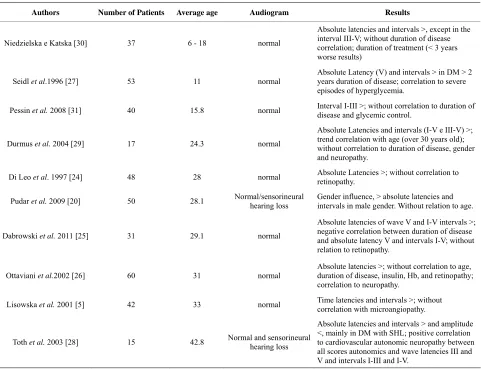
[image:3.595.58.539.111.445.2]brainstem. This test basically evaluates the absolute la-tency of waves, which is the time needed for the stimula-tion to initiate the auditory potential in a determined structure. Further, the test evaluates intervals—which are the time necessary for the electric potential to pass from one structure to another.
Table 2 presents data regarding auditory brainstem
response (ABR), which demonstrates that in almost all of the studies there is an increase in at least one latency time. This data confirms the studies with OAE, because the delay in the latency time is generally associated to peripheral dysfunction.
With regard to intervals, the majority of the studies demonstrate that some intervals are increased, which indicates that a central auditory component also exists which is resultant of the metabolic alterations from type 1 DM. Regarding an association of the alterations of ABR and comorbidities, it was possible to verify that in the majority of studies, there was some degree of asso- ciation between them. Ugur et al. 2009 [15] observed that the time of treatment contributed to worse ABR
re-sponses, demonstrating that control of the disease is fundamental into preventing auditory alterations. The study by Seidl et al. [27] presented similar findings, demonstrating that the duration of the disease and severe episodes of hyperglycemia affect the results of the ABR. Ottaviani et al. [26] and Toth el al. [28] observed a cor-relation between ABR and neuropathy, as well as with cardiovascular autonomic neuropathy. However, similar to studies with OAE, there is no consensus between these studies, which is probably due the protocols used and the distinct differences between them.
With regard to patient age and possible alterations of the ABR, there was no difference between studies, as these criteria were present in the same way in the studies with younger and older populations. However, Durmus et al. [29] observed a tendency of correlation in patients over 30 years of age.
In terms of gender, Pudar et al. [20] verified that male patients present absolute latencies and longer intervals than female patients with type 1 DM, in comparison to subjects without the disease.
Table 2. Studies of type 1 diabetes mellitus using the auditory brainstem response (ABR) test.
Authors Number of Patients Average age Audiogram Results
Niedzielska e Katska [30] 37 6 - 18 normal
Absolute latencies and intervals >, except in the interval III-V; without duration of disease correlation; duration of treatment (< 3 years worse results)
Seidl et al.1996 [27] 53 11 normal
Absolute Latency (V) and intervals > in DM > 2 years duration of disease; correlation to severe episodes of hyperglycemia.
Pessin et al. 2008 [31] 40 15.8 normal Interval I-III >; without correlation to duration of disease and glycemic control.
Durmus et al. 2004 [29] 17 24.3 normal
Absolute Latencies and intervals (I-V e III-V) >; trend correlation with age (over 30 years old); without correlation to duration of disease, gender and neuropathy.
Di Leo et al. 1997 [24] 48 28 normal Absolute Latencies >; without correlation to retinopathy.
Pudar et al. 2009 [20] 50 28.1 Normal/sensorineural hearing loss Gender influence, > absolute latencies and intervals in male gender. Without relation to age.
Dabrowski et al. 2011 [25] 31 29.1 normal
Absolute latencies of wave V and I-V intervals >; negative correlation between duration of disease and absolute latency V and intervals I-V; without relation to retinopathy.
Ottaviani et al.2002 [26] 60 31 normal
Absolute latencies >; without correlation to age, duration of disease, insulin, Hb, and retinopathy; correlation to neuropathy.
Lisowska et al. 2001 [5] 42 33 normal Time latencies and intervals >; without correlation with microangiopathy.
Toth et al. 2003 [28] 15 42.8 Normal and sensorineural hearing loss
Absolute latencies and intervals > and amplitude <, mainly in DM with SHL; positive correlation to cardiovascular autonomic neuropathy between all scores autonomics and wave latencies III and V and intervals I-III and I-V.
Hypoglycemia alters performance in tests of general mental abilities [32-34], presenting variable sensitivity in accordance with cerebral function, however little is known of its effect in specific cerebral processes. With regard to processing auditory information, it is possible to confirm that hypoglycemia can interrupt short term auditory storage and slow the speed at which the brain is capable of processing obtained information [32,35,36]. Following this, early diagnosis of auditory alterations resulting from type 1 DM is very important, because these central alterations can result in difficulty of sound comprehension and further can compromise the acquisi-tion of auditory abilities (auditory processing), which is responsible for success of verbal communication. Further, considering that type 1 DM occurs mainly in children who do not yet possess established auditory abilities, understanding this process becomes even more important, in order to implement preventative measures and early therapies.
4. CONCLUSION
The findings of this review demonstrate that patients with type 1 DM can have auditory alterations stemming from a central cochlear origin.
5. ACKNOWLEDGEMENTS
This article is part of the Luciene Fernandes’ PhD Thesis of Bahiana School of Medicine and Public Health Postgraduate Course.
REFERENCES
[1] American Diabetes Association (2010) Diagnosis and
classification of diabetes mellitus. Diabetes Care, 33,
S67-69. doi:10.1186/1471-2458-11-564
[2] Hall, V., Thomsen, R., Henriksen, O. and Lohse, N. (2011)
Diabetes in sub saharan Africa 1999-2011: Edpidemiol-ogy and public health implications—A systematic review. BMC Public Health, 11, 564.
[3] Tufano, A., Cimino, E., Di Minno, M.M.D., Ierano, P.,
Marrone, E., Strazzullo, A., Di Minno, G. and Cerbone, A.M. (2011) Diabetes mellitus and cardiovascular pre- vention: The role and the limitations of currently avail-
able antiplatelet drugs. International Journal of Vascular
Medicine, 2011, 1-5.
[4] Brender, E., Burke, A.E. and Glass, R.M., (2006) Audi-
ometry. Journal of the American Medical Association
(JAMA), 295, 460. doi:10.1001/jama.295.4.460
[5] Lisowska, G., Namyslowski, G., Morawski, K. and Stro-
jek K. (2001) Early identification of hearing impairment
in patients with type 1 diabetes mellitus. Otology &
Neurotology, 22, 316-320.
doi:10.1097/00129492-200105000-00008
[6] Maia, C.A.S. and Campos, C.A.H. (2005) Diabetes
mellitus como causa de perda auditiva. Revista Brasileira
De Otorrinolaringologia, 71, 208-214.
[7] Kakarlapudi, V., Sawyer, R. and Staecker, H. (2003) The
effect of diabetes on sensorioneural hearing loss. Otology
& Neurotology, 24, 382-386.
doi:10.1097/00129492-200305000-00006
[8] Kariya, S., Cureoglua, S., Fukushimad, H., Moritad, N.,
Baylanc, M.Y., Maedab, Y., Nishizakib, K. and Paparella, M.M. (2010) Comparing the cochlear spiral modiolar ar- tery in type-1 and type-2 diabetes mellitus: A human
temporal bone study. Acta Medica Okayama, 64, 375-
383.
[9] Cullen, J.R. and Cinnamond, M.J. (1993) Hearing loss in
diabetics. Journal of Laryngology & Otology, 107, 179- 182.
[10] Celik, O., Yalcin, S., Celebi, H. and Oztürk, A. (1996)
Hearing loss in insulin-dependent diabetes mellitus. Auris
Nasus Larynx, 23, 127-132.
[11] Bainbridge, K.E., Hoffman, H.J. and Cowie, C. (2008)
Diabetes and hearing impairment in the United States: Audiometric evidence from the national health and nutri-
tion examination survey, 1999 to 2004. Annals of Internal
Medicine, 149, 1-10.
[12] Elamin, A., Fadlallah, M. and Tuevmo, T. (2005) Hearing
loss in children with type 1 diabetes. Indian Pediatrics,
42, 15-21.
[13] Gawron, W., Pospiech, L., Noczynska, A. and Kozioro-
wska, E. (2004) Sudden hearing loss as a first complica- tion of long-standing Type 1 diabetes mellitus: A case re- port. Diabetic Medicine, 21, 96-98.
doi:10.1046/j.1464-5491.2003.01067.x
[14] Kemp, D.T., Ryan, S. and Bray, P. (1990) A guide to the
effective use of otoacustic emissions. Ear and Hearing,
11, 93-100. doi:10.1097/00003446-199004000-00004
[15] Ugur, A.K., Kemaloglu, Y.K., Ugur, M.B., Gunduz, B.,
Saridogan, C., Yesilkaya, E., Bideci, A., Cinaz, P. and Goksu, N. (2009) Otoacoustic emissions and effects of contralateral white noise stimulation on transient evoked
otoacoustic emissions in diabetic children. International
journal of Pediatric Otorhinolaryngology, 73, 555-559.
doi:10.1016/j.ijporl.2008.12.002
[16] Lisowska, G., Namyslowski, G., Morawski, K. and Stro-
jek, K. (2001) Cochlear dysfunction and diabetic micro-
angiopath. Scandinavian Audiology, 30, 199-203.
[17] Fukushima, H., Cureoglu, S., Schachern, P.A., Kusunoki.
T., Oktay, M.F., Fukushima, N., Paparella, M.M. and
Harada, T. (2005) Cochlear changes in patients with type
1 diabetes mellitus. Otolaryngology—Head and Neck
Surgery, 133, 100-106.
doi:10.1016/j.otohns.2005.02.004
[18] Erdem, T., Ozturan, O., Miman, M.C., Ozturk, C. and
Karatas, E. (2003) Explorations of the early auditory effects of hyperlipoproteinemia and diabetes mellitus
using otoacustics emissions. European Archives of Otorhi-
nolaryngology, 260, 62-66.
[19] Fernandes, L.C. and Santos-Momensohn, T.M. (2009)
Tinnitus and normal hearing: A study on the transient
Otorhinolaryngology, 75, 414-419.
doi:10.1590/S1808-86942009000300017
[20] Pudar, G., Vlaski, L., Filipović, D. and Tanackov, I. (2009) Correlation of hearing function findings in patients suf- fering from diabetes mellitus type 1 in regard to age and gender. Medicinski Pregled, 62, 395-401.
doi:10.2298/MPNS0910395P
[21] Park,M.S., Park, S.W. and Choi, J.H. (2001) Distortion
product otoacoustic emissions in diabetics with normal
hearing. Scandinavian Audiology, 30, 148-115.
doi:10.1080/010503901300007362
[22] Di Nardo, W., Ghirlanda, G., Paludetti, G., Cercone, S.,
Saponara, C., Del Ninno, M., Girolamo S.D., Magnani, P. and Di Leo, M.A.S. (1998) Distortion-product otoacous-tic emissions and selective sensorineural loss in IDDM. Diabetes Care, 21, 1317-1321.
doi:10.2337/diacare.21.8.1317
[23] Alborch, M.O., Morant, V.A., García, C.J., Pérez, D.V.B.,
Lorente, R. and Marco A.J. (1998) The study of oto-
acoustic emissions in diabetes mellitus. Acta Otorri- nolaringology, 49, 25-28.
[24] Di Leo M.A.S., Di Nardo, W., Cercone, S., Ciervo, A., Lo
Monaco, M., Greco, A.V., Paludetti, G. and Ghirlanda, G.L. (1997) Cochlear Dysfunction in IDDM patients with
subclinical peripheral neuropathy. Diabetes Care, 20,
824-828. doi:10.2337/diacare.20.5.824
[25] Dabrowski, M., Mielnik-Niedzielska, G. and Nowa-
kowski, A. (2011) Involvement of the auditory organ in
type 1 diabetes mellitus. Journal of Endocrinology, 62,
138-144.
[26] Ottaviani, F., Dozio, N., Neglia, C.B., Riccio, S. and
Scavini, M. (2002) Absence of otoacoustic emissions in insulin-dependent diabetic patients. Is there evidence for
diabetic cochleopathy? Journal of Diabetes and Its
Com-plications, 16, 338-343.
doi:10.1016/S1056-8727(01)00224-0
[27] Seidl, R., Birnbacker, R., Hauser, E., Bernert, G., Freilin- ger, M. and Schober, E. (1996) Brainstem auditory evoked potentials and visually evoked potentials in young
patients with IDDM. Diabetes Care, 19, 1220-1224.
doi:10.2337/diacare.19.11.1220
[28] Tóth, F., Várkonyi, T.T., Rovó, L., Lengyel, C., Légrády,
P., Jóri, J., Czigner, J. and Kiss, J.G. (2003) Investigation
of auditory brainstem function in diabetic patients. Inter-
national Tinnitus Journal, 9, 84-86.
[29] Durmus, C., Vetiser, S. and Durmus, O. (2004) Auditory
brainstem evoked responses in insulindependent (ID) and non-insulin-dependent (NID) diabetic subjects with nor-
mal hearing. International Journal of Audiology, 43,
29-33. doi:10.1080/14992020400050005
[30] Niedzielska, G. and Katska, E. (1998) ABR disturbances
in children with insulin dependent diabetes mellitus. In-
ternational Journal of Pediatric Otorhinolaryngology, 44,
1-4. doi:10.1016/S0165-5876(98)00017-2
[31] Pessin, A.B.B, Martins, R.H.G., Pimenta, W.P., Simões,
A.C.P., Marsiglia, A. and Amaral, A. (2008) Auditory evaluation in patients with type 1 diabetes. The Annals of Otology, Rhinology & Laryngology, 117, 366-370.
[32] McCrimmon, R.J., Deary, I.J. and Frier, B.M. (1997)
Auditory information processing during acute insulin- induced hypoglycaemia in non-diabetic human subjects. Neuropsychology, 35, 1547-1553.
[33] Hannoen, R., Tupola, S., Ahonen, T. and Riikonen, R.
(2003) Neurocognitive functioning in children with type-1 diabetes with and without episodes of severe
hy-poglycaemia. Developmental Medicine & Child
Neurol-ogy, 45, 262-268.
doi:10.1111/j.1469-8749.2003.tb00341.x
[34] McAulay, V., Deary, I.J., Sommerfield, A.J. and Frier,
B.M. (2006) Attentional functioning is impaired during
acute hypoglycaemia in people with type 1 diabetes. Diab
Medical, 1, 26-31. doi:10.1111/j.1464-5491.2005.01795.x
[35] Strachan, M.W.J., Ewing, F.M.E., Frier, B.M.,
Mccrim-mon, R.J. and Deary, I.J. (2003) Effects of acute hipogly-caemia on auditory information processing in adults with type I. Diabetology, 46, 97-105.
[36] Cooray, G.K., Maurex, L. and Brismar, T. (2008) Cogni-
tive impairment correlates to low auditory event-related
potential amplitudes in type 1 diabetes. Psychoneuroen-
docrinology, 33, 942-950.