Energy-Constrained Duty-Cycle Optimization for Wireless
Implanted Communication Devices
Zhao Xu, Ye Li
Shenzhen Institutes of Advanced Technology, Chinese Academy of Sciences, Shenzhen, China Email: [email protected]
Received March 20, 2012; revised March 25, 2012; accepted March 30, 2012
ABSTRACT
Energy minimization is an important goal in wireless implanted communication devices. In this context, a cross-layer method is used to optimize parameters in different layers of OSI model, but, there are still several challenges affecting the optimization algorithm. The first point is the accurate energy model, and the second point is the suitable channel model exclude traditional free space channel model. In this paper, we establish a system level accurate energy consump- tion model and build a suitable channel model for implanted communication devices; analysis the energy-constrained duty cycle optimization with a cross-layer method. Simulation results reveal that adaptive duty cycle to minimize the energy consumption of the wireless implanted communication system is implemented based on accurate energy con- sumption model and channel model. Simulation results show a good performance on energy saving.
Keywords: Energy Minimization; Energy Consumption Model; Channel Model; Duty-Cycle; Optimization; Cross-Layer
1. Introduction
The rapid developments of wireless communication and low power implanted techniques have opened up new frontiers in the race to conquer healthcare challenges. As wireless sensor networking technology comes into reality, it brings the revolution of E-Health application and new challenge of limited energy consumption, especially for implanted communication devices operating without bat- tery replacement in a long time. For instance, capsule endoscopy needs to work continuously in human body for over 8 hours. Even, as to wireless pacemaker, it’ll operate inside the heart for many years. Therefore, the “battery gap” [1] makes energy saving become a very important consideration for the green E-Health application.
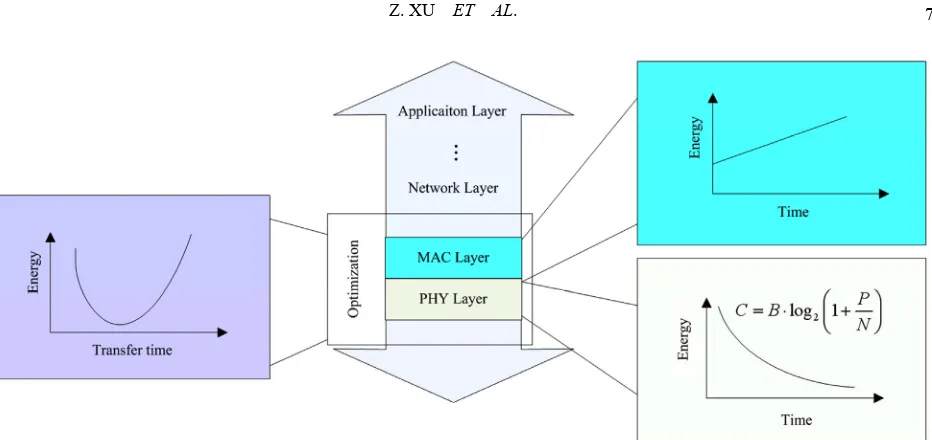
To minimizing the energy consumption, we should achieve an optimal joint design across all layers of the network protocol stack. The duty cycle is a very impor-tant parameter effecting the energy consumption in me-dia access control (MAC) layer, but the effect by physi-cal (PHY) layer also should be considered. In PHY layer, according to the Shannon formula, the energy should be saved by low data rate which means in a high duty cycle; but in MAC layer, there is contrary result that is longer sleep time (lower duty cycle) with higher data rate can
minimize the energy consumption (Figure 1). So the
relationship between the energy consumption and trans-fer time is not a monotonically function, and the mini-mum energy point achieved by the duty cycle optimiza-tion crossing layers.
Cross-layer optimization has been widely used in ad- hoc networks and wireless sensor networks. There is an extensively study on cross-layer optimization between data link layer and network layer. In [2], Jaejoon Cho et al. propose an energy-efficient routing method to enable nodes to reduce control traffic routing overhead using routing distance without big routing table. Safwat et al. present energy efficient scheme by successfully receiving a CTS or an ACK frame in MAC layer [3]. In [4], Jianwu
Zhang et al. propose an optimal routing of minimizing
the transmission energy without the link adaptation.
Sichitiu et al. present node sleep mechanism based on
MAC layer and routing [5]. For cross-layer optimization between PHY layer and MAC layer, Karvonen et al. present an optimization method on the code and sleep/ awake periods [6]. In [7], Huang et al. propose a cross- layer method for the joint design of scheduling and power control in wireless ad hoc networks by adaptive modula-tion with power control. Kwon et al. present a cross layer optimization by the power control in the physical layer, the ARQ control in the MAC layer, and the routing pro-tocol in the network layer [8]. The works all above have achieved a joint optimization from different layers, but for wireless implanted communication devices, the analysis also should take accurate energy model and im-planted channel model into account, not only based on an ideal fixed energy model and free space channel.
Figure 1. Duty cycle optimization crossing layers.
devices. With the consideration of the parameters affected by PHY and MAC layers, we implement an adaptive duty cycle optimization to minimize the energy consumption based on accurate energy model and channel model for wireless implanted communication devices.
2. System Model
2.1. Energy Model
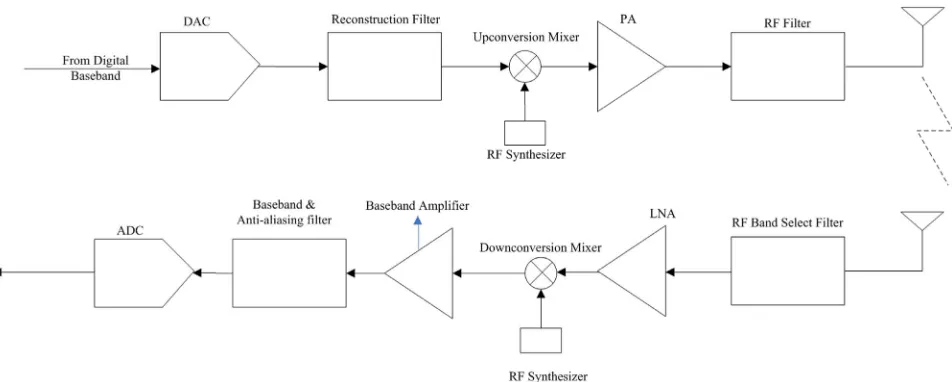
A communication link connecting the transmitting path and the receiving path is considered. It is assumed that the analysis is done with MQAM modulation. In order to minimize the total energy consumption, all signal pro- cessing blocks at the transmitter and the receiver need to be considered in the optimization model. It is also as-sumed that no complicated signal processing techniques such as multiuser detection or iterative decoding are used. The power consumption in these parts are quite small [9] compared with the power consumption in the RF cir-cuitry block, which is closely related to the carrier fre-quency. Thus, in this paper, these blocks (e.g., source cod-ing, pulse-shapcod-ing, and digital modulation) are neglected to simplify the model. The resulting signal paths on the
transmitter and receiver sides are shown in Figure 2,
where it is seen that on the transmitter side, the baseband signal is converted to an analog signal by the digi-tal-to-analog converter (DAC), then filtered by the re-construction filter and modulated by the mixer, then am-plified by the power amplifier (PA), and finally filtered again and transmitted to the wireless channel. On the receiver side, the RF signal is first filtered by the RF band selected filter and amplified by the low noise amplifier (LNA), then down converted by the mixer, and amplified again by the baseband amplifier, then filtered again be-fore going through the analog-to-digital converter (ADC)
to convert back to a digital signal. Although this model is based on a generic low-IF transceiver structure, the frame-work can be easily modified to analyze other architec-tures as well.
It is assumed that an implanted device has W bits to transmit with a deadline T. The transceiver spends time Tactive ≤ T to communicate these bits, then Td is a
pa-rameter to optimize which is equal to Td = Tactive/Tsleep,
and then returns to the sleep mode where all the circuits in the signal path are shut down for energy saving. In wireless communication system, the full-duplex trans-ceiver works in two modes (active and sleep mode).
Correspondingly, the total energy consumption Etotal
re-quired to send L bits also consists of two components.
total active sleep active active sleep sleep
E E E P T P T (1)
Then, the energy-constrained modulation problem can be modeled as
minimize
subject to 0 1
0.1 d 1 E
T
m d m
(2)
where it is seen that the task is to find the most efficient way to choose the transmission duty cycle under the given system constraints so that the total energy con-sumption is minimized. For the second constraint, the transmit distance (only 0.1 m to 1 m) is very short for implanted device, in this paper, we choose d0 = 0.5 cm as
the reference distance. From the resulting optimal Td, the
duty cycle optimization for energy efficiency can be ob-tained.
Figure 2. Transceiver circuit blocks of the analog signal chain.
Energy consumption for PA is dominant in all com-ponents of RF front-end and the power consumption model of the PA is given by [11]
2 2
2
2 / 2
1 1
2
16π 2 1
3
3 2 1
1 1
1
4 2
b PA
r t
b b
C roll off
d L
P N
G G K
Q BER b
PAR PAR
/ 2
2b 1 (3)
where BER is the bit error rate, PAR is the
peak-to-av-erage ratio, N, b, Gt, Gr, are the noise power, modulation level, transmitter and receiver antenna gains respectively. And K is a constant, L is the system loss factor not related to propagation, λ is the carrier wavelength.
According to [13], the medical devices can operate on the medical implanted communication band (from 402 MHz to 405 MHz). Most of medical sensors have a maximum current consumption less than 6 mA and the
supply voltage vary from 1.8 V to 3.5 V. We assume Pe
equal to 13 mW in our analysis. Consider the modulation
and denote, where Rs is the symbol rate, in hertz. Then,
the active energy consumption per bit for the RF front- end for all modulation levels b is given by
active_bit e
3 2 2
2
2 1
1
0 2
/ 2
/ 2
1
13 10 16π
2 1
3
1 1 1
1
4 2
3 2 1
( )
2 1
active bit PA s
b s r t
b b
C roll off b
E P T P P
R b d L
R b G G K
N Q BER b
b
PAR PAR
2.2. Channel Models for Implanted Sensor Devices
For implanted channel model, the traditional system design is established with normal free space channel. Since the impact of human tissue on signal transmission is serious, we must evaluate the impacts of human tissue and build an accurate channel model suitable for implanted devices.
Many theoretical and measurement-based studies pre- sented in literature have shown that the average received signal decreases logarithmically with distance. Therefore, the average path loss for a distance between transmitter and receiver is expressed as
dB dB 0 10
0
10 log d
PL d PL d n
d
(5)
where, n is the path loss exponent that indicates the rate at which the path loss increases with distance and d0 is a
reference distance set in measurement, PLdB(d0) is the
reference path loss in dB corresponding to the reference distance d0, and we don’t consider the Gaussian noise the
path loss model.
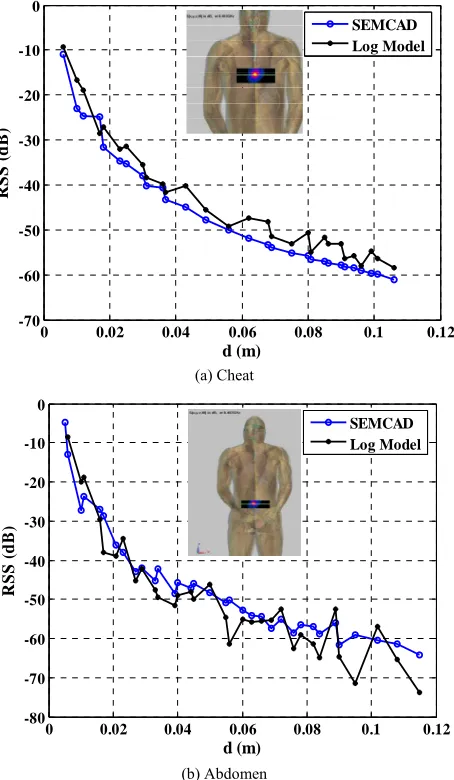
SEMCAD is used to analysis the path loss exponent implanted communication model at both chest and
ab-domen (Figure 3), and we can get the average value of
pass loss exponent as shown in Table 1.
2.3. Energy Model for Implanted Devices
(4)
From above analysis, we can see that the tissue impacts the signal transmission severely. So, we have to consider the tissue’s effect before optimization algorithm.
According to [14], the path loss for free space model can be expressed as
2 2
dB 2
16π
10log
r t
d L PL
G G
(6)
0 0.02 0.04 0.06 0.08 0.1 0.12 -70 -60 -50 -40 -30 -20 -10 0 RS S ( d B ) d (m) SEMCAD Log Model
0 0.02 0.04 0.06 0.08 0.1 0.12
-70 -60 -50 -40 -30 -20 -10 0 RS S ( d B ) d (m) SEMCAD Log Model (a) Cheat
0 0.02 0.04 0.06 0.08 0.1 0.12
-80 -70 -60 -50 -40 -30 -20 -10 0 RSS ( d B) d (m) SEMCAD Log Model
0 0.02 0.04 0.06 0.08 0.1 0.12
[image:4.595.60.287.86.476.2]-80 -70 -60 -50 -40 -30 -20 -10 0 RSS ( d B) d (m) SEMCAD Log Model (b) Abdomen
[image:4.595.309.540.494.685.2]Figure 3. Path loss model for implanted sensor nodes.
Table 1. Modeling parameters for implanted channel.
d0(m) PL0(dB) n
Chest 0.005 9.215 1.6652
Abdomen 0.005 4.805 2.0242
dB 2 2 10 2 16π 10 PL r t d
G G L (7) But for the implanted communication channel, accord- ing to Equation (5), we can get
dB(0) dB
10 10
0
10 10
n PL d d PL
d
(8)
Since Equation (7) and Equation (8) are used to ex-press the path loss of free space communication model and implanted communication model respectively, we can replace the left part of Equation (7) with the left part of Equation (8) when calculate the power consumption
with the additional consideration of the effect of human tissue, and update the power consumption of the class A linear PA with MQAM modulations derived by
dB(0)
' 10 0 2 1 1 2 1
10 2 1
3 1 1 Q 1 4 2 n PL d b PA b d P d K
N b BER PAR
(9)
Then, the total energy consumption per bit can be ex-pressed by
' ' ' active_bit e3 dB 0
10 0 2 1 1 0 2 / 2 / 2 1
13 10 1
10
3
1 1 1
2 1 1
4 2
3 2 1
2 1
active bit PA s n PL d s b b b
C roll off b
E P T P P
R b
d
R b d K
N Q BER b
b PAR PAR (10)
3. Optimization Algorithm
In this section, we consider a duty cycle optimization method for energy-constrained communication system.
We present the duty cycle optimization Td opt_ in MAC
layer by the optimal parameters in PHY layer for mini-mizing the energy consumption. The sleep mode is equal to Tsleep=Ttotal – Tactive, and the power consumption of the
RF front-end in sleep mode can be fixed at 0.5 mw. The total energy consumption can be expressed as
'
total sleep total '
e sleep total
1
active active active
PA d total d
E P T P T T
P P T T P T T
(11)
The duty cycle Td can be expressed as
active s d
total total s total
W
T R b W
T
T T R b T
(12)
Thus, b is
d total c s
W b
T T R R
(13)
total
E is a function of d, and Td
,total d
E f d T
large or the modulation level should be selected for a (14)
tive/sleep mode should be changed. The optimal duty cycle is the value which can directly show the suitable point when the energy consumption is minimal. There-fore, Td opt_ is the duty cycle that minimize Etotal, and
then i e expressed as
min
T E
t can b
_ min ,
d d
d opt TR total TR f dTd (15)
The number of elements in the set R is practically fi-ni
4. Cross-layer Optimization Design for
Fi s the effect of the duty cycle with different
ini
y- co
5. Conclusion
ergy-constrained duty-cycle
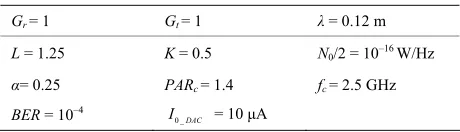
optimiza-Table 2. System parameter values.
Gr = 1 t
te, for instance
0.1,0.2,0.3,0R .4,0.5,0.6,0.7,0.8,0.9,1 .
Implanted Wireless Communication
System
gure4 show
values of the distance d for Total energy consumption of the implanted communication device. For larger distance,
the energy consumption will increase by fixed Td. When
distance is fixed, there is a duty cycle which could m -mize total energy consumption, that is, Td opt_ .
According to Figure 4, we will have an energ
nstrained duty cycle optimization for implanted BSN
communication devices. For instance, if assume that d =
0.2 m, we can get the minimum energy consumption
when Td is equal to 0.2, which means that the ratio of
active e to sleep time is 1:4. According to (11), if duty
cycle Td = 0.2 is chosen, the total energy consumption
Etotal = mJ.
tim
2.8
In this paper, an en
tion for a wireless transceiver of implanted devices is proposed. Two important models have been studied: a system level energy model for the RF front-end and a channel model for implanted communication. The effects of signal bandwidth, PAR, symbol rate, modulation level, transmission distance, duty-cycle, and the implanted communication path loss are considered. With a cross-layer method, we got the optimal duty-cycle to minimize the total energy consumption. For such a system, tradeoffs between the transfer time and the energy consumption and communication quality are presented. Future work includes adding the effect of error coding on the energy model.
G= 1 λ= 0.12 m
L = 1.25
Figure 4. Total energy consumption versus duty-cycle with
part by the National S & T
REFERENCES
[1] K. Lahiri, A. and D. Panigrahi,
fficient
PS and
hang, Y.-F. Chen and J.-J. Zhang, “Joint Routing,
, C. Pomalaza-Raez and M. Hamalainen, different distance.
6. Acknowledgements
This work was supported in
Major Project of China (Grant No. 2011ZX03005-001- 04), the Guangdong Innovation Research Team Fund for Low-cost Healthcare Technologies (GIRTF-LCHT).
Raghunathan, S. Dey
“Battery-Driven System Design: A New Frontier in Low Power Design,” Proceedings of 7th Asia and South Pa- cific and the 15th International Conference on VLSI De- sign, Bangalore, 7-11 January 2002, pp. 261-267. [2] J. Cho, S. Kim, H. Nam and S. An, “An Energy-E
Mechanism Using CLMAC Protocol for Wireless Sensor Networks,” Third International Conference on Network- ing and Services,Athens, 19-25 June 2007, p. 3.
[3] A. Safwat, H. Hassanein and H. Mouftah, “EC E2LA: New Paradigms for Energy Efficiency in Wireless Ad Hoc and Sensor Networks,” Global Telecommunica- tions Conference, Canada, 1-5 December 2003, pp. 3547- 3552.
[4] J.-W. Z
MAC, and Link Layer Optimization in Virtual MIMO Sensor Networks,” IET International Conference on Wireless Mobile and Multimedia Networks Proceedings, Hangzhou, 6-9 November, 2006, p. 26.
[5] M. L. Sichitiu, “Cross-Layer Scheduling for Power Effi- ciency in Wireless Sensor Networks,” Twenty-third An- nual Joint Conference of the IEEE Computer and Com- munications Societies, Hong Kong, 7-11 March 2004, pp. 1740-1750.
[6] H. Karvonen W/Hz
K = 0.5 N0/2 = 10–16
α= 0.25 PARc = 1 “Cross-Layer Energy Efficiency of FEC Coding in UWB
Sensor Networks,” IEEE International Conference on Ultra-Wideband, Waltham, 24-27 September 2006, pp. .4
–4
fc = 2.5 GHz
[image:5.595.57.287.669.735.2]357-362. doi:10.1109/ICU.2006.281576
[7] W. L. Huang and K. B. Letaief, “Cross-Layer Scheduling and Power Control Combined with Adaptive Modulation for Wireless Ad Hoc Networks,” IEEE Transactions on Communications, Vol. 55, No. 4, 2007, pp. 728-739. doi:10.1109/TCOMM.2007.894093
[8] H. Kwon, T. H. Kim, S. Choi and B. G. Lee, “A Cr Layer Strategy for Energy-Efficient
oss- Reliable Delivery in Wireless Sensor Networks,” IEEE Transactions on Wire- less Communications, Vol. 5, No. 12, 2006, pp. 3689- 3699. doi:10.1109/TWC.2006.256992
[9] M. Srivatsava, “Power-Aware Communication Systems,” Kluwer Academic, Boston, 2002.
[10] H. C. Liu, J. S. Min and H. Samueli, “A Low-Power Base- band Receiver IC for Frequency-Hopped Spread Spec- trum Communications,” IEEE Journal of Solid-State Cir- cuits, Vol. 31, No. 3, 1996, pp. 384-394.
doi:10.1109/4.494200
[11] Y. Li, B. Bakkaloglu and C. Chakrabarti, “A System
hang, Y. Li and Y.-W. Zhang, “Energy
-Power Radio Chip
ireless Communications: Principles Level Energy Model and Energy-Quality Evaluation for Integrated Transceiver Front-Ends,” IEEE Transactions on Very Large Scale Integration Systems, Vol. 15, No. 1, 2007, pp. 90-102.
[12] J.-Q. Zhai, H.-S. Z
Efficient RF Front-Ends Architecture Design for Wireless Sensor Networks,” Proceedings of the Networks Security Wireless Communications and Trusted Computing, Wu- han, 24-25 April 2010, pp. 236-239.
[13] P. D. Bradley. “Implantable Ultralow Facilitates In-Body Communications,” 2007.
http://mobiledevdesign.com/hardware_news/radio_impla ntable_radio_chip/
[14] T. S. Rappaport, “W