Airway obstruction in competitive swimmers
Marja Päivinen1,2, Tuula Putus3, Pentti Kalliokoski4, Heikki Tikkanen1,2
1
Department of Sports and Exercise Medicine, Institute of Clinical Medicine, University of Helsinki,Helsinki, Finland; [email protected]
2
Foundation for Sports and Exercise Medicine, Helsinki, Finland 3
University of Turku, Turku, Finland 4
Department of Environmental Sciences,University of Eastern Finland, Kuopio, Finland
Received 20 January 2013; revised 21 February 2013; accepted 28 February 2013
ABSTRACT
Background: Swimming has been shown to cause beneficial effects on lung function. How- ever, increased adverse effects have been hy- pothesized due to the air quality of indoor swim- ming pools. Objectives: To compare competitive swimmers present lung function to swimmers twenty to thirty years ago and examine the as- sociations between lung function and medical history and reported respiratory symptoms in present swimmers. Methods: One hundred swim- mers, 47 females and 53 males were studied with flow-volume spirometry. These findings were compared with ones obtained 20 - 30 years ago among 98 swimmers, 40 females and 58 males. Forced expiratory volume in one second (FEV1), forced expiratory volume (FVC) and their
ratio (FEV%) were analysed for airways obstruc- tion. Associations between lung function and asthma, allergy, and respiratory symptoms were examined using questionnaire. In addition air- ways inflammation was measured with exhaled nitric oxide measurement (FENO) in present swim-
mers. Airborne trichloramine was measured in air of indoor swimming pools. Results: Airway obstruction was found in 15%, 15 out of 100 stu- died swimmers, which all reported physician dia- gnosed asthma and/or family history of asthma. Most, 12 out of 15 of swimmers with obstruction finding, were males. Twenty to thirty years ago obstruction was found in 17 of the 98 swimmers. Airborne concentrations of trichloramine in the present swimming pools, were low, less than 0.1 mg/m3. Conclusion: Airway obstruction was as- sociated with asthma and family history of asth- ma. There was no increase in obstruction find- ings among competitive swimmers within 2 - 3 decades. Measured concentrations of trichlora- mine raised no concern on swimmers health.
Keywords:Pulmonary Function Tests; Obstruction; Asthma; Allergy; Symptoms; Swimming
1. INTRODUCTION
Prevalence of asthma and respiratory problems among endurance athletes and especially among competitive swimmers has been suggested to be increased within last decades [1]. However, beneficial effects of swimming training; improvement of lung function and relief of res- piratory symptoms in asthmatics have been reported [2-6]. Swimming has also been recommended physical exercise for asthmatics, because of its low asthmogenity. Swimming triggers fewer respiratory symptoms than running or cycling at same intensity level [7].
Competitive swimmers have high training amounts and increased minute ventilation during their training. Higher than predicted lung volumes and capacities has been observed in competitive swimmers [8,9]. However, competitive swimmers are exposed to the indoor swim- ming pool air by the water disinfection by-products, es- pecially trichloramine, which has been suggested to be harmful for respiratory health [10-12].
The aim of this study was to examine if obstruction findings are increased among competitive swimmers within two to three decades by measuring spirometry in present competitive swimmers and comparing the find- ings with the competitive swimmers 20 to 30 years ago. Secondary aim was to examine the associations between spirometry findings and asthma, allergies, respiratory symptoms and airways inflammation in present swim- mers, and to examine environmental conditions by meas- uring trichloramine concentrations of indoor swimming pool air.
2. METHODS
exhaled nitric oxide (FENO) were measured. Swimmers
mean training history was 9 (SD 4) years and training frequency for 7 (SD 3) times per week which is 14 hours (SD 6) of training per week.
Spirometry findings from 20 - 30 years ago of 98 com- petitive swimmers, 40 females and 58 males, with mean age of 14 (SD 2) years, were examined.
Forced vital capacity FVC and forced expiratory vol- ume in one second (FEV1) and their ratio FEV% were
analysed. All studied swimmers were non smokers. Spi- rometry findings of present competitive swimmers were compared with findings in competitive swimmers 20 - 30 years ago.
Present swimmers filled structured questionnaire which consisted questions about basic information, training his- tory, allergies, asthma, family history of asthma, family history of allergies and respiratory symptoms during swimming training. Same questionnaire has been used in earlier studies in competitive swimmers [13,14].
Flow-volume spirometry was measured with Spiro Star 2000 spirometer (Medikro Finland) according to the ATS and ERS guidelines [15]. Spirometry results were expressed as percent of personal age, size and sex match- ed predicted values. Airways obstruction finding was con- firmed when FVC or FEV1 were less than 79% or FEV%
was less than 87% of predicted values for Finnish popu-lation [16] or for Finnish children under 18 years [17] according to the ATS and ERS criteria [18, 19].
Exhaled nitric oxide measurements (FENO) were per-
formed with hand-held Niox Mino (Aerocrine Sweden) analyzer. Method has been suggested to be suitable for studying environmental effect for airways in indoor swimming pools [20,21]. FENO results were presented as
concentration, parts per billion (ppb) of nitric oxide in exhaled air.
Concentrations of airborne trichloramine by the indoor pools were determined with the method described by Hery et al. [22]. Trichloramine is collected onto impreg- nated quartz filter, reduced to chloride and analyzed by ion chromatography.
T-test was used for comparing the groups. First, the normality of data was studied with Shapiro-Wilk test. If it failed the rank sum Mann-Whitley test was performed.
All comparison analyses were performed with Sig- maPlot software 11.0. Systat Software, inc. San Jose CA. USA.
The Ethics committee of The Hospital district of Hel- sinki and Uusimaa approved the study protocol.
3. RESULTS
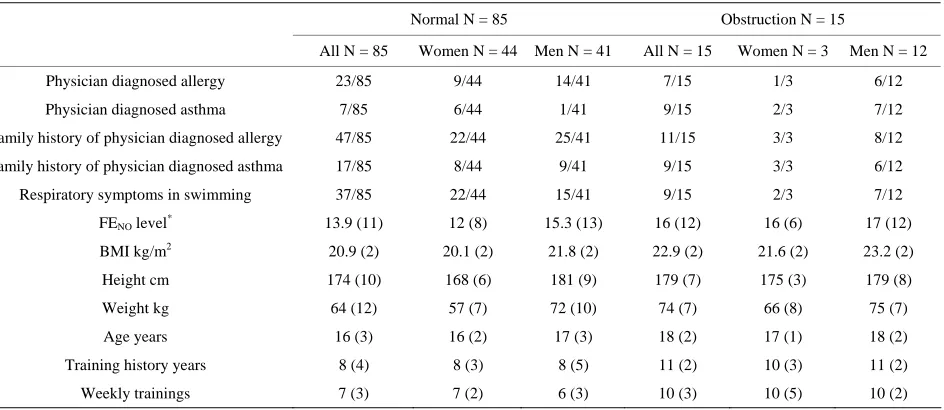
Airway obstruction was found in 15% of the swim- mers. All of them reported asthma or family history of asthma. Almost all, 12 out of 15 swimmers with obstruc- tion finding were men (Table 1).
Mean (SD) FVC was 111 (13) %, FEV1 was 111 (14)
%, and their ratio FEV% was 97 (9) % and peak expira- tory flow PEF was 106 (14) % of predicted. Percents of predicted were significantly higher in present swimmers than in swimmers 20 - 30 years ago (Table 3).
Findings of airway obstruction did not associate with reported respiratory symptoms or elevated FENO level in
swimmers. However, FEV% was significantly lower and FENO were significantly higher in non-symptomatic swim-
mers than in symptomatic swimmers (Table 4).
[image:2.595.68.540.512.717.2]The airborne concentrations of trichloramine were low,
Table 1. Demographics of 100 competitive swimmers, 85 swimmers with normal spirometry and 15 swimmers with airway obstruc- tion finding.
Normal N = 85 Obstruction N = 15
All N = 85 Women N = 44 Men N = 41 All N = 15 Women N = 3 Men N = 12
Physician diagnosed allergy 23/85 9/44 14/41 7/15 1/3 6/12
Physician diagnosed asthma 7/85 6/44 1/41 9/15 2/3 7/12
Family history of physician diagnosed allergy 47/85 22/44 25/41 11/15 3/3 8/12
Family history of physician diagnosed asthma 17/85 8/44 9/41 9/15 3/3 6/12
Respiratory symptoms in swimming 37/85 22/44 15/41 9/15 2/3 7/12
FENO level* 13.9 (11) 12 (8) 15.3 (13) 16 (12) 16 (6) 17 (12)
BMI kg/m2 20.9 (2) 20.1 (2) 21.8 (2) 22.9 (2) 21.6 (2) 23.2 (2)
Height cm 174 (10) 168 (6) 181 (9) 179 (7) 175 (3) 179 (8)
Weight kg 64 (12) 57 (7) 72 (10) 74 (7) 66 (8) 75 (7)
Age years 16 (3) 16 (2) 17 (3) 18 (2) 17 (1) 18 (2)
Training history years 8 (4) 8 (3) 8 (5) 11 (2) 10 (3) 11 (2)
Weekly trainings 7 (3) 7 (2) 6 (3) 10 (3) 10 (5) 10 (2)
*
with normal spirometry FENO was measured successfully in 73 out of 85 swimmers; 39 out of 44 women and of the men 34 out of 41. All of the swimmers
Table 2. Airway obstruction findings in present competitive swimmers and in competitive swimmers 20 - 30 years ago.
Spirometry finding
Present swimmers N = 100 M 53/N 47
Swimmers 20 - 30 years ago
N = 98 M 58/N 40
Normal 85/100 81/98
Obstruction criteria FEV1/FVC or
FEV1/VC < 88% of
predicted
15/100 17/98§
§
Four swimmers had obstruction finding (65% - 79% of predicted) in FVC,
[image:3.595.59.286.289.407.2]FEV1 or both.
Table 3. Spirometry findings, age and BMI in present swim- mers and in swimmers 20 - 30 years ago (FVC, FEV1 and FEV% presented as percent of size, age and sex predicted val- ues).
Present swimmers N = 100 M 53/N 47
Swimmers 20 - 30 years ago N = 98
M 58/N 40
P-value
Age (years) 17 (3) 14 (2) P <0.001*
BMI 21 (2) 19 (2) P < 0.001*
FEV %§ 85 (7) 82 (8) P = 0.125
FVC (%) 111 (13) 99 (13) P < 0.001*
FEV1 (%) 111 (14) 107 (19) P < 0.001*
FEV % (%) 97 (9) 93 (9) P = 0.002*
§ratio of FVC and FEV
1, *Significant difference.
Table 4. Spirometry findings and FENO result in present swim- mers with respiratory symptoms and without. Spirometry re- sults are presented as percent of predicted.
No Respiratory symptoms
N = 54 mean (SD)
Respiratory symptoms
N = 46 mean (SD)
P-value
FVC 110 (13) 113 (13) P = 0.236ns
FEV1 109 (13) 107 (15) P = 0.661ns
FEV% 99 (8) 95 (9) P = 0.014*
PEF 103 (15) 99 (14) P = 0.200ns
MEF 50 101 (26) 94 (25) P = 0.149ns
FENO (ppb) 14 (19) 19 (14) P = 0.001*
*
Significant difference, nsNo significant difference.
less than 0.1 mg/m3, in the indoor swimming pools the competitive swimmers trained.
4. DISCUSSION
Prevalence of airway obstruction was 15% in the studied 100 swimmers which was not higher than in swimmers measured 20 - 30 years ago. This finding is contrary to the suggestions of respiratory problems being increased in endurance athletes especially in swimmers
within the last decades [1].
Spirometric values FVC, FEV1, and PEF were appro-
ximately 110 % of the individual predicted value. This is consistent with the study of Magel and Faulgner 1967 and suggests that swimming training may have beneficial effects on lung function [23].
Mean FEV% was 97% of predicted level suggesting airway obstruction in the group of swimmers. FEV% result in the studied swimmers, as a ratio of FVC and FEV1, may be a sign of the typical increased lung vol-
ume in swimmers which is believed to be developed as a result of repetitive rapid inhalation near TLC during swimming [24].
Results of FVC, FEV1, FEV% presented as percent of
size, age and sex predicted values in studied competitive swimmers were significantly better than in competitive swimmers 20 - 30 years ago. Therefore, it can be con- cluded, that there was no decrease of lung function in competitive swimmers over 2 - 3 decades.
All of the present swimmers with obstruction finding in spirometry had asthma or family history of asthma. Obstruction findings did not associate with reported res- piratory symptoms which is consistent to previous stud- ies of Rundell et al. in elite athletes [25,26].
There were many swimmers with obstruction finding, who did not report respiratory symptoms. This may be explained by the phenomenon of “Poor perceivers” of asthma, which has been introduced in previous studies [26-29]. Some athletes may not recognise the symptoms of airways obstruction, because the changes in pulmo- nary function in pulmonary disease develop slowly.
Almost all of the obstructive swimmers (13 out of 15) were men. That may be linked to the obtained gender dif- ferences in previous studies. Half of the males with air- way obstruction did not report symptoms at all. In recent study of competitive swimmers [14] there was found sig- nificant difference in reported symptoms between female and male swimmers. Females reported significantly more symptoms and also during lower intensity swimming than males [14]. Results may suggest that females with lung function problem may have more symptoms during swimming and therefore may search for medical help and sufficient medication earlier than males.
Differences in symptoms may have also something to do with the body size. The males are bigger in size and reporting fewer symptoms. Interestingly in this study the females with obstruction finding were mean 0.07 meters taller than other female swimmers without obstruction finding (Table 1). The economy of movement during swimming in water related to body size and weight is different than economy of movement on land. Also water environment itself may have an effect on swimmers lung function differently according to size.
[image:3.595.57.287.468.598.2]but had no findings in pulmonary function tests. That may tell that flow-volume spirometry may not be sensi- tive enough to detect early phase of pulmonary disease which may start in small airways and cause respiratory symptoms: in t-test there was found significant differ- ence in FEV% in swimmers who reported respiratory symptoms compared to swimmers not reporting symp- toms, suggesting a slight fall in pulmonary function (Ta- ble 4) even though it was not enough for obstruction finding. These findings may courage to study the respi- ratory symptoms and their underlying factors in athletes further with more sensitive pulmonary function testing methods.
A significant difference was also found in exhaled ni- tric oxide level between swimmers with reported symp- toms and without. However normal FENO level, (ppb <
20) was found in both groups. This may be a sign of pos- sible protective anti-inflammatory effects of endurance exercise training in swimmers. Endurance training in- cluding swimming has been suggested to have anti-in- flammatory effects [30,31].
Mean values of FENO were normal in present swim-
mers which may reflect the possible inflammation pro- tective role of swimming training. Significant differences were found in inflammatory level in FENO and in FEV%
as percent of predicted when swimmers with and without symptoms were compared. As the mean values of FENO
were normal in present swimmers, the environmental effect of frequent exposure to indoor swimming pool air does not support any harmful consequences.
The airborne concentrations of trichloramine at the indoor swimming pools the swimmers trained were, less than 0.1 mg/m3, clearly less than 0.5 mg/m3 which is the suggested critical level for respiratory symptoms and which also is the Finnish occupational exposure limit.
According to the findings the lung function in active young Finnish competitive swimmers is the same or even improved over in new generation after 2 - 3 decades. All of swimmers with airway obstruction had asthma or fam- ily history of asthma.
REFERENCES
[1] Arie, S. (2012) What can we learn from asthma in elite athletes? British Medical Journal, 344, Article ID: e2556. doi:10.1136/bmj.e2556
[2] Wicher, I.B., Ribeiro, M.A., Marmo, D.B., Santos, C.I., Toro, A.A., Mendes, R.T., Cielo, F.M. and Ribeiro, J.D. (2010) Effects of swimming on spirometric parameters and bronchial hyperresponsiveness in children and ado- lescents with moderate persistent atopic asthma. Journal of Pediatrics, 86, 384-390. doi:10.2223/JPED.2022 [3] Matsumoto, I., Araki, H., Tsuda, K., Odajima, H., Nishi-
ma, S., Higaki, Y., Tanaka, H., Tanaka, M. and Shindo, M. (1999) Effects of swimming training on aerobic capacity
and exercise induced bronchoconstriction in children with bronchial asthma. Thorax, 54, 196-201.
doi:10.1136/thx.54.3.196
[4] Font-Ribera, L., Villanueva, C.M., Nieuwenhuijsen, M.J., Zock, J.P., Kogevinas, M. and Henderson, J. (2011) Swim- ming pool attendance, asthma, allergies, and lung func- tion in the Avon longitudinal study of parents and chil- dren cohort. American Journal of Respiratory and Criti- cal Care Medicine, 183, 582-588.
doi:10.1164/rccm.201005-0761OC
[5] Goodman, M. and Hays, S. (2008) Asthma and swim- ming: A meta-analysis. Journal of Asthma, 45, 639-647. doi:10.1080/02770900802165980
[6] Bemanian, M.H., Shirkhoda, S., Nakhjavani, M. and Mo- zafari, H. (2009) Effect of swimming on peak expiratory flow rate of atopic children. Iranian Journal of Allergy,
Asthma and Immunology, 8, 121-123.
[7] Bar-Yishay, E., Gur, I., Inbar, O., Neuman, I., Dlin, R.A. and Godfrey, S. (1982) Differences between swimming and running as stimuli for exercise-induced asthma. Euro- pean Journal of Applied Physiology, 48, 387-397. doi:10.1007/BF00430229
[8] Armour, J., Donnelly, P.M. and Bye, P.T. (1993) The large lungs of elite swimmers: An increased alveolar number?
European Respiratory Journal, 6, 237-247.
[9] Cordain, L., Tucker, A., Moon, D. and Stager, J.M. (1990) Lung volumes and maximal respiratory pressures in col- legiate swimmers and runners. Research Quarterly for Exercise & Sport, 61, 70-74.
[10] Drobnic, F., et al. (1996) Assessment of chlorine expo- sure in swimmers during training. Medicine & Science in Sports & Exercise, 28, 271-274.
doi:10.1097/00005768-199602000-00018
[11] Helenius, I., et al. (2002) Effect of continuing or finishing high-level sports on airway inflammation, bronchial hy- perresponsiveness, and asthma: A 5-year prospective fol- low-up study of 42 highly trained swimmers. Journal of Allergy and Clinical Immunology, 109, 962-968.
[12] Bernard, A., et al. (2006) Chlorinated pool attendance, atopy, and the risk of asthma duringchildhood. Environ- mental Health Perspectives, 114, 1567-1573.
doi:10.1289/ehp.8461
[13] Paivinen, M.K., Keskinen, K.L. and Tikkanen, H.O. (2010) Swimming and asthma: Factors underlying respiratory symptoms in competitive swimmers. The Clinical Respi- ratory Journal, 4, 97-103.
[14] Päivinen, M.K., Keskinen, K.L. and Tikkanen, H.O. (2013) Swimming and asthma: Differences between women and men. Journal of Allergy, 2013, Article ID: 520913. doi:10.1155/2013/520913
[15] Miller, M.R., Hankinson, J., Brusasco, V., Burgos, F., Casaburi, R., Coates, A., Crapo, R, Enright, P., van der Grinten, C.P., Gustafsson, P., Jensen, R., Johnson, D.C., MacIntyre, N., McKay, R., Navajas, D., Pedersen, O.F., Pellegrino, R., Viegi, G. and Wanger, J. (2005) ATS/ERS task force. Standardisation of spirometry. European Res- piratory Journal, 26, 319-338.
[16] Viljanen, A.A., Halttunen, P.K., Kreus, K.-E. and Viljanen, B.C.(1982) Spirometric studies in non-smoking, healthy adults. Scandinavian Journal of Clinical and Laboratory Investigation, 42, 5-20.
[17] Koillinen, H., Vanne, O., Niemi, V. and Laakkonen, E. (1998) Terveiden suomalaisten lasten spirometrian ja ulo- shengityksen huippuvirtauksen viitearvot. Suomen Lää- kärilehti, 39, 395-402.
[18] American Thoracic Society (1991) Lung function testing: Selection of reference values and interpretative strategies.
American Review of Respiratory Disease, 144, 1202- 1218. doi:10.1164/ajrccm/144.5.1202
[19] Pellegrino, R., Viegi, G., Brusasco, V., Crapo, R.O., Bur- gos, F., Casaburi, R., Coates, A., van der Grinten, C.P., Gustafsson, P., Hankinson, J., Jensen, R., Johnson, D.C., MacIntyre, N., McKay, R., Miller, M.R., Navajas, D., Pedersen, O.F. and Wanger, J (2005). Interpretative stra- tegies for lung function tests. European Respiratory Jour- nal, 26, 948-968. doi:10.1183/09031936.05.00035205 [20] Bernard, A., Carbonelle, S., Nickmilder, M. and de Bur-
bure, C. (2005) Non-invasive biomarkers of pulmonary damage and inflammation: Application to children expos- ed to ozone and trichloramine. Toxicology and Applied Pharmacology, 206, 185-190.
doi:10.1016/j.taap.2004.10.022
[21] Sandrini, A., et al. (2009) Fractional exhaled nitric oxide in asthma: An update. Respirology, 15, 57-70.
doi:10.1111/j.1440-1843.2009.01616.x
[22] Hery, M., Gerber, J.M., Gendre, J.C., Hubert, G. and Re- buffaud, J. (1995) Exposure to chloroamines in the atmo- sphere of indoor swimming pools. Annals of Occupa- tional Hygiene, 39, 427-439.
[23] Magel, J.R. and Faulkner, J.A. (1967) Maximum oxygen
uptakes of college swimmers. Journal of Applied Physi- ology, 22, 929-933.
[24] Rundell, K.W., et al. (2001) Self-reported symptoms and exercise-induced asthma in the elite athlete. Medicine & Science in Sports & Exercise, 33, 208-213.
doi:10.1097/00005768-200102000-00006
[25] Rundell, K.W., et al. (2000) Exercise-induced asthma screening of elite athletes: Field versus laboratory exer- cise challenge. Medicine & Science in Sports & Exercise,
32, 309-316. doi:10.1097/00005768-200002000-00010
[26] Parsons, J.P., et al. (2009) Management of exercise-in- duced bronchospasm in NCAA athletic programs. Medi- cine & Science in Sports & Exercise, 41, 737-741. doi:10.1249/MSS.0b013e31818d569d
[27] Parsons, J.P., et al. (2007) Prevalence of exercise-induced bronchospasm in a cohort of varsity college athletes. Me- dicine & Science in Sports & Exercise, 39, 1487-1492. doi:10.1249/mss.0b013e3180986e45
[28] Morris, M.J., Schwartz, D.S., Nohrenberg, J.L. and Doo- ley, S.N. (2007) Airway hyper reactivity in asymptomatic military personnel. Military Medicine, 172, 1194-1197. [29] Hull, J.H., et al. (2007) Exercise-induced bronchocon-
striction in athletes-should we screen?Medicine & Sci- ence in Sports & Exercise, 39, 2117-2124.
doi:10.1249/mss.0b013e3181578db2
[30] Mahler, D.A. (1993) Exercise-induced asthma. Medicine & Science in Sports & Exercise, 25, 554-561.
doi:10.1249/00005768-199305000-00005
[31] Bonsignore, M.R., et al. (2003) Increased airway inflame- matory cells in endurance athletes: What do they mean?