
A Comment on "Cycles and Instability in
a Rock-Paper-Scissors Population Game:
A Continuous Time Experiment"
Wang, Zhijian and Zhu, Siqian and Xu, Bin
Experimental Social Science Laboratory, Zhejiang University, Chu
Kochen Honors College, Zhejiang University, Public Administration
College, Zhejiang Gongshang University, KITPC, Institute of
Theoretical Physics, Chinese Academy of Sciences
26 November 2013
Online at
https://mpra.ub.uni-muenchen.de/51691/
Zhijian Wang1,∗ Siqian Zhu1,2
, Bin Xu3,1,4
,
1 Experimental Social Science Laboratory, Zhejiang University. 2 Chu Kochen Honors College, Zhejiang University.
3 Public Administration College, Zhejiang Gongshang University. 4 SKLTP, ITP, Chinese Academy of Sciences.
*correspondence: [email protected]
Abstract
The authors (Cason, Friedman and Hopkins, Review of Economic Studies, 2014) claimed that control treatments (using simultaneous matching in discrete time) replicate previous results that exhibit weak or no cycles. After correcting two mathematical mistakes in their cycles tripwire algorithm, we study the cycles by scanning the tripwire in the full strategy space of the games and we find significant cycles that were omitted by the authors. So we suggest that all of the treatments exhibit significant cycles.
JEL numbers: C72, C73, C92, D83;
Keywords: experiments, learning, cycles, mixed equilibrium, discrete time
The existence of cycles in mixed equilibrium games has been a cutting edge question in the field crossing game theory [1] and evolutionary game theory [2] for decades. It is a milestone contribution of Cason, Friedman and Hopkins [3] that they confirmed the existence of cycles by quantitative measurement in control experiments, but we can hardly agree with one of their conclusions in their latest article.
In their article [3], they claimed that control treatments (using simultaneous matching in discrete time) replicate previous results that exhibit “weak or no cycles”, which depended on the result —— the stable discrete time treatments (SD) do not exhibit clear cyclical behavior indicated by CRI’s not significantly different from 0 (see their Table 3).
Two mathematical mistakes in the measurement algorithm were found after we checked their result above.1 Then we corrected the mistakes (see Appendix). Using the refined measurement, if the start
point (α, β) of the tripwire for counting cycles (see Fig. 1) was set at (1 4,
1
4) —— Nash equilibrim (NE)
of the games as [3], CRI of SD will still not be significantly different from 0 (see up panel in Table 1 and compare it with their Table 3). So, for SD, we agree that there are only weak or no cyclesaround NE.
However, if we set (α, β) at (0.23, 0.26) for SD-Mixed and at (0.22, 0.40) for SD-Pure and use the CRI measurement as criterion still,2 we can find that CRI of both SD-Mixed and SD-Pure aresignificantly
different from 0 , indicating that there are indeed cyclical behaviors (see low panel in Table 1).
Meanwhile, if we use the accumulated counting number of cyclesC as the index (see the Eq.(2) in [4] for detailed explanation) instead of CRI, we also find that all ¯C (of the experimental blocks) for the treatments are significantly different from 0 (see Table 2). This, again, indicates the existence of cycles.
So, for SD, we doubt the validity of their conclusion that there are“weak or no cycle”. We suggest that the treatments (using simultaneous matching in discrete time) do exhibit significant cycles rather than“weak or no cycles”.3
1
We thank the authors’ [3] confirmation on this point during the ESA-NA (2014) Conference.
2
Our pilot results suggest that using angular motion of the transits (e.g. theθin Eq.(10) in [4]) is an efficient way of observing cycles too. We hope to return to this issue in a future study.
3
Number of Number of Cycle
Game Condition (α, β) Counter-Clock Clockwise Rotation p-value
-wise Transits Transits Index (CRI)
S Continuous-Instant (1 4,
1
4) 25.2 5.5 0.65* 0.028 S Continuous-Slow (1
4, 1
4) 9.4 0.8 0.87* 0.027
S Discrete-Mixed (SD-Mixed) (1 4,
1
4) 2.3 1.2 0.38 0.116
S Discrete-Pure (SD-Pure) (1 4,
1
4) 1.0 1.0 0.13 0.753
UaContinuous-Instant (1
4, 1
4) 31.9 0.9 0.94* 0.027 UaContinuous-Slow (
1 4,
1
4) 8.2 0.0 1.00* 0.014
UaDiscrete-Mixed (
1 4,
1
4) 2.3 0.2 0.79* 0.027
UaDiscrete-Pure (
1 4,
1
4) 1.9 0.3 0.79* 0.027
UbContinuous-Slow (1
4, 1
4) 0.3 8.5 -0.93* 0.028 S Discrete-Mixed (SD-Mixed) (0.23, 0.26) 2.3 1.1 0.41* 0.035
[image:3.612.94.527.140.330.2]S Discrete-Pure (SD-Pure) (0.22, 0.40) 4.1 3.3 0.14* 0.028
Table 1 Mean Transits and CRI (Update Table 3 in [3] with Refined Measurement).
*Denotes CRI Index is significantly (p-value<5%) different from 0 according to 2-tailed Wilcoxon test.
Game Condition (α, β) B1† B2 B3 B4 B5 B6 C¯‡ p-value S Continuous-Instant (1
4, 1
4) 128 53 120 74 58 157 98.3* 0.028 S Continuous-Slow (1
4, 1
4) 49 47 45 55 24 38 43.0* 0.028 S Discrete-Mixed (SD-Mixed) (0.23,0.26) 3 0 3 2 9 18 5.8* 0.035
S Discrete-Pure (SD-Pure) (0.22,0.40) 6 4 2 4 8 1 4.2* 0.027
Ua Continuous-Instant (
1 4,
1
4) 158 114 218 195 175 70 155.0* 0.028 Ua Continuous-Slow (
1 4,
1
4) 45 53 48 39 28 34 41.2* 0.028 Ua Discrete-Mixed (
1 4,
1
4) 9 16 10 6 6 17 10.7* 0.027 Ua Discrete-Pure (
1 4,
1
4) 5 11.5 1.5 13 5.5 11 7.9* 0.028 Ua Discrete-Pure (
1 4,
1
4) -52 -29 -43 -49 -40 -33 -41.0* 0.028 Table 2: The accumulated counting number of cycles (C) in each block. †B indicates block, number 1∼6 indicates the block number in related treatment. ‡C¯ indicates the mean accumulated counting number of
[image:3.612.95.534.372.505.2]CRI was defined as [3] CRI=CCT−CT
CCT+CT, andCCT and CT can be interpreted as follows. Supposing the
Poincare section (“tripwire”) is the segment between Pc:≡(α, β) as shown in Fig. A1 (referring to the
Fig. 1 in [3]) andPe=(α,0), and a transit is a directional segment from state (x1, y1) observed att to
state (x2, y2) at (t+ 1). These two segments could cross atX as
X :≡(Xx, Xy) =
α, y1+
(y2−y1)(α−x1)
x2−x1
. (1)
Accordingly,CCT =P
Ct>0CtandCT =
P
Ct<0|Ct|in whichCtvalue of the transit (at timet) should
be4
Condition 1 Ct= 0 ifX6∈(Pc, Pe]∪x2=x1
Condition 2 Ct= 1 ifX∈(Pc, Pe]∩x2> α > x1
Ct=−1 ifX∈(Pc, Pe]∩x2< α < x1
Condition 3 Ct= 12 ifX∈(Pc, Pe]∩x2> x1∩(x1=α∪x2=α)
Ct=−12 ifX∈(Pc, Pe]∩x2< x1∩(x1=α∪x2=α)
At the same time, the accumulated counting number of cycles isC:=P
Ct (exactly the same as Eq.(2)
in [4]). According to [4], when C serves as an index, the criterion for testing the existence of cycles is that: ifC is significantly different from 0, then there are cycles; otherwise, no cycles.
There are two mathematical mistakes in the measurement algorithm (see Result 3.do in their paper’s supplement). Mistake-1: For Condition 2, a necessary condition forCt=±1 was wrongly set as y1
+y2
2 <
β. Mistake-2: For Condition 3,Ctwas wrongly set as 0.
Algorithm Index Mean
Game Condition (α, β) refined chosed Index p-value (before/after) CRI/C value
SDiscrete-Pure (SD-Pure) (0.22, 0.40) before CRI 0.07 0.173 (0.22, 0.40) before C 2.17 0.113 (0.22, 0.40) after CRI 0.14* 0.028 (0.22, 0.40) after C 4.20* 0.027
Table A1: Explanation for Necessity of Correction for the Measurement Algorithm.
*Denotes CRI Index is significantly (p-value<5%) different from 0 according to 2-tailed Wilcoxon test.
These mistakes need to be corrected. Table A1 exhibits both results, algorithm not refined and refined. Obviously, without refined algorithm we cannot find cycles even if we set (α, β) at (0.22,0.40). On the contrary, with the refined algorithm, the existence of cycles can be verified by both CRI and C. This comparison implies that the algorithm correction is necessary.
Programs for the replication of the results in this paper are provided in supplements.
Acknowledgments
We thank John Ledyard, Charles Plott, Hai-Jun Zhou, Daniel Friedman and Qiqi Cheng for helpful discussion. This work was supported by Grants from 985 at Zhejiang University, SKLTP of ITP CAS (No.Y3KF261CJ1) and Philosophy & Social Sciences Planning Project of Zhejiang Province (13ND-JC095YB).
4
0.25 0.5 0.75 1 0.25
0.5 0.75 1
(1 4,
1 4) (α, β)
(0.82,0.10) (x1, y1)
(x2, y2)
C
0
Scissors Rock
Paper
Figure A1: Illustration of the tripwire for counting cycles (Poincare section) [3]. A tripwire for counting cycles is a segment constructed between the reference point (α, β) and the simplex edge, as the vertical dashed line extending below the point (α, β). The reference point of the right tripwire should be at (α, β)=(0.82, 0.10), while the authors [3] set it at (α, β) = (1
4, 1
4) (the Nash equilibrium), the reference point of the tripwire in
the middle, and thus discovering weak or no cycles for stable discrete time treatments (SD). The arrow indicates a transit from (x1, y1) to (x2, y2), crossing the tripwire from the left side.
References
1. Kuhn, Harold W, John C Harsanyi, Reinhard Selten, Jorgen W Weibull, and Eric van Damme. 1997. “The work of John Nash in game theory.” Economic Sciences, 1991-1995 :160.
2. Smith, J.M. 1982. Evolution and the Theory of Games. Cambridge university press.
3. Cason, T. N., D. Friedman, and E. Hopkins. 2014. “Cycles and Instability in a Rock-Paper-Scissors Population Game: a Continuous Time Experiment.” Review of Economic Studies 81, doi:10.1093/restud/rdt023.
4. Xu, B., H.-J. Zhou, and Z. Wang. 2013. “Cycle frequency in standard Rock-Paper-Scissors games: Evidence from experimental economics.” Physica A: Statistical Mechanics and its Applications
[image:5.612.222.406.111.305.2]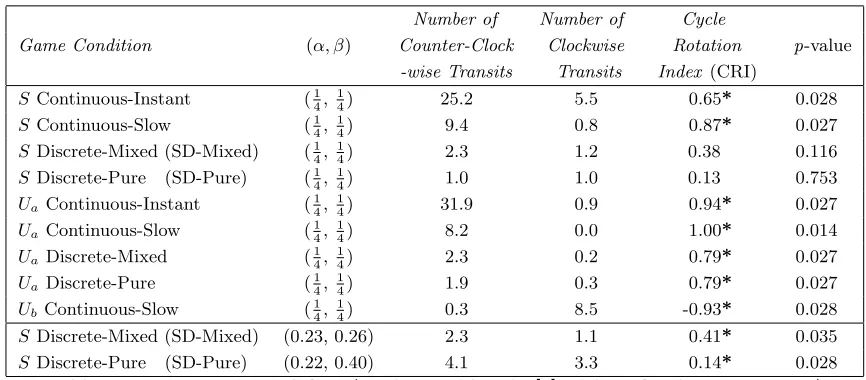
![Figure A1:Illustration of the tripwire for counting cycles (Poincare section) [3].0.10), while the authors [3] set it at (dashed line extending below the point (A tripwire forcounting cycles is a segment constructed between the reference point (α, β) and t](https://thumb-us.123doks.com/thumbv2/123dok_us/7776375.719535/5.612.222.406.111.305/illustration-tripwire-poincare-extending-tripwire-forcounting-constructed-reference.webp)
