Geometric Study of the Weak Equilibrium in a Weighted
Case for a Two-Dimensional Competition Game
López M. Dolores1, Rodrigo Javier2, Sánchez José Manuel1
1
Departamento de Matemática Aplicada de la E.T.S.I. Caminos, Canales y Puertos. Universidad Politécnica de Madrid, Madrid, Spain
2
Departamento de Matemática Aplicada, E.T.S. de Ingeniería, Universidad Pontificia Comillas de Madrid, Madrid, Spain Email: [email protected], [email protected], [email protected]
Received January 18, 2013; revised February 22, 2013; accepted March 2, 2013
Copyright © 2013 López M. Dolores et al. This is an open access article distributed under the Creative Commons Attribution Li-cense, which permits unrestricted use, distribution, and reproduction in any medium, provided the original work is properly cited.
ABSTRACT
In this work, an improvement of the results presented by [1] Abellanas et al. (Weak Equilibrium in a Spatial Model.
International Journal of Game Theory, 40(3), 449-459) is discussed. Concretely, this paper investigates an abstract game of competition between two players that want to earn the maximum number of points from a finite set of points in the plane. It is assumed that the distribution of these points is not uniform, so an appropriate weight to each position is assigned. A definition of equilibrium which is weaker than the classical one is included in order to avoid the uniqueness of the equilibrium position typical of the Nash equilibrium in these kinds of games. The existence of this approximated equilibrium in the game is analyzed by means of computational geometry techniques.
Keywords: Game Theory; Approximated Equilibrium; Location; Computational Geometry; Convex Hull
1. Introduction
Works exist that generalize the study of the Nash equi- librium in a competitive game with two players [1,2]. This generalization is usually performed by means of new definitions of equilibrium that are weaker than the classical one.
In this paper, the definition of weak equilibrium and the game stated in [1] is adapted to a more general game where an appropriate weight is assigned to each position the players aim for. The results included in said paper have been then generalized to be adapted to these new considerations.
The study carried out in this article after the considera- tion of weights implies a step forward with respect to the existing competition models, since it enables a better adaptation to real cases.
The description of the game is as follows: Two consi- dered players want to earn the maximum number of po- ints from a finite set of points in the plane. For this pur- pose they choose their positions in the plane to attract the
largest possible weight of a given set of n weighted
points in the plane H
p1,,pn
.The perpendicular bisector of the players’ locations partitions the plane into two regions. Each player is con-
sidered to capture those points which lie closer to their own position than to that of the other player [3-8]. The pay-off of each player is then the total weight of the cap-tured points.
In formal terms, consider a strategic game
, ,
G N X , whereN
1, 2
2 2
X
is the set of two
play-ers, i:X
1, 2
i
is the strategy space, and ,
is the payoff function of each player.
The description of the payoff function in the game presented above is given by:
1 1, 2
t t
weight of the points pi such that
i,1
i,2
d p t d p t
2 1,2
t t
weight of the points pi such that
1
1 2 1 2
, , ,
i i
d p t d p t n t t
t t
if 1 2, where d p t,
i
tance between the points pi, t. In the case where t1 = t2 represents the Euclidean dis-
1 2
1, 2 1,2
2
n
t t t t is defined.
Therefore, if the weight of a point pi is defined as
w pi ki, with ki > 0 and k1 n , then the
payoff of the first player will be the sum of the weights of all positions located in the same half-plane as t1, in-cluding the points on the bisector. The payoff of the
sec-k n
ond player follows the same pattern, except for positions on the bisector.
Along the paper, the following definitions apply: 1) The weight of a subset
1, ,
of H isk
i i
p p
1
k ij
j w p
i m
i1, , i
w
p p
k
.
2) stands for the i-th weight bigger than
2
n
i m
that
can be attained by a subset of H. Therefore is recur-sively defined as follows:
1 minI H
m w /
2
n
I w I
I mi1
2C
and
min /
i I H
m w w I
for i .3) is the intersection of the convex hulls of the
subsets of H with weight bigger than . For a definition of the convex hull of a set, see [9].
The rest of this paper is structured as follows: In Sec- tion 2, necessary and sufficient conditions are presented for the weak equilibrium positions to exist in this weighted game. Section 3 studies the maximum number of weak equilibrium positions in which the two players are lo-cated in positions of H.
2. Weak Equilibrium
Lillo et al. 2007 [10] present necessary and sufficient conditions for the Nash equilibrium positions to exist in a game as the one considered in this paper. These condi- tions are stated in terms of geometric features such as convex hulls. The main conclusion is that the Nash equi- librium in the game, if it exists, is an unique point (t, t)
for some . In other words, both players will
choose the same position, except in cases where the po- ints of H are aligned.
2
t
0 0 1,2
t t
2 2 1, 2
K t t
To avoid this situation, a definition of equilibrium which is weaker than the classical one is proposed:
Definition 1: A strategy profile
is a weak equilibrium if:
1 0 2 0
1,2 1, 1,2
t t K t t
where
1 0 0
1 minI H 1,2
K w I w I t t and
2 0 0
1, 2 2 minI H
K w I w I t t , that is to say
1
K is the least weight greater than of a sub-
set of H (analogously for
1 0 0 1,2
t t
2 K ).
Remark: This definition is an adaptation to the dis- crete case of the
-equilibrium studied by Monderer and Shapley, 1996 [2].A geometric analysis is developed here that extends the concepts relative to the study of the Nash equilibrium in a weighted game and underlies the search for the equi- librium positions, if they exist, according to the new definition.
Proposition 1:
A weak equilibrium position
t t10,20 necessarily sat-
1 0 0 2 0 0
1,2 1, 1,2 1
t t n m t t n m
isfies .
Proof:
If there exists a weak equilibrium position with, say,
1 0 0
1,2 1
t t n m, then it is satisfied that
1 0 0 1 0 0 2,2 1 1, 2
2
n
t t n m t t
1
0 02,2 1
t t K
, so a
contradiction because
0 0 1,2t t
1 n m
1 m
is a weak equilibrium position.
Remark: The proposition yields that the payoffs in a
weak equilibrium position must be for a player
and for the other or
2
n
1 n m
for both. It can be noted
that is the largest payoff smaller than
2
n
m n
that a
player can obtain.
The following proposition gives a necessary and suffi-cient condition for the existence of weak equilibrium positions:
Proposition 2:
If 1 , then there exists weak equilibrium posi-
tions in the proposed game if and only if Cm1.
Proof:
First it is seen that the condition is necessary: If
1 m
C , then there exists a subset of H with weight
greater than such that its convex hull does not con-
tain the position 2 chosen by the second player (as-
sumed without loss of generality that the payoff of the second player in said position is greater or equal than
1 m
0
t
2
n 0
1
t ). So if the first player is located in the position
with a payoff lower than or equal to
2
n
0
t
1 m
, then the first
player can deviate to a position t1 that separates 2
and the convex hull aforementioned, hence the first
player will get a payoff greater than , therefore
1 0 1, 2 1
t t K . Consequently, there is not a position
0 0 1,2t t
1 m
C
m
C
1 m
1 m of weak equilibrium.
Now it is stated that the condition is sufficient: If is not the empty set, then any player can locate in
1
to ensure that the other player cannot get an earning
big-ger than in any location, because the first player
controls all the subsets of H with weight bigger than .
Hence, every position
t t, t1 m
C
with in is a weak
equilibrium position, because ,
2
i n
t t
for i1, 2
and any player who deviates would obtain a payoff smaller or equal to m1.
weak equilibrium positions. The possible weak equilib-rium positions in the proposed game are:
1)
t t1,2
with , t1 t2 belonging to Cm1,
1,2
2 i
t t
n for i1, 2.
2) If there does not exist a combination of points of H
with weight
2
n
1,2
t t
t C t2
1
t t,
n m, the positions
with one of thepoints, say , belonging to
1, the other one, ,
be-longing to , and .
1 C
m
t t1,2
m12
2
m 1 2 1
3) If there exists a combination of points of H with
weight
2
n
1, 2
t t
t
2 m
C t2
, the positions with one of the points,
say 1, belonging to , the other point, , belong-
ing to
2
n
C ,
t t1,2
and
.2
1, 2 1
t t m
C
C
n
n
n2
1 m
C
3
n
m n
1
1 n m
3. Maximum Number of Weak Equilibrium
Positions
Now the problem of finding the maximum number of points of H that can be included in m1 will be
consid-ered. This subset of H can be interesting for practical purposes, because it carries a large number of weak equi-librium positions in which at least one player locates in the position of one of the points in H. As an example, if the game has a political scope, where the players are par-ties and H is a finite set of types of voters,then this sub-set gives a large number of weak equilibrium positions with the parties fitting to one type of voters.
Concretely the following problem is considered:
Find the maximum number of points of H that can be
included in m1 for all the possible configurations of
points in the plane (no three aligned) and all the pos-sible assignations of weights for these points with
2 . This last condition implies that . The
maximum number to be found is denoted by max.
n
m
3.1. An Upper Bound
The following proposition gives an upper bound for max that is bounded in n. A preliminary lemma is needed:
Lemma 1:
There is some point of H in the boundary of the con-vex hull of H that does not belong to .
Proof:
If , then the points of H are in convex position (a point set is in convex position if every point of the set is
a vertex of its convex hull), so the condition 2
implies that there is a convex hull of a subset of H of
weight 1 that does not contain every point of H.
Hence there is a point of H in the boundary of the convex hull of H that does not belong to .
m
C
4
n
1
C
1 m
If and every point of H in the boundary of the
convex hull of H belongs to m , then every subset of H
with two elements must have weight 2
2
n
m
C
. Otherwise,
there would be a subset of H of cardinal three with
weight 1, not containing every point of H in the
boundary of the convex hull of H, a contradiction
be-cause
1
m contains every point of H in the boundary of
the convex hull. With 4 being the weight of H, this im-plies that every subset of H with two elements must have weight = 2. But this is possible if and only if w p
i 1for every piH and then 2 , a contradiction.
If and every point of H in the boundary of the
convex hull of H belongs to
1, then i 1
for every i
4
m n
4
n
m
C w p
n mp H such that i is in the boundary of
the convex hull of H. Hence, if the four points of H with smallest
p
x
coordinate are considered, say 1, 2,, , then m1 is included in the convex hull of
p p
3
p p4 C
p p p p, , ,
C
max 3
1 2 3 4 . So there is at least a point of H in the
boundary of the convex hull of H that does not belong to
1
m , which is the point of H with the greatest x
coordi-nate, a contradiction.
Proposition 3:
It is satisfied that .
Proof:
Consider a point of H in the boundary of the convex
hull of H and not belonging to
1
m , say n, which
ex-ists by lemma 1. Arrange the other points of H according
to the angle with respect to n, say 1 n1
C p
p p,,p
p
i
. The initial angle 0 is determined by a ray emanating from n and containing a segment of the boundary of the convex
hull of H. Hence, if is the smallest index such that
p1,,pi
has weight greater than2
n
, then
1, , i, n
1w p p p m ,
1, , 1
2 i
n
w p p
, so
1
, , ,
2
i n n
n
w p p p . This last inequality implies that
i2 i1 i n1 n
1, so m1 is included inthe intersection of the convex hulls of 1 i n ,
, , , ,
w p p p p p m C
p,,p p,
p ,p ,p,,p ,p
p p
2 1 1
i i i n n . This intersection is included
in the region limited by the ray emanating from n to
2
i and the ray emanating from to i. This
re-gion contains four points of H: , , and .
n
p p
p p p p
p C
C
max 3
2
i i1 i n
But n is not in m1 by the assumption, so at most
three points of H can be located in
1
m and then
2
i
. Note that if , then i2 makes no sense.
But in this case m1 is included in the convex hull of
p C
p p p1, 2, n
m
C
3
n
, so at most two points of H are included in .
1
Remark: If and , then a point of H,
say 1, must have weight 1. Hence m1 is contained
in the intersection of the convex hulls of
2 3
m n
p m C
p p1, 2
,
p p1, 3
, that is to say, in
p1 . As a matter of fact,
1 1
m
greater than m1 contains to p1. So max = 1 for n3.
3.2. Examples Where the Upper Bound Is Attained
Now it can be seen that for even , , the upper
bound for max is attained in an example with equally
weighted points, so for even , :
n n
n
4
4
n
n
3 n p
p
p
max3
Example 1:
Let be an even number greater than 4 and consider
points in convex position. If three new
points n 2, n1, n are located in the intersection
of the convex hulls of the subsets of
3
p
n3 ,2 n
C
1, ,
p
p
3
1,,pn
with3 2 2
n
n
, ,
points, in such way that
the points are in general position (no three points in the same line) and weight 1 is assigned to each point,
then a set H p1 pn Cm1
C
n
1, ,
p
max
3
with three points in is obtained.
pn2,pn1,pnAn example with 3 points in
1
m can be seen for odd
n, n5, so 3 for odd , n5:
3 n p
Example 2:
Consider n points with weight
1
2 n p
n
n each in the vertices of a regular polygon, a point
with weight 2n
n1 n
1 n p
in C and two points
, with weight
3 ,2
n p
1
n
n Cn2 ,2
p
p
1, , neach and in . First
it is noted that n2 can be located in the intersection aforementioned and non-collinear with two points of
1 n3 because that intersection does not have an
empty interior set. In the same way it can be seen that the points n1, n can be located i n2 ,2 such that
e n points are in general position because this last
intersection also does not have an empty interior set. p
p
p,,n C
th
Now it can be seen that there does exist a subset of
H p p with weight
2
n
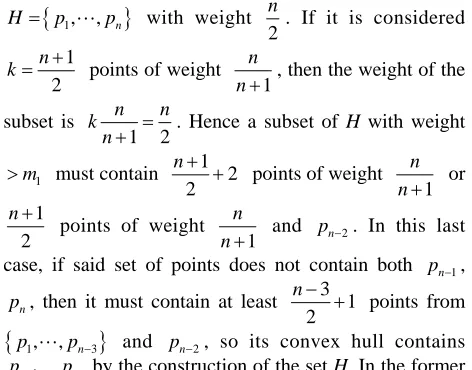
. If it is considered
1 2
n
k points of weight
1
n
n , then the weight of the
subset is
1 2
n
n k
n . Hence a subset of H with weight
must contain 1
m
1 2
2
n
points of weight
1
n
n or
1 2
n
points of weight
1
n
2
1 n p n and pn . In this last
case, if said set of points does not contain both ,
n
p , then it must contain at least 3
2
n
1
p
p1 n p
points from
1,,pn
n p
3 and n2, so its convex hull contains
, by the construction of the set H. In the former
case, the said set of points contains at least 3 2
2
n
points from
p1,,p
p
3
n , so its convex hull contains
2
n , pn1, by the construction of the set H. Con- sequently,
n p
pn2, pn1, n belong to Cm1 as desired.
Now examples of sets H with three points in are
shown for
p
1 m
C 4,5
n :
Example 3:
Consider three non-collinear points 1, 2, 3 and
a point inside the triangle having vertices , ,
p p p
4
p p1 p2
3
p . Assign weight 4
3 to p1, p3, 2
[image:4.595.314.533.330.716.2]3 to p2, p4. See
Figure 1. This allows for 1
8 3
m
, ,
, which is attained in
the following subsets of H p1 p4 :
p p p1, 2, 4
,
p p p2, 3, 4
,
p p1, 3
. Hence the subsets of H withweight 8
3
must contain p1, p3 and one point of
p p2, 4
, and then their convex hulls contain the convex hull of
p p p1, 3, 4
. This implies that Cm1 contains
p p p, ,
p p p
4
p p5
1
p p2 p3
1 3 4
Example 4:
.
Consider three non-collinear points 1, 2, 3 and
two points , inside the triangle having vertices
, , . Assign weight 5
3 to p1, 5
6 p2
5 p
to , …,
. See Figure 2. This allows for 1
10 3
m , which is
Figure 1. Example for n = 4. Cm is the shaded region.
1
p5
5/6
5/6 5/3
5/6
[image:4.595.55.291.545.730.2]5/6
attained in the subsets of H
p1,,p5
of cardinal
p fthree containing p1 and 2,p p p3, 4, 5
.Hence the subsets o
in the set
H with weight 10
3 must con
p2 3 4 5
1, 4,p5 . Thi
points o
-
tain to p1 and at least three points of ,p p p, ,
,and then their convex hulls contain
p p simplies that Cm1 contains this set of three f H.
Proposition 3, its remark and the previous examples yi
hat 1 for n3.
4. Conclusions
ensional competition model has been
erations mean a step forward in the com-pe
lib
w
REFERENCES
[1] M. Abellanas, nd I. Lillo, “Weak
eldthe following corollary:
Corollary 1:
It is satisfied t max
A discrete two-dim
proposed and analysed using geometric strategies. To give the game a general scope, a weight to each point of the finite set which the players fight for has been assign- ed. In this model, Nash equilibrium positions in the ma- jority of the situations do not exist, see [10]. To resolve this situation, a weakened definition of equilibrium has been presented, which ensures for each player that the other can not improve his payoff by more than one quan- tity if he changes his position. This new definition of equilibrium can be useful in cases which have no Nash equilibrium.
These consid
tition models existing in the literature and adapt better to real situations. For instance, if the game is applied to the optimum location of services to gain customers, as- signing weights to the different customers implies the consideration that those who are potentially more related to the service can have a higher value in the competition.
The study of the existence and locations of weak equi- rium positions in this paper have been expanded in scope by applying techniques from computational geo- metry such as the intersection of convex hulls, which can be used because of the discrete nature of the game.
With respect to the study of the maximum number of eak equilibrium positions located in the set H of target points, it has been able to find that maximum for all the sets of n points and all the possible weightings of such points, thus obtaining a very general and original result. Furthermore, the presented examples show that the cases
in which said maximum number is attained are the ones with equally or almost equally weighted points. There- fore, these are the most interesting cases for applied pur- poses.
M. López, J. Rodrigo a
Equilibrium in a Spatial Model,” International Journal of Game Theory, Vol. 40, No. 3, 2011, pp. 449-459. doi:10.1007/s00182-010-0241-y
[2] D. Monderer and L. S. Shapley, “Potential Games,” Games and Economic Behavior, Vol. 14, No. 1, 1996, pp. 124- 143. doi:10.1006/game.1996.0044
[3] M. Abellanas, I. Lillo, M. López and J. Rodrigo, “Elec- toral Strategies in a Dynamical Democratic System,” Euro- pean Journal of Operational Research, Vol. 175, No. 2, 2006, pp. 870-878. doi:10.1016/j.ejor.2005.05.019 [4] M. Abellanas, M. López and J. Rodrigo, “Searching for
Equilibrium Positions in a Game of Political Competition with Restrictions,” European Journal of Operational Re- search, Vol. 201, No. 3, 2010, pp. 892-896.
doi:10.1016/j.ejor.2009.04.002
[5] R. Aurenhammer and R. Klein, “Voronoi Diagrams,” In:
ihara and S. Chiu, “Spatial
o Com- J.-R. Sack and J. Urrutia, Eds., Handbook of Computa- tional Geometry, Elsevier Science Publishers B.V. North- Holland, Amsterdam, 2000.
[6] A. Okabe, B. Boots, K. Sug
Tessellations Concepts and Applications of Voronoi Dia- grams,” John Wiley & Sons, Chichester, 2000.
[7] D. Serra and C. Revelle, “Market Capture by Tw petitors: The Preemptive Location Problem,” Journal of regional Science, Vol. 34, No. 4, 1994, pp. 549-561. doi:10.1111/j.1467-9787.1994.tb00882.x
[8] M. Smid, “Closest Point Problems in Computational
, M. Overmars and O. Sch-
y of Geometry,” In: J.-R. Sack and J. Urrutia, Eds., Handbook on Computational Geometry, Elsevier Science, Amster- dam, 1997.
[9] M. de Berg, M. van Kreveld
warzkopf, “Computational Geometry-Algorithms and Ap- placations,”2nd Edition, Springer, New York, 1997.