AN EVALUATION OF DRUG UTILIZATION PATTERN IN DIABETES
ASSOCIATED INFECTIONS
P. Mounika*, Yogananda R.andBharathi D. R.
Department of Pharmacy Practice, S.J.M. College of Pharmacy, Basaveshwara Medical
College Hospital and Research Center - Chitradurga-577502.
ABSTRACT
Objectives: The goal of the study was to assess antibiotic prescribing
pattern in the management of infections in diabetes patients and to
estimate the prevalence of infections in diabetic patients. The present
study aims at improving the patient’s health care. Materials and
Methods: A prospective observational study was carried out for a
period of six months at General Medicine department of Basaveshwara
Medical College & Hospital, Chitradurga. Results: Out of 187 Patients
102 were females and 85 were males. Majorly the age groups between
46-60years are admitted with Diabetes. The prevalence of infections in
diabetic patients was 67(35.83%). Among 67 patients, 32 and 35 were
infected males and females respectively. 24 patients were more
prevalent with Diabetic foot followed by 23 with cellulitis, 19 with
UTI and 1 patient with Diabetic foot with cellulitis. 65(97.01%) were prescribed with class of
Cephalosporin’s followed by Proton pump inhibitors, Betalactam Antibiotics and other class
of drugs. 65.67% were Ceftriaxone, 17.91% were Cefaperazone, 8.95% were Cefuroxime,
55.22% were pipericillin+Clavulanic acid, 35.82% were Amoxicillin+clavulanic acid, 7.46%
were Doxycycillin, 25.37% were Amikacin, 7.46% were Gentamicycin, 19.40% were
Metranidazole, 23.88% were Nitrofurantoin, 5.77% were Trimethaprime+sulphamethaxazole,
46.26% were Clindamycin, 8.955% were Ofloxocin, 22.38% were Azithromycin.
Conclusion: The prescribing pattern could be improved by reducing the number of drugs per
prescription. Prescription indicators recommended by the WHO can help the Health Care
Centres to obtain better organization and improve health care attention to the public. Thus the
present study may be propitious for the physicians for optimizing rational use of drugs to
Volume 7, Issue 11, 1116-1125. Research Article ISSN 2277– 7105
Article Received on 15 April 2018,
Revised on 06 May 2018, Accepted on 27 May 2018
DOI: 10.20959/wjpr201811-12528
*Corresponding Author
P. Mounika
Department of Pharmacy
Practice, S.J.M. College of
Pharmacy, Basaveshwara
Medical College Hospital
and Research Center -
reduce or prevent the drug related problems and also to improve the quality of life and better
patient care.
KEYWORDS: Diabetes Mellitus, Infections, Antibiotics, Prescription Pattern.
INTRODUCTION
Diabetes mellitus is characterized by poor control of serum glucose levels that result in
hyperglycemia either due to insufficient insulin or poor response to available insulin, altered
metabolism of lipid, carbohydrates, and proteins with increased risk of cardiovascular
diseases.[1]
Diabetic foot infections are infections that can develop in the skin, muscles, or bones of the
foot as a result of the nerve damage and poor circulation that is associated with diabetes.
People with diabetes are more susceptible to developing infection, as high blood sugar levels
can weaken the patients immune system defence. In addition, some diabetes related health
issues such as nerve damage and reduce blood flow to the extremities increase the body’s
vulnerability to infection. The middle-age population is affected that may be due to their
more sedentary life style and adiposity in the developed and under developing countries. The
prevalence of this disease across the world was estimated to be 2.8% in the year 2000 and
4.4% in 2030. In diabetes, the infections can be prevented only if the patient maintains strict
glycaemic control.[2]
Drug utilization study has been defined by the World Health Organization (WHO) in 1977 as
“study of marketing, distribution, prescription, and use of drugs in society, with special
emphasis on the resulting medical, social, and economic consequences. Objectives of drug
utilization includes description of different patterns of drug use in specific populations,
identification and definition of likely problems, general analysis of the problem,
establishment of decisions on problems solving, assessment of the effects of the action taken
and the type of drug utilization studies are quantitative and qualitative current state of drug
use, study state of drug use by indication, daily dose and length of stay and study
appropriateness of drug utilization.[3]
Diabetic subjects probably have a higher risk of the following infections: asymptomatic
bacteriuria, lower extremity infections, cystitis, pyelonephritis, Fournier’s gangrene, diabetic
systemic immunologic defects probably account for higher infection rates in diabetic
patients.[4]
Antibiotics are the most frequently prescribed drugs among the hospitalized patients
especially in Intensive care and Surgical departments. Programs designed to encourage
appropriate antibiotic prescriptions in health institutions are an important element in quality
of care infection control and cost containment.[5]
The fact that antibiotic sensitivity changes with time. Therefore knowledge of common
bacteria involved and their current sensitivity pattern will help us not only in providing the
best initial empirical therapy but also in preventing the long term morbidity.[6]
Therefore, this study is aimed to evaluate the drug utilization pattern in diabetic associated
infections.
METHODOLOGY
Study design: This was a prospective observational study.
Study site: The study was conducted on In-patient of Medicine and Surgery department of Basaveshwara Medical College & Hospital, Chitradurga.
Study period: The study was conducted over a period of six months from November 2016 to
April 2017.
Study subjects: All diabetics patients with any infections admitted in medicine and surgical units of tertiary care hospital during the study period was eligible for enrollment. Patient who
met the following criteria will be enrolled.
Inclusion Criteria
Diabetic patients associated with secondary infections admitted to general medicine ward
and surgical ward.
Both genders.
Age greater than 30 years.
Exclusion Criteria
Gestational diabetes.
Ethical approval
The study was approved by the Institutional Ethical Committee of Basaweshwara Medical
College Hospital & Research Centre, Chitradurga.
Vide number: SJMCP/IEC/20/2016-17 (ANNEXURE -1)
Sources of data
Medical records of In-patients
Interviews with patient & care takers.
Study procedure
• Subjects with diabetic infections who are admitted to medicine and surgical wards, age
above 18 years of both genders will be enrolled into the study. Informed consent form is
issued and explained to the subjects and their representatives in the vernacular language.
Demographic details includes name, age, gender, weight, BMI, medical and medication
history, chief complaints, laboratory values, diagnosis and drugs prescribed are collected in a
pre desingned data collection form. Patient follow up will be done for update of antibiotics in
current therapy. The collected data will be analysed by using XL Sheet and SPSS statistical
methods.
Statistical analysis: Using the Statistical Package for Social Service (SPSS), XL Sheet.
RESULTS
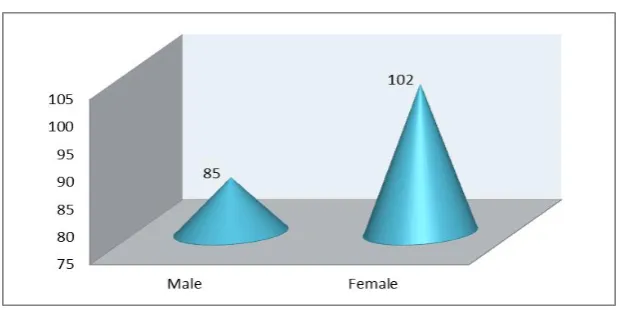
1. Gender: Among the whole 187 patients 85 were males and 102 were females. The result are shown in table 1 and graphically represented in figure 1.
Gender Number of patients % of patients
Female 102 54.54%
Male 85 45.45%
2. Distribution According to Prevalence
In this study population among 187 patients 67 members were having infections like UTI,
Diabetic foot, Cellulitis, 120 with no infections,. The Results are shown in Table 3 and
graphically by Figure 3.
Prevelence: Distribution of Patients According to Prevalence of Disease. Prevalence No of Patients Percentage
Infected 67 35.83
Un-infected 120 64.17
3. Distribution According to Type of infections.
In this study population 67 Infected Patients 35.82% were Diabetic Foot, 34.32% were
Cellulitis, 28.35% were UTI, 1.49% were Diabetic foot with cellulites. The result are shown
[image:5.595.143.457.66.221.2]in table 3 and graphically represented in figure 3.
Table 3: Distribution According to Type of infections.
Type of infections No of patient Percentage
Cellulitis 23 34.32%
Diabetic foot 24 35.82%
UTI 19 28.35%
Diabetic foot with cellulitis 1 1.49%
4. Distribution of Patients According to Class of Drugs
In this study population 97.01% were Cephalosporins, 82.08% were Beta lactum
inhibitors,32.83% were Aminoglycosides,19.40% were Nitrotimadazoles, 46.26% were
Lincosamides, 29.8% were sulfonamides, 8.95% were Fluroquinolones, 22.38% were
Macrolides, 58.20%n were NSAIDS, 79.10% were Anti-Diabetic Drugs, 94.02% were PPIS,
41.79% were 5H2t Antagonist, 59.70% were total. The result are shown in table 8 and grap
hically represented in figure 8.
Table 4: Distribution of Patients According to Class of Drugs.
Class of drugs No of patients Percentage
Cephalosporin’s 65 97.01%
Beta-lactam inhibitors 55 82.08%
Amino glycosides 22 32.83%
Nitroimadazoles 13 19.40%
Lincosamides 31 46.26%
Sulfonamides 20 29.85%
Fluroquinolones 6 8.95%
Macrolides 15 22.38%
NSAIDS 39 58.20%
Anti-Diabetic drugs 53 79.10%
PPIS 63 94.02%
5H2t antagonist 28 41.79%
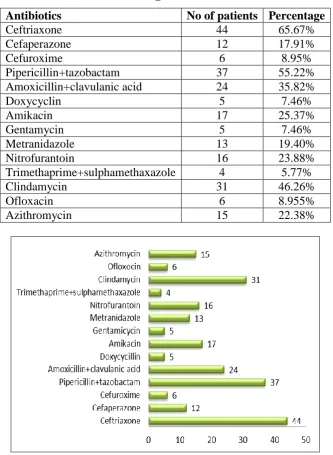
5. Distribution of Patients According to Antibiotics Prescribed.
In this study population 65.67% were Ceftriaxone, 17.91% were Cefaperazone, 8.95% were
Cefuroxime, 55.22%were pipericillin+Clavulanic acid, 35.82% were Amoxicillin+clavulanic
acid,7.46% were Doxycycillin, 25.37% were Amikacin, 7.46% were Gentamicycin,19.40%
were Metranidazole, 23.88% were Nitrofurantoin, 5.77% were
22.38% were Azithromycin. The result are shown in table 9 and graphically represented in
[image:7.595.132.466.140.596.2]figure 9.
Table 5: Distribution of Patients According to Antibiotics Prescribed.
Antibiotics No of patients Percentage
Ceftriaxone 44 65.67%
Cefaperazone 12 17.91%
Cefuroxime 6 8.95%
Pipericillin+tazobactam 37 55.22%
Amoxicillin+clavulanic acid 24 35.82%
Doxycyclin 5 7.46%
Amikacin 17 25.37%
Gentamycin 5 7.46%
Metranidazole 13 19.40%
Nitrofurantoin 16 23.88%
Trimethaprime+sulphamethaxazole 4 5.77%
Clindamycin 31 46.26%
Ofloxacin 6 8.955%
Azithromycin 15 22.38%
DISCUSSION
The prospective observational study was conducted on In-patients of Medicine and Surgery
department to assess the antibiotic prescribing pattern and prevalence of infections in diabetic
patients. In the present study a total 187 patients are enrolled. 85 were males and 102 were
females. The prevalence of infections in females are greater than males. The most disease are
seen in the age group of 46-60years (45.45%). The major infections disease are seen in the
Diabetic foot with cellulitis. The mariorly prescribed antibiotics are (65.67%) ceftrixone,
(55.22%) pipericillin+tazobactam, (35.82%) amoxicillin+clavulanic acid, (23.88%)
nitrofurantoin, (46.26%) clindamycin, (22.38%) azithromycin (97.01%). Cephalosporins,
(82.08%) beta lactum antibiotics, (94.02%) Proton pump Inhibitors, (58.08%) NSAIDS,
(46.26%) Lincosemides, (79.10%) Anti-diabetic drugs are majorly prescribed drugs.
A prospective non interventional study conducted by Brahmbhatt SV et al., on drug utilization pattern & rationality in treatment of type II diabetes mellitus: a population based
analysis and found that Diabetes mellitus was observed to be highest in patients with the age
group of 60-70 years, affecting 66% males and 34% females. Among the participants 42
(84%) were already on treatment for diabetes while 8 (16%) were diagnosed at the time of
admission. We observed that 27 (54%) patients were treated with insulin + oral hypoglycemic
agents, 13 (26%) were treated with only Insulin while 10 (20%) patients were prescribed only
oral hypoglycemic agents. The most common co-morbid conditions observed by us were
hypertension, chronic renal disease, diabetic foot, septicemia, urinary tract infections and
other susceptible infections.[31]
Another prospective observational study conducted by Massodi SR et al., on the Pattern of infections in patients with diabetes mellitus–Data from a tertiary care medical centre in
Indian sub-continent shown that Diabetic patients with infections were older (50.5 years
versus 46.6 years),had diabetes of longer duration (6.6 years versus5.5years), and had higher
fasting glucose (282 mg/dl versus 210 mg/dl), triglycerides (192 mg/dl versus 174 mg/dl) and
creatinine (1.1 mg/dl versus0.9 mg/dl). The prevalence of microvascular complications and
coronary artery disease were significantly higher in the group with infections. The infections
encountered included soft tissue infections (171, 42.8%), pulmonary infections (121, 30.2%),
urinary tract infections (108, 28.4%) and more than one infection (20, 5.3%); two patients
had rhino cerebral mucormycosis. Overall Staphylococcus aureus was the most frequently
isolated pathogen, causing 62.93% of soft tissue infections and 20% of bacterial pulmonary
infections. About one-fifth of the patients with infections.[49]
Another prospective study conducted by Ali N et al; on the Amongst the reported patients (Table 1, n=856), there were 82.2% type II and 17.46% type I diabetic patients. There were
410 patients with diabetic foot who were put on main drug therapy for the control of
hyperglycemia and supportive antibiotic drug therapy for the control of concomitant foot
measures were routinely performed for patients. foot care. To 69.48%of the admitted cases,
insulin therapy was recommended for the management of hyperglycemia as main therapy
(data not shown). The prescribed oral hypoglycemics were in the order of metformin
(39.64%), glibenclamide (12.6%), glimepiride (9.5%), pregabalin (7.93%), and
tolbutamide(1.8%). In 60.3% of the treated cases, combination of insulin and oral
hypoglycemics was tried. In addition toother supportive measures advised for the
management of diabetic foot, the antibiotic therapy (Table 2, n=410) was in the order of
ceftriaxone (83.3%) > co-amoxiclav(36.66%) > clindamycin and ciproß oxacin (26.66%)
>cefuroxime and levoß oxacin (10.0%)>clarithromycinand cefoperazone/sulbactam,
cephradine and fusidic acid (6.6%) > cefotaxime sodium, and oxytetracyclin (3.33%). Placing
ceftriaxone as the Þ rst choice in the antibiotic therapy carries no logic, as ceftriaxone has low
activity against gram-positive organisms. It is recommended that an ideal antibiotic should
cover staphylococcus and streptococcus species as their incidence is approximately 85.0 % of
the culture.c Therefore, while going for the treatment of antimicrobial therapy on empiric
basis till the arrival of laboratory culture sensitivity reports in diabetic foot, we shall consider
the use of co-amoxiclav as a Þ rst choice as it is active against gram positive and
beta-lactamase-producing strains. Similarly, the use of ciproß oxacin should be discouraged as a
primary antibiotic therapy because there is 10.0 % involvement of coli form species in the
foot ulcers and may be considered upon the laboratory culture sensitivity report.[39]
CONCLUSION
According to the analyzed results and from view of literature, the conclusions made are; The prevalence rate of infections among the diabetic patients founds 35.83%.
Among 67 infected diabetic patients 47.76% were males and 52.23% were females
and conclude that females are more prone to diabetic infections.
Age above 45-60 age groups of diabetic patients with infections is more.
Among 67 infected patients 100% were having past medical history of diabeties mellitus.
Among 67 infected patients 79.10% were under past medication history. 1Diabeties with infections was more prevalent in study population followed by cellulitis, diabetic foot, UTI.
Among 187 diabetic patients 67 patients diagnosed with diabetic infections.
diabeties mellitus.
Majorly 97.01% cephalosporins, 82.08% beta lactams, 22% aminoglycosides, 19.40%
nitroimadazoles, 46.2% lincosamides, 22.38% macolides are mainly prescribed antibiotics followed by other class of drugs in diabeties associated infections.
Among 187 patients 79.10% Anti-diabetic, 29.85% sulfonamides, 22.38% macrolides,
58.20% NSAIDS, 94.02% PPIS, 59.70% other class of drugs.
The prescribing pattern could be improved by reducing the number of drugs per prescription.
Prescription indicators recommended by the WHO can help the Health Care Centres to obtain
better organization and improve health care attention to the public. Thus the present study
may be propitious for the physicians for optimizing rational use of drugs to reduce or prevent
the drug related problems and also to improve the quality of life and better patient care.
REFERENCES
1. Ali N, Rehman S, Imran M, Hussian I, Shehbaz N, Jamshed H, Hayat A, Khan S, Anwar
MJ. The In-Practice Prescribing Pattern for Antibiotics in the Management of Diabetic
Foot. J Young Pharm, 2009; 1(4): 375-78.
2. Raj K, Kamalesh K, Kajal HL. A study of drug prescribing pattern and cost analysis
among diabetic patients in a tertiary care teaching institute in north India. Journal of Drug
Delivery & Therapeutics, 2013; 3(2): 56-61.
3. Thomas Z, Narendra K, Swamy A CH, Mahendravarman P, Senthilvelan M. A study on
drug utilization, prescribing pattern and use of antibiotics in management of diabetic foot
ulcer. IJIPSR, 2015; 3(8): 1037-49.
4. Boyko EJ, Lipsky BA. Infections and diabetes. West J. Med., 1991; 130: 485-99.
5. Preeth M, Shobhana J. Study on prescribing patterns of antibiotics used in the
management of various infectious diseases in Andhra Pradesh. IRJP, 2011; 2(7): 112 - 15.
6. Ijaz M, Ali S, Khan SM, Hassan M, Bangesh IH. Urinary tract infection in diabetic
patients, causative bacteria and antibiotic sensitivity. J. Med. Sci., 2014; 22(3): 110-14.
7. Chen L, Smith GD, Harbord RM, Lewis SJ. Alcohol Intake and Blood Pressure: A
Systematic Review Implementing a Mendelian Randomization Approach. PLoS