Facilitating Customer Adherence to Complex Services through Multi-Interface Interactions:The Case of a Weight Loss Service
Abstract
Today’s communication landscape affords multiple service interfaces to promote customer engagement (i.e. adherence) with complex and prolonged services, but understanding of how customers use them is limited. This study compares personal and non-personal interfaces that provide educational and/or emotional support for customers to develop the operant resources (i.e. competence and motivation) necessary for adherence. A survey of 270 subscribers to a weight-loss programme demonstrates that booklets and a website (non-personal interfaces) provide educational support that enhances role clarity and ability to adhere, respectively. For novices, it is customer forums (personal interface) that afford the educational support needed to develop ability. Group meetings (personal interface) provide emotional support that boosts customer motivation to adhere and, in turn, encourages them to help other customers. Our study distinguishing types of support for adherence, accessed via multiple service interfaces, has implications for management and highlights needs for future research into complex and prolonged services.
Facilitating Customer Adherence to Complex Services through Multi-Interface Interactions:The Case of a Weight Loss Service
1. Introduction
Complex and prolonged services, such as healthcare, weight-loss, education and sports services, require highly engaged customers who participate in co-producing the service to reap the desired benefits (Bitner, et al., 1997). These are services for which customers contribute a considerable range of resources (cognitive, emotional and physical inputs) within their own sphere to co-produce the service, often over prolonged periods of time, by adhering to guidelines set out by the service provider (see also Bitner et al., 1997; Spanjol et al., 2015; Sweeney et al., 2015). Firms are motivated to support adherence as it leads to customer goal attainment, satisfaction (Dellande et al., 2004) and positive word of mouth (Verleye et al., 2014). The modern communications landscape offers firms a multitude of ways to interact with and support customers (Patricio et al., 2011). Further, interactions amongst customers providing help and support to one another are increasingly facilitated through firm-hosted on-line forums (Dholakia et al., 2009), adding to the range of interfaces customers can draw upon to develop the resources necessary for co-production activities. However, there is a lack of insight on how customers seek support in multi-interface environments and, consequently, little guidance for service providers on ways to combine interfaces to support their customers (Neslin et al., 2006). The purpose of this paper is to explore how multiple service interfaces, and the forms of support they provide, help customers to develop the operant resources (i.e. competencies and motivation) necessary for adherence.
2015) because it requires a considerable co-production effort from customers, involving the development of competencies and sustained levels of motivation over some time. Our research focuses upon customer perceptions of educational and emotional support provided by the firm and other customers (i.e. multiple actors) through various service interfaces, examining the effect on aspects of competence and motivation that enable adherence and promote helping other customers.
Traditionally, instructions from providers, viewed as embodied service provider expertise, were regarded as the most powerful cue for adherence (Bowman, Heilman and Seetharaman, 2004; Dellande et al., 2004) and attention has centred upon customer education as a way to enable customers to perform ascribed roles and tasks. Although this work has provided valuable insights into the features of customer education (relating to content, channel, timing and source) that influence its effectiveness (Temerak, Winklhofer and Hibbert, 2010), most studies have examined only a single service interfaces, such as face-to-face consultations, leaflets or websites (Auh et al., 2007; Bowman, et al., 2004; Dellande et al., 2004; Lin and Hsieh, 2011; Zaho et al., 2008) and have focused on firm-customer dyads. This reflects a narrow view on service when it is increasingly recognised that developing operant resources can take place through multiple actors, accessible through various interfaces within service networks (Breidbach et al., 2014).
To advance our understanding of how service providers can support customers in developing the operant resources necessary for adhering to complex and prolonged services, this paper draws on literature on education and social support to illuminate differences in the types of support provided by personal and non-personal interfaces. Further, it provides empirical insights into the reciprocity generated when customers make use of personal interfaces. Through this inquiry, we hone in on two aspects of customer engagement -adherence and customer helping behaviour (Van Doorn et al., 2010; Verleye et al., 2014) - and offer insights on how to manage these types of customer engagement behaviour via personal and non-personal service interfaces in the context of complex and prolonged services.
2. Literature review and hypotheses development 2.1 Customer co-production and adherence
Scholars have long recognized the importance of enabling customers to perform ‘in-role’ behaviours (e.g. Bettencourt and Brown, 1997) defined as “behaviors necessary for successful service creation” (Yi, Nataraajan, and Gong, 2011:88). In complex service contexts, these tend to be conceived as a form of co-production given the importance of service provider expertise in shaping recommended activities (Mende and van Doorn, 2015). Early research was dominated by a managerial perspective and focused upon customers’ willingness and ability to enact the roles ascribed to them (Kelley, Skinner and Donnelly, 1992; Lengnick-Hall, 1996). However, in the last fifteen years this literature (Bendapudi and Leone, 2003; Dellande et al., 2004; Guo et al., 2013; Meuter et al., 2005) has aligned with the idea that value is co-created (Vargo and Lusch, 2008), acknowledging the idiosyncratic nature of value, the contextualized nature of customers’ behaviour and the importance of mutual service relationships.
to co-produce complex services; also viewed as forms of customer engagement (Van Doorn, et al., 2010). Although these two constructs have distinct conceptualisations, they are often used interchangeably (Black and Gallan, 2015). Compliance reflects the extent to which a customer conforms to a service provider’s requests, policies, or procedures (Guo et al., 2013) and has been criticised on the grounds that it neglects the potential agency of customers (Bastable, 2006). Consequently, some recent research (Seiders et al., 2014, Snell, White and Dagger, 2014; Spanjol et al., 2015) has elected to focus upon adherence, most notably for research into well-being, which interfaces with literature in the field of health.
we define customer adherence as ‘customers’ co-production activities that apply service guidelines, within the parameters for personalization, to progress toward desired service benefits’. This definition reflects the context of our study and aligns with contemporary concepualizations of co-production that acknowledge the personalised nature of service benefits and customer agency in contextualisation processes.
2. Developing customer operant resources to facilitate adherence
2008), newsletters (Gruen, Summers and Acito, 2000), consultation with service personnel (Auh et al., 2007; Dellande et al., 2004; Eisingerich and Bell, 2008; Seiders et al., 2014) and online forums (Dholakia et al., 2009). A notable exception is a study by Beuningen et al. (2009) who differentiate between firms, third parties and peers as information sources and explores their influence on self-efficacy depending on consumer evaluations of the information each provides in terms of argument quality and source credibility. This research has offered valuable insights but only limited guidance on the diverse ways in which service organisation operating in contemporary communication landscapes can support co-production (Hibbert, Winklhofer and Temerak, 2012; Pera, Occhiocupo and Clarke, 2016).
embedded social networks, incorporating close social ties such as family and friends, are more likely to provide both emotional and instrumental support. Research has shown that support from social groups in service contexts not only enables co-production activities; it also encourages customers to reciprocate by helping others (Dholakia et al., 2009; Rosenbaum and Massiah, 2007). Customers are likely to feel indebted toward others (i.e., the community) for benefits received (i.e., knowledge and social support) and pay back by offering help to the community (Palmatier et al., 2006). This form of engagement with the customer community is valuable to augment and sustain the resources of the community. The emerging literature on customer engagement links these various concepts. It provides evidence that support from other customers and from the service provider is essential to gain role readiness necessary to stimulate engagement behaviours (e.g. compliance and helping other customers) (Verleye, et al., 2014).
less often in contemporary scholarship as research often seeks to characterise communications via new information and communication technologies (Liu and Shrum, 2002). However, this traditional distinction is relevant here given the capacity of inter-personal interactions to afford the types of resources needed to support adherence.
2.3 Conceptual model
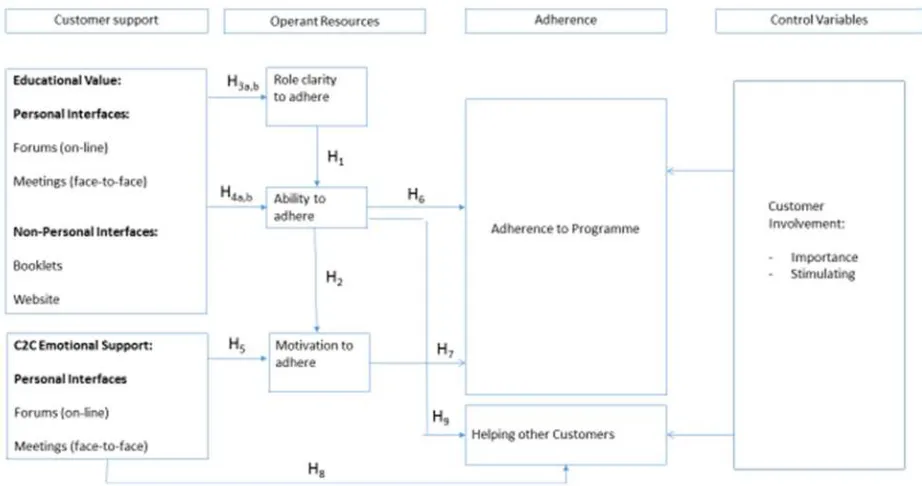
The gaps in research on support for customer adherence to complex and prolonged services are addressed in the conceptual framework developed for this study, which is depicted in Figure 1. The framework posits that different forms of support, incorporating multi-interface (non-personal and personal) and multi-actor support, are needed to develop key operant resources that enable customers to adhere to a service and encourage them to help other customers, thus contributing to the cycle of activity that strengthens the resources of the customer community. Although helping behaviour is not directly linked to adherence, it is included in the model to close the loop of receiving support from other customers (see Verleye et al., 2014).
In the following sections, we outline the theoretical rationale for the key relationships represented in our framework and advance research hypotheses. The framework also includes involvement as a control variable, which is discussed in the research method section.
Insert Figure 1 – about here
external forces shape service exchange. In this study we concentrate on micro level processes by which customers’ develop operant resources for adherence and draw upon SCT because it attends to individuals’ internal processes but recognises that they act within external constraints (see Evans (2007) for a review of theories that recognize forces of structure and agency). A similar balance characterises role theory, which reflects individual interpretations of roles but, acknowledges that social and service roles are shaped by external forces.
Key components of role readiness are role clarity, ability and motivation (Dong et al., 2008; Meuter et al., 2005). Role clarity “reflects the consumers’ knowledge and understanding of what to do” (Meuter et al., 2005: 64). Ability is defined as the skills and confidence to undertake the role (Bitner et al., 2002), while motivation is “a customer’s incentive to carry out their role” (Dellande et al., 2004: 79). When customers understand their expected roles in the service co-production process, they are better placed to assess whether they have the necessary skills and abilities to perform tasks associated with those roles which, in turn, has a motivating effect (Bandura, 1986; Bettencourt et al., 2002). Empirical studies have confirmed the positive influence of role clarity on customers' ability and, in turn, on their motivation to engage in a particular behaviour (Dellande et al., 2004; Dong et al., 2008; Zaho et al., 2008). It therefore follows that:
H1: Role clarity positively impacts on a customer’s ability to adhere to a service programme
H2: Customer ability positively impacts on a customer’s motivation to adhere to a service programme
motivation (combined in the self-efficacy construct) (Beuningen et al., 2009; Snell et al., 2014). Dellande et al. (2009) provide a more comprehensive view with a study that examines how educational support impacts upon all three dimensions of role readiness (i.e. role clarity, ability and motivation). However, in common with the broader customer education literature (Auh et al., 2007; Dholakia et al., 2009; Eisingerich and Bell, 2008; Zaho et al., 2008) they focused only a single educational interface (i.e. service personnel) and do not examine the effects of emotional support, which can also be accessed through personal interfaces.
Our model addresses this gap by examining how multiple interfaces influence role readiness, distinguishing amongst the types of support that each affords. We concentrate on personal (i.e. group meetings, online forums) and non-personal (i.e. booklets and a website) interfaces and our foregoing discussion explains the strengths of each type of interface to provide educational support, incorporating inert and/or experience-based knowledge, and emotional support. We propose that educational support specifically develops elements of role readiness relating to customers’ knowledge and experience, that is, role clarify and ability. We posit that support through each type of interface is positively associated with role clarity and ability, although the strength of these relationships may vary due to the type of knowledge that personal and non-personal interfaces convey:
H3a: Educational input received via personal interfaces (i.e. meetings and online forums) positively impacts role clarity to adhere to a service programme.
H3b: Educational input received via non-personal interfaces (i.e. booklets and website) positively impacts role clarity to adhere to a service programme.
H4b: Educational input received via non-personal interfaces (i.e. booklets and website)positively impactscustomer ability to adhere to a service programme.
While education has the potential to indirectly affect motivation due to its influence on role clarity and ability, emotional support is likely to have a direct positive effect in motivating customers to adhere to a programme. Personal interfaces such as group meetings and online forums can bring together service staff and customers to create social networks. Engaging with these personal interfaces affords emotional support in the form of assistance and encouragement that helps to build a sense of confidence and control in relation to personal health (Pålsson, and Norberg, 1995), such that customers are more motivated to address their own challenges, persist with actions and invest effort in overcoming obstacles (Dholakia et al., 2009). A primary effect of emotional support, therefore, is to motivate customers for adherence activities:
H5: Emotional support received via personal interfaces (i.e. meetings and online forums) enhances customer motivation to adhere to the programme.
have developed the necessary knowledge and skills, also has a direct effect on adherence (Dellande et al., 2004). This is consistent with SCT, in that people are more prone to engage in activities for which they are capable, and to avoid those that are beyond their abilities (Ozer and Bandura, 1990). Hence, we hypothesize the following:
H6: Customer ability is positively associated with adherence to a service programme
H7: Customer motivation is positively associated with adherence to a service programme
H8: Receiving emotional support via personal interfaces promotes helping other customers.
We note above that people undertake activities when they feel they have the relevant abilities. Research has shown that this extends not only to core service co-production activities, but also to voluntary behaviours (e.g., sharing their complaints and concerns with the service provider) (McKee et al., 2006). Similarly there is evidence that customers who lack the knowledge and ability for such activities avoid them and play more passive roles (Halstead, Jones and Cox, 2007). Thus, we propose:
H9: Customer ability to adhere to the programme is positively associated with helping behaviour.
3. Methodology
3.1 Research setting, approach and participants
Data, to test the hypothesized relationships, were collected via an online survey. To understand how support enabled customer adherence, filter questions were included to identify participants familiar with all four interfaces that give access to support. We recruited participants by posting a hyperlink to the on-line survey on WeightWatchers forums. A total of 480 responses were received, of which 413 were complete. Analysis of the filter questions revealed a total of 270 respondents making use of the booklet, website, online forums and group meetings, who were retained in the final sample. All of the respondents were female, reflecting WeightWatchers predominantly female customer base. The sample combined novice and experienced members; 19.3 % (n = 52) were first time WeightWatchers members, and 80.7 % (n = 218) repeat users.
3.2 Statistical analysis
The model (see Figure 1) is analysed using the Partial Least Squares approach (PLS) (Chin, 1998). PLS allows testing of formative and reflective measurement models, which is not possible in standard covariance based methods (EQS and LISREL) (Diamantopoulos and Winklhofer, 2001).
3.3 Measurement models and variables
The following provides a detailed account how each construct is measured. Appendix A lists the items and type of measurement models employed to capture each of the constructs in the conceptual model.
original scale (i.e. resourceful and intelligent) were removed at the piloting stage, as they were not consistently interpreted by respondents in reference to all the four educational interfaces examined in this context.
Emotional support was measured by a scale adapted from Rosenbaum and Massiah (2007). This scale focuses on social interaction, which is central to emotional support, as opposed to instrumental support. The original scale incorporated nine items, but one of these indicators (gives you information or advice) was removed due to the overlap with educational value.
Role readiness encompasses role clarity, ability and motivation. These constructs, and their measurement, originated from organisational behaviour literature but have been adapted for research into service customers. For this study, we adopt Meuter et al.’s (2005) role clarity scale. Ability and motivation are each measured by four-item formative indicators derived from Dellande et al. (2004), who also apply these constructs in a weight-loss context. The indicators are adapted to capture the customers’ ability and motivation to adhere to the diet plan, engage in physical activity, pointing food and tracking daily food points. Two other items in the original scale were removed due to lack of relevance to our research context. In particular, they were related to the packaged food supplements.
WeightWatchers revealed a total of 14 different activities that capture adherence to the service programme as defined earlier (see Appendix A). To satisfy guidelines of formative measure development (Diamantopoulos and Winklhofer, 2001), a generic measure of customer coproduction behaviour developed by Groth (2005) (minus two items removed after piloting -see Appendix A) was included to validate the newly developed measure of customer adherence to the WeightWatchers service programme.
To measure customer helping behaviour we used Groth’s (2005) scale, which distinguishes customer helping from other forms of citizenship behaviour. Four reflective indicators in this scale were adapted to capture helping others to adhere to the WeightWatchers programme. Respondents were asked to rate all items on a 7-point response format, ranging from 1 (fully disagree) to 7 (= fully agree).
3.4 Control variable
4. Results
4.1Measurement Model 4.1.1 Reliability
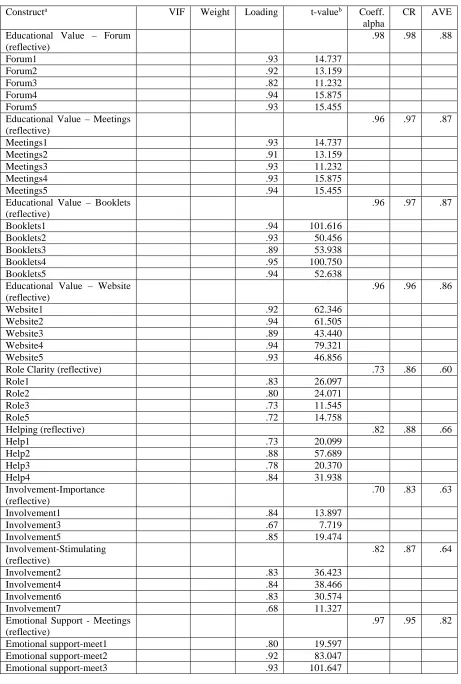
Reflective measurement items were first subjected to principle component analysis and then, confirmatory factor analysis using 5000 bootstrap samples. All the measurement items loaded on their respective factors (see Table 1), exceptions being a single item (Role 4) belonging to role clarity construct as well as three items (Involve 8, Involve 9 and Involve 10) belonging to customer involvement. The factor loadings ranged from 0.67 to 0.96, which is indicative of reliability of the constructs (see Table 1). The values of Cronbach's alpha, composite reliability and AVE exceeded the recommended thresholds in the literature (Hair et al., 2013).
Against our expectations, the seven measurement items of customer involvement loaded on two different factors instead of one. By investigating the wording of the these items, three items (i.e. important, relevant, means a lot) were found to reflect a personal “importance” component of weight-loss, while the other four items (interesting, exciting, appealing, fascinating) were found to reflect how “stimulating” they find weight-loss. These results may reflect the nature of the health care services, which is different from other commercial services (e.g., hospitality services) by being important but not stimulating or an exciting service to go through (Berry and Bendapudi, 2007).
Insert Table 1 - around here
4.1.2 Validity
discriminant validity, with square root of AVE exceeding any correlation between constructs (Fornell and Larcker, 1981) (see Table 2).
Insert Table 2 - about here
To establish the validity of the 14-item formative adherence construct, the process described by Diamantopoulos and Winklhofer (2001) is used. Items generated to form the whole domain of the construct are based on an extensive content analysis of documents associated with the programme and via two independent experts familiar with the programme. To assess convergent validity of the formative measure, it is linked with a generic 3-item reflective measure of adherence (see Appendix A). The path coefficient (β = .699, p <.01)
indicates a considerable level of redundancy, thus confirming convergent validity (Hair et al., 2013). Maximum VIF of the formative items is 2.81, indicating no problems with multicollinearity. Finally, all 14 formative items have significant outer weights confirming the relevance of the item pool. Weights are derived via multiple regression analysis with the latent variable score as dependent variable and the formative indicators as independent variables (see Hair et al., 2013).
4.2 Structural model and hypotheses testing
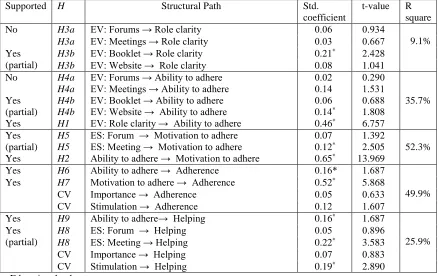
The structural model is tested using a bootstrapping approach with 5000 sub-samples. R2 values show that the model explains 49.9% of customer adherence and 25.9% of helping behaviour. In terms of role readiness, the model explains 9.1% of role clarity, 35.7% of ability to adhere and 52.3% of motivation to adhere (see Table 3 for a summary of results).
= .65, p <.05). Amongst the non-personal learning resources included in our study, the educational value of booklets (β = .21, p <.05) enhances an individual’s role clarity, lending
partial support to H3b; and the educational value of the website strengthens their ability to adhere to a service programme, as proposed by H4b (β = .14, p <.05). In contrast, that of a website does not appear to increase role clarity (H3b: β = .08, n.s.) and the educational value of booklets does not seem to be linked to a user’s ability to adhere (H4b: β = .06, n.s.). In terms
of the educational value of personal interfaces (forums and meetings), they neither seem to improve role clarity (H3a: β = .06, n.s. for Forums; β = .03, n.s. for Meetings), nor a customer’s ability to adhere to a service programme (H4a: β = .02, n.s. for Forums; β = .14, n.s. for
Meetings).
Previous research highlights that users with varying levels of expertise require different educational input (Bell and Eisingerich, 2007). To examine how approaches to learning develop as customers gain experience we follow the approach adopted by Dagger and O’Brien (2010) and compare novice (n= 52) and experienced customers (n = 218), employing the multi-group moderator analysis function within SmartPLS 3. For novice customers, the educational value of forums enhances their ability to adhere (β = .276 p<.05), which is not the case for experienced customers (β = -.002, n.s.). In contrast, for experienced customers the education value of the website strengthens their ability to adhere to the programme (β =.164, p<.05), which does not apply to novice user (β =.091, n.s.).
Wirth regards to H5, we found evidence that emotional support received via face-to-face group meetings (β = .12, p<.05) motivates an individual to adhere, while emotional support received through personal interactions with the Forum does not appear to motivate (β = .07,
n.s.), thus only partly supporting H5.
As expected, ability (β = .16, p<.05) and motivation (β = .52, p<.05) to adhere positively
helps other customers depends on their ability to adhere to the programme, confirming H9 (β
= .16, p<.05). The results partially support H8, demonstrating that individuals’ benefitting from receiving emotional support via attending meetings, a personal interface, are also more inclined to help others (β = .22, p<.01), while the emotional support via on-line Forums does not appear to encourage individuals to help other customers (β = .05, n.s.). Amongst the control variables,
individuals who finds weight-loss stimulating are more inclined to engage in helping behaviour (β = .19, p<.01).
In summary, the findings show that each of the four interfaces indirectly enhances adherence through their effect on the three components of role readiness (i.e. role clarity → ability → motivation). The four interfaces support different components of role readiness, or
5. Discussion and conclusions
For customers to benefit from prolonged and complex services, customer engagement in the form of adherence to a service programme is often required. This is especially true of needs-based services (e.g., chronic disease management, weight-loss, debt management), which necessitate a high level of expertise and motivation from customers as activities necessary to benefit from the service predominantly take place within the customer’s sphere (Seiders et al., 2014), resulting in the customer co-producing the service. There is a valuable body of literature that reveals how customer education in various forms can, individually support service co-production (e.g. Auh et al., 2007; Dellande et al., 2004; Eisingerich and Bell 2006; Lengnick-Hall et al., 2000; Zaho et al., 2008). However, the changes in communication landscape bring to the forefront that our current understanding does not offer sufficient guidance for providers of complex services. We argue, to fully understand and support customer adherence demands a better grasp of the interfaces through which customers acquire the necessary operant resources, which we capture through the concept of ‘role readiness’ (i.e. role clarity, ability and motivation). Unlike earlier work, we simultaneously explore the role of educational and emotional support provided by the firm and other customers through non-personal and personal service interfaces and their impact on customer adherence. We highlight that non-personal interfaces (booklets and a website) primarily provide firm-based inert knowledge, whereas personal interfaces (group meetings and forums) are multi-faceted and, alongside inert knowledge, they also provide insight on how it can be applied in practice, under various circumstances (Contu and Wilmott, 2003), and offer emotional support (Rosenbaum ad Massiah, 2007).
results confirm that all three psychological processes are important antecedents of adherence to the weight-loss programme.
Turning our attention to the various interfaces, in the overall sample we find that non-personal interfaces such as firm-generated educational support in booklets enables customers to develop role clarity and the website, which incorporates more detailed information (e.g., recipes for meals consistent with the parameters of the regimen) helps customers to develop the ability to follow the programme. Given that a customer’s ability is vital for their motivation to adhere which in turn is essential for adherence, the non-personal interface of a website is an important educational tool. These findings are broadly comparable with previous research that connects firm-based education with customer expertise (although not necessarily based on frameworks that distinguish between role clarity and ability) (Bell and Eisingerich, 2007). However, when we compare novice and experienced WeightWatchers members, we find that the educational value of the website enhances ability for adherence only amongst experienced members. For novice customers the personal interface of forums is more important for developing their abilities. These findings are consistent with the idea that novice customers’ interactions with experienced communities play an important role in enabling them to access experience-based knowledge that helps them to incorporate new activities into their everyday life (Lave and Wenger, 1991). Novice users appear to draw on the experiences from other forum members to contextualise the provider-based information given in the form of booklets and websites in order to find solutions that work for them.
a weight-loss context. This contrast highlights the limitations of customer-to-customer learning and that the main role of customer-to-customer interactions in our study is to give each other emotional support. Only novice customers feel they can improve their ability to adhere from other customers via the forum. More broadly, this research complements previous research that concentrates only on educational inputs for which the effects on motivation are mainly indirect (e.g. Zaho et al., 2008).
The study shows that customers who are confident in their ability and benefit from the personal interactions during weekly meetings are more likely to engage in helping other customers. The desire to help is greater for those who find the topic of weight-loss more stimulating. These findings confirm previous research that examines emotional support and voluntary customer contributions in on-line and off-line service settings (Bove et al., 2009; Dholakia et al., 2009; Rosenbaum and Massiah, 2007). However, by examining this activity alongside adherence we reveal the intersection between these engagement behaviours by showing that customers are also more likely to help others when a personal interface (i.e. group meetings) has enabled them to develop relevant operant resources (i.e. motivation). To sustain the cycle of customers supporting each other within a service network, it is essential to encourage them in both beneficiary and provider roles (Ekman et al., 2016). Finally, our study demonstrates that educational and emotional inputs via non-personal and personal interfaces are required to accommodate the needs of novice as well as experienced users.
6. Managerial implications and future research directions
resources. This study of a weight-loss programme illustrates, for example, that educational support provided through non-personal interfaces (booklets and websites) are valuable resources, especially for experienced customers, who are able to develop role clarity and ability by drawing upon them. It is likely that they act as a reference guide that customers can refer to repeatedly, in their own time, as they build competencies relating to the programme. By contrast, customer forums are a particularly important interface for more novice users as they allow them to contextualise the programme by drawing on the expertise and experience of other users. However, both groups find that the personal interface of meetings helps to motivate them. The differences that we see here between novice and experienced customers highlight the need for a targeted approach such that support for adherence is adapted to the needs of particular customer segments. With the use of technology, there will be ever more scope to develop support that, at least in part, is targeted to individual needs and preferences (e.g., supplying content based on food diary or exercise tracking information). Our findings demonstrate the opportunity to strengthen the resource base by encouraging customers to assume voluntary contributor roles; understanding what motivates these contributions is key to developing such a strategy, especially in the context of complex and prolonged services offered to a mass market, where one-to-one support is likely to be prohibitively expensive.
dyads, to investigate how customers engage with various interfaces and the resources that they derive as they seek to develop the competencies that they need to adhere to complex services. Given that significant problems arise when customers are not able to adhere to programmes, we would also encourage greater research attention to the lack of necessary resources, or barriers to accessing resources, for those people who struggle with adherence.
Our study is limited by the single context in which we examine support for adherence and by the cross-sectional nature of the research. Future research across contexts, and using longitudinal data to represent the dynamic nature of the prolonged services, will help to address these limitations. Further, the sample of this study was recruited on-line to include respondents who use both non-personal and personal interfaces, to examine their perceptions of the educational and emotional values provided by each. However, this has led to the exclusion of respondents who only use off-line interfaces. Future research could also explore similarities and differences between different segments (i.e. on-line users, off-line users and multi-interface users) in the education and emotional support that enables adherence.
References
Adelman, M.B., & Ahuvia, A.C. (1995). The antecedents, processes and outcomes of social support in an introductory service.Journal of Business Research, 32, 273-282.
Auh, S., Bell, S., McLeod, C., & Shih, E. (2007). Co-production and customer loyalty in financial services.Journal of Retailing, 83, 359-370.
Baldus, B. J., Voorhees, C., & Calantone, R. (2015). Online brand community engagement: Scale development and validation.Journal of Business Research, 65 (5), 978–985. Bandura, A. (1986). Social foundations of thought and action: A social cognitive theory.
Englewood Cliffs, NJ: Prentice-Hall.
Bell, S., & Eisingerich, A. (2007). The paradox of customer education: Customer expertise and loyalty in the financial services industry. European Journal of Marketing, 41(5/6), 466-486.
Bendapudi, N., & Leone, R. (2003). Psychological implications of customer participation in co-production.Journal of Marketing, 67, 14-28.
Berry, L., & Bendapudi, N. (2007). Health care: A fertile field for service research.Journal of Service Research, 10(2), 111-122.
Bettencourt, L. A., & Brown, S. W. (1997). Contact employees: Relationships among workplace fairness, job satisfaction and prosocial service behaviors.Journal of Retailing, 73, 39–61.
Bettencourt, L.A., Ostrom, A.L., Brown, S.W., & Roundtree, R.J., (2002). Client co-production in knowledge-intensive business services. California Management Review, 44(4), 100– 128.
Beuningen, J., Ruyter, K., Wetzels, M., & Streukens, S. (2009). Customer self-efficacy in technology-based self-service.Journal of Service Research, 11(4), 407-428.
Bitner, M., Faranda, W. T., Hubbert, A. R., & Zeithaml, V. A. (1997). Customer contributions and roles in service delivery. International Journal of Service Industry Management, 8(3), 193-205.
Bitner, M., Ostrom, A., & Meuter, M. (2002). Implementing successful self-service technologies.Academy of Management Executive, 16(4), 96-108.
Black, H.G. & Gallan, A.S. (2015). Transformative service networks: Co-created value as well-being.The Service Industries Journal, 35(15-16), 826-45.
Blau, J. (1964).Exchange and power in social life. New York: Wiley.
Bove, L., Pervan, S., Beatty, S., & Shiu, E. (2009). Service worker role in encouraging customer organisational citizenship behaviours. Journal of Business Research, 62, 698-705.
Breidbach, C., Brodie, R., & Hollebeek, L. (2014). Beyond virtuality: From engagement platforms to engagement ecosystems.Managing Service Quality, 24(6), 592–611. Burleson, B. R. (2008). What counts as effective emotional support? Explorations of situational
and individual differences. In M. T. Motley (ed.), Studies in Applied Interpersonal Communication(pp. 207–227). Newbury Park, CA: Sage.
Chan, K., Kin, C., & Simon, L. (2010). Is customer participation in value creation a double-edged sword? Evidence from professional financial series across cultures. Journal of Marketing, 74, 48-64.
Chen, Q., & Wells, W. (1999). Attitude toward the site.Journal of Advertising Research, 39, 27-37.
Chin, W. W. (1998). The partial least squares approach to structural equation modeling, in G. A. Marcoulides (ed.) Modern Methods for Business Research, (pp 295-336) London: Lawrence Earlbaum Associates Inc.
Contu, A., & Willmott, H. (2003). Re-embedding situatedness: The importance of power relations in learning theory.Organization Science, 14(3), 238–296.
Dellande, S., Gilly, M., & Graham, J. (2004). Gaining compliance and losing weight: the role of the service provider in health care services.Journal of Marketing, 68, 78-91.
Dennis C. (2003). Peer support within a health care context: A concept analysis,International Journal of Nursing Studies, 40, 321–32.
Dholakia, U., Blazevic, V., Wiertz, C., & Algesheimer, R. (2009). Communal service delivery: How customers benefit from participation in firm-hosted virtual P3 communities. Journal of Service Research, 12(2), 208-226.
Diamantopoulos, A., & Winklhofer, H. (2001). Index construction with formative indicators: An alternative to scale development.Journal of Marketing Research, 38, 269-277. DiMatteo, M.R. (2004). Social support and patient adherence to medical treatment: A
meta-analysis.Health Psychology, 23(2), 207-218.
Dong, B., Evans, K., & Zou, S. (2008). The effects of customer participation in co-created service recovery.Journal of the Academy of Marketing Science, 36, 123-137.
Eisingerich, A., & Bell, S. 2008. Perceived service quality and customer trust: does enhancing customers' service knowledge matter?.Journal of Service Research, 10(3), 256-268. Ekman, P., Raggio, R.D., & Thomson, S.M. (2016). Service network value co-creation:
Defining the roles of the generic actor.Industrial Marketing Management, 56, 51-62. Evans, K. (2007) Concepts of bounded agency in education, work and the personal lives of
young adults.International Journal of Psychology, 42(2), 85-93.
Fornell, C., & Larcker, D. (1981). Evaluating structural equation models with unobservable variables and measurement error.Journal of Marketing Research, 18, 39-50.
Gallan, A.S., Jarvis, C.B, Brown, S.W., & Bitner, M.J. (2013). Customer positivity and participation in services: An empirical test in a health care context. Journal of the Academy of Marketing Science, 41(3), 338-356.
Groth, M. (2005). Customers as good soldiers: Examining citizenship behaviours in internet services deliveries.Journal of Management, 31(1), 7-27.
Gruen, T., Summers, J., & Acito, F. (2000). Relationship marketing activities: Commitment, and membership behaviours in professional associations.Journal of Marketing, 64, 34-49.
Guo, L., Arnould, E.J., Gruen, T.W., & Tang, C. (2013). Socializing to co-produce pathways to consumers’ financial well-being.Journal of Service Research, 16(4), 549-563. Hair, J. F., Hult, G.T. Ringle, C., & Sarstedt, M. (2013). A Primer on Partial Least Squares
Structural Equation Modeling (PLS-SEM). Sage, Los Angeles, USA.
Halstead, D., Jones, M.A., & Cox, A.N. (2007). Satisfaction theory and the disadvantaged consumer. Journal of Consumer Satisfaction, Dissatisfaction and Complaining Behavior, 20, 15-35.
Hartley, B., & Pickton, D. (1999). Integrated marketing communications requires a new way of thinking.Journal of Marketing Communications, 5(2), 97-106.
Haskard-Zolnierek, K.B., & DiMatteo, M.R. (2009). Physician communication and patient adherence to treatment: A meta-analysis.Medical Care, 47(8), 826–834.
Heinonen, K, Strandvik, T., & Voima, P. (2013) Customer dominant value formation in service, European Business Review, 25(2), 104–123.
Hennig-Thurau, T. (2000). Relationship quality and customer retention through strategic communication of customer skills.Journal of Marketing Management, 16, 55-79. Hibbert, S., Winklhofer, H., & Temerak, M. S. (2012). Customers as resource integrators:
Toward a model of customer learning.Journal of Service Research, 15(3), 247-261. Hollebeek, L. D., Glynn, M. S., & Brodie, R. J. (2014). Consumer brand engagement in social
media: Conceptualization, scale development and validation. Journal of Interactive Marketing, 28(2), 149-165.
Kelley, S., James, H., & Steven, S. (1990). Customer participation in service production and deliver.Journal of Retailing, 66(3), 315-335.
Kelley, S., Skinner, S., & Donnelly, J. (1992). Organisational socialisation of service customers.Journal of Business Research, 25, 197-214.
Lave, J., & Wenger, E. (1991). Situated Learning: Legitimate peripheral participation, Cambridge: Cambridge University Press.
Lengnick-Hall, C.A., (1996). Customer contributions to quality: A different view of the customer-oriented firm.Academy of Management Review, 21 (3), 791–824.
Lengnick-Hall, C.A., Claycomb, V., & Inks, L. (2000). From recipient to contributor: Examining customer roles and experienced outcomes. European Journal of Marketing, 34(3/4), 359-383.
Lin, J-S C., & Hsieh, C-C (2011). Modeling service friendship and customer compliance in high‐contact service relationships. Journal of Service Management, 22(5), 607–631. Liu, Y., & Shrum, L. J. (2002). What is interactivity and is it always such a good thing? Implications
of definition, person, and situation for the influence of interactivity on advertising effectiveness.
Journal of Advertising, 31(4), 53-64.
Lutfey, K.E., & Wishner, W.J. (1999). Beyond "compliance" is "adherence": Improving the prospect of diabetes care.Diabetes Care, 22(4), 635-639.
Malthouse, E. C., & Calder, B. J. (2011). Comment: engagement and experiences: comment on
Brodie, Hollenbeek, Juric, & Ilic (2011).Journal of Service Research, 14(3), 277-279.
McKee, D., Simmers, C.S., & Licata, J. (2006). Customer self-efficacy and response to service. Journal of Service Research, 8 (3), 207–220.
Mende, M., & van Doorn, J. (2015). Coproduction of transformative services as a pathway to improved consumer well-being findings from a longitudinal study on financial counseling,Journal of Service Research, 18(3), 351-368.
Meuter, M., Bitner, M., Ostrom, A., & Brown, S. (2005). Choosing among alternative delivery modes: An investigation of customer trial of self-service technologies. Journal of Marketing, 69, 61-83.
Mittal, V., & Sawhney, M. (2001). Learning and using electronic information products and services: A field study.Journal of Interactive Marketing, 15(1), 2-12.
Moiso, R., & Beruchashvili, M. (2009). Questing for well-being at weightwatchers: The role of the spiritual-therapeutic model in a support group.Journal of Consumer Research, 36, 857-875.
Neslin, S. A., Grewal, D., Leghorn, R., Shankar, V., Teerling, M. L., Thomas, J. S., & Verhoef, P. C. (2006). Challenges and opportunities in multichannel customer management. Journal of Service Research, 9(2), 95-112.
Nyer, P., & Dellande, S. (2010). Public commitment as a motivator for weight loss.Psychology & Marketing, 27(1), 1-12.
Ozer, E. M., & A. Bandura (1990). Mechanisms governing empowerment effects: A self-efficacy analysis.Journal of Personality and Social Psychology, 58, 472-486.
Palmatier, R., Dant, R., Grewal, D., & Evans, K. (2006). Factors influencing the effectiveness of relationship marketing: A meta analysis,Journal of Marketing, 70, 136-153.
Pålsson, E., & Norberg, A. (1995). Breast cancer patients’ experiences of nursing care with the
focus on emotional support: the implementation of a nursing intervention. Journal of
Patrício, L., Fisk, R. P., Falcão e Cunha, J., & Constantine, L. (2011). Multilevel service design:
from customer value constellation to service experience blueprinting.Journal of Service
Research, 14(2), 180-200.
Pera, R., Occhiocupo, N., & Clarke, J. (2016). Motives and resources for value co-creation in a multi-stakeholder ecosystem: A managerial perspective.Journal of Business Research. 69(10), 4033-4041.
Reynolds, K.E., & Beatty, S.E. (1999). Customer benefits and company consequences of customer-salesperson relationships in retailing,Journal of Retailing, 75 (Spring), 11-32. Rosenbaum, M. (2008). Return on community for consumers and service establishments.
Journal of Service Research, 11(2), 179-196.
Rosenbaum, M., & Massiah, C. (2007). When customers receive support from other customers: Exploring the influence of inter-customer social support on customer voluntary performance.Journal of Service Research, 9(3), 257-270.
Rouse, P.C., Ntoumanis, N., Duda, J.L., Jolly, K., & Williams, G.C. (2011). In the beginning: Role of autonomy support on the motivation, mental health and intentions of participants entering an exercise referral scheme.Psychology and Health, 26, 729–749.
Seiders, K.,Flynn, A.G.,Berry, L.L., &Haws, K.L.(2014).Motivating customers to adhere to expert advice in professional services: A medical service context,Journal of Service Research, 18(1),39–58.
Snell, L., White, L., & Dagger, T. (2014). A socio-cognitive approach to customer adherence
in health care.European Journal of Marketing, 48(3/4), 496-521.
Solomon, M., Surprenant, C., Czepiel, J., & Gutman, E. (1985). A role theory perspective on dyadic interactions: The service encounter.Journal of Marketing, 49, 99-111.
of medication adherence in chronically ill individuals. Journal of Service Research, 18(3), 284-302.
Sweeney, J. C., Danaher, T. S., & McColl-Kennedy, J. R. (2015). Customer effort in value cocreation activities: Improving quality of life and behavioral intentions of health care customers.Journal of Service Research, 18(3), 318-335.
Tang, C., Guo, L., & Gopinath, M. (2016). A social-cognitive model of consumer well-being: A longitudinal exploration of the role of the service organization. Journal of Service Research,19(3), 307 – 321.
Temerak, M.S., Winklhofer, H., & Hibbert, S.A. (2010). Managing customer participation through customer education: A research agenda, American Marketing Association Summer Educators’ Conference Proceedings, Chicago, IL:AMA.
Vargo, S.L., & Lusch, R. (2008). Service-dominant logic: Continuing the evolution. Journal of the Academy of Marketing Science, 36(1), 1-10.
Van Doorn, J., Lemon, K. N., Mittal, V., Nass, S., Pick, D., Pirner, P., & Verhoef, P. C. (2010). Customer engagement behavior: Theoretical foundations and research directions. Journal of Service Research, 13(3), 253-266.
Verleye, K., Gemmel, P., & Rangarajan, D. (2014). Managing engagement behaviors in a network of customers and stakeholders: Evidence from the nursing home sector.Journal of Service Research, 17(1), 68-84.
Xie, C., Bagozzi, R., & Troy, S. (2008). Trying to prosume: Toward a theory of consumers as co-creators of value.Journal of Academy of Marketing Science, 36, 109-122.
Yim, C.K., Tse, D.K., & Chan, K. W. (2008). Strengthening customer loyalty through intimacy and passion: Roles of customer-firm affection and customer–staff relationships in services.Journal of Marketing Research, 45(6), 741–756.
Zaho, X., Mattila, A., & Tao, L. (2008). The role of post-training self-efficacy in customers’ use of self-service technologies.International Journal of Service Industry Management, 19(4), 492-505.
Zaichkowsky, J. (1994). The personal involvement inventory: reduction, revision and application to advertising.Journal of Advertising, 23(4), 59-70.
Table 1: Measurement Model Results
Constructa VIF Weight Loading t-valueb Coeff.
alpha
CR AVE Educational Value – Forum
(reflective)
.98 .98 .88
Forum1 .93 14.737
Forum2 .92 13.159
Forum3 .82 11.232
Forum4 .94 15.875
Forum5 .93 15.455
Educational Value – Meetings (reflective)
.96 .97 .87
Meetings1 .93 14.737
Meetings2 .91 13.159
Meetings3 .93 11.232
Meetings4 .93 15.875
Meetings5 .94 15.455
Educational Value – Booklets (reflective)
.96 .97 .87
Booklets1 .94 101.616
Booklets2 .93 50.456
Booklets3 .89 53.938
Booklets4 .95 100.750
Booklets5 .94 52.638
Educational Value – Website (reflective)
.96 .96 .86
Website1 .92 62.346
Website2 .94 61.505
Website3 .89 43.440
Website4 .94 79.321
Website5 .93 46.856
Role Clarity (reflective) .73 .86 .60
Role1 .83 26.097
Role2 .80 24.071
Role3 .73 11.545
Role5 .72 14.758
Helping (reflective) .82 .88 .66
Help1 .73 20.099
Help2 .88 57.689
Help3 .78 20.370
Help4 .84 31.938
Involvement-Importance (reflective)
.70 .83 .63
Involvement1 .84 13.897
Involvement3 .67 7.719
Involvement5 .85 19.474
Involvement-Stimulating (reflective)
.82 .87 .64
Involvement2 .83 36.423
Involvement4 .84 38.466
Involvement6 .83 30.574
Involvement7 .68 11.327
Emotional Support - Meetings (reflective)
.97 .95 .82
Emotional support-meet1 .80 19.597
Emotional support-meet2 .92 83.047
Emotional support-meet4 .90 52.542
Emotional support-meet5 .92 85.628
Emotional support-meet6 .93 78.900
Emotional support-meet7 .90 57.644
Emotional support-meet8 .93 86.952
Emotional Support - Forum (reflective)
.98 .98 .88
Emotional support-forum1 .93 62.462
Emotional support-forum2 .95 101.670
Emotional support-forum3 .95 99.359
Emotional support-forum4 .92 33.661
Emotional support-forum5 .95 72.524
Emotional support-forum6 .96 118.546
Emotional support-forum7 .91 55.247
Emotional support-forum8 .93 34.721
Ability (formative) n.a. n.a. n.a.
Ability 1 1.289 0.47 5.457
Ability 2 1.278 0.31 3.698
Ability 3 1.592 0.33 3.500
Ability 4 1.138 0.32 4.227
Motivation (formative) n.a. n.a. n.a.
Motivation1 1.324 0.44 5.262
Motivation2 1.267 0.26 2.618
Motivation3 1.682 0.48 5.310
Motivation4 1.434 0.12 1.433
Adherence (formativeC) n.a. n.a. n.a.
Adherence 1 1.326 0.08 6.229
Adherence 2 1.333 0.11 9.034
Adherence 3 2.315 0.15 17.574
Adherence 4 1.925 0.13 14.048
Adherence 5 1.756 0.13 13.737
Adherence 6 2.078 0.14 15.645
Adherence 7 1.160 0.07 5.572
Adherence 8 1.573 0.11 10.516
Adherence 9 1.885 0.13 13.811
Adherence 10 1.529 0.12 12.78
Adherence 11 2.082 0.14 16.115
Adherence 12 2.566 0.10 10.237
Adherence 13 2.810 0.11 9.778
Adherence 14 2.260 0.11 9.526
VIF = Variance inflation factor, SL = standard loading, CR = composite reliability, AVE = average variance extracted
a See Appendix A for item description
b Absolute t-values of > 1.645 are one-tailed significant at 5%
Table 2: Mean, correlations and AVE
EV = Educational value ES = Emotional support
Diagonal displays sqrt of AVE. a= formative constructs;
b= mean value of construct: 1 = strongly disagree to 7 = strongly agree n.a. not applicable
Meanb 1 2 3 4 5 6 7 8 9 10 11 12 13
1 Abilitya 5.43 n.a.
2 Adherencea 4.94 0.58 n.a.
3 EV:Booklet 5.80 0.35 0.23 .93 4 ES:Forum 5.97 0.23 0.17 0.11 .94 5 ES:Meeting 5.54 0.38 0.29 0.38 0.15 .91 6 EV:Forum 5.77 0.16 0.13 0.24 0.57 0.06 .91 7 Helping 4.42 0.40 0.28 0.24 0.16 0.37 0.13 .81 8 Importance 6.31 0.21 0.26 0.21 0.09 0.11 0.13 0.21 .80 9 Stimulating 4.70 0.44 0.38 0.24 0.10 0.27 0.04 0.37 0.35 .80 10 EV:Meeting 5.51 0.32 0.28 0.58 0.03 0.68 0.07 0.22 0.14 0.22 .93 11 Motivationa 5.16 0.71 0.68 0.30 0.24 0.38 0.15 0.38 0.26 0.33 0.37 n.a.
Table 3: PLS Results: Path coefficients and R2 R square t-value Std. coefficient Structural Path H Supported 9.1% 0.934 0.06
EV: Forums → Role clarity H3a
No
0.667 0.03
EV: Meetings → Role clarity H3a
2.428 0.21*
EV: Booklet → Role clarity H3b
Yes
(partial) H3b EV: Website → Role clarity 0.08 1.041
35.7%
0.290 0.02
EV: Forums → Ability to adhere H4a
No
1.531 0.14
EV: Meetings → Ability to adhere H4a
0.688 0.06
EV: Booklet → Ability to adhere H4b
Yes
(partial) H4b EV: Website → Ability to adhere 0.14* 1.808 6.757 0.46*
EV: Role clarity → Ability to adhere H1 Yes 52.3% 1.392 2.505 13.969 0.07 0.12* 0.65*
ES: Forum → Motivation to adhere ES: Meeting → Motivation to adhere Ability to adhere → Motivation to adhere H5 H5 H2 Yes (partial) Yes 49.9% 1.687 0.16*
Ability to adhere → Adherence H6
Yes
5.868 0.52*
Motivation to adhere → Adherence H7
Yes
0.633 0.05
Importance → Adherence CV
1.607 0.12
Stimulation → Adherence CV
25.9% 1.687
0.16*
Ability to adhere→ Helping H9
Yes
0.896 0.05
ES: Forum → Helping H8
Yes
(partial) H8 ES: Meeting → Helping 0.22* 3.583
0.883 0.07
Importance → Helping CV
2.890 0.19*
Stimulation → Helping CV
EV = Educational value ES = Emotional support CV = control variable;
Appendix A: Measurements and Items
A.1 Educational Value of 4 different interfaces: (Source: Chen and Wells, 1999), reflective measure,
Interactive: (a) online discussion boards (b) meetings (i.e. the leader and other members)? Non-personal: (c) booklets given at the meetings (d) WeightWatcher’s website - aside from the online discussion boards.
1. Not informative /informative
2. Not a good source of knowledge/a good source of knowledge 3. Not educational/educational
4. Not useful/useful* 5. Not helpful/helpful*
A.2 Emotional Support (Source: Rosenbaum & Massiah, 2007), reflective measure Meetings/Forums
1. Encourage you/others not to give up 2. Try to cheer you/others up
3. Show their understanding 4. Show sympathy
5. Are friendly
6. Try to make you/others feel at ease 7. Are warm and affectionate towards you 8. Try to reassure you/others
A.3 Role Clarity (Source: Meuter et al. 2005), reflective measure 1. I am certain about how to effectively lose weight
2. I am not sure how to lose weight properly (*) 3. I know what is expected of me if I lose weight
4. The steps in the process of losing weight are clear to me 5. Directions are vague regarding how to lose weight (*) A.4 Ability (Source: Dellande et al. 2004), formative measure 1. Not able to follow diet plans described by WeightWatchers 2. Able to determine my daily level of physical activity 3. Able to determine my daily intake of food points 4. Not able to track my daily food/beverage intake
A.5 Motivation (Source: Dellande et al. 2004), formative measure
1. I feel motivated to follow the diet plans prescribed by WeightWatchers 2. I feel motivated to determine my daily level of physical activity
3. I feel motivated to determine my daily intake of food points
4. I don’t feel motivated to track my daily food/beverage intake (Recoded) A.6 Adherence (Source: Developed by authors), formative measure
1. I vary my meals
5. I stick to my daily food points allowance 6. I weigh loose food for accurate pointing 7. I stick to food/meals with low points 8. I make healthy food choices
9. I point/track all my exercise activities
10. If I go over the daily food point limit one day, I cut down in the days that follow 11. I plan my meals ahead
12. I plan for weekends/outings by saving some food points 13. I plan for weekends/outings by saving exercise points 14. If I go over the daily food points, I do more exercise Adherence (Source: Groth, 2005), reflective measure 1. I perform all the weight-loss tasks that are required 2. I adequately complete all expected weight-loss activities 3. I follow all their weight-loss directives
A.7 Helping (Source: Groth, 2005), reflective measure
1. I assist other members in finding Weight Watchers products 2. I help other members with their weight-loss
3. I teach other members how to lose weight correctly 4. I explain to other members how to lose weight correctly.
A.8 Customer Involvement (Source: Zaichkowsky, 1994), reflective measure. 1. Important-Unimportant (reverse coded)
2. Boring-interesting
3. Relevant- irrelevant (reverse coded) 4. Exciting-unexciting
5. Means nothing-means a lot to me 6. Appealing-unappealing (reverse coded) 7. Fascinating-mundane (reverse coded) 8. Worthless-valuable
9. Involving-uninvolving (reverse coded) 10. Not needed-needed