Please cite as:
Kefalidou, G. (2017). When immediate interactive Feedback Boosts Optimization Problem Solving: A ‘Human-in-the-Loop’ approach for solving Capacitated Vehicle Routing Problems. Computers in Human Behavior, 73, 110-124, doi: http://dx.doi.org/10.1016/j.chb.2017.03.019
Note: This is an uncorrected proof of the manuscript. An updated version exists on the Computer in Human Behavior journal’s website here:
http://dx.doi.org/10.1016/j.chb.2017.03.019;
When immediate interactive Feedback Boosts Optimization Problem Solving: A ‘Human-in-the-Loop’ approach for solving Capacitated Vehicle Routing Problems
Genovefa Kefalidou1
Lancaster University, United Kingdom
Correspondence concerning this article should be addressed to Genovefa Kefalidou, Human Factors Research Group, Faculty of Engineering, The University of Nottingham, NG7 2RD, Nottingham, UK at all times
Email: [email protected]
1 Present address: Human Factors Research Group, Faculty of Engineering, The University of Nottingham, NG7
When immediate interactive Feedback Boosts Optimization Problem Solving: A
‘Human-in-the-Loop’ approach for solving Capacitated Vehicle Routing Problems
Abstract
In past, feedback in problem solving was found to improve human performance and focused mainly on learning applications. Interactive tools supporting decision-making and general problem-solving processes have long being developed to assist operations but not in optimization problem solving. Optimization problem solving is currently addressed within Operational Research (OR) through
computational algorithms that aim to find the best solution in a problem (e.g. routing problem). Limited investigation there is on how computerized interactivity and metacognitive support (e.g. feedback and planning) can support optimization problem solving. This paper reports on human performance on Capacitated Vehicle Routing Problems (CVRPs) using paper-based problems and two different versions of an interactive computerized tool (one version with live explanatory and directive feedback alongside planning (strategy) support; one version without strategy support but with live explanatory feedback). Results suggest that human performance did not change when people were given paper-based post-problem feedback. On the contrary, participants’ performance improved significantly when they used either version of the interactive tool that facilitated both live feedback support. No differences in performance across the two versions were observed. Implications on current theories and design implications for future optimization systems are discussed.
1.
Introduction
Enhancing human performance in problem solving through the use of technology-oriented interventions has been the focus of research within the past decades. Programmed instruction aims to provide triggers to the solver or learner to perform and adopt a target behaviour while reinforcing it (Bangert-Drowns, Kuli, Kulik & Morgan, 1991). Despite the breadth and spread of different technology-enhanced innovations to support human problem-solving, evidence for improvements in human performance have been scarce and inconsistent when tested in laboratory settings. For example, it was found that immediate feedback provision could disrupt performance and task execution (see e.g. Munro, Fehling & Towne, 1985; Schmidt, Young, Swinnen & Shapiro, 1989; Schooler & Anderson, 1990) but could also prevent accumulating error-detection skills. Research in learning and problem solving have acknowledged the so-called ‘assistance dilemma’.
According to the notion of ‘assistance dilemma’ there is a debate as to how much assistance and instructions individuals need to have available to complete a problem-solving task (Koedinger & Aleven, 2007) suggesting a need to define a ‘golden threshold’ for balancing the levels and volume of
information and assistance is being provided to users in completing a learning and problem solving task. Research on error-trapping and feedback provision during problem solving, on the other hand, seems to be inconsistent with some researchers claiming that immediate feedback when solving problems is good and can provide good performance (Corbett & Anderson, 2001; Kapa, 2001) and others saying the opposite (Schooler & Anderson, 1990; Cheshire, Ball & Lewis, 2005; Lurie & Swaminathan, 2009).
according to which concurrent (or immediate feedback) can result to interference caused by error-flagging and the searching for correct response. As such, delayed feedback (or else known as Delay Retention Effect – DRE) is more favourable because errors are expected to be forgotten and not interfere with retention of information for the task completion. A number of studies support delayed feedback (e.g. Kulhavy & Anderson, 1972; Surber & Anderson, 1975) but there are a number of studies that oppose DRE favoring immediate feedback provision (e.g. Corbett & Anderson, 1989, 2001; Dihoff, Brosvic, Epstein, & Cook, 2003). Shute (2008) provides an excellent review on formative feedback issues.
Kapa (2001) found similar results in a study with 441 teenager pupils when asked to solve mathematical word problems using a computerized learning environment that supported directive feedback during problem solving process and corrective/directive feedback at the end of problem solving process. What she found was that pupils’ performance was improved significantly in all
conditions where feedback was present during the problem solving process but not when it was present at the end of the problem solving phase. Kapa posited that the reason why directive feedback during the problem solving process was more successful than corrective/directive feedback at the end of the process was because directive feedback allowed pupils to make connections with prior knowledge making the subject matter more memorable and distinctive in their cognitions. On the other hand, pupils that were exposed to corrective/directive feedback at the end of the problem solving process were asked to be more creative (e.g. search for alternative solutions), something that they may not have found necessary (i.e. not motivated enough) as they had already provided a solution to the problem. As a consequence of this ‘de-motivation’, their performance was decreased compared to the pupils with directive concurrent feedback.
Azevedo and Bernard (1995) conducted an extensive meta-analytic study looking at the effects of computerized feedback on human performance and learning in 22 studies. They found out that the provision of immediate feedback is a critical factor determining computerized instruction and learning and constitutes and instructional advantage. Achievements and outcomes were greater for the
and problem-solving outcomes. For example, which and what procedures and embedded tools within a computerized environment can aid problem solving and learning activities? Also, what metacognitive approaches are and when more beneficial for human performance?
Cheshire, Ball and Lewis (2005) on the other hand, found that when they tested children’s performance on analogical reasoning tests across ‘feedback’, ‘no feedback’, ‘explanation and feedback’, ‘explanation’, ‘practice’ and ‘control’ conditions, the best performances were generated when children were provided with ‘explanation and feedback’ or just ‘feedback’ while solving the problems (where feedback involved providing children with a responses as to whether their solution was correct or incorrect). This suggests that providing feedback at the end of the problem improved children’s’ performance facilitating retention while demonstrating a higher feedback value over explanation as feedback on its own (compared to explanation provision on its own) promoted better problem solving performance in children. Despite the differences found in literature in regards to the effects of time on feedback, it seems that presence of feedback (at the end of the process) is beneficial for both quality of human performance and time completion as well supporting a more metacognitive theoretical approach (instead of a mental representation approach) in analogical problem solving that facilitates the
generation of strategies and higher-order thinking processes.
adequately. It is important to note that these observations are referring to feedback that is not constantly visually provided to the participants throughout the problem-solving and/or learning task.
1.1 The Value of Optimization Problem Solving – The Case of Capacitated Vehicle Routing
Problems (CVRPs)
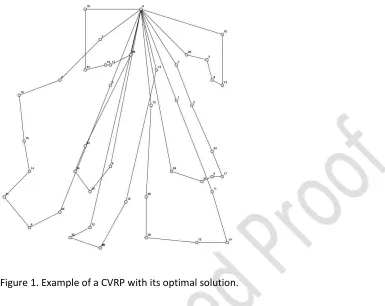
Optimization problem solving constitutes a cognitive process that relates strongly to everyday applied tasks (e.g. finding the best and most efficient route between two locations) and has strong applications in the field of Operational Research (OR) and Transport Logistics (Danzig & Ramser, 1959; Toth & Vigo, 2002). Capacitated Vehicle Routing Problems (CVRPs – see Figure 1 for an example) is an optimization routing problem, where a fleet of trucks is responsible to deliver goods from a depot to a set of customers (under a number of constraints such as weight load allowed per truck and number of routes) are being utilized by Logistics and Supply Chain industries to perform deliveries CVRPs’ objective is to minimize the total length of the distance travelled. Use of computational algorithms such as exact algorithms, heuristics and metaheuristics that address large instances (e.g. high number of customers to deliver items to) are currently being employed for solving such problems (Blasum & Hochstaettler, 2000; Fisher, 1994; Lee & Mitchell, 1998; Toth & Vigo, 2001; Burke & Kendall, 2005).
Despite the efficiency computational algorithms (e.g. exact algorithms, heuristics and
Figure 1. Example of a CVRP with its optimal solution.
Furthermore, there is little evidence that such computational strategies provide optimal solutions in a reasonable time frame as the number of customers increase (Maringer, 2006; Michalewitz & Fogel, 2004; Hu, 1982) making debatable the efficiency they offer (Ioannou, 2008; Crainic, Gendreau & Potvin, 2009). As such, unfortunately, there is not yet a complete algorithm that can provide a solution that is both quick and optimal when the number of customers is large.
optimization problems. However, such research tested human performance only without speculating (or testing) metacognitive mechanisms that may explain performance levels.
Further attempts in examining how to improve current computational approaches for
optimization problem solving focused on developing interactive optimization approaches, the aim of which is to bring the human operator ‘in-the-loop’. Examples include solving everyday problems (Boyd & Vandenberghe, 2004) to more specialized ones such as spacecraft design (Fukunaga & Stechert (1997) and routing problems (Waters, 1984; 1987; Sreevalsan et al., 2007; Klau, Lesh, Marks & Mitzenmacher, 2010). What all these interactive optimization attempts offered was either algorithmic real-time reconfiguration, which almost entirely excluded any human involvement in the execution and
procedural loop (i.e. human almost out-of-the-loop responsible for refining algorithmic parameters and not constructing routes from scratch) or allowed direct human intervention where human solutions would be ‘refined’ by computational algorithms. They all reported however, improvements in optimization results as a product of these interactive synergies.
Considering the positive effects that feedback mechanisms appear to exhibit in human performance (e.g. Shute, 2005), the lack of examination of effects of these in route optimization problem solving and the need to re-think the current approaches employed in optimization
computational algorithms (i.e. consideration of procedural cognitive processes rather than adoption of metacognitive mechanisms), this paper aims to test the effects that metacognitive approaches such as feedback provision (as a self-regulatory mechanism) on both paper-based and computerized settings have on human performance on optimization problem solving such as CVRPs. As part of the task environment manipulation and considering the current literature on the effects of the timing of feedback provision, the author varied feedback provision timing while considering the presence of additional metacognitive elements such as heuristics planning provision.
Furthermore, while prior research focused on testing ‘human-in-the-loop’ frameworks in optimisation tasks where computational algorithms were either embedded within the system or operators
manipulated solutions, in this paper, the author presents a first step in applying the ‘human-in-the-loop’ framework in solving CVRPs without the use of any computational algorithm but by providing
computational support for certain aspects of the CVRPs (i.e. calculations) and direct route construction by humans. In doing so, the author aims to provide an empirically cognitive-driven approach in direct route planning, providing insights as to how human cognition can enrich this task. The author reports results from a lab-based study that looked upon human performance when interacting with a CVRP computerised tool.
This paper presents the results from two lab-based experiments on solving CVRPs.
computer-based CVRPs. One version of the tool provided concurrent feedback on violation of problem constraints and the second version of the tool (i.e. full version) provided concurrent feedback on route length (as each route was constructed), feedback on constraints violation and facilitated assistance in route planning through the provision of two types of heuristics (Calculating and Clustering) that prior research (Kefalidou & Ormerod, 2014) found to be predictors of good human performance in CVRPs. Within the context of the presented research, humans played an active role (rather than a supervisory role) in solving CVRPs. Human performance was captured in both experiments by measuring
participants’ solutions quality (i.e. how far away their solutions were from the best known solutions as published within the current OR literature).
As such, the purpose of this paper is firstly to draw upon principles and applications of feedback as developed within literature in learning and identify how it manifests within a different domain – that of the optimization problem solving literature. Secondly, the present research aims to identify the impact computerized feedback has on optimizing human performance in a route optimization problem following a joint-cognitive approach. It is important to emphasize that this is a first attempt in adopting a joint cognitive system approach in a route optimization problem setting where humans provide solutions without any assistance from a computational algorithm and provides a test-bed for
understanding how people optimize (i.e. attempt to find best solutions) through metacognitive feedback and planning provision. While notions of learning (and accumulation of knowledge) is an intrinsic
1.
Experiment 1
In Experiment 1, the aim was to observe any differences in human performance when provided with post-problem feedback. The aim of the error-trapping mechanism was to investigate whether providing post-problem feedback would improve or not human performance. In this condition, if participants produced invalid solutions, they were asked to re-visit the CVRP and find a valid solution before they proceeded further (utilizing a similar control mechanism with prior research (e.g. Corbett & Anderson, 2001 and Chi et al., 1989). However, as the aim of the experiment was to identify effects of post-problem feedback only (and not for example effects of automatic immediate correction) on human performance, the author followed Chi et al’s (1989) approach of feedback provision (i.e. if errors are found in solutions after problem completion, then the solutions are returned back to participants for correction) rather than Corbett and Anderson’s (2001) approach on providing forced immediate correction during the problem solving process.
Considering prior research on feedback suggesting that delayed feedback can be beneficial for human performance (known as Delay Retention Effect – DRE) as they not interfere with retention of information for the task completion (e.g. Kulhavy & Anderson, 1972; Surber & Anderson, 1975; Cheshire et al., 2005; Schooler & Anderson, 1990), it was hypothesized that post-problem feedback will improve human performance. Furthermore, considering for the posterior timing in the provision of feedback, it was anticipated that this would have an effect on total problem time completion. The fact that provision of feedback was absent in prior research on computerized interactive optimization problem solving (e.g. Waters 1984; 1987; Klau et al., 2010) informed heavily the motivation and rationale for testing effects of feedback provision on optimization human problem solving performance. The two hypotheses are presented below.
H2: Post-problem feedback will affect time completion.
The control condition of the experiment was to solve the problems without being forced to produce a valid solution.
3.1. Method
3.1.1. Participants
Sixty-nine postgraduate students (35 female and 34 male; mean age = 21.8) from XXXXXXXXXXX University participated (32 in control condition and 37 in the experimental). They were recruited on a credit-based system. Participants were both English-native and foreign speakers. Informed consent was obtained from all participants.
3.1.2. Task and Materials
Figure 2. CVRP Paper-based Example Stimuli
3.1.3. Design
The experiment had two independent variables. A within-subjects factor which was the CVRP Problem, with four levels (nodes and routes respectively being 33-4, 33-5, 39-6 and 45-7) while the second was a between-subjects factor of Environment with two levels (i.e. error-trapping versus
control). Dependent variables were the Percentage Above Optimal (PAO) for each solution attempt, and Solution Time (sec). Optimal solutions were calculated using a Tabu Search algorithm (Mu, Fu, Lysgaard & Eglese, 2009).
3.1.4. Procedure
different colored pencils to design different routes and was explained to them that if they wanted to make further calculations they could use the stimuli paper where the problems were displayed on (see Figure 2). The first problem that they were given to solve was a practice problem and as such it was not included in the analysis phase.
The CVRPs were given to each participant in a random order to minimize practice effects. Participants could ask any questions –if they needed- throughout the duration of the experiment. There was no time restriction, however, participants were made aware that the experiment takes approximately 1 hour.
In the control group, participants were not exposed to ‘error-trapping’ and post-problem feedback mechanisms and as such once they finished solving each problem, they immediately moved on to solve the next problem in line. On the contrary, participants in the experimental (i.e. ‘error-trapping’ and post-problem feedback) group, were exposed to post-post-problem feedback at the end of the completion of each problem. If their solutions were found with errors, then they were requested to revisit and correct their solutions prior to proceeding to the next problem. They were not allowed to proceed to the next problem unless they had corrected the current erroneous solution.
1.1.
Results
Each solution was checked for calculation errors and/or violations of problem constraints. Solutions containing any errors (from the control group) were disregarded from the quantitative analysis while erroneous solutions were tracked as part of the error-trapping mechanism and the post-problem feedback in the experimental condition ( see table X below for more details). Similarly to
Table 1.
Errors occurred in Experiment 1 across conditions
Error No of
Participants
Control Weight constraint
Node exclusion
Route violation
3
1 1
Experimental
(Error-trapping)
Weight constraint
Node exclusion
Both
10
1
1
Note: the Error-trapping group errors were not excluded from the analyses; instead participants were required to revise their solution and generate a valid solution. Their solutions were included in the analyses.
As Table 1 suggests, participants in the Experimental condition (error-trapping and post-problem feedback) performed approximately double number of errors compared to the control group. It is not clear the reason why this might have happened and further research is needed to ascertain this.
1.1.a.
Percentage above optimal (PAO) data
(mean PAO error-trap = 12.18, control = 14.20). The pattern was reversed for the 39-6 and 45-7
problems (39-6: mean PAO control = 16.43, error-trap = 20.52; 45-7: control = 16.0, error-trap = 17.51).
Table 2:
Mean % above optimal (PAO; standard deviations in brackets) for each problem in error-trap and control groups.
P2 (33-4) P3 (33-5) P4 (39-6) P5 (45-7)
Error trap 6.56*
(5.57) 12.18 (10.77) 20.52 (15.40) 17.51 (7.35)
Control 7.31*
(8.71) 14.20 (13.29) 16.43 (14.30) 16.06 (7.17)
Overall Mean 6.88*
(7.05) 13.06 (11.87) 18.73 (14.95) 16.88 (7.25)
Note: * indicates closer to optimal results (where optimal is 0)
As such, results suggest that H1 (Post-problem feedback will improve human performance) is not supported.
1.1.b.
Solution times
A two-way ANOVA on solution times revealed a significant effect of Environment, F(1,62) = 5.64, p2 = .061, p < .05 but a non-significant effect of time completion of problems, F(3, 186) = 2.07, p2 = .032, p = .105. Most importantly, there was no significant interaction between time completion of problems and Environment, F(3, 186) = .990, p2 = .016, p = .398 suggesting that error-trapping mechanism had no effect on time completion.Table 3 shows the means and standard deviations of the time completion data. As can be seen, the control Group performed faster than the error trap group in all conditions.
Table 3.:
Mean Solution Times (sec), (Stds in brackets) for each problem in ‘error trap’ and control’ groups.
P2 (33-4) P3 (33-5) P4 (39-6) P5 (45-7)
Error trap group 573* (259.53) 638 (1047.52) 597 (224.01) 859 (418.28)
Control group 470*
(189.55) 515 (260.72) 477 (171.36) 529 (277.68) Overall Mean Time Completion 528* (235.57) 584 (801.60) 544 (209.86) 715 (396.97)
Considering the Time Completion results, it appears that H2 (Post-problem feedback will affect time completion) was not supported.
1.2.
Discussion
Overall, results from Experiment 1 confirm prior results in this field (e.g. Kefalidou & Ormerod (2014)), in that the participants performed worse on the same problems in both experiments (P4 - 39-6) even though prior research focussed on different experimental factors (e.g. verbalization and cognitive load) rather than error-trapping and post-problem feedback, which was the experimental factor of this lab-based study. A significant effect of problem complexity was found, indicating that the problems with higher numbers of nodes and routes to draw (e.g. 39-6 and 45-7) were seemingly considered more difficult to solve as people generated less optimal compared to less complex problems (e.g. 33-4 and 33-5). This finding was expected as the complexity of a problem suggests its difficulty and necessitates more effort in order to be successfully solved.
Although effects of error trapping appear to vary by problem, none of the effects on time completion were significant. Furthermore, there was no interaction between problem complexity and environment (i.e. error-trapping and post-problem feedback). This implies that providing post-problem feedback to the solvers does not have any impact on their performance contrary to H1 (i.e. Post-problem feedback will improve human performance). This currently appears not to support prior research on positive effects of post-problem (or delayed) feedback on human performance (see e.g. Kulhavy & Anderson, 1972; Surber & Anderson, 1975; Cheshire et al., 2005).
. A suggestion to explain the occurrence of no effects, might be that the timing of feedback is a factor that may influence human performance on CVRPs. For example, if feedback was given during the problem-solving process (instead of being given at the end of the problem solution), human
research that supports the notion that concurrent immediate feedback provision can be beneficial to human performance in learning and problem solving (see e.g. Corbett & Anderson, 2001; Kapa, 2001; Azevedo & Bernard, 1995). This is further investigated in Experiment 2. Such an improvement might occur because immediate and concurrent feedback allows humans to re-plan and re-evaluate their solving behaviour (as their problem space is dynamically changed), allowing them to minimize the chance of getting trapped in the same errors. Furthermore, concurrent live feedback promotes self-awareness and conscious processing in problem-solving. As it has already been discussed earlier, there is research that accounts for such a possibility (Corbett & Anderson, 2001; Cheshire, Ball & Lewis, 2005).
Concerning time completion, there was a non-significant effect of time completion and no interaction between error-trapping and time completion suggesting that the effect on time is the same regardless of what condition (error-trapping or no error-trapping) someone is in. Also, completion time and PAO were not positively correlated, r = -.013, n = 70, p = .285. However, as the number of nodes and routes to design increased (problems P4 (39-6) and P5 (45-7)), the control group performed better than the error trap group.
solution. However, in problems with lower complexity (e.g. 33-4 and 33-5), the same participants performed better than the participants in the control group. A possible explanation for this observation is that the error-trap participants perceived and tackled those problems with a more ‘optimizing’ attitude due to lower problem complexity. This is an avenue for further future research. On a similar note, it would be expected that post-problem feedback and error trapping group should perform better in all problems. However, looking more carefully the problem-by-problem performance, there seems to be no linearity. This may be taken to suggest that learning does not seem to occur within the timeframe of this study as performance is not steadily increasing. Similarly, demotivation (as an explanation for decreased performance) may not be exhibited for the same exact reasons. However, more research is needed to ascertain this speculation.
2.
Experiment 2
Considering the results from Experiment 1 in regards to post-problem feedback and error-trapping, this second experiment investigated how humans solve CVRPs when the task environment changes in regards to visual and interactive aspects. Particular interest was whether human
While in previous research in this field (e.g. see Kefalidou & Ormerod, 2014), task environment was manipulated in terms of calculation demands, in the current experiment, the manipulation was three-fold. Firstly, the stimuli upon which CVRPs were presented was computer-based rather than paper-based, aiming to test human performance when interacting with a different task environment. Secondly, certain aspects of the problem task such as calculations were supported directly by the computer-based environment (through the provision of directive and explanatory concurrent feedback support), while planning support was offered as well (e.g. heuristics provision) based on prior research suggesting that two strategies (i.e. Calculating and Clustering) in CVRPs problem solving appear to predict good human performance – see Kefalidou & Ormerod (2014)) aiming to test whether concurrent (as opposed to Experiment 1 post-problem feedback) would have an effect on human performance. Thirdly, the interactive computerized support tool (from now on it will be referred to as the CVRP Problem Solver – CVRPS) was implemented with two modes: one constituted the full mode of the computer system (incorporating live user feedback on length of routes and weight values (i.e.
concurrent directive feedback) and constraint violations (i.e. concurrent explanatory feedback) as well as planning support (through heuristics provision) and the second was a stripped version of CVRPS (incorporating no concurrent live feedback for routes length and weight values (but for constraints violations i.e. concurrent explanatory feedback) and no planning heuristic support. Heuristic and planning support was formulated based on prior research where human heuristics predicting optimal performance were found (e.g. calculating and clustering - see e.g. Kefalidou & Ormerod, 2014) and aimed to provide an additional metacognitive mechanism to solvers (alongside with feedback provision) that assists them in planning their route solutions.
live feedback) in case they were violating a constraint of the CVRP (e.g. missing out a node from the solution or violating the weight constraint per route) only and did not provide feedback in regards to the quality of their solutions. The reason facilitating this kind of feedback within this version of CVRPS was to ensure that participants did not violate the basic constraints of CVRPs and for testing whether
concurrent explanatory live feedback provision had any effect on their performance (as compared to Experiment 1).
Prior work on interactive tool-based optimization (e.g. Water’s (1984) Klau et al. (2010) work) did not include investigations on whether systems that provide explanatory and discreet concurrent feedback could potentially evoke a better human performance on solving optimization problems. No investigations were either performed to test how human optimization problem-solving develops when interacting with a computer-based tool – instead, prior research focussed mainly on tracking Human Machine Interactions (HMIs) when computational algorithms had already initiated the solutions (e.g. Waters (1984) or on utilizing computational algorithms and human operator interventions as
According to prior research (e.g. Corbett & Anderson, 2001; Kapa, 2001), immediate corrective feedback provided by computer systems (e.g. intelligent computer tutors) during problem solving learning tasks (e.g. learning a programming language and mathematical word problems) and problem solving tasks (e.g. solving analogy problems) resulted in faster time completion and better performance. More specifically, Corbett and Anderson (2001) found before that immediate corrective feedback improves the speed of task completion while computerized feedback improved human performance in learning. Furthermore, research from Kapa (2001) on mathematical word problem solving suggested that metacognitive support such as feedback provision during problem solving improved human performance compared to post-problem support conditions.
As such, it was expected that the use of CVRPS will improve human performance (in terms of both quality and time completion – see Corbett & Anderson (2001) and Kapa (2001) prior research) as it provides metacognitive support such as explanatory and directive concurrent feedback as well as planning support (e.g. Calculating and Clustering heuristics). Participants that are solving the problems using both versions of the software are expected to perform better than the participants that use the paper-based version due to the metacognitive support CVRPS provided to solvers – this included the following support: calculation tasks automatically including the calculation of 1) current total weight and 2) distance covered/route length (via concurrent directive live feedback in full software version) and 3) warning messages provision (via concurrent explanatory live feedback) if a violation occurs (both versions of the software).
feedback provision). In the full CVRPS version, participants were provided with the currently total distance covered per route, which was continuously updated every time they made a new action (live directive feedback). This feature was hypothesized that would encourage and help the participants construct short routes and enable them to compare easier alternative routes as per prior research (e.g. Corbett & Anderson, 2001; Kapa, 2001; Azevedo & Bernard, 1995) as it would allow ‘on-the-fly’
restructuring of their solutions facilitating early error correction and full awareness of their cognitive processes. Finally, the use of CVRPS tool (that facilitates concurrent feedback provision) will have an impact on time completion. Experiment 1 results on time completion suggested that there was no significant difference despite the presence of post-problem feedback support. However, prior research on computerized feedback provision (e.g. Corbett & Anderson, 2001) suggested that immediate corrective feedback resulted to faster time completion rates on the problem solving learning task. Consequently, this begged the question whether the provision of concurrent computerized feedback would have an effect on time completion.
As such four hypotheses were formed to test human performance using CVRPS under these conditions. These are presented below:
H3: Participants’ performance will improve when using CVRPS tool
H4: Concurrent live feedback will improve human performance when using CVRPS
H5: Human performance is improved when participants receive both directive and explanatory feedback alongside with planning support (i.e. heuristics support) during the problem solving process using CVRPS tool
Therefore, in the current experimental setting, it would be expected that best performances would be observed when using the full version of CVRPS (e.g. as a means for metacognitive support provision through concurrent explanatory and directive feedback and through planning/heuristics support). Furthermore, the worst performances would be expected when participants use the paper-based version of the experiment (facilitating no metacognitive support such as feedback and/or planning support provision).
4.1.
Method
4.1.1.
Participants
Seventy-seven postgraduate students from XXXXXXXXXXX University participated, 26 in the paper-based condition (13 Female; 13 Male), 26 in the stripped CVRPS version condition (13 Female; 13 Male) and 24 in the full CVRPS version condition. All participants were paid £6 to participate. In the full software version condition there were 11 female and 13 male participants. In total, the number of the female participants was 37 and the number of male participants was 39 (mean age = 21.9). The
participants that were recruited were both English-native and foreign speakers. Similarly to Experiment 1, informed consent was obtained from all participants.
4.1.2.
Task and Materials
Participants in the two computer-based conditions solved five computer-based stimuli with CVRP nodes drawn on them. The CVRP problems used in this experiment were the same with the ones used in Experiment 1. Problems were displayed using the computer display as shown in Figure 3. Participants in the Paper condition solved the same five CVRP presented in paper-based form (see Figure 2 in
computer-based versions, participants used the mouse to drag-and-drop the pointer to construct each route. The colouring of each route was programmed to be implemented automatically. Participants using the full version of the software were given the opportunity to employ (if they wished to) a ‘Clustering’ strategy through the use of the ‘Group’ option tab of the software and a ‘Calculating’ strategy through the use of the ‘Routes’ option. This formed the metacognitive ‘planning support’ for solving CVRPs. Camtasia, a desktop real-time recording software, was used to log in video files all participants’ activities in the computer-based conditions while they were solving CVRPs. The software also recorded any informal verbalizations made by participants.
Figure 3. Using the ‘Group’ (Clustering) tab option in the full CVRPS version
The constraints and guidelines for Experiment 2 were the same as in Experiment 1. Although in the paper-based version all the constraints were explained orally to each participant before and during the experiment, in both versions of CVRPS, the participants were provided with two types of
Figures 3, 4 and 5). Figure 4 shows the messages (concurrent live explanatory feedback and concurrent ‘live’ directive feedback) and planning (heuristics) provision within the full version of CVRPS. The
stripped version of CVRPS provided only one type of metacognitive support and that was the concurrent ‘live’ explanatory feedback on constraints violations (lower panel in Figure 6).
[image:29.612.71.376.466.689.2]Figure 5. Rearranging cluster of nodes (participants using the planning (heuristics) support in the full
[image:30.612.75.512.132.342.2]CVRPS version)
Figure 6. Concurrent ‘live’ explanatory feedback provision in the stripped version of CVRPS
(metacognitive planning (heuristics) support and concurrent ‘live’ directive feedback was not
activated in this version of CVRPS).
4.1.3.
Design
neither view the right-hand panel with the route information nor information on constructing each route. What they could view is only a warning message at the bottom of the window in case they violated a problem constraint. In the paper-based version (where no support was provided), the information about CVRPs was presented in an identical manner as in the Experiment 1. Similarly to Experiment 1, dependent variables were the Percentage Above Optimal (PAO) for each solution attempt, and the solution time (sec).
4.1.4.
Procedure
Each participant was given a paper sheet with the general instructions for the experiment (see Experiment 1). For the paper-based condition, a printed book containing the task instructions and stimuli was given (see Figure 2 in Experiment 1). Each problem had its instructions on the same page where the participants had to solve the problem. Participants used different colored pencils to design different routes and it was explained to them that if they wanted to make further calculations they could use the paper where the problems were displayed. The first problem was a practice problem and was not included in the analysis.
For the computer-based versions (strategy/concurrent live feedback (directive and explanatory)-support and no strategy-explanatory)-support (with concurrent live explanatory feedback), the researcher initiated CVRPS and loaded each problem to be solved from a text file. An introduction to the use of CVRPS was given to participants before they started the experiment that lasted approximately 10 minutes. Then the researcher initiated the recording software (i.e. Camtasia). Participants then loaded the practice
Similarly to Experiment 1, the control group was not exposed to ‘error-trapping’ and post-problem feedback mechanisms and as such once they finished solving each problem, they immediately moved on to solve the next problem in line. On the contrary, participants in the experimental (i.e. CVRPS versions) groups, were exposed to concurrent feedback (explanatory and directive) and planning (strategy) support during the problem solving process but rather the feedback was provided as a warning and self-awareness mechanism. As such, they were not ‘forced’ by the system to provide correct solutions prior to proceeding to the next problem to solve. Participants were able to proceed to the next problem as soon as they provided a solution (valid or invalid) to the current problem.
The problems were presented in a random order in all conditions. Also, it was made clear to all participants that they could ask any questions whenever they felt necessary. There was no time restriction, but participants were told that the experiment was expected to take approximately 1 hour.
4.2.
Results
Similar to the previous experiment, each solution was checked for calculation errors or violations of problem constraints. Solutions containing any errors were disregarded from the analysis (these were relevant for the control group only and are the same as the ones presented in Experiment 1 – Table 1). It is important to note here that there was no force mechanism (as prior research employed e.g. Corbett & Anderson, 2001 or similar to Experiment 1 paper-based error-trapping mechanism) to demand or prevent participants from proceeding to the next problem if the solution they provided was invalid. The reason to do so, was that the purpose of this experiment was not to simulate the post-problem
the individual route length and total solution length. Participants’ solution routes from both the computer-based conditions were provided by CVRPS.
4.2.1.
Problem Complexity and Group Effects on PAO
[image:33.612.67.549.269.599.2]Mean PAOs for all the conditions are shown in Table 4. As it can be seen, the strategy/concurrent live feedback-support group performed better than the other groups for all the problems.
Table 4.:
Mean % above optimal (PAO: Stds in brackets) for each problem in each condition of Experiment 2.
P2 (33-4) P3 (33-5) P4 (39-6) P5 (45-7) Planning
(Strategy)/concurrent live explanatory and directive feedback support 4.64* (4.57) 8.85 (5.71) 11.34 (7.08) 12.46 (4.37)
No planning/strategy support (with concurrent live
explanatory feedback) 5.55* (5.64) 8.92 (7.27) 14.61 (9.35) 13.14 (5.06) Paper-based (no planning and
feedback support – control group) 9.81* (7.79) 13.95 (9.27) 20.51 (15.33) 17.45 (7.80)
Overall Mean PAO 6.58*
(6.42) 10.49 (7.78) 15.35 (11.50) 14.26 (6.19) Note: * indicates closer to optimal results (where 0 is the optimal)
33-4 and 33-5 problems – as observed in Experiment 1 as well- , p < 0.001 in all comparisons, and there was no difference on PAO scores between 39-6 and 45-7 problems, p = 1.00. This suggests that participants’ performed better in problems with lower number of nodes and routes.
There was a significant effect of Group, F(2,73) = 7.09, p2 = .163, p = .002, planning (strategy)/concurrent live explanatory and directive feedback support : M = 9.32, no planning (strategy)/with concurrent live explanatory feedback support: M = 10.56, paper-based/no support: M = 15.43). Follow-up pair-wise comparisons indicated that participants in the paper-based group have lower PAO scores than participants in the other two groups, planning (strategy)/concurrent live explanatory and directive feedback support vs. paper-based/ no support: p = .002; no planning (strategy)/with concurrent live explanatory feedback support vs. paper-based: p = .012. There was no significant interaction found between Problem and Group, F(6, 219) = .819, p2 = .022, p = .556.
As such, results appear to provide support for H3 (Participants’ performance will improve when using CVRPS tool) and H4 (Concurrent live feedback will improve human performance when using CVRPS). However, results suggest that H5 (Human performance is improved when participants receive both directive and explanatory feedback alongside with planning support (i.e. heuristics support) during the problem solving process using CVRPS tool) is not supported as no difference on human performance was observed within the two CVRPS groups.
4.2.2.
Solution times
Table 5:
Mean solution times (standard deviations in brackets) for each problem.
P2 (33-4) P3 (33-5) P4 (39-6) P5 (45-7)
Planning Strategy /concurrent live explanatory and directive feedback support 508 (195) 420* (292) 582 (307) 651 (298) No planning strategy support (with concurrent live explanatory feedback support) 598 (230) 482* (246) 582 (246) 835 (409) Paper-based (no support) 574 (243) 521 (240) 451* (163) 497 (244) Overall Mean 559
(223) 473* (261) 540 (252) 665 (350)
Note: * indicates faster results
pattern was observed in all problems (mean TC ‘planning strategy/concurrent live explanatory and directive feedback support’ P2 = 508, P3 = 420, P4 = P4 = 582, P5 = 651 vs. mean TC ‘no planning strategy support/with concurrent live explanatory feedback’ P2 = 598, P3 = 492, version’ P4 = 582, P5 = 835). Overall, the fastest performance across all conditions was in P2 problem (33-4) (mean TC = 473) and slowest in the P5 problem (45-7) (mean TC = 665).
As such, H6 (The use of CVRPS tool will have an effect on time completion) was supported.
3.
Discussion
The results from this experiment indicate that use of CVRPS to solve CVRP problems improved participants’ performance as they produced even closer to optimal solutions than their fellows in the paper-based version of the experiment. This occurs independently of whether the participants used the full version of the software or just the stripped version. This provides support to the notion previously discussed in literature that concurrent feedback provision improves human performance in terms of response quality and time completion. For example, similarly to Corbett & Anderson (2001)
performance between both CVRPS experimental groups (i.e. concurrent live explanatory feedback support vs. concurrent live directive and explanatory feedback support with planning (strategy) support). This suggests that the provision of additional metacognitive support constructs (i.e. concurrent live directive feedback and planning (strategy) support provision did not improve human performance further. Instead, results suggest that these additional metacognitive supports may have slowed down performance.
The fact that the use of CVRPS (both versions) improved performance compared to the paper-based group (control group with no metacognitive support) but the optimal performances across the two computerized CVRPS versions were not different can be taken to suggest that human performance improvement may have occurred due to the presence of the concurrent live explanatory feedback support provision rather than the presence of planning (strategy) support provision and the presence of concurrent live directive feedback support provision. Instead, it seems as if the presence of planning (strategy) support and the concurrent live directive feedback support only improved time completion and not the quality of generated solutions. However, it is important to note that this has not been observed universally across all problems. This may be due to differentiations on problem complexity (or even cognitive load levels), which is something that future research should explore further.
CVRPS appear to have supported participants in ‘Optimizing’ tasks (e.g. more confident readjustment of routes to aim for the shortest one), while off-loading from the task of performing themselves e.g. arithmetic monitoring to ensure that no arithmetic constraints were violated.
Furthermore, the warnings (i.e. concurrent live explanatory feedback) that were provided in both versions of the software (full version and stripped version) improved participants’ performance as it was observed within the results in the stripped software version as well. The CVRPS stripped version did not provide participants with any information on routes’ length or weight information to assist and support them (no concurrent live directive feedback and planning (strategy) support). Even though this
information was missing from the stripped version, participants performed better than in the paper-based version. Looking at the differences in participants’ time completion who used both versions of CVRPS (full vs. stripped) and the paper-based version, it was observed that participants who used the full CVRPS version performed faster than the paper-based suggesting that a portfolio of metacognitive support (i.e. two different types of concurrent live feedback and planning support) provides the
potential to speed up (but not further optimize) performance. This was expected as participants, in this case, did not need to spend any time in performing calculation tasks or evaluating the length of each route they constructed. This finding is aligned with the time completion results from the stripped version of CVRPS where participants in this instance performed slower than those ones using the full CVRPS version.
Secondly, the explicit planning (strategy) support provision in CVRPS (i.e. Calculating and
spend more time (compared to the full CVRPS version) to perform calculations and evaluate the length of each route by eye. Despite them having to perform these tasks by themselves, the quality of their performance was retained (and in some problem-by-problem cases was better than those in the full version of CVRPS). An explanation for that may be that the warning messages and the concurrent live feedback provided to participants to prevent them from making errors acted as a reinforcement to focus better their attention on the problem tasks reducing the cognitive load.
Regarding time completion performance on the paper-based version, it was observed that participants in this group were faster, yet the worst performers, especially in solving more complex (and larger) problems (i.e. P4 – 39-6 and P5 – 45-7). Although they did not use CVRPS to solve the problems, - thus they needed to perform all the calculation tasks by themselves with no feedback and planning support- they completed the problems faster than participants who used both versions of CVRPS. An explanation to this phenomenon is that for the problems with more demands, features and task requirements, paper-based problems seem to facilitate the problem complexity levels responsible for impairing human performance – these include both calculation and visuo-spatial demands. Instead, the short completion time shown on P4 and P5 problems of the ‘paper-based version’ control Group indicated that participants in this group exhibited a rather ‘satisficing’ approach as they provided not optimal, yet valid solutions faster than their fellows in the other conditions. Another perhaps
Also, the presence of the computerized tool may offer a task environment where participants can off-load problem complexity demands onto the tool, leading to a paradox as they have to allocate less effort to complete the problem-solving task, but at the same time put more attention to the task (promoting optimality and increasing time completion). However, to be able to further ascertain such a notion, further research is needed on this direction. In relation to the general performance across problems, the results from this experiment match with the overall prior research (e.g. Kefalidou & Ormerod (2014) and Experiment 1 in this paper as participants performed worse in the same problem in all those experiments (P4 - 39-6) even though the experimental factor was different (verbalization and cognitive load – Kefalidou & Ormerod (2014) , post-problem feedback and error-trapping – Experiment 1 and computerized interactive system use and concurrent live feedback – Experiment 2 in this paper).
5.
General Discussion
metacognitive support mechanisms can improve human performance compared to situations where metacognitive support is not present in optimization problem solving tasks. This can be taken to further suggest that the beneficial outcomes that metacognitive support exhibits in learning and other problem solving contexts seems to extrapolate to a different domain in problem solving, that of optimization problem solving.
Error trapping, feedback provision and planning support provision (as metacognitive support) were explicitly tested within the reported experiments. The present research found that error-trapping and post-problem feedback had no effect on human performance and time completion contrary to prior research suggesting the opposite (e.g. Cheshire et al., 2005; Schooler & Anderson, 1990). However, the use of the interactive computerized support tool (CVRPS) (that facilitated metacognitive support through concurrent feedback and planning provision) improved human performance compared to performance on the pen and paper version of CVRPs where no support was present. However, no differences in human performance were found in participants’ solutions that used either version of CVRPS suggesting that different metacognitive support (and self-regulatory mechanisms particularly) exhibit benefits in human performance in different ways.
However, when solvers from the post-problem feedback group faced higher complexity problems, their performance degraded, yet maintained validity, providing partial support to the notion that
delayed feedback can improve error-tracking. However, in problems with lower complexity, the same participants performed better than the participants from the control Group. An explanation for these results may occur due to motivational aspects. For example, error-trapping could have acted beneficially in the less complex problems (and enhancing solvers’ motivations) as the provided guidance did not involve longer re-planning or ‘undoing’ actions leading to closer to optimal solutions. On the other hand, error-trapping for more complex problems may had impaired solvers’ motivation levels (and
consequently their performance) as it ‘forced’ them to re-think and re-plan more extensively their solutions to provide a valid solution (thus satisficing).
In such a case, higher cognitive load could be induced in more complex problems via the number of steps for re-planning and ‘undoing’ solvers would need to perform would also be increased. Prior research in the literature suggested that cognitive load can reduce problem solvers’ motivation to act upon the provided feedback (Ashford, 1986; Corno & Snow, 1986) and as such, results from this experiment could be taken to confirm prior literature.
found but also a significant interaction between group and completion time. This suggests that participants who used CVRPS (both ‘strategy/concurrent live feedback support’ and ‘no strategy/with concurrent live feedback support’) performed faster than those in the paper-based group. This was expected as the CVRPS tool implemented provided (automatic) support for the calculations needed. The latter – in paper-based settings- are expected usually to delay the completion of a CVRP. In relation to performance quality (how close to optimal solutions are) both CVRPS versions performed better than paper-based group. This supports the notion that interactive computerized tools can provide a layer for performance improvement (Waters, 1984; Klau et al, 2010).
Pair-wise comparisons of CVRPS performance revealed no difference between the two CVRPS versions i.e. groups showed no difference in the quality of solutions generated using the system suggesting that the task environment in these two versions did not significantly vary to generate
More specifically, planning (strategy) support mechanisms appeared to make no difference on the quality of performance exhibited in CVRPS, contrary to computerized concurrent explanatory feedback that was present in both versions of CVRPS. This suggests that planning (strategy) support engages metacognition on a different level from that of feedback provision, which is something that can be further supported by the fact that in the CVRPS group that facilitated planning, time completion appeared to be faster compared to the CVRPS group that facilitated concurrent live feedback only. However, interesting observations did not only take place in regards to planning (strategy) provision but also in regards to the type of computerized concurrent feedback provision provided in both CVRPS groups.
Particularly, in both the stripped and full CVRPS versions, concurrent live explanatory feedback was provided but concurrent live directive feedback was only provided in the full CVRPS version
The findings presented in this research are in alignment with Corbett and Anderson (2001) suggestions that computerized feedback provision in problem-solving can aid performance but does not appear to support research from Lurie and Swaminathan (2009) and Schooler and Anderson (1990) that suggest that delayed feedback is more beneficial. Furthermore, Corbett and Anderson (2001) found that immediate feedback resulted to faster responses, something that the present research found as well. It is important to note, however, that Corbett and Anderson’s (2001) results referred to immediate corrective feedback (automated correction of participants’ responses), which is something that was not tested in the present research. The types of feedback tested in this research included paper-based post-problem feedback (delayed feedback), computerized concurrent live explanatory feedback and
computerized concurrent live directive feedback, from which computerized concurrent feedback was found to be more beneficial for participants’ solutions compared to the control (no feedback) group. What this tells us is two main things: firstly, that other types of computerized concurrent feedback mechanisms appear to promote better solutions (and faster); secondly, that the beneficial computerized feedback provision impact on human performance extrapolates to other domains rather than problem solving in learning literature.
suggests that getting information in regards to length of routes and weight loaded ‘as-and-when’ each route constructed, alongside with the ability to plan the routes is not enough to add benefit to the overall performance compared to the benefit gained from knowing what violations occurred.
Despite the fact that the present research did not test learning per se (but instead human performance in optimization problem solving), Assistance Dilemma is a useful theory to consider in optimization problem solving as it becomes apparent (through the present research) that different types of feedback, different types of metacognitive mechanism supports (e.g. feedback and planning) and different timings in the provision of feedback seem to impact on human performance differently.
These findings not only offer a new perspective on how feedback provision can influence
performance but also on what the role of feedback is in optimization. Looking at the means of solutions quality and time completion, it seems that performance is not linear. This may occur due to problem complexity characteristics or even cognitive load effects. As such problem complexity and its
Anderson, 1990) suggested beneficial outcomes on human performance. As such, testing it in isolation, would be an avenue for future research.
Furthermore, feedback appears to be a contributor to motivation improvement in learners according to past literature (see e.g. Lepper & Chabay, 1985; Narciss & Huth, 2004). According to Anderson et al. (1984) for example, problem solvers and learners can become demoralised –or even confused- by unidentified errors and as such, feedback has to be provided either immediately, delayed or by request. Proponents of physical classrooms in learning or problem solving contexts, suggest that strategies such as team-working, self-esteem building and self-directed learning are better facilitated in face-to-face physical environments (Hattie, 1992) and this might be something that can additionally boost optimization problem solving processes. More recently, Oliver and Omari (2001) explored student performance and responses to problem solving learning tasks utilising a collaborative web-based technological approach and found that collaborative reflection can be critical for the improvement of performance. Similarly, Wang and Wu (2008) conducted a study with university students that used NetPorts, an online collaborative platform, through which they were able to process peer assessments, view anonymous peer feedback and submit homework. What they found was that high self-efficacy students tended to utilize more critical thinking and elaborate strategies while self-efficacy benefitted more from receiving elaborated feedback. In their study, student performance was improved when students were informed whether their responses were correct or not.
5.1 Towards Route Optimization Joint Cognitive Systems
Several school of thoughts have emerged positing opportunities that technology-enhanced
interventions can offer for enhancing human problem-solving including cognitive technologies (Larkin, McDermott, Simon & Simon, 1980; Pea, 1985, Sweller, 1989; Woods & Roth, 1988), intelligent
technologies (Salomon, Perkins & Globerson, 1991; Sleeman & Brown, 1982) and cognitive tools (Lajoie & Derry, 2013; Jonassen, 1992). The core notion that these approaches encompass is the joint-cognitive approach where machines support human operations and actions within their working or physical environment. As a consequence of these approaches, computational technologies have been viewed as extension of human cognition - and further as an extension of cognitive tasks. Within this application context, humans become supervisors rather than controllers. Particularly in problem-solving, and with the use of joint cognitive systems, humans are able to utilise their knowledge and co-operate with the computer to perform the problem-solving task in a dynamic way simulating human tutoring behavior. However, often becomes evident that the existing knowledge base does not become activated and utilised ‘as and when’ needed. Indeed prior research has found that humans need explicit prompts to utilise prior knowledge successfully within a problem solving context and task even if the learning experience is recent (Gick & Holyoak, 1980; Kotovsky, Hayes & Simon, 1985).
of any computational algorithms (as the above mentioned prior research), it has demonstrated that humans are capable of generating good solutions and that interactive environments that allow for full completion of problems with support from concurrent computerized feedback act beneficially in assisting them generating better and faster solutions. The present results provide support to the notion that computer environments such as CVRPS that provide metacognitive support can aid human
performance in optimization problem solving and that can potentially act as a ‘learning’ platform for enhancing human cognition.
Furthermore, the present research can also provide a framework for improving computational optimization algorithms while understanding better cognitive processes when attempting to solve such hard problems (including deep machine learning approaches). For example, human performance is known to be subjected to ecological parameters and the task environment (e.g. Newell & Simon, 1956). Newell and Simon (1956), task environment and ecological rationality play an important role in
To conclude, the research presented in this paper has provided an insight into how a computerized interactive system can utilize both planning (strategies) support and concurrent live feedback to improve human performance when solving CVRP problems. Through this research it has been confirmed that people can find close to optimal solutions on CVRPs without the use of any computational algorithms but also it was found that concurrent live feedback provision (contrary to paper-based post-problem feedback – Experiment 1) can significantly improve performance, slowing down time completion rates. Interestingly, and in regards to the different feedback provision types utilized in the present research, it seems that computerized concurrent directive feedback and planning support do not improve human performance further compared to when participants received
computerized concurrent explanatory feedback only.
Implications for future optimization interactive tools and even decision-support tools across different domains should take into account the following: 1) provision of concurrent feedback that can either warn or prevent (in case of critical systems) humans from error-making – in such an instance, the interactive system becomes the supervisor and the human is the actor utilizing the strengths that humans can offer to the optimization problem-solving process. Switching the roles in interactive systems that support a ‘human-in-the-loop’ approach changes the size of the problem space, an action that has the potential to promote optimality 2) flexibility in role and switching between different metacognitive support (feedback vs planning (strategy) support) could be beneficial especially when applications refer to more than one different problem-solving (or decision-making) contexts. A future step would be to include a set of additional human-inspired strategies and heuristics to test further whether planning (strategy) support within an interactive system improves performance significantly. Such an
investigation would give further light as to what the significance of concurrent live feedback and
interact with it (having available as well human-inspired strategies as in this presented research). Finally, a future step would be to investigate collaborative interactions and problem-solving as opposed to solo problem solving using the CVRPS presented here. Such research would allow us to ascertain human behaviors especially in regards to feedback provision and interpretation of useful prompts and warnings. This research has shown that the use of interactive software tools (again without the use of any
computational algorithms) can improve human performance simply by providing concurrent computerized feedback.
Acknowledgements
6.
References
Ashford, S. J. (1986). Feedback-seeking in individual adaptation: A resource perspective. Academy of Management journal, 29(3), 465-487.
Azevedo, R., & Bernard, R. M. (1995). A meta-analysis of the effects of feedback in computer-based instruction. Journal of Educational Computing Research, 13(2), 111-127.
Azevedo, R., & Hadwin, A. F. (2005). Scaffolding self-regulated learning and metacognition– Implications for the design of computer-based scaffolds. Instructional Science, 33(5), 367-379.
Bangert-Drowns, R.L., Kulik, C.C., Kulik, J.A. & Morgan, M. (1991). The instructional effect of feedback in test-like events. Review of Educational Research, 61,213-238.
Blasum, U. & Hochstättler, W. (2000). "Application of the Branch and Cut Method to the Vehicle Routing Problem". Technical Report zaik2000-386, Centre of Applied Computer Science, Zentrum fur Angewandte Informatik Koln Technical Report.University of Cologne, Germany, 2000-386
Bodhani, A. (2012). Shops offer the e-tail experience, Engineering and Technology, Vol. 7 (5), 46-49
Bodhani, A. (July, 2012), Smart Transport, Engineering & Technology,. 70-73.
Burke, E. K. & Kendall, G. (2005). “Search Methodologies – Introductory Tutorials in Optimisation and Decision Support Techniques”, Springer, USA.
Cadenas, J. M., & Verdegay, J. L. (2000). Using ranking functions in multiobjective fuzzy linear programming. Fuzzy sets and systems, 111(1), 47-53.
Cheng, C. D., & Kosorukoff, A. (2004, June). Interactive one-max problem allows to compare the performance of interactive and human-based genetic algorithms. In Genetic and Evolutionary
Computation Conference (983-993). Springer Berlin Heidelberg.
Cheshire, A., Ball, L. J. & Lewis, C. N. (2005). Self-Explanation, Feedback and the Development of Analogical Reasoning Skills: Microgenetic Evidence for a Metacognitive Processing Account. Chapter in : In B. G. Bara, L.W. Barsalou & M. Bucciarelli (Eds.), Proceedings of the Twenty-Seventh Annual
Conference of the Cognitive Science Society (435-441). Mahwah, NJ: Lawrence Erlbaum Associates
Chi, M. T., Bassok, M., Lewis, M. W., Reimann, P., & Glaser, R. (1989). Self‐explanations: How students study and use examples in learning to solve problems. Cognitive science, 13(2), 145-182.
Colgan, L., Spence, R., & Rankin, P. (1995). The cockpit metaphor. Behaviour & Information Technology, 14(4), 251-263.
Corbett, A. T. & Anderson, J. R. (2001). Locus of feedback control in computer-based tutoring: Impact on learning rate, achievement and attitudes. In Proceedings of ACM CHI'2001 Conference on Human Factors in Computing Systems, 245-252
Corno, L., & Snow, R. E. (1986). Adapting teaching to individual differences among learners. Handbook of research on teaching, 3(605-629).
Cortellessa, G., Cesta, A., Oddi, A., & Policella, N. (2004). User Interaction with an Automated Solver: The Case of a Mission Planner. PsychNology Journal, 2(1), 140-162.
Crainic, T. G., Gendreau, M., & Potvin, J. Y. (2009). Intelligent freight-transportation systems: Assessment and the contribution of operations research. Transportation Research Part C: Emerging Technologies, 17(6), 541-557.
Danzig, G.B. & Ramser, J. M. (1959) The truck dispatching problem, Management Science, 6, 81– 91
Dihoff, R. E., Brosvic, G. M., Epstein, M. L., & Cook, M. J. (2004). Provision of feedback during preparation for academic testing: Learning is enhanced by immediate but not delayed feedback. The Psychological Record, 54(2), 207.
Fedra, K., & Harmancioglu, N. B. (2005). A web-based water resources simulation and optimization system. Proc. of CCWI, 167-172.
Ferreira, J. D. M., do Nascimento, H. A. D., & de Albuquerque, E. S. (2006, January). Interactive optimization in cooperative environments. In Proceedings of the 2006 Asia-Pacific Symposium on Information Visualisation-Volume 60 (pp. 117-120). Australian Computer Society, Inc..
Fisher, M. L. (1994). "Optimal Solution of Vehicle Routing Problems Using Minimum K-trees", Operations Research, Vol. 42, 626-642.
Fukunaga, A. S., & Stechert, A. D. (1997, June). An evolutionary optimization system for spacecraft design. In Industrial and Engineering Applications of Artificial Intelligence and Expert Systems:
Proceedings of the Tenth International Conference (p. 1). CRC Press.
Gick, M. L., & Holyoak, K. J. (1980). Analogical problem solving. Cognitive psychology, 12(3), 306-355.
Gleicher, M., & Witkin, A. (1994). Drawing with constraints. The Visual Computer, 11(1), 39-51.