A comparison of the clinical effectiveness and cost of specialised individually-delivered parent training for preschool attention-deficit/hyperactivity disorder and a generic, group-based
programme: A multi-centre, randomised controlled trial of the New Forest Parenting Programme versus Incredible Years.
Edmund J S Sonuga-Barke1,2, Joanne Barton3, David Daley4, Judy Hutchings5, Tom Maishman6, James Raftery7, Louise Stanton6, Cathy Laver Bradbury8 , Maria Chorozoglou9 David Coghill10, 11 , Louisa Little6, Martin Ruddock1, Mike Radford6, Guiqing Lily Yao7, Louise Lee1, Lisa Gould1, Lisa Shipway1, Pavlina Markomichali1, James McGuirk3, Michelle Lowe3, Elvira Perez Vallejos4, Joanna Lockwood4 and Margaret J.J. Thompson1,8.
1. Academic Unit of Psychology, University of Southampton, SO17 IBJ.
2. Department of Experimental Clinical and Health Psychology, Ghent University. 3. North Staffordshire Combined Healthcare NHS Trust
4. Division of Psychiatry and Applied Psychology, University of Nottingham & NIHR MindTech, Institute of Mental Health, University of Nottingham NG7 2TR
5. Centre for Evidence Based Early Intervention, School of Psychology, Bangor University, 6. Southampton Clinical Trials Unit, University of Southampton
8. CAMHS, Solent NHS Trust, Better Care Centre, Southampton
9. Southampton Health Technology Assessment Centre (SHTAC), Faculty of Medicine, University of Southampton,
10. Departments of Paediatrics and Psychiatry, Faculty of Medicine, Dentistry and Health Sciences, University of Melbourne.
11. Division of Neuroscience, School of Medicine, University of Dundee
Correspondence: Professor Edmund J S Sonuga-Barke, Department of Child and Adolescent Psychiatry, Institute of Psychiatry, Psychology and Neuroscience, King’s College London, 16 De Crespigny Park, Camberwell, London SE5 8AF. Email – [email protected]. Professor Sonuga-Barke is the guarantor for the data from this study and affirms that this manuscript is an honest, accurate, and transparent account of the study being reported; that no important aspects of the study have been omitted; and that any discrepancies from the study as planned (and, if relevant, registered) have been explained. This study focused on child outcomes, subsequent manuscripts will explore parental outcomes, and moderators of
Abstract
Objective: To compare the efficacy and cost of specialised individually-delivered parent training
(PT) for preschool children with attention-deficit/ hyperactivity disorder (ADHD) against generic
group-based PT and treatment as usual (TAU). Design: Multi-centre, three-arm parallel group
randomised controlled trial. Research Setting: National Health Service Trusts. Participants:
Preschool children (33-54 months) fulfilling ADHD research diagnostic criteria. Interventions: New Forest Parenting Programme (NFPP) – 12 week individual, home-delivered ADHD PT programme; Incredible Years (IY) – 12 week group-based, PT programme initially designed for children with behaviour problems. Main outcome measures: Primary outcome - Parent ratings of child’s ADHD symptoms (Swanson, Nolan & Pelham Questionnaire - SNAP-IV). Secondary outcomes - teacher ratings (SNAP-IV) and direct observations of ADHD symptoms and parent/teacher ratings of conduct problems. NFPP, IY and TAU outcomes were measured at baseline (T1) and post-treatment (T2). NFPP and IY outcomes only were measured 6 months post treatment (T3). Researchers, but not therapists or parents, were blind to treatment allocation. Analysis employed mixed effect regression models (multiple imputation).
conduct-problems (p>.05). The cost per family of providing NFPP in the trial was significantly lower than IY (£1,591 versus £2,103).
Conclusions: Although, there were no differences between NFPP and IY with regards clinical effectiveness, individually-delivered NFPP cost less. However, this difference may be reduced when implemented in routine clinical practice. Clinical decisions should take into account parental preferences between delivery approaches.
Funding: National Institute of Health Research.
Introduction
Preschool attention-deficit/hyperactivity disorder (ADHD) impacts daily functioning[1] and predicts future burden [2]. Parent training (PT), which aims to teach parents ways to improve their children’s behaviour using social learning theory based principles and techniques[3,4] is the first line treatment for preschool ADHD[5]. Some programmes are delivered individually, on a one-to-one basis, [3] others are delivered to small groups of parents [7,8]. The National
Institute for Health and Care Excellence (NICE) currently recommends group-based PT for ADHD in young children [5] based on an assumption that it is no less efficacious and likely to be
cheaper than individually- delivered PT. At the time that this recommendation was published there was insufficient evidence from trials evaluating group- and individual-PT approaches in the treatment of ADHD and so NICE extrapolated from evidence from studies of PT for conduct problems, when giving this advice. Given that ADHD and conduct problems, although often co-existing, are different disorders with a different aetiology, pathogenesis and prognosis, which require different treatments, establishing the relative efficacy and cost-effectiveness of individual and group approaches for preschool ADHD is an important mental health research priority.
To achieve this, here we present the Comparison of Preschool Parenting Interventions (COPPI) trial, the first randomised controlled trial (RCT) directly comparing the efficacy and cost-effectiveness of a PT programme delivered on a one-to-one basis - the New Forest
NFPP was selected for the trial, as it is the only widely available individually-delivered programme developed as a PT intervention specifically for preschool children with ADHD. It is delivered at home on a one-to-one basis and tailored to the parent. It has four main
therapeutic elements: (i) Psycho-education about ADHD; (ii) ADHD-tailored strategies to
promote proactive parenting/better communication; learning to wait, and cueing the child into a change of task; (iii) play-based enhancement of the parent-child relations and; (iv) attention training through structured games and teachable moments [10-12]..RCTs support the value of NFPP with regard to reducing ADHD and conduct problems [6,11,12] as well as improving parental mental health and parent-child interaction, at least in the short term [12]..
During the design of the study when considering which group-based PT comparator to use we initially considered adapting the NFPP for use with groups to allow a direct comparison of group and one-to-one approaches of the same PT approach. However, as this would require a whole programme of research and development, before the current trial could be initiated, we decided on a more pragmatic approach – to contrast NFPP with a group-based approach that already had an established evidence-base and was recommended by NICE[5]. We chose IY for this role because it is widely used in the UK and was an example used by NICE to illustrate the sort of programme it recommended for children with preschool ADHD. IY comprises a series of developmentally-based interventions for parents, children and teachers, derived from
and persistence coaching to promote language and attention focus; (iii) praise and incentives to promote appropriate child behaviours; (iv) predictable routines and effective limit setting; and (v) proactive strategies to manage misbehaviour. A large body of literature supports its value with regard to conduct problems and the IY-basic parent programme has also shown promise in treating ADHD behaviours [14-17].
Our research questions were: Is NFPP superior to IY and treatment as usual (TAU) in terms of reduction of parent-rated ADHD symptoms (our primary outcome)? Do any observed effects generalise to teacher-rated and directly observed ADHD symptoms and extend to
parent/teacher-rated conduct problems (secondary outcomes)? What are the costs and cost effectiveness of each type of treatment?
Methods Design
A multi-centre three-arm, parallel randomised controlled trial comparing NFPP with both IY and TAU, for preschool children with a research diagnosis of ADHD.
Participants
Participants were enlisted (February 2012 to January 2014) at three UK sites: (i) University of Southampton (with Solent NHS Trust (Southampton and Portsmouth Cities)); (ii) North
Staffordshire Combined Health Care NHS Trust; (iii) University of Nottingham (with Nottingham City Care/Nottinghamshire County Health Partnerships). Ethical approval from the NHS
Research Ethics Committee and site-specific approvals from the contributing sites were
tranches in a way that allowed one or more IY groups to run at each site. Our aim was for our sample to be as representative of the entire preschool ADHD population as possible and therefore children, including those with co-occurring problems or living in difficult
circumstances, were recruited from a wide range of sources. Sources included health visitors, Sure Start professionals, speech therapists, paediatric and child psychiatry clinics and adult mental health services. Posters, radio advertisements and social media were also employed. Children were included if: (i) they were between 2 years 9 months and 4 years 6 months old; (ii) had a parent/caregiver aged 18 years or over; (iii) screened positive for ADHD symptoms (score =/>20) on the Werry-Weiss-Peters Activity Rating Scale (WWP) [18] and; (iv) were given an ADHD research diagnosis of any sub-type based on the parent DISC-IV - ADHD Scale [19]. In order to further ensure the inclusion of a wide-ranging representative sample of ADHD preschool children, cases were only excluded if they had: (i) a full clinical diagnosis of autism spectrum disorder; (ii) were severely delayed developmentally (18 months or more behind their chronological age on the Parent Involvement Project (PIP) Developmental Scales [20]; (iii) had a main caregiver with a serious mental illness (e.g. psychosis). They were also excluded for
practical reasons including: (iv) if children were in short-to-medium term foster care
placements; (v) on the Child Protection Register or (vi) when their main carer had insufficient English language. Information concerning exclusion was available to referrers and reassessed at the screening and first assessment visit.
Allocation and Blinding
system (3 (NFPP): 3 (IY): 1 (TAU) ratio) in order to ensure power for the comparison of the two treatment arms. Stratification was by site and tranche. Parents and therapists were not blinded to treatment allocation. However, to protect blinding for all other members of the team
including statisticians and researchers collecting and coding direct observations, only site PIs and designated administrative staff liaised with the trials unit and participants, with regard to allocation. Families were informed of the need to maintain blindness. This meant that
researchers who collected outcome measures at T2 and T3 (see below) were, as far as possible, blind to treatment allocation. Teachers were also potentially blind to allocation. The coding of the observation data (which was videoed) was done by a researcher who had not met the family and was unaware of the group allocation. Inter-centre reliability of observation data was high.
Interventions
The general principles and structure of NFPP and IY are described in the Introduction. More detailed procedural information is given here. Both interventions are described in the published protocol1.
NFPP: Prior to the trial we conducted a detailed analysis of the content of the NFPP
programme. This led to its extension from an 8 to a 12-week version [22-23], which meant it could be delivered at a slower pace with more emphasis on reinforcing messages to help parents with literacy or intellectual problems. New modules addressing: (a) child sleep
videoed to provide interactive feedback. Each session lasted approximately 1.5 hours.
Handouts, DVD/CDs and other resources were provided. Sessions were videoed for supervision purposes [12].
IY: This was delivered in venues as local to the families as possible, in clinics or Sure Start centres. In each study centre, weekly sessions of approximately 2 to 2.5 hours duration were run for 12 weeks (with breaks for half-term school holidays). Handouts, CDs, books and gifts were distributed. Lunches and crèches (a facility where parents could leave their children while they attended training) were provided by child-care experts. Transport was also provided if needed (these factors are part of the standard IY protocol for a trial). Parents received weekly phone calls from therapists and, where possible, parents who missed a session received a home visit. This constituted 9% of IY sessions. Pairs of therapists worked together in each group to deliver the therapy. All sessions were videoed for supervision purposes.
Training and supervision
met twice as a group for five hours with MJJT and CLB. IY supervision was delivered face-to-face by one of four mentors approved by the programme developer. Each therapist should have received 32, two-hour supervision sessions covering a trial group exercise (four sessions) and regular sessions across tranches (12 in tranche 1, four in tranches 2, 3 and 4 and two in tranches 5 and 6). There were also four, four-hour meetings for all therapists. However, therapists occasionally missed supervisions and new therapists who joined the project at all three sites received supplementary sessions in addition to initial training and on-going planned supervision. However, due to staff changes this did not equate to the planned schedule and new staff did not have an opportunity to trial the programme before participating in research groups.
Treatment as usual
Children in TAU received the standard patterns of preschool ADHD care available in their region. In two of the regions, there was little provision for preschool ADHD while in one region provision might include parenting education and training.
Treatment fidelity
supervision. This was completed independently of blinded coding of video-tapes of the child’s behaviour and parent-child interaction that were used as outcome variables at T1, T2 and T3. Measures
Assessment schedule
Trained researchers collected data at three time points: Baseline (T1), post treatment (T2 approximately week 14) and at six-month follow-up after treatment (T3). The diagnostic screen was completed at home, in a clinic or by telephone. Baseline measures were taken at the family home at T1 prior to randomisation. For ethical reasons, T2 was the last follow-up for TAU participants who were subsequently offered a community-based PT programme. This was because the ethical committee judged that a potentially effective therapy should not be withheld from this group for longer than absolutely necessary.
Screen and Diagnostic Interviews
Eligibility assessments: i) Werry-Weiss-Peters Questionnaire [18] is a 27-item parent completed questionnaire. The cut-off score of 20 identifies around 15–18% of the population [25]
was at least six months behind their chronological age in relation to at least one milestone. Outcome measures
Swanson Nolan and Pelham (SNAP)-IV–Parent (primary outcome), Teacher Scales (SNAP-IV-T: SNAP-IV-P) [26] are well-validated 26 item questionnaires measuring the full 18 DSM-5 ADHD symptoms (9 inattentive, 9 hyperactive/impulsive) as well as eight oppositional defiant disorder (ODD) symptoms. Items are rated for frequency on a four-point scale (0=not at all, to 3=very much). Cronbach’s alpha for these measures in this sample were parent ADHD = 0.89, parent ODD = 0.89, teacher ADHD = 0.96 and teacher ODD = 0.93.
Eyberg Child Behaviour Inventory (ECBI) is a well-validated parent-completed 36-item childhood problem behaviour inventory. Each item is rated on both a 7-point Intensity Scale (Never to Always) and a Yes-No Problem Scale. Children scoring 15 or more on the problem scale were deemed to have clinically significant problems [27]. Cronbach’s alpha for this measure in this sample was Intensity = 0.93 and Problem = 0.87.
Directly Observed Attention (DOA) [6] is derived using direct observation of five-minute episodes of child solo play on the ‘Little People Animal Sounds Zoo’ (which includes different activity zones). An index of attending to, and switching from, one zone to another was
calculated (time on task/total number of switches from zone to zone). The measure has good psychometric properties [6]. In the current study the task was videoed and an observer rated the behaviours against established codes. Inter-rater reliability between coders was high both within (0.85-0.96), and between centres (0.76 to 0.96).
related cost data were collected including: care service use (health clinics, health visitors, GPs, paediatric and mental health services); extra educational provision (school nurses, educational psychologist); social services and parental time off work. Data was collected over a three-month window or ‘since the last CSRI’ (if measures were at T2 and T3). The CSRI has been used in a number of evaluations of child mental health care [28].
General Health Questionnaire (GHQ) [29] is a screener for common mood related-conditions such as depression and anxiety. Parents completed the 12-item versions with items scored from 0 to 3. Those with a score of 11 or more are deemed to have probable mental health problems. Cronbach’s alpha for this measure in this sample was 0.89.
Sample size determination
The trial was primarily powered to answer two questions. Is NFPP superior to (i) IY, and (ii) TAU in terms of reductions in parent-rated ADHD symptoms? Previous trials supported a
Funding
This was an independent study funded by the National Institute for Health Research (NIHR)
under its Programme Grants for Applied Research scheme (RP-PG-0108-10061 to Solent NHS
Trust who were the grant holders and hosted the trial).
Statistical Analyses
Statisticians at Southampton Clinical Trials Unit followed a pre-specified statistical analysis plan (available on request) using SAS version 9.4 and STATA version 12.1. Missing data were
assessed by comparing baseline characteristics for participants by availability of primary endpoint information and was assumed to be either missing at random/missing completely at random. Missing data was handled by multiple imputation with STATA with the incorporation of REALCOM [30, 31] for therapist clustering (burn in length 500, number of iterations 2,500 and 10 multiple imputations). Based on the ITT population, mixed effects regression models (using realcomImpute, mi estimate and xtmixed commands in STATA) tested the superiority of NFPP over IY and TAU in terms of primary (parent ADHD ratings) and secondary analyses (teacher ADHD ratings, teacher and parent ratings of ODD and Direct Observation of Attention) at T2 and T3 separately. T1 scores, treatment arm, centre and tranche were entered as fixed effects and participant and therapists as random effects. Results are presented in terms of estimated least square mean differences (with 95% 2-sided Confidence Intervals [CIs]).
Sensitivity analyses were conducted using the complete case analysis set, a per protocol sample (excluding participants who breached trial protocol), and those attending eight or more
TAU were also made using the same models. All p-values reported are 2-sided. A significance level of <0.05 was considered statistically significant. ITT analyses are presented using multiple imputed data, unless otherwise stated. Standard Mean Differences (SMD) were calculated as ad hoc effect size analyses.
Cost Analysis
Although we planned to conduct a cost utility analysis comparing NFPP and IY, this was premised on finding statistically significant differences between TAU and both NFPP and IY on the primary outcomes. Since the results (Table 2) showed very small, non-significant differences in outcomes between IY and NFPP arms, the focus shifted to establishing the difference in costs between NFPP and IY. This matters because NICE recommendations assumed lower cost per family for group as opposed to individual therapy. Taking a combined societal/NHS perspective, the cost of interventions, to the health service and the family, was estimated. Information about resources required to provide the interventions was collected using a Time Collection Form (TCF) to record the time therapists spent in delivering the intervention inclusive of preparation and travel time. The provision of manuals, handouts, training and supervision and any necessary fidelity procedures were also costed. Resource use was combined with relevant 2013 unit cost data to estimate the costs of providing interventions. Two adjustments were made to remove trial-specific cost elements that would not apply in normal practice: (i) travel time to supervision in both arms was omitted and, (ii) as crèche costs were unusually high in one of the centres they were reduced to an average. Both of these elements were
available on request). Given the diversity of provision, we were not in a position to estimate the service costs for the families who received TAU.
Results Sample
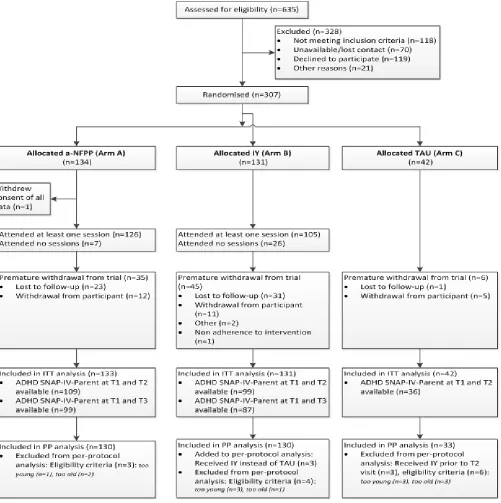
Three hundred and seven participants were recruited; one participant withdrew consent of all data (see Figure 1). Per protocol analyses excluded 13 participants because of trial protocol violations and three because they received IY rather than TAU prior to T2 (Figure 1).
IY had lower levels of initial engagement than NFPP; 19.8% (n=26) of participants attended no sessions (i.e. had no intervention at all) compared to 5.3% (n=7). Of those participants that attended the first session, 18% (n=23) of IY participants withdrew prematurely compared to 22.2% (n=26) for NFPP. More NFPP, than IY participants, attended eight or more sessions, 64.7% (n=86) versus 46.6% (n=61) – although for the IY intervention this was very unevenly distributed across the three centres (36 – 54%). Those remaining in the trial were not statistically different from those dropping out in terms of baseline characteristics (data
available on request). Demographics and background characteristics of the sample at baseline were well balanced across arms (Table 1). Parents in the sample had relatively high levels of unemployment, single parenthood, educational underachievement and depressed mood. The number of parents who had GHQ scores of 11 or over (the accepted clinical threshold) were NFPP 100 (75.2%); IY 104 (79.4%); TAU 31 (73.8%). A substantial proportion of children displayed developmental delay (75% of the total sample, with 50% of the total sample displaying language delay (Table 1.)).
TAU data were available for all but 6 (14.3%) participants. In the current trial the content of TAU varied considerably. Many individuals received no treatment. Where they did receive some, it was typically of a non-specialised nature offered in child and adolescent clinics or in the community for families with a young child with ADHD. The use of health services during the trial was common but in most cases these were for general medical concerns and not for behavioural problems. Nine children visited child mental health services. Of these two children attended a special nursery and one a speech therapist. Two parents attended a general support group (Sure Start). In addition, six parents attending CAMHS received parent training for their children’s behaviour problem. In five cases this was Triple-P which was offered at one of the sites and in one site it was non-specific behavioural advice. One child had an assessment by an educational psychologist. Parents of six children had respite support by family members. No children in the study received medication for ADHD.
Treatment Fidelity
For NFPP a random selection of 11% of cases were assessed for fidelity with each site contributing five individual whole sets of parent treatment sessions. For IY, data on content delivered were submitted for 53% of groups from two of the sites. Content fidelity was 70% for NFPP and 74% for the two IY sites for which results were available.
Efficacy
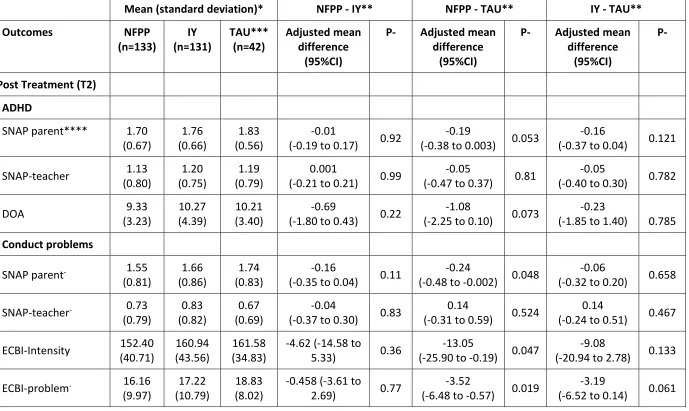
Table 2 reports mean scores for the primary and secondary outcomes by treatment arm at T2 and T3 for NFPP and IY for ITT analyses and the adjusted mean difference in outcome from the mixed effects regression models. At T2 (n=24) 18.0% and (n=32) 24.4% of primary outcome data were missing for NFPP and IY respectively. No statistically significant differences between NFPP and IY were observed on parent assessed ADHD symptoms at T2 (adjusted mean for NFPP=1.715, for IY=1.724 mean difference -0.009 95%CI -0.191 to 0.173, p-value 0.921; effect size (SMD) = 0.06). For all secondary outcomes differences between NFPP and IY were small and not statistically significant (all p values >0.9; Table 2). Sensitivity analyses of the; (i) complete case set, (ii) per protocol sample and (iii) parents receiving eight or more sessions gave similar results (available on request).
NFPP versus TAU: TAU T2 primary outcome data were missing for n=6 (14.3%) participants of the primary outcome. Small benefits of NFPP over TAU were seen for parent-rated ADHD SNAP-IV scores (mean difference -0.189 95%; CI-0.380 to 0.003; SMD = 0.35) – effects just short of conventional levels of significance (p=.053). The effects on DOA also approached significance (p=0.073; SMD = 0.37; Table 2). NFPP produced statistically significant reductions in conduct problems on all three parent-rated measures compared to TAU (all p-values<.05; SNAP ODD - SMD = 0.34; ECBI intensity - SMD = 0.45; ECBI problem - SMD = 0.69; Table 2). No differences were seen for teacher rated outcomes (all p-values>.5). One NFPP-related adverse event was reported - an accidental minor head injury.
significant reductions in conduct problems for the ECBI measure compared to TAU (p=0.061; Table 2). Complete case and per protocol analysis gave similar results (available on request). Costs
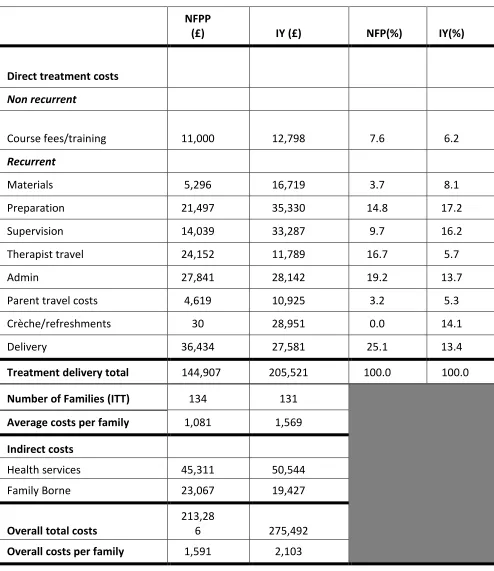
Table 3 reports the cost breakdown for the interventions. As discussed above following review of the raw data some adjustments were made that reduced the cost of transport to
supervisions and of crèches, as the high cost of both were a consequence of trial-specific arrangements which would not translate to a real world setting (details available on request). The costs of créches will depend on the number of children attending as one worker has to be employed for every two children attending. In both cases, these adjustments reduced the IY cost estimates. Despite this, overall mean total cost was significantly lower for NFPP than IY (£1,591 versus £2,103) a difference of £512 (95%CI £324 to £700). The difference was almost entirely related to intervention costs (£1,081 in NFPP versus £1,569 in IY). As expected, therapist travel costs were more expensive for NFPP, while facility costs (crèches, halls and refreshments and parent travel costs) were greater for IY. More surprising were the higher preparation/supervision costs for IY. This partly arose from the need for additional supervision due to therapist changes and in part was due to trial recruitment difficulties involving an extension in trial length and the need to run additional groups (16 as opposed to the initially planned 15) that resulted in very small groups.
Discussion
efficacious for preschool ADHD than IY. The apparent lack of superiority of NFPP over IY went against our expectations, as NFPP was designed specifically for the treatment of preschool ADHD while the IY version used was not. Second, NFPP was less costly to deliver than IY – even after taking into account differences in the initial supervision costs. Like NICE, we predicted that many components of the costs of group and individual PT would be similar but that these costs would be spread more thinly in IY. In hindsight, some of the cost differences observed in favour of NFPP might have been expected especially given the high premium placed on training and supervision by IY, and particularly when running a trial with naive therapists. To what extent do these trial-based cost estimates represent the real world? A recent IY study found that similarly high costs during a trial phase fell dramatically when rolled out in everyday care [32] as once therapists are trained supervision costs are less and training manuals do not need to be provided, although materials for parents are still required. Furthermore, it is possible in the community setting, that créches and lunches, and patient travel may not be needed. However, these estimates of IY as routine care were based on a different trial. No such trial exists for NFPP and we were unable to estimate equivalent costs in COPPI. Our cost comparisons should therefore be treated with some caution.
developmental delay and/or lived in difficult family circumstances and these may have made them more difficult to treat. This would also apply to the effects of IY, which were also less than would have been expected, although possibly accounted for by the high no show rate of 20%. The NFPP results were however consistent with recent meta-analyses [33]. The SMD for parent-rated ADHD was 0.35 in the current trial, which is similar to the SMD of 0.37 found in a recent meta-analysis for PT for ADHD. As in previous trials of PT, the parent-rated benefits of PT relative to TAU did not generalise to teacher ratings [11]. Parent ratings may over-inflate treatment effects because of the bias likely to be associated with parents’ lack of blindness and their investment in the therapeutic process. Alternatively, ratings may reflect real changes in children’s behaviour in the home setting that do not translate into improvement in other settings. Both IY and NFPP place a strong emphasis on improving the parent-child relationship so that behavioural improvements related to this therapeutic element might be especially likely to affect home rather school based outcomes. The (near significant) positive effects seen for NFPP compared to TAU on the direct observation measure of attention are more consistent with this latter account.
time in completing questionnaires. This took the form of £5 gift vouchers for each set of complete data collected at baseline, T1 and T2. This was introduced roughly half way through the trial. Gift vouchers were handled by the researchers that collected the outcome data. However, it is possible that the challenging nature of the sample, as discussed above, could have contributed to the higher than expected levels of drop out. Importantly there was no evidence for selective drop out and so we were able to utilise a mixed effect regression model and multiple imputation to include information from all participants. Second, some elements of the IY implementation in COPPI may not have been optimised. Groups varied in terms of
numbers of participants. IY developers recommend 12 individuals per group but most trials have started with eight - although numbers can drop during the treatment. The number of IY groups with less than 8 members at the time of recruitment was 13 out of 19 – with a range 5 to 12 of participants per group and a modal value of 6/7. Furthermore, the twenty per cent of families that did not attend any sessions received no treatment. This high rate of IY “no shows” could be explained by: (i) parents failing to make the time/date of sessions (despite confirming their availability prior to randomisation); (ii) parents’ initial preference for individual over group approaches and/or (iii) difficulties in planning and organising their lives. Third, while overall IY content fidelity was acceptable for two sites (over 70%), data were not collected from one site. We do not know the full reason for this but it seems like it was due to a simple oversight. Staff changes made checking the return of ratings difficult. However all therapists had attended supervision and their tapes had been discussed in supervision. Fourth, response rate for teachers was lower than that for parents. Fifth, there was a degree of turnover of staff in both programmes
trial in two centres and the need to run four additional tranches due to low recruitment [21]. Finally, it
was not possible to estimate the costs of TAU. This meant that we were unable to make cost
comparisons of this against IY and NFPP.
COPPI was designed to address the appropriateness of NICE guidance recommending group-based PT for ADHD in young children. The finding that NFPP may be less costly than IY supports a revision of NICE’s recommendations in favour of group rather than individual services.
Arguably, both individually-delivered and group-based PT should be made available to families of children with preschool ADHD[34]. An option of individually-delivered PT is further
Contributors: ESB was the trial chief investigator, was responsible for trial design and oversight and wrote the first draft of the paper. LS was the senior trial statistician responsible for the statistical aspects of the trial design, provided statistical oversight throughout and in
conjunction with TM completed the analyses. TM carried out central statistical monitoring for the trial, created the statistical analysis plan, analysed and reported regular information for the Data Monitoring and Ethics Committee and in conjunction with LS completed the analyses. MT was the overall clinical lead for the project, site PI for Southampton and oversaw the training and supervision of the NFFP therapists with CL-B. JH oversaw the training and supervision of the IY programme. JR and LY estimated the costs and drafted the health economics section. DD was site PI for Nottingham and provided training on assessment. JB was site PI for North Staffs. DC advised on the design of the study. LL, LG, LS, PM, JM, ML, EPV, and JL were research fellows on the trial and collected the outcome data. MRud. helped with the collection of the data for the costing. MRad. was data manager. MC developed the time costing forms for the cost
effectiveness-analysis. All authors contributed to the manuscript and approved its submission.
Journal of Child Psychology & Psychiatry. DD has received speaking fees from Shire and Eli Lilly, Danish ADHD association, Danish Ministry for Social Care and book royalties from Jessica Kingsley. JH has earned occasional fees as a trainer in the Incredible Years parent programmes. MT has received recent research funding from Shire, a speaker fee from Janssen-Cilag, earns fees from training and supervision in the New Forest Parenting programme and book royalties from Jessica Kingsley and Hodder-Arnold. CL-B earns fees from training and supervision in the New Forest Parenting programme and book royalties from Jessica Kingsley and Hodder-Arnold. In the last three years, she has also received speaker fees from Janssen-Cilag and Shire. DC has received speaking fees, consultancy and research funding from Shire Pharma, Consultancy and speakers’ fees from Novartis and Sandoz, and speakers’ fees from Janssen Cilag and Eli Lilly. He has received book royalties from OUP. He receives an honorarium as Editor for the Journal of Child Psychology & Psychiatry. JB has received book royalties from the Royal College of Psychiatrists. All other authors have no financial disclosures to make.
Acknowledgements
Paula Browne and Alison Hurry who delivered the therapy. Shihua Zhu assisted with health economic modelling of the data. Dr Catherine Thompson helped with the editing and
Research in Context
Research before this study
We examined recent systematic reviews and meta-analyses of parenting training for ADHD (last published in 2014) and conducted a search using ISI Web of Knowledge and MEDLINE in August 2016 to identify recent RCTs. Search terms included – “parent training”, “Attention-Deficit Hyperactivity Disorder”, “ADHD”, “preschool”. Meta- analyses highlight the value of PT for pre-schoolers with ADHD – specifically improving parenting and reducing parent reported ADHD and conduct problem symptoms. No prior RCT has included a cost-effectiveness analysis of PT specifically for use in preschool ADHD populations. No prior study has compared the efficacy and cost-effectiveness of individually delivered and group-based parent training approaches.
Added value of this study
This is the largest RCT of parent training as a treatment for preschool children with ADHD, the first to incorporate a cost analysis and the first to compare an individually delivered (NFPP) and a group-based (IY) approach. NFPP and IY did not differ from one another in terms of their effects on ADHD or conduct problems although, against expectation, in the trial context NFPP was less costly. Furthermore, attendance was higher in NFPP families.
Limitations
Implications of all the available evidence
PT plays an important role in the treatment of preschool ADHD. Given it established that NFPP
was equally effective to IY but likely to be cheaper, the current trial did not support the NICE
recommendation in favour of group-based over individually-delivered parent training for the
Table1: Demographic, background and baseline characteristics of participants in the three treatment arms (ITT population).
NFPP (n=133)*
IY (n=131)*
TAU (n=42)* Child characteristics
Age (months) – mean (SD) 43.4(7.01) 42.0(6.49) 42.3(7.79)
Female – n (%) 32 (24) 38 (29) 12 (40)
Language delay – n (%) 56 (53) 54 (52) 21 (60)
Developmental delay- n (%) 92 (77) 88 (75) 25 (74)
Conduct problems - n (%) 104(81) 101(79) 26(63)
Parent /caregiver characteristics
Left school no qualifications – n (%) 23 (17) 13 (10) 4 (10)
Female - n (%) 129 (97) 126 (96) 40 (95)
Unemployed - n (%) 88 (66) 81 (62) 26 (62)
Partner unemployed - n (%) 19 (14) 19 (15) 8 (19)
Single-parent- n (%) 41 (31) 39 (30) 12 (29)
Low mood - n (%) 100 (75) 104 (79) 31 (74)
Baseline measures Child ADHD
SNAP parent – mean (SD) 2.08 (0.51) 2.14 (0.48) 2.04 (0.45) SNAP-teacher – mean (SD) 1.16 (0.82) 1.33 (0.80) 1.17 (0.85) Direct observation of attention –
mean (SD)* 10.15 (4.76) 10.52 (4.18) 9.55 (3.22)
Child Conduct Problems
Table 2: Primary and secondary outcomes immediately post treatment and at six months (ITT population)
Mean (standard deviation)* NFPP - IY** NFPP - TAU** IY - TAU**
Outcomes NFPP
(n=133) IY (n=131) TAU*** (n=42) Adjusted mean difference (95%CI)
P- Adjusted mean difference
(95%CI)
P- Adjusted mean difference
(95%CI)
P-
Post Treatment (T2) ADHD
SNAP parent**** 1.70 (0.67) 1.76 (0.66) 1.83 (0.56) -0.01
(-0.19 to 0.17) 0.92
-0.19
(-0.38 to 0.003) 0.053
-0.16
(-0.37 to 0.04) 0.121
SNAP-teacher 1.13
(0.80) 1.20 (0.75) 1.19 (0.79) 0.001
(-0.21 to 0.21) 0.99
-0.05
(-0.47 to 0.37) 0.81
-0.05
(-0.40 to 0.30) 0.782
DOA 9.33
(3.23) 10.27 (4.39) 10.21 (3.40) -0.69
(-1.80 to 0.43) 0.22
-1.08
(-2.25 to 0.10) 0.073
-0.23
(-1.85 to 1.40) 0.785 Conduct problems
SNAP parent- 1.55
(0.81) 1.66 (0.86) 1.74 (0.83) -0.16
(-0.35 to 0.04) 0.11
-0.24
(-0.48 to -0.002) 0.048
-0.06
(-0.32 to 0.20) 0.658 SNAP-teacher- 0.73
(0.79) 0.83 (0.82) 0.67 (0.69) -0.04
(-0.37 to 0.30) 0.83
0.14
(-0.31 to 0.59) 0.524
0.14
(-0.24 to 0.51) 0.467 ECBI-Intensity 152.40
(40.71)
160.94 (43.56)
161.58 (34.83)
-4.62 (-14.58 to
5.33) 0.36
-13.05
(-25.90 to -0.19) 0.047
-9.08
(-20.94 to 2.78) 0.133 ECBI-problem- 16.16
(9.97)
17.22 (10.79)
18.83 (8.02)
-0.458 (-3.61 to
2.69) 0.77
-3.52
(-6.48 to -0.57) 0.019
-3.19
Health outcome 6 months (T3): ADHD
SNAP parent 1.76
(0.67)
1.73 (0.68)
- 0.04
(-0.14 to 0.23)
0.64 - - - -
SNAP-teacher 1.01
(0.74)
1.04 (0.70)
- -0.05
(-0.33 to 0.24)
0.75 - - - -
DOA 8.82
(4.00)
8.15
(2.96) -
0.55
(-0.35 to 1.45) 0.23
- - - -
Conduct problems
SNAP parent- 1.68
(0.86)
1.69 (0.88)
- -0.04
(-0.25 to 0.18)
0.75 - - - -
SNAP-teacher- 0.55 (0.68)
0.71 (0.70)
- -0.15
(-0.45 to 0.15)
0.33 - - - -
ECBI-Intensity 159.53 (46.43)
159.56 (43.15)
- 3.77
(-6.06 to 13.60)
0.45 - - - -
ECBI-problem- 17.00 (11.68)
15.98 (10.54)
- 2.10
(-0.73 to 4.94)
0.14 - - - -
* From participants with complete data
** Results from mixed model on multiple imputed data adjusted for baseline (T1), tranche and centre as fixed effects and therapist and participant as random effects
Table 3: Breakdown direct and indirect costs by arm
NFPP
(£) IY (£) NFP(%) IY(%)
Direct treatment costs Non recurrent
Course fees/training 11,000 12,798 7.6 6.2
Recurrent
Materials 5,296 16,719 3.7 8.1
Preparation 21,497 35,330 14.8 17.2
Supervision 14,039 33,287 9.7 16.2
Therapist travel 24,152 11,789 16.7 5.7
Admin 27,841 28,142 19.2 13.7
Parent travel costs 4,619 10,925 3.2 5.3
Crèche/refreshments 30 28,951 0.0 14.1
Delivery 36,434 27,581 25.1 13.4
Treatment delivery total 144,907 205,521 100.0 100.0
Number of Families (ITT) 134 131
Average costs per family 1,081 1,569 Indirect costs
Health services 45,311 50,544
Family Borne 23,067 19,427
Overall total costs
213,28
6 275,492
Figure 1: CONSORT Diagram showing the flow of participants through the study.
1. Faraone SV, Asherson P, Banaschewski T,Biederman J, Buitelaar JK, Ramos-Quiroga JA, Rohde LA, Sonuga-Barke EJS, Tannock R and Franke B. (2015 Attention-Deficit/Hyperactivity
Disorder. Nature Reviews: Disease Primers. 15020.
2. Chorozoglou M, Smith E, Koerting J,et al. Preschool hyperactivity is associated with long‐ term economic burden: evidence from a longitudinal health economic analysis of costs incurred
across childhood, adolescence and young adulthood. Journal of Child Psychology and
Psychiatry. 2015; 56(9):966-75.
3. Chronis AM, Jones HA, Raggi VL.( 2015) Evidence-based psychosocial treatments for children and adolescents with attention-deficit/hyperactivity disorder. Clinical Psychology
Review. 26(4):486-502.
4. Scott S, Dadds MR. (2009) Practitioner Review: When parent training doesn’t work: theory‐ driven clinical strategies. Journal of Child Psychology and Psychiatry. 50(12):1441-50.
5. National Collaborating Centre for Mental Health (UK) ( 2009)
Attention-Deficit/Hyperactivity Disorder: Diagnosis and Management of ADHD in Children, Young
People and Adults. British Psychological Society (UK).
6. Sonuga-Barke EJ, Daley D, Thompson M, et al. (2001) Parent-based therapies for preschool attention-deficit/hyperactivity disorder: a randomized, controlled trial with a community sample.
Journal of the American Academy of Child & Adolescent Psychiatry. 40(4):402-8.
7. Jones K, Daley D, Hutchings J, et al. (2007) Efficacy of the Incredible Years Basic Parent Training Programme as an early intervention for children with conduct problems and ADHD.
Child: Care, Health and Development. 33(6):749-56.
8. Niec, LN, Hemme JL, Yopp JM . Brestan EV (2016). Group Parent-Child Interaction Therapy: A Randomized Control Trial for the Treatment of Conduct Problems in Young
Children. Journal of Consulting and Clinical Psychology 84(8): 682-698.9. Webster-Stratton C.
(1998) Preventing conduct problems in Head Start children: strengthening parenting
competencies. Journal of Consulting and Clinical Psychology. 66(5):715.10. Sonuga-Barke EJ,
Thompson M, Abikoff H, et al. (2006 Nonpharmacological interventions for preschoolers with
11. Abikoff HB, Thompson M, Laver‐ Bradbury C, et al. (2015) Parent training for preschool ADHD: a randomized controlled trial of specialized and generic programs. Journal of Child
Psychology and Psychiatry. 56(6):618-31.
12. Thompson MJ, Laver-Bradbury C, Ayres M. (2009) A small-scale randomized controlled trial of the revised new forest parenting programme for preschoolers with attention deficit
hyperactivity disorder. European Child & Adolescent Psychiatry.18(10):605-16
13. Webster-Stratton C. (2008) The Incredible Years parents and toddlers series. Seattle, Washington: Author.
14. Scott S, Spender Q, Doolan M,,et al. (2001) Multicentre controlled trial of parenting groups for childhood antisocial behaviour in clinical practice British Medical Journal. 323(7306):194.
15. Hutchings J, Bywater T, Daley D, Gardner F, Whitaker C, Jones K, Eames C, Edwards RT. (2007) Parenting intervention in Sure Start services for children at risk of developing conduct
disorder: pragmatic randomised controlled trial. British Medical Journal. 334(7595):678.
16. Webster-Stratton CH, Reid MJ, Beauchaine T. (2011) Combining parent and child training for young children with ADHD. Journal of Clinical Child & Adolescent Psychology.
40(2):191-203.
17. Perrin EC, Sheldrick RC, McMenamy JM, et al. (2014) Improving parenting skills for families of young children in pediatric settings: A randomized clinical trial. JAMA Pediatrics.
168(1):16-24.
18. Routh D. (1978). Hyperactivity. Magrab P, ed Psychological Management of Pediatric Problems. 2nd edition. Baltimore: University Park Press. 1978.
19. Costello EJ, Edelbrock CS, Costello AJ. (1985) Validity of the NIMH Diagnostic Interview Schedule for Children: A comparison between psychiatric and pediatric referrals. Journal of
Abnormal Child Psychology. 1985; 13(4):579-95.
20. Jeffree DM, McConkey R. (1998) Parent Involvement Project (PIP) Developmental Charts. 2nd edition: Hodder Education.
21. McCann DC, Thompson M, Daley D, et al. (2014) Study protocol for a randomized
controlled trial comparing the efficacy of a specialist and a generic parenting programme for the
22. Koerting J, Smith E, Knowles MM et al. (2013) Barriers to, and facilitators of, parenting programmes for childhood behaviour problems: a qualitative synthesis of studies of parents and
professionals’ perceptions. European Child & Adolescent Psychiatry. 22(11):653-70.
23. Smith E, Koerting J, Latter S, et al. (2015) Overcoming barriers to effective early parenting interventions for attention‐ deficit hyperactivity disorder (ADHD): parent and practitioner views.
Child: Care, Health and Development. 41(1):93-102.
24. McEwan F, Thompson M, Laver‐ Bradbury C, et al. (2015) Innovations in Practice:
Adapting a specialized ADHD parenting programme for use with ‘hard to reach’ and ‘difficult to
treat’ preschool children. Child and Adolescent Mental Health. 20(3):175-8.
25. Thompson MJJ. (2002) The development of a community service for young children in the New Forest: joint work by a child guidance clinic with health visitors MD thesis [Unpublished]
University of Glasgow
26. Swanson J, Nolan W, Pelham WE. The SNAP-IV rating scale. (1992) URL: http://www. adhd. net.[25.07. 2006].
27. Robinson EA, Eyberg SM, Ross AW. (1980) The standardization of an inventory of child conduct problem behaviors. Journal of Clinical Child & Adolescent Psychology. 9(1):22-8.
28. Beecham J, Knapp M. (2001) psychiatric interventions. In Thornicroft G. Ed Measuring Mental Health Needs. 2nd edition London: Gaskell.
29. Goldberg D. (1992) General health questionnaire (GHQ-12). Windsor, UK: Nfer-Nelson. 30. Yang X, Shoptaw S. (2005) Assessing missing data assumptions in longitudinal studies: an example using a smoking cessation trial. Drug and Alcohol Dependence. 77(3):213-25.
31. Dolan P. (1997) Modeling valuations for EuroQol health states. Medical care. 35(11):1095-108.32. Edwards RT, Linck P, Berry R, Charles J, Jones C, Bywater T, Hutchings J (2016)
Incredible Years Parenting Programme. Cost-Effectiveness and Implementation Journal of
Children’s Services. 11;54-72.
33. Daley D, Van der Oord S, Ferrin M, et al. (2014) Behavioral interventions in attention-deficit/hyperactivity disorder: a meta-analysis of randomized controlled trials across multiple
outcome domains. Journal of the American Academy of Child & Adolescent Psychiatry.
34. Wymbs FA, Cunningham CE, Chen Y, Rimas HM, Deal K, Waschbusch DA, Pelham Jr WE. (2015) Examining parents’ preferences for group and individual parent training for children