Navigating In Large Hospitals
Nancy Hughes
∗, James Pinchin
†and Michael Brown
‡Horizon Digital Economy Research University of Nottingham
Nottingham, UK
Email:∗[email protected] †[email protected] ‡[email protected]
Dominick Shaw
Division of Respiratory Medicine,School of Clinical Sciences University of Nottingham
Nottingham, UK
Email:[email protected]
Abstract—Navigating around large hospitals can be a stressful and time-consuming experience for all users of the hospital infrastructure. Navigation difficulties encountered by patients and visitors can result in missed appointments or simply create a poor impression of the hospital organisation. When staff encounter navigation difficulties this can lead to cost and efficiency issues and potentially put patient safety at risk. Despite the provision of an array of in-hospital navigational aids, ‘getting lost’ continues to be an everyday problem in these large complex environments. This study aims to to identify factors which affect navigation in hospitals. We do not seek to evaluate the effectiveness of a single navigation aid, instead the objective of this study was to understand the environment in which a new system must operate and the gaps in provision left by existing navigation aids. This study is intended to be used to inform the development of new in-hospital navigational aids, be they technological or otherwise. Eleven participants, all users of a large hospital site, were asked to describe specific first hand experiences of navigating in a hospital. The ‘Critical Incidence Technique’ was applied in a series of semi-structured interviews to elicit information about a participants navigation experience. This work presents the results of these interviews, with concepts identified and organised into five themes: The ‘Impact’ of poor navigation, ‘Barriers’ to effective navigation, ‘Enhancers’ for effective navigation, ‘Types of Navigation Aids’ and user groups with ‘Specific Navigational Needs’. The number of navigation aids available to participants was identified as an issue in itself, we found examples of thirty seven distinct sources of information available to a hospital user. We begin by introducing previous work on in-hospital navigation before describing the study design employed in this research. The themes and categories identified from the interview data are enumerated and described, with examples given from the interview transcripts. Finally we go on to give a discussion of some potential navigation solutions in light of the identified factors. This study highlights that a candidate navigation aid must be carefully designed and implemented if it is to compliment the thirty seven other sources of navigation information available to the hospital user.
I. INTRODUCTION
Hospitals are typically large, complex and evolving spaces, which are being regularly reconfigured and extended as operational needs shift and change, often resulting in a confusing, non systematic layout [1]. They are also often situated within dense built-up areas, making not only the journey ‘through’, but also ‘to’ the hospital a major navigational challenge. In addition to this, hospitals need to accommodate a hugely diverse range of needs and emotional
states, from those of a family member accompanying an emergency admission or a junior doctor on a night shift, to a routine day-patient. They also need to address a range of physical and cognitive abilities. For example the injured, infirm and partially sighted [2] as well as those with reduced cognitive and thus spatial abilities [3].
It is not surprising therefore that navigating around large hospitals is often a major source of anxiety, frustration and stress for those visiting and working there. It also has significant and direct ‘cost’ implications in terms of missed appointments, whilst also putting an overall strain on staff time and resources in guiding others [4].
To overcome such issues a host of ‘non-technical’ navigational and locative aids have been incorporated into hospital environments, based upon a well-documented understanding of spatial cognition [5], wayfinding [6] and signage design [7]. These solutions vary widely and include directive signage; wall mounted ‘You are here maps’; colour coded flooring; alphabetical/numerical naming systems; turn by turn directions on hospital letters and more recently, web and app-based interactive maps and ‘journey planners’. However, such a diversity and volume of information has the potential to be fragmented and overwhelming, with more recent examples often being more technologically motivated than necessarily user-driven. Indeed, despite such a wealth of navigational information, getting lost in hospitals is still a common, everyday problem [8].
Many advances have been made in indoor positioning in recent years, some technological solutions being specifically developed for use in the hospital (e.g. [9], [10], [11], [12]). However, as Kjærgaard et al point out in [13], ‘While much effort has gone into achieving high positioning accuracy... it is our contention that the general problem is not sufficiently well understood, thus preventing deployments and their usage by applications to become more widespread’. Indeed [13] studied the deployment of positioning systems from the point of view of the organisation providing the technology. In their work they identified the diversity of user groups as one of the barriers to successful deployments.
problem. The ultimate aim of our work is to provide an evidence base upon which to improve existing navigational aids or inform the provision of new forms of contextually appropriate guidance. These improvements will significantly reduce everyday navigational inefficiencies and improve the overall ‘user experience’ for patients, visitors and staff alike.
II. METHOD
Participants were recruited through a mixture of hospital Facebook pages, Twitter feeds, staff bulletins, printed flyers and hospital contacts. Eleven participants were recruited, five males and six females ranging from 31 to 77 years of age, each with recent experience of navigating the Nottingham University Hospital Trust (Queens Medical Centre and City Hospital). Participants were selected in order to represent a wide range of users of Hospital sites and included: 3 patients, 1 administrative staff, 2 hospital volunteers, 2 medical students, 2 ward sisters and 1 night shift coordinator (Senior Nurse).
Each participant was interviewed using a semi-structured Critical Incident Technique (CIT) [14] approach. CIT is an acknowledged qualitative research method for eliciting real-life human experiences, their relative meaning and significance. This method involves asking participants to recall specific recent experiences, in this case focusing on in-hospital navigation events. Participants are asked to recall an event. The interviewer then probes as to what led up to the event, the specifics of what happened and how that event influenced them after it happened. Participants were each asked to recall up to three ‘positive’ and then up to three ‘negative’ events when a critical navigation event had an impact on their visit or working lives.
For example, “I’d like to begin by asking you to think about your own experiences of arriving and finding your way around a hospital environment. . . if you could think of 2-3 examples that you felt were positive. . . starting with your more positive experiences, can you describe, the circumstances or background to this experience, why this experience was positive and what were the implications of this experience?”.
Each interview was audio-recorded and supporting notes were made. Interviews were then transcribed and analysed using Thematic Analysis as described by Braun and Clarke [15]. This process involved the involved the identification and coding of individual statements or ‘critical behaviours’ [16]. Subsequently these codes where organised into categories and sub-categories of increasing specificity, through an iterative process of re-examination and reorganisation. This process of analysis served to highlight a framework of core navigational issues, which will now be discussed.
III. RESULTS
The eleven interviews used in this study ranged in duration from 9.5 to 28.2 minutes, depending on the time participants had available and also their ability to recall and describe individual examples/instances. Indeed, as the interviews progressed it became apparent that hospital staff in particular, often found it difficult to identify discrete navigational experiences, tending to describe more generalised issues, and benefited from some ‘thinking time’ prior to the
interview. Despite this, a total of 3hrs 20 minutes of verbal data was generated and subsequently transcribed.
From this body of textual data, 788 individual statements or ‘critical behaviours’ were identified e.g. “you know the areas of the hospital well and you can navigate quite successfully”, each of which was subsequently summarised in a ‘descriptive code’ e.g “Benefit of survey knowledge”. These descriptive codes were then numbered in terms of the nature of the content / concept they represented. The descriptive codes within each of the overarching categories were then further re-examined, reorganised and re-numbered into smaller, increasingly specific and meaningful categories. Through this process of iterative re-examination and re-organisation, 5 themes emerged, demonstrating the complex issues associated with navigation in hospital environments.
1) Impacts
Many participants talked about specific impacts of patients, visitors and staff having navigation issues. The emergence of this category shows that patients and staff are aware of the impact navigation issues are having on both hospital operations and them personally. Four sub-categories emerged in the ‘impacts’ theme.
2) Types of Navigation Aid Used
Unsurprisingly many of the participants discussed different types of navigation aid which they used. The sheer number of different options currently available was interesting, with eleven sub-categories identified of which all but one refer to existing solutions.
3) Barriers to Navigation
Fifteen sub-categories were identified describing personal, environmental and contextual barriers to navigation to and within hospitals.
4) Enhancers to Navigation
We identified fourteen factors which had a positive influence on in-hospital navigation. For example verbally delivered information was especially valued by the participants.
5) Specific Navigational Needs
Six sub-categories were identified describing specific groups with distinct navigational needs, for example transient staff.
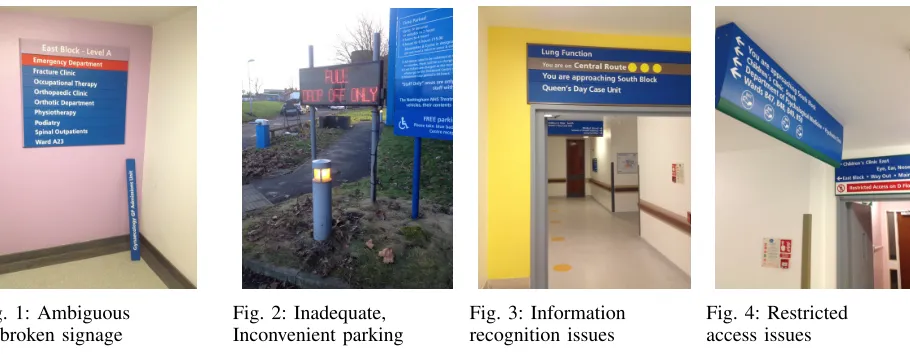
Fig. 1: Ambiguous or broken signage
Fig. 2: Inadequate, Inconvenient parking
Fig. 3: Information recognition issues
Fig. 4: Restricted access issues
In sections III-A - III-E we describe in full each sub-category identified for the themes above. In some cases the category is illustrated by a quote from one of the interviews.
A. Impacts
Time Time spent on navigation issues, either personal navigation or being interrupted to give directions.
e.g. ‘A lot of time going up and down stairs to try and find the one with the exit you thought you could get out of.’ Participant 11, Night Service Lead.
Procedures Strict and often wasteful procedures exacerbate navigation issues. e.g. ‘A patient was going from our ward to Hayward House . . . the City nurses that have worked there for years say, oh they have to have an ambulance to go around the road. “Really?” I said. We could put them in a wheelchair and I’ll just push them there? No you can’t policy says you can’t.’ Participant 7, Ward sister.
Availability Where a lack of navigation resources (maps, volunteers etc.) had a impact on other hospital operations.
e.g. ‘. . . if they [volunteers] were present about the hospital, you wouldn’t feel bad to ask them rather than bothering staff who are busy.’ Participant 4, Therapy Support Worker.
Cost The cost considerations at play, mainly focused on transport to, from and between hospital sites.
[image:3.612.47.303.309.538.2]e.g. ‘Park and ride buses are excellent, it’s free . . . ’ Participant 4, Therapy Support Worker.
TABLE I: Sub-categories for the ‘impacts’ theme identified from interview data.
Table I expands the four categories grouped under the ‘Impacts’ theme. The time and cost categories could perhaps be expected with staff concerned with both the impact of their own navigation and the impacts of helping visitors and patients. While time spent travelling can have a positive impact on staff (giving time to think, plan etc) it was seen as wasted time or a cost when the travelling was unnecessarily inefficient. Patients were more concerned with navigation time needing to be factored into their total travel time and the impact of a ‘poor’ journey on their ability to arrive for an appointment on time.
While some staff discussed the affect of inefficient navigation on the ‘system’ through missed or delayed
appointment, patients and visitors were concerned with the incurred financial costs of getting to their destination. The participating hospital trust is based on two main sites separated by several miles and the logistics of moving between sites were discussed by multiple participants.
A perhaps unexpected impact of the need for navigation and travel on the hospital ‘system’ was through the interaction of travel and procedures. Rules intended to protect vulnerable patients or save staff time were perceived by staff as having a negative impact on the quality of patient care. This is illustrated by the example given in table I:
‘A patient was going from our ward to Hayward House . . . the City nurses that have worked there for years say, oh they have to have an ambulance to go around the road. “Really?” I said. We could put them in a wheelchair and I’ll just push them there? No you can’t policy says you can’t.’
Participant 7, Ward sister.
B. Types of Navigation Aid Used
In table II the eleven types of navigation aid mentioned by staff and patients are described. Over the eleven types of navigation aid reported we found examples of thirty seven specific sources of information available to those traveling to a hospital.
The first interaction between the hospital and its users is often through the appointment letter or a workplace allocation. These letters or emails give the first navigation clues, ranging from full textual directions to simply the name of the clinic a patient or staff member is to attend. Many participants therefore mentioned textual information.
Textual Information Such as hospital letters and written notices to staff. Verbal Directions The most commonly mentioned navigation aid, verbal
directions are the most obvious and available resource once in the hospital environment.
Physical Landmarks Used by many participants as navigation hubs to return to and regain their bearings.
Colour Coding Used in various ways across the two participating sites, with colour indicating blocks, specialties and common route across the hospitals.
Static Maps Another popular navigation aid, especially with staff who have to negotiate many different routes around the hospital. Mental Models Those with more experience of the hospitals developed survey knowledge and mental models and at times made a conscious effort to do so.
Labeling Systems A range of numbering and naming systems are used so that the name of a ward gives an indication of it’s location (floor, building or block).
Signage A huge range of signage is present at both of the participating sites.
Transport and Escort Transport and escort services are both effective and well liked aids to navigation, but it would be cost prohibitive to provide these at scale.
External Information External information such as web sites and map based apps were used by most participants.
[image:4.612.48.305.58.436.2]Future Solutions All participants discussed potential future solutions ranging from high tech navigation to simply increasing the availability of existing resources.
TABLE II: Sub-categories for the ‘types of navigation aid used’ theme identified from interview data.
A number of forms of infrastructure based guidance were mentioned by the participants. These ranged from dedicated colour coding of routes to various forms of signage and systematic labelling of departments. The use of colour coded of routes seemed more prevalent amongst staff who had time to identify and understand the system. Of the two hospital sites participating in this work one is based around a systematic ward labelling system (e.g. C51) while the other uses non-systematic labels (e.g. ‘Beeston Ward’). The systematic labelling method was identified as useful with some staff, e.g.:
‘It’s quite easy to navigate and the wards are numbered in such a way that you know what floor they’re on’
Participant 9, Medical Student
However problems with this system emerged such as the lack of context in this naming system - the name gives no clue as to the specialty of the department. Meaning can also be given to names where no meaning or another meaning was
intended, for example ‘E12’ being taken to mean ‘east 12’ rather than ‘floor E, room 12’.
All types of hospital users described the use of mental models to help them navigate e.g:
‘. . . understand the concept of the four blocks, you know and figuring it all out for myself.’
Participant 7, Ward Sister
These models were often built around landmarks, signage or simply an understanding of the building design (the ‘four blocks’ mentioned by the participant above). Patients and visitors often relied on mentally reversing their route to a destination in order to find their way out.
Maps, both fixed in the hospital building and obtained before travelling to the hospital site, were mentioned by many participants. The communication of a very complex geography leads to maps which are often too general for use in ‘end to end’ navigation and are often used in the building of a mental model rather than turn by turn navigation. This is discussed more under the ‘Barriers to Navigation’ theme.
Few participants mentioned ‘future solutions’ or technology based solutions to navigation problems. When this subject was raised the expectation was for an ‘audio guide’ or similar.
C. Barriers to Navigation
In table III we categorise the barriers to effective navigation mentioned by the participants.
A group of these categories describe the impact of infrastructure, and especially the maintenance of infrastructure, as a barrier to navigation. The sheer size of the hospital sites was identified as an issue with navigation errors often resulting in long periods of way-finding and large distances being covered. Isolation in these large sites, especially out of hours, led to security concerns.
‘The discharge lounge where patients go when being discharged . . . that‘s the south block A floor I think, again it‘s miles away from the main entrance. You wonder why.’
Participant 5, Hospital Volunteer Worker
Signage, where present, must be maintained so as to be visible and up to date if it is to be an aid rather than a barrier to effective navigation. Similarly access constraints must be well communicated if their impact is to be minimised. This is especially true for users in the hospital out of normal daylight working hours. In this ‘off peak’ period departments and corridors which are open during the day may be locked down for reasons of security.
‘She didn’t know how to get into the departments either, she didn’t know whether she needed to swipe her card in.’
Participant 4, Therapy Support Worker
Cognitive Limitations Several participants discussed personal cognitive limitations such as memory and special reasoning. Limitations to Access Staff and patients alike found that limitations to access prevented them taking optimal routes around the hospital and could make it difficult to find any way to navigate to their intended location. Limited Locative or
Navigational Information.
This category describes lack of communication about where specific staff and facilities are located physically, adding another layer of complexity to the navigation task.
Distances The sheer size of a hospital site means that relative locations and distances between points of interest can be an issue, with large distances to travel across a complex environment.
Security / Safety Concerns over security and safety were mentioned by those working or visiting out of hours. Availability of Limited
Resources
Availability of Limited Resources such as staff and wheelchairs can slow transit across the hospital. Personal Perceptions /
Beliefs
Personal perceptions or beliefs, especially around confidence to navigate, could stop individuals from even attempting to navigate certain areas. Impact of Mental / Physical
Condition
Many participants mention the impact of mental or physical conditions such as stress and mobility issues.
Identifiability and Visibility of Information
Even when information was available the identifiability and visibility of information could be a concern.
Longevity, Dispensability and Redundancy
Many of the available navigation aids need to be maintained across the large sites leading to problems with infrastructure degradation. Continuity / Consistency A lack of consistency and continuity in navigation
aid provision suggested a lack of centralised responsibility.
Meaningfulness At times meaningfulness was incorrectly assigned to ward names, leading to confusion.
Accuracy and Ambiguity Accuracy and Ambiguity were an issue, especially in the directions given in hospital appontment letters.
Prior Experience Lack of, or outdated, prior experience could impact visitors ability to easily transverse the sites. Time The impact of time was clear in some interviews, with the pressure of patient needs or simple upcoming appointments causing people to make mistakes.
Awareness / Communication
[image:5.612.53.298.54.547.2]Issues of awareness and communication of updated or changed navigation information were also highlighted as a concern.
TABLE III: Sub-categories for the ‘barriers to navigation’ theme identified from interview data.
is updated. This concept also appeared as ’awareness’ of navigation problems.
The mental state of the person navigating was also raised by the participants as a potential barrier to navigation. Perceptions or expectations of navigation problems were intimidating to some participants.
‘Your stress levels go up and you start getting a bit sweaty and your heart rate goes up [when lost].’
Participant 1, Hospital Visitor
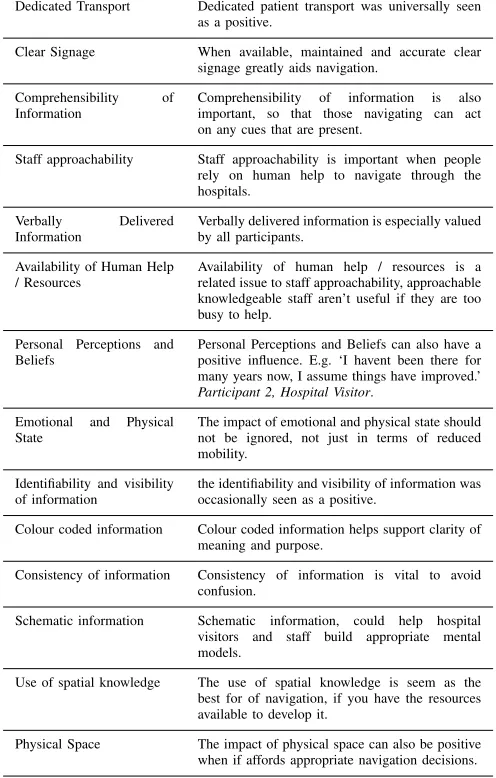
Dedicated Transport Dedicated patient transport was universally seen as a positive.
Clear Signage When available, maintained and accurate clear signage greatly aids navigation.
Comprehensibility of Information
Comprehensibility of information is also important, so that those navigating can act on any cues that are present.
Staff approachability Staff approachability is important when people rely on human help to navigate through the hospitals.
Verbally Delivered Information
Verbally delivered information is especially valued by all participants.
Availability of Human Help / Resources
Availability of human help / resources is a related issue to staff approachability, approachable knowledgeable staff aren’t useful if they are too busy to help.
Personal Perceptions and Beliefs
Personal Perceptions and Beliefs can also have a positive influence. E.g. ‘I havent been there for many years now, I assume things have improved.’
Participant 2, Hospital Visitor. Emotional and Physical
State
The impact of emotional and physical state should not be ignored, not just in terms of reduced mobility.
Identifiability and visibility of information
the identifiability and visibility of information was occasionally seen as a positive.
Colour coded information Colour coded information helps support clarity of meaning and purpose.
Consistency of information Consistency of information is vital to avoid confusion.
Schematic information Schematic information, could help hospital visitors and staff build appropriate mental models.
Use of spatial knowledge The use of spatial knowledge is seem as the best for of navigation, if you have the resources available to develop it.
[image:5.612.321.569.58.447.2]Physical Space The impact of physical space can also be positive when if affords appropriate navigation decisions.
TABLE IV: Sub-categories for the ‘enhancers to in-hospital navigation’ theme identified from interview data.
The nature of the hospital environment means that often users are in a stressed state before being asked to navigate. Participants described the detrimental effect of physical and mental conditions on their navigation. The clinical environment can also be an intimating environment for those unfamiliar with it. Some participants described a sense of ‘trespassing’ when navigating, especially ‘out of hours’.
D. Enhancers to Navigation
In contrast to section III-C, table IV lists the categories identified under the ‘Enhancers to Navigation’ theme. While the ‘Types of Navigation Aid Used’ theme contained specific aids or mechanisms for supporting navigation, this theme contains conditions or properties of navigation aids which the participants described in a positive manner.
‘The way they denote the blocks is by colours. So if someone says West block I immediately think orange block. So this is how I direct patients.’
Participant 8, Ward Sister
Especially valued by patients and visitors was the availability of transport, approachable staff and human help.
‘Rather than sort of saying more technology or something, may be better to have people helping out.’
Participant 4, Therapy Support Worker
Staff described how the physical space could be a great asset to navigation, either through the use of colour as above, or through the design of the building itself.
‘It was certainly easier to describe at [another hospital] where to go . . . you come into the hospital and there‘s this one long corridor.’
Participant 9, Medical Student
Mental state was also identified as an enhancer to the process of navigating. Positive beliefs about the navigation process, about the organisation or an optimistic outlook could give confidence to a hospital user e.g:
‘I haven‘t been there for many years now, I assume things have improved.’
Participant 2, Hospital Visitor
E. Specific Navigational Needs
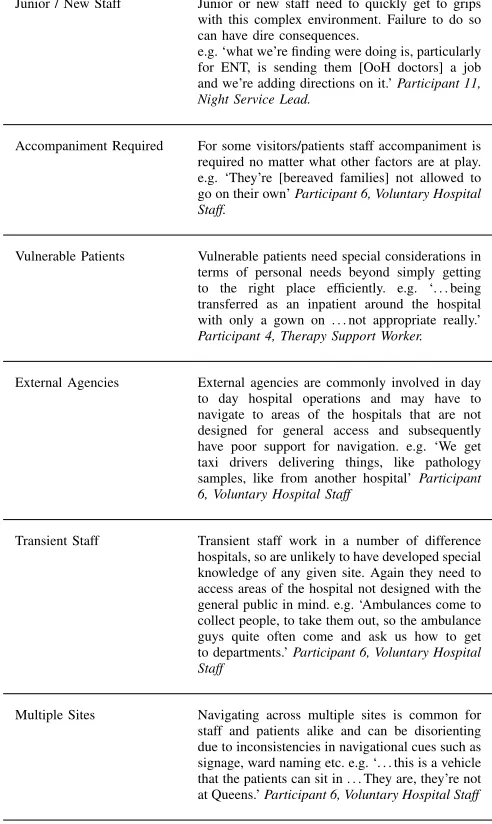
In this study hospital users were informally labelled as ‘staff’ or ‘patients / visitors’. In table V six [sub] groups of users were identified who have specific or unusual navigation needs.
The navigation problems experienced by transient or new staff were raised repeatedly. Many staff are transient in a large teaching hospital. They may be students on rotation, contractors working on the infrastructure or temporary cover staff. These staff are often supported by other staff and in some cases procedures have been adapted to allow for their expected lack of familiarity with the site. In some cases, especially contractors, visiting staff need to navigate to a very specific location which may be ‘behind the scenes’ and unfamiliar even to experienced clinical staff.
Users who are vulnerable by dint of their medical condition or situation often require special arrangements - commonly a staff escort or portering. In this case they may be taken to a new location but given less support when it comes time to exit, or find their way to a familiar landmark.
Finally users, the majority of participants in this study, who have to navigate multiple sites were identified as having special navigational needs. This group require support with inter-site navigation, transport arrangements and systematic differences between sites. For example transiting between multiple naming or colour coding systems in one navigation session.
Junior / New Staff Junior or new staff need to quickly get to grips with this complex environment. Failure to do so can have dire consequences.
e.g. ‘what we’re finding were doing is, particularly for ENT, is sending them [OoH doctors] a job and we’re adding directions on it.’Participant 11, Night Service Lead.
Accompaniment Required For some visitors/patients staff accompaniment is required no matter what other factors are at play. e.g. ‘They’re [bereaved families] not allowed to go on their own’Participant 6, Voluntary Hospital Staff.
Vulnerable Patients Vulnerable patients need special considerations in terms of personal needs beyond simply getting to the right place efficiently. e.g. ‘. . . being transferred as an inpatient around the hospital with only a gown on . . . not appropriate really.’
Participant 4, Therapy Support Worker.
External Agencies External agencies are commonly involved in day to day hospital operations and may have to navigate to areas of the hospitals that are not designed for general access and subsequently have poor support for navigation. e.g. ‘We get taxi drivers delivering things, like pathology samples, like from another hospital’Participant 6, Voluntary Hospital Staff
Transient Staff Transient staff work in a number of difference hospitals, so are unlikely to have developed special knowledge of any given site. Again they need to access areas of the hospital not designed with the general public in mind. e.g. ‘Ambulances come to collect people, to take them out, so the ambulance guys quite often come and ask us how to get to departments.’Participant 6, Voluntary Hospital Staff
[image:6.612.321.567.63.475.2]Multiple Sites Navigating across multiple sites is common for staff and patients alike and can be disorienting due to inconsistencies in navigational cues such as signage, ward naming etc. e.g. ‘. . . this is a vehicle that the patients can sit in . . . They are, they’re not at Queens.’Participant 6, Voluntary Hospital Staff TABLE V: Sub-categories for the ‘specific navigational needs’ theme identified from interview data.
IV. POTENTIALSOLUTIONS
It is clear from this study that navigation in hospitals remains a problem which impacts all type of hospital user. The impact of poor navigation support may take many forms; they may be financial, emotional or even reputational. This study did not focus on navigation solutions but it was apparent early in the process of data analysis that different solutions may be required for different hospital ‘users’. In this section we discuss a range of potential solutions for two sets of hospital users - ‘veterans’ and ‘novice users’.
A. Veteran Users
of familiar landmarks when navigating themselves or giving directions to others.
Veteran users do not often get lost themselves but are often called upon to guide others and occasionally are required to find their way to a new, unfamiliar location. To best support the hospital system this group should be able to help others quickly, easily and accurately. There are two parts to this problem - identifying a suitable route and then communicating it to the patient or visitor.
A technological solution could lend itself well to solving the problem of identifying a suitable route. An in-hospital navigation app could be downloaded or an interactive website could be made available on the mobile devices routinely used by staff. An ideal solution would provide up to date department level end to end directions with notable landmarks, including walk time estimates and an orientation facility. This user group are familiar with the specialist terminology used in the hospital and are capable of making skillful place searches and judgments. There are an emerging number of hospital-based navigation apps already in use, as issues with indoor mapping and positioning resolve. For example that in use at Miami’s Children Hospital and the Mayo Clinic Rochester, Minnesota [17].
Solutions based on smartphone devices allow navigation information to be delivered to the user quickly and on a device which is often carried for other purposes. This approach allows guidance and mapping to be updated according to the context (e.g. ‘staff navigation’ or ‘visitor directions’) and, crucially, the time of day. However these solutions require planning, the app must be downloaded or a data connection and website made readily available. Users must be made aware of the availability of these solutions and have a reasonably high level of comfort with technology, something which may be becoming more common but is still by no means ubiquitous.
The second aspect of the problem, communicating directions to patients, is one commonly encountered by volunteers in the hospital sites participating in this study. In that case paper maps are made available which can be annotated and given to the novice hospital user. Unfortunately these volunteers are not available for all working hours and, being a limited resource, are positioned to best help people entering the hospital. They are of limited help to new staff or those in the ‘core’ of the hospital. It is not practical to make paper maps available to all staff who may be asked to give directions and the process of annotating a map is time consuming.
It is our opinion that the problem of allowing the clear, rapid and accurate communication of directions is closely related to the problem of making a site ‘simple’ to navigate. If straightforward navigation is be built into the ‘ethos’ of a building at design stage then the impacts of poor navigation will naturally be minimised for all users. However this is not a practical or cost effective solution in buildings which are established, and on sites which have in some cases evolved over many years. Systems such as colour coding areas of the hospital or the systematic naming of rooms were identified by our participants as useful, often by veteran users who had time to understand the system. Once such a system is established it can be drawn upon both for personal navigation and for
guidance, for example ‘follow this corridor until the walls are painted pink’ is a more straightforward direction to follow than ‘follow this corridor to east block’. If a system based on name, or colour, is to be established it must be fully implemented and maintained across the site(s) and included in all navigation aids, signage, maps and text or verbal directions.
B. Novice Users
Novice users are often new to a site. They are yet to establish a mental model of the buildings and may be unfamiliar with colouring or naming conventions. Novice users may be patients, visitors, new staff or external agencies working on the site. A ‘one size fits all’ solution is therefore unlikely to be found for this group.
A disproportionate number of hospital users are elderly. Numerous studies (e.g. [18]) have shown that smartphone uptake remains as low as 37% in the over 55’s rendering a solution based on mobile technology less appealing. Still more hospital users are rushed, making an unplanned visit, or simply do not own a ‘suitable’ smartphone. This study indicates that the overwhelming focus for patients and visitors navigating the hospital was ‘human help’ i.e. nurses, volunteers, receptionists, porters etc. The great comfort people received and value they placed in being able to ask staff for directions was apparent, and equally apparent was the willingness and commitment of the staff to help.
A potential solution may therefore be to enhance the ‘meet and greet’ role, by increasing the number of staff or volunteers available or even improving their distribution and visibility. However, as many volunteers are themselves often of advancing years and maybe reluctant to walk to patrol outlying areas of the hospital, ‘FaceTime’ points could be used, particularly in more remote corridors, which people could touch to connect to a ‘live’ volunteer. Verbal, turn by turn directions could then be given ‘remotely’ by a volunteer, from the particular ‘FaceTime’ point accessed, maintaining the human connection.
Such locative, adaptive information could also be achieved through the use of ‘smart’ hospital letters. Patients and visitors entering the hospital could pass their letter, printed with the particular department or clinics code, over a reader which would then display turn by turn directions from that point, to their destination. This textual information could be further augmented with a map, locative images and/or a route video. However, although this solution may be useful for scheduled appointments, there are obviously a host of navigational situations and users it wouldn’t accommodate.
The hospital letter itself was also identified as a source of navigational and locative confusion, often with the particular hospital, block or building name being omitted, with just the name of the department or clinic being given. Some letters included specific route directions, maps and on-line links, whilst others simply stated the department’s name. As such, another ‘low-tech’ solution would be to re-design the hospital letter itself, ensuring any navigational information was clear, consistent, comprehensive and current.
patents with a means to access the most appropriate existing information for their specific needs.
V. CONCLUSION
Hospitals are a challenging environment in which to navigate or create navigation solutions. From a technological point of view the spaces to navigate are indoors, large, multilevel and complex. The spaces are temporally variable and often labelled with medical specialties which may be unfamiliar to a lay-person. Hospital users are also extremely varied, from able bodied staff who have an established mental model of the site and its systems to less able users who are entering the hospital environment for the first time. The focus of the current study has been to identify why hospital users continue to get lost given a history of attempts to aid their navigation.
In this study we interviewed eleven hospital users representing various user groups including staff, patients and volunteers who provide help and guidance to other hospital users. Participants in this study described a range of impacts which poor navigation has on their experience of using hospital infrastructure. Some impacts, like increased stress and anxiety, were very personal. Others were more system focused, such as clinical staff time being used to direct visitors and patients.
The participants in this study identified sixteen types of ‘barrier to navigation’. Some were expected, such as a lack of consistency, accuracy, availability or identifiability of navigation information. Navigation aids, such as colour coded paths or systematic room labelling, went unnoticed or misunderstood by participants. The effect of emotion or state of mind on navigation and route selection was also noted in many forms. Some participants reported a sense of unease or of ‘trespassing’ when in the hospital while others had security concerns, especially out of hours. The expectation of potential navigation difficulties even stopped some participants attempting to navigate certain areas.
The sheer number of current navigation aids listed by the participants in this study was noteworthy. Over the eleven types of navigation aid reported we found examples of thirty seven specific sources of information available to those traveling to a hospital. These information sources vary wildly in terms of reliability and accessibility leaving visitors and staff open to confusion and information overload. Technological solutions were raised by very few participants while ‘human help’ was mentioned and valued by nearly every participant.
Our study has highlighted the range of needs in the hospital environment. While the labels ‘staff’ and ‘patient’ cover the majority of hospital users the full range of user types is far more nuanced. Some staff are very new to the hospital and are required to navigate to a large range of locations at all time of day or night. Some patients and visitors are able-bodied and making a planned, prepared visit to a single location. Other patients are under significant stress and making an unplanned, unprepared, visit. We identified six user types with ‘specific navigational needs’ from vulnerable patients to external agencies working in the hospital.
Recent solutions have typically, and understandably, focused on the increasing availability of indoor mapping
and positioning technologies e.g. the ‘indoor sat nav’. These solutions suit the user who is comfortable with technology, making a planned visit and aware of the availability of the technological solution. They offer up-to-date, tailored guidance which is adaptive to the current state of the hospital site. This study highlights that, unless they are to join the thirty seven other sources of navigation information available to users, any such solution must also support the specific emotional, intellectual and human needs of the user.
ACKNOWLEDGMENT
This work was funded by the RCUK Horizon Digital Economy Research Hub grant, EP/G065802/1 and the Nottingham Hospitals Charity.
The authors wish to thank the patients and staff of Nottingham University Hospitals NHS Trust for their help in this study.
REFERENCES
[1] Y. Li, M. Brown, J. Pinchin, and J. Blakey. Comparison of Methods to Support In-Hospital Navigation. InInternational Navigation Conference 2015, 2015.
[2] P Mollerup. Wayshowing in Hospital. Australasian Medical Journal, 1(10):112–114, 2009.
[3] G.L. Allen, K.C. Kirasic, S.H. Dobson, R.G. Long, and S. Beck. Predicting Environmental Learning From Spatial Abilities: An Indirect Route.Intelligence, 22(3):327–355, 1996.
[4] L.B. Martins and H. F. V. de Melo. Wayfinding in Hospital: A Case Study. In Design, User Experience, and Usability. User Experience Design for Everyday Life Applications and Services, pages 72–82. Springer, 2014.
[5] P.W. Thorndyke and S.E. Goldin.Spatial Learning and Reasoning Skill. Springer, 1983.
[6] P. Arthur and R. Passini. Wayfinding: People, Signs, and Architecture. Toronto: McGraw-Hill Ryerson, 1992.
[7] C. Calori and I. Chermayeff. Signage and Wayfinding Design: A Complete Guide to Creating Environmental Graphic Design Systems. Wiley Hoboken, NJ, 2007.
[8] C.N. Rooke, L.J. Koskela, and P. Tzortzopoulos. Achieving a Lean Wayfinding System in Complex Hospital Environments: Design and Through-Life Management. In Proceedings of the 18th Annual Conference of the International Group for Lean Construction, pages 233–242. National Building Research Institute, Technion-Israel Institute of Technology, 2010.
[9] J Yang, Z Wang, and X Zhang. An ibeacon-based indoor positioning systems for hospitals. International Journal of Smart Home, 9(7):161–168, 2015.
[10] L Calderoni, M Ferrara, A Franco, and D Maio. Indoor localization in a hospital environment using random forest classifiers. Expert Systems with Applications, 42(1):125–134, 2015.
[11] J Pinchin, M Brown, J Blum, D Shaw, and J Blakey. Integrating wifi based positioning with a job management system to study task management behaviour. In Position, Location and Navigation Symposium-PLANS 2014, 2014 IEEE/ION, pages 193–200. IEEE, 2014.
[12] Prashant Krishnamurthy. Technologies for positioning in indoor areas. Indoor Wayfinding and Navigation, page 35, 2015.
[13] M.B. Kjærgaard, M.V. Krarup, A Stisen, T.S. Prentow, H Blunck, K Grønbæk, and C.S. Jensen. Indoor positioning using wifi–how well is the problem understood? In International Conference on Indoor Positioning and Indoor Navigation, volume 28, page 31st, 2013.
[14] J. C. Flanagan. The Critical Incident Technique.Psychological Bulletin, 51(4):327, 1954.
[16] H. Hughes, K. Williamson, and A. Lloyd. Critical Incident Technique.Exploring methods in information literacy research. Topics in Australasian Library and Information Studies, 28:49–66, 2007.
[17] M Plotnick. Digital Wayfinding Improves Hospital
Navigation, Patient Experience. Available from:
http://www.healthcarefacilitiestoday.com/posts/Digital-wayfinding- improves-hospital-navigation-patient-experience-Information-Technology–1382. [Accessed:19th March 2015].