http://wrap.warwick.ac.uk/
Original citation:
Matias, Y., Rajpoot, Nasir M. (Nasir Mahmood) and Sahinalp, S. (2008) Implementation
and experimental evaluation of flexible parsing for dynamic dictionary based data
compression. In: 2nd Workshop on Algorithm Engineering (WAE 1998), Saarbrucken,
Germany, 20-22 Aug 2008
Permanent WRAP url:
http://wrap.warwick.ac.uk/61046
Copyright and reuse:
The Warwick Research Archive Portal (WRAP) makes this work by researchers of the
University of Warwick available open access under the following conditions. Copyright ©
and all moral rights to the version of the paper presented here belong to the individual
author(s) and/or other copyright owners. To the extent reasonable and practicable the
material made available in WRAP has been checked for eligibility before being made
available.
Copies of full items can be used for personal research or study, educational, or
not-for-profit purposes without prior permission or charge. Provided that the authors, title and
full bibliographic details are credited, a hyperlink and/or URL is given for the original
metadata page and the content is not changed in any way.
A note on versions:
Implementation and Experimental Evaluation of Flexible Parsing
for Dynamic Dictionary Based Data Compression
(extended abstract)
Yossi Matias1
Department of Computer Science, Tel-Aviv University, Tel-Aviv, 69978, Israel, and Bell Labs, Murray Hill, NJ, USA
e-mail: [email protected]
Nasir Rajpoot 2
Department of Computer Science, University of Warwick, Coventry, CV4-7AL, UK e-mail: [email protected]
S¨uleyman Cenk S.ahinalp3
Department of Computer Science, University of Warwick, Coventry, CV4-7AL, UK, and Center for BioInformatics, University of Pennsylvania, Philadelphia, PA, USA
e-mail: [email protected]
We report on the implementation and performance evaluation of greedy parsing with lookaheads for dy-namic dictionary compression. Specifically, we consider the greedy parsing with a single step lookahead which we call Flexible Parsing (FP) as an alternative to the commonly used greedy parsing (with no-lookaheads) scheme. Greedy parsing is the basis of most popular compression programs includingunix compressand
gzip, however it does not necessarily achieve optimality with regard to the dictionary construction scheme in use. Flexible parsing, however, is optimal, i.e., partitions any given input to the smallest number of phrases possible, for dictionary construction schemes which satisfy the prefix property throughout their execution. There is an on-line linear time and space implementation of theFPscheme via the trie-reverse-trie pair data structure [MS98]. In this paper, we introduce a more practical, randomized data structure to implement
FPscheme whose expected theoretical performance matches the worst case performance of the trie-reverse-trie-pair. We then report on the compression ratios achieved by two FP based compression programs we implemented. We test our programs againstcompressandgzipon various types of data on some of which we obtain up to 35% improvement.
1. Introduction
The size of data related to a wide range of applications is growing rapidly. Grand challenges such as the human genome project involve very-large distributed databases of text documents, whose effective storage and communication requires a major research and development effort. From DNA and protein sequences to medical images (in which any loss of information content can not be tolerated) vital data sources that will
1
partly supported by Alon Fellowship 2
supported by Quaid-e-Azam scholarship from the Government of Pakistan 3
shape the information infrastructure of the next century require simple and efficient tools for lossless data compression.
A (lossless) compression algorithm C reads input string T and computes an output string, T0, whose
representation is smaller than that ofT, such that a corresponding decompression algorithmC←can takeT0
as input and reconstructT. The most common compression algorithms used in practice are the dictionary schemes (a.k.a. parsing schemes [BCW90], or textual substitution schemes [Sto88]). Such algorithms are based on maintaining a dictionary of strings that are calledphrases, and replacing substrings of an input text with pointers to identical phrases in the dictionary. The task of partitioning the text into phrases is calledparsingand the pointers replacing the phrases are calledcodewords.
A dictionary can be constructed in static or dynamic fashion. Instaticschemes, the whole dictionary is constructed before the input is compressed. Most practical compression algorithms, however, use dynamic schemes, introduced by Ziv and Lempel [ZL77, ZL78], in which the dictionary is initially empty and is constructed incrementally: as the input is read, some of its substrings are chosen as dictionary phrases themselves. The dictionary constructed by most dynamic schemes (e.g., [ZL77, ZL78, Wel84, Yok92]) satisfy theprefix propertyfor any input string: in any execution step of the algorithm, for any given phrase in the dictionary, all its prefixes are also phrases in the dictionary.
In this paper we focus only on the the two most popular dictionary based compression methods: LZ78 [ZL78], its LZW variant [Wel84], and LZ77 [ZL77]. A few interesting facts about LZ78 and LZ77:
• The LZW scheme is the basis for unix compress program, gif image compression format, and is
used in the most popular fax and modem standards (V42bis). LZ77 algorithm is the basis for all zip
variants.
Both algorithms: (1) are asymptotically optimal in the information theoretic sense, (2) are efficient, withO(1) processing time per input character, (3) require a single pass over the input, and (4) can be applied on-line.
• LZ78 (and the LZW) can be implemented by the use of simple trie data structure with space complexity proportional to the number of codewords in the output. In contrast, a linear time implementation of the LZ77 builds a more complex suffix tree in an on-line fashion, whose space complexity is proportional to the size of the input text [RPE81].
• It is recently shown that LZ78 (as well as LZW) approaches the asymptotic optimality faster than LZ77: the average number of bits output by LZ78 or LZW, for the firstncharacters of an input string created by an i.i.d. source is only O(1/logn) more than its entropy [JS95, LS95]. A similar result for more general, unifilar, sources has been obtained by Savari [Sav97] - for the average case. For the LZ77 algorithm, this redundancy is as much as O(log logn/logn) [Wyn95]. Also, for low entropy strings, the worst case compression ratio obtained by the LZ78 algorithm is better (by a factor of 8/3) than that of the LZ77 algorithm [KM97].
• The practical performances of these algorithms vary however depending on the application. For ex-ample the LZ77 algorithm may perform better for English text, and the LZ78 algorithm may perform better for binary data, or DNA sequences. 4
4
Almost all dynamic dictionary based algorithms in the literature including the Lempel-Ziv methods ([ZL77, ZL78, Wel84, MW85, Yok92]) usegreedy parsing, which takes the uncompressed suffix of the input and parses its longest prefix, which is a phrase in the dictionary. The next substring to be parsed starts where the currently parsed substring ends. Greedy parsing is fast and can usually be applied on-line, and is hence very suitable for communications applications. However, greedy parsing can be far from optimal for dynamic dictionary construction schemes [MS98]: for the LZW dictionary method, there are strings T which can be (optimally) parsed to somemphrases, for which the greedy parsing obtains Ω(m3/2) phrases.
For static dictionaries -as well as for the off-line version of the dynamic dictionary compression problem-, there are a number of linear time algorithms that achieve optimal parsing of an input string, provided that the dictionary satisfies the prefix property throughout the execution of the algorithm (see, for example, [?]). More recently, in [MS98], it was shown that it is possible to implement the one-step lookahead greedy parsing (or shortly flexible parsing -FP) for the on-line, dynamic problem, in amortizedO(1) per character. This implementation uses space proportional to the number of output codewords. It is demonstrated thatFPis optimal for dictionaries satisfying the prefix property in every execution step of the algorithm: it partitions any input string to minimum number of phrases possible while constructing the same dictionary. (For instance, the algorithm using the LZW dictionary together with flexible parsing inserts to the dictionary the exact same phrases as would the original LZW algorithm with greedy parsing.) The implementation is based on a rather simple data structure, the trie-reverse-trie-pair, which has similar properties with the simple trie data structure used for greedy parsing. It is hence expected thatFPwould improve over greedy parsing without being penalized for speed or space.
In this study, we report an experimental evaluation ofFPin the context of LZW dictionary construction scheme. We implement compression programs based on FP (the implementations are available on the WWW [Sou]), and study to what extent the theoretical expectations hold on “random” or “real-life” data. In particular, we consider the following questions:
1. Is it possible to obtain a new dictionary construction scheme based on FP? If yes, how would it perform in comparison toFP with LZW dictionary construction or the LZW algorithm itself - both asymptotically and in practice? (Note that the general optimality property ofFPdoes not apply once the dictionary construction is changed.)
2. The trie-reverse-trie-pair is a pointer based data structure whose performance is likely to suffer from pointer jumps in a multi-layer memory hierarchy. Are there alternative data structures to obtain more efficient implementations of FP - in particular can we employ hashing to support dictionary lookups without all the pointer jumps?
3. What are the sizes of random data on which the better average case asymptotic properties of the LZ78 over LZ77 start to show up?
4. Does the worst case optimality ofFP translate into improvement over greedy parsing on the average case?
5. Do better asymptotic properties of LZW in comparison to LZ-77 andFPin comparison to LZW show up in any practical domain of importance? Specifically how well does FP perform on DNA/protein sequences and medical images?
1. We consider a data compression algorithm based onFP, which constructs the dictionary by inserting it the concatenation of each of the substrings parsed with the character following them - as in the case of LZW algorithm. We will refer this algorithm as the FP-based-alternative-dictionary-LZW algorithm, or FPA. The dictionary built by FPA on any input still satisfies the prefix property in every execution step of the algorithm. In our experiments we consider the implementation of FPA as well as the implementation of the compression algorithm which builds the same dictionary as LZW, but uses FP for output generation which we refer as LZW-FP. We compare the compression ratios obtained by LZW-FP and FPA with that ofunixcompressandgzip.
2. We present an on-line data structure based on Karp-Rabin fingerprints [KR87], which implements both LZW-FP and FPA in expectedO(1) time per character, by using space proportional to the size of the codewords in the output. We are still in the process of improving the efficiency of our implementations; we leave to report our timing results to the full version of this paper. We note, however, that our algorithms run about 3−5 times slower than compress which is the fastest among all algorithms, both during compression and decompression. We also note that all the software, documentation, and detailed experimental results available on the WWW [Sou]. The readers are encouraged to check updates to the web site and try our software package.
3. We first demonstrate our tests on pseudorandom (non-uniform) i.i.d. bit strings with a number of bit probabilities. We observe that the redundancy in the output of each of the four programs we consider approach to the expected asymptotic behavior very fast - requiring less than 1KB for each of the different distributions, and better asymptotic properties of LZW in comparison to LZ77 can be very visible. For files of size>1M B,compresscan improve overgzipup to 20% in compression achieved. A next step in our experiments will involve pseudo-random sources of limited markovian order.
4. We report on our experimens with several “real-life” data files as well; those include DNA/protein se-quences, medical images, and files from the Calgary corpus and Canterbury corpus benchmark suites. These results suggest that both LZW-FPand FPA are superior to LZW (unixcompress) in
compres-sion attained, up to 20%. We also observe that both LZW-FPand FPA are superior togzipfor most non-textual data and all types of data of size more than 1M B. For pseudo-random strings and DNA sequences the improvement is up to 35%. On shorter text files, gzipis still the champion, which is followed by FPA and LZW-FP.
2. The Compression Algorithms
In this section we describe how each of the algorithms of our consideration, i.e., (1) the LZ77 algorithm (the basis forgzip), (2) the LZW variant (the basis forUNIX compress) of the LZ78 algorithm, (3) LZW-FP
algorithm and (4) FPA algorithm, work. Each of the algorithms fit in a general framework that we describe below.
We denote a compression algorithm byC, and its corresponding decompression algorithm by C←. The
input toC is a string T, ofn characters, chosen from a constant size alphabet Σ; in our experiments Σ is either ascii or is {0,1}. We denote byT[i], theith character ofT (1≤i≤n), and byT[i:j] the substring which begins atT[i] and ends at T[j]; notice thatT =T[1 :n].
a corresponding label that we call a codeword. We denote the jth block byT[b
j :bj+1−1], or shortlyTj, where b1 = 1. The output ofC, hence, consists of codewordsC[1], C[2], . . . , C[k] for somek, which are the codewords of blocksT1, T2, . . . , Tk respectively.
The algorithm C maintains a dynamic set of substrings called the dictionary,D. Initially, Dconsists of all one-character substrings possible. The codewords of such substrings are their characters themselves. As the input T is read, C adds some of its substrings toD and assigns them unique codewords. We call such substrings ofT phrases ofD. Each blockTj is identical to a phrase in D: henceC achieves compression by replacing substrings ofT with pointers to their earlier occurrences inT.
The decompression algorithmC←that corresponds toC, takesC[1 :k] as input and computesT[1 :n] by
replacing eachC[j] by its corresponding blockTj. Because the codewordC[j] is a function ofT[1 :bj−1] only, the decompression can be correctly performed in an inductive fashion.
Below, we provide detailed descriptions of each of the compression algorithms.
Description of the LZW Algorithm. The LZW algorithm reads the input characters from left to right while inserting inDall substrings of the form T[bm:bm+1]. Hence the phrases of LZW are the substrings obtained by concatenating the blocks ofT with the next character following them, together with all possible substrings of size one. The codeword of the phraseT[bm:bm+1] is the integer|Σ|+m, where|Σ|is the size of the alphabet Σ. Thus, the codewords of substrings do not change in LZW algorithm. LZW uses greedy parsing as well: themth blockT
mis recursively defined as the longest substring which is inDjust beforeC readsT[bm+1−1]. Hence, no two phrases can be identical in the LZW algorithm.
Description of the LZW-FP Algorithm. The LZW-FP algorithm reads the input characters from left to right while inserting in D all substrings of the formT[b0m :b0m+1], whereb0m denotes the beginning location of blockmif the compression algorithm used were LZW. Hence for dictionary construction purposes LZW-FP emulates LZW: for any input string LZW and LZW-FP build identical dictionaries. The output generated by these two algorithms however are quite different. The codeword of the phraseT[b0
m:b0m+1] is the integer|Σ|+m, where|Σ|is the size of the alphabet Σ. LZW-FPuses flexible parsing: intuitively, the mth blockT
m is recursively defined as the substring which results in the longest advancement in iteration m+ 1. More precisely, let the functionf be defined on the characters ofT such thatf(i) =`whereT[i:`] is the longest substring starting atT[i], which is inDjust beforeCreadsT[`]. Then, givenbm, the integerbm+1 is recursively defined as the integerαfor whichf(α) is the maximum among allαsuch thatT[bm:α−1] is inDjust beforeCreads T[α−1].
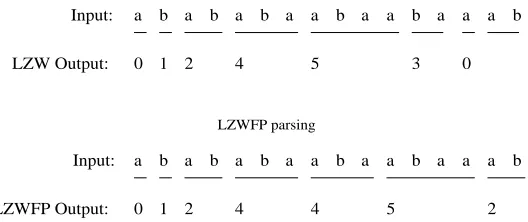
We demonstrate how the execution of the LZW and LZW-FPalgorithms differ in the figure below.
Description of the FPA Algorithm. The FPA algorithm reads the input characters from left to right while inserting in D all substrings of the formT[bm : f(bm) + 1], where the function f is as described in LZW-FPalgorithm. Hence for almost all input strings, FPA constructs an entirely different dictionary with that of LZW-FP. The codeword of the phraseT[bm:f(bm) + 1] is the integer|Σ|+m, where|Σ|is the size of the alphabet Σ. FPA again uses flexible parsing: givenbm, the integer bm+1 is recursively defined as the integerαfor whichf(α) is the maximum among allαsuch that T[bm:α−1] is inD.
0 3 5 4 2 1 0 b a a a b a a b a a b a b a b a
a b a b a b a a b a a b a a a b
0 1 2 4 4
[image:7.595.177.441.87.198.2]LZWFP parsing LZWFP Output: Input: LZW Output: Input: LZW parsing 5 2
Figure 1: Comparsion ofF Pand greedy parsing when used together with the LZW dictionary construction method, on the input stringT =a, b, a, b, a, b, a, a, b, a, a, b, a, a, a, b.
the formT[j:`],j ≤` < i are inD, together with all substrings of size one. The codeword of the substring T[j:`], is the 2-tuple, (i−j, `−j+ 1), where the first entry denotes the relative location ofT[j:`], and the second entry denotes its size. LZ77 uses greedy parsing: themthblockT
m=T[bm:bm+1−1] is recursively defined as the longest substring which is inDjust before CreadsT[bm+1−1].
3. Data Structures and Implementations of Algorithms
In this section we describe both the trie-reverse-trie data structure, and the new fingerprints based data structure for efficient on-line implementations of the LZW-FP, and FPA methods. The trie-reverse-trie pair guarantees a worst case linear running time for both algorithms as described in [MS98]). The new data structure based onfingerprints[KR87], is randomized, and guarantees expected linear running time for any input.
The two main operations to be supported by these data structures are (1) insert a phrase to D (2) search for a phrase, i.e., given a substringS, check whether it is inDand return a pointer. The standard data structure used in many compression algorithms including LZW, the compressed trieT supports both operations in time proportional to |S|. A compressed trie is a rooted tree with the following properties: (1) each node with the exception of the root represents a dictionary phrase; (2) each edge is labeled with a substring of characters; (3) the first characters of two sibling edges can not be identical; (4) the concatenation of the substrings on a path of edges from the root to a given node is the dictionary phrase represented by that node; (5) each node is labeled by the codeword corresponding to its phrase. Dictionaries with prefix properties, such as the ones used in LZW and LZ78 algorithms, build a regular trie rather than a compressed one. The only difference is that in a regular trie the substrings of all edges are one character long.
O(1) time, and insertion operation in time linear with the size of the phrase, while usingO(|D|) space, where
|D|is the number of phrases inD.
Trie-reverse-trie-pair data structure. Our first data structure builds the trie,T, of phrases as described above. In addition toT, it also constructsTr, the compressed trie of thereversesof all phrases inserted in theT. Given a stringS =s1, s2, . . . , sn, its reverseSr is the stringsn, sn−1, . . . , s2, s1. Therefore for each nodev in T, there is a corresponding nodevr in Trwhich represents the reverse of the phrase represented by v. As in the case of the T alone, the insertion of a phraseS to this data structure takes O(|S|) time. Given a dictionary phraseS, and the nodeuwhich representsSinT, one can find out whether the substring obtained by concatenatingS with any characterain isD, by checking out if there is an edge fromuwith corresponding charactera; hence extend operation takesO(1) time. Similarly the contract operation takes O(1) time by going fromuto u0, the node representing reverse ofS in Tr, and checking if the parent ofu0
representsS[2 :|S|]r.
Fingerprints based data structure. Our second data structure is based on building a hash table H of size p, a suitably large prime number. Given a phrase S = S[1 : |S|], its location in H is computed by the function h, where h(S) = (s[1]|Σ||S|+s[2]|Σ||S|−1+. . .+s[|S|]) mod p, where s[i] denotes the lexicographic order ofS[i] in Σ [KR87]. Clearly, once the values of|Σ|k mod p are calculated for allkup to the maximum phrase size, computation of h(S), takes O(|S|) time. By takingpsufficiently large, one can decrease the probability of a collision on a hash value to some arbitrarily small value; thus the average running time of an insertion would beO(|S|) as well. Given the hash valueh(S) of a string, the hash value of its extension by any charactera can be calculated byh(Sa) = (h(S)|Σ|+lex(a))mod p, where lex(a) is the lexicographic order of a in Σ. Similarly, the hash value of its suffix S[2 : |S|] can be calculated by h(S[2 :|S|]) = (h(S)−s[1]|Σ||S|)mod p. Both operations takeO(1) time.
In order to verify if the hash table entryh(S) includesS in O(1) time we (1) give unique labels to each of the phrases inD, and (2) in each phraseSinH, store the label of the suffixS[2 :|S|] and the label of the prefixS[1 :|S| −1]. The label of newly inserted phrase can be|D|, the size of the dictionary. This enables both extend and contract operations to be performed in O(1) expected time: suppose the hash value of a given stringS ishS, and the label ofS is `. To extendS with charactera, we first compute fromhS, the hash value hSa of the string Sa. Among the phrases whose hash value is hSa, the one whose prefix label matches the label of S gives the result of the extend operation. To contractS, we first compute the hash value hS0 of the string S0 =S[2 : |S|]. Among the phrases whose hash value is hS0, the one whose label
matches the suffix label ofS gives the result of the extend operation. Therefore, both extend and contract operations take expectedO(1) time.
Inserting a phrase in this data structure can be performed as follows. An insert operation is done only after an extend operation on some phraseS (which is inD) with some charactera. Hence, when inserting the phraseSainDits prefix label is already known: the label ofS. Once it is decided thatSais going to be inserted, we can spendO(|S|+ 1) time to compute the suffix label ofSa. In case the suffixS[2 :|S|]ais not a phrase inD, we temporarily insert an entry for S[2 :|S|]ain the hash table. This entry is then filled up whenS[2 :|S|] is actually inserted inD. Clearly, the insertion operation for a phraseR and all its prefixes takesO(|R|) expected time.
above) are the same; hence the total time needed to insert all phrases in LZW-FP should be identical to that of LZW, which is linear with the input size. Parsing withFP consists of a series of extend and contract operations. We remind that: (1) the functionf on characters ofT is described asf(i) =`where T[i:`] is the longest substring starting at T[i], which is in D. (2) givenbm, the integer bm+1 is inductively defined as the integerαfor which f(α) is the maximum among allα such thatT[bm:α−1] is in D. In order to computebm+1, we inductively assume that f(bm) is already computed. Clearly S =T[bm: f(bm)] is in D andS0=T[b
m:f(bm) + 1] is not inD. We then contractS byicharacters, untilS0 =T[bm+i:f(bm) + 1] is in D. Then we proceed with extensions to compute f(bm+i). After subsequent contract and extends we stop once bm+i > f(bm). The last value of i at which we started our final round of contracts is the valuebm+1. Notice that each character in T participates to exactly one extend and one contract operation, each of which takesO(1) time via the data structures described above. Hence the total running time for the algorithm isO(n).
A linear time implementation of FPA. Parsing in FPA is done identical to LZW-FP and hence takes O(n) time in total. The phrases inserted in D are of the formT[bm :f(bm) + 1]. Because in parsing step m, the phraseT[bm:f(bm)] is already searched for, it takes onlyO(1) time per phrase to extend it via our data structures. Hence the total running time for insertions isO(n) as well.
Linear time implementations of decompression algorithms for LZW-FP and FPA. The decom-pression algorithms for both methods simply emulate their corresponding comdecom-pression algorithms hence run inO(n) time.
4. The Experiments
In this section we describe in detail the data sets we used, and discuss our test results testing how well our theoretical expectations were supported.
4.1. The test programs
We used gzip, compress, LZW-FP and FPA programs for our experiments. The gzipand compress
programs are standard features ofunixoperating system. In our LZW-FP implementation we limited the
dictionary size to 216 phrases, and reset it when it was full as in the case of
compress. We experimented
with two versions of FPA, one whose dictionary was limited to 216phrases, and the other with 224phrases.
4.2. The data sets
Our data sets come from three sources: (1) Data obtained viaunix drand48()pseudorandom number
generator. (2) DNA and protein sequences provided by Center for BioInformatics, University of Pennsylvania and CT and MR scans provided by the St. Thomas Hospital, UK [Sou]. (3) Text files from two data compression benchmark suites: the new Canterbury corpus and the commonly used Calgary corpus [Sou].
Specifically, the first data set includes three binary files generated by the unix drand48() function.
The data distribution is i.i.d. with bit probabilities (1) 0.7−0.3, (2) 0.9−0.1, and (3) 0.97−0.03. The second data set includes two sets of human DNA sequences from chromosome 23 (dna1, dna2), one MR (magnetic resonance) image of human (female) breast in uncompressedpgmformat in ASCII (mr.pgm), and one CT (computerized tomography) scan of a fractured human hip ct.pgm in uncompressedpgmformat in ASCII [Sou]. The third set includes the complete Calgary corpus, which is the most popular benchmark suite for lossless compression. It includes a bibliography file (bib), two complete books (book1, book2), two binary files (geo, pic), source codes inc, lisp, pascal(progc, progl, progp), and the transcript of a login session (trans). The third set also also includes all files of size>1M Bfrom the new Canterbury corpus: a DNA sequence from E-coli bacteria (E.coli), the complete bible (bib.txt) , and (world192.txt).
4.3. Test results
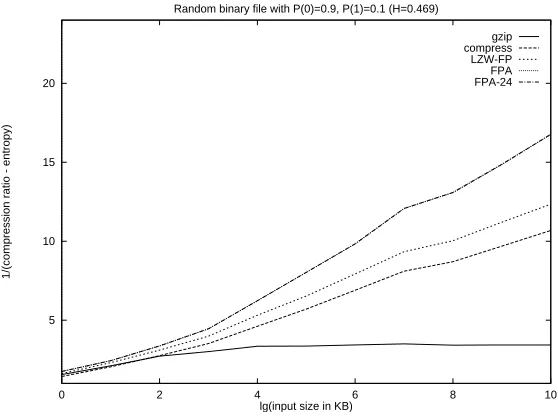
In summary, we observed that FPA implementation with maximum dictionary size 224performs the best on all types of files with size>1M Band shorter files with non-textual content. For shorter files consisting text,gzipperforms the best. Also the theoretical expectations for the convergence rate in the redundancy of the output for i.i.d. data were consistent with the test results. We observed that the constants involved in the convergence rate for FPA and LZW-FP were smaller than that of LZW, and gzipwas worse than all.
Our tests on the human DNA sequences with LZW-FPand FPA show similar improvements over com-pressandgzip- with a dictionary of maximum size 216, the improvement is about 1.5% and 5.7% respectively. Some more impressive results were obtained by increasing the dictionary size to 224, which further improved the compression ratio to 9%. The performance of LZW-FP and FPA onmrandctscans differ quite a bit: LZW-FPwas about 4%−6% better thancompressand was comparable togzip; FPA’s improvement was about 15% and 7% respectively. As the image files were rather short, we didn’t observe any improvement by using a larger dictionary. One interesting observation is that the percentage improvement achieved by both FPA and LZW-FP increased consistently with increasing data size. This suggests that we can expect them to perform better in compressing massive archives as needed in many biomedical applications such as the human genome project.
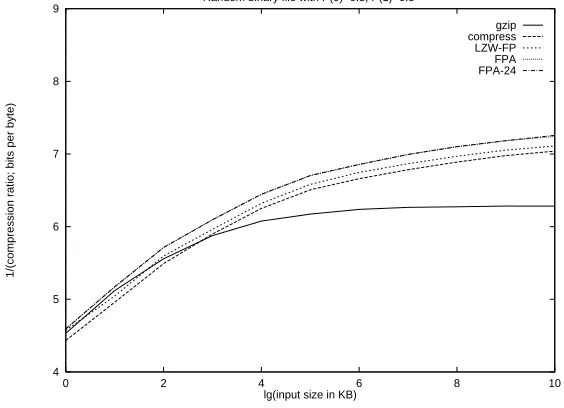
Our tests on pseudorandom sequences were consistent our theoretical expectations: the asymptotic prop-erties were observed even in strings of a fewKB size. In general, all LZW based schemes performed better than gzip, which is based on LZ77. Our plots show that the redundancy in the output is indeed propor-tional to 1/lognwith the smallest constant achieved by FPA - in both cases, the constant is very close to 1.0; the constant for LZW-FP and LZW are about 1.5 and 2.0 respectively. This suggests that for on-line entropy measurement, FPA may provide a more reliable alternative to LZ78/LZW or LZ77 (see [FNS+
95] for applications of LZW and LZ77 for entropy measurement in the context of DNA sequence analysis).
Our results on text strings varied depending on the type and size of the file compressed. For short files with long repetitions, gzipis still the champion. However, for all text files of size>1M B, the large dictionary implementation of FPA scheme outperformsgzipby 4.7%−8.5%, similar to the tests for DNA sequences.
References
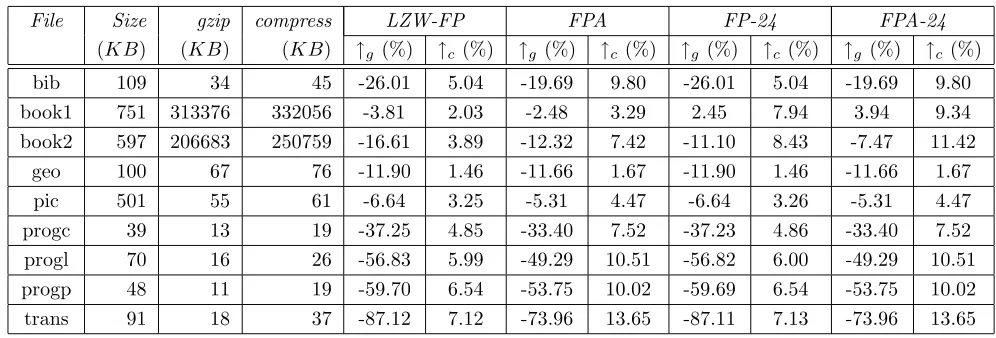
File Size gzip compress LZW-FP FPA FP-24 FPA-24 (KB) (KB) (KB) ↑g (%) ↑c (%) ↑g (%) ↑c (%) ↑g (%) ↑c (%) ↑g (%) ↑c(%)
bib 109 34 45 -26.01 5.04 -19.69 9.80 -26.01 5.04 -19.69 9.80 book1 751 313376 332056 -3.81 2.03 -2.48 3.29 2.45 7.94 3.94 9.34 book2 597 206683 250759 -16.61 3.89 -12.32 7.42 -11.10 8.43 -7.47 11.42
geo 100 67 76 -11.90 1.46 -11.66 1.67 -11.90 1.46 -11.66 1.67
pic 501 55 61 -6.64 3.25 -5.31 4.47 -6.64 3.26 -5.31 4.47
[image:11.595.68.566.70.239.2]progc 39 13 19 -37.25 4.85 -33.40 7.52 -37.23 4.86 -33.40 7.52 progl 70 16 26 -56.83 5.99 -49.29 10.51 -56.82 6.00 -49.29 10.51 progp 48 11 19 -59.70 6.54 -53.75 10.02 -59.69 6.54 -53.75 10.02 trans 91 18 37 -87.12 7.12 -73.96 13.65 -87.11 7.13 -73.96 13.65
Table 1: Compression evaluation using files in the Calgary corpus
The original file size (with some prefixes), compressed file size bygzipand compress, and the improvement (%) made byLZW-FP,FPA,FP-24, andFPA-24overgzipand compress
File Size gzip compress LZW-FP FPA FP-24 FPA-24
(KB) (KB) (KB) ↑g (%) ↑c (%) ↑g (%) ↑c (%) ↑g (%) ↑c (%) ↑g (%) ↑c (%)
E.coli 4530 1341245 1255647 6.91 0.56 6.43 0.05 8.84 2.63 8.48 2.24 bible.txt 3953 1191063 1401885 -12.87 4.11 -7.79 8.42 0.13 15.15 4.68 19.01 world192.txt 2415 724595 987035 -31.70 3.32 -20.36 11.64 -2.38 24.84 6.54 31.39
Table 2: Compression evaluation using files in the Canterbury corpus (Large Set)
The original file size (with some prefixes), compressed file size bygzipand compress, and the improvement (%) made byLZW-FP,FPA,FP-24, andFPA-24overgzipand compress
[FNS+
95] M. Farach, M. Noordeweir, S. Savari, L. Shepp, A. J. Wyner, and J. Ziv. The entropy of DNA: Al-gorithms and measurements based on memory and rapid convergence. InACM-SIAM Symposium on Discrete Algorithms, 1995.
[JS95] P. Jacquet and W. Szpankowski. Asymptotic behavior of the Lempel-Ziv parsing scheme and digital search trees. Theoretical Computer Science, (144):161–197, 1995.
[KM97] S. R. Kosaraju and G. Manzini. Some entropic bounds for Lempel-Ziv algorithms. InSequences, 1997.
[KR87] R. Karp and M. O. Rabin. Efficient randomized pattern matching algorithms. IBM Journal of Research and Development, 31(2):249–260, 1987.
[LS95] G. Louchard and W. Szpankowski. Average profile and limiting distribution for a phrase size in the Lempel-Ziv parsing algorithm. IEEE Transactions on Information Theory, 41(2):478–488, March 1995.
[MS98] Y. Matias and S. C. Sahinalp. On optimality of parsing in dynamic dictionary based data com-pression. Unpublished Manuscript, 1998.
[image:11.595.73.595.302.380.2]File Size gzip compress LZW-FP FPA FP-24 FPA-24 (KB) (KB) (KB) ↑g (%) ↑c (%) ↑g (%) ↑c (%) ↑g (%) ↑c (%) ↑g (%) ↑c (%)
dna1 3096 1001439 960249 5.59 1.54 5.75 1.70 8.73 4.82 8.91 5.00 dna2 2877 866080 832173 4.64 0.75 4.33 0.43 6.09 2.26 5.89 2.05 mr.pgm 260 26 29 -7.23 3.60 6.38 15.84 -7.22 3.61 6.38 15.84
[image:12.595.74.577.72.164.2]ct.pgm 1039 110 110 4.10 3.61 14.56 14.12 4.10 3.61 14.56 14.12
Table 3: Compression evaluation using experimental biological and medical data
The original file size (with some prefixes), compressed file size bygzipand compress, and the improvement (%) made byLZW-FP,FPA, andFPA-24 overgzipandcompress
4 5 6 7 8 9
0 2 4 6 8 10
1/(compression ratio; bits per byte)
lg(input size in KB) Random binary file with P(0)=0.5, P(1)=0.5
gzip compress LZW-FP FPA FPA-24
Figure 2: The compression ratios attained by all five programs on random i.i.d. data with bit probabilitiesP(0) =
P(1) =.5.
[image:12.595.163.445.234.438.2][RPE81] M. Rodeh, V. Pratt, and S. Even. Linear algorithm for data compression via string matching. Journal of the ACM, 28(1):16–24, January 1981.
[Sav97] S. Savari. Redundancy of the Lempel-Ziv incremental parsing rule. InIEEE Data Compression Conference, 1997.
[Sou] http://www.dcs.warwick.ac.uk/people/research/Nasir.Rajpoot/work/fp/index.html.
[Sto88] J. A. Storer. Data Compression: Methods and Theory. Computer Science Press, 1988.
[Wel84] T.A. Welch. A technique for high-performance data compression. IEEE Computer, pages 8–19, January 1984.
[Wyn95] A. J. Wyner. String Matching Theorems and Applications to Data Compression and Statistics. Ph.D. dissertation, Stanford University, Stanford, CA, 1995.
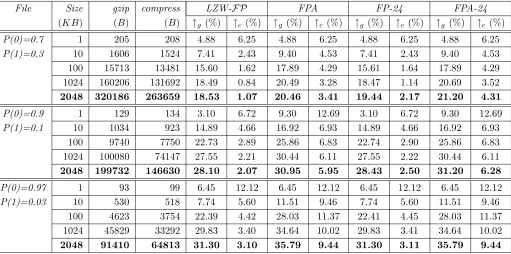
File Size gzip compress LZW-FP FPA FP-24 FPA-24 (KB) (B) (B) ↑g(%) ↑c (%) ↑g (%) ↑c (%) ↑g (%) ↑c (%) ↑g (%) ↑c (%)
P(0)=0.7 1 205 208 4.88 6.25 4.88 6.25 4.88 6.25 4.88 6.25
P(1)=0.3 10 1606 1524 7.41 2.43 9.40 4.53 7.41 2.43 9.40 4.53
100 15713 13481 15.60 1.62 17.89 4.29 15.61 1.64 17.89 4.29 1024 160206 131692 18.49 0.84 20.49 3.28 18.47 1.14 20.69 3.52 2048 320186 263659 18.53 1.07 20.46 3.41 19.44 2.17 21.20 4.31
P(0)=0.9 1 129 134 3.10 6.72 9.30 12.69 3.10 6.72 9.30 12.69
P(1)=0.1 10 1034 923 14.89 4.66 16.92 6.93 14.89 4.66 16.92 6.93 100 9740 7750 22.73 2.89 25.86 6.83 22.74 2.90 25.86 6.83 1024 100080 74147 27.55 2.21 30.44 6.11 27.55 2.22 30.44 6.11 2048 199732 146630 28.10 2.07 30.95 5.95 28.43 2.50 31.20 6.28
P(0)=0.97 1 93 99 6.45 12.12 6.45 12.12 6.45 12.12 6.45 12.12
[image:13.595.78.589.72.326.2]P(1)=0.03 10 530 518 7.74 5.60 11.51 9.46 7.74 5.60 11.51 9.46 100 4623 3754 22.39 4.42 28.03 11.37 22.41 4.45 28.03 11.37 1024 45829 33292 29.83 3.40 34.64 10.02 29.83 3.41 34.64 10.02 2048 91410 64813 31.30 3.10 35.79 9.44 31.30 3.11 35.79 9.44
Table 4: Compression evaluation using independent identically distributed random files containing only zeros and ones with different probability distributions
The original file size (with some prefixes), compressed file size bygzipand compress, and the improvement (%) made by LZW-FP, FPA, FP-24, and FPA-24 over gzip and compress; random data generated by drand48().
[ZL77] J. Ziv and A. Lempel. A universal algorithm for sequential data compression.IEEE Transactions on Information Theory, IT-23(3):337–343, May 1977.
6 8 10 12 14 16 18 20
0 2 4 6 8 10
1/(compression ratio; bits per byte)
lg(input size in KB) Random binary file with P(0)=0.9, P(1)=0.1
[image:14.595.165.445.107.320.2]gzip compress LZW-FP FPA FPA-24
Figure 3: The compression ratios attained by all five programs on random i.i.d. data with bit probabilitiesP(0) =.9 andP(1) =.1.
2 4 6 8 10 12
0 2 4 6 8 10
1/(compression ratio - entropy)
lg(input size in KB)
Random binary file with P(0)=0.5, P(1)=0.5 (H=1)
gzip compress LZW-FP FPA FPA-24
[image:14.595.164.444.437.648.2]5 10 15 20
0 2 4 6 8 10
1/(compression ratio - entropy)
lg(input size in KB)
Random binary file with P(0)=0.9, P(1)=0.1 (H=0.469)
[image:15.595.165.444.274.482.2]gzip compress LZW-FP FPA FPA-24