MASTER THESIS
CHARITABLE
CONTRIBUTIONS
AN EXPERIMENTAL STUDY IN
THE EFFECTS OF FRAMING
TYPES ON MONETARY
DONATION BEHAVIOUR IN A
DOOR-TO-DOOR COLLECTION
CONTEXT
ISMAY LEANNE BAX
JANUARY 2018
FACULTY OF BEHAVIORAL, MANAGEMENT
AND SOCIAL SCIENCES
COMMUNICATION STUDIES
CORPORATE AND ORGANIZATIONAL
COMMUNICATION
EXAMINATION COMMITTEE
DR. A. BELDAD
ABSTRACT
OBJECTIVE Door-to-door collections provide an essential source of income to charitable organisations. Unfortunately, the effectiveness of door-to-door collections in acquiring funds is
declining. Prior research shows that framing can improve the effectiveness of charitable
appeals. This research aims to gain insights into the effects of framing charitable appeals on
donation behaviour in a door-to-door collection context. Framing types included in this research
are beneficiary (other-benefit; self-benefit; self-and-other-benefit) and valence (gain frame; loss frame). These framing types are included since charitable organisations generally emphasise
them in their charitable appeals, yet little is known about the effects of these frames in a
door-to-door collection context.
METHOD A field experiment, employing a door-to-door collection for the Dutch organisation the Kidney Foundation, using a 2 x 3 between-subjects design was conducted in the Dutch
municipality Brummen (n = 528). Respondents were aged between 18 and 93 years (M = 54.0,
SD = 17.08). 45.5% of the respondents were male (n = 240), 54.5% of the respondents were female (n = 288). Donation behaviour was measured by compliance and amount.
RESULTS Results show that when beneficiary and valence message elements were included in the charitable appeal, less people (77.3%) complied to the solicitation to make a monetary
donation compared to when these message elements were not included (96.2%). When
beneficiary and valence message elements were included in the solicitation, the results show that the solicitation should best include a loss frame and address both self-and-other-benefits.
CONTRIBUTION Charitable organisations can benefit from this research since it provides insights into the effects of different charitable appeals on donation behaviour. Additionally, this
research fills important gaps in current literature by including self-and-other-benefit appeals
and by extending research regarding valence to the field of ethical decision making.
CONCLUSION In a door-to-door collection context less is more. Merely asking for a monetary donation is found to be most effective in influencing donation behaviour, specifically
in influencing compliance. Nevertheless, charitable organisations should invest in finding other potential methods to increase monetary donations.
KEYWORDS
Donation behaviour; door-to-door collection; framing; gain appeal versus loss appeal;
Page of content
1 Introduction Page 3
2 Theoretical framework 6
2.1 Donation behaviour 6
2.2 Door-to-door collections 6
2.3 Framing 7
2.3.1 Beneficiary 8
2.3.2 Valence 11
2.4 Gender as a moderator 12
3 Method 15
3.1 Main experiment 15
3.2 Manipulation check 17
3.3 Participants 18
3.4 Context 19
4 Results 21
4.1 Inclusion of message elements 22
4.2 Beneficiary 23
4.2.1 Self-and-other-benefit appeals 25
4.3 Valence 26
4.4 Gender as a moderator 26
5 Discussion 29
5.1 Discussion of research results 29
5.1.1 Inclusion of message elements 29
5.1.2 Beneficiary 30
5.1.3 Valence 31
5.1.4 Gender as a moderator 32
5.2 Theoretical and practical implications 32
5.3 Future research directions 33
5.4 Limitations 33
6 Conclusion 34
Acknowledgements 35
References 36
Appendix 42
1
Introduction
Charitable organisations depend on donations for their survival (Beldad, Snip & Hoof, 2014),
of which monetary donations are most important (Hsu, Liang & Tien, 2005). According to the
Central Bureau for Statistics, the Dutch population has become more generous towards
charitable organisations during the last ten years (CBS, 2015). However, this increase in
generosity is not experienced in door-to-door collections. Door-to-door collections have
become less effective in acquiring funds since 2001 (CBF, 2017a). Charitable organisations
reach a decreasing number of households, for example households do not answer the door, and
potential donors are less willing to make a monetary donation. Nevertheless, a diverse range of
charitable organisations use door-to-door collections to acquire funds (Landry, Lange, List,
Price & Rupp, 2006). Door-to-door collections provide an essential source of income, making
them indispensable to charitable organisations (Nierstichting, 2015). More research is needed
in order to gain a better understanding of potential methods to increase monetary donations to
charitable organisations through door-to-door collections. Therefore, this research will focus
on door-to-door collections.
The method that charitable organisations use to request donor support is essential in
optimising their charitable appeals (Grace & Griffin, 2006; White & Peloza, 2009). Studies
show that framing donation messages can enhance charitable appeals and increase an
individual’s intention to donate money to charitable organisations (Chang & Lee, 2009; Das,
Kerkhof, Kuiper, 2008; Jeong et al., 2011; Ye, Teng, Yu & Wang, 2015). This research aims to
gain insights into the effects of framing charitable appeals on donation behaviour in a
door-to-door collection context. Two framing types are of interest since charitable organisations
generally emphasise them in their charitable appeals. These framing types are the type of
beneficiary emphasised in the charitable appeal, and the valence of the charitable appeal (Chang
& Lee, 2009; Fisher, Vandenbosch & Antia, 2008). This research will refer to these framing
types as the variables beneficiary and valence. Little is known about the effects of these framing types in a door-to-door collection context. Of interest is the question whether beneficiary and
valence enhance charitable appeals and increase monetary donation behaviour in a door-to-door collection context, or if different effects will occur.
Charitable donations can be directed towards two possible beneficiaries; the donor and
another entity, the latter being one or more other individuals or an organisation (White &
Peloza, 2009). Charitable organisations can emphasise beneficiaries in their charitable appeals.
studies compare the effects of self-benefit appeals versus the effects of other-benefit appeals
(Fisher et al., 2008; White & Peloza, 2009; Ye et al., 2015), separating the appeal types. It is
also possible for charitable organisations to simultaneously emphasise both the donor and
another entity as beneficiaries of a charitable donation. For example, a charitable radio
commercial for the Brain Foundation states that one in four people has a brain disorder
(Hersenstichting, 2017), and that a brain disorder can happen to you, your partner or someone
else. By donating, the Brain Foundation can help both you and others. This research will include
appeals which emphasise both the donor and another entity as beneficiaries and refer to them
as self-and-other-benefit appeals.
Furthermore, charitable appeals can be framed on a continuum from negative to positive
valence, emphasising the negative outcomes of not making a donation or the positive outcomes of making a donation. The literature refers to these charitable appeals as loss framed and gain
framed appeals, respectively (Das et al., 2008). Current literature is ambiguous about the effects
of loss framed versus gain framed appeals (Chang & Lee, 2009; 2010; Farrell, Ferguson, James
& Lowe, 2001; O’Keefe & Jensen, 2007; Reinhart, Marshall, Feeley & Tutzauer, 2007). It
remains unclear how valence can affect donation behaviour. More research is needed in order to gain a better understanding of the effects of valence on donation behaviour. As such, the research question which is central to this research reads:
RQ To what extent do the beneficiary and valence emphasised in a charitable appeal affect monetary donation behaviour during a door-to-door collection?
This research has important theoretical implications, filling gaps in current literature. Studies
show that beneficiary and valence can affect donation intention (Das et al., 2008; Ye et al., 2015). However, little is known about possible interaction effects between these variables. The
gender of the donor might act as a moderator since men and women often react differently to
charitable appeals (Brunel & Nelson, 2000). This research will consider possible interaction
effects between the beneficiary and valence emphasised in a charitable appeal and the gender of the donor. Hereby, the variable beneficiary will include a self-and-other-benefit frame since prior research merely focuses on self-benefits versus other-benefits and lacks this combined
frame.
Second, the variable valence is primarily implemented in research regarding health care (Gallagher & Updegraff, 2012; O’Keefe & Nan, 2012; Rothman, Bartels, Wlaschin & Salovey,
2001; Reinhart et al., 2007). This research will extend current literature regarding valence by focussing on financial ethical decision making, such as donating money to a charitable
organisation.
Third, limited research has been directed toward understanding how diverse charitable
appeals can affect men versus women (Brunel & Nelson, 2000). Nowadays, increasing attention
has been given to gender related issues in diverse disciplines such as sociology and psychology.
This research will extend gender related literature, thereby contributing to the study of gender
in advertising, specifically charitable advertising.
Finally, literature into donation intention is extensive but research into actual donation
behaviour is limited. This research employs a field experiment measuring actual donation
behaviour and should therefore be considered as nonstandard (Harrison & List, 2004),
broadening current knowledge about monetary donations.
Apart from theoretical implications this research has important practical implications as
well. The findings of this research will benefit charitable organisations through providing
insights into the effects of different charitable appeals and through providing executable
strategies which can maximise the effectiveness of charitable appeals during door-to-door
collections (Ye et al., 2015). Charitable organisations can customise their charitable appeals
depending on their target audience, for example men versus women, and possibly collect more
2
Theoretical framework
This theoretical framework discusses relevant constructs central to this research. Donation
behaviour and door-to-door collections will be briefly elaborated on, after which general
framing theory and the framing of the variables beneficiary and valence are described. For each framing type it is determined how the frame could affect donation behaviour. Finally the role
of gender in moderating the effects of beneficiary and valence will be discussed.
2.1 Donation behaviour
Donation behaviour, the act of donating, may take different forms. Amongst others, it can occur
in the form of time, knowledge, belongings, blood, organs or money (Grace & Griffin, 2006).
The entire Dutch population donates over €5.7 billion each year to charitable organisations
(CBF, 2017b). Monetary donations mainly consist of donations through door-to-door
collections, fundraisers, one-time donations or structural donations (Donatiewijzer, 2012).
Specifically, when referring to donation behaviour, this research means the act of
donating money by a donor after being solicited to do so by a collector during a door-to-door
collection. Two dependent variables need to be taken into consideration regarding this form of
donation behaviour. First, whether a monetary donation is actually given or not, and thus
whether the donor complies with the solicitation to donate (Grant & Dutton, 2012; Ye et al.,
2015). This research will refer to this variable as compliance. And second, the monetary amount donated per given donation (Grant & Dutton, 2012; Ye et al., 2015). This research will refer to
this variable as amount.
2.2 Door-to-door collections
Charitable appeals generally include message elements regarding the beneficiary and/or
valence (Chang & Lee, 2009; Fisher et al., 2008). However, during door-to-door collections charitable appeals often do not include such message elements. Instead, these appeals generally
provide minimal information in which a collector merely asks a potential donor if he or she
would like to give a contribution to a certain charitable organisation. Including message
elements regarding the beneficiary and valence, and thus giving more information, is uncommon in a door-to-door collection context. The potential donor might not expect to receive
such information. Including unexpected message elements and engaging the mind of the
potential donor, can disrupt the potential donor and reduce resistance to a persuasive attempt
According to the disrupt then reframe theory, individuals experience tension between
approaching and avoiding certain persuasive attempts (Davis & Knowles, 1999). By disrupting,
the individual is susceptible to the persuasive attempt. The disruption functions as a distraction
and induces mindlessness in processing the persuasive attempt, which directly follows the
disruption (Fennis et al., 2006). In the context of charitable giving a potential donor might
experience tension between wanting to help and being resistant to the expense. By disrupting,
an individual might be susceptible to the solicitation as a persuasive attempt, and be more prone
to comply to make a monetary donation (Erickson, 1964; Fennis et al., 2006). Including
message elements regarding the beneficiary and valence, and thus disrupting the potential donor, might therefore increase compliance. However, where the persuasive attempt includes a
compliance aspect, the question if a donor would like to give a contribution is a yes or no question, the persuasive attempt does not include an aspect referring to an amount. Disrupting a potential donor should therefore not affect the amount of money donated regardless of the
susceptibility to the persuasive attempt. As such, the hypotheses regarding the inclusion of
beneficiary and valence message elements read the following:
H1a Charitable appeals including beneficiary and valence message elements generate more compliance than charitable appeals not including beneficiary and valence message elements
H1b Charitable appeals including beneficiary and valence message elements and charitable appeals not including beneficiary and valence message element generate an equal
amount
2.3 Framing
The notion of framing rests on the fact that a certain issue can be viewed from a variety of
perspectives. When making a specific perspective of an issue more salient in communication,
individuals exposed to the framed communication can develop a particular conceptualization
of the issue, reorient their thinking about the issue and/or alter their behaviour regarding the
issue (Chong & Druckman, 2007; Entman, 1993). Current literature refers to two distinct types
of frames; frames in communication and frames in thought (Brewer, 2003; Druckman, 2001).
The types of frames are similar since both types regard variations in salience. However, they
differ in that the former focuses on the content of the message, while the latter focuses on the
perception of the individual. This research will focus on frames in communication.
communication encourages individuals to think along particular lines by highlighting certain
features of a message. This process is called a framing effect (Druckman, 2001).
Framing effects occur when alternative phrasings of the same basic issue produce
different evaluations or behaviours (Chong & Druckman, 2007; Kühberger, 1995). In other
words, a frame can steer and promote certain evaluations or behaviours while impeding other
evaluations or behaviours. Therefore, individuals can interpret varying framed communications
of the same basic issue differently (Borah, 2011). Current literature refers to two distinct types
of framing effects; equivalency framing effects and emphasis framing effects (Cacciatore,
Scheufele & Iyengar, 2016; Druckman, 2001). Equivalency framing effects occur when frames
in communication which are presented in either a positive or a negative way, however logically
and effectively identical, cause individuals to have different preferences regarding the issue
presented. Emphasis framing effects differ from equivalency framing effects in that the frames
in communication are not logically and effectively identical. Instead, emphasis framing effects
cause individuals to focus on certain aspects of an issue instead of other aspects regarding the
same issue.
This research will focus on emphasis framing effects through the use of two different
frames in communication; beneficiary and valence. These will be discussed below.
2.3.1 Beneficiary
According to the theory of self-interest, people are oriented to pursue their self-interests (Miller,
1999). This implies that even donation behaviour is, subliminally, motivated by some egoistic
desire (Fisher et al., 2008; Grace & Griffin, 2006; Holmes, Miller & Lerner, 2002; Ratner &
Miller, 2001; Ye et al., 2015). A self is trying to accomplish this desire and wants a result
(Cropanzano, Goldman & Folger, 2005), meaning that giving a monetary donation has to result
in a possible benefit for the donor in order for the self-interested donor to donate. Acquiring
self-benefits can be a powerful motivator in ethical decision making (Cropanzano et al., 2005;
Ye et al., 2015), especially when donating money to charitable organisations. Since making a
monetary donation is costly (Piff, Kraus, Côté, Cheng & Keltner, 2010), a self-benefit in return
can make the act of donating more appealing.
The outcomes of a monetary donation can involve different beneficiaries. Ye et al.
(2015) operationalise donation outcomes to be benefits to oneself, as well as benefits to others.
It is important to differentiate between beneficiaries since charitable organisations emphasise
either one or both in their charitable appeals (White & Peloza, 2009). Fisher et al., (2008) even
characteristic of charitable appeals. Generally, charitable giving is positioned as either egoistic
or altruistic. When charitable giving is positioned as egoistic, benefits to the donor are
emphasised. On the contrary, when charitable giving is positioned as altruistic, benefits to
others are emphasised (White & Peloza, 2009). This research will refer to the former as
self-benefit appeals, which are defined as appeals that emphasise the donor as potential beneficiary
of the monetary donation, and to the latter as other-benefit appeals, which are defined as appeals
that emphasise one or more other individuals or an organisation as potential beneficiary of the
monetary donation (Fisher et al., 2008; White & Peloza, 2009).
Holmes et al. (2002) show that a self-benefit in return for a donation generates more and
higher monetary donations compared to no self-benefit in return. Helping behaviour is
facilitated by self-interested justifications. Holmes et al. (2002) provided an option to buy
candles instead of making a mere monetary donation. Participants had little interest in the
candles, but contributed more often and higher amounts compared to the mere donation
condition. Furthermore, participants contributed higher amounts when the price of the candles
was framed as a bargain, in other words an egoistic price, compared to an altruistic price, even
though the actual price was the same. Likewise, Landry et al. (2006) found that receiving a
lottery ticket in return for a monetary donation increased both the number and the average
monetary amount donated per donation. A study by Falk (2007) also illustrates that a
self-benefit in return increases the number of monetary donations. When free postcards and
envelopes were added to solicitation letters which asked for a monetary donation, more
individuals made a donation. The studies by Falk (2007), Holmes et al. (2002), and Landry et
al. (2006) include tangible self-benefits, yet according to Briers, Pandelaere and Warlop (2007),
even an illusionary or intangible benefit can make the act of donating more attractive (White &
Peloza, 2009). The anticipation of intrinsic benefits, such as feeling good, can motivate
individuals to donate money to charitable organisations (Chang, 2012; Grace & Griffin, 2006).
West (2004) even argues that ethical decision making is “about feeling good, not doing good, and illustrates not how altruistic we have become, but how selfish” (p. 1).
However, some research does illustrate an altruistic side in ethical decision making. By
a televised fund-raising study Fisher et al. (2008) show that other-benefit appeals are more
effective than self-benefit appeals. The number of donations was higher when individuals
believed their monetary donation would help others rather than themselves. Research into organ
donation also suggest that altruism is significantly associated with donation behaviour and
intention (Morgan & Miller, 2002). Nevertheless, according to an extensive literature research
than altruistic motives. Therefore, the hypotheses regarding beneficiary read the following:
H2a Self-benefit appeals generate more compliance than other-benefit appeals H2b Self-benefit appeals generate a higher amount than other-benefit appeals
In addition, charitable organisations can simultaneously emphasise both the donor and another
entity in their appeals as beneficiaries of a charitable donation (White & Peloza, 2009). This
research will refer to these charitable appeals as self-and-other-benefit appeals, which are
defined as appeals that emphasise both the donor and one or more other individuals or an
organisation as potential beneficiaries of the monetary donation. No prior research examines
the effects of self-and-other-benefit appeals. However, the study by Holmes et al. (2002) offers
an interesting viewpoint regarding this issue. Even though the study did not include an actual
appeal emphasising both benefits to the donor and to others, it did offer participants a chance
to behave in a simultaneously altruistic and egoistic manner. Participants could support a
charitable cause, illustrating altruistic behaviour, by buying a candle for themselves, illustrating
egoistic behaviour. The act can be seen as partly altruistic since participants had little interest
in the candles. Holmes et al. (2002) state that the major contribution of their research is “the
finding that helping behaviour is facilitated when the framing of the helping act permits people
to see themselves as altruistic but not unconditionally so” (p. 150). Self-and-other-benefit
appeals might allow donors to see themselves this way, and could affect donation behaviour in
a different manner than mere self-benefit and other-benefit appeals do.
Additionally, when self-benefit appeals are expected to be more effective in influencing
donation behaviour than other-benefit appeals, it is logical to assume that self-and-other-benefit
appeals should be more effective in influencing donation behaviour than mere other-benefit
appeals. That is, self-and-benefit appeals include a self-benefit aspect where mere
other-benefit appeals lack this aspect. This research further assumes that when more people can
benefit from a monetary donation, a charitable appeal is more effective in influencing donation
behaviour. That is, the more people benefit from a monetary donation, the more reasons a donor
has to help. This assumption follows the logic of two are better than one. Therefore, additional
hypotheses regarding beneficiary, specifically regarding self-and-other-benefit appeals, read the following:
H3b1 Self-and-other-benefit appeals generate more compliance than self-benefit appeals
H3b2 Self-and-other-benefit appeals generate a higher amount than self-benefit appeals
2.3.2 Valence
Messages can be framed on a continuum from negative to positive valence. These messages are
referred to as loss versus gain framed messages (Das et al., 2008). Loss framed messages can
refer to negative consequences that will happen and positive consequences that will not happen,
whereas gain framed messages can refer to positive consequences that will happen and negative
consequences that will not happen (Meyers-Levy & Maheswaran, 2004; Rothman et al., 2006).
Current literature is ambiguous about the effects of loss framed versus gain framed
messages. Prospect theory might explain these ambiguous results. According to prospect theory
behavioural outcomes can differ when messages emphasise losses versus gains (Farrell et al.,
2001; Grau & Folse, 2007). In their widely cited experiment Tversky and Kahneman (1981)
posed a problem where a disease is expected to kill 600 people. To combat the disease two
alternative programs are proposed. Two gain framed programs, which focussed on saving lives,
read:
Program A If this program is adopted, 200 people will be saved
Program B If this program is adopted, there is 1/3 probability that 600 people will be saved, and 2/3 probability that no people will be saved When asked which program participants preferred, 72% chose program A and 28% chose
program B. According to Tversky and Kahneman (1981) “the prospect of certainly saving 200
lives is more attractive than a risky prospect of equal expected value, that is, a one-in-three
chance of saving 600 lives” (p. 453). However, when the two alternative programs proposed to
combat the disease focussed on lives lost, the opposite occurred. Two loss framed programs
read:
Program C If this program is adopted, 400 people will die
Program D If this program is adopted, there is 1/3 probability that no people will die, and 2/3 probability that 600 people will die
When asked which program participants preferred, 22% chose program C and 78% chose
program D. The prospect of certainly losing 400 lives is less attractive than a risky prospect of
equal expected value, that is, a two-in-three chance of losing 600 lives. Even though all four
programs are effectively identical, individuals tend to be risk seeking when messages emphasise
losses and risk avoiding when messages emphasise gains (Martino, Kumaran, Seymour &
the message encourages risky behaviour. In contrast, gain framed messages are more effective
in promoting behaviour when the message encourages cautious behaviour (Millar & Millar,
2000; Rothman et al. 2006).
In a study encouraging sunscreen use, illustrating cautious behaviour, Detweiler, Bedell,
Salovey, Pronin and Rothman (1999) show that beach-goers exposed to gain framed messages
regarding sun-protective behaviours were more likely than beach-goers exposed to loss framed
messages regarding sun-protective behaviours to request sunscreen and intended to repeatedly
apply sunscreen with a sun protection factor of 15 or higher while at the beach. According to
prospect theory, cautious behaviour is perceived as more certain in its consequences. People
prefer certain options when they are considering gain framed messages from a neutral reference
point. Therefore, gain framed messages are more motivating in encouraging cautious behaviour
(Detweiler et al., 1999). Likewise, Farell et al. (2001) found that information presented in a
positive frame resulted in more confidence in the safety of blood for transfusion. Farell et al.
(2001) argue that the transfusion of blood can be seen as a prevention procedure, focussing on
cautious rather than risky behaviour, since it is likely to prevent negative outcomes, such as
continuous bleeding, during surgery.
In this context, it is reasonable to assume that donating money to charitable
organisations consists primarily of cautious behaviour rather than risky behaviour since it is
likely to prevent negative outcomes as well. That is, by donating money to a charitable
organisation, the charitable organisation can invest in prevention, education and research
regarding the cause of the charitable organisation (CBF, 2017c; Nierstichting, 2015). Therefore,
following prospect theory, the hypotheses regarding valence read the following:
H4a Gain framed appeals generate more compliance than loss framed appeals H4b Gain framed appeals generate a higher amount than loss framed appeals
2.4 Gender as a moderator
Men and women show different patterns of charitable giving (Andreoni & Vesterlund, 2001).
Gender could interact with the variable beneficiary. According to Brunel and Nelson (2000) women prefer altruistic other-benefit appeals over egoistic self-benefit appeals, where men
prefer egoistic self-benefit appeals over altruistic other-benefit appeals. Andreoni and
Vesterlund (2001) picture a much more complicated image. During a modified dictator game
individuals were given eight different allocation problems where tokens had to be divided
and the amount a token was worth to either themselves and to others. After completing all eight
allocation problems, one of the eight problems would be chosen at random and carried out,
resulting in individual payoff. By doing this individuals had to think carefully about each
allocation decision. Results indicated that men are more likely to be either perfectly selfish or
perfectly selfless. Therefore, applied to this research, both self-benefit and other-benefit appeals
might be more effective for men in affecting donation behaviour. Women, on the other hand,
tend to be equalitarian and prefer to share payoffs evenly (Andreoni & Vesterlund, 2001).
Therefore, self-and-other-benefit appeals might be more effective for women in affecting
donation behaviour. The hypotheses regarding the moderating effect of gender on the relation
between beneficiary and donation behaviour read the following:
H5 Gender moderates the direction of the relation between beneficiary and donation behaviour
H5a1 Self-benefit appeals are more effective for men than for women in affecting compliance
H5a2 Self-benefit appeals are more effective for men than for women in affecting amount H5b1 Other-benefit appeals are more effective for men than for women in affecting compliance
H5b2 Other-benefit appeals are more effective for men than for women in affecting amount
H5c1 Self-and other-benefit appeals are more effective for women than for men in affecting
compliance
H5c2 Self-and-other-benefit appeals are more effective for women than for men in affecting
amount
Furthermore, gender could interact with the variable valence. Gender might enhance possible effects of gain and loss framed messages on donation behaviour. That is, according to prospect
theory individuals tend to be risk avoiding when messages emphasise gains (Martino et al.,
2006; Tversky & Kahneman, 1981). Women tend to be more risk averse than men (Eckel &
Grossman, 2008). In contrast, according to prospect theory individuals tend to be risk seeking
when messages emphasise losses (Martino et al., 2006; Tversky & Kahneman, 1981). Men tend
to be more risk seeking than women (Eckel & Grossman, 2008). Therefore, the possible effects
of gain framed appeals on donation behaviour might be stronger for women compared to men,
and the possible effects of loss framed appeals on donation behaviour might be stronger for
men compared to women. The hypotheses regarding the moderating effect of gender on the
H6 Gender moderates the strength of the relation between valence and donation behaviour H6a1 The effect of gain framed appeals is stronger for women than for men in affecting
compliance
H6a2 The effect of gain framed appeals is stronger for women than for men in affecting
amount
H6b1 The effect of loss framed appeals is stronger for men than for women in affecting compliance
H6b2 The effect of loss framed appeals is stronger for men than for women in affecting
amount
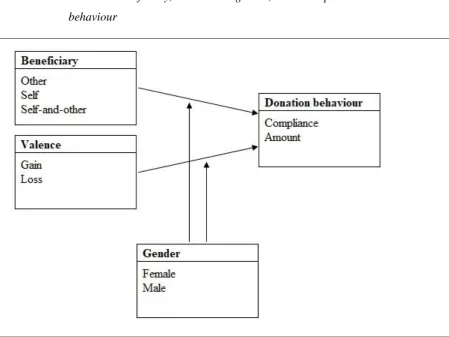
[image:15.595.73.523.351.688.2]Figure 1 illustrates the theoretical model which is central to this research.
Figure 1 Theoretical model illustrating the hypothesised effects of the independent variables beneficiary, valence and gender, and the dependent variable donation
behaviour
3
Method
In this research the effects of beneficiary (other-benefit appeal versus self-benefit appeal versus self-and-other-benefit appeal) and valence (gain framed appeal versus loss framed appeal) on monetary donation behaviour (measured by compliance and amount) during a door-to-door collection were examined by a field experiment (n = 528) using a 2 x 3 between-subjects design. Prior to the main experiment a pre-test was performed which can be found in the appendix.
3.1 Main experiment
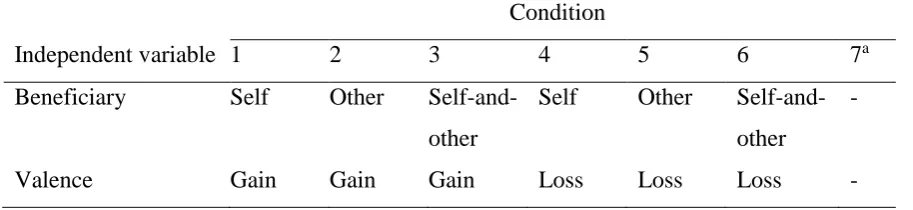
The main experiment consisted of seven conditions, including one control condition and six
manipulated conditions (see table 1). The field experiment was conducted from 18 to 23
September 2017, from 16:00 to 20:00 hours, in the municipality Brummen and represented a
door-to-door collection with the addition of beneficiary and valence message elements for the manipulated conditions. The researcher acted as collector during the door-to-door collection.
Since appearance of the collector might influence donation behaviour (Landry et al., 2006) the
collector wore the same outfit and hairdo during the entire collection period. The collector rang
the doorbell of the household and, after the potential donor answered the door, asked the
potential donor to make a monetary donation to the Dutch charitable organisation The Kidney
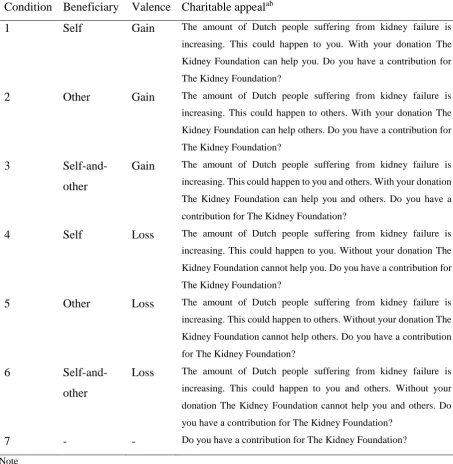
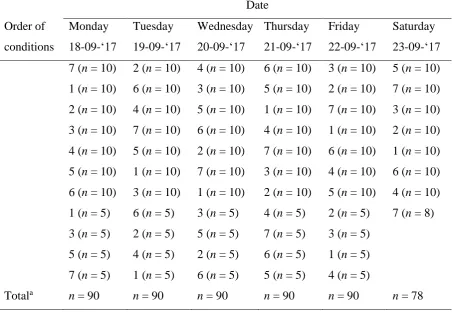
Foundation conform the charitable appeals shown in table 2. Each day, the order of solicitations
[image:16.595.69.526.543.648.2]was randomized (see table 3).
Table 1 Distribution of manipulations for the independent variables beneficiary and valence across seven conditions
Condition
Independent variable 1 2 3 4 5 6 7a
Beneficiary Self Other Self-and-
other
Self Other
Self-and-other
-
Valence Gain Gain Gain Loss Loss Loss -
Note
aExperimental condition 7 is the control condition and does not include manipulations
Donation behaviour was measured through two dependent variables, compliance and amount. The collector carried an official collection tin from the Kidney Foundation which was sealed.
donated. The collector wrote down this amount. After the potential donor gave, or did not give, a monetary donation the (non-)donor was told that the collector was conducting an experiment.
The collector ensured (non-)donors anonymity in research participation. Donors were ensured
all contributions were donated to the Kidney Foundation. When the (non-)donor agreed to
participate in the study demographic information was collected regarding the age and gender of
[image:17.595.72.526.259.724.2]the respondent and manipulation checks were performed (resulting in a sample of n = 528).
Table 2 Charitable appeals used for soliciting for a monetary donation across seven
conditions
Condition Beneficiary Valence Charitable appealab
1 Self Gain The amount of Dutch people suffering from kidney failure is increasing. This could happen to you. With your donation The
Kidney Foundation can help you. Do you have a contribution for
The Kidney Foundation?
2 Other Gain The amount of Dutch people suffering from kidney failure is increasing. This could happen to others. With your donation The
Kidney Foundation can help others. Do you have a contribution for
The Kidney Foundation?
3
Self-and-other
Gain The amount of Dutch people suffering from kidney failure is increasing. This could happen to you and others. With your donation
The Kidney Foundation can help you and others. Do you have a
contribution for The Kidney Foundation?
4 Self Loss The amount of Dutch people suffering from kidney failure is increasing. This could happen to you. Without your donation The
Kidney Foundation cannot help you. Do you have a contribution for
The Kidney Foundation?
5 Other Loss The amount of Dutch people suffering from kidney failure is increasing. This could happen to others. Without your donation The
Kidney Foundation cannot help others. Do you have a contribution
for The Kidney Foundation?
6
Self-and-other
Loss The amount of Dutch people suffering from kidney failure is increasing. This could happen to you and others. Without your
donation The Kidney Foundation cannot help you and others. Do
you have a contribution for The Kidney Foundation?
7 - - Do you have a contribution for The Kidney Foundation?
Note
aThe main experiment was conducted in Dutch. Table 2 shows a translation
Table 3 Randomised order of solicited conditions across collection period from 18 to 23
September 2017
Date
Order of
conditions
Monday
18-09-‘17
Tuesday
19-09-‘17
Wednesday
20-09-‘17
Thursday
21-09-‘17
Friday
22-09-‘17
Saturday
23-09-‘17
7 (n = 10) 2 (n = 10) 4 (n = 10) 6 (n = 10) 3 (n = 10) 5 (n = 10) 1 (n = 10) 6 (n = 10) 3 (n = 10) 5 (n = 10) 2 (n = 10) 7 (n = 10) 2 (n = 10) 4 (n = 10) 5 (n = 10) 1 (n = 10) 7 (n = 10) 3 (n = 10) 3 (n = 10) 7 (n = 10) 6 (n = 10) 4 (n = 10) 1 (n = 10) 2 (n = 10) 4 (n = 10) 5 (n = 10) 2 (n = 10) 7 (n = 10) 6 (n = 10) 1 (n = 10) 5 (n = 10) 1 (n = 10) 7 (n = 10) 3 (n = 10) 4 (n = 10) 6 (n = 10) 6 (n = 10) 3 (n = 10) 1 (n = 10) 2 (n = 10) 5 (n = 10) 4 (n = 10) 1 (n = 5) 6 (n = 5) 3 (n = 5) 4 (n = 5) 2 (n = 5) 7 (n = 8) 3 (n = 5) 2 (n = 5) 5 (n = 5) 7 (n = 5) 3 (n = 5)
5 (n = 5) 4 (n = 5) 2 (n = 5) 6 (n = 5) 1 (n = 5) 7 (n = 5) 1 (n = 5) 6 (n = 5) 5 (n = 5) 4 (n = 5)
Totala n = 90 n = 90 n = 90 n = 90 n = 90 n = 78
Note
aIncuded in the table are the n = 528 respondents who wanted to participate in the study. Excluded cases (n = 33)
are not represented, they were excluded during the field experiment
3.2 Manipulation check
Manipulation checks were performed by two spoken closed-ended questions. The first question
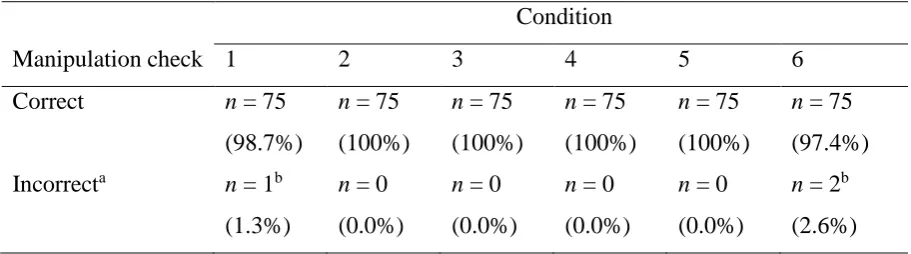
measured the effectiveness of the manipulation for the independent variable beneficiary. The question read: Who was emphasised in the charitable appeal? Was this yourself, others or yourself and others? The second question measured the effectiveness of the manipulation for the independent variable valence. The question read: Did the charitable appeal emphasise the positive outcomes of donating or the negative outcomes of not donating? The results of the manipulation check are presented in table 4. In total n = 450 respondents answered both questions of the manipulation check correct, these respondents were included in the research.
Table 4 Distribution of answers to the manipulation check across six conditions
Condition
Manipulation check 1 2 3 4 5 6
Correct
Incorrecta
n = 75 (98.7%) n = 1b (1.3%)
n = 75 (100%)
n = 0 (0.0%)
n = 75 (100%)
n = 0 (0.0%)
n = 75 (100%)
n = 0 (0.0%)
n = 75 (100%)
n = 0 (0.0%)
n = 75 (97.4%)
n = 2b (2.6%)
Note
aRespondents (n = 3) who answered the manipulation check incorrect were removed from the sample during the
field experiment to ensure 100% manipulation
bIncorrect answer for the manipulation of the independent variable beneficiary
3.3 Participants
A total of N = 959 Dutch households residing in the municipality Brummen were approached to make a monetary donation to the Kidney Foundation through a door-to-door collection. Some
households (n = 398) did not answer the door, in most cases no residents were at home. These households were removed from the sample, resulting in a participation rate of 58.5%. Another
n = 33 respondents were removed from the sample since they donated money to the Kidney Foundation through different means (n = 12), were under aged (n = 2, respondents under the age of 18 years were excluded due to ethical reasons), did not comprehend the Dutch language
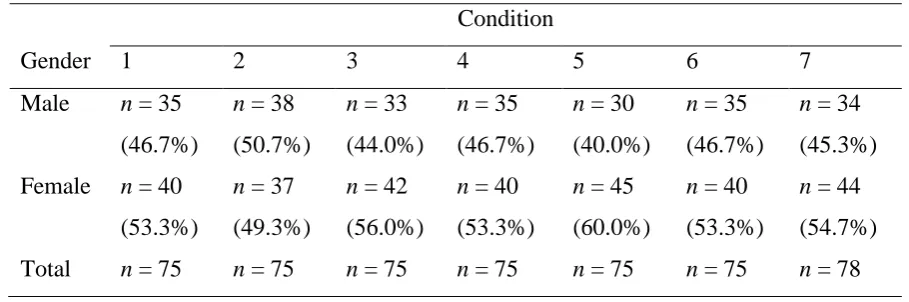
(n = 4), did not answer the manipulation check correct (n = 3), had money ready when they answered the door (n = 9), or did not want to participate in the study (n = 3). The final sample included n = 528 Dutch households. Respondents were aged between 18 and 93 years with the average age of the sample being M = 54.0, SD = 17.08 years. Age is divided equally across conditions (see table 5) and will therefore be excluded from further analysis. In total 45.5%
[image:19.595.69.543.661.769.2](n = 240) of the respondents were male, and 54.5% (n = 288) of the respondents were female. Table 6 shows the distribution of respondents’ gender across the seven conditions.
Table 5 Distribution of respondents’ age (n = 528) across seven conditions
Condition
Age 1 2 3 4 5 6 7
Total
M = 54.3
SD = 17.35
n = 75
M = 52.8
SD = 16.95
n = 75
M = 53.6
SD = 16.83
n = 75
M = 54.4
SD = 17.30
n = 75
M = 53.8
SD = 17.26
n = 75
M = 54.2
SD = 16.79
n = 75
M = 54.7
SD = 17.61
Table 6 Distribution of respondents’ gender (n = 528) across seven conditions
Condition
Gender 1 2 3 4 5 6 7
Male
Female
Total
n = 35 (46.7%)
n = 40 (53.3%)
n = 75
n = 38 (50.7%)
n = 37 (49.3%)
n = 75
n = 33 (44.0%)
n = 42 (56.0%)
n = 75
n = 35 (46.7%)
n = 40 (53.3%)
n = 75
n = 30 (40.0%)
n = 45 (60.0%)
n = 75
n = 35 (46.7%)
n = 40 (53.3%)
n = 75
n = 34 (45.3%)
n = 44 (54.7%)
n = 78
3.4 Context
The Dutch charitable organisation the Kidney Foundation was contacted for collaboration since
the charitable organisation met two criteria. First, the goals and activities of the charitable
organisation had to be applicable to all ages since households consist of individuals from
various age categories. And second, the charitable organisation had to be located in The
Netherlands and the cause the charitable organisation supported had to be relevant for the Dutch
population since the research would be conducted in The Netherlands. The Kidney Foundation
agreed to collaborate and was therefore included in this research. The Kidney Foundation is
founded in 1967 and has since committed itself to the prevention of kidney diseases.
In The Netherlands a charitable organisation can only collect funds through a
door-to-door collection during a specific assigned collection week (CBF, 2017d). The assigned
collection week for the Kidney Foundation in 2017 was from 17 to 23 September. Due to
religious reasons, no to-door collection was held on Sunday 17 September 2017. The
door-to-door collection was held from 16:00 to 20:00 hours every day, since people would most
likely be home during this timeframe.
This research employed a field experiment measuring actual donation behaviour,
therefore the location of the experiment was critical. Bureau Louter compared 371 Dutch
municipalities, with a population of at least ten thousand, on 106 indicators (divided over
economic innovation, economic structure, education, labour, location/infrastructure,
politics/society, population dynamics, prosperity, and residential market/environment) and
ranked them to the degree in which they deviate from the Dutch average (Louter, 2015),
resulting in a list with municipalities which are considered most average to least average. Of
the top ten most average municipalities in The Netherlands, the municipality Brummen in the
location for the door-to-door collection in consultation with the Kidney Foundation. No other
collectors would raise funds for the Kidney Foundation in Brummen during the collection week.
Residents of Brummen would only be exposed to the door-to-door collection for this research.
4
Results
This research aimed to gain insights into the effects of framing charitable appeals on donation
behaviour in a door-to-door collection context. Framing types included in this research were
beneficiary and valence. A total amount of € 636.65 was collected for the Kidney Foundation during the door-to-door collection. On average respondents, who complied to the solicitation
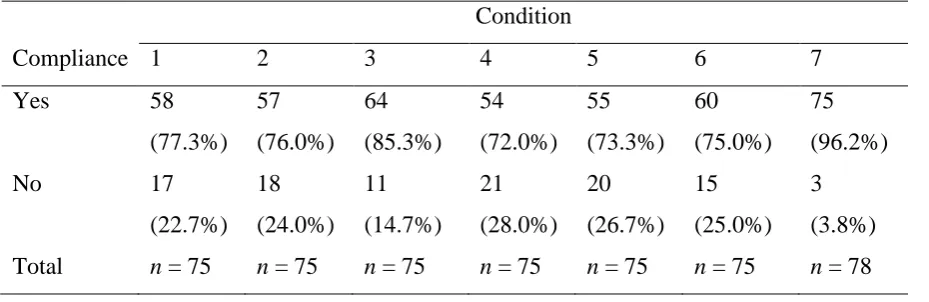
and were included in the research, donated M = € 1.48, SD = 1.06 to the charitable organisation. In total n = 423 respondents complied to the solicitation and made a monetary donation to the Kidney Foundation through the door-to-door collection, and n = 105 respondents did not comply to the solicitation and did not make a monetary donation to the Kidney Foundation
through the door-to-door collection. Table 7 shows the distribution of compliance across seven conditions. Tables 8 and 9 show the distribution of compliance for the variables beneficiary
(table 8) and valence (table 9). Table 10 shows the distribution of amount across seven conditions. Data were analysed with the use of SPSS Statistics.
[image:22.595.70.535.404.555.2]
Table 7 Distribution of compliance across seven conditions (n = 528)
Condition
Compliance 1 2 3 4 5 6 7
Yes 58
(77.3%) 57 (76.0%) 64 (85.3%) 54 (72.0%) 55 (73.3%) 60 (75.0%) 75 (96.2%)
No 17
(22.7%) 18 (24.0%) 11 (14.7%) 21 (28.0%) 20 (26.7%) 15 (25.0%) 3 (3.8%)
Total n = 75 n = 75 n = 75 n = 75 n = 75 n = 75 n = 78
Table 8 Distribution of compliance for the independent variable beneficiary (n = 450)
Beneficiary
Compliance Other Self Self-and-other
Yes 112 (74.7%) 112 (74.7%) 124 (82.7%)
No 38 (25.3%) 38 (25.3%) 26 (17.3%)
[image:22.595.73.521.606.711.2]Table 9 Distribution of compliance for the independent variable valence (n = 450)
Valence
Compliance Gain Loss
Yes 179 (79.6%) 169 (75.1%)
No 46 (20.4%) 56 (24.9%)
[image:23.595.65.528.254.337.2]Total n = 225 n = 225
Table 10 Distribution of amount across seven conditions (n = 423)
1 2 3 4 5 6 7
Amount
Total
M = €1.08..
SD = .69
n = 58
M = €1.39
SD = .97
n = 57
M = €1.51
SD = 1.05
n = 64
M = €1.59
SD = 1.04
n = 54
M = €1.67
SD = 1.27
n = 55
M = €1.53
SD = 1.09
n = 60
M = €1.59
SD = 1.15
n = 75
4.1 Inclusion of message elements
It was hypothesised that charitable appeals including beneficiary and valence message elements generated more compliance than charitable appeals not including these message elements (H1a), and that the inclusion of beneficiary and valence message elements would not affect
amount, that is, no difference was expected in amount between charitable appeals including and not including these message elements (H1b). For the variable compliance the effectiveness of including beneficiary and valence message elements was tested by Logistic Regression Analysis. Table 11 shows the results of this analysis. As shown in table 11, including
beneficiary and valence message elements has a significant main effect (B = -1.989, S.E. = .600,
p < .05) on compliance. When beneficiary and valence message elements were included less individuals were willing to comply to the solicitation to make a monetary donation compared
to when no message elements were included. This significant main effect was not conform
research expectations, therefore the results lend no support for H1a. Additionally, the gender of
Table 11 The effectiveness of including beneficiary and valence message elements for the
dependent variable compliance
B S.E. Sig.
Gendera .196 .221 .375
Message elementsb -1.989 .600 .001
Note: tested by Logistic Regression Analysis
aThe first category is the reference category. For gender ‘female’ is shown in the table, ‘male’ is used as reference
bThe first category is the reference category. For message elements ‘message elements included’ (manipulated
conditions) is shown in the table, ‘message elements not included’ (control condition) is used as reference
For the variable amount the effectiveness of including beneficiary and valence message elements was tested by Univariate Analysis of Variance. Table 12 shows the results of this
analysis. As shown in table 12, including beneficiary and valence message elements has no significant main effect (F(1, 419) = .947, n.s.) on amount. For both, when beneficiary and
valence message elements were included and when beneficiary and valence message elements were not included, the amount remained equal. The results lend support for H1b. Additionally, the gender of the donor has no significant main effect on amount (F(1, 419) = .984, n.s.).
Table 12 The effectiveness of including beneficiary and valence message elements for the
dependent variable amount
df F Sig.
Gender 1 .984 .322
Information 1 .947 .331
Note: tested by Univariate Analysis of Variance
Even though including beneficiary and valence message elements is less effective than not including these message elements in affecting donation behaviour, specifically compliance,
beneficiary and valence message elements might affect donation behaviour differently depending on what frame is included in the charitable appeal. To test how beneficiary and
valence affect donation behaviour, the control condition is excluded from further analysis since the control condition does not include beneficiary and valence message elements.
4.2 Beneficiary
[image:24.595.70.525.489.552.2]higher amount (H2b) than other-benefit appeals. For the variable compliance Logistic Regression Analysis was used to test whether different effects would be generated for
self-benefit appeals compared to other-self-benefit appeals. Table 13 shows the results of this analysis.
As shown in table 13, no significant main effect was found for self-benefit appeals compared
to other-benefit appeals (B = -.003, S.E. = .266, n.s.). Self-benefit appeals do not generate more
[image:25.595.67.525.284.349.2]compliance than other-benefit appeals. The results lend no support for H2a. Additionally, the gender of the donor has no significant main effect on compliance (B = .157, S.E. = .267, n.s.).
Table 13 The effects of self-benefit appeals and other-benefit appealsa on the dependent
variable compliance
B S.E. Sig.
Genderb .157 .267 .557
Other-benefitc -.003 .266 .992
Note: tested by Logistic Regression Analysis
aSelf-and-other-benefit appeals are excluded from analysis
bThe first category is the reference category. For gender ‘female’ is shown in the table, ‘male’ is used as reference
cThe first category is the reference category. For beneficiary ‘other-benefit’ is shown in the table, ‘self-benefit’ is
used as reference
For the variable amount Univariate Analysis of Variance was used to test whether different effects would be generated for self-benefit appeals compared to other-benefit appeals. Table 14
shows the results of this analysis. As shown in table 14, no significant main effect was found
for beneficiary (F(1, 216) = 2.337, n.s.). Self-benefit appeals (M = €1.34, S.E. = .096) do not generate a higher amount than other-benefit appeals (M = €1.55, S.E. = .097). The results lend no support for H2b. Additionally, the gender of the donor has no significant main effect on
amount (F(1, 216) = .616, n.s.).
Table 14 The effects of self-benefit appeals and other-benefit appealsa on the dependent
variable amount
df F Sig.
Gender 1 .616 .433
Beneficiary 1 2.337 .128
Note: tested by Univariate Analysis of Variance
4.2.1 Self-and-other-benefit appeals
It was hypothesised that self-and-other-benefit appeals would generate more compliance than other-benefit appeals (H3a1) and self-benefit appeals (H3b1). It was also hypothesised that
self-and-other-benefit appeals would generate a higher amount than other-benefit appeals (H3a2) and self-benefit appeals (H3b2). For the variable compliance Logistic Regression Analysis was used to test whether different effects would be generated for self-and-other-benefit appeals
compared to other-benefit appeals and self-benefit appeals. Table 15 shows the results of this
analysis. As shown in table 15, no significant main effects were found for self-and-other-benefit
appeals compared to other-benefit appeals (B = -.486, S.E. = .287, n.s.) and self-benefit appeals (B = -.481, S.E. = .287, n.s.). Self-and-other-benefit appeals do not generate more compliance
[image:26.595.73.525.403.508.2]than other-benefit appeals and self-benefit appeals. The results lend no support for H3a1 and H3b1. Nevertheless, table 15 shows a trend which is not statistically significant for p < .05 but would be for p < .10, indicating that self-and-other-benefit appeals might be able to generate more compliance compared to other-benefit appeals and self-benefit appeals.
Table 15 The effects of beneficiary and valence on the dependent variable compliance
B S.E. Sig.
Gendera .279 .277 .219
Other-benefitb -.486 .287 .090
Self-benefitb -.481 .287 .094
Valencec -.266 .228 .242
Note: tested by Logistic Regression Analysis
aThe first category is the reference category. For gender ‘female’ is shown in the table, ‘male’ is used as reference
bThe last category is the reference category. For beneficiary ‘other-benefit’ and ‘self-benefit’ are shown in the
table, ‘self-and-other-benefit’ is used as reference
cThe first category is the reference category. For valence ‘loss’ is shown in the table, ‘gain’ is used as reference
For the variable amount Univariate Analysis of Variance was used to test whether different effects would be generated for self-and-other-benefit appeals compared to other-benefit appeals
and self-benefit appeals. Table 16 shows the results of this analysis. As shown in table 16, no
Table 16 The effects of beneficiary and valence on the dependent variable amount
df F Sig.
Gender 1 1.061 .304
Beneficiary 2 1.409 .246
Valence 1 5.935 .015
Note: tested by Univariate Analysis of Variance
4.3 Valence
It was hypothesised that gain framed appeals would generate more compliance (H4a) and a higher amount (H4b) than loss framed appeals. For the variable compliance Logistic Regression Analysis was used to test whether different effects would be generated for gain framed appeals
compared to loss framed appeals. Table 15 shows the results of this analysis. As shown in table
15, no significant main effect was found for valence (B = -.266, S.E. = .228, n.s.). Gain framed appeals do not generate more compliance than loss framed appeals. The results lend no support for H4a. Additionally, the gender of the donor has no significant main effect on compliance (B = .279, S.E. = .277, n.s.).
For the variable amount Univariate Analysis of Variance was used to test whether different effects would be generated for gain framed appeals compared to loss framed appeals.
Table 16 shows the results of this analysis. As shown in table 16, a significant main effect was
found for valence (F(1, 336) = 5.935, p < .05). Loss framed appeals (M = €1.61,
S.E. = .081) generate a higher amount than gain framed appeals (M = €1.34, S.E. = .078). This significant main effect was not conform research expectations, therefore the results lend no
support for H4b. Additionally, the gender of the donor has no significant main effect on amount (F(1, 336) = 1.061, n.s.).
4.4 Gender as a moderator
It was hypothesised that gender moderates the direction of the relation between beneficiary and donation behaviour (H5) and that gender moderates the strength of the relation between valence
and donation behaviour (H6). Two Univariate Analyses of Variance were used to test for
Table 17 Interaction effects between beneficiary, valence and gender on the dependent
variable compliance
df F Sig.
Gender*Beneficiary 2 .320 .726
Gender*Valence 1 .039 .844
Beneficiary*Valence 2 .026 .975
Gender*Beneficiary*Valence 2 .297 .743
Note: tested by Univariate Analysis of Variance
Table 18 Interaction effects between beneficiary, valence and gender on the dependent
variable amount
df F Sig.
Gender*Beneficiary 2 .038 .963
Gender*Valence 1 .084 .772
Beneficiary*Valence 2 1.822 .163
Gender*Beneficiary*Valence 2 .394 .675
Note: tested by Univariate Analysis of Variance
As shown in table 17, no significant interaction effects were found for compliance. Gender does not moderate the direction of the relation between beneficiary and compliance (F(1, 438) = .320, n.s.). Self-benefit appeals are equally effective for men and women in affecting compliance (no support for H5a1), other-benefit appeals are equally effective for men and women in affecting compliance (no support for H5b1), and self-and-other-benefit appeals are equally effective for men and women in affecting compliance (no support for H5c1). Furthermore, gender does not moderate the strength of the relation between valence and
compliance (F(1, 438) = .039, n.s.). The strength of the effect of gain framed appeals on
compliance is equal for men and women (no support for H6a1), and the strength of the effect of loss framed appeals on compliance is equal for men and women (no support for H6b1). As shown in table 18, no significant interaction effects were found for amount. Gender does not moderate the direction of the relation between beneficiary and amount (F(1, 336) = .038, n.s.). Self-benefit appeals are equally effective for men and women in affecting amount (no support for H5a2), other-benefit appeals are equally effective for men and
[image:28.595.68.524.303.408.2]gender does not moderate the strength of the relation between valence and amount (F(1, 336) = .084, n.s.). The strength of the effect of gain framed appeals on amount is equal for men and women (no support for H6a2), and the strength of the effect of loss framed appeals
on amount is equal for men and women (no support for H6b2).
In sum, the results lend no support for H5 and H6. Furthermore, no interaction effects
were found between the independent variables beneficiary and valence for both compliance and
amount, and no three-way interaction effects were found between the variables beneficiary,
valence and gender for both compliance and amount.
[image:29.595.73.530.318.723.2]Table 19 provides an overview of the support for the research hypotheses.
Table 19 Overview of the support for research hypotheses
Support for hypothesis
Hypothesis Supported Not supported
H1a H1b H2a H2b H3a1 H3a2 H3b1 H3b2 H4a H4b H5 H5a1 H5a2 H5b1 H5b2 H5c1 H5c2 H6 H6a1 H6a2 H6b1 H6b2 Supported
Not supporteda Not supported Not supported Not supportedb Not supported Not supportedb Not supported Not supported Not supporteda Not supported Not supported Not supported Not supported Not supported Not supported Not supported Not supported Not supported Not supported Not supported Not supported Note
aSignificant effect was not conform research expectations
5
Discussion
The main research question posed in this research reads: To what extent do the beneficiary and valence emphasised in a charitable appeal affect monetary donation behaviour during a door-to-door collection? This section discusses the research results, providing an answer to the research question. Furthermore, theoretical and practical implications, future research
directions and limitations are discussed.
5.1 Discussion of research results
This research measures actual monetary donation behaviour through a door-to-door collection.
Overall, the results show that including beneficiary and valence message elements in the solicitation to donate is counterproductive. Less people complied to the solicitation when these
message elements were included, compared to when these message elements were not included.
However, when beneficiary and valence message elements were included in the solicitation, the results show that the solicitation should best include a loss frame and address both
self-and-other-benefits.
5.1.1 Inclusion of message elements
The research results show that the inclusion of beneficiary and valence message elements did not affect amount. For both, when these message elements were and were not included, the
amount remained equal. The present finding is compatible with the research expectations. However, the research results also show that when beneficiary and valence message elements were included in the charitable appeal, less people were willing to comply to the solicitation to
make a monetary donation compared to when these message elements were not included. The
present finding is not compatible with the research expectations. It was expected a potential
donor would be disrupted and more susceptible to the charitable solicitation by the inclusion of
unexpected message elements and engaging the mind of the potential donor, and hence increase
compliance. The present finding might be explained by the way the message elements were applied in the charitable solicitations.
The effectiveness of disrupt then reframe theory hinges on inducing the potential donor
to be mindless (Davis & Knowles, 1999; Fennis et al., 2006), which can be achieved by
confusing the potential donor in the disruption. Erickson (1964) confused individuals by play