I University of Twente
Faculty of Behavioural, Management & Social Sciences (BMS)
M.Sc. Business Administration
Technical University of Berlin Faculty of Economics & Management
M.Sc. Innovation Management and Entrepreneurship
Master’s thesis
Introduction of self-management in organizations
and teams – a multiple case analysis
by
Meret Ginten
Supervisor 1: Dr. M.L. Ehrenhard, University of Twente Supervisor 2: Dr. M. de Visser, University of Twente
I
Acknowledgements
I would like to thank my supervisors from the University of Twente Dr. M.L. Ehrenhard and Dr. M. de Visser for their guidance and dedication that made this thesis possible. I would also like to thank Karina Cagarman from TU Berlin for her role as supervisor and advice.
For the participation in this study I want to thank all interview participants and especially my contact persons in the organizations. Their engagement and openness made a deeper insight into the topic possible.
II
Abstract
More and more organizations are decentralizing authority and experimenting with new management approaches. Although, self-management as a management approach for teams and organizations has been applied over decades, research on the experiences of employees working with this approach is scarce. As many organizations and teams use individual approaches to self-management, the question of what experiences they have in common arises. The research objectives of this study were to identify the key topics for employees when switching to self-management and to identify the main benefits and challenges of the change to self-management for teams and organizations.
To meet the research objectives a qualitative multiple case study approach was chosen. The research was based on interviews with employees of two organizations in Germany that implemented self-management over one year ago. One implemented self-self-management in just one team and the other for the whole organization. The semi-structured interviews were conducted with five employees from each organization.
The results showed that the main topics for teams and organizations when switching to self-management are the change of the structures and processes, the change to self-organization and the processes of payment. Furthermore, the redistributed responsibilities lead to employee satisfaction as they have more options to bring in their skills according to their interests. However, the responsibility is also perceived as a burden because employees need to take final decisions themselves. They appreciate the personal development and the development of their team, but the ongoing process of change is time-consuming. Conflicts are uncovered and need to be solved during the process. Coming from hierarchical structures a higher desire for guidance was communicated.
The findings indicate that increasing the quantity of scientific results would be beneficial for gaining more understanding of the influences of self-management on employees. Moreover, the results can serve to raise practitioners’ awareness of what topics are especially relevant when introducing self-management in teams or organizations.
III
Table of figures
Figure 1. Evolution of organizations. Adapted from Reinventing organizations (p. 36), by F. Laloux,
2014, Brussels: Nelson Parker. Copyright [2014] Frédéric Laloux. ... 5
Figure 2. From „Holacracy vs. Hierarchy”, S. Lee, 2016 (http://www.businessinsider.de/zappos-ceo-tony-hsieh-on-misconception-about-Holacracy-2016-2?r=US&IR=T). Copyright [Samantha Lee/Business Insider] ... 14
Table of tables
Table 1. Basic coding categories ... 27Table 2. Derived coding categories ... 27
Table 3. Key topics introduction of self-management ... 28
Table 4. Betterplace lab main benefits of changing to self-management ... 28
Table 5. Betterplace lab main challenges of changing to self-management ... 28
Table 6. Traum-Ferienwohnungen main benefits of changing to self-management ... 28
Table 7. Traum-Ferienwohnungen main challenges of changing to self-management ... 28
Table 8. Common key topics of introducing self-management (1) ... 29
Table 9. Common and differing main benefits of introducing self-management (1) ... 29
Table 10. Common and differing main challenges of introducing self-management (1) ... 29
Table 11. Betterplace lab overview main benefits ... 34
Table 12. Betterplace lab overview main challenges ... 37
Table 13. Betterplace lab overview key topics introduction of self-management ... 41
Table 14. Traum-Ferienwohnungen overview main benefits... 46
Table 15. Traum-Ferienwohnungen overview main challenges ... 49
Table 16. Traum-Ferienwohnungen overview key topics introduction of self-management ... 52
Table 17. Common and differing main benefits of introducing self-management (2) ... 54
Table 18. Common and differing main challenges of introducing self-management (2) ... 54
Table 19. Common key topics of introducing self-management (2) ... 58
IV
Table of contents
Acknowledgements ... I
Abstract ... II
Table of figures ... III
Table of tables ... III
Appendix ... III
Table of contents ... IV
1 Introduction ... 1
1.1 Context of study ... 1
1.2 Research goal and research questions ... 3
1.3 Thesis structure ... 4
2 Literature review ... 5
2.1 Evolution of organizations towards self-management ... 5
2.1.1 Evolutionary stages of organizations by Frédéric Laloux ... 5
2.1.2 Practical examples ... 8
2.1.3 Teams as key component of learning organizations... 8
2.1.4 Models based on teams and hierarchy ... 9
2.2 Latest developments in introducing self-management in organizations ... 10
2.2.1 Sociocracy ... 10
2.2.2 Holacracy as a guideline to self-management ... 13
2.2.2.1 Pitfalls ... 16
2.3 Characteristics of self-managed organizations ... 18
2.4 Necessary conditions to implement self-management ... 20
3 Methodology ... 22
3.1 Research Approach ... 22
3.2 Research design ... 22
3.2.1 Strategy ... 22
3.2.2 Selection & sample ... 23
3.2.3 Measurement ... 24
3.2.4 Data collection ... 25
3.3 Data analysis ... 26
3.4 Reliability and validity ... 29
3.5 Ethics ... 30
V
4.1 Betterplace Lab ... 32
4.1.1 Identified Benefits and Challenges of the change to self-management ... 34
4.1.1.1 Benefits self-organization ... 34
4.1.1.2 Benefits freedom/ free choices ... 34
4.1.1.3 Benefits team ... 35
4.1.1.4 Benefits responsibility ... 35
4.1.1.5 Challenges structures and processes ... 37
4.1.1.6 Challenges responsibility ... 37
4.1.1.7 Challenges complexity ... 38
4.1.1.8 Challenges meetings ... 38
4.1.2 Key topics identified in the change to self-management ... 41
4.1.2.1 Processes payment ... 41
4.2 Traum-Ferienwohnungen.de ... 44
4.2.1 Identified Benefits and Challenges of the change to self-management ... 46
4.2.1.1 Benefits self-organization ... 46
4.2.1.2 Benefits responsibility ... 46
4.2.1.3 Benefits team ... 47
4.2.1.4 Benefits whole personality ... 47
4.2.1.5 Challenges structures and processes ... 49
4.2.1.6 Challenges responsibility ... 49
4.2.1.7 Challenges wish for guidance... 50
4.2.1.8 Challenges complexity ... 50
4.2.2 Key topics identified in the change to self-management ... 52
4.2.2.1 Processes payment ... 52
4.3 Cross-case analysis results ... 54
4.3.1 Common benefits and challenges of the change to self-management ... 54
4.3.1.1 Benefits self-organization ... 54
4.3.1.2 Benefits responsibility ... 54
4.3.1.3 Benefits team ... 55
4.3.1.4 Challenges structures and processes ... 56
4.3.1.5 Challenges responsibility ... 56
4.3.1.6 Challenges complexity ... 56
4.3.2 Common key topics when changing to self-management ... 58
4.3.2.1 Processes payment ... 58
VI
5.1 Conclusion ... 60
5.2 Limitations of the study ... 61
5.3 Research recommendations ... 63
1
1
Introduction
“As a big company, you are constantly trying to foolproof yourself against being big, because you see the advantage of being small, nimble and entrepreneurial.
Pretty much every great thing gets started by a small team.”
Google CEO Sundar Pichai (Kiss, 2017)
1.1
Context of study
Over the last decade companies and markets have been influenced by the digital revolution and the increasing globalization. The increased digitization enables faster communication but also causes a faster change of markets, products and services. Companies face higher competition in global markets. To gain advantages over their competitors, companies need to be innovative to survive in the long run.
Organizations are constantly forced to adapt to changing environments and competition. To change and adapt is one of the key activities for firms. Nevertheless, a lot of companies have failed to make use of new business opportunities and still do. This can be observed in different industries and markets.
One example for these challenges is NOKIA, which was one of the largest mobile phone companies in terms of volume, sales, market share and profit in the 1990s and early 2000s. Nevertheless, the company failed to succeed in the smartphone market in the early 2010s (Bouwman et al., 2014). One aspect of the failure was their “control culture that conflicted with the culture of an innovative, engineering and design oriented start up” (Bouwman et al., 2014, p.16). The case of NOKIA shows that key factors for
innovation are highly educated creative employees that support innovation and a corresponding culture in the company. The question arises how companies can be managed to include the full potential of their employees.
In particular, large firms in Germany are still very hierarchical and have corresponding control mechanisms in their organization (Recruiting Redaktion, 2016). The Human Resource (HR) Expert Tom Haak, founder of the HR Trend Institute, identified nine trends in HR. One of them is the development from hierarchy to network. Closed organizations are developing to open organizations with more employees in the flexible workforce. There is an increasing importance for communities where transparency is key (Haak, 2015).
The topic of business organization is becoming a central topic in many companies. The Global Human Capital Trends 2016 report of Deloitte states that 92 percent of the companies studied believe that redesigning the organization is very important or important. “Companies are decentralizing authority,
2 empowered teams that communicate and coordinate activities in unique and powerful ways.”
(McDowell et al., 2016, para.1; Ismail, Malone, & van Geest, 2017, pp.101-105).
The report shows that awareness of different organizational structures and management approaches is growing. In addition, a study from 2014 of the Institute for Production Systems and Design Technology in Berlin reveals that the importance of immaterial values in industrial countries is growing. It identifies the trend of changing from a producing economy to a knowledge based economy with highly qualified employees, which is pushed by the atomization of industrial processes (p. 24). This trend can also be seen in the understanding of capital. Zeleny (1989) describes the evolution from a traditional view of capital based on land, raw materials, machines, labour and money to knowledge as the most important capital factor in modern organizations. Hence, organizations need to think about how they can manage and organize a knowledge based company.
A basis for the development of new organizational structures with corresponding management approaches has been the finding that teams constitute the key structure of learning organizations (Ismail et al.,2017, p.102), but they need to be organized in some structure (Romme, 1997, pp. 149-150). Self-management approaches like sociocracy and Holacracy have emerged in theory and practice. They use an alternative circular organizational structure in contrast to the hierarchical organization chart. Both concepts have been adapted by various organizations in different countries. The most recent approach to self-management, Holacracy, by Brian J. Robertson, has been adapted by as many as 300 US companies (Helmore, 2015, para.1).
There are already existing examples of companies that have adapted new approaches to management and organization. Mostly to increase productivity they have been working with self-managed teams or even turned their whole organization into a self-managed company. While companies such as Volvo or FedEx have used self-managed teams to achieve breakthroughs in their production or service, companies such as Zappos and Morning Star have turned their whole structure and management approach around to a self-managed model (Bernstein, Bunch, Canner & Lee, 2016, p. 41).
3
1.2
Research goal and research questions
The topic of self-management and self-management approaches like Holacracy is discussed in the literature and magazines as well as the tech community.
In Germany the introduction of new self-management approaches did just start. Non-profit organizations as well as start-ups and companies started to experiment with Holacracy or their own self-management approaches. The research revealed that there is no one fits all solution for organizations to switch to a self-management approach. Many organizations have had to find their own way to change structures and processes according to their needs (Laloux, 2014). Current research focuses on organizational structures and processes.
The topic for this study will be the experiences of employees with the change to self-management on a team or organizational level. Cases like Zappos as well as the research of Laloux have shown that the change process to a self-management approach can be challenging and lead to a resignation of employees, but also empower them by distributing authority. Furthermore, there exist no studies on the experiences of employees with the change to self-management in Germany yet.
The purpose of this case study will be to explore the common topics that arise for employees with the change to a self-management approach in a team or organization in Germany.
Central question:
How do employees experience the change to self-management as a new management approach?
Sub questions:
1. What are the key topics that are relevant to employees when switching to self-management?
2. What are the main benefits of the change to self-management for employees?
3. What are the main challenges of the change to self-management for employees?
4. What are common key topics for employees of teams and organizations that switched to self-management?
5. What are common main benefits for employees of teams and organizations that switched to self-management?
4 To answer the research questions two organizations were chosen for case studies. One is a non-profit organization called gut.org, which is located in Berlin. One team in this organization implemented a self-management approach based on Frédéric Laloux’s book “Reinventing organizations”. The team is the betterplace lab, which “does research where innovation and the common good meet” (betterplace
lab (a), 2016). The team offers publications, consulting and events that cover developments in the digital-social field (betterplace lab (b), 2017). The rest of the company structure stayed as it was. The second organization is the online platform Traum-Ferienwohnungen, which moved from a hierarchical management approach to an individual self-management approach. Both underwent a change process, but the outcomes were different and on a different scale considering that the betterplace lab team consists of 13 people (betterplace lab (c), 2017) and Traum-Ferienwohnungen, which counted 120 employees (Traum-Ferienwohnungen (a), 2017). They also differed in their legal structures, the former being a non-profit organization and the latter a non-profit oriented organization. These differences may help to identify common and differing experiences in these organizations with the change process to a self-management approach.
1.3
Thesis structure
The thesis is divided in five chapters. It includes an overview of the theory about past and current organizational forms and associated management approaches as well as practical examples. The theory section is followed by a description of the methodology applied for performing the qualitative research. In the practice section the results of the research are presented, analysed and discussed. Finally, the thesis gives an outlook for further academic work and management implications.
5
2
Literature review
2.1
Evolution of organizations towards self-management
To understand the change process to a self-management approach it is important to understand the evolution of organizational forms with their structures and processes (Oestereich & Schröder, 2017; Brandes-Visbeck & Gensinger, 2017). Hence, this chapter will give an overview of the evolution of organizations and the recent developments and concepts associated with self-managed teams and organizations.
2.1.1
Evolutionary stages of organizations by Frédéric Laloux
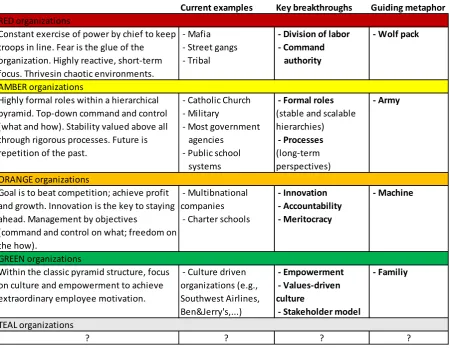
[image:12.595.89.540.347.695.2]Frédéric Laloux analyses past and present organizational models in his book "Reinventing organizations" (2014). He describes the development of different organizational models in human history from 100.000 years ago to the present (Laloux, 2014, p. 35). He identifies the following main organizational models:
Figure 1. Evolution of organizations. Adapted from Reinventing organizations (p. 36), by F. Laloux, 2014, Brussels: Nelson Parker. Copyright [2014] Frédéric Laloux.
Today these different organizational forms exist alongside each other (Laloux, 2014, p. 35). Since one of the most common structures over decades has been a strict hierarchy, the description starts at the
Current examples Key breakthroughs Guiding metaphor
Constant exercise of power by chief to keep troops in line. Fear is the glue of the organization. Highly reactive, short-term focus. Thrivesin chaotic environments.
- Mafia - Street gangs - Tribal
- Division of labor - Command authority
- Wolf pack
Highly formal roles within a hierarchical pyramid. Top-down command and control (what and how). Stability valued above all through rigorous processes. Future is repetition of the past.
- Catholic Church - Military
- Most government agencies
- Public school systems
- Formal roles
(stable and scalable hierarchies)
- Processes
(long-term perspectives)
- Army
Goal is to beat competition; achieve profit and growth. Innovation is the key to staying ahead. Management by objectives
(command and control on what; freedom on the how).
- Multibnational companies - Charter schools
- Innovation - Accountability - Meritocracy
- Machine
Within the classic pyramid structure, focus on culture and empowerment to achieve extraordinary employee motivation.
- Culture driven organizations (e.g., Southwest Airlines, Ben&Jerry's,...) - Empowerment - Values-driven culture
- Stakeholder model
6 amber organization stage. Amber organizations such as the military are based on formal roles in a defined hierarchy and strict command and control structures, with past actions repeated again and again (see Figure 1). Orange organizations are the next step and are represented by today's multinational companies (see Figure 1).
The most common hierarchical structure in organizations is the pyramidal structure which is based on structural models of Henri Fayol and Frederick Taylor and dates back to the industrial revolution (Oestereich & Schröder, 2017, p.72; “Holawhat, 2015”) (see Figure 2, p.14). Oestereich and Schröder (2017) explain that in this structure the value creation happens on the lowest level which is topped by several management levels up to the top-management. In this organizational structure power is executed top-down and on the level of departments such as IT, Human Resources and Procurement. Every employee is assigned to one department to a job description and has a boss that he reports to. This structure dates from a time in which many employees executed repetitive tasks (Helmore, 2015).
The development from amber to orange organizational structures shows a need for additional structure or structures different from only strict hierarchies. According to Mintzberg (1979) purely hierarchical structures can become inert, bureaucratic and centralized. In orange organizations, the hierarchical structures are kept as a basis, but they are updated by project groups, expert staff functions, internal consultants and virtual teams to support communication and innovation (Laloux, 2014, p. 26). This shows a first step towards combining hierarchical structures with teams to achieve defined goals.
After the development of amber and orange organizations (see Figure 1), the green organizations emerged. Laloux (2014) characterizes these organizations by three breakthroughs:
First, they empower employees by pushing decisions to the front-line and see leaders as servant leaders to the employees. Second, they have an inspirational culture and their actions are driven by the organization’s defined values instead of by pure strategy. Third, while orange organizations focus on the shareholder perspective, green organizations take multiple shareholder perspectives into account. They integrate social responsibility into their daily business instead of publishing a corporate social responsibility report as a duty. Green organizations do the first step towards empowerment of employees and have a focus on culture which aims at achieving high employee satisfaction (Laloux, 2014, pp. 31-36).
7 contrary, organizations have been experimenting with this approach of managing and organizing organizations for decades.
Comparing the evolutionary stages of organizations, authors such as Maslow and others agree that the shift from green to teal organizations is also a shift in the worldview (Laloux, 2014, p.43). According to Laloux (2014) organizations up to the green stage consider their worldview the only valid one, people in teal organizations accept that there is an evolution in consciousness and that there are many ways of dealing with the world. This corresponds with the last stage of “self-actualization” of Maslow’s hierarchy of needs (Maslow, 2017). In consequence Laloux (2014) calls these organizations evolutionary-teal (p. 43).
What is common to evolutionary-teal organizations is that the founders of these organizations often speak of them as “…living organism or living system.” (Laloux, 2014, p. 56). This corresponds to the
view of some self-management models that will be presented in 2.2.
Laloux researched twelve organizations that operate entirely or partly with evolutionary teal structures and processes. They all had at least 100 employees.
He also included further best practice examples of smaller size or different industries (Laloux, 2014, p.59). With his research on teal organizations Laloux (2014) identified three principles that teal organizations are based on:
1. Self-management
They are operating based on self-management, and there are no hierarchies and no consensus is necessarily needed in decision-making. The employees make all the important decisions. Founders of a company only build the environment, but they must obey to the same consensual ruleset.
2. Wholeness
All people are seen as human beings with all aspects of their personality. The organization also recognizes emotions, intuitivism and spiritual aspects apart from the “professional” self of employees.
3. Evolutionary purpose
Evolutionary-teal organizations develop organically and not by following a defined goal that needs to be reached with certain steps. The direction of development cannot always be predicted but it follows the reason for the existence of the organization. (p. 56)
8
2.1.2
Practical examples
One important aspect that Laloux (2014) identified in evolutionary-teal organizations is self-management. Self-managed teams were the beginning of self-management and have been variously used across continents in various ways. In Europe, they were associated with "participative management and industrial democracy". In Japan, they are formed as "quality circles and continuous improvement efforts"(Bernstein et al., 2016). In the USA, they were the organizational form for innovation task forces. Many companies have benefitted largely from using self-managed teams especially in their manufacturing and service divisions (Bernstein et al., 2016, p.41).
Bernstein et al. (2016, p.41) describe that already in the early 1980s, the scholars Henry Mintzberg and Warren Bennis witnessed a development towards adhocracy entailing flexible and informal management structures. The rise of the internet has since led to ‘the networked firm’. In the 1990s the use of self-managed teams became more common since the organizations wanted to benefit from the promise of higher productivity.
According to Cummings and Worley self-managed teams have been implemented by large corporations such as Intel, General Mills, General Electric, Boeing and Motorola (2014, p.415). Nonetheless most of them used these team structures only partially in their organization.
The next step was to think beyond self-managed team structures. Organizations dared to question hierarchical structures and started to experiment with self-managed organizational structures (Bernstein et al., 2016, p.41).
One of these companies is Gore which became famous for its weatherproof textiles known as ‘Gore Tex’. The company with 10,000 employees worldwide operates based on an empowerment oriented
work structure (Schermuly (a), 2016).
2.1.3
Teams as key component of learning organizations
The structures identified from the practical examples show that teams are a key component of self-management approaches. This fact is also reflected in further academic literature. When researching academic literature and practical examples of different organizational structures, you find that teams play an essential role. In academia, several authors (e.g. Argyris, 1992; Kofman and Senge, 1993; Senge, 1990) argue that teams are the key learning unit in organizations. According to Carley (1992) “… a team
is a set of decision-makers without a chain of command but with equal voice in the final decision…” (as cited in Romme, 1997). And in 1993 Kofman et al. state that teams are the kind of “communities of commitment” in which free and creative exploration of complex and subtle issues is possible (as cited
9 Self-management has existed for a long time in organizations. It empowered people to make their own choices according to the daily situations they face at work instead of executing decisions made further up the hierarchy chain. Bernstein et al. (2009) found that already in sixty-five years ago, Eric Trist from the Tavistock Institute observed a rise in productivity when people working in mines formed self-organized teams. Miners in England started to work in autonomous, multiskilled groups with interchanging roles, thereby making it possible to work 24 hours with minimal supervision. They proved that productivity was not linked to performing the same task repeatedly. Over the decades self-managed teams were used in different forms (pp.40-41).
2.1.4
Models based on teams and hierarchy
As early as the sixties scholars like Argyris (1957), McGregor (1960) and Likert (1961) started to think about alternative management structures that covered how benefits of hierarchies and team learning can be combined by using involvement-oriented, participative-management methods instead of control-oriented methods (as cited in Romme, 1997, p. 151).
One of the most important aspects to consider when questioning hierarchical structures was what organizational structures that best support an organization’s (team) learning processes should be like. In his article "Organizational Learning, Circularity and Double-linking" of 1997, A.G.L. Romme evaluates concepts for the structure of learning organizations (p. 149). As mentioned above, Romme thinks that a balance between hierarchy and teams is needed as both "are essential for large organizations as learning systems" (1997, p. 151).
The scholars Likert and Ackoff tried to solve this problem. According to Romme, Likert developed in 1961 the concept of a participative group organization, which he called system 4. It was developed further by Ackoff in 1981.
10
2.2
Latest developments in introducing self-management in organizations
The latest developments in self-management have been influenced by the open-source movement and agile and scrum methodologies as well as the sharing economy. They lead to participative and responsive organizational structures like podularity and Holacracy. Aside from these structures many firms are also experimenting with their own self-management approaches (Bernstein et al., 2016, p.42; Ismail et al., 2017, pp.195-216).
The concept of Holacracy, introduced by Brian J. Robertson, will be presented in detail as it is currently the best described self-management model which illustrates common aspects of the current application of a circular management model. It has been applied more often than other designs and in companies of different sizes. In the US approximately 300 companies have adopted Holacracy and 1,000 organizations worldwide (Helmore, 2015; HolacracyOne (a), 2017). As the concept of Holacracy is mainly based on the sociocracy model of Endenburg, this model will be presented first.
2.2.1
Sociocracy
Definition
The term Sociocracy comes from the old Latin words socius for ‘colleague or associate’ and the old
Greek –kratein for ‘to rule’.
Development
The basics of the organizational model Sociocracy have already been developed shortly after the Second World War. At the beginning of the 1970s it underwent a time of prosperity in the Netherlands and subsequently in other European countries. It was used as an innovative organizational model for participatory leadership (brand eins, 2009). In the mid-2000s American entrepreneurs such as Evan Williams, a twitter co-founder, rediscovered sociocracy as they were searching for models that were applicable in the fast-developing digital industry of the Silicon Valley (“Holawhat?”, 2015, para.7; Compagne, 2014).
The entrepreneur in the software industry Brian J. Robertson was searching for a social technology that he could apply in his software company Ternary Software (Robertson, 2016). He discovered the ideas of the Dutch Gerard Endenburg and Kees Boeke when he met John A. Buck, a sociocracy consultant, who introduced Robertson to Endenburg (Oestereich & Schröder, 2017). Robertson mainly based his operating system for companies called Holacracy on the principles of the sociocracy model of Endenburg.
11 Schröder). His sociocracy model was based on the ideas of the Dutch Kees Boeke who had founded a reform school in Utrecht called ‘Werkplaats Kindergemeenschap’ in 1926, where the daughters of the
Dutch royal family went to school (Kees en Betty, n.d.). Boeke described his ideas in the book ‘Redelijke ordening von de menschengemenschaap’, where he mentions the principle of the consent based decision of the Quaker’s (Oestereich & Schröder, 2017).
As Endenburg developed a model for his company he tried to eliminate top-down decisions and majority based decisions, as he found that they do not lead to the best solutions for problems and they leave involved people dissatisfied (Oestereich & Schröder, 2017, p.74). In the 1970s Endenburg developed and introduced his model sociacracy in his company Endenburg Elektrotechniek BV (Sociocracy Group., n.d.). In 1974 he founded the first Sociocratic Center which aims at developing and spreading the model. Today there exist sociocratic centers worldwide and schools and universities as well as organizations and companies are applying the model in Europe and the USA (Sociocracy Group., n.d.).
Basic concept
The sociocratic model replaces organizational hierarchies by circles. The organization has a general circle that has the function of a management board. Additionally, a top circle has the function of a supervisory board and decides on topics such as the appropriation of earnings. Under the top circle division circles are organized with different teams. The circles are double-linked by representatives from the larger circles and the sub-circles. Within a circle all members are equal, and employees can be members in several circles (Oestereich & Schröder, 2017).
Circles, consent, hierarchy
Based on Endenburg the four basic principles of sociocracy are the following (Soziokratie Zentrum Österreich, n.d.):
1. Principle of consent
Consent as primary decision-making procedure
2. Circular organizational structure
The organization is structured by hierarchical circles that can make decisions autonomously
3. Double-linking
12 4. Sociocratic election
The circles elect employees for tasks and roles such as the links based on the consent principle and with an open discussion.
Hereby, consent decision refers to the principle that a decision can only be made if no one in the group has a severe objection. The principle leads to a high acceptance of the final decision (Endenburg, G. & Buck, J.A., 2012, p.9).
Endenburg emphasizes that sociocracy is no basic democratic organizational structure, instead sociocracy modifies hierarchies. The most important is what the people in the circles make out of the flexibility that they gain out of sociocracy. In an interview with the German magazine brand eins Endenburg said: “Life is a dynamic process, but in our work environment we are confronted with inflexible models, conditioned to ‘yes’ and ’no’, ‘top’ and ’bottom’, dominated by computers, which are programmed the same way. There is a growing need for a system that promotes flexibility.” (brand
13
2.2.2
Holacracy as a guideline to self-management
Defintion
The term Holacracy comes from the old Greek words hólos for ‘all’ and –kratia for ‘power’. You could also describe it as a distribution of power to all. Hence, the name expresses the basic concept which is “…governance (-cracy) of and by the organizational holarchy (hola-)” (Robertson, 2016, p. 39).
Development
Holacracy is a management system that is based on the sociocracy approach of Gerard Endenburg. Brian J. Robertson, a young entrepreneur in the American software industry, was searching for a social technology to change the structures of his software company Ternary Software. Consequently, he developed his own version of sociocracy and incorporated concepts of agile software development methods such as Scrum and Kanban (Bernstein et al., 2016). After introducing Holacracy in his own software company in 2007 he continued to further develop the concept. Based on the practical experiences he founded the consultancy HolacracyOne, which helps companies to implement Holacracy and published the Holacracy constitution which includes the basic rules and principles of the concept (HolacracyOne (b), 2017; HolacracyOne (c), 2017). Over 300 companies in the US have adopted Holacracy and the most prominent customer of HolacracyOne is Zappos, an Amazon-owned online shoe retailer (“Holawhat?”, 2015, para.1, Helmore, 2015, para.1). In Germany the large logistics and railway
corporation Deutsche Bahn is experimenting with Holacracy in two departments and introduced the principle of consent decision making in another department (Seifert, 2017, para.13). Just a few other mainly small sized companies have started to adopt the concept such as the Berlin based start-up soulbottle (Johanna, 2016).
Basic concept
HolacracyOne wants to provide a so-called operating system for purpose-driven and responsive companies (HolacracyOne (d), 2017). Robertson sees the underlying informal structures of hierarchical organizations as the source of problems such as a lack of motivation, bureaucracy, inefficiency, unclear decision processes and others (Holacracy, 2014). In consequence Holacracy adopts structures and processes that differ from the hierarchical structures that have dominated organizations in the last decades. “The main objective is to distribute authority throughout an organization” (“Holawhat?”, 2015).
14 book Koestler argues that the whole world is defined by different types of hierarchies relating to language, music, chemistry and biology (as cited in Brinsa, 2015, para.5).
According to Ethan Bernstein, a Harvard Business School Professor, “the philosophy is not to erase hierarchies entirely but to allow companies to form hierarchies organically (…)” (Helmore, 2015,
para.6). To illustrate what a holarchy is, Robertson uses the example of cells in a body that form organs, which are a part of the body (2015, p. 38). It means that the company works as a system that is constantly changing and adapting. As a result, Robertson understands Holacracy as an operating system for organizations.
Figure 2. From „Holacracy vs. Hierarchy”, S. Lee, 2016 (
http://www.businessinsider.de/zappos-ceo-tony-hsieh-on-misconception-about-Holacracy-2016-2?r=US&IR=T). Copyright [Samantha Lee/Business Insider]
Constitution, Circles, Roles and Meetings
[image:21.595.83.545.260.553.2]15 Traditional job descriptions are replaced by roles, as they often do not represent reality and quickly become outdated (HolacracyOne (d), n.d.). Each role includes different accountabilities to clarify expectations and authority for colleagues and other stakeholders. By introducing roles authority is decentralized and distributed to the employees. Every employee can change and fill in different roles and thereby bring in more of his skills (Robertson, 2016; Schermuly (a), 2016; Brinsa, 2015). As an example, a software developer that has experiences with looking after apprentices can also engage in a role that has these accountabilities in human resources.
When a role becomes too complex an additional role is created. Several roles then form a circle, such as roles that are concerned with accountabilities related to marketing. The circles create and govern themselves as they create, abolish and change roles constantly (Robertson, 2016; Schermuly (a), 2016). Decisions are made locally. This process characterizes the ongoing change and adaptation of the holacratic organization.
The sub-circles are part of the whole organization which is called the ‘Anchor Circle’. To follow the mission and goals of the ‘Anchor Circle’ communication is very important. The communication from the ‘Anchor Circle’ is executed by roles called ‘Lead links’ that are sent to the sub-circles. To represent
the sub-circles so-called ‘Rep Links’ are elected, by members of the sub-circle, to bring feedback from the frontline to the ‘Anchor Circle’ (see Figure 2, p.14). The objective is to make it a healthy
environment for the sub-circle (Robertson, 2016, pp.49-50). The roles of the links could be perceived as a replacement of former hierarchical positions. The difference to hierarchical organizations is that the employee that fills in the ‘link’ role can always change. Roles are defined around the work and not the
people. Hence, authority is truly distributed to teams and roles. The structures as well as the double-linking have been adapted from Endenburg’s sociocracy.
All circles have their purpose and goals. The coordination works autonomously and is based on different types of meetings. Here the connection of Scrum to Holacracy is reflected. These three different meeting types are the most important:
1. Tactical meetings
16 2. Issue-specific meetings
These meetings deal with specific issues that could not be solved in the tactical meetings. For these meetings only the roles that are concerned with the issue are assembled to bring in their expertise to solve the issue.
3. Governance meetings
These meetings are held every month up to every three months. In these meetings the organization’s design and power distribution are handled. Governance issues that arise in
tactical meetings are assigned to the next governance meeting.
(Hughes & Klein, 2015; Robertson, 2014, pp. 94-103)
Apart from the meeting processes there exists another major difference to the sociocracy model. HolacracyOne has developed and now provides a software called GlassFrog to facilitate the handling of processes, roles, responsibilities and projects.
2.2.2.1 Pitfalls
The implementation of Holacracy can be difficult in an existing organization. As one of the research objectives is to identify potential challenges during the implementation of self-management we will have a closer look at the identified fields of Robertson.
Distribution of power
When adopting Holacracy, the current leader needs to cede power and give the authority to the roles created in the organization. For many leaders, it is a large step to take. And with the new rules of Holacracy, the attempts of a former leader to still execute his former power become more obvious. Leaders must trust that the people in the organization will be capable of self-management and they need to obey the new rules just like everybody else (Robertson, 2016, p.167-168). One famous example of a CEO ceding power in the process of introducing self-management in Germany is Hermann Arnold, who was the CEO of Haufe-Umantis. The company develops software HR software and offers consultancy (Thurn, 2017). Nevertheless, they always have the option to drop Holacracy at any point.
Uncooperative executives
17 Short stop
18
2.3
Characteristics of self-managed organizations
Theory and practice have shown that organizations that adopt self-management can choose different approaches. Despite their differences, Bernstein et al. (2016) have identified three characteristics of self-managed organizations. Furthermore, Laloux has identified common key elements in his research of the practical application of self-management in organizations (2014).
1. Teams form the structure
Like Robertson, Laloux found that self-managed organizations were distributing authority and accountability from the former management to self-managed teams that form the new organizational structure. Nevertheless, these team structures can be more varied than described in the Holacracy approach (see Appendix). In Holacracy they are called "circles", in podularity "pods" and in other organizations just "teams". These form the organization instead of hierarchical structures such as individuals, units, departments or divisions. The teams collectively define roles that are then assigned to individuals. In contrast to hierarchical organizations, these organizations adjust their structure constantly according to perceived changes in their environment. Teams change or are created when new roles and tasks arise (Bernstein et al., 2016). In addition, many organizations move a lot of tasks from staff functions to the self-managed teams. This can immensely reduce the size or accountabilities of staff functions like human resources or even eliminate them (Laloux, 2014, pp. 65-73).
2. Teams design and govern themselves
If self-management is applied in teams of a company, the teams usually still operate within the hierarchical structures of the overall organization. One example is innovation teams that are linked to large companies and operate their daily business separately, but are still part of the corporation’s
structure and need to report to the corporations’ management. In contrast, holacratic organizations create a constitution which contains rules on how circles are to be created, changed and removed. Hence, the circles do not only apply self-management, but they also design and govern themselves. These circles build a different organizational structure instead of being applied on top of existing hierarchies. They also constantly change according to the organizations needs and challenges.
3. Leadership is contextual
19 Link alternatives
In Holacracy double-linking between circles is used to communicate and to exchange knowledge. Laloux identified some more options of how companies handle knowledge exchange and coordination between teams. In manufacturing, each manufacturing teams sends on member to a regular cross team meeting where the workload is discussed and afterwards workers can volunteer to switch teams for production peaks (Laloux, 2014, p. 77). When new challenges arise that overstretch several teams, the teams self-nominate temporary project teams. In addition, a consulting function for several teams may be needed. This can be covered by a role that provides consultancy but does not have the authority to impose decisions on the teams. Nevertheless, this role can collect and share best practices from within or outside the company to help teams to make better decisions (Laloux, 2014, p. 78). These options show that links or link alternatives not only facilitate communication and the distribution of power, they also support knowledge sharing and the distribution of work.
Decision making
As with the Holacracy approach, Laloux found that decision making in self-managing organizations does not work by consensus. The reason is that to achieve consensus endless discussions arise. In addition, nobody really feels responsible for the final decision. To avoid this situation, self-managing organizations have developed various decision-making processes that are based on the advice process. They allow the decision-maker to keep the ownership of the decision while enabling him or her to include relevant feedback into it (Laloux, 2014, pp. 102-103). These decision processes complement decision processes like the consent principle of Endenburg.
Trust versus control
20
2.4
Necessary conditions to implement self-management
While Robertson describes practical steps on how to implement self-management in an existing organization in terms of structure and processes, Laloux also covers necessary conditions for the change and approaches differing from Robertson’s Holacracy (2014).
Psychological ownership
Freedom to self-manage comes with responsibility and the employees need to be willing to assume that responsibility. They need to understand the organization’s purpose to see a purpose in their own work
and to become committed emotionally. When introducing self-management, people need to trust the leaders to make the right choice to implement self-management (Laloux, 2014, pp. 269-272).
Middle and senior management
Changes in organizations are often seen as a threat. Especially those that hold the power will be likely to oppose the changes, as they will have to cede their former power and find a new role within the organization. How to deal with the different hierarchical layers of an organization is one of the most challenging aspects when switching to self-management (Laloux, 2014). To overcome resistance, many organizations that have introduced self-management practices, such as Zappos or AES, have offered a severance package to those who were not able to find a suitable role or who did not approve of the change to self-management. In the case of Zappos, the CEO Tony Hsieh defends Holacracy arguing that 82% of the employees did not choose to take the severance package. He thinks that most of the employees did leave to pursue other projects (Ferenstein, 2016).
Redesign
Redesigning the structure of the organization is another key element of the change to self-management. Organizations need to decide which structure suits best their needs. Laloux identifies different approaches for introducing self-management. One option is simply to abolish control mechanisms or staff functions to enable people to self-manage in the resulting creative chaos. In this case a high psychological ownership of people over their work is beneficial, since they would not want to let anybody down (Laloux, 2014, p. 275).
The second option is to invite people to be part of the redesign process in the organization. This way you can include people’s experience and knowledge about the organization. In addition, external
facilitators such as coaches can help to support the change process. An important aspect is that people need clarity about their future prospects in advance of the process since their former jobs will disappear and be replaced by roles (Laloux, 2014, pp. 275-276).
21 be booked that help to introduce the new “operating system”. But there are also other organizations that
have adopted self-management and offer an insight into their practices, for example, the “Self-Management Institute” of Morning Star. But organizations can also create and use their own internal
22
3
Methodology
3.1
Research Approach
For this research, an inductive research approach was combined with a deductive research approach. This combination of approaches was justified by the fact that a theoretical framework has already been created by Robertson and Laloux. The combination of a deductive and inductive approach is also suggested by Saunders, Lewis and Thornhill (2009), “…not only is it perfectly possible to combine deduction and induction within the same piece of research, but also in our experience it is often advantageous to do so” (p.127). The theoretical framework was used to support the coding of the
qualitative data collected, and also as a basis for explaining the self-management approach introduced into the team or organizations of the companies studied.
Since the literature on experiences of employees working in companies with self-management is scarce, an inductive approach was chosen to answer the research questions. The aim was to build theory based on the data analysis instead of testing theory or hypothesis. This approach has the benefit of enabling the researcher to discover new patterns and to adapt the theory based on discoveries made during the process of data collection and analysis (Saunders et al., 2009).
Furthermore, the study is of an exploratory nature as it aims at finding out “what is happening; to seek new insights; to ask questions and to assess phenomena in a new light” (Robson, 2002, p.59). The advantage is that this type of research is “flexible and adaptable to change” (Saunders et al., 2009,
p.140).
3.2
Research design
3.2.1
Strategy
The chosen research strategy is the case study. This is one of the most recommended research strategies for exploratory research (Saunders et al., 2009, p. 146) or when theoretical knowledge is limited (Siggelkow, 2007). According to Morris & Wood the case study strategy enables the researcher “to gain a rich understanding of the context of the research and the processes being enacted” (as cited in Saunders
et al., 2009, p.146).
This study uses a multiple case study approach to compare employees’ experiences with the change process to self-management in different organizations. Yin (2003) argues that multiple case studies are preferable over single case studies. They enable the researcher to compare whether findings from the first case also occur in other cases. Hence multiple case studies offer the opportunity to generalize from the findings in the first case (Saunders et al., 2009, pp. 146-147).
23 collection. Hence, as explained by Saunders et al. (2009) the study is a multi-method qualitative study in which qualitative research methods are combined. It combines semi-structured interviews with the collection and analysis of documents such as articles about the organizations, a constitution or the corporate website.
3.2.2
Selection & sample
For the case studies matching organizations or teams needed to be found. I was already in contact with a non-profit organization in Berlin that had introduced self-management in 2015 and they were the first ones I contacted to conduct interviews. In addition, I searched for further companies that had introduced self-management and contacted 15 companies for additional cases. The selection criteria were:
1. Change to self-management in a team or the organization within the last two years
2. The change to self-management must have taken place more than eleven month ago
These criteria were chosen because the new self-management approach needs time to become established and the employees need to have experienced the change for a long enough period.
In total ten interviews were conducted with two organizations. The first one was the German non-profit organization gut.org. This organization combines three business units, one of which is the social fundraising platform called betterplace.org. The company provides the platform and knowledge for social projects to raise funds for their cause. The second business unit is betterplace solutions which is a consultancy that provides support to companies for their social engagement. In 2010 the organization added a third unit, a research team called betterplace lab (Jahresbericht 2015, 2015, p. 11). This team consists of 13 employees who work on the question of how digital technologies can be best used for social purposes (betterplace lab (d), 2017). They approach the topic with studies, analysis, research trips and events (betterplace lab (d), 2017). In 2015, they changed their team-management approach to a self-management approach based on the book “Reinventing Organizations” by Frédéric Laloux (2014). They also worked with an external coach.
Of the contacted organizations for further cases one agreed to participate in qualitative interviews. These interviews were the base for the second case.
24 two founders of this internet platform. The interview shows that new management approaches are also gaining awareness in knowledge based companies such as the Axel Springer SE.
After growing from a team of two founders to 70 employees the management of Traum-Ferienwohnungen decided to change the management approach. To carry out this change process, they worked together with an elected delegation of their employees and an external consultant. The result was a self-management approach influenced by their challenges and needs.
These two organizations introduced self-management either at the team level or at the organizational level. They also practiced self-management for more than one year.
3.2.3
Measurement
A feature of case study research is the use of various sources of evidence (Benbasat, Goldstein & Mead, 1987; Eisenhardt, 1989; Yin, 1994). According to Yin (1994) six sources of evidence can be used documents, interviews, direct observations, participant observation, archival records, and physical artifacts. In addition, Benbasat, Goldstein & Mead (1987, p.374) point out the importance of using complementary evidence to assemble rich data and in this way capture the contextual complexity of the issue. Consequently, the data collection was divided into four stages:
1. Stage: Literature review
To gain a deeper understanding of the topic of self-management a literature review was conducted to develop a profound understanding of the evolution of management and existing forms of self-management. This review served as the foundation of the research. Databases such as Web of Science, ScienceDirect and Google Scholar were used. The research provided an overview of the existing
academic work and research gaps on the topic. It also enabled an understanding of the different forms of and the approaches to self-management and provided a basis for understanding the experiences described by the employees described in the semi-structured interviews.
2. Stage: Secondary sources
As many organizations approach the change to self-management in their own way findings from academic literature were complemented by information on practical developments derived from business magazines and internet sources. As part of a broad literature review, two current publications, Brian J. Robertson’s Holacracy the revolutionary management that abolishes hierarchy and Frédéric Laloux’s Reinventing organizations were studied in detail. Both give insights into current
25 3. Stage: Gathering information on organizations
To identify potential organizations for additional cases relevant information was gathered through Google. The search was conducted in German and in English. During the process, social media initiatives were identified in Meetup and facebook. They included groups that practice and discuss self-management approaches such as Holacracy or the approaches presented by Laloux. This research provided the contact to further organizations that practice self-management.
To prepare for stage four, information on the organizations that agreed to participate in the semi-structured interviews was collected. Sources of this information were:
• Corporate websites and corporate publications
• Annual reports
• Press releases, articles and blog posts
4. Stage: Primary data collection
To obtain an insight into the employees’ experiences with self-management semi-structured interviews were conducted.
According to Saunders et al. (2009), semi-structured interviews contain a set of pre-defined questions regarding the research objectives. To answer the research question sufficiently new questions or the sequence of questions can be adjusted depending on the progress of the interview (Saunders et al., 2009). This ensures a flexibility and openness that allows respondents to answer in their own words. Moreover, semi-structured interviews are beneficial for collecting different experiences, emotions, and opinions. This approach is often used in the context of qualitative research as it paves the way for exploring with the respondents of the organizations all aspects mentioned in the literature (Longhurst, 2010).
3.2.4
Data collection
First data was collected on the websites of the organizations. Additionally, information published in magazines or on the corporate website were used to gain an impression of the change process and self-management approach used in the organizations. Further publications such as an organization’s constitution were used to add to the data derived from the conducted qualitative interviews.
26 organization or in other locations suggested by the interviewee. The other five interviews were telephone interviews, scheduled according to the preference of the interviewee.
The duration of the interviews was intended to be between 30 and 60 minutes, but it varied because although in every interview predefined questions were asked, new ones were added or emerged during the interview, as recommended by Saunders et al. (2009). All interviews were audio-recorded, with the permission of the interviewee, to facilitate the transcription for the final analysis.
The objective of the interviews was to collect two sets of qualitative data. The first set reflected the experiences of the first organization with the change process to self-management and the second set of data the experiences of the second organization with their change process to self-management.
3.3
Data analysis
The data collected from the online or print sources was analysed to shape the basis for the interviews and for use as additional information to the interview data. The data derived from the ten interviews was prepared for analysis by transcribing the audio records of the interviews. It was made anonymous by assigning synonyms to every interview.
Qualitative data is “based on meanings expressed through words; its collection results in non-standardized data requiring classification into categories; and analysis is conducted through the use of conceptualization” (Saunders et al., 2009, p. 482). Furthermore, Boeije (2010) specifies that the outputs
of qualitative collection techniques result in detailed and unstructured data. Hence, in the analysis phase, the researcher needs to divide the data into pieces and reassemble them again into a coherent whole (Boeije, 2010, p.76).
To conceptualize the collected data an inductive approach was used. This approach is used if there is no clearly defined theoretical framework as it is the case when introducing self-management. The data is analysed with the aim of identifying relationships (Saunders et al., 2009).
27 The basic categories Starting point, Structures, Processes and Conflicts were created to provide information on the change process to self-management and current situation of the two cases. They also provided a basis for identifying some of the key topics when switching to self-management, in order to answer research questions 1. and 4..
[image:34.595.214.414.225.333.2]The initial categories Benefits and Challenges were created to provide information for the research questions 2.,3.,5. and 6. (see Table 1).
Table 1. Basic coding categories
In the process of analysing the data further sub-categories emerged as some categories appeared to be too broad for further analysis as recommended by Miles and Huberman (1994, as cited in Saunders et al., p. 495).
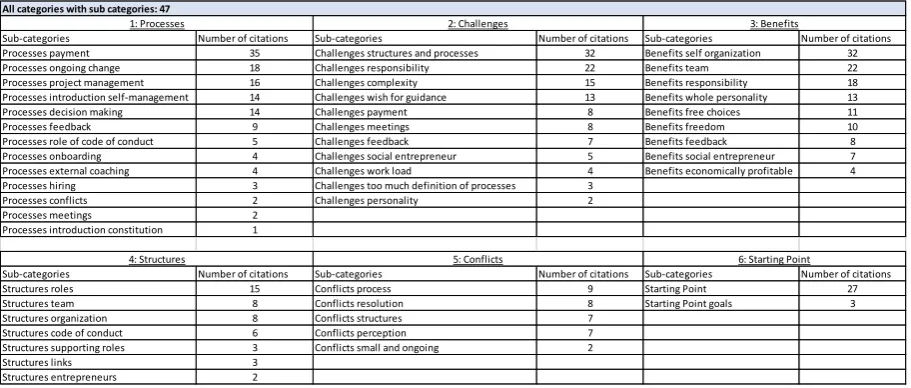
[image:34.595.85.541.463.657.2]In the coding process, 47 sub-categories emerged from the six initial categories (see Table 2).
Table 2. Derived coding categories
These sub-categories were then analysed based on the research questions. To answer the research questions the qualitative data was quantified (see Table 3). The number of citations in the subcategories was counted separately for both cases. The aim was to identify which topics were mentioned most often in the interviews. The top three topics are then presented and discussed in the results section. This is the suggested approach when the aim is to identify the frequency of events (Saunders et al., p.497).
Basic categories coding: 6 Starting Point Benefits Challenges Structures Processes Conflicts
Sub-categories Number of citations Sub-categories Number of citations Sub-categories Number of citations Processes payment 35 Challenges structures and processes 32 Benefits self organization 32
Processes ongoing change 18 Challenges responsibility 22 Benefits team 22
Processes project management 16 Challenges complexity 15 Benefits responsibility 18
Processes introduction self-management 14 Challenges wish for guidance 13 Benefits whole personality 13
Processes decision making 14 Challenges payment 8 Benefits free choices 11
Processes feedback 9 Challenges meetings 8 Benefits freedom 10
Processes role of code of conduct 5 Challenges feedback 7 Benefits feedback 8
Processes onboarding 4 Challenges social entrepreneur 5 Benefits social entrepreneur 7 Processes external coaching 4 Challenges work load 4 Benefits economically profitable 4 Processes hiring 3 Challenges too much definition of processes 3
Processes conflicts 2 Challenges personality 2
Processes meetings 2
Processes introduction constitution 1
Sub-categories Number of citations Sub-categories Number of citations Sub-categories Number of citations
Structures roles 15 Conflicts process 9 Starting Point 27
Structures team 8 Conflicts resolution 8 Starting Point goals 3
Structures organization 8 Conflicts structures 7
Structures code of conduct 6 Conflicts perception 7
Structures supporting roles 3 Conflicts small and ongoing 2
Structures links 3
Structures entrepreneurs 2 All categories with sub categories: 47
1: Processes 2: Challenges 3: Benefits
28
Table 3. Key topics introduction of self-management
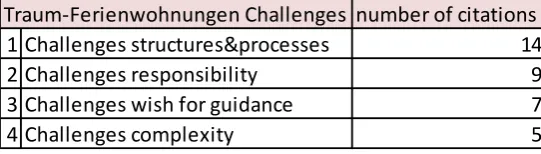
[image:35.595.178.450.310.388.2]To answer the research questions on benefits and challenges of the change to self-management, the citations in the sub-categories Benefits and Challenges were counted separately for each case (see Tables 4-7). The number of citations indicated which four topics were the most relevant, and those of the four main categories were chosen since the number of mentions declined with the subsequent sub-categories of the list.
[image:35.595.179.446.424.503.2]Table 4. Betterplace lab main benefits of changing to self-management
Table 5. Betterplace lab main challenges of changing to self-management
Table 6. Traum-Ferienwohnungen main benefits of changing to self-management
Table 7. Traum-Ferienwohnungen main challenges of changing to self-management
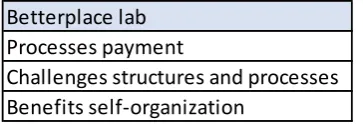
Betterplace lab number of citations Traum-Ferienwohnungen number of citations 1 Processes payment 19 Benefits self-organization 17 2 Challenges structures and processes 19 Processes payment 16 3 Benefits self-organization 14 Challenges structures and processes 13
number of citations
1 Benefits self organization 14
2 Benefits freedom/ free choices 14
3 Benefits team 12
4 Benefits responsibility 6
Betterplace lab Benefits
number of citations 1 Challenges structures&processes 18
2 Challenges responsibility 13
3 Challenges complexity 10
4 Challenges meetings 8
Betterplace lab Challenges
number of citations
1 Benefits self organization 17
2 Benefits responsibility 12
3 Benefits team 10
4 Benefits whole personality 8
Traum-Ferienwohnungen Benefits
number of citations 1 Challenges structures&processes 14
2 Challenges responsibility 9
3 Challenges wish for guidance 7
4 Challenges complexity 5
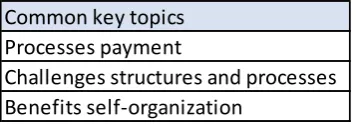
[image:35.595.170.451.537.614.2] [image:35.595.175.446.652.729.2]29 Finally, the two cases were compared in a cross-case analysis to answer the research questions 4., 5. and 6.. For this the data of the betterplace lab provided information on the change to a self-management approach at the team level and the data of the portal traumferienwohnungen.de on the change to self-management at the level of a whole organization. The cross-case analysis was based on the comparison of the findings in the analysis of the sub-categories of the research objectives one and two (see Table 8-10).
Table 8. Common key topics of introducing self-management (1)
Table 9. Common and differing main benefits of introducing self-management (1)
Table 10. Common and differing main challenges of introducing self-management (1)
3.4
Reliability and validity
Concerning the reliability of research Robson has identified four threats (2002). The first one is the subject or participant error. This pertains to the timing chosen to conduct the interviews, as participants can be in different moods to answer questions depending on when the interview takes place. This aspect was controlled by the fact that all interviewees were free to choose a time for the interview that fit into their schedule.
The second threat is subject or participant bias. This refers to the possibility that respondents answer according to their employers or bosses’ preferences. According to Robson (2002), it can occur especially
in organizations characterized by an authoritarian management style or by low job security. This threat Common key topics
Processes payment
Challenges structures and processes Benefits self-organization
Benefits
Similar sub-categories Organization Differing sub-categories Benefits self-organization Betterplace lab Benefits freedom/ free choices Benefits responsibility Traum-Ferienwohnungen Benefits whole personality Benefits team
Challenges
Similar sub-categories Organization Differing sub-categories Challenges structures&processes Betterplace lab Challenges meetings