0
Media, mind & moves
Name: Jorn van der Zaag
Student Number: S1617877
Date: 07-10-2017
Submi tte d i n parti al ful filment of the re qui re ments for the de gre e of Maste r of Sci e nce , program Publ i c Admi nistration, Uni versity of Twe nte
Supervisors:
Dr. A.J.J. Meershoek
&
1
Abstract
Recently, the cities of Manchester, London, Paris, and Brussels sadly became locations where terrorism has claimed lives. These cities are just a few examples of cities wherein terrorist attacks have happened recently. A common denominator of the terrorist attacks in these cities is that they are described in a very detailed way in media announcements about terrorism. As a result, a possibility arises that these media announcements about terrorism could influence citizens’ perception and experience of safety.
As a result, this thesis examined the relationship between media announcements about terrorism and the possible effects it could have on the safety experience and/or perception of citizens in Enschede. Therefore, this thesis examined 1). what factors promote and inhibit the effect of media announcements about terrorism on safety experience and perception of people according to the scientific literature and 2). to what extent were the small sample of citizens in Enschede exposed to inhibiting and promoting factors. Furthermore, 3). it examined if media announcements about terrorism influence the safety perception and experience of people in Enschede and, finally 4). which media announcements about terrorism have given residents of Enschede anxious feelings of insecurity.
The indicators used to measure whether or not media announcements about terrorism affect the safety experience and/or perception of citizens in Enschede were divided in three different concepts, namely effect promoting & inhibiting factors, safety experience, and safety perception. The first concept was measured by the indicators frequency receiving news, used media source, dependency media sources, and location. Indicators used specifically to measure safety experience were emotion felt after receiving news about terrorism, current safety experience, and change of curre nt safety experience. Safety perception was measured by the indicator perception change. These indicators were measured by executing in-depth interviews with random citizens of Enschede.
The analysis of the data shows that scholars who have done research about the relationship do not agree with each other. For each of the indicators chosen to measure promoting or inhibiting effects, confirming results were given according to scientific literature. According to the interviews, the small sample receives news about terrorism frequently and is also up-to-date on recent terrorist attacks by receiving information through media announcements. Social media & internet is the media source most used by the small sample. Furthermore, for almost half of the sample, the dependency to receive news about terrorism after receiving media announcements about terrorism increased. Western Europe is the most mentioned location of terrorism in news about terrorism according to the sample.
In addition, the sample grades their safety experience as either neutral, safe, or very safe. Only two participants state that their current safety experience is changed much due to news about terrorism. However, this has not resulted in an unsafe or very unsafe safety experience. Even though th e safety experience is rated as neutral, safe, or very safe, the safety perception of almost half of the sample is changed. As a result, all possible forms of change in safety perception were mentioned by the sample.
2
Preface
In front of you the thesis ‘Media, mind, and moves’ is presented. This is the final product for the Master Public Administration with the speciality Public Safety at the University of Twente. In other words, the final product before ending an interesting journey as a student. After finishing my Bachelor thesis of the Safety and Security Management Studies at Saxion University of Applied Sciences, I decided that the Bachelor thesis would not be my final product of my student career. As a result, I made the d ecision to expand my knowledge by doing a Master as well.
During the time period, I was thinking about a subject for my Master thesis, several terrorist attacks were committed in different cities around the world. Some of these terrorist attacks were described very extensively in different media announcements through various media sources. I noticed that I started to get interested in examining whether or not these different media announcements about terrorism spread among citizens through various media sources could affect citizens’ safety experience and perception. Therefore, I decided that this would be an interesting subject for my Master thesis.
In order to do my thesis, I received advice from several persons. Therefore, I would, firstly, like to thank my first supervisor Dr. G. Meershoek for his time, guidance, patience, and for sharing his support and knowledge to help me throughout the thesis. Secondly, I would like to thank my second supervisor Dr. R. Ossewaarde for his clear-headed thinking whenever asked for help during the thesis period.
Finally, but most importantly, I would like to thank my family and friends who have supported, aided, and encouraged me during the thesis period. I would like to express my deep gratitude towards my family and friends because they know, just as I do, that without their support, this thesis would not have happened.
3
List of Abbreviations
Abbreviations Official designations
BSO Black September Organization
C-CAT Canadian Coalition Against Terror
CBS The Statistics Netherlands
CRGs Community Response Grids
FBI Federal Bureau of Investigation
IGS Institute for Innovation and Governance Studies INTERPOL International Criminal Police Organization
MLOs Multicultural Liaison Officers
NATO North Atlantic Treaty Organization
4
Contents
Abstract... 1
Preface ... 2
List of Abbreviations... 3
1. Introduction ... 7
1.1 Situation and complication ... 7
1.2 Research goal ... 9
1.3 Academic relevance ... 9
1.4 Practical relevance ... 10
1.5 Central research question and sub-questions ... 11
1.6 Background of the research problem ... 11
1.6.1 History, causes, and evolution of terrorism ... 11
1.6.2 Modern terrorism... 13
1.6.3 Evolution media ... 13
1.6.4 Link media terrorism Olympic games ... 14
1.7 Outline and approach... 16
2. Theoretical framework ... 17
2.1 Media sources citizens ... 17
2.2 Media dependency for information... 20
2.3 Relationship media announcements terrorism and safety experience ... 22
2.4 Relationship media announcements terrorism and safety perception ... 25
2.5 Figure theoretical framework ... 30
2.6 Conclusion theoretical framework ... 31
3. Methodology ... 32
3.1 Thesis case ... 32
3.1.1 Case study... 32
3.2 Data collection & purpose sub-questions ... 33
3.2.1 Literature research ... 33
3.2.2 Interviews ... 33
3.2.3 Case selection Enschede ... 34
3.2.4 Unit of analysis, domain, and settings ... 35
3.2.5 Sample citizens Enschede... 35
5
3.3.1 Conceptualization ... 36
3.3.2 Operationalization & indicators ... 36
3.3.3 Validity ... 38
3.3.4 Reliability ... 39
3.3.5 Limitations interviews ... 39
4. Results ... 40
4.1 Promoting and inhibiting effects of media announcements about terrorism on safety experience and perception of people according to scientific literature ... 40
4.1.1 Frequency receiving news... 40
4.1.2 Used media source... 43
4.1.3 Dependency media sources ... 48
4.1.4 Location ... 49
4.2 To what extent were these people exposed to inhibiting and promoting factors? ... 50
4.2.1 Frequency receiving news... 50
4.2.2 Used media source... 52
4.2.3 Dependency media sources ... 56
4.2.4 Location ... 57
4.3 Do media announcements about terrorism influence the safety perception and experience of people in Enschede? ... 58
4.3.1 Safety experience... 59
4.3.2 Safety perception ... 61
4.4 Which media announcements about terrorism have given residents of Enschede anxious feelings of insecurity? ... 63
5. Conclusion... 66
Conclusion of sub-question 1 ... 66
Conclusion of sub-question 2 ... 66
Conclusion of sub-question 3 ... 67
Conclusion of sub-question 4 ... 68
Conclusion of central research question ... 68
6. Hypotheses ... 70
Hypothesis 1 ... 70
Hypothesis 2 ... 71
Hypothesis 3 ... 72
6
Discussion ... 73
Recommendations future research... 73
References... 75
Appendix ... 85
7
1.
Introduction
On Saturday the 10th of December 2016, two bombs went off close by the Besiktas Vodafone Arena in Istanbul, Turkey (Damon, Blau, & Ellis, 2016). As a result of the bombings, 155 people got injured and 38 people were killed of which mostly police officers. The two bombings were claimed by a Kurdish militant group that is known as the Kurdish Freedom Hawks. As a reaction, Turkish President Recep Tayyip Erdogan stated that terrorist attacks like these are not accepted in Turkey and that the Turkish government will take action against those who commit terrorist attacks.
However, the terrorist attacks in Turkey aren’t the first terrorist attacks that have happened recently. For instance, in the past 15 years, several cities in the world sadly became the victim of terrorist attacks as well. Another recent example of one of these horrifying events is the terrorist attack in the Bataclan concert hall in November 2015 when three heavily armed terrorists killed 90 citizens in Paris (BBC, 2015). In addition, another recent example of a terrorist attack is the shooting in a nightclub in Orlando when a terrorist killed at least 50 citizens in June 2016 (BBC, 2016). Terrorist attacks like the events in Paris (NRC, 2015) and Orlando (Ellian, 2016) are just a few examples of recent events that have shaken up emotions of citizens around the world.
Terrorist attacks like those mentioned above, are published in the media all over the world. When citizens receive news of these terrorist attacks, there is a possibility that this news can influence citizens’ perception and experience of safety feelings. As a result of the impact of media announcements about terrorism, it also becomes possible that citizens change their behavior after receiving news about terrorist attacks. A clear example of the influence of media on behavioral changes in citizens occurre d, for example, in Enschede. Where, in February 2016, a citizen threw a Molotov cocktail at a mosque hoping to prevent the arrival of more refugees (Bos, 2016). Afterwards the citizen explained his actions by arguing that he heard about the series of rape done by refugees in Cologne and feared that this could happen in Enschede as well.
1.1 Situation and complication
As mentioned in the introduction, a common denominator of recent terrorist attacks is that they are highlighted in international and national media in a comprehensive detailed way. Due to this
comprehensive description in the media, a possibility arises that news announcements about terrorism could influence citizens’ perception and experience of safety in an individual and general way. A current example of this change in perception and experience of safety is seen in a recent poll from the
Washington Post. According to the poll of the Washington Post (2015), a majority of Americans, who voted on the poll, are more fearful of terrorist attacks in America after receiving news of the events in Paris. This increase in anxiety about safety among citizens does not only occur in America. Recent research from a Dutch poll revealed that more than half of the 20.000 questioned members of an opinion survey felt less secure about their safety after receiving the news about the terrorist attacks in Paris (Rademaker, 2015).
8 counterterrorism measure. A Google executive has announced that the search engine will show anti -radicalization links when would-be jihadists type in words related to extremism (Burr, 2016).
Even though the media can be used against terrorism, the media could also play a negative role. According to the research of Krueger and Malečková (2003), terrorism can be defined as premeditated, politically motivated violence perpetrated against noncombatant targets by subnational groups or clandestine agents, usually intended to influence an audience. They state in their research that it is mostly not the intention of terrorists to cause direct harm to victims but rather to cause fear and terror among a target audience. This development is agreed upon by Frey, Luechinger, and Stutzer (2007) by stating that terrorist attacks must instigate a revolution and aim at winning the hearts of the people. In order to realize this, terrorists most likely avoid killing or maiming innocent people not directly
connected with the existing political and economic regime. However, in their research it is also argued that the lethality of terrorist attacks has been attributed to an increasing amount of fund amentalist terrorist groups as well. This is done due to the fact that terrorists want to realize mass casualties of innocent people as a result of their attacks in order to make their cause known to a bigger public. That the role of the media can play a negative role regarding terrorism is also shown in the research of Jetter (2014). According to his results, terrorists seek to find media coverage of terrorism in order to generate mass hysteria, fear, and to get public attention in order to promote their agenda. As an illustration, their results suggest that terrorist organizations should use suicide attacks as their main form of terrorism due to the fact that this form of terrorism increases the attention it receives in the media.
9
1.2 Research goal
As is seen in the examples given above, media announcements about terrorism could have effect on citizens’ safety experience and safety perception. Therefore, the aim of this thesis is to examine whether or not media announcements about terrorism change the safety experience and perception of a sample of citizens in Enschede. By doing this, it might become possible to explain certain relational effects. By conducting this thesis, it might become possible, for example, to explain what made the citizen in Enschede decided to throw a Molotov cocktail at a mosque after receiving news about the series of rape done by refugees in Cologne (Bos, 2016). In other words, this thesis might find a relationship between the kind of media source the citizen used to receive news and the particular effects of this media source that made him decide that his safety experience and perception had changed and, therefore, decided to throw the Molotov cocktail at the mosque.
At the end of this thesis, it might be that the results will reveal why more than half of the 20.000 questioned members of an opinion survey of recent research from a Dutch poll felt less secure about their safety after receiving the news about the terrorist attacks in Paris (Rademaker, 2015).
1.3 Academic relevance
Before explaining why this thesis has academic relevance, it is, firstly, necessary to give a few short arguments to explain the importance of research. Firstly, research is the scholarly pursuit of new knowledge, discovery, or creative activity in an area with the goal of advancing that area's frontiers or boundaries (Toledo university, 2017). Secondly, the results of research can be used to put into practice to improve outcomes (Kolt, 2009).
Scholars have already done research on the relationship between media announcements about terrorism and changes in safety experience and perception. For example, as Jetter (2004) states in his research that an examination on the relationship of media announcements about terrorism and its effects on the safety experience and perception can aid in understanding which forms of terrorism get the most prominent attention in the media, it can aid in analyzing the goals of terrorist groups through the description in the media, and it can help in discovering habits of terrorist groups in order to fight against terrorism. In addition, Jetter (2004) states that research about the relationship of media announcements about terrorism and the safety experience and perception might also specify why certain acts of terror actually have a changing effect on safety perception and experience of citizens. Several arguments can be given why this thesis has academic relevance. As has been read above, scholars have done research between the relationship of media announcements about terrorism and possible changes in safety experience and perception. However, research previously conducted mostly aims at showing that media announcements about terrorism could lead to a change in safety experience and perception. However, this thesis tries to reveal what particular effects of these media
10 Furthermore, this thesis can be seen as relevant due to the fact that this thesis can be compared with both previous and future conducted research. The comparison may be of great importance to actually learn or discover new developments and patterns in the safety experience and perception changes of citizens in Enschede due to media announcements of terrorism.
1.4 Practical relevance
Except for academic relevance, this thesis could be of practical use as well. In 2008, the Dutch Ministry of Security and Justice developed a research analysis called the Veiligheidsmonitor (Veiligheidsmonitor, 2016). This analysis is an annual screening for safety, quality of life, and victimization which monitors the subjective and objective safety of Dutch citizens (Veiligheidsmonitor, 2016). The main goal of the
Veiligheidsmonitor is to inform the government about public perception in order to make the Netherlands a safer and better place to live (Veiligheidsmonitor, 2016). The last analysis of the Veiligheidsmonitor has indicated that the perceived safety of citizens in Enschede has developed in a negative way.
Due to the fact that the Veiligheidsmonitor is an analysis at the national level, the municipality of Enschede decided to develop their own Veiligheidsmonitor, which is called the integrated safety and security policy document. The main goal of this policy document is to inform the government about public perception on safety issues for a pleasant living, working, and recreational environment in Enschede (IVP, 2013). According to this policy document, citizens’ perception and experience of safety is an element that decides whether or not Enschede is a pleasant city to live, work, and recreate in. As mentioned in other sections of this thesis, several research results might indicate that there is indeed a relationship between media announcements about terrorism and changes in the safety perception and experience of citizens. Therefore, the research results of this thesis can be put into practice by, for example, the police or municipality of Enschede in order to anti cipate on the changes in safety perception and experience of citizens in Enschede that come forth due to media announcements of terrorism.
Finally, another practical use of this thesis is that producers of media announcements could also use the research results. If the results indicate that gruesome images of brutalized bodies and sensationalized news about terrorism has a negative effect of safety experience and perception of citizens, producers of media announcements could help in reducing mass hysteria and fear amongst the general public by using only objectivity and responsibility in announcing media announcements about terrorism (Kapadia, 2016).
11
1.5 Central research question and sub-questions
As is explained in the research goal section as well, the aim of this thesis is to examine whether or not media announcements about terrorism changes the perception and experience of safety of citizens in Enschede. Therefore, the following central research question is developed. By answering this central research question, it becomes possible to reveal what kind of particular eff ects of media announcements about terrorism actually change safety experience and perception of citizens. This answer is important due to the fact that it might reveal guidelines in providing and receiving media announcements about terrorism to citizens that might possibly change their safety experience and perception.
Central research question
• In which ways is the perception and experience of safety of citizens in Enschede influenced by media announcements about terrorism?
Due to the formulation of the central research question, it is necessary to do further research about the individual elements of the central research question before answering the question. For example, in order to understand why citizens in Enschede have, possibly, increased feelings of anxiety after receiving media announcements about terrorism, it needs to be known which media announcements actually have ensured these increased feelings of anxiety. Therefore, the following sub questions have been formulated.
Sub questions
1 • What factors promote and inhibit the effect of media announcements about terrorism on safety experience and perception of people according to the scientific literature?
2 • To what extent were these people exposed to inhibiting and promoting factors? 3 • Do media announcements about terrorism influence the safety perception and
experience of people in Enschede?
4 • Which media announcements about terrorism have given residents of Enschede anxious feelings of insecurity?
1.6 Background of the research problem
In this chapter, information is displayed in order to gain a better understanding of this thesis and why the central research question, the sub-questions and the research goal are developed. It will provide underlying information on the history, causes, and evolution of terrorism, modern terrorism, the evolution of the media, and it will describe the first well-known link between media and terrorism. In other words, this chapter will provide background information on the development of the relationship of media announcements about terrorism and changes in safety experience and perception of people.
1.6.1 History, causes, and evolution of terrorism
Before going into further detail on the relationship of the media and the safety perception and
12 Rapoport (2004) explains the history of terrorism as a wave concept. According to his description, a wave of terrorism is a cycle of activity in a given time period with each its own characteristics (Rapoport, 2004). Firstly, terrorism became known in the anarchist wave. In this first wave, terrorism was
characterized by the many domestic assassinations of political figures in order to affect public attitudes. In this wave, terrorism was seen as a strategy and not as a means. The second wave is known as the anticolonial wave and is characterized by the creation of multiple organizations that called themselves freedom fighters in order to establish new states such as Ireland, Cyprus, and Algeria. The third wave of terrorism is now known as the new left wave. This wave is characterized as a time period wherein the Soviet Union provided material support to would-be terrorist organizations. Terrorist groups, such as the German Red Army Faction, Italian Red Brigades, and the Sandinistas emerged in order to stand as vanguards for the Third World masses. The final wave is known as the religious wave and characterizes itself by acts of terrorism deriving from religious thoughts in order to establish that religion in certain areas.
As mentioned above by Rapoport (2004), different sorts of terrorism have come in waves over the years. In addition of the waves, Lutz (2005) explains that acts of terrorism over time each have their own different causes as well. One of the causes of terrorism is, as an illustration, the absence of a strong state structure of governments in transition. According to Lutz (2005), the presence of a weak state structure or the transition from one government form to another is not specifically a cause for terrorism but it can contribute and facilitate terrorism. This is due to the fact that, for example, government forms in transition are weakened and vulnerable and may find trouble in controlling their own territory. Due to the fact that control mechanisms are weakened at that moment as well, a result could be that other, political, groups take advantage of this transition by grabbing the opportunity to express their wishes and needs through violence. Crenshaw (1981) confirms this in her research by stating that terrorism is an attractive strategy for small organizations of diverse ideological persuasions who want to attract
attention for their cause, provoke the government, intimidate opponents, appeal for sympathy, impress an audience, or promote the adherence of the faithful if states have weak control mechanisms or lack the responsiveness to demands.
A second cause for terrorism given by Lutz (2005), is the collapsing of empires or multiethnic states. Terrorism can arise due to the invariability of boundary disputes and problems resulting from the admixtures of populations. Where a single state splits up in multiple states, groups can see this as an opportunity to grasp power and implement their own ideology. This argument is mentioned by
Crenshaw in her research as well. According to her, there is indeed a possibility that long-standing social traditions that are sanctioned as terrorism against the state in the previously singular state, as for example in Ireland, can further enhance its attractiveness for terrorist organizations to initiate operations (Crenshaw, 1981). Huntington (1997) agrees with Crenshaw and Lutz by also stating that civilizational clash could result in violence. The exhibiting of groups with different identities could lead to more conflict either between different groups within a country or between different country groups organized along civilizational lines. This is due to the fact that it’s easier for terrorist groups to gather support against other identity groups with other ideologies.
Finally, Lutz (2005) explains that globalization and modernization is another cause for terrorism. New ideas, institutions, products, and forms of organizations that can come forth from globalization and modernization can encroach on local societies and, as a result, undermine existing political institutions and lead to political decay and weakness. This is also stated in the research of Krieger and Meierrieks (2011). According to their research it is easier for terrorists to find support by building on related
13 perceived as unfair to them. Obviously, the examples mentioned above are not the only causes for terrorism. As Azar (2003) mentions in his research other causes for terrorism are, for example, ideological, religious, nationalist, poverty, and oppression. However, what is possible to say about terrorism and its causes, is the fact that terrorism is a concept that constantly evolves and adapts o ver the years with new forms, causes, and goals.
1.6.2 Modern terrorism
The evolution of terrorism over the years has resulted in what is now known as modern terrorism. Currently, the Dutch National Coordinator for Security and Counterterrorism of the Ministry of Security and Justice defines terrorism in the following way: ‘’Terrorism is defined as threatening, making
preparations for or perpetrating, for ideological reasons, acts of serious violence directed at people or other acts intended to cause property damage that could spark social disruption, for the purpose of bringing about social change, creating a climate of fear among the general public, or influencing political decision-making (National Coordinator for Security and Counterterrorism, 2016)’’. The American Federal Bureau of Investigation defines terrorism as well. However, they divide terrorism in international and domestic terrorism. The FBI describes terrorism as international terrorism if it fits the following three characteristics:
• Involve violent acts or acts dangerous to human life that violate federal or state law;
• Appear to be intended to intimidate or coerce a civilian population; to influence the policy of a government by intimidation or coercion; or to affect the conduct of a government by mass destruction, assassination, or kidnapping; and
• Occur primarily outside the territorial jurisdiction of the U.S., or transcend national boundaries in terms of the means by which they are accomplished, the persons they appear intended to intimidate or coerce, or the locale in which their perpetrators operate or seek asylum. In addition, they describe terrorism as domestic if acts fit the following three characteristics:
• Involve acts dangerous to human life that violate federal or state law;
• Appear intended to intimidate or coerce a civilian population; to influence the policy of a government by intimidation or coercion; or to affect the conduct of a government by mass destruction, assassination. or kidnapping; and
• Occur primarily within the territorial jurisdiction of the U.S (FBI, 2016).
As is seen above, terrorism is a political concept that has been given different definitions by different parties and, therefore, many authors will agree that a single definition of terrorism cannot be given. This is due to the fact that terrorism is a concept constantly evolving, as is seen in the paragraph above. Furthermore, terrorism is interpreted differently by different parties which is in line with their character and tradition. For example, during World War II, French resistance fighters were seen as heroes of liberation by the French while the Germans saw these resistance fighters as terrorist (Sorel, 2003). In other words, it could almost be said that terrorism is all a matte r of perspective.
1.6.3 Evolution media
Wimmer and Dominick (2013) state that mass media is any communication channel used to
simultaneously reach a large number of people, including radio, TV, newspapers, magazines, billboards, films, recordings, books, the Internet, and smart media. However, before continuing with the
14 According to Lee (n.d), books are the oldest form of media with the first known book written in Egypt around 1400 B.C. In 1456, a media instrument called the printing press was introduced which became a very important invention due to the fact that it had a remarkable impact on the daily lives of people. The printing press was capable of the mass production of books and, as a result, books in different languages circulated throughout Europe reaching all kinds of people. It even resulted in the prohibition of printing books due to the fact that the circulation of books and the information within it could threaten the power of the state and church.
Before people started to use social media to get updated on daily news around the world, a mass media instrument that was used, and still is, were newspapers. The first known history of this mass media instrument begins in 100 B.C. when the first news-sheets appeared. Newspapers were the first form of mass media that actually reached a large amount of people of all sorts (Lee, n.d). One of the first European newspapers that appeared on a regular base was the ‘’Nieuwe Tidingen’’ in Antwerp around 1605, which mostly had information about war and business. In addition, newspapers can actually be seen as the first media instrument that made it possible for all layers of society to receive information. However, the evolution of mass media did not stop with the printing press and, as a result, new mass media instruments were developed in order to reach people. Another instrument that reached out to a large audience was the radio. The radio became dominant during and after World War II due to the fact that it could provide information about the war much quicker than newspapers. During this time period, people wanted and demanded a form of mass media that could quickly announce up -to-date news about their relatives and friends fighting in the war (Obillo, 2013). The next step in the evolution of the media is the television. According to Obilli (2013), this form of mass media became dominant due to the fact that it combined pictures with sound. In addition, due to technological innovations as the satellite, it even became possible to transmit major world events in real-time. According to Stephens (2000), due to technological innovations, this even resulted in the fact that 98 percent of U.S. homes had at least one television set in the late 1990s.
Finally, the latest step in the evolution of mass media is the birth of the internet in the end of the twentieth century and all its expansions, which made it possible for people all around the world to receive news from all corners of the world within seconds (Obillo, 2013). Furthermore, with this form of mass media innovation it also became possible for people to get connected with each other and respond to one another in a direct way.
1.6.4 Link media terrorism Olympic games
15 Another historic example wherein the relationship of the media and terrorism is displayed, is shown in the terrorist organization Hizballah (Osipova, 2011). When Hizballah was established, they had two main objectives. Their first objective was forming an Islamic government in Lebanon. Their second objective was to maintain a continued resistance against unwanted foreign invaders, such as Israel. Therefore, Hizballah also launched its first newspaper known as al Ahed in order to spread its goals. In this newspaper, Hizballah submitted reports on the group’s activities and editorials. Furthermore, al Ahed had parts that were devoted to education, political theory, and served as a public platform for many of its leaders. However due to media innovations, Hizballah did not only use newspapers for their case, they started to use the television as well. In 1991, Hizballah launched a television channel called al Manar wherein they illustrated the operations Hizballah would undertake in order to gain progress for their case (Osipova, 2011).
Both examples above show how terrorist organizations use the media as an advantage. However, countries or organizations can also use the media against terrorist organizations. To illustrate this, the terrorist attacks on the World Trade Centers, on September 11, 2001, will be used as an example. According to the Advocacy Coalition Framework, the role of the media can briefly be identified as both a conduit, defined as a resource for members to influence policy outcome and as a contributor, defined as a member of competing advocacy coalitions (Sabatier and Jenkins-Smith, 1993, as cited by Shanahan, McBeth, Hathaway & Arnell, 2008). As a result of the terrorist attacks, the U.S. government’s handling of terrorism changed (Powell, 2011). For example, the Bush administration reacted to these events by framing the occurrence of these events as a ‘’War on Terror’’. Before explaining how the Bush
administration framed the ‘’War on Terror’’, it is, firstly, necessary to explain what is meant by frames. According to Rein and Schon (1993), frames are the integration of facts, values, theories, and interests, which, in other words, can be explained as the formation in which certain subjects are presented. As a reaction to the attacks, the Bush administration made use of packaging. Rein and Schon (1993) explain packaging as referring to particular types of framing, namely, the process by which a central organizing idea, or frame, is embodied in a policy position that is then expressed through such
condensing symbols as metaphors or slogans. The Bush administration made use of packaging by using the frame they created in order to launch a national security policy to combat the terrorist acts which received gigantic attention in the media. Due to this anti-terror campaign in the media, set up by the Bush administration, it gained the power to sign the Authorization for Use of Military Force into law (Daskal & Vladeck, 2014). This law authorized the Bush administration to use all necessary and
appropriate force against those nations, organizations, or persons he determines planned, authorized, committed, or aided the terrorist attacks that occurred on September 11, 2001, or harbored such
organizations or persons in order to prevent any future acts of international terrorism against the United States by such nations, organizations or persons. Furthermore, the media campaign made sure that the Bush administration gained the publics’ support, Congress overwhelmingly supported Bush, the
16
1.7 Outline and approach
In this chapter, the outline and approach of this thesis in described. In chapter 1, the introduction and situation and complication chapters describe some events that provide more insight on recent terrorist attacks and its effect on citizens. Furthermore, chapter 1 describes the research goal of this thesis and why this research goal has an academic and practical relevance. It furthermore describes the formulated central research questions and the sub-questions that will be answered. Finally, the background of the research problem can be found in chapter 1 wherein readers of this thesis can get more familiarized with the subject.
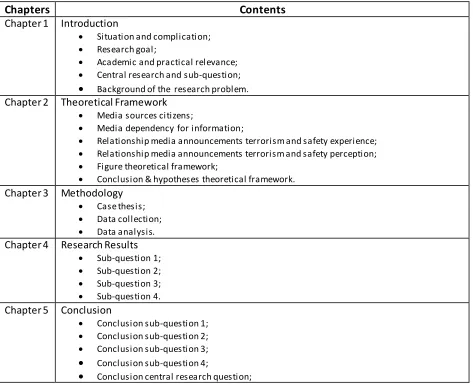
The theoretical framework is found in chapter 2 wherein theories of different scholars on the subject of the relationship of media announcements about terrorism and its effect on the safety experience and perception of citizens is shown. Chapter 3 will describe the methodology of this thesis. In this chapter, the chosen method of study is explained and argued. The research results of the thesis will be displayed in chapter 4. The sub-questions will be answered in chapter 4. The answers in chapter 4 will provide the basis for writing the conclusion which can be found in chapter 5. The discussion that follows as a result of this thesis can be found in chapter 6. Finally, chapter 7 provides the references used in this thesis and other appendices used. In addition, in the table below is a structured reading guide for the outline of the thesis provided.
Chapters
Contents
Chapter 1 Introduction
• Situation and complication;
• Research goal;
• Academic and practical relevance;
• Central research and sub-question; • Background of the research problem.
Chapter 2 Theoretical Framework • Media sources citizens;
• Media dependency for information;
• Relationship media announcements terrorism and safety experience;
• Relationship media announcements terrorism and safety perception;
• Figure theoretical framework;
• Conclusion & hypotheses theoretical framework.
Chapter 3 Methodology • Case thesis;
• Data collection;
• Data analysis.
Chapter 4 Research Results • Sub-question 1;
• Sub-question 2;
• Sub-question 3;
• Sub-question 4.
Chapter 5 Conclusion
• Conclusion sub-question 1;
• Conclusion sub-question 2;
• Conclusion sub-question 3; • Conclusion sub-question 4;
[image:17.612.72.545.329.714.2]17
• Hypothesis 1; • Hypothesis 2; • Hypothesis 3.
Chapter 6 Discussion
• Discussion;
• Recommendations for future research.
Chapter 7 References & appendices
2.
Theoretical framework
This thesis aims to examine if there is a relationship between media announcements about terrorism and the effects it has on the safety experience and perception of citizens. Therefore, this chapter provides an underlying theoretical framework wherein different theories and discussions from different scholars are given in order to aid in answering the central research question.
The first paragraph of this theoretical framework will merely provide research results of Mitchell, Gottfried, Barthel, and Shearer (2016), in order to gain insight about the kind of media sources citizens use and how these media sources differ among varying age groups in modern days. In the following paragraph, information will be provided wherein is shown why citizens depend on inf ormation from media sources in case of terrorism. The third paragraph will discuss different theories from different scholars on the effects of media announcements about terrorism on the safety experience of citizens. In the fourth paragraph of this theoretical framework, the safety perception of citizens after receiving media announcements about terrorism will be discussed.
In the last part of chapter 2, a figure is displayed that is designed in order to show the relational effects of media announcements about terrorism and the safety experience and perception of citizens. Finally, this chapter will end with a short conclusion of the theoretical framework with the constructed
hypotheses. As a result of the noticed discussions among scholars, multiple hypotheses are formulated as a result of contradicting arguments of the scholars and will be included in this thesis.
2.1 Media sources citizens
As is mentioned previously in this thesis, the goal of this research is to examine which particular effects of media announcements have a changing effect on citizens’ safety experience and perception. Before going into any further detail of the changing effects of media announcements about terrorism on the safety experience and perception of citizens, it is firstly necessary to understand what kind of media sources citizens nowadays actually use to receive their news.
[image:18.612.71.541.70.170.2]18
Figure 1. About four-in-ten Americans often get news online. Reprinted from Pewresearch website, by Mitchell, A., Gottfried, J., Barthel, M., & Shearer, E., 2016, retrieved from http://www.journalism.org/2016/07/07/pathways -to-news/ Copyright 2017 by Pew Research Center.
As is seen in figure 1 as well, the dominant media source for receiving news is the television. However, it can also be noticed that the television is mostly dominant for the age group 50-64 and higher. The age groups 18-29 and 30-49 also have a high percentage of receiving their news through online media sources, which indicates that the younger age groups make more use of online media sources to receive news. In addition, other results of Mitchell, Gottfried, Barthel, and Shearer (2016) reveal some more remarkable information about media sources used by people.
[image:19.612.207.396.232.301.2]
Figure 2. News watchers overwhelmingly prefer television, while readers prefer the web. Reprinted from Pewresearch website, by Mitchell, A., Gottfried, J., Barthel, M., & Shearer, E., 2016, retrieved from
[image:19.612.78.532.530.620.2]19 As is seen in figure 2, people use different instruments to receive their news. This can be either watching, reading, or listening to news. The instrument to receive news also has effect on the media source used for receiving news. As is shown in figure 2, those who prefer to listen when receiving news use the radio as their media source. However, what can be said to be remarkable is the fact that those who like to read the news make, nowadays, more use of online media sources than printed sources in order to receive their news.
[image:20.612.161.453.480.565.2]In the information above is shown that people use different media sources to receive news. However, the media sources above do not mention news spread through human interaction as a media source. In their research, Mitchell, Gottfried, Barthel, and Shearer (2016) have also examined human interaction as a media source to spread news. For instance, their results indicate that about two-thirds (63%) of the Americans say family and friends are an important way they get news, whether online or offline and at least 10% see them as the most important source of receiving news. Figure 3 will display the importance of human interaction.
Figure 3. Online news consumers more likely to get news from professional outlets than from friends, family – but just as likely to think each provides relevant news . Reprinted from Pewresearch website, by Mitchell, A., Gottfried, J., Barthel, M., & Shearer, E., 2016, retrieved from http://www.journalism.org/2016/07/07/pathways -to-news/
Copyright 2017 by Pew Research Center.
20 However, the figure also shows that 15% of those who get online news from close personal contacts say those updates are very near to their interests, compared with 11% who get news from news
organizations and 4% of those who get news from more distant contacts.
2.2 Media dependency for information
As described in the paragraph above, citizens rely on different media sources to receive news, wh erein is also seen that different media sources vary between different age groups. The next step in this thesis is to give some more insight why citizens depend on information from varying media sources. In the background of the research problem paragraph is referred to Wimmer and Dominick (2013) their
definition of mass media. They define mass media as any communication channel used to simultaneously reach a large number of people, including radio, TV, newspapers, magazines, billboards, films,
recordings, books, the Internet, and smart media.
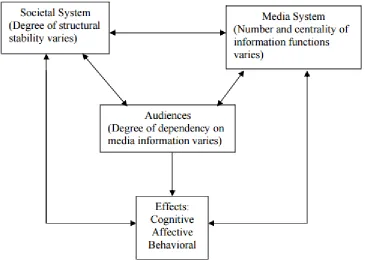
Several arguments serve as an explanation by scholars to explain the dependency of media announcements citizens for information about terrorism of citizens. A leading theory about media dependency for information is created by Ball-Rokeach and DeFleur (1976) wherein they state that the relationship between the media and, for example, the perception or experience of safety can, firstly, be explained by the dependency theory. This theory states there is an integral relationship among
[image:21.612.103.468.391.651.2]audiences, media and the larger social system. Their research results indicate that citizens depend on media information to meet certain needs and achieve certain goals. According to them, the dependency of citizens on the media for information is a cause that could change a certain experience or perception. Figure 4 is a visualization of their theory.
21 The dependency of information from media sources about terrorism is also seen in other research. For instance, another argument wherein is shown that citizens depend on media for information about terrorism is given in the research results of Loges (1994). According to these research results, citizens rely on information after a threat. Furthermore, the results indicate that a threat is positively related to the use of media, which means that higher perception or experience of a threat in the environment of citizens will intensify media usage among citizens. In other words, this theory states that citizens are more likely to use media sources if a situation of terrorism occurs.
As is mentioned above, several scholars state that citizens depend on media sources for information about terrorism. However, on the one hand, Heath and Gilbert (1996) state in their research that media effects are not simple main effects but, rather, involve many moderators. In other words, their theory states that the characteristics of the media announcements and the characteristics of the audience receiving the message decides the relationship between media announcements and safety experience and perception among citizens. Therefore, it must be considered that these different characteristics of the media announcements and the characteristics of the audience shape the dependency for
information about terrorism.
This can best be explained by the research results of Anderson and Caumont (2014). As an illustration, their results indicate that half of social network site users share news stories, images or videos, and nearly as many (46%) discuss a news issue or event with each other. In addition to sharing news on social media, a small number of people also covers news themselves, by posting photos or videos of news events. However, it must be noted that this sharing of news through social media can both be received negatively and positively by audiences. That the sharing of news through social media could have a negative impact on the receiving audience is seen in, for example, the riots in Ferguson wherein the use of social media played an important role in spreading news among citizens whose, as a response, reactions were based on news received through social media.
The importance of internet and news spread through human interaction is an important feature and this is also seen in research results of Rainie (2001). Even though Americans relied mostly on television for their news and the phone primarily for their communication needs in the days following the terror attacks on the World Trade Center in New York City and the Pentagon, the research results indicate something more. The results also indicate that those Americans who used the internet as their main media source used this mostly as a useful supplemental role in the form of a communication tool towards others and as a news source.
22
2.3 Relationship media announcements terrorism and safety experience
In the paragraphs above is insight provided wherein can be seen that citizens use different media sources and is described that citizens rely on information from media sources in case of terrorist attacks. This paragraph will firstly discuss the concept of safety experience. Secondly, it will discuss the effect of terrorism on safety experience. Finally, it will discuss what specific features about media announcements about terrorism do change the safety experience of citizens.
In order to discuss this aspect of the thesis, it is firstly necessary to explain that this thesis assumes a distinction between safety experience and safety perception. As might be expected, safety experience is a rather broad concept with no singular definition. For example, Heber (2008) states that feelings of safety, is normally viewed as a lack of worry, risk, and fear. In addition, Pleysier (2011) states that safety experience is a part of the subjective safety definition. Pleysier (2011), defines subjective safety as the personal experience of safety, unsafety feelings, or fear of crime. Due to the fact that safety experience is a broad concept with not a singular definition, there is a clear need for a certain view of safety experience is this thesis. Therefore, safety experience in this thesis will only be viewed as the manner how citizens experience safety feelings. Multiple example and arguments by different scholars will show that media announcements about terrorism could have effect on the safety experience of citizens. That terrorism actually affects the safety experience of citizens in seen in research of Balnaves and Aly (2007). Their research indicates that terrorist attacks could change the safety experience of citizens in a negative way. Their results confirm a dramatic change in the feelings of safety before and after the September 11 terrorist attacks. For instance, 710 respondents (over 90%) reported feeling either very safe or fairly safe before the terrorist attacks. In contrast, only 487 (65%) stated that they felt either very safe or fairly safe after the terrorist attacks. Furthermore, their research showed a negligib le response to feeling 'very unsafe' prior to the terrorist attacks (11 responses) increasing to 92 (8.1 %) after the attacks. The relationship of media announcements about terrorism and safety experience is seen in the research results of Chiricos, Padgett, and Gertz (2000). Their results indicate that the consumption of news on both a local and national level is significantly related to fear of crime, independent of the influence of other predictors, and that this is one of the main aspects which influence the relationship between media announcements and safety experience. Furthermore, it must be noted that they do state that the effect of local news consumption on fear of crime has a greater influence than the effects of national news. According to their results this is the case due to the fact that local news is closer to the everyday lives of viewers, and, therefore, will have a bigger impact on their lives (Chiricos, Padgett, & Gertz, 2000). In addition, the research results of Romer, Jamieson, and Aday (2003) indicate the dependency for information of media sources about terrorism and safety experience as well. For example, their research shows that viewers of local television news experience increased perceptions of crime risk on both a personal and societal level. Finally, their results support the fact that an increasing crime coverage on national television news also increased the general fear of crime of the public.
On the other hand, research conducted by Rubin, Haridakis, Hullman, Sun, Chikombero, and
Pornsakulvanich (2003) shows other results. In their research, Rubin et al. (2003) examined cultivation effects of television exposure on fear of terrorism and whether individual -level differences (i.e., locus of control, victimization experience, and gender) could explain the relationship between media
23 are more fearful and feel less safe from terrorist activity. Finally, they noticed that crime victims are more fearful of terrorism.
[image:24.612.128.485.219.502.2]Following the research of Rubin et al. (2003), Nellis and Savage (2012) also conducted research about the relationship of media announcements about terrorism and citizens’ safety experience. However, in contrast to the research mentioned above, the results of Nellis and Savage (2012) notice that paying greater attention to the news does not appear to affect terrorism fears. This is also seen in research conducted by Ragsdale (2003). This research also indicates that heavy viewers of television actually are no more likely to believe they will become victims of terrorism than light or medium viewers, which can also be seen figure 5.
Figure 5. Personally likely to become victim of terrorism by level of television consumption of terrorist crisis. Reprinted from University of Florida website, by A. M. Ragsdale, 2003, retrieved from
http://etd.fcla.edu/UF/UFE0000888/ragsdale_a.pdf Copyright 2003 by Andrew Mark Ragsdale.
Another theory wherein an aspect is shown that can explain the relationship between media
announcements and the safety experience of citizens comes from Heath and Petraitis (1987). In thei r study, it is stated that news about specific crimes increases fear among citizens in high -crime
24 However, on the other hand, the research results of Huddy, Feldman, Lahav, and Taber (2003) indicate that this does not always have to be the case. For example, they mention in their research that a CBS anchor opened a program by stating that the bombings in Oklahoma City in 1995 showed how vulnerable Americans are for domestic terrorism (Huddy, Feldman, Lahav & Tabed, 2003). They suspected that the news announcements about the Oklahoma City bombing would alle gedly heighten the public’s awareness and insecurity about domestic terrorism. Even though they expected a
heightened awareness and anxiety, their research results showed something else. For example, their results indicate that the bombings did not substantially nor lastingly increased the public’s reckoning when it came to personal vulnerability. Furthermore, the results even show that a majority (57 percent) of respondents to a Gallup poll (1995b), immediately after the bombings, said that they were “not too worried” or “not worried at all” that they themselves or a relative “will become a victim of a terrorist attack similar to the bombing in Oklahoma City.” The scholars also tried to discover why this was the case and when they asked the respondents why they were not worried, 45 percent cited low probability and, whether fatalistically or realistically, 46 percent mentioned that there was nothing one could do to prevent it.
In addition, the way the media announces the news also affects the experience of safety among citizens. Heath (1984), for instance, states that news of sensational crimes affe cts the way citizens experience safety. For example, the results indicated that nonlocal sensational crimes reassure readers of that news due to the fact that it can be used by the reader to offset the scaring effects on their own local crimes. In addition, Sandman, Miller, Johnson, and Weinstein (1993), also state that it is necessary to keep in mind that the manner of providing news is a cause for change in safe ty experience. According to their results, outrage, which they define as a function of whether people feel the authorities can be trusted, is a cause for change in safety experience and perception as well. As an illustration, they tested through the manipulation of media announcement whether or not the delivering party of media announcements affected the safety experience and perception of citizens. Their results indicate that when an agency was depicted as untrustworthy and secretive and the community was depicted as outraged, subjects rated risk as much more serious and their responses to the risk as much more frightened and less safe. In addition, if the agency and community were to be depicted as mutually respectful and cooperative, on the other hand, subjects saw the risk as much less serious, and described their own reactions as concerned rather than frightened or unsafe. In other words, the delivering party of media announcements about terrorism could also be cause for change in safety experience of ci tizens.
As previously stated, media announcements about terrorism and terrorist attacks do infl uence the public experience of safety in all sorts of manners. Another example of this change in safety experience is given in the research results of Fairbrother, Stuber, Galea, Fleischman, and Pfefferbaum (2003). According to their research results, posttraumatic stress reactions among children after the September 11 terrorist attacks could be explained by television exposure. Their results indicated that 18% of the children in New York City experienced severe or very severe posttraumatic stress reactions after September 11 due to the fact that they saw images of an airplane hitting the World Trade Center building, the collapsing of the towers, and people falling or jumping out of the building. This is also seen in other conducted research. As an illustration, Boscarino, Adams, Figley, Galea, and Foa (2006) show in their research results that Hispanics, those with less education, those with current posttraumatic stress disorder (PTSD), and those with a history of stressor exposures, felt that they may be at higher risk during a future attack following the September 11 terrorist attacks.
25 results indicated that crime-related media consumption among men and women will have greater impact on women’s fear of crime than men. Furthermore, their results also indicate that the
consumption of crime-related news was higher among Caucasian women than women of color and that this consumption of news also has a bigger impact on Caucasian women’s fear of becoming victim of a crime than women of color.
2.4 Relationship media announcements terrorism and safety perception
As mentioned in the previous paragraph, this thesis views safety experience and safety perception as two different concepts. In this thesis, safety perception will be viewed on the basis of the definition of the Dutch Centre for Crime Prevention and Safety (2016). They define safety perception as the way people perceive safety. The Dutch Health & Youth Department (2016) adds to this description of perceived safety, that perceived safety can best be explained as the experience of safety feelings in certain areas. Furthermore, the concept of perceived safety is a subjective one, meaning that perceived safety is a catchall phrase. However, in this thesis, safety perception will be viewed as a following result of safety experience. In other words, safety experience is the feeling of people whereby safety
perception is seen as a result that follows from the safety experience of people. This paragraph will provide several examples and arguments used by scholars to show whether or not safety perception of citizens could change through media announcements about terrorism. It will also discuss whether or not these changes in safety perception will results in positive or negative perception.
In order to illustrate that the safety perception of citizens could change due to terrorism, several examples from scholars will be given to gain insight. Firstly, an example wherein is seen that terrorism could change safety perception of citizens either positively or negatively can be explained by the Terrorism Risk Insurance Act passed by the U.S. Congress. This Act established a national terrorism insurance program that provides up to $100 billion commercial coverage with a specific but temporary risk-sharing arrangement between the federal government and insurers after the terrorist attack on September 11, 2001 (Kunreuther & Michel-Kerjan, 2004). As a result of this passed Act, insurers were obligated to make an insurance policy against terrorism available to all their clients. The Terrorism Risk Insurance Act is not the only Act which makes it possible for citizens to be insured against terrorism. For example, Israel has a terrorism insurance programme as well. Due to their compensation fund, according to the Israeli Property Tax Act, compensation is to be partially paid by the State of Israel and partially by the insurance industry. The idea of compensation paid from tax law embodies the idea of insurance with the state providing compensation for damages caused by war and hostile acts (which includes terrorism). In other words, one of the positive effects for individual citizens is that all direct damage that has
occurred within Israel due to hostilities or war will be compensated by the compensation fund (Property Tax Law Applicability Territorial Compensation Fund), according to the conditions stated in the
regulations. This means that, for example, household properties, such as electrical goods, that have endured direct damages will be valued based upon market value (OECD, 2017).
self-26 protection decisions may lead to externalities that extend beyond the insurance market and affect public goods. For instance, the cancellation of a building project in a high-profile downtown area might hurt national prestige or morale by appearing to capitulate to terrorists. These e xternal effects of self-protection are largely absent with, for example, natural catastrophe risks. Therefore, even though terrorism insurance has its positive effects like the Israeli terrorism insurance programme which takes care of damage due to terrorism, being insured against terrorism could also have negative effects for the safety perception citizens.
Another example wherein is noticed that safety perception could change either positively or negatively as a result from terrorism is shown in the research of Huddy, Feldman, Capelos, and Provost (2002). In their research, the scholars conducted a survey of 1,221 residents of Long Island and Queens, New York, wherein they explored the degree to which personal and national threats affect perceptions of the consequences of, and possible solutions to, terrorism. Their results showed, for example, some of the negative effects of terrorism. As an illustration, 55% of the respondents said that they were handling mail at home more carefully as a consequence of the news about anthrax contamination. In addition, 26% mentioned that they had delayed or cancelled plans to travel by air, 7% stated that they had changed upcoming vacation travel plans, 18.4% declared that they were driving into Manhattan less often, 13% reported taking mass transportation into Manhattan less often, and 31% told that they had changed their daily routine to spend more time with their children or family since 9/11. The impact of the terrorist attacks (including the anthrax-contaminated mail) on people’s lives is also evident from the 52% of respondents who said that, in the week before the interview, they had found it somewhat or very difficult to concentrate on their job or normal activities.
However, on the other hand, Vázquez, Pérez-Sales, and Hervás (2008) state that there could be some positive effects of terrorism for individuals’ safety perception as well. In their book, they mention that the research results of Peterson and Seligman (2003) indicate that terrorism can have positive eff ects for individuals’ safety perception in terms of communicative behaviour. Peterson and Seligman (2003) researched if Americans changed following the September 11 terrorist attacks. According to their results, in the immediate aftermath of September 11, citizens started to behave differently by turning to others, which in turn changed their social environment so that the relevant behaviours were rewarded and thus maintained. Communicative forms of behaviour of individuals, such as kindness, gratitude, love, and teamwork, were perceived as positively and, as a result, increased following the terrorist attacks (Peterson & Seligman, 2003). In addition to the research of Peterson and Seligmon (2003), the research results of Vásquez, Hervás, and Pérez-Sales (2006), also indicate that the events of terrorism could have positive effects on citizens’ safety perception. In their research, they examined the positive
consequences after the March 11 attacks in Madrid. According to their results, an area of frequent growth was feeling closer to others (80% of the total sample), a higher social cohesion (79% of the total sample), and feeling personally prepared for similar future situations (31% of the total sample). In conclusion, even though terrorism can have catastrophic consequences, it can have positive effects for the safety perception of citizens as well.
27 that a majority of Americans citizens, (59%), engaged in positive participated civil action such as
contribution to charities, blood donations, and performing volunteer work. In addition, Penner (2004) also shows that a change in safety perception can occur as a response to terrorism. His research indicates that, for example, the number of visits to the website www.volunteermatch.com, which is a website wherein citizens can register themselves for volunteer work, tripled as a result of the September 11 terrorist attacks.
Other examples wherein can be seen that certain activities, as a response to terrorism, could influence safety perception positively is seen in research of Dikici (2008). In this research was revealed that several community policing programs implemented between 2002 and 2006 to fight terrorism had positive consequences. For example, the results indicate that 12 out of 50 parents with whom police experts intensively made contact persuaded their sons/daughters, who were among the active armed mi litants, to surrender. Research of Akbulut and Beren (2012) also indicated that community policing as a measure of counterterrorism can have positive results for safety perception of citizens. For instance, their results showed that community policing projects raise the sensitivity of people who have attended any kind of activity. As a result, people started to take precautions not to fall victim to terror.
Other initiatives as a reaction to terrorism are, for instance, the Canadian Coalition Against Terror. This organization is a non-partisan policy, research and advocacy body committed to seeking innovative legal and public policy strategies in the fight against terrorism. C-CAT is comprised of Canadian terror victims, counterterrorism professionals, lawyers and other individuals dedicated to bui lding bridges between the private and public sectors in the battle against terrorism and to assisting terror victims in rebuilding their lives as a response to terrorism (C-CAT, 2010). Another example of a locally initiated organization as a response to terrorism is the launching of the Citizens Corps in January 2002 by the President of the United states of America. The Citizen Corps was created to help coordinate volunteer activities that will make our communities safer, stronger, and better prepared to re spond to any emergency situation. In addition, it can help in providing opportunities for people to participate in a range of measures to make their families, their homes, and their communities safer from the threats of crime, terrorism, and disasters of all kinds (Citizens Corps, 2002).
However, it is also necessary to illustrate that citizens’ safety perception could change due to media announcements about terrorism as well. This change in safety perception is shown in, for example, t he research from Seabra, Abrantes, and Kastenholz (2014). According to their findings, the amount of attention given to terrorism in the media increases tourists’ risk perception in international travel. The consequence of this is that tourist seek more information about the ir trip and are more concerned for their safety before they travel. In addition to this theory, the research results of Sönmez and Graefe (1998) mention the same kind of change in perception among citizens who are planning to travel. The respondents in their research most often associated health, financial, political instability, equipment, and terrorism risks with international travel. According to their research results, their respondents expressed concern regarding terrorism or political turmoil. As an illustration, 88% of the research respondents agreed that "politically unstable countries should be avoided by tourists". This implies that respondents' propensity for international tourism may be somewhat constrained by concerns about terrorism or political instability. In addition, 57% of the respondents agreed that "the possibility of terrorism discourages" them from international tourism.