MASTER THESIS
PROJECT PORTFOLIO MANAGEMENT
USING CAPABILITY- BASED PLANNING
Yuchen Wang
S1518240
Master of Science in Business Information Technology University of Twente
Enschede, The Netherland
Graduation committee:
Dr. Maria-Eugenia Iacob, University of Twente Dr. Ir. Marten. van Sinderen
Acknowledgement
This report is the result of my final project in Business & IT MSc program at the University of Twente. I conducted this research as a graduate internship at BiZZdesign B.V. After an intensive period, today is the day to write this note of thanks as the finishing touch on my thesis. It has had a big impact on me to write this thesis. Now, I would like to reflect on the people who have supported and helped me throughout this period. Without them, this accomplishment would not be possible. Firstly, I would like to give my deepest gratitude to my supervisors from the University of Twente: Ms. Maria Iacob and Mr. Marten van Sinderen for their valuable guidance, pointing me to the right direction so that I can complete my thesis. I also want to sincerely thank Mr. Dick Quartel for all of the opportunities I was given to conduct my research, and for the freedom of choosing my research topic that provided an intense learning for me both in the scientific area and on a personal level. Besides, a special note of thanks is extended to Ms. Adina Aldea for her insightful comments on the thesis.
Secondly, I would like to thank my friend Tania. We were not only able to support each other by deliberating over our problems and achievements, but also by talking about things other than just papers.
Finally, I want to dedicate this thesis to my dearest parents and my boyfriend, Yi, for their constant encouragement when I encountered difficulties.
Summary
In today’s dynamic environment, organizations have to modify their strategy and deal with the ongoing project portfolios in a fast pace.
By using the technique of Capability-based planning, organizations could figure out the capabilities with strategic importance and constitute the focal points of strategy transformation; identify the gap by assessing the current and target states of the capabilities; implement the strategy by closing the gap with corresponding working packages.
Then, in order to ensure the strategy alignment of the project portfolios in a strategy shift, a complete method is designed based on the CBP with a start from the business strategy shift. The method goes through the determination of strategy capabilities shift and affected ongoing projects, and concludes by supporting the project selections and prioritizing.
I
Contents
Contents ... I
List of Tables ... IV List of Figures ... VI
Chapter1: Introduction ... 1
1.1 Problem Statements ... 1
1.2 Research Objective... 2
1.3 Research Question ... 3
1.3.1 Main Research Question ... 3
1.3.2 Sub Research Question: ... 4
1.4 Research Scope ... 4
1.5 Research Method ... 4
1.5.1 Design Science Research Methodology ... 4
1.5.2 Literature Review ... 5
1.6 Research Structure ... 6
Chapter2: Literature Review ... 7
2.1 Searching Strategy ... 7
2.1.1 Searching Database ... 7
2.1.2 Inclusion and Exclusion Criteria ... 7
2.1.3 Data Collection and Analysis ... 8
2.1.4 Deviations ... 8
2.2 Portfolio Management ... 9
2.2.1 Searching Process ... 9
2.2.2 Portfolio Management Definition ... 11
2.2.3 Project interdependencies ... 13
2.2.4 PPM method ... 15
2.2.4.1 Core Process Model in Portfolio Management (Padovani & Carvalho, 2016) ... 15
2.2.4.2 Project Portfolio selection process (Tavana, et al., 2015) ... 18
2.3 CBP ... 20
2.3.1 Searching Process ... 20
2.3.2 Definitions ... 21
2.3.3 CBP methodology with TOGAF and ArchiMate ... 22
2.3.4 Relationships Between Capabilities ... 26
2.4 The IT4IT RA ... 28
2.4.1 IT4IT RA Overview ... 28
2.5 The relationship between PM and CBP ... 30
3.1 Overview ... 32
3.2 Phase A: Knowledge Mapping Phase ... 34
3.2.1 A1. Model the capability map and the strategy ... 35
3.2.2 A2. Model the ongoing projects ... 40
3.2.3 Recommendations ... 42
3.3 Phase B. Project Assessing ... 42
3.3.1 B1. Assess the ongoing projects ... 43
3.3.2 B2. Model possible solutions ... 45
3.3.3 B3. Assess project strategy priority ... 48
3.3.4 Recommendations ... 53
3.4 Phase C. Portfolio Arranging ... 54
3.4.1 C1. Build strategy implementation blueprint ... 54
3.4.2 C2. Model the project dependencies ... 55
3.4.3 Recommendations ... 56
Chapter4: Case Study ... 57
4.1 Introduction... 57
4.1.1 Strategy Shift ... 57
4.1.2 Ongoing Projects ... 58
4.2 Phase A: Knowledge Mapping ... 60
4.2.1 Modelling capability map and strategies ... 60
4.2.2 Map ongoing project. ... 66
4.3 Phase B: Portfolio Assessing ... 68
4.3.1 Assess and adjust projects ... 68
4.3.2 Propose projects to the capability that has no ongoing project related 72 4.3.3 Projects Strategy Priority Score ... 75
4.4 Phase C: Portfolio Arranging ... 76
4.4.1 Strategy implementation blueprint ... 76
4.4.2 Project Dependencies ... 77
Chapter5: Evaluation ... 79
5.1 Survey ... 79
5.2 Discussion of the result ... 81
5.2.1 Background information ... 81
5.2.2 Acceptance of the method ... 82
Chapter6: Discussion and Conclusion ... 85
6.1 Answers to Research Questions ... 85
6.2 Contribution ... 86
6.3 Research Limitation ... 87
6.3.1 Limitations of literature review ... 87
6.3.3 Limitations according to the evaluation ... 88
6.4 Recommendation for Future Work ... 88
References ... 90
Appendixes ... 95
A. Alignment among constructs, indicators and its references of portfolio management ... 95
B. Capability performance assessment framework (Cheng, 2015) ... 98
C. Survey for the workshop ... 99
List of Tables
Table 1 Literature contributions in portfolio management ... 10
Table 2 Definitions about portfolio management ... 12
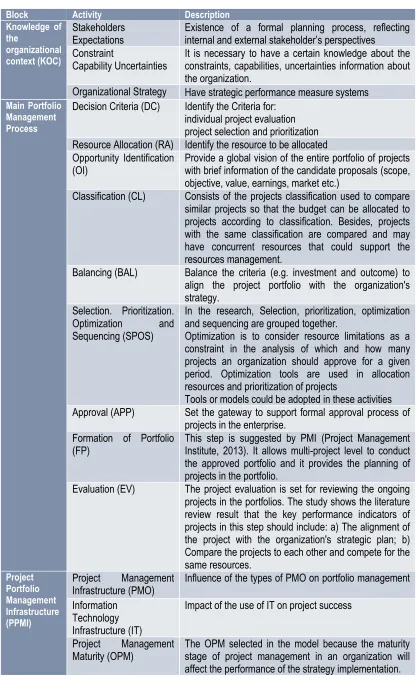
Table 3 Activities in PPM construct model ... 17
Table 4 Definitions about Capability ... 21
Table 5 Relationship types between capabilities ... 26
Table 6 Example of project portfolio backlog ... 30
Table 7 General view of knowledge mapping phase ... 34
Table 8 Overview of step A1 ... 35
Table 9 Example of capability serving relationship matrix ... 37
Table 10 Example of performance level of strategic capability ... 39
Table 11 Overview of step A2 ... 40
Table 12 Example of project dependency matrix ... 41
Table 13 Example of ongoing project card ... 42
Table 14 General view of project assessing phase... 43
Table 15 Overview of step B1 ... 43
Table 16 Example of anticipated performance level ... 44
Table 17 Overview of step B2 ... 46
Table 18 Example of project dependency card ... 48
Table 19 Overview of step B3 ... 48
Table 20 Example of Strategy-Subgoal matrix ... 49
Table 21 Example of Goal-Capability matrix ... 50
Table 22 Example of identifying capability priority... 50
Table 23 Example of project contribution ... 51
Table 24 Example of identifying project priority ... 52
Table 25 General view of portfolio arranging phase ... 54
Table 26 Overview of step C1 ... 54
Table 27 Overview of step C2 ... 55
Table 28 Example of blueprint card ... 56
Table 29 Capability service relationship matrix ... 61
Table 30 Goal -subgoal matrix ... 62
Table 31 Sub-goal capability matrix ... 63
Table 32 Target performance level of the strategic capabilities ... 64
Table 33 Ongoing projects dependencies matrix ... 68
Table 34 Anticipate project contribution of billing process management ... 69
Table 35 Anticipate project contribution of Regulatory analysis ... 71
Table 36 Project dependency card of Application Rationalization ... 71
Table 37 Gap analysis of capabilities without related ongoing projects ... 72
Table 38 Overview of proposed project Revision of PPM process ... 73
Table 40 Overview of proposed project product rationalization ... 74
Table 41 Overview of proposed project installment of APM process ... 74
Table 42 Overview of proposed project revision of billing process version A ... 75
Table 43 Overview of proposed project revision of billing process version B ... 75
Table 44 Project strategy priority ... 75
List of Figures
Figure 1 DSRM process model (Peffers, et al., 2008) ... 5
Figure 2 SLR process model (Sepúlveda, et al., 2016) ... 6
Figure 3 Searching process of portfolio management ... 10
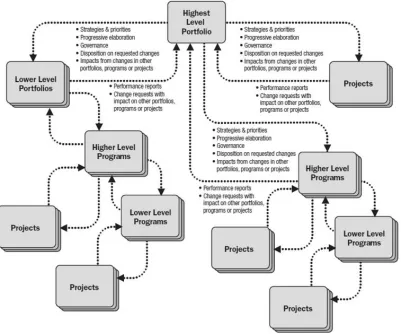
Figure 4 Portfolio, program and project management interactions (PMI, 2013) ... 14
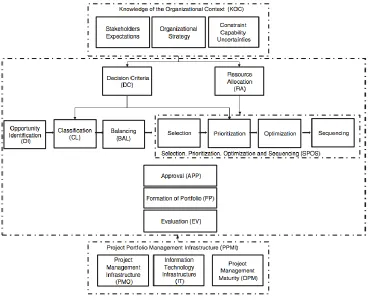
Figure 5 PPM construct model ... 15
Figure 6 Project selection process model (Tavana, et al., 2015) ... 18
Figure 7 Searching process of CBP ... 20
Figure 8 The capability-based planning method (Papazoglou, 2014) ... 23
Figure 9 Motivation extension meta model (Aldea, et al., 2015). ... 24
Figure 10 Capability increment ... 24
Figure 11 Relationships between “Strategy Elements”, “Motivation” and “Core Elements” ... 25
Figure 12 Specialization of “Internal Behavior Elements”... 25
Figure 13 Strategy mapping of “Centralize IS” (Aldea, et al., 2015). ... 26
Figure 14 Overview of relationships in ArchiMate 3.0 ... 27
Figure 15 IT4IT RA level 1 framework version 2.0 ... 28
Figure 16 Process of project portfolio backlog management ... 29
Figure 17 Relationship between capabilities, EA, and projects... 30
Figure 18 Conceptual model of the method ... 32
Figure 19 Capability-based project portfolio management ... 33
Figure 20 Process of Build/Update Capability Map ... 36
Figure 21 Example of capability map ... 36
Figure 22 Process of mapping the strategies to capabilities ... 37
Figure 23 Example of strategy mapping ... 38
Figure 24 Process of identifying the current and target performance level of capabilities ... 38
Figure 25 Capability dimensions ... 39
Figure 26 Process of modeling ongoing project ... 40
Figure 27 Example of modeling ongoing project ... 41
Figure 28 Process to assess ongoing projects ... 44
Figure 29 Example of customer billing process related projects ... 45
Figure 30 Example of modeling proposed projects a ... 46
Figure 31 Example of modeling proposed projects b ... 47
Figure 32 Example of project strategy priority ... 53
Figure 33 Example of radar chart from a project perspective ... 54
Figure 34 Example of strategy implementation blueprint ... 55
Figure 35 Example of the projects dependencies ... 56
Figure 36 Previous Mission, vision, strategy of ArchiPharma ... 58
Figure 38 Realization relationship between plateaus and programs in ArchiPharma 58
Figure 39 Capability map of ArchiPharma ... 60
Figure 40 Strategy assessment of product leadership ... 62
Figure 41 Sales & marketing management ... 63
Figure 42 Identified strategic capabilities ... 64
Figure 43 Identify ongoing project objectives ... 66
Figure 44 Link projects to capabilities ... 67
Figure 45 Identified capabilities that relate to ongoing project ... 67
Figure 46 Ongoing project dependencies ... 68
Figure 47 Billing process management related ongoing project radar ... 69
Figure 48 Proposed projects of billing process management ... 70
Figure 49 Capability radar of regulatory analysis ... 71
Figure 50 Proposed solution of regulatory analysis ... 72
Figure 51 project strategy priority chart ... 76
Figure 52 Strategy implementation blueprint ... 77
Figure 53 Project dependencies ... 78
Figure 54 UTAUT Research model (Venkatesh, et al., 2003)... 79
Figure 55 Frequency of using CBP and PPM ... 81
1
Chapter1:
Introduction
In this chapter, there are six sections generated to provide the general concepts of the research:
1. Section 1.1 Problem Statements. It provides a concise description of the problems that should be addressed in this research.
2. Section 1.2 Research Objectives. It describes the expected achievement of this research.
3. Section 1.3 Research Question. It states the formulated research questions, according to the research objective. This research involves one main question and three sub questions.
4. Section 1.4 Research Scope. It defines the scope of this research, outlining the limitations of the research and explaining the exclusion of the research.
5. Section 1.5 Research Methods. It illustrates the research methodology applied to the research.
6. Section 1.6 Report Structure. It shows the general outlines of this thesis report.
1.1
Problem Statements
In early 2000s, people started to recognize the importance of applying portfolio management. As “the art and science of making decisions about investment mix and policy, matching investments to objectives, asset allocation for individuals and institutions, and balancing risk against performance” (Investopedia, 2003), portfolio
management provides a central oversight of budget management. And it supports the strategy alignment of the investments (Jeffery & Leliveld, 2004). What’s more, portfolio management can help organizations to make the decisions that will set them apart from competitors (Project Management Institude, 2012). Especially for the large-scaled organizations, dealing with numerous portfolios in different stages simultaneously is critical. Adopting a portfolio management approach could assist them deflect the issues like projects run without delivering because of focus lacking; or strategic targets could not be completely implemented by the deliveries because of alignment lacking.
2
customers’ changing habits. Then, they need to keep adjusting their ongoing projects to align with the latest strategy.
Without an appropriate approach, organizations have to face tremendous pressure of technology transformation in today's fast-paced business world.
However, currently the portfolio management literatures have made little mention of potential disturbances to the portfolios regarding to a strategic shift. Only the Project Management Institute’s standard described two types of portfolio changes. One type refers to periodical reviews of the portfolio performance “to ensure that the portfolio contains only components that support achievement of the strategic goals. To achieve this, components must be added, reprioritized, or excluded based on their performance and ongoing alignment with the defined strategy in order to ensure effective management of the portfolio” (Project Management Institute, 2008b, p. 77).
The other type relates to significant changes in the business environment leading to a new strategic direction: “as environments inside and outside the organization change, criteria for determining the composition and direction of the portfolio may also change. When the need for new criteria becomes evident, the portfolio management team needs to examine the current criteria in the strategic plan and move ahead with appropriate changes, usually focusing first on categorizing. If strategic change is not occurring, the efforts should focus on portfolio balancing” (Project Management
Institute, 2008b, p. 84). Nevertheless, it only mentioned why to change and what to change about the portfolios. There are still no appropriate solutions to identify the projects, which did not align with strategy or being disturbed due to the strategy shift. Then organizations need an approach to remove the strategic deflection in the portfolios by identifying, assessing, and adjusting the disturbed projects in the portfolios.
1.2
Research Objective
Organizations need support quick identification, assessment and adjustment of affected ongoing projects. Then, organizations could have a more effective portfolio management. Therefore, it is essential to identify if the deliverables of the ongoing project align with the strategy.
3
According to the method, strategy is mapped into a set of capabilities. Besides, they adopted approaches like capability heat map and capability maturity assessment to quantify the current and target capability performance.
Moreover, the Open Group currently released a new framework the IT4IT reference architecture (IT4IT RA) for supporting the business management of IT. The framework provides a blueprint that organization could design and organize transformations via value streams that support the continuous measurement of portfolio’s business value. It has a strong connection with the stakeholders (The Open Group, 2015).
Therefore, the main purpose of this paper is to investigate and develop a method that integrates the Capability-based Planning (CBP) into portfolio management: strategy alignment throughout the organization transformation. We use CBP in the new method because CBP has been adopted by organizations to support the strategy alignment (Azevedo, et al., 2015). With the capability standing in between, strategies could be turned into portfolios accurately.
What’s more, since the IT4IT is a standard architecture from the open group to enable the supporting functions like financial tracking of the projects and it is as a vender neutral model, which means that most of organizations could refer it without vendor limitations. We also plan a literature review of the IT4IT to identify if it could help to optimize the project portfolio management method.
There are limitations that may also undermine the objective of the proposed research. One limitation in the research is the vast variations between organizations in terms of size: The proposed method may not be a proper method to support medium- and small- sized organizations because of their simple organization structure. They could easily identify if the project aligns with the strategy. Besides, the details of how to propose or adjust project will be simplified in this research, as they are not the emphases.
1.3
Research Question
1.3.1 Main Research Question
According to the determined problem and its corresponding research goal, the main research question is defined as:
4
In order to provide a comprehensive solution, the main research question is separated into sub research questions, which are shown as the following section 1.3.2.
1.3.2 Sub Research Question:
The new method needs to adopt some mechanisms from CBP. Thus, it is necessary to have a better insight of the portfolio management and CBP separately. Then with the knowledge of these elements, the new model could be optimized with the useful mechanisms. In general, two sub questions are identified as:
RQ1: What is the relationship between portfolio management and CBP?
RQ2: How could CBP help to optimize portfolio management?
1.4
Research Scope
The new method proposed here could be applied in the process of portfolio management, analyzing the dependency relationships within the new strategies and the ongoing portfolios in order to support adjustment, integration to optimize the transformation process in a dynamic situation.
In order to support the portfolio integration and management process iteration, in this research, it is assumed that portfolio management might not only monitor changes, but might also manage and control changes and track the implement processes. It is therefore suggested that the existing processes be supplemented with additional empirical information.
1.5
Research Method
1.5.1 Design Science Research Methodology
For this research project, to design a successful method is crucial to arrange the design process within a scientific research. Therefore, this research mainly follows the Design Science Research Methodology (DSRM) guidelines (Peffers, et al., 2008) which is frequently cited for developing new methods. Design Science offers an effective means of addressing the relevancy gap that has plagued academic research, particularly in the management and information systems disciplines. The type of “wicked organizational problems” could be more effectively addressed using a type of paradigm shift offered by design science. (Hevner & Chatterjee, 2010)
5
Figure 1 DSRM process model (Peffers, et al., 2008)
In the DSRM Process Model, there are six key activities processed in this research. These key activities are:
Problem Identification and Motivation: In this phase, the research problems will be identified. Formulate the research questions of this thesis and relate them to the problem statement and the motivation of this research and problem identification is described in chapter 1.
Define the objectives for a solution: The next step is to define the objectives of the solution. It is based on the defined problem and the studies of previous literatures. It will be documented in chapter 2
Design and development: Depending on the literature review, the solution will be developed. The method for will be designed in chapter 3.
Demonstration: After the method has been designed and developed, the usability of it should be demonstrated by solving one or more problems. This could be done by the experimentation, simulation, cased study, or other appropriate activity. Case study will be carried and described in chapter 4.
Evaluation: To measure how well the method supports the solution of the defined problems. This step aims at comparing the objectives of the solution to the result from the use of the method, which will include the interview of the experts in this area. This part will be described in chapter 5.
Communication: The communication step would be done in the end after the thesis is published and the thesis defense would be finished.
Within the design process, there is also an iteration arranged from “Define the objectives” to “Communication” if necessary.
1.5.2 Literature Review
6
(Kitchenham, 2004; Kitchenham & Charters, 2007). Although both guidelines are applied in software engineering area, they have been still widely adopted in the various literature reviews because of their essentials, generic and valid principles. Consequently, the guidelines are adopted in this systematic review as well.
The processes of each phase are shown in Figure 2 that generated by Sepúlveda, Cravero & Cachero (2016) and adapted from Kitchenham and Charters (2007). From the figure, all the steps are managed into three phases: planning, conducting and reporting.
In the report, the literature review presented in Chapter2: with the searching process and searching result.
1.6
Research Structure
The main body of the research report consists of 6 chapters in order to illustrate the whole processes of defining the method. The identification of the research problem and the motivation behind are defined in Chapter 1 (Introduction). Then in Chapter 2, the summary of the literature review about the important concepts and techniques is given. Furthermore, in Chapter 3, the development of the new method is clarified with the explanation. Chapter 4 demonstrated the method with a case study. The evaluation of the method is presented in Chapter 5 using workshop and questionnaires. Finally, Chapter 6 comprises the research with the conclusion and results of the entire research questions.
7
Chapter2:
Literature Review
In this chapter, a systematic literature review is generated. The result can be used to support the design of the new method and it could also be adopted as a reference for the future corresponding research. The chapter is structured with five sections. Section 2.1 introduces the searching strategy of the review. Then the following section 2.2, 2.3 and 2.4 present the result and discussion of the review; and a brief conclusion of the whole literature review is structured in the last section, section 2.5, as the answer to RQ1.
2.1
Searching Strategy
2.1.1 Searching Database
All the selected literatures in this literature review are from the following 4 databases:
Scopus (https://www.scopus.com/)
UT Library (https://www.utwente.nl/ub/en/)
Google Scholar (https://scholar.google.nl/)
ScienceDirect (http://www.sciencedirect.com/)
The defined searching strings are firstly applied in the databases Scopus and ScienceDirect. Two more databases (UT Library and Google Scholar) are adopted to support 1) search the articles from the bibliographic references of the selected literature and 2) searching for extra articles since there is just a few articles determined in Scopus and ScienceDirect.
2.1.2 Inclusion and Exclusion Criteria
Defining criteria could assist to search and screen the candidate articles. The criteria are broadly grouped into two categories: inclusion criteria and exclusion criteria. The inclusion criteria are composed of:
Articles that published since Jan 1st, 2000;
Scientific Reports i.e. literature with clearly defined research questions, search process, data extraction and data presentation from academic publications;
Grey Literatures i.e. survey reports or white papers from top consultant companies or published books.
8
RA and CBP are new topics in the research. Secondly, although some published books and white papers from top consulting companies are not documented completely in a scientific way, they are still widely cited by scientific literature, which confirms their academic ability.
Exclusion Criteria:
Duplicate reports (the article exist in different journals with a complete version of the study has been included in the review).
Articles from a non-academic digital magazine, blogs or newspaper.
2.1.3 Data Collection and Analysis
Following data should be extracted from each included article:
The source (journal or conference) and full reference, which contributes to retrieve key literature.
Classification of the article Type (i.e. SLR, Meta-Analysis MA, book), which supports the quality assessment of the literature review.
Main topic area, which provides needed information for answering research questions.
The author(s), their institution and the country where it is situated, which also supports the quality assessment of the literature review.
Summary of the study.
From the extracted data, the analysis is arranged according to the research questions and research process. Besides, for addressing quality assessment, the affiliations of the authors and their institutions need to be reviewed and justify whether the selected study help to answer the research questions.
2.1.4 Deviations
Deviations in the search strategy are necessary in order to make the systematic literature review feasible. Either a great or an insufficient number of findings might make completion of the study impossible.
9
recorded in the selected databases, an extra step to screen the references of the key literature.
The searching process performed for each string could be concluded as:
Step 1. Initial searching. The defined searching string is firstly applied in the databases Scopus and ScienceDirect, meeting the inclusion criteria.
Step 1.2. Extra searching (Optional). Search the defined string in the databases Google Scholar and UT Library if the individual search returns less than 50 results.
Step 2. Articles Screen:
Step 2.1(Optional). The result articles are firstly excluded with extra constrains if the individual search returns more than 500 results.
Step 2.2. The filtered articles are excluded by scanning the title and the abstract.
Step 2.3. The filtered articles are excluded by viewing the whole context.
Step 3. 2nd round searching:
Step 3.1. Review the bibliographies of the selected articles
Step 3.2. Search the articles in Google Scholar and UT Library by their titles and authors.
2.2
Portfolio Management
2.2.1 Searching Process
The searching string is defined as “portfolio management” and initial searching results of ScienceDirect and Scopus are:
1438 results found for pub-date > 1999 and ("portfolio management"). 6235 results for KEY (portfolio management) AND DOCTYPE ( ar )
Then, the extra constrains are applied that limited key words should be contained in the title and abstract. Thus, the new searching query as applied in ScienceDirect.com and Scopus in April, 2016 is:
450 results found for pub-date > 1999 and TITLE (portfolio management) or KEYWORDS (portfolio management).
10
The whole searching process of this section is illustrated as Figure 3 below with the action and the result of the filtered articles.
[image:20.595.102.487.117.581.2]After the screening process, there are 18 articles selected as the key literatures on portfolio management in this study. The Table 1 lists the selected articles and shows if it could provide the information about definitions and models.
Table 1 Literature contributions in portfolio management
# Literature Definition Model
1 (Tavana, Keramatpour, Santos-Arteaga, & Ghorbaniane, 2015) √
2 (Investopedia, 2003) √
3 (Jeffery & Leliveld, 2004) √ √ Articles excluded by the abstract (n = 31)
Articles excluded after full text scanning
(n = 9)
Articles excluded by constrains (n = 6783) Total articles
retrieved by the search strategy (n = 7673)
Articles retrieved with extra constrains
(n = 548)
Articles selected after title reading (n = 51)
Articles selected after abstract reading
(n = 20)
Articles excluded by title (also duplication) (n = 497)
Articles retrieved on the bibliographic references if the selected articles (n = 7)
Articles selected as key literatures (n = 18)
Articles selected after full text scanning
(n = 11)
11
4 (Padovani & Carvalho, 2016) √ √
5 (Pajaresa & Lópeza, 2014) √ √
6 (Project Management Institute, 2013) √
7 (Petit, 2012) √
8 (Martinsuo, 2013) √
9 (Killen & Kjaer, 2012) √ √
10 (Heising, 2012) √ √
11 (Melton, 2011) √
12 (Young & Conboy, 2013) √
13 (Amaral & Araújo, 2009 ) √ √
14 (Bitman, 2005) √
15 (Archer & Ghasemzadeh, 1999) √
16 (Bodenstaff, Quartel, & Lankhorst, 2014) √ √
17 (Bodenstaff & Quartel, 2014) √ √
18 (Patanakul P. , 2015) √
In the following sections, the literature review result of portfolio management is expounded with details from three perspectives. Firstly, a comparison of the relevant term definitions is presented in section 2.2.2. Then, in section 2.2.3, we illustrate the importance of project dependency relationship. At last, the process of portfolio management is exemplified with three proposed models selected from these key literatures, which is in section 2.3.4.
2.2.2 Portfolio Management Definition
According the definition from the book Real Project Planning (Melton, 2011) the terms project, portfolio and program are used to describe specific activities:
Project: is a bounded piece of work which is non-routine for the organization. It is not a part of business as usual (BAU) but has a defined start and end point (when it is integrated into BAU).
Program: is a set of interdependent projects working together to achieve a defined organizational goal. There is dependency between project outputs/benefits.
Portfolio: is a collection of projects using a common resource pool. These resources could be assets, people or funding.
12
Project: is a temporary endeavor undertaken to create a unique product, service, or result.
Program: is a group of related projects, subprograms, and program activities that are managed in a coordinated way to obtain benefits not available from managing them.
Portfolio: means projects, programs, sub portfolios, and operations managed as a group to achieve strategic objectives.
projectmanagement: is the application of knowledge, skills, tools, and techniques to project activities to meet the project requirements.
programmanagement: is the application of knowledge, skills, tools, and techniques to a program to meet the program requirements and to obtain benefits and control not available by managing projects individually.
portfolio management: is the centralized management of one or more portfolios to achieve strategic objectives.
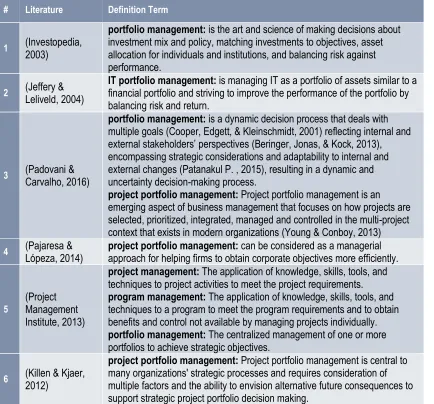
[image:22.595.87.521.361.765.2]And according to the data collection of the literature review, the definitions of the relevant terms in portfolio management are listed as Table 2:
Table 2 Definitions about portfolio management
# Literature Definition Term
1 (Investopedia,
2003)
portfolio management: is the art and science of making decisions about investment mix and policy, matching investments to objectives, asset allocation for individuals and institutions, and balancing risk against performance.
2 (Jeffery &
Leliveld, 2004)
IT portfolio management: is managing IT as a portfolio of assets similar to a financial portfolio and striving to improve the performance of the portfolio by balancing risk and return.
3 (Padovani &
Carvalho, 2016)
portfolio management: is a dynamic decision process that deals with multiple goals (Cooper, Edgett, & Kleinschmidt, 2001) reflecting internal and external stakeholders’ perspectives (Beringer, Jonas, & Kock, 2013), encompassing strategic considerations and adaptability to internal and external changes (Patanakul P. , 2015), resulting in a dynamic and uncertainty decision-making process.
project portfolio management: Project portfolio management is an emerging aspect of business management that focuses on how projects are selected, prioritized, integrated, managed and controlled in the multi-project context that exists in modern organizations (Young & Conboy, 2013)
4 (Pajaresa &
Lópeza, 2014) project portfolio management: can be considered as a managerial approach for helping firms to obtain corporate objectives more efficiently.
5
(Project Management Institute, 2013)
project management: The application of knowledge, skills, tools, and techniques to project activities to meet the project requirements. program management: The application of knowledge, skills, tools, and techniques to a program to meet the program requirements and to obtain benefits and control not available by managing projects individually. portfolio management: The centralized management of one or more portfolios to achieve strategic objectives.
6 (Killen & Kjaer,
2012)
13 7 (Heising, 2012)
project portfolio management: can be considered as the simultaneous management of the collection of projects that make up an investment strategy of a company (Artto & Dietrich, 2004; Levine, 2005; Patanakul & Milosevic, 2009)
8 (Amaral & Araújo, 2009 )
project portfolio: is defined as a group of projects that compete for scarce resources and are conducted under the sponsorship or management of a particular organization. (Archer & Ghasemzadeh, 1999)
9 (Bodenstaff, Quartel, & Lankhorst, 2014)
enterprise portfolio management: is an integrated portfolio management approach that tightly manages strategy planning against the various portfolios of interdependent assets, like product portfolios and project portfolios.
10 (Bodenstaff &
Quartel, 2014)
application portfolio management: is a management approach that allows structuring large IT landscapes by grouping applications (e.g. based on functionality or dependency) into portfolios which are then managed as a whole.
The series definitions of portfolio management provided by Project Management Institute (PMI) and the project portfolio management definition from Young & Conboy (2013) are adopted. This is a conscious decision for two reasons. First, according to the cited number, these definitions have been widely adopted by other literature (Petit, 2012; Martinsuo, 2013; Young & Conboy, 2013; Abrantes & Figueiredo, 2015; Patanakul P. , 2015). The definition proposed by Young & Conboy also referred the definition from PMI. Secondly, PMI provides the most comprehensive definitions in its lexicon (Project Management Institute, 2015) with the context of portfolio management.
2.2.3 Project interdependencies
Although in this model, shown projects are independent entity groups (no interdependence among projects). It has been proved that interdependencies may exist between project resources in the organization which has large scale and requires dozens of projects (Melton, 2011). What’s more, the increasing importance of acknowledging project interdependencies has also been widely accepted (Stummer & Heidenberger, 2003; Dahlgren & Söderlund, 2010; Killen & Kjaer, 2012). Thus, organizations have to identify the dependent relationships between projects in order to make optimal decisions for providing the best outcomes.
Horizontal relationship
14
need of the outcome or the knowledge that provided by another project. For these interdependencies, the project implementation should be strictly scheduled otherwise a project may have to pause and wait for the knowledge or outcome from another project.
Vertical relationship
Although definitions are proposed in use of projects, programs and portfolios by different researchers or organizations with different perspectives, the interaction relationship among these three terms are presented similarly. The figure before is an example that shows how portfolios programs, and projects fit together in one organization.
[image:24.595.100.501.279.613.2]In organizations, as Figure 4 illustrates, a portfolio may consist of lower level portfolios, programs, and projects with shared strategies. The similar relationships are also modeled between programs and their projects.
15
2.2.4 PPM method
In this section, three process models are illustrated. The first one is a construct model about the core processes involved in portfolio management. The other two models put more emphases on the process of project selection.
2.2.4.1 Core Process Model in Portfolio Management (Padovani & Carvalho, 2016)
[image:25.595.114.483.329.631.2]A construct model of project portfolio management is proposed in one of the latest researches (Padovani & Carvalho, 2016). In the literature, authors identified the core processes in project portfolio management. And validated the model using a survey-based research. Besides, they also did an investigation for the relationship between project portfolio management and enterprise performance. And the result shows a strong significant and positive relationship between the process of project portfolio management and performance.
Figure 5 PPM construct model
16
management alignment. The emphases are put on both the external environment and internal context.
The second part located in the middle shows needed processes in project portfolio management. There are two preparation activities decision criteria (DC) - to identify the criteria for decision making and Resources Allocation(RA) - to investigate the allocable resources. They are quite essential since they are the key to support the activities that require decision making. The needed inputs of these two activities are from the top level. Thus, they are also the key to insure the strategy alignment. Apart from Decision Criteria and Resources Allocation, there are also relevant activities of proposing, evaluating, selecting and arranging projects.
The last part in the bottom of the figure is the project portfolio management infrastructure (PPMI) block. It consists of three main activities which are information technology infrastructure, project management maturity and project management structure. They are emphasized since they do affect the success of both project portfolio management and projects themselves. A brief description of each block composing the suggested model together with each one of their corresponding activities is presented in Table 3.
Apart from this construct model, there is also a comprehensive literature review result showing the indicators of each key element in the construct model with their corresponding references structured in Appendix A.
The second part located in the middle shows needed processes in project portfolio management. There are two preparation activities decision criteria (DC) - to identify the criteria for decision making and Resources Allocation(RA) - to investigate the allocable resources. They are quite essential since they are the key to support the activities that require decision making. The needed inputs of these two activities are from the top level. Thus, they are also the key to insure the strategy alignment. Apart from Decision Criteria and Resources Allocation, there are also relevant activities of proposing, evaluating, selecting and arranging projects.
17
Table 3 Activities in PPM construct model
Block Activity Description Knowledge of
the
organizational context (KOC)
Stakeholders
Expectations Existence of a formal planning process, reflecting internal and external stakeholder’s perspectives Constraint
Capability Uncertainties It is necessary to have a certain knowledge about the constraints, capabilities, uncertainties information about the organization.
Organizational Strategy Have strategic performance measure systems
Main Portfolio Management Process
Decision Criteria (DC) Identify the Criteria for: individual project evaluation project selection and prioritization Resource Allocation (RA) Identify the resource to be allocated Opportunity Identification
(OI) Provide a global vision of the entire portfolio of projects with brief information of the candidate proposals (scope, objective, value, earnings, market etc.)
Classification (CL) Consists of the projects classification used to compare similar projects so that the budget can be allocated to projects according to classification. Besides, projects with the same classification are compared and may have concurrent resources that could support the resources management.
Balancing (BAL) Balance the criteria (e.g. investment and outcome) to align the project portfolio with the organization's strategy.
Selection. Prioritization. Optimization and Sequencing (SPOS)
In the research, Selection, prioritization, optimization and sequencing are grouped together.
Optimization is to consider resource limitations as a constraint in the analysis of which and how many projects an organization should approve for a given period. Optimization tools are used in allocation resources and prioritization of projects
Tools or models could be adopted in these activities Approval (APP) Set the gateway to support formal approval process of
projects in the enterprise. Formation of Portfolio
(FP) This step is suggested by PMI (Project Management Institute, 2013). It allows multi-project level to conduct the approved portfolio and it provides the planning of projects in the portfolio.
Evaluation (EV) The project evaluation is set for reviewing the ongoing projects in the portfolios. The study shows the literature review result that the key performance indicators of projects in this step should include: a) The alignment of the project with the organization's strategic plan; b) Compare the projects to each other and compete for the same resources. Project Portfolio Management Infrastructure (PPMI)
Project Management
Infrastructure (PMO) Influence of the types of PMO on portfolio management Information
Technology Infrastructure (IT)
Impact of the use of IT on project success
Project Management
18
Apart from this construct model, there is also a comprehensive literature review result showing the indicators of each key element in the construct model with their corresponding references structured in Appendix A.
2.2.4.2 Project Portfolio selection process (Tavana, et al., 2015)
The study from Tavana, et al. (2015) proposed a three-stage hybrid method for the project selection in the portfolio management with a process model described in the paper. The proposed method integrates the models fuzzy TOPSIS (the technique of order preference by similarity to ideal solution), DEA (data envelopment analysis) for multiple criteria decision making in order to make the framework more structured and systematic. And the scope of this framework covers the processes from project creation to the final project selection in the portfolio management.
[image:28.595.92.500.311.677.2]The three-stage approach introduced in the study is described in Figure 6. The framework is composed of three main phases involving: a preparatory stage, a project evaluation stage, and a portfolio selection stage. The first phase is the preparatory
19
stage aiming to prepare the needed resources for the further processes. This phase consists of three steps:
P1. Identify the decision maker(s). This step is to identify the relevant stakeholders as decision makers.
P2. Identify objectives, priorities, initial constraints, and thresholds. Step 2 is arranged to formulate the required information in the portfolio management.
P3. Identify evaluation criteria. The last step in phase 1 is to identify the criteria for the later projects evaluation.
After phase 1, following phase 2 is also a preparation of the project selection, but phase 2 puts emphases on the projects themselves by identifying project evaluation.
E1. Identify and screen projects. In this step, the inefficient projects should be figured out and screened.
E2. Homogeneity Projects. Step 2 is arranged as a gateway. In this step, the decision makers selected in step P1 should check if all projects are homogeneously classified. There are two options: move to E4 directly if all projects are homogeneously classified, or proceed to next step E3 if there still projects need to be classified.
E3. Classify projects to reach homogeneity. According to the literature, projects could be classified by different criteria like research and development criteria, project size, project time, technology type. The classify criteria are identified by decision makers.
E4. Measure attributes & E5. Determine weights for attributes. These two steps are arranged to measure each project’s value based on various criteria.
E6. Satisfaction with the scores and weights. E6 is a gateway to ensure the satisfaction with the weights and scores. Otherwise, steps E4 and E5 will be iterated until getting the approvals.
E7. Evaluate projects. The step is to evaluate the projects based on fuzzy TOPSIS and produce a ranked list of the projects.
E8. Identify the augmented scores. The step aims at strengthening the consistency between the results obtained from the linear IP model applied in the portfolio selection stage.
The last phase is to select the projects, which includes the following steps:
S1. Constraints and portfolio’s preferences determination in this period. In S1, the DMs decide to remove or add constraints.
S2. Form the portfolios that satisfy this period’s objectives and constraints: a large number of project portfolios can be created, particularly when the number of constraints is low.
20
S4. Check satisfaction with the scores and weights. In the gateway, the DMs review the criteria weights and the portfolio score to ensure their satisfaction.
S5. Perform portfolio evaluation and make a provisional decision. The DMs select portfolios that are higher in the rank as a temporary decision. If the group agrees, continue to the next step; otherwise, return to steps S1 to S4.
S6. Apply sensitivity analysis and make a final decision about the project portfolio. In this step, measure the effect on the model results caused by a change in the variables. If a small shift leads to a significant change, the DMs must agree on whether to keep the current portfolio or make a new decision.
2.3
CBP
2.3.1 Searching Process
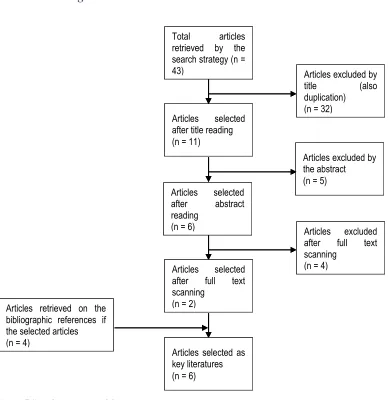
[image:30.595.100.490.288.688.2]The searching queries as “capability based planning” applied in ScienceDirect.com and Scopus in April, 2016 are:
Figure 7 Searching process of CBP
Articles excluded by the abstract (n = 5)
Articles excluded after full text scanning
(n = 4) Total articles
retrieved by the search strategy (n = 43)
Articles selected after title reading (n = 11)
Articles selected after abstract reading
(n = 6)
Articles excluded by title (also duplication) (n = 32)
Articles retrieved on the bibliographic references if the selected articles (n = 4)
Articles selected as key literatures (n = 6)
Articles selected after full text scanning
(n = 2)
Articles excluded by the abstract (n = 5)
Articles excluded after full text scanning
(n = 4) Total articles
retrieved by the search strategy (n = 43)
Articles selected after title reading (n = 11)
Articles selected after abstract reading
(n = 6)
Articles excluded by title (also duplication) (n = 32)
Articles retrieved on the bibliographic references if the selected articles (n = 4)
Articles selected as key literatures (n = 6)
Articles selected after full text scanning
(n = 2)
Articles excluded by the abstract (n = 5)
Articles excluded after full text scanning
(n = 4) Total articles
retrieved by the search strategy (n = 43)
Articles selected after title reading (n = 11)
Articles selected after abstract reading
(n = 6)
Articles excluded by title (also duplication) (n = 32)
Articles retrieved on the bibliographic references if the selected articles (n = 4)
Articles selected as key literatures (n = 6)
Articles selected after full text scanning
21
Search results: 23 results found for pub-date > 1999 and ("capability based planning").
20 results for TITLE-ABS-KEY (“capability based planning”) AND DOCTYPE (ar
OR re) AND PUBYEAR > 1999 AND (LIMIT-TO (DOCTYPE, “ar”))
The searching process of this section is illustrated as Figure 7 with the action and the result of the filtered articles.
2.3.2 Definitions
In Oxford Dictionary, a capability is simply defined as “the power or ability to do something”. However, this definition is over general for specific usages. Then, the
Open Group defined “capability” in the context of enterprise architecture:
“An ability that an organization, person, or system possesses. (The Open Group, 2011)”
In the TOGAF book, “capabilities are expressed in general and high-level terms and typically require a combination of organization, people, processes, and technology to achieve, for example, marketing, customer contact, or outbound telemarketing” (The Open Group, 2011). Besides, from its context, capabilities are also able to be subdivided as pure business capabilities such as Process Claim or Order Management or as technical capability such as Service Mediation. The study of Papazoglou (2014) collected the definitions of the capability- related terms. The following Table 4 lists some of the definitions with the corresponding literature.
Table 4 Definitions about Capability
# Literatures Definition 1 (The Open Group,
2011) Capability: is an ability, capacity or potential that an organization, person or system possesses. Capabilities are typically expressed in general and
high-level terms and typically require a combination of organization and different assets (e.g. people, processes, and technology) to be achieved and thus realize their goal.
2. (Azevedo, et al.,
2015) Capability: is an ability to employ resources to achieve some goal.
3 (Burton, 2013); (Bredemeyer et al., 2003)
Business capabilities are the ways in which enterprises combine resources, competences, information, processes and their environments to deliver consistent value to customers. They describe what the business does and what it will need to do differently in response to strategic challenges and opportunities.
4 (Brits et al., 2006);
(Henry, 2011) Strategic business capabilities are the business capabilities that offer a competitive advantage to the organization by being better than those
owned by the organization’s competitors and by being difficult to imitate or replicate and that also contribute in shaping and realizing the organization’s business strategy.
5 (Acha, 2000);
22
appraisal, utilization and development.
6 (Alizadeh, 2012) Strategic technological capability is the generic knowledge intensive ability to jointly mobilize different scientific and technical resources which enables a firm to successfully develop its innovative products and/or productive processes, by implementing competitive strategy and creating value in a given environment.
7 (Helfat, 2003); (O’Regan & Ghobadian, 2004)
Organizational capability refers to the organizational ability to perform a coordinated task, utilizing organizational resources (tangible, intangible and personnel-based), for the purpose of achieving a particular end result in order to improve performance.
There have been literatures identifying business capability modeling as an essential element and stating that capabilities are applied in the large variety of tasks in EA management (Barroero, 2010; Brits & Botha, 2007; Klinkmuller et al., 2010; Weber & Schmidtmann, 2008).
2.3.3 CBP methodology with TOGAF and ArchiMate
The Open Group apply CBP in the context of EA, and define it as:
“a business planning technique that focuses on business outcomes, dealing with the planning, execution and delivery of the target strategic business capabilities.”
The need for CBP in the context of organizations has become more apparent in the recent years. From an Enterprise Architecture and IT perspective, CBP is a powerful mechanism to ensure that the strategic business plan drives the enterprise from a top-down approach (The Open Group, 2011).
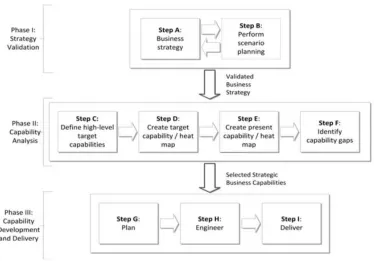
From the definition, we can see that CBP could serve as an approach for translating strategy into action. From the study of Papazoglou(2014), proposed a method for implementing CBP in TOGAF framework and Cheng(2015) practiced the method in the enterprise context. The method is proposed to formulate the strategy into a set of capabilities with defined input and output.
23
Figure 8 The capability-based planning method (Papazoglou, 2014)
24
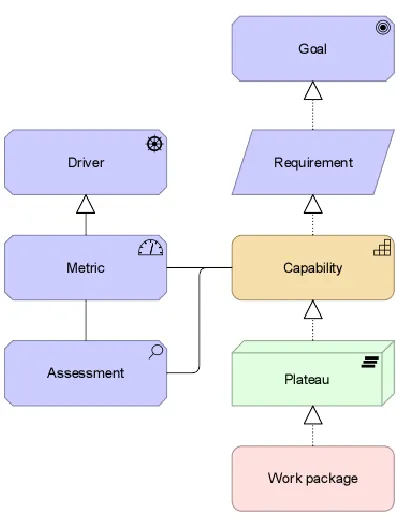
Figure 9 Motivation extension meta model (Aldea, et al., 2015).
The Open Group defined the capability could be realized by the capability increments, which could be separated into three dimensions, which has been is shown as Figure 10 (The Open Group, 2012).
[image:34.595.193.391.65.326.2]
Figure 10 Capability increment
25
Figure 11 Relationships between “Strategy Elements”, “Motivation” and “Core Elements”
As shown in Figure 11 capability is affected by behavior elements and resource which is assigned to the capability. And according to the Open Group, the resources can be classified into tangible and intangible assets, which include financial, physical, technology, and human assets.
Figure 12 Specialization of “Internal Behavior Elements”
26
As shown in Figure 13, Aldea, et al. also provide an example of mapping the strategy “Centralized IS”, in order to briefly outline how the related strategic capability identified.
Figure 13 Strategy mapping of “Centralize IS” (Aldea, et al., 2015).
In order to assess how well the objective of Centralize IS can be fulfilled at the moment, several strategic KPIs are used, such as Process performance, Process variance, and Information consistency. Then the result shows there are several problems standing in the way of successfully centralizing IS. 1) The Process performance metric scores low because there are “Multiple and inconsistent CRM databases”. 2) Process variance metric scores low because it is “Difficult to comply with new regulations due to complex landscape”. 3) Information consistency metric scores low because there is a “Non-uniform way of billing customers”. Then, the capability “Customer management” is identified that relate to implement to centralize IS.
2.3.4 Relationships Between Capabilities
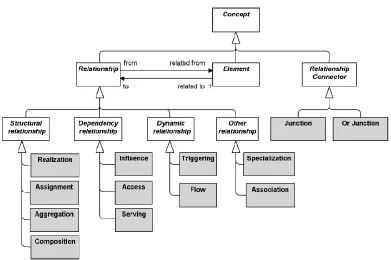
Capabilities are normally modelled independently in the CBP methodology. But relationships between capabilities exist. In ArchiMate 3.0, there are 7 types relationships have been identified and defined between capabilities. Table 5 is generated based on the relationship matrix in ArchiMate 3.0 to represent all 7 types and their corresponding definitions.
Table 5 Relationship types between capabilities
Elements Type Description
Capability and Capability
27
A capability is a particular kind of another capability.
A capability has a temporal or causal relationship with another capability.
A capability provides its functionality to another capability.
[image:37.595.102.493.213.473.2]Additionally,The Figure 14 shows all the relationship types and their classification in the ArchiMate 3.0.
Figure 14 Overview of relationships in ArchiMate 3.0
Generally,
the
relationships are classified into four categories as: Structural relationships, which model the static construction or composition of concepts of the same or different types;
Dependency relationships, which model how elements are used to support other elements;
Dynamic relationships, which are used to model behavioral dependencies between elements;
Other relationships, which do not fall into one of the above categories.
28
kind of another capability”. It hardly happens when building the business capability map. Therefore, only the composition relation and the serving relation will have a strong influence on the capability performance.
2.4
The IT4IT RA
As mentioned in the introduction, it is interesting to see if the IT4IT RA could contribute to the new method. Therefore, we also made a literature review of IT4IT RA.
2.4.1 IT4IT RA Overview
[image:38.595.90.522.427.656.2]The IT4IT RA is a new standard reference architecture raised by the Open Group in order to face the challenge that managing the business of IT. And it is a value chain-based operating model of the functions that IT performs to help organizations to identify the activities that contribute to business competitiveness (The Open Group, 2015). Since it is a quite new topic, there is no scientific publications while the searching process arranged. The main references of the IT4IT RA are from the website of the open group. The IT4IT Reference Architecture uses both formal and informal notation style to depict the element. The related notations are list in the Appendix B. and the IT4IT RA Level 1 framework is shown in Figure 15.
Figure 15 IT4IT RA level 1 framework version 2.0
29
Additionally, the framework also shows the required data objectives, represented as black and purple rounds.
Since the core concept of the IT4IT RA is to manage IT department as an individual enterprise, the IT services could be treated as the “product” of the “IT company”. As aforementioned, there are four phases designed in the architecture model in order to achieve the “Strategy”. Thus if the company runs with high reliance on IT, this model could also be referred to achieve the strategy of the company.
[image:39.595.105.492.309.552.2]To enable financial tracking during the implementation, the IT4IT RA uses an information model to consistently manage all portfolios. Likewise, all the IT services are managed consistently across business units. Therefore, in each step, the cost and the business value could be recorded in its Portfolio Backlog. The following Figure 16 shows a process model of managing portfolios.
Figure 16 Process of project portfolio backlog management
From the models, we can see recording a business need in the portfolio backlog is required. The business identifies requirements during planning and records those efforts in the roadmap (portfolio backlog). Then IT links portfolio backlog items to one or more product backlog items. This allows traceability of product backlog items to the scope agreement when one or more portfolio backlog items are approved to work.
30
In this research, we found out that, IT4IT may help organization while implementing the projects. However, in this case, we focus on the strategy alignment of the projects and put emphases on assessing and adjusting the project. Therefore, there is little help from IT4IT that can bring to the new method after the literature review.
[image:40.595.86.500.258.469.2]Since we suppose portfolio backlog is a good way to keep the key information of the projects. And mapping these backlogs to the related capability backlogs could trace and record the complete degree of strategy implementation. We would keep the form of the backlog as an approach to keep the project information. Following Table 6 shows a sample of a project portfolio backlog.
Table 6 Example of project portfolio backlog
Project Name
Summary This would represent the short description/ title/ summary of a given backlog item.
Description This would be the full description; ideally supports rich text. Backlog Priority This priority is unique across all backlog items.
Stakeholders This would be used to link a portfolio backlog item to the stakeholders. Proposed Budget This would be requirement, defect, or known error.
Fiscal Year This would indicate in which fiscal year the roadmap item (portfolio backlog item) is planned.
Capability Goals Capability name Influence level
Backlog Status The status shows the state of the backlog item. Status would be used by both the business and IT to determine whether it was an agreed roadmap item, proposed, in progress, etc.
Financial Cost Current/planned cost related to this backlog
2.5
The relationship between PM and CBP
Figure 17 Relationship between capabilities, EA, and projects
31
on the left side of the diagram, Capability Increments document the changes to Business Capabilities that are needed to implement the Strategies. Each Capability could be decomposed into one or more Capability Increments, representing a unit of change that could be implemented as a work package. And the work packages could be managed as project portfolios.
32
Chapter3:
Portfolio Management Method
In this chapter, a new portfolio management method is proposed with a complete introduction. In section 3.1, an overview of the method is firstly documented. Then, all the details are exposed in the following sections.
3.1
Overview
The new proposed portfolio management method could support organizations to secure the strategy alignment of projects, especially when the strategy shifts. The method is proposed based on the research from Padovani & Carvalho (2016) and Cheng (2015). Padovani & Carvalho listed and validated the important activities in project portfolio management, which provides a complete overview of the project portfolio management. And the model designed by Cheng provided an operating process model to support strategy implementation by using CBP.
[image:42.595.147.452.393.655.2]In the proposed method, the capabilities will bridge the gap between strategies and project portfolios. Figure 18 shows the conceptual model of the new methods.
Figure 18 Conceptual model of the method
33
[image:43.595.107.503.151.408.2]It could help stakeholders to re-weight the capabilities. Meanwhile, the related projects could be re-weighted or even adjusted. At last the strategy priority of the ongoing projects and the new proposed project could be identified, which supports the organization to select and arrange the project portfolios.
Figure 19 Capability-based project portfolio management
In order to achieve aforementioned idea, a new method is proposed based on the research from Padovani & Carvalho (2016) and Cheng (2015). As shown in Figure 19, there are three phases designed in the new proposed method:
1. Knowledge Mapping Phase
In Knowledge Mapping Phase, the related information about the current situation and the strategy could be collected and modeled. It could be self-iterated for correcting the capability map.
2. Project Assessing Phase
Based on the collected information, this phase is to assess the impacted ongoing projects and modeled possible solutions. What’s more, the strategy priority of all the projects would be estimated to support the project selection. There could be iteration between B2 and B3 for modeling appropriate solutions. There could also be an iteration between Phase A and Phase B to adjust the identified strategic capabilities.