http://wrap.warwick.ac.uk/
Original citation:
Okamoto, T., Kayama, M. and Cristea, Alexandra I. (2001) Consideration of building a
common platform of collaborative learning environment. In: International Conference on
Computer in Education (ICCE 2001), Seoul, Korea pp. 800-807.
Permanent WRAP url:
http://wrap.warwick.ac.uk/61139
Copyright and reuse:
The Warwick Research Archive Portal (WRAP) makes this work by researchers of the
University of Warwick available open access under the following conditions. Copyright ©
and all moral rights to the version of the paper presented here belong to the individual
author(s) and/or other copyright owners. To the extent reasonable and practicable the
material made available in WRAP has been checked for eligibility before being made
available.
Copies of full items can be used for personal research or study, educational, or
not-for-profit purposes without prior permission or charge. Provided that the authors, title and
full bibliographic details are credited, a hyperlink and/or URL is given for the original
metadata page and the content is not changed in any way.
A note on versions:
Considerations for Building a Common Platform of
Collaborative Learning Environment
Toshio Okamoto, Mizue Kayama & Alexandra Cristea
Graduate School of Information Systems, University of Electro-Communications
<[email protected] >
Abstract
This paper reports on considerations about a common and basic functions/components for building a collaborative learning environment. We make efforts to specify the technological issues towards the future standardization[4,13] of this environment through our research experiences. The problem of standardization includes many embarrassed aspects, however it will extend and widen the field of applications possible within the collaborative learning paradigm, and will make possible the usage of the fruits of years of research and individual implementations of the concept of collaborative learning, from many researches, developments and experiences. So we would like to locate this problem as building a common platform.
Keywords: Collaborative Learning; Learning Environment; Common Platform
1. COLLABORATIVE LEARNING SUPPORT
Collaborative learning is a fundamental learning form that has been more and more stressed out with the paradigm shift from the teaching side to the learning side in the current learning technology. The object of collaborative learning is the group activity and the collaborative mutual interdependence relations within the group(s)[2]. Simply put, in collaborative learning, each learner is accorded a sub-task, and by each learner accomplishing it, the group goal is reached and collaborative mutual interdependent learning is achieved.
Distributed collaborative learning is a type of collaborative learning that can take place in the network environment, etc., with multiple learners geographically far from one another[8]. Geographically a distanced situation can mean remote or far physically, but this also covers cases where direct interaction and dialogue is not possible among participants due to other reasons. Distributed collaborative learning support is a research domain that tries to find out ways to support the collaboration of multiple learners on the network (CSCL - Computer Supported Collaborative Learning)[5], in problem solving or other cooperative curriculum activities, according to the used LT (Learning Technology)[6].
Compared with CSCW (Computer Supported Cooperative Work)[1,7,14], CSCL has as a goal not so much the working efficiency, but the learning achievement efficiency, and the promotion of deep understanding of the subject field by the learner, combined with the recognition or meta-recognition of this achieved ability by other persons[3,10].
The regular CSCL-management software implementation provides usually 2 types of activity space: a private working space and a collaborative working space, where the learners can exchange information in a synchronous or asynchronous manner. Many researches are studying these two types of activity spaces, the information exchange types that exist and those that are necessary[9,12].
In this chapter, we describe primitive and interactive activities among participants in collaborative learning from macro point of view. As the technological functions, CSCL should provide any appropriate tools for those activities. In order to carry out those functions, the following resources are absolutely required in collaborative learning environments. Furthermore, more refined cognitive tools would be desired for facilitating group collaborative learning, corresponding to above enumerated activities as much as possible. So, we regard the common platform/infrastructure to have those resources built easily in the system as extremely essential conditions.
The primitive activities that appear in collaborative learning are:
• Dialogue (with Interaction)
• Data/Idea sharing.
• Observing/suggesting.
• Turn-taking.
• Coordinating/Control.
• Planning/Executing.
• Initiative/Supervising
The resources required in collaborative learning are:
• Dialogue Channel .
• Shared Workplace (shared object space).
• Technologically mediated remote communication (audio & visual).
• Personal Workplace
3. STRUCTURE MODEL OF THE COLLABORATIVE LEARNING
ENVIRONMENT
Figure 1 displays the collaborative learning concept from the point of view of the learner behavior and the resources' usage. From the point of view of collaborative learning behavior, we can differentiate between learner-to-learner dialogue (communication) and other activities (problem solving, etc.). The figure shows the layers prepared for the collaborative learning goal and the collaborative work, as well as the layer containing the various learning resources to consult during collaborative learning. To these resources belong all possible resources to which the learner has access
during the learning in an Internet environment, such as learning materials, all-purpose tools, specialized tools, learning applications, various learning data, etc.
In a collaborative learning situation, a learner could face a problem that s/he cannot solve, and, by interactions with his/her learning companion(s), exchange meaningful information, that can open up to him/her other person's ways of perception and help him/her find out the inconsistencies of his/her own judgment steps. Present researches analyze situations as presented above, their coming into being, their catalyzators and effects, and have as a goal to single out the triggering elements, in order to reproduce such situations. Moreover, as the learning efficiency has been shown to increase in such situations, many systems try to positively encourage them with the help of computer implementations.
4. ESSENTIAL STRUCTURAL ELEMENTS/COMPONENTS OF
THE COLLABORATIVE LEARNING ENVIRONMENT
Figure 1 The Structural Model of the Collaborative Learning Environment
Information Reference Performance Layer
Dialogue
Collaborative Work Space
(CWS)
Various Resources for Learning
Individual Work Space (IWS)
...
Individual Work Space (IWS)
4-1. Essential elements of
the collaborative learning
model
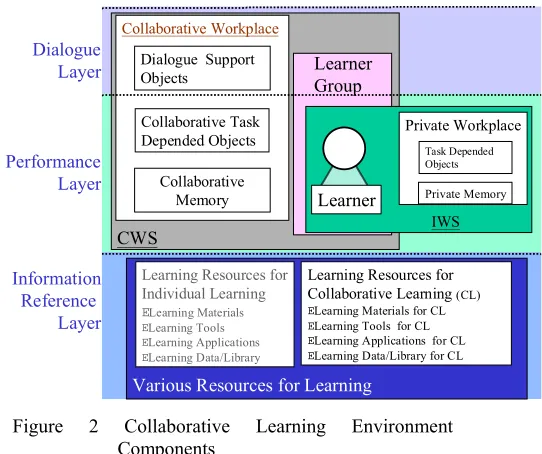
Figure 2 shows the details and various essential elements of the conceptual image of the collaborative learning model. The working place and working subjects are brought together and labeled accordingly. Learners can belong to one or more groups and can be involved in projects or parts of projects together, therefore sharing that particular space, and work privately for the rest.
The shared working place (collaborative workplace) contains the dialogue support objects for
dialogue and information exchange support, the collaborative working objects for activity support, and the collaborative memory, for reference and information accumulation, as can be seen in the figure. On the other hand, the private working place contains the working depository of the private working objects, and the private memory for consultation and accumulation of private activities related information.
Moreover, the information referencing layer contains information oriented towards individual and collaborative learning goals, learning materials, various educational data, libraries, educational applications, all-purpose tools, market applications, etc.
4-2. Essential structural elements (objects) for building the collaborative learning
environment
There are 6 essential structural/basic elements (objects) for building the collaborative learning environment:
1. Collaborative learning environment representation 2. Collaborative work space representation
3. Collaborative learning resource(s) representation 4. Collaborative work place representation 5. Learner group model in collaborative learning 6. Collaborative memory structure representation
Collaborative learning environment representation
Many systems have already used the collaborative learning paradigm, and helped us comprehend the important structural points necessary for a collaborative learning environment. We have displayed these in figures 1 and 2, as the hierarchical structure of the collaborative learning environment, composed of a collaborative work space, a private work space and a space for various resources. Moreover, to define the collaborative learning environment, it is vital to define the 4 concepts below.
1. structural model of the collaborative learning environment
2. essential structural elements of the collaborative learning environment
3. attribute(s) of the essential structural elements of the collaborative learning environment 4. relation(s) of the essential structural elements of the collaborative learning environment
Figure 2 Collaborative Learning Environment Components Information Reference Layer Performance Layer Dialogue Layer Collaborative Workplace Private Workplace Learner
Dialogue Support Objects Collaborative Task Depended Objects Collaborative Memory CWS
Various Resources for Learning
Learning Resources for Individual Learning
ELearning Materials
ELearning Tools
ELearning Applications
ELearning Data/Library
[image:4.595.239.510.99.326.2]Collaborative working space representation
The collaborative work space is an essential structural element of the collaborative learning environment that establishes a virtual space for collaborative activities for each group, and ensures the continuity of these collaborative activities within that space (by activity related information recording, etc.). The definition of the work space requires also the definition of the following terms below.
1. structure of the collaborative learning space
2. essential elements of the collaborative learning space structure
3. attribute(s) of the essential elements of the collaborative learning space structure 4. relation(s) of the essential elements of the collaborative learning space structure
Learning resource(s) representation
The collaborative learning resource(s) are the resources that have to be guaranteed for private activity or for collaboration (for all or a few members), such as screen sharing or operation sharing. For this definition, we need to clarify the term below:
1. essential structural elements of the collaborative learning resource(s) 2. fundamental referencing model of resources
Collaborative work place representation
The collaborative work place belongs to the collaborative work space, and is an essential component of the collaborative working environment, used with respect to the group. Namely, the collaborative work place is in a relation of "use_of" with respect to the group. The collaborative work place is determined by the objects used for collaborative communication support for the distant group members, by the objects necessary to establish collaborative work, and lastly, by the collaborative memory that uses both previous object types for storage and retrieval. Moreover, the understanding and defining of the collaborative work place requires the definition of the terms below:
1. collaborative work place structure
2. essential elements of the collaborative work place structure
3. attributes of the essential elements of the collaborative work place structure 4. relation(s) of essential elements of the collaborative work place structure
Learners' group model for collaborative learning
The group is defined within the collaborative work space of the collaborative learning environment. The group uses the collaborative work place and pursues the collaborative learning goal. This goal is defined as a set of individual achievements expected from the multiple members of the group. To define the learner group model, the following elements and terms must be defined:
1. group model structure
2. essential elements of the group model structure
3. attribute(s) of the essential elements of the group model structure
Collaborative memory structure representation
The collaborative memory is included in the collaborative work place of the collaborative work space. The collaborative memory serves to store the objects used for dialogue support and the objects used and developed in collaborative working or problem solving. Moreover, it has the role to retrieve these objects and stored information at requests in relation with collaborative working. To define the collaborative memory structure, the definition of the following terms below is necessary:
1. collaborative memory structure
2. essential elements of the collaborative memory structure
3. attribute(s) of the essential elements of the collaborative memory structure 4. relation(s) of the essential elements of the collaborative memory structure
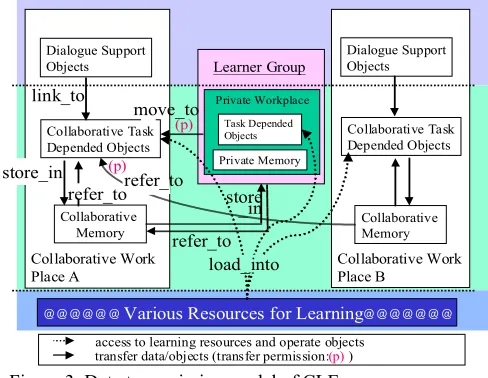
Figure 3 Data transmission model of CLE
Collaborative Work Place A
@ @ @ @ @ @ Various Resources for Learning@ @ @ @ @ @ @
Dialogue Support Objects Collaborative Task Depended Objects Collaborative Memory Private Workplace Task Depended Objects Private Memory Collaborative Work Place B Dialogue Support Objects Collaborative Task Depended Objects Collaborative Memory link_to store_in move_to load_into refer_to (p) (p)
access to learning resources and operate objects transfer data/objects (transfer permission:(p) )
Learner Group
refer_to store_in
refer_to
[image:6.595.265.509.108.297.2]5-1. Data transmission model in
collaborative learning environment
Figure 3 shows the exclusively the data transmission model in collaborative learning environment populated with learners and group(s). The collaborative learning support system has to able to send and receive, at a learner's request, collaborative and private work space essential elements information. Figure 3 illustrates our hypotheses, and displays a minimum of required relations, as will be explained below. E.g., there has to be ensured a function able to fetch collaborative/private work objects requested by the group or privately from various resource(s) (load_into relation). This relation is defined within the essential
structural elements of the collaborative learning environment.
The figure shows also other essential relations between the essential structure elements of the collaborative work space. A relation ensures the sending and receiving of problem solving communication data within the collaborative working place, between the dialogue support objects and the collaborative working objects (link_to relation). Another relation ensures the inserting/ saving of objects, results and information from the private work place of the private work space as collaborative work objects of the collaborative work place (insert_in relation). The relations between the collaborative work objects and the collaborative memory are "store_to", when it refers to storing work objects into the collaborative memory, and "refer_to" when it means referring objects already stored.
5-2. Common objects for interface
The common objects for building the interface means defining the 5 items below. 1. Interface between learning resource(s) and collaborative work object(s) 2. Interface between dialogue support object(s) and collaborative work object(s)
3. Interface between the private work space and collaborative work object(s) of the collaborative work place
4. Interface between collaborative work object(s) of the collaborative work place and the collaborative memory
5. Interface between the collaborative memory and the group model
Interface between learning resource(s) and collaborative work object(s)
The group performs collaborative activities by loading the collaborative work object(s) of the collaborative work place from the learning resources, for group and personal use. Namely, the learning resource(s) are used by multiple groups. By activating a group request, a memory image of the requested learning resource(s) is produced, and therefore the collaborative working object(s) of the group collaborative working place come into being. Moreover, after finishing the collaborative learning, or after a group request, the collaborative working object(s) are deleted. For defining these types of functionality and the interface and its regulations, following items below must be defined.
1. learning resource(s) reference structure
2. essential elements of the learning resource(s) reference structure
Interface between dialogue support object(s) and collaborative work object(s)
The dialogue support object enhances the information exchange between the learners and manages the communication activity history. The role of the communication among learners is to support the smooth proceeding of the various learning and work activities managed by collaborative work object(s). Namely, the communication that takes place in order to achieve the group learning goal is closely related to the collaborative work for problem solving. Therefore it is indispensable for the group portfolio creation and the group results report to attach links between the collaborative work for problem solving, as well as the communication related to it. For the computer to understand the meaning of the communication, it is necessary to link the output of the dialogue support object and the collaborative working object. For this purpose, the items below need to be defined.
1. dialogue support object and collaborative work object output data structure
2. essential elements of the dialogue support object and the collaborative work object output data structure
3. attribute(s) of the essential elements of the dialogue support object and the collaborative work object output data structure
Interface between the private working space and collaborative work object(s) of the collaborative work place
Collaborative learning does not always take place in the collaborative work space. A group member can bring in work results from the learner's private work place to the collaborative work place, or the work result from the collaborative work place can be copied to the private work place. The private work place contains private work object(s) and a private memory. The above type of information exchange is our working hypothesis. For this purpose, together with the definition of the collaborative work object input data, the definition of the output data of the private work place is also necessary.
1. private work place output data structure
2. essential elements of the private work place output data structure
3. attribute(s) of essential elements of the private work place output data structure 4. relation(s) of the essential elements of the private work place output data structure 5. protocol between the private work place agent and the collaborative work place agent 6. protocol between the collaborative work place agent and the collaborative work object agent
Interface between collaborative work object(s) of the collaborative work place and the collaborative memory
The collaborative work object output data is the learning log data for problem solving via collaborative learning. The interface uniformity between the collaborative work object(s) and the collaborative (group) memory within the collaborative work place is ensured by the collaborative learning log exchange and the collaborative work object addition/deletion. By establishing a uniform representation of the collaborative learning log, the accumulation in the collaborative (group) memory and the reference to the collaborative (group) memory can be implemented in an interoperable form. The technological issues to specify our hypothesis contains the 9 items written below.
1. relation between the essential elements of the collaborative work place structure and learning log structure
2. storage request structure of the learning log into the collaborative memory
3. essential elements of the storage request structure of the learning log into the collaborative memory 4. attribute(s) of the essential elements of the storage request structure of the learning log into the
collaborative memory
5. relation(s) of the essential elements of the storage request structure of the learning log into the collaborative memory
6. the reference request structure of the learning log from the collaborative memory
7. essential elements of the reference request structure of the learning log from the collaborative memory 8. attribute(s) of the essential elements of the reference request structure of the learning log from the
collaborative memory
Interface between the collaborative memory and the group model
The collaborative memory of the collaborative work place stores various data developed during the group curriculum activities. This information is the ordered and managed information of the group model. Thereafter, the group model is registered. In the case some new group activity commences, the previous activity history and results from the group model are referred. Therefore, the collaborative memory maintenance is necessary. In order to establish the correct reference to such information, the items below have to be defined and regulated
1. relation between the collaborative memory attribute(s) and the group model attribute(s) 2. output data structure from the collaborative memory into the group model
3. essential elements of the output data structure from the collaborative memory into the group model 4. attribute(s) of the essential elements of the output data structure from the collaborative memory into
the group model
5. relation(s) of the essential elements of the output data structure from the collaborative memory into the group model
6. DATA EXCHANGE IN THE COLABORATIVE LEARNING
ENVIRONMENT
6-1. Virtual agent in the collaborative learning environment
One of the essential structural elements of the collaborative learning environment is the virtual agent[11]. The information exchange between the other essential structural elements is done via agent(s). The attribute(s) of the appropriate essential elements are stored in the collaborative memory as well as the learning log developed during the collaborative learning curriculum. Furthermore, depending on the request from group member(s) and collaborative work object(s), agents refer the information in the collaborative memory and integrate the exchanged information into a defined form. The concrete function of agents is to cope with the behavioral differences of the essential structural elements. Moreover, the information exchange protocol content varies, according to the transmission source and reception destination, and according to the behavior or functions of the bi-directional structure of the essential elements. However, the basis functions and structure of the agents in the collaborative learning environment are defined simply as the exchange, deletion, addition of essential structural elements.
6-2. Collaborative learning Agent
The technological issues to specify for the agents delimited by the hypothesis is represented by the 5 items below.
1. collaborative learning environment agent(s) structure 2. collaborative learning environment agent type(s)
3. essential elements of the collaborative learning environment agent(s) structure
4. attribute(s) of the essential elements of the collaborative learning environment agent(s) structure 5. relation(s) of the essential elements of the collaborative learning environment agent(s) structure
7. CONCLUSION
The technological concept formation of the basic and common platform for building the collaborative learning environment needs a collective effort and is an ongoing process. We have outlined here some of the primitive considerations from our experiences, and the issues to specify towards the future standardization. In addition, further required functions for the collaborative learning environment are as follows[10].
• Coordination (constrained and mediated by external environment)
• Reification (material evidence in the external environment)
• Storage (in later use, for the purpose of reflection)
Examples of general tools for supporting collaboration are as follows.
• Concept Mapping tool
• Editors for argumentation network
• Work flow (planning tool)
• WYSIWIS (What You See Is What I See)
So far, we have integrated a few parallel projects that have related goals concentrated around distance-learning and life-long distance-learning, also under the name RAPSODY [4] and RAPSODY-EX[5]. In this paper, from the academic point of view, we mentioned systematically the fundamentals about the common functions/components for building the platform of a collaborative learning environment through our research experiences for the future direction of the standardization. However, those considerations and issues are the first step for standardizing it. So, we need much more investigation and discussion to have a lot of people understood the important of this matter.
8. REFERENCES
[1] Conklin, J. & Begeman, M.L.: gIBIS: A Hypertext Tool for Exploratory Policy Discussion, ACM Transaction on Office Information Systems, Vol.6, No.4, pp.303-331, 1988.
[2] Dillenbourg, P. and Self, J. :Designing Human-Computer Collaborative Learning, In “Computer Supported Collaborative Learning” (Ed.:O’Malley, C.), NATO ASI series vol.F-128, Berlin: Springer-Verlag, pp.245-264, 1994.
[3] Dillenboug, P.: Collaborative Learning, cognitive and computational approaches, Advances in learning and instruction series, Pergamon, 1999.
[4] IEEE Computer Society Learning Technology Task Force (LTTF) http://lttf.ieee.org/
[5] ISO/IEC JTC1Standards for Information Technology for Learning, Education, and Training (SC36) : http://jtc1sc36.org/
[6] ISO/IEC Joint Technical Committee 1(ISC/IEC JTC1): http://www.jtc1.org/
[7] Malcolm K.Crowe : Cooperative Work with Multimedia, Springer-Verlag, ISBN3-540-58315-7, (1994) [8] O'Malley, C.(Ed.): Computer Supported Collaborative Learning, NATO ASI series Vol.F-128, Berlin:
Springer-Verlag, 1994.
[9] Okamoto, T.: The Distance Ecological Model to support, Self/Collaborative-learning in the Internet Environment, ISSEI 2000, Bergen, Norway, Section V; Workshop no.: 511, 2000.
[10] Okamoto, T. Cristea, A. and Kayama, M.:ICCE 2000 Invited Talk, Towards Intelligent Media-Oriented Distance Learning and Education Environments, ICCE 2000 proceedings, 2000
[11] Paiva, A., Communicating with Learner Modelling Agents, ITS 96 Workshop on Architectures and Methods for Designing Cost-Effective and Reusable ITSs, Montreal, 1996
[12] Synnes, K., Parnes, P. , Widen, J., Schefstroem, D., Net-based Learning for the Next Millennium, SCI/ISAS99, Florida, USA. ,1999
[13]The International Organization for Standardization(ISO) : http://www.iso.ch/
[14] Winograd, T. & Flores, F.: Understanding Computers and Cognition, Addison-Wesley Publising, 1986.