I
STRUCTURING THE FRONT END OF
INNOVATION AT AN HIGH TECH COMPANY
Innovation is getting more and more important. With the speed of innovation and the needs of customers it is important to structure the front end of innovation. In this research the relations between absorptive capacity, Lead User method and the front end of innovation are investigated, and a manual is written on how the Lead User method can contribute to more successful innovations for company X
Name: Michel Brookhuis Student number: s1005308 Master Business Administration
1st supervisor: Rik van Reekum 2nd supervisor: Erwin Hofman
Supervisor company: Sales/product manager company X
Words: 24.677
II
PREFACE
This master thesis is the result of a half year research at unit 1, one of the business units of company X located in the Netherlands, and is written to get my master degree in Business Administration at the University of Twente.
The research started in September after some e-mails between the University and company X. The first goal of this research was finding new product concepts for Company X by using the Lead User method in a pilot, a method developed by Eric von Hippel in 1986.
After some weeks of investigating the Dutch electricity market and the development of smart grids by visiting seminars, exhibitions and talking to some experts in the field I get a better understanding of the market in which unit 1 is active. After this investigation and some changes within Unit 1 the scope of the research has been changed. The goal of the research became finding out if Company X as a whole saw the value in the Lead User method to structure the front end of innovation, and write a manual on how this method can be used by unit 1.
I would like to thank my examiners from the University of Twente: Dr. Rik van Reekum and Dr. ir. Erwin Hofman, for the guidance during this research and for giving feedback on the thesis.
Secondly I would like to thank the people from Company X. The 66 people who respond to the questionnaire and the 15 people who were very open during the interviews on the innovation process at Company X and the value of the Lead User method. My special thanks go to my supervisor from company X and the people from Company X unit 1, for having me for the last half year, the collaboration and the guidance during the research.
I hope that this research and manual can contribute to an innovative and sustainable future for Company X Unit 1.
Michel Brookhuis
III
MANAGEMENT SUMMARY
Innovation is important in every company, when you do not come up with new products, the competition will overtake you. The innovation process starts with idea generation and finding valuable concepts which lead to new products. When these concepts do not match with the needs of the market they won’t be successful and competitors will make better products. At Company X products are developed from the inside of the organization, this can lead to products that do not meet the demands of the customers and are not competitive with products from the competitors. The last product from unit 1 was introduced six years ago and had too many feat ures which made it very expensive. At this moment unit 1 needs new breakthrough innovations and they want a more effective way of innovating. Over the last years Company X attract a lot of employees with expertise in sales and/or marketing, and state in their annual report that keeping up with the technology and cooperate with key customers is very important. Due these changes fewer budgets are available for research and development which made it more important to find a way to structure the front end of innovation, and save time and money.
This first step in the whole innovation process has a lot of uncertainties and is also called the fuzzy front end. To reduce some of those uncertainties, information must be acquired and exploited by the company; this is called the absorptive capacity of an organization. This absorptive capacity can be divided in potential and realized absorptive capacity.
A structured way to gather new information and use this for the development of new products is the Lead User method. Lead Users are people who are facing a problem in their profession or hobby and have a high incentive to solve this problem. They are also willing to cooperate with a company and other Lead Users to share their information and come up with new product concepts for the company. With a multidisciplinary team from the organization a four step process is carried out, from developing a target market and project goal, to organizing a Lead User workshop. The main goal of the research is to write a manual for Company X Unit 1 on how they can introduce the Lead User method. The main research question to come to this goal:
How can Lead User method contribute to a more effective front end of innovation?
IV
In a questionnaire the absorptive capacity of Company X was tested. The outcome of this questionnaire showed that people within Company X are actively looking for information in their target market but also in other markets which can be valuable. Sharing of that information occurs mainly within departments, the sharing of information with other departments or even other business units is less. It means that valuable information is not shared with all the persons and there is not a good integration of the marketing and R&D departments, which can lead to innovations and products which not meet the needs of the target market. When it is about the current customers, the questionnaire showed that they are seen as a valuable source of information when it is about improvements and incremental innovations, but that they can also tribute to more radical and breakthrough innovations.
The interviews, which are done to get a better understanding of the absorptive capacity and the added value and pitfalls of the Lead User method, showed that people find it important to know what the needs and trends in the market are, but that such information is not shared with the research and development department in a structured way. The main decisions on new product development are still made in the hallway or at the coffee machine.
Lead User method is seen as a valuable method to get more structure in the process and seen as a method that can give new insights. Because the business units are growing and ties are getting weaker people do not know what everybody is working on, so working with people from different departments will be valuable and can lead to products that add value.
The pitfalls and dangers that people see in the Lead User method are the time it will cost and the formal structure. To get the most value out of the method it is important that there is enough time and space to do in depth investigation and talk to potential Lead Users. Despite the fact that Lead User method will lead to a reduction of time and costs in the concept development process, the current workload at Company X will make it hard to execute this method well, so time and space must be created by the management in order to solve the organizational problem of Company X. On the final question if people are willing to try a method like this, the responses are pos itive and people see the value when they get the time and space.
V
SAMENVATTING
Innovatie is een van de meest belangrijke zaken binnen organisaties tegenwoordig. Niet innoveren betekent stilstaan terwijl de concurrentie je voorbij streeft. Het is dus belangrijk steeds nieuwe producten of diensten te ontwikkelen die aansluiten op de behoeften van de markt. Binnen bedrijf X wordt er veel vanuit de technologie geïnnoveerd, nieuwe concepten en producten worden vaak door de mensen van R&D bedacht en ontwikkeld. Deze manier van innoveren kan leiden tot producten die niet goed aansluiten op de markt of niet kunnen concurreren tegen andere producten op de markt. Het laatste product is zes jaar geleden gelanceerd, is erg universeel en heeft hierdoor een hoger prijskaartje dan die van de concurrent. De laatste jaren zijn veel nieuwe mensen aangetrokken in de verkoop en marketing om zo meer marktgericht te opereren. In het jaarverslag van 2013 wordt aangegeven dat bedrijf X geen technologieën mag missen, en dat er samengewerkt moet worden met belangrijke klanten. Door alle veranderingen is er minder budget voor ontwikkeling, daarom is het erg belangrijk een gestructureerde methode te hanteren om effectiever te kunnen innoveren en tijd en geld te besparen.
Het eerste deel van het hele innovatieproces is de ontwikkeling van nieuwe concepten. Dit is vaak een rommelig en onzeker proces en wordt ook wel de ‘’fuzzy front end’’ genoemd. Om onzekerheid weg te kunnen nemen is het belangrijk om informatie binnen te halen, te delen en te gebruiken binnen een organisatie. Dit wordt ook wel de absorptie capaciteit van een organisatie genoemd. Dit is onder te verdelen in potentiele absorptie capaciteit en gerealiseerde absorptie capaciteit. Een goede integratie van de marketing en de R&D afdeling is cruciaal voor dit deel.
VI
onderzoek is het schrijven van een handleiding over hoe bedrijf X unit 1 deze Lead User methode kan gebruiken. De centrale vraag in dit onderzoek luidt als volgt:
Hoe kan de Lead User methode bijdragen aan een meer effectief innovatieproces?
Naast deze vraag is het belangrijk om te weten hoe de relaties tussen de absorptie capaciteit, de Lead User methode en de front end of innovation zijn, en misschien nog wel belangrijker, zijn mensen binnen bedrijf X bereidt om met de Lead User methode aan de slag te gaan?
Met een vragenlijst is de absorptie capaciteit van bedrijf X onderzocht. De uitkomst van deze vragenlijst laat zien dat mensen binnen bedrijf X actief op zoek zijn naar nieuwe informatie in eigen markt maar ook in andere potentiële markten. Het delen van deze informatie gebeurt vooral binnen de afdelingen en tussen verschillende afdelingen en business units veel minder, dit zorgt voor een slechte integratie van de marketing en R&D afdelingen, en tot producten die niet aansluiten bij de behoeften van de markt. Tot slot worden klanten als waardevol gezien voor zowel de verbetering van producten als in het vinden van compleet nieuwe producten.
De interviews zijn gedaan om beter inzicht te krijgen in de absorptie capaciteit en de mogelijkheden en valkuilen van de Lead User methode. De antwoorden van de interviews laten zien dat mensen het belangrijk vinden om op de hoogte te blijven van de trends en behoeften van de markt, maar dat die informatie niet wordt gedeeld op een formele manier, en dat de grootste beslissingen worden gemaakt tijdens het wandelen naar de kantine of bij het koffieapparaat. Lead User methode wordt gezien als een waardevolle methode om meer structuur in het innovatieproces te krijgen, maar ook als een methode die kan leiden tot nieuwe inzichten. Omdat de marktgroepen groeien, worden de relaties zwakker tussen de afdelingen, en weten mensen niet meer wat er allemaal speelt in hun marktgroep. Een multidisciplinair team zou waardevol zijn en zou kunnen leiden tot meer waardevolle producten.
VII
Op de laatste vraag; of mensen aan de slag zouden willen gaan met de Lead User methode, zijn de reacties erg positief. Mensen zouden best tijd en energie vrij willen maken om met behulp van Lead Users naar nieuwe concepten te zoeken.
VIII
LIST OF ABBREVIATIONS
ACAP: Absorptive Capacity
BU: Business Unit
DSO: Distribution System Operator
EV: electric vehicle
FOE: Front end of innovation
ICT: Information and Communication Technology
KWh: Kilo Watt hour
LET: Lead User Theory
LEM: Lead User Method
MCS: Management Control Systems
NDA: Non-Disclosure Agreement
NPD: New Product Development
PV: Photovoltaic (solar panels)
IX
LIST OF FIGURES AND TABLES
In order op appearance:
Figure 1: Research model
Table 1: Overview of the research
Figure 2: Stakeholders in the market
Figure 3: Conceptual model, relations between absorptive capacity, Lead User Method and the front end of innovation
Table 2: Example of the pattern matching method
Table 3: Response rate per business unit
Table 4: Scores on potential and realized absorptive capacity
Table 5: Pattern matching, front end of innovation
Table 6: Pattern matching, information sharing and R&D- marketing integration
Table 7: Pattern matching, Lead User Method
Figure 4: The electricity grid in the Netherlands
X
CONTENTS
Preface ... II
Management summary ... III
Samenvatting ... V
List of abbreviations ... VIII
List of Figures and Tables ... IX
1. Introduction ... 1
1.1 Company X ... 4
1.2 Research Goal ... 5
1.3 Research Questions ... 5
1.4 Relevance ... 6
1.5 Research Design ... 7
1.5.1 Research Model... 8
1.6 Outline and Planning... 9
2. Theoretical Framework ... 10
2.1 ‘‘The Fuzzy Front End’’ ... 10
2.2 Absorptive Capacity ... 11
2.2.1 Sharing Information and R&D- Marketing Integration ... 13
2.3 Lead User Method ... 15
2.3.1 The relation between Absorptive capacity and Lead User Method ... 18
2.4 Conceptual Model ... 19
3. Methodology ... 20
3.1 The Questionnaire ... 20
3.2 Interviews ... 21
XI
4. Results ... 25
4.1 Questionnaire ... 25
4.2 Interviews ... 28
4.2.1 The Added Value of Lead User Method ... 32
4.2.2 Pitfalls of the Lead User method ... 34
4.2.3 Theory vs. Practice ... 35
5. Conclusions & implications ... 37
5.1 Conclusions ... 37
5.2 Theoretical implications ... 39
5.3 Practical Implications ... 40
6. Limitations & Future Research ... 42
6.1 Limitations ... 42
6.2 Future research ... 43
6.3 Reflection ... 44
References ... 46
Appendix A: Literature on the energy market ... 51
Appendix B: Questionnaire ... 55
Appendix C: Results Questionnaire ... 58
1
1.
INTRODUCTION
Innovation is important in every company, when you do not innovate your competitors will overtake you. The first stage in new product development is finding new product concepts, this can be a very messy process and very uncertain. This stage in new product development is also called the fuzzy front end. Finding these new product concepts can be done by people from inside the organization like the R&D department, it is also possible to listen to the market to get new information and knowledge to find new concepts. Like many other technical companies, Company X developed new concepts and products on their own. This way of innovating also known as technology push, had led to products which did not meet the market needs. Products had too many features and were too expensive or had too less features and nobody needed the product. Since a couple of years most business units started to listen more to their customers but still some innovations are coming from the R&D department. The way of product innovation has to go to a more market pull system, Company X state in their annual report of 2013 that competitors are coming closer and it is getting more and more important to work together with key customers and produce products that have added value in the market and serves the needs of the customers. Over the last years Company X attracted a lot of new people with expertise on sales and/or marketing, due this movement less money is available for research and development, so it is getting more important that the budget which is available is used in a proper way. When finding a way to structure the first stage of innovation and listen more to the customers and other third parties Company X can save time and money in the development process and can also develop products that are more valuable in the market. When this research started at Company X on the first of September the goal was finding new product concepts for Company X Unit 1. When the problem became clearer the research was moved to the research as it is right now, introducing a method to structure the front end of innovation.
2
company able to translate the new acquired information in valuable knowledge which can be used to find new products and innovations? To share this information it is important that there is a good integration between the sales, marketing and R&D departments. When this absorptive capacity is high and the organization is willing to listen to the outside world, the uncertainties from the front end of innovation can be reduced.
But this information must be acquired; a structured way to acquire and use this information is the Lead User method. Lead Users are people who are facing a problem from their profession or hobby and have a high incentive to solve this problem. Lead User method was developed by Eric von Hippel, and the goal is organizing a workshop with these Lead Users and experts to come up with new product concepts. The whole project consists of four phases. In the first phase a multidisciplinary team is formed, and the focus and the goals of the project are formulated. The second phase is a research on the trends and needs in the market. Next to those trends and needs interviews are held with experts. In the third phase the main goal is finding Lead Users which will be invited for the workshop in the last phase. The Lead Users can be found on the internet by looking at blogs and forums, another way of looking for Lead Users is to use ‘Pyramiding’, every person you speak knows someone else with more expertise. In the fourth and final phase the workshop is organized and the Lead Users and experts are invited for two or three days to come up with different new concepts. After the whole Lead User project the company can decide and make a selection, which concepts are valuable and which are not. Before introducing the Lead User method it is important to know how high the absorptive capacity of a firm is because this method is focused on listening to the outside world.
In this research the next main question must be answered:
How can Lead User method contribute to a more effective front end of innovation?
To answer this question the next steps are taken:
3
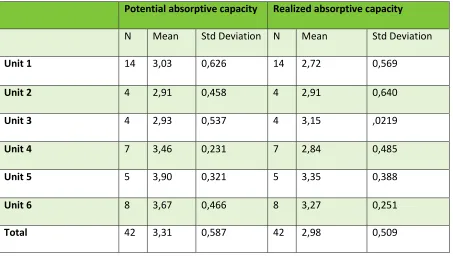
the potential absorptive capacity (3,31) is higher than the realized absorptive capacity (2,98), but this difference is not significant.
4
1.1 COMPANY X
Company X is a Dutch company founded in 1929. Worldwide Company X has more than 700 employees. Company X started as a supplier in a business to business market but last years they started with developing products on their own and creating their own vision. The core business of Company X is making technology for daily use. Company X is divided in different business units which are all focusing on intelligent technology. Every business unit is responsible for the development and commercializing of their own product. (Company X, 2014)
The vision of Company X:
“Company X creates added value with products that solve relevant problems. That is why we talk about
technology that matters. The key focus in this is not the technology, but the way in which it is used on a
day-to-day basis. The distinctive aspect of the solutions of Company X is that new technologies are
processed in a creative and innovative way into elegant, user-friendly products. The success of Company
X is based on creativity, a fundamental understanding of technology and electronics, and extremely good
cooperation with our customers. We translate our ideas about the market and technology into products
which are sold throughout the world”.
In the annual report of 2013, Company X stated that there are changes needed in the strategy of new product development. The main points they name are:
- Markets are more turbulent and Company X may not miss a new technology. - We may not make products that are not what the customers need.
- We must cooperate with our key customers to deliver valuable products. - We must be more sensitive for the changes in the market.
5
1.2 RESEARCH GOAL
After the literature study the research is divided in three main parts. The first part is a questionnaire to get an overview of the absorptive capacity of Company X. The second part are interviews to get a deeper understanding of the absorptive capacity and the added value and pitfalls of the Lead User method, and the third and final part is focused on writing a manual that can be used by Company X Unit 1 in their innovation process.
The main research goal for this research is therefore to:
Write a manual for Company X, on how to use Lead User method to structure the front end of
innovation
1.3 RESEARCH QUESTIONS
To realize this goal, there is one main question to answer:
How can Lead User method contribute to a more effective front end of innovation of Company X?
Before answering this main question it is important to know the relation with the absorptive capacity and the willingness of Company X to work with the Lead User method.
So these sub questions must be answered:
What is the relation of absorptive capacity with the front end of innovation and the Lead User method?
6
1.4 RELEVANCE
There is an academic relevance and a practical relevance. The academic relevance can be found in the first two parts of the research, the questionnaire and the interviews. The practical relevance can be found in the second part, the manual on how Lead User method can be used at Company X to get a more structured front end of innovation.
1.4.1 ACADEMIC RELEVANCE
The academic relevance of this research can be found in the first two parts of the research. In the literature study the relation between the Lead User method and the front end of innovation became clear, and also the relation between the absorptive capacity of a company and the front end of innovation. The relation between the absorptive capacity and the Lead User method can be tested, in this research a score is given for the absorptive capacity of Company X, after implementing and using the Lead User method for a while, it will be valuable to test if the absorptive capacity is higher than in this research. With testing this, the relationship between absorptive capacity and Lead User method can be investigated.
1.4.2 PRACTICAL RELEVANCE
7
1.5 RESEARCH DESIGN
The research has taken six months, from September 2013 till March 2014. The research started with some weeks of desk research to get a better understanding of the trends in the energy market, and also to get a better understanding of the opportunities and problems that Company X Unit 1 faces. The study about the energy market is not used in the research but is attached in appendix A. After this desk research, a literature study took place in this literature study three main topics are studied; the front end of innovation, Lead User method and absorptive capacity. After getting a better understanding of these topics, a model is constructed which shows the relations between the topics.
The data collection is divided in two parts. The first part is an online questionnaire spread amongst 66 employees. The goal of this part is to get an overview of the potential and realized absorptive capacity within Company X. The second part are interviews to get a better understanding on how information is shared, the role customers play in new product development and what the added value and pitfalls of the Lead User method are at Company X. At the end of the data collection it became clear that the potential absorptive capacity was a bit higher than the realized absorptive capacity and that the employees of Company X think that users of their product can be very valuable when it is about product improvement and even new concept development.
The final part of the research is a manual based on the handbook of von Hippel for unit 1 of Company X. In this manual the Lead User method is explained and there is an overview of which steps must be taken but also how they must be carried out. The manual is not included in this research document, but is another document which is only available for Company X.
8
[image:19.612.54.551.98.474.2]1.5.1 RESEARCH MODEL
9
1.6 OUTLINE AND PLANNING
The total time scheduled for the research is about 6 months, starting from September. There will be space for changes in time and duration of the project. In the table below a more specific outline of the research is given.
After defining the problem of Company X, the goal of the research and defining the model and design, the next chapter goes deeper in the theoretical topics of this research; the different topics are discussed and a model is presented on how the topics relate.
Activity Start Date Duration Outcome
Field research and interviews in energy market
09-09-2013 1,5 month Overview of the current energy market and the challenges in the future
Writing research proposal, feedback and improving
22-10-2013 2 weeks After feedback, the final research proposal and chapter 1 of the research
Literature research 28-10-2013 3 weeks Chapter 2 research
Set up and send questionnaire 18-11-2013 1 week Questionnaire about absorptive capacity
Rewriting research so far/ trend analysis energy market
25-11-2013 2 week Up to date thesis, and overview trends in the market for the lead user manual
Analyzing answers questionnaire 9-12-2013 2 weeks Statistics about the potential and realized absorptive capacity
Christmas holidays 23-12-2013 2 weeks Charge for the final phases
Making interview protocol 02-01-2014 2 weeks An interview protocol to get deeper understanding of the absorptive capacity
Start planning and holding interviews
06-01-2014 3 weeks Better overview of absorptive capacity and pitfalls for Lead User method
Writing Manual 27-01-2014 2 weeks Writing manual for Company X Unit 1
Add conclusions and reflection, writing final thesis.
[image:20.612.68.550.165.604.2]10-02-2013 2 weeks Finalizing the thesis
10
2.
THEORETICAL FRAMEWORK
The theory which is used in this research is based three main topics. The first one is the front end of innovation, also called the fuzzy front end, how does Company X come with new product concepts now? Which factor influence this front end? In this research the absorptive capacity and the Lead User method are investigated. First the absorptive capacity is described; some theory on sharing of information and R&D and Marketing integration is added for a better understanding, and after that the Lead User method is discussed. This chapter ends with a model and a short description of the relation between the absorptive capacity and the Lead User method, and how this plays a role in this research.
2.1 ‘‘THE FUZZY FRONT END’’
11
concepts at this moment are all intern at Company X. They come up with their own ideas and try to build the best products. People think that the customers do not know what they need because they do not know what the possibilities and the new techniques are . This resistance against information from the external world is called the not-invented-here syndrome (Hussinger & Wastyn, 2011). After some interviews with different Company X employees, this way of concept developing is used by Company X. They also say that there are some changes the last years. Customers are getting more important in the development of new products , but not enough. Using customers and other parties can be valuable according to different employees. As mentioned by the article of Chau, (2000) the life cycle of new technologies is getting shorter and it is getting harder for designers in companies to keep up with all the trends and changes in the market. An open platform where companies work together with suppliers and customers can make it a lot easier and can save a lot of time and money (Chau & Tam, 2000). Looking to the outside world, working together with other parties and use that information to develop better products is called the absorptive capacity.
2.2 ABSORPTIVE CAPACITY
Absorptive capacity was first introduced by Cohen & Levinthal, (1990). The definition they use for absorptive capacity is: The ability of a firm to recognize the value of new, external information, assimilate it, and apply it to commercial ends (Cohen & Levinthal, 1990, p.128).
In more recent work of Zahra & George (2002) this definition is expand with a sustained competitive advantage. They see ACAP as dynamic capability of a firm. Absorptive capacity is related to the learning of an organization so it is also important that information that is acquired is shared within the company, people within the organization must know this new information so they can also use this. Using task forces and cross functional teams makes it easier to disseminate information through an organization (Jansen, van den Bosch, & Volberda, 2005). Absorptive capacity can be divided in four different dimensions, the four dimensions are:
Acquisition: Identifying the external knowledge but also get it in your company.
12
Transformation: The transformation of the newly acquired knowledge into the change of the current routines in the organization. In this dimension the information becomes natural in the organization.
Exploitation: The new acquired information is used to create new processes and products (Zahra & George, 2002).
Zahra & George make a distinction between potential and realized absorptive capacity. When a firm is capable of finding and acquire knowledge we talk about potential absorptive capacity. When an organization is also able to transform and exploit the new knowledge we speak about realized absorptive capacity. An organization which is able to use their realized absorptive capacity is more efficient than organizations which only acquire information and do not use in their innovation process.
To recognize and use external information it is important that there is already knowledge about the trends and the target market. Without this knowledge it is very hard to understand and recognize valuable information of the external world (Lane & Lubatkin, 1998).
13
2.2.1 SHARING INFORMATION AND R&D- MARKETING INTEGRATION
As mentioned in the literature about absorptive capacity the sharing of information is important. In a company like Company X where different business units are active, it is hard to share all information. Hansen, (1999) showed that there are weak and strong ties when it is about information sharing. Both have pros and cons. But he concludes that weak ties are more valuable when it is about information that is not complex and independent. Strong ties, which are taking a lot of time to maintain but giving people also a better overview which person had which information, are more valuable when it is about technology, and when the information is dependent. For breakthrough innovations a stronger relation between the business units but also between the departments are more valuable than informal weak ties (Hansen, 1999). Next to these strong and weak ties it is also possible to introduce a control sys tem, Simons (1994), describes four main management control systems (MCS). Beliefs systems, introducing value cores of the organization. Boundary systems, which defines limits and the boundaries which can be used as standards. Diagnostic control system, whereby formal feedback is used on the base of predefined goals. And the last one, Interactive control system, whereby more interaction and a dialogue is made possible (Simons, 1994). When talking about innovation, beliefs systems are used to inspire employees to find new solutions. Boundary systems also try to motivate people but with some boundary restrictions, the same is true for the diagnostic control systems. The interactive system makes it possible for firms to position themselves in a dynamic market place and give employees more space to finds new solutions (Widener, 2007).
14
department is the communication. There is a difference in language use, but also differences in values and function loyalties (Moenaert & Souder, 1990), therefore it is important to have more integration between the departments. Moenaert describes three main categories: task specification, organizational structural design, and climate methods. Task specification, w hich is more formal integration, the tasks are planned and coordinated. Structural design focuses on the elimination of boundaries, and the improvement of direct contact like for example, task forces. The third ones are climate methods, these final methods are aimed at promoting the more cultural sense of the departments.
Next to R&D and Marketing, Sales plays also a crucial role in the new product development. They are most active on the market and can gather information that is not available for other people which are involved (Anderson & Dubinsky, 2004). In more recent work of Ernst (2010), the distinction is made between marketing and sales. They found a significant positive effect on the relations between marketing, sales and R&D when it’s about success of new product development. They conclude that the relation between Sales and R&D is the most important in the concept and development stages and less important when it’s about the product implementation (Ernst, Hoyer, & Rubsaamen, 2010). This integration of the different departments makes it easier to share, but also transform and exploit new acquired information, and increase in this way the realized absorptive capacity of an organization.
15
2.3 LEAD USER METHOD
As described the Lead User method can make the so called ‘’fuzzy front end’’ less ‘’fuzzy’’ and more structured, but also focus on more information sharing between the departments.
Lead User method was introduced by Eric von Hippel in 1986. He defines lead users as: ‘’users whose present strong needs will become general in a marketplace months or years in the future’’ (von Hippel, 1986, p. 791).
Lead users differ from normal users in the way that they think from their own real world, so they can’t think outside of that and define what the needs and concepts of the future are. ‘’general’’ customers can be useful for improving your products and help with incremental innovations (Churchill, von Hippel, & Sonnack, 2009). According to von Hippel (1988) lead users have two main characteristics:
Lead users experience a problem years before the public acknowledge them Lead users have a high incentive to solve these problems
The figure below shows the difference between Lead Users and normal users of a product.
[image:26.612.74.293.405.593.2]Lead users are most useful when a new product solves a problem and make the future of the users easier. Lead users are less useful when it is for example about new materials for industrial use (von Hippel, Horizontal innovation networks - by and for users, 2002).
16
Lead users do not have to come from your target market, Hienerth (2007) found in his research on this topic that users from a different market find more novel concepts. When people are further distanced from the technology they find less novel concepts.
To start a lead user project, Eric von Hippel wrote a handbook, where the four phases of the project are described (Churchill, von Hippel, & Sonnack, 2009). The time normally needed for such a project is about four to six months. The first phase consists of defining the focus of the project and its overall goals. It is important to identify needs and define your searching field in this stage but also define what kind of innovation you want, extending a product or a real breakthrough innovation. In this phase you also have to select the project team from your own organization. According to von Hippel such a team consist at least four persons from different expertise, like a team leader, a technical-, manufacturing- and a marketing expert (Churchill, von Hippel, & Sonnack, 2009).
In the second phase you start with the research. As a team you start investigating what the needs and trends of the market are. There are different ways to achieve the information that is needed. In most cases the team starts with a literature scan about the trends in the markets, these trends can be discussed. After this scan most of the time interviews are done with experts in the target market. After this research it is important to write down the needs of the customers and analyze the similarities and differences.
Phase three is used to make sure the needs in trends in phase two are found more specific. With these trends you have to make propositions, is this possible to do and can we make money with it (Churchill, von Hippel, & Sonnack, 2009)? It is important in this phase to find the right lead users for your project. In the fourth phase you need these in meetings for concept development. There are three types of Lead Users according to von Hippel:
Lead users in your target market
Lead Users which use the same applications in a high end market Lead Users with respect to important attributes faced by users
17
One of the most difficult tasks in this process is to find the right lead users. The identification of lead user in the literature of van Hippel is more focused on industrial products. In this method lead users are found by trends, and expectations (Churchill, von Hippel, & Sonnack, 2009). In more recent work is argued that lead users in consumer market also can be identified by competence. Skills and knowledge, willingness to learn and experiment, and the ability to engage in dialogue are those competences (He & Chen, 2010). Another way of finding Lead Users is with the use of pyramiding. Pyramiding is finding Lead Users by asking people if they know people which know more about a topic. Via this way you find with every other person a person that knows more about a topic. When you found your person with the desired expertise you have reached ‘’the top of the pyramid’’ as they call it (Poetz & Prügl, 2009). According to Eisenberg, (2011) there is a new phenomenon when it is about finding lead users; ‘’Netnography’’ which is a combination of ethnography and internet. You find your Lead User by looking at forums about the topic and find the most active members and posters. The use of user toolkits for innovation is a different way of innovation with Lead Users. This is based on a trial and error principle. Companies give their customers the opportunity to try new products and find new solutions. With these this toolkit the customers can learn how to use the product but also how to improve it (von Hippel, 2001). But why will lead users share their valuable data for free? According to Harhoff, Henkel. & von Hippel, (2003) people will share their information because they cannot innovate their whole idea by themselves, they need information from other parties and try to benefit from that innovation. When this information is not shared everyone must innovate on their own which lead to a lot of different products. The sharing of information leads also to a better welfare of society.
18
some barriers and pitfalls which can lead to problems and rejecting the theory. Managers are sometimes not sure about the added value of the information of Lead Users. They think that their own R&D department has the same information. Another issue is the mindset of the company, they are used to their own methods and do not know a lot about lead users , this makes it hard to implement the method. (Churchill, von Hippel, & Sonnack, 2009). Olson describes in his article seven factors that are important when you want to use Lead Users. His main points are a good support from the management during the project, a good in depth investigation in the topic and an extensive trend analysis. Your project is dependent on your own search for Lead, Users, when you find the best users your project will be a success. And his final advice, test always the developed concepts on general users; they are your target market (Olson & Bakke, 2004).
2.3.1 THE RELATION BETWEEN ABSORPTIVE CAPACITY AND LEAD USER METHOD
19
2.4 CONCEPTUAL MODEL
To show what the relations are between the different topics in this research the next model is developed. Company X wants to develop products that meet the needs of their customers better, so a more effective way of innovating is needed which saves time, money and makes sure that there are fewer uncertainties in the front end of the whole process. Effectiveness of the front end of innovation is operationalized as the number of concepts that leads to innovations which are successful in the market. The Lead User method has a positive effect on the effectiveness of the front end of innovation and can reduce the uncertainties, and lead to more market conform innovations.
[image:30.612.89.546.413.678.2]The absorptive capacity is split in potential and realized absorptive capacity as described in the literature. This absorptive capacity has an influence on the Lead User method and the front end of innovation. Before Lead User method can be implemented in a company a certain level of absorptive capacity is needed, the company must be willing to listen to the outside world and use the acquired information. On the other hand, when Lead User method is implemented in an organization the absorptive capacity will go up, because the method pushes the organization to invite Lead Users and experts to come up with new concepts.
Figure 3: Conceptual model, relations between absorptive capacity, Lead User Method and the front end of innovation
+
Legend:
= Topics are split
= Relation between the topics
20
3.
METHODOLOGY
After describing the theoretical topics in the previous chapter, this chapter describes the methods that are used to gather the data that is needed and how this data is analyzed. There are two parts in the data collection. The first part is the questionnaire about the absorptive capacity of Company X. The second part are the interviews with people from different business units to get a deeper understanding of the absorptive capacity at Company X and finding the added value and pitfalls for the implementation of the Lead User method. After these parts a manual is written on how Lead User method can be used at Company X and how it gives more structure to the front end of innovation.
3.1 THE QUESTIONNAIRE
21
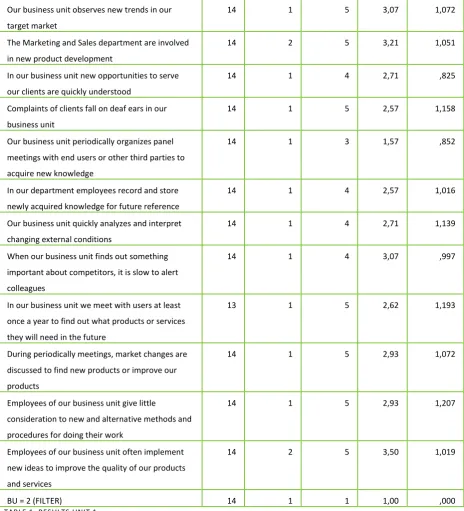
of the organization in recognizing the value of the new information and if they store the information for later use. Finally some questions are asked about how the new information is used when it is about new products (Jansen, van den Bosch, & Volberda, 2005). The whole questionnaire as it was presented to the Company X employees can be found in appendix B, the questions about potential absorptive capacity are marked with a P and the question about the realized absorptive capacity with a R, these marks were not visible for the employees of Company X. To analyze the questionnaire, first the reliability will be measured with Cronbach’s alpha α, for a questionnaire like this a score >0,7 is acceptable. (Bland & Altman, 1997). For further analysis the descriptive statistics will be calculated, this gives an overview of the scores given. A distinction will be made between the business units, but also between the different departments. To see if the differences between the business units and departments are significant a one-way Anova test is done. The results of this questionnaire can be used to see what the score of Company X is on absorptive capacity for future research and if Company X is willing to listen to customers and other third parties.
3.2 INTERVIEWS
22
transcriptions are word-for-word, so emotions, false starts and words that are mumbled are left out. The transcriptions are in Dutch and quotes will be translated in the result section of this research.
The first goal of the interviews is getting a deeper understanding of the current way of developing new product concepts, the role customers play, and the absorptive capacity of Company X. The second goal is to find out if employees see the Lead User method as a valuable method to structure the front end of innovation. It is important to know what the pitfalls and dangers are when using Lead User method in a company like Company X. The questions for the interviews were formulated after analyzing the results of the questionnaire, so it was possible to get deeper understanding on the most valuable questions.
The analysis of the interviews is based on the method of pattern matching which was introduced by Ying (1994). With this method it is possible to compare the empirical evidence with the ideal world from the theory (Dewulf & Graaf, de, 2010). So with this method it is possible to compare the different theories about absorptive capacity, information sharing and Lead User method with the situation as it is at Company X. To amplify this, some examples are presented from the interviews. The general criticism on this method is the lack of precision and next to that also the control effect, the researcher can influence the situation just with his appearance, and the biased viewpoints, this occurs when the researcher has a selective perspective or interpretation of the situation (Amaratunga, Baldry, Sarshar, & Newton, 2002).
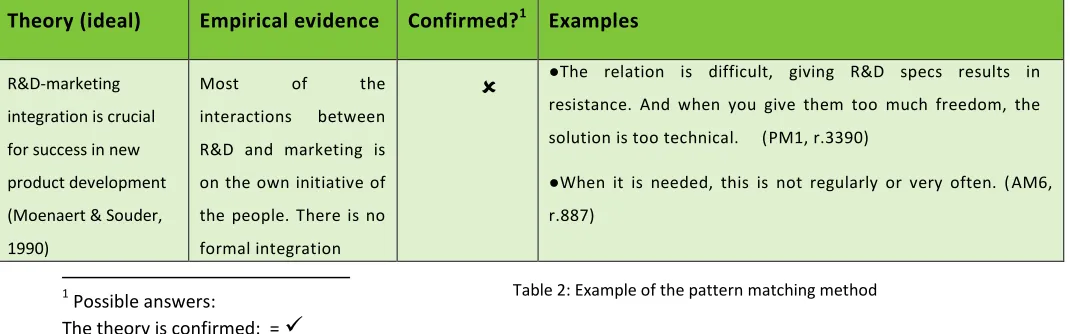
An example of how the method will be used can be found below:
Theory (ideal) Empirical evidence Confirmed?1 Examples
R&D-marketing
integration is crucial
for success in new
product development
(Moenaert & Souder,
1990)
Most of the
interactions between
R&D and marketing is
on the own initiative of
the people. There is no
formal integration
●The relation is difficult, giving R&D specs results in resistance. And when you give them too much freedom, thesolution is too technical. (PM1, r.3390)
●When it is needed, this is not regularly or very often. (AM6,
r.887)
1 Possible answers:
The theory is confirmed: =
The theory is partly confirmed =
The theory is not confirmed =
No data available to compare theory and pragmatic reality =
[image:33.612.41.576.502.669.2]
23
After analyzing the answers from the interviews a manual is written on the use of Lead User method and how the method can add value to the new product development process of Company X Unit 1.
3.3 THE MANUAL
The manual that will be written for Company X Unit 1 will be guidance for the business unit to show how Lead User method can be used and be a valuable addition to the innovation process. The manual is divided in four parts as described in the handbook of von Hippel. The final handbook is as mentioned not in this document but available for Company X.
Phase 1: Preparing for your lead user project.
In this phase the goals and the area of the new product and target market will be defined. Also a planning must be made for the research in phase two. After the goals and target product/market are known, a project group must be selected.
Phase 2: Identifying Trends and Key Customer Needs
As described in chapter two this phase is used to do an in depth investigation on trends in the target market. In this phase there will be a literature study and interviews with lead use r experts. The goal of this phase is to identify the trends from the literature, but also get new information from the open interviews with the lead use experts. Those experts can be found in literature and magazines on this topic. For example an innovation manager of a grid operator or ener gy supplier can be a Lead User expert.
Phase 3: Understanding the needs and solutions of Lead Users
24
Phase 4: Improving solution concepts with lead users and experts
In this final phase the main activity is organizing a workshop with the identified Lead Users, experts, and project group. These workshops take usually two to three working days of intensive design work. In these workshops the concepts developed in phase three must be worked out. Ten lead users are normally invited to these workshops. At the end of this pha se new product concepts must be developed. The key elements of these concepts are: specification of the design of the products is there a commercial potential, the ways the products must be developed and produced. At the end of the pilot an overview will be written about the new concepts.
25
4.
RESULTS
After Describing the methodology in the previous chapter, this chapter gives an overview of the results and is divided in two main parts. In the first part the results of the questionnaire are analyzed, a significance of 95% is used in these results. The second part describes the results of the interviews; the questions in the interviews are based on the outcomes of the questionnaire. The results can be found in the different tables, paragraphs are added f or the added value and pitfalls of the method. This chapter ends with a comparison of the theory, and the reality as it comes forth from the interviews.
4.1 QUESTIONNAIRE
As mentioned in the methodology chapter the questionnaire was spread amongst 66 employees of Company X and there are differences in the response rate between the different business units. In total the response rate was (42/66)*100 = 64%. This is divided over the business units as this:
Before analysing the scores of the different questions the reliability of the questionnaire; the Cronbach’s alpha α is calculated. For a research like this the Cronbach’s alpha must be over 0,7 (Bland & Altman, 1997). For the potential absorptive capacity the Cronbach’s alpha is 0,827 and for the realized absorptive capacity this is 0,737. The questionnaire is reliable and the questions are consistent. There is an overview of tables with results in Appendix C.
Business unit Sample (A) Response(B) Response rate (B/A)*100
Unit 1 16 14 (14/16)*100 = 88%
Unit 2 7 4 (4/7)*100 = 57%
Unit 3 10 4 (4/10)*100 = 40%
Unit 4 13 7 (7/13)*100 = 54%
Unit 5 10 5 (5/10)*100 = 50%
[image:36.612.65.550.378.524.2]Unit 6 10 8 (8/10)*100 = 80%
26
Some remarkable outcomes from the questionnaires are the high scores when it is about the search for new knowledge to do the job which is 4, 19 but when the question is about using that same knowledge the score is only 3, 02.
When it is about knowledge sharing it becomes clear that there are differences in who they share information with. Within the business unit the information is most of the time shared with people which are also active in the same department. This is in line with the expectations on forehand. The information sharing between the business units scored low (2,43).
Result which were not expected are the high scores for the value of users when it is about improving products and develop complete new product concepts. These scored 4,59 and 4,12. So people think that these people can be very helpful but when it is about how they use their users the scores are much lower. Panels meetings with users are not used to get new information and also asking users for new ideas is not included in the process.
In comparison with the other business units, the people within Unit 1 give the same scores on the first points that are mentioned above. When it is about arranging meetings with users or other parties they give lower scores than the other business units, but this is not significant. A one-way Anova test shows that there are significant differences between business units when it is about the appliance of new acquired knowledge to the job. Livestock management gives a higher score than the other divisions. AVI scores significant lower on the question: I’m looking for knowledge in other areas than my target market.
Another remarkable score is the score on the questions: more guidance from experts in market research and innovation management will be helpful. These scores are 3,81 and 3,83.
27
Another distinction can be made, namely between the different departments, the difference between the commercial site of the business units; Sales/Marketing and the research and development side. Before the questionnaire there were some expectations about the differences between these two groups. A difference score was expected on the question: the marketing and sales department are involved in new product development. The expectation was that R&D would score this much lower than Sales/Marketing. The scores after the questionnaire are almost the same. 3,45 and 3,38. A one-way Anova test is done to see if there were significance differences between the different departments. Only two questions scored significant different, these to questions were: complaints of clients fall on deaf ears in our business unit and employee’s record and store newly acquired knowledge for future reference.
Potential absorptive capacity Realized absorptive capacity
N Mean Std Deviation N Mean Std Deviation
Unit 1 14 3,03 0,626 14 2,72 0,569
Unit 2 4 2,91 0,458 4 2,91 0,640
Unit 3 4 2,93 0,537 4 3,15 ,0219
Unit 4 7 3,46 0,231 7 2,84 0,485
Unit 5 5 3,90 0,321 5 3,35 0,388
Unit 6 8 3,67 0,466 8 3,27 0,251
[image:38.612.68.521.85.341.2]Total 42 3,31 0,587 42 2,98 0,509
28
4.2 INTERVIEWS
The first goal of the interviews is getting a deeper understanding of the current way of new concept development at Company X, the role that the customers play, and the absorptive capacity. The second goal is related to the Lead User method; see employees at Company X Lead User method as a valuable way of structuring the front end of innovation, and the pitfalls and dangers which the employees see. In Appendix D the interview protocol is presented, the transcripts that are made are excluded from this research and are for confidential use for company X.
30 E xa m p le s ● R u le n u m b e r o n e i s, n e ve r d o w h a t th e c u st o m e rs a sk s. T h e c u st o m e r h a s n o i d e a . Y o u h a ve t o u n d e rs ta n d t h e ir n e e d s a n d p ro b le m s (RD7 , r. 2 1 6 9 ) ● W e w e n t to c u st o m e rs t o s e e h o w t h e y u se o u r p ro d u ct s a n d w e a ls o p u rc h a se d a n d a n a ly ze d co m p e ti ti ve s ys te m s . (M M4 , r. 6 4 6 ) ● W e a re w o rk in g w it h a p a rt n e r m o d e l a n d w e s e e th a t it i s d if fi cu lt t o k e e p t h e f e e li n g w it h t h e m a rk e t. ( RD 8 , r. 3 1 2 1 ) ● In te g ra ti o n o f R & D a n d s a le s is i m p o rt a n t. P e o p le st a y in t h e ir o w n d e p a rt m e n t. W e d o u se s cr u m t o in fo rm t h e p e o p le o f m a rk e ti n g a n d s a le s . (RD4 , r. 2 5 0 2 ) ● T h e r e la ti o n i s d if fi cu lt , g iv in g R & D a s p e c re su lt s in re si st a n ce . A n d w h e n y o u g iv e t h e m t o o m u ch fr e e d o m , th e s o lu ti o n i s to o t e ch n ic a l. (PM1 , r. 3 3 9 0 ) ● W h e n i t is n e e d e d , th is i s n o t re g u la rl y o r ve ry o ft e n . (AM6 , r. 8 8 7 ) ● T h a t a re n o t in n o va ti o n s th a t a re s m a ll im p ro ve m e n ts , to m a ke i t b e tt e r. (RD7 , r. 2 2 0 7 ) ● C u st o m e r su p p o rt g e ts a l o t o f fe e d b a ck f ro m cu st o m e rs a n d t h is i s sh a re d w it h u s, b u t n o t e n o u g h . ( PM3 , r. 1 7 9 6 ) C o n fi rm e d ?
Empir ic al e vi d e n ce P e o p le a re l o o ki n g fo r in fo rm a ti o n i n n e w sl e tt e rs , e xh ib it io n s. T h is i s th e m a in w a y to g a th e r in fo rm a ti o n fr o m t h e m a rk e t a n d co m p e ti to rs . N e xt t o t h a t th e re i s co n ta ct w it h cu st o m e rs a n d b u si n e ss p a rt n e rs . B u t n o t e ve ry o n e h a s th is k n o w le d ge . M o st o f th e i n te ra ct io n s b e tw e e n R & D a n d m a rk e ti n g is o n t h e o w n i n it ia ti ve o f th e p e o p le . T h e re i s n o f o rm a l in te gr a ti o n C u st o m e rs a re g iv in g fe e d b a ck a n d t a lk t o s a le s a n d s u p p o rt t o i m p ro ve p ro d u ct s a n d d o s m a ll in cr e m e n ta l ch a n ge s. T h e o ry ( id e a l) T o g e t th e m o st v a lu a b le in fo rm a ti o n a n d s u cc e ss fu l p ro d u ct s it i s im p o rt a n t to k n o w y o u r su p p li e rs , cu st o m e rs , a n d co m p e ti to rs ( M o e n a e rt & S o u d e r, 1 9 9 0 ) * H o w m u ch d o y o u l o o k a t yo u r ta rg e t m a rk e t b u t a ls o t o d if fe re n t m a rk e ts ? * = n o t b a se d o n t h e o ry R& D -m ar ke tin g in tegratio n is cru cial fo r su cc es s in n ew p ro d u ct d ev elop m en t (Mo en aert & So u d er,1990) Cu
32
4.2.1 THE ADDED VALUE OF LEAD USER METHOD
The reduction of time and money is one of the drivers to implement the Lead User method according to the literature. Researches at different companies like 3M showed that using the Lead User method indeed saves time and money. It is impossible to check if Company X can save time and money with implementing the method for two reasons. The first reason is that in the current situation at Company X people do not know how much time they spend on the development of new product concepts, this a task that they do in their daily job, between their tasks. The other reason is that the money spent on the Lead User method varies every time and before the method is implemented it is impossible to say how much money a Lead User project will cost. Based on the literature and other companies which already use the Lead User method Company X must assume that using the Lead User method can save time and money.
33
all busy with their daily jobs so there is not a lot of time. Time for this method must be created and the management.
34
4.2.2 PITFALLS OF THE LEAD USER METHOD
Next to the positive intentions of the interviewees and the willingness to participate when this method will be introduced there are also different pitfalls and dangers which came up during the interviews. The literature gives different points which need attention when introducing Lead User method, like the support from management and to put enough time and effort in the process. The interviewees at Company X saw next to these points also different dangers and pitfalls for the Lead User method. The main pitfall which they see is that it is getting to informal. That people are going to come up with ideas which absolutely do not fit the strategy of the business unit. ‘’ It can become one big pool of ideas, which becomes confusing and then slowly dies’’ (RD8, 2014, r.3274). “You have to go in a certain direction, and not start dreaming‘’ (EM5, 2014, r.2929). ‘’You must define roles and responsibilities” (RD4, 2014, r.2648). “When external people come up with ideas which seems to be quite close to your market, it is often quite far away of it” (RD7, 2014, r. 2354). When the method is introduced as described in the literature this issue is not a big deal.
Information sharing is also seen as one of the dangers, but the interviewees are divided when it is about this point. The people are divided over three opinions.
We have to make use of non-disclosure agreement (NDA), for the right intentions and not for the legal issues. With companies you sign an NDA, just for the intention that we want to talk to each other (RD8, 2014, r. 3395)
We don’t need NDAs but we don’t share valuable information from our side. You decide up front what can be shared and what not. And that someone supervise that. (BD3, 2014, r.1289)
We share our information, because the more information is shared the more valuable the results will be. When you do not share information it is useless. When you share it, it can be valuable (RD8, 2014, r. 3386).
35
4.2.3 THEORY VS. PRACTICE
As is seen in the three tables and the questions above there are some differences and similarities between the ideal from the theory and the empirical evidence as it is found at Company X. The differences are described below:
Working together with customers and suppliers lead to more market conform innovations, at Company X it is getting more important to listen to their customers. They see that the products they develop with this information have a better connection with the market and are more successful. Real co-working with suppliers, customers and other third parties like Lead Users and Experts will be important for the development of future products.
The current way of technology push driven innovations and the dangers are mentioned during the interviews and occurred at different products of Company X. As stated in the annual report and from the interviews it becomes clear that a more market pull mechanism is needed to develop products which do meet the needs of the customers, and innovate more effective. A good relation between Marketing/Sales and R&D is crucial for successful product
development. Within Company X there is a lot of ad hoc policy; people are sitting in one big room so people can talk easily with each other. Only when it is necessary people from R&D and marketing arrange a meeting but most of the time it is the responsibility of the people in which way they talk to each other and share information. With Lead User method this integration is necessary to form a good project team and get the most value from the project. During the interviews people state that a better integration of the different departments would make the product development easier.
36