On route from error to learning
An exploratory study into the process of learning from error in
teams
Researcher
Kirste den Hollander s1479482
[email protected]
Supervisors
Rike Bron, MSc
[email protected]
Dr. Bas Kollöffel
[email protected]
Date
Summary
Through their composition and complexity organizations are inevitably faced with error. Recent developments in literature show that certain types of errors hold great potential for improving organisational performance and innovation through learning. Herein lies an essential role for teams as their ability to deal with error can have major influence on organisational learning. Nonetheless, limited research has been done regarding the actual process from error to learning on the team level in their daily work setting. To understand how the process of learning from error works one must gain understanding about the error handling strategies teams apply in dealing with error and how these strategies influence learning. Therefore, the current study explored the process of learning from error in teams by inquiry into the application of error handling strategies in a diverse set of 11 teams in both the public and the private sector by means of a questionnaire. Concurrently, in-depth interviews with single team members were done to identify how the error handling strategies are applied and how these strategies foster or hinder learning. The results indicated that the process of learning from error fostered by a combination error handling strategies. The process starts with identifying the error as such. Hereafter the error needs to be analysed and discussed for the team to be able alter and improve their actions. Moreover, the results suggest that the effectiveness of analysing and discussing could be fostered by first addressing the underlying emotions the errors evokes through de-escalating. The combination of these strategies form a process which allows teams to addressing the underlying variables of the error as well as the subsequent adaptation of their behaviour and actions which facilitates sustainable learning. When a team employed strategies such as anticipation and deliberate risk taking error were more likely to be identified. On the contrary, the commonly applied combination of the strategies identification and correcting was insufficient in fostering sustainable learning of the teams. The correction must be reinforced by analysing and discussing errors in order facilitate the process. Finally, four conditions were found the process of learning from error, namely: attitude of the team leader, time, accountability and team roles.
Keywords
Acknowledgements
“By seeking and blundering we learn.”
― Johann Wolfgang von Goethe
I want to thank my supervisors, colleagues, family, friends and especially my partner for aiding and abetting me in my quest to learn from this process full of failures and successes. It has been a long time coming but I know I learned from the experience and will continue to do so in the future.
Table of content
Introduction ... 1
Theoretical framework ... 2
Actions, errors and consequences ... 2
Learning from error ... 3
Perspectives on errors ... 3
Error handling strategies ... 4
Barriers to learning from error ... 5
Research model and questions ... 6
Method ... 7
Research design ... 7
Participants ... 7
Measures ... 8
Instrument ... 8
Validity and reliability ... 8
Interviews ... 9
Procedure ... 10
Data analysis ... 10
Results ... 12
Error handling strategies applied by teams ... 12
Practical implications of the error handling strategies on learning from error... 13
Mastery ... 14
Identification ... 14
Analysing errors ... 15
Correction ... 16
Improvement ... 16
Communication ... 17
Discussing errors. ... 17
Addressing errors ... 18
Raising errors ... 18
De-escalation. ... 19
Awareness ... 20
Anticipation ... 20
Fear of error ... 21
Error strain ... 21
Covering up ... 22
Conditions fostering the implementation of error handling strategies ... 22
Attitude of team leader. ... 23
Time ... 23
Accountability. ... 23
Team roles. ... 24
Discussion ... 25
Discussion of results ... 25
Limitations and future research ... 28
Practical implications ... 29
Conclusion ... 30
Bibliography ... 31
Appendix I – Team Error Orientation Questionnaire ... 34
Appendix II – Constructs Team Orientation Questionnaire ... 38
Appendix III – Team Error Orientation Questionnaire ... 40
Appendix IV – Types of errors mentioned per team ... 41
Introduction
In the modern knowledge economy organisations are often complex and layered systems which rely on flexibility as well as their ability to generate new knowledge to remain competitive (Kessels, 2001). Herein, the organisations increasingly rely upon their teams to carry out large parts activities within them, with expanding levels of independence (Van Woerkom, 2012). Combined with the complexity of work and human nature these circumstances dictate that these teams are inevitably faced with error (Putz, Schilling, Kluge, & Stangenberg 2013). Edmondson (1996) and Van Dyck, Frese, Baer & Sonnentag (2005) found that these errors could hold great potential for improving organisational performance and innovation through learning. Leading to a situation in which adequate error handling strategies of the team become a key strategic resources (Harteis, Gruber & Bauer, 2008).
Ideally, teams would fully utilise the aforementioned potential. However, learning from error often proves to be challenging (Tjosvold, Yu & Hui, 2004). Errors are often perceived as a loss of time or the cause of low quality products (Van Dyck et al., 2005). Subsequently, being confronted with errors can lead to various negative emotions such as anger, frustration and despair (Heimbeck, Frese, Sonnnentag, & Keith, 2003). These negative tones surrounding the subject create an atmosphere which obfuscates the potential for learning (Cannon & Edmondson, 2005). Creating the imperative for understanding how teams learn from error (Tjosvold, Yu & Hui, 2004; Van Woerkom, 2012)
Theoretical framework
The aim of the theoretical framework is to provide an overview of the theoretical concepts could be of value in exploring and defining the process of learning from errors in teams. Expanding upon the definition of error and learning, the theoretical framework will focus on the two main perspectives on error as well as known error handling strategies and their expected relationship with the process of learning form error.
Actions, errors and consequences
In everyday conversation the term error often refers to the error as well as the action leading up to the error as well as the consequence (Homsma et al. 2009). However, the action, error and consequence are three separate entities which are important to distinguish in order fully to grasp the scale and intricacies of the topic.
Actions. Actions are the envoy which eventually lead to a successful or erroneous outcome. Frese and Zapf (1994) define actions as: "goal oriented behaviour that is organized in specific ways by goals, information integration, plans and feedback and can be regulated consciously or via routines" (p. 271). In the case of deviation from this goal one speaks of error.
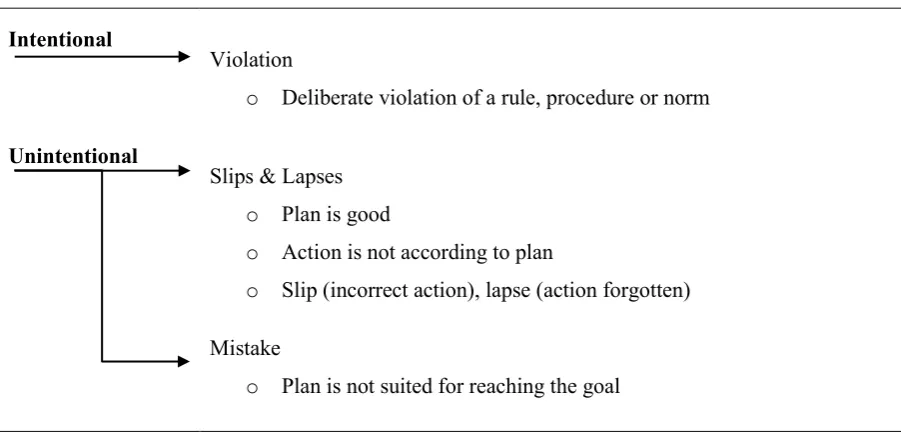
Errors. Errors, also indicated in literature as mistakes and failings, can be classified as either intentional or unintentional as visualized in Figure 1. (Reason, 1990). Intentional errors are deliberate violations of an organisational rule, procedure of a norm. Consequently, these errors are not suitable for learning purposes (Bauer & Mulder, 2008). Unintentional errors are unintended deviations in ones plans or actions which, unlike their intentional counterpart, can yield positive learning outcomes (Putz et al. 2013). Unintentional errors can be divided into two categories, each with their own specificities concerning the process leading up to the error.
The first category concerns slips and lapses: slips are incorrect actions whereas lapses are actions which are forgotten (Reason, 1990). When these types of errors occur a good plan is in place but the following action is not in line with the intended outcome. An example of this could be an employee who cleans the machinery at the end of the day, a good plan, but uses the wrong kind of cleaning material which clogged the machine, incorrect action.
Figure 1.Overview types of error
Consequences. The consequences are the outcomes and implications of the deviation from the desired results. Nonetheless, the deviation does not imply anything about the nature of the consequence (Homsma et al. 2009). An error could have an array of, minor or serious and positive or negative, consequences depending on the situation or system the team is working in (Van Dyck, 2000). One of the positive consequences of an error is learning (Frese & Keith, 2015).
Learning from error
Learning from errors refers to the activities through which the team to extract insights from unexpected and undesired results and modify their future behaviour, processes or systems accordingly (Cannon & Edmondson, 2001). In this definition learning is not merely seen as an outcome but as a process. The process requires more than addressing the superficial symptoms of the errors. When only the superficial symptoms addressed the underlying problem remains unsolved (Edmondson, 1996). Argyris and Schön (1978), describe this as single loop learning: the error is observed and dealt with without looking at the broader context in which the error took place. To facilitate sustainable progress and learning, double loop learning is required: a form of learning in which the error is analysed in an integral manner in conjunction with feedback to create sustainable solutions that are incorporated into working behaviour. The manner in which teams approach this process closely relates to their perspective on errors and their perspective on the consequences of errors.
Perspectives on errors
There are two types of perspectives on errors that can be distinguished; error prevention and error management (Frese & Keith, 2015). The main difference between the two perspectives is how errors are perceived by the team (Van Dyck, 2000). In the error prevention perspective, errors are perceived as a loss of time or the cause of low quality products errors and are to be avoided at all cost
Intentional
Violation
o Deliberate violation of a rule, procedure or norm
Unintentional
Slips & Lapses
o Plan is good
o Action is not according to plan
o Slip (incorrect action), lapse (action forgotten)
Mistake
(Gelfand, Frese & Salmon, 2011). Teams who predominately hold this perspective focus on the prevention of errors by implementing processes, tools or systems to lower the possibility of the occurrence of an error (Frese & Keith, 2015). In contrast, in the perspective of error management errors are regarded as an inevitable by-product of working and cannot completely be prevented. In this perspective teams focus on minimizing the negative consequences of an error and maximizing the positive outcomes (e.g. learning and future prevention) after the error occurred (Van Dyck et al., 2005). When teams hold error prevention as singular perspective there is a considerable possibility that they overly rely on their system to prevent error. This increases the likelihood that early warning signs of error are missed and that the errors are overlooked (Van Dyck, 2000; Cannon & Edmondson, 2005). The error management perspective can mitigate the disadvantages of the error prevention perspective while cultivating the advantages that errors offer. Therefore, Frese & Keith (2015) propose that error prevention needs to be reinforced by error management.
Error handling strategies
Rybowiak, Garst, Frese and Batinic (1999) developed a model with eight error handling strategies individuals apply in coping and dealing with errors at work. These strategies either directly and indirectly support or hinder the application error management perspective in the work environment. The error handling strategies are: (1) analyse the cause, (2) communicate about the error, (3) short-term error correction, (4) long-term improvement, (5) anticipation of error in work endeavours, (6) deliberate
[image:9.595.70.527.572.647.2]risk taking, (7) strain caused by the error and (8) covering-up errors. Expanding from this research, Van Dyck (2000) investigated whether these eight strategies could also be translated and identified on the organisational level. However, the eight strategies were difficult to delineate on the organisation level. However, it did result in a framework with three overarching strategies. These overarching strategies are mastery, awareness and fear of errors, see Table 1.
Table 1
Framework error handling strategies on the organisational level (Van Dyck, 2000)
Mastery Awareness Fear of error
Analysing errors Anticipation Error strain
Communication Risk taking Covering up
Correction Improvement
will be in maximize the positive consequences of error (Van Dyck, 2000). This is supported by Cannon and Edmondson (2005) who describe three activities that are crucial in supporting learning from error: (1) identifying errors, (2) analysing and discussing errors, as well as (3) deliberate experimentation. These activities are crucial since timely and proactive identification and attention to small errors can improve the skills and knowledge of the team in ways that allow for the future avoidance of the same or of similar errors (Barach & Small, 2000). Moreover, by sharing and discussing errors team members not only learn themselves but also as a group (Van Woerkom, 2012). Furthermore, experimentation is a proactive way of learning from errors: the possibility of errors is actively sought out through novel ways of working, to generate learning and/or innovation (Frese & Keith, 2015). Subsequently, the error handling strategies linked with fear of errors show a negative attitude toward error as it creates a lot of tension and stress when a fault arises. These strategies are most prevalent in teams where employees are being judged or feel judged when errors occur (Rybowiak, et al., 1999). Hence, they feel unable to communicate, analyse and correct their error which makes it more difficult for a team to convert errors to learning experiences (Van Dyck, 2000).
Barriers to learning from error
Even though the benefits from utilising error as a learning opportunity are clear, such an ideal state is challenging to achieve (Baumard & Starbuck, 2005). Cannon and Edmondson (2005) indicated that both technical and socials barriers can hinder learning from error. Technical barriers are typified by not knowing or lack of knowledge. As a results technical barriers can hinder the identification of errors as such due to a lack of knowledge about the task or process. This is often caused by the complexity of processes within modern organisations. During analysis and discussion, a lack of knowledge, regarding processes and skills to give meaning to errors, can also hinder teams in learning. In addition, the learning can be hindered by a lack of knowledge concerning, the implementation, of experimental working. (Cannon & Edmondson, 2005).
Research model and questions
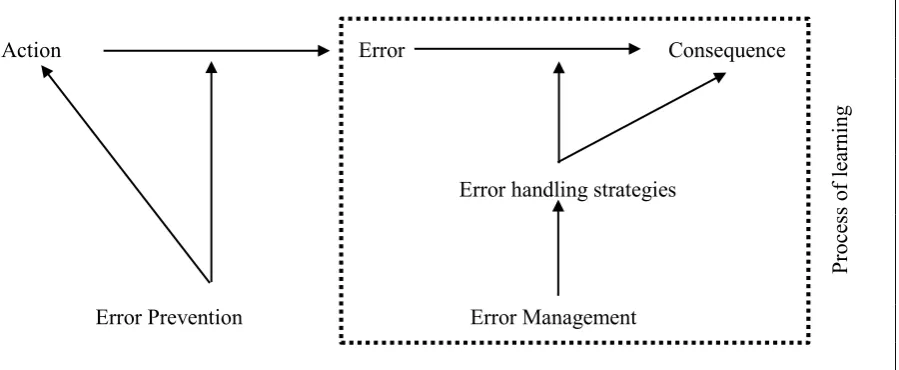
The goal is to advance the understanding of the manner in which teams are able to generate sustainable progress and learning through error. Based the literature it is assumed that the error handling strategies, prompted by the error management perspective, influences the process from error to learning in teams, see Figure 2. Ergo, the following research question was formulated:
“How is the process of learning from error put into practice in the daily work setting of teams in both the public and private sector?”
In order to answer this research question, the following sub-questions were formulated:
Which error handling strategies are applied by teams in the public and private sector and is there a difference between the strategies teams apply?
What are the practical implications of the error handling strategies for learning from error?
Which conditions foster or hinder the implementation of error handling strategies to learn from error?
Action Error Consequence
Proc
ess
o
f l
ea
rni
ng
Error handling strategies
[image:11.595.76.526.359.544.2]Error Prevention Error Management
Method
Research design
The aim of this study was to explore the process of learning from error in a team based setting. For this purpose, a mixed method design was chosen as it maximizes the strengths of such an inquiry by using the benefits of both quantitative and qualitative data gathering. The design allowed for creating convergence and corroboration between findings in studying the same phenomenon. In this study the mixed method design followed a partial, concurrent and equal status structure (Leech & Onwuegbuzie, 2009). A questionnaire was used to identify error handling strategies used amongst teams in dealing with error. Concurrently, in-depth interviews with single team members were carried out to identify practical implications of the error handling strategies on learning as well as the fostering and hindering conditions for implementing the error handling strategies in day-to-day work.
Participants
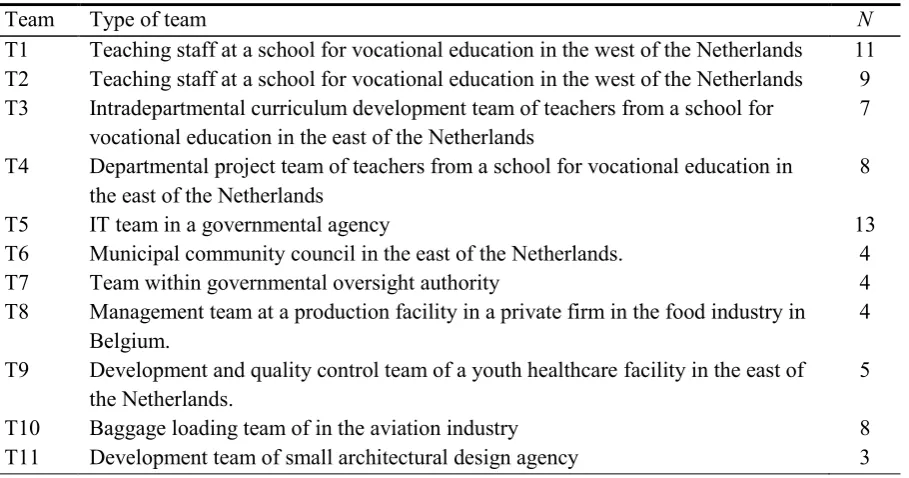
[image:12.595.74.529.526.765.2]The main units of analysis in this study were teams working in both the public and private sector. With regard to the public sector a distinction was made between the sub-sectors education and government. For the purpose of the study teams were defined as ‘a small number of people with complementary skills who are committed to a common purpose, set of performance goals, and approach for which they hold themselves mutually accountable’ (Katzenbach & Smith, 1993, p. 2). The teams were selected by means of purposive sampling. The context and aforementioned definition created the guideline for this type of sampling. Hence, 15 teams were invited to participate in the study of which 11 teams agreed to participate, see Table 2. Convenience sampling was used to select one team member of each team for an additional interview.
Table 2
Overview and background of the participating teams
Team Type of team N
T1 Teaching staff at a school for vocational education in the west of the Netherlands 11 T2 Teaching staff at a school for vocational education in the west of the Netherlands 9 T3 Intradepartmental curriculum development team of teachers from a school for
vocational education in the east of the Netherlands
7
T4 Departmental project team of teachers from a school for vocational education in the east of the Netherlands
8
T5 IT team in a governmental agency 13
T6 Municipal community council in the east of the Netherlands. 4
T7 Team within governmental oversight authority 4
T8 Management team at a production facility in a private firm in the food industry in Belgium.
4
T9 Development and quality control team of a youth healthcare facility in the east of the Netherlands.
5
T10 Baggage loading team of in the aviation industry 8
Measures
Instrument. To measure the error handling strategies applied by teams the validated Error Management Culture Questionnaire (EMCQ) by Van Dyck (2000), based on the Error Orientation Questionnaire (EOQ) as developed by Rybowiak et al. (1999), was used. To fit the purpose of the study the 36 items of the EMCQ were adapted to apply to the team level, see Appendix I. Moreover, the validated Dutch version of the EOQ was used to translate the adapted items to Dutch to safeguard the conceptual integrity and validity of the questionnaire by Rywbowiak et al. (1999).
The questionnaire consisted of eight error handling subscales, namely: communicating (e.g. when a team member is unable to correct an error, he/she turns to the team), improving (e.g. our errors point us to what we can improve), analysing (e.g. after making a mistake, we try to analyse what caused it.), correcting (when an error has occurred we usually know how to rectify it), risk taking (e.g. we would rather make mistakes than do nothing), anticipating (e.g. in our team we take the occurrence of errors into account), covering up errors (e.g. in our team people prefer to keep their errors to themselves) and error strain (e.g. if an error occurs, people get upset and irritated), see appendix II. Team members were asked to indicate to what extent the statements applied to their teams on a Likert-scale ranging from 1 (does not apply at all) till 5 (applies completely).
Validity and reliability. To test the validity and reliability of the questionnaire a series of tests were used. Preliminary analyses of the kurtosis and skewness normality showed no violations in the assumption of normality (Field, 2013). Hence, an explanatory factor analysis (EFA) was used to investigate whether the factor structure as expected based on the theory could be confirmed in the current data. Since, the sample size (N=76) was relatively low for performing an EFA the Kaiser-Meyer-Olkin’s measure of sampling adequacy and the Bartlett’s test of Sphericity were analysed to determine whether the sample was sufficient. With the KMO higher than .60 (KMO = .666) and a significant Bartlett’s test of Sphericity (p < .001) the data was deemed sufficient for factor analysis (Field, 2013).
In order to select an EFA that would optimally fit with the goals and data there were several key considerations: (a) the extraction method, (b) the rotation method, (c) the number of factors and (d) the criteria for item removal. The reasoning for each item is explained below:
a) Principle component analysis was chosen as extraction method since this method aims to reduce the number of items in the data while retaining as much as the original item variance as possible (Worthington & Whittaker, 2006).
b) Direct Oblimin was selected as rotation method for there was an expectation that the variables, as most psychological measures, are correlated (Field, 2013).
d) The interpretation of the pattern and structure matrix was based on the recommendations of Worthington & Whittaker (2006) and were executed as followed. Item reduction was performed if one of the following cases applied: (1) an item’s highest significant factor loading is smaller than .32; (2) an item is loading .32 on two of more factors or (3) cross-loading with less than .15 difference from the item with the highest factor cross-loading.
An initial analysis was computed to obtain eigenvalues for each factor in the data: ten factors had eigenvalues over Kaiser’s criterion of 1 and explained 70,497% of the variance. However, none of the factors loaded with more than two items, as such all factors were seen as unreliable. Therefore, based on the three factor indication of the scree plot and expected number of factors from prior research, an EFA with three fixed factors was performed. Items 11, 12, 22, 24 and 29 were removed for not meeting the criteria as outlined by Worthington & Whittaker (2016), leaving 31 items remaining across the three factors. The distribution of the items among the factors coincided and underlined the findings of the research into the error handling strategies on the organisational level of Van Dyck (2000). Following her reasoning the factors were labelled identically; factor 1 was labelled mastery and contained the items of analysing, correcting, improving and communicating errors ( = .86). Factor 2 contained the items risk taking and anticipating and was labelled as awareness ( = .83) Factor 3 was labelled fear of error and contained the items error strain and covering up ( = .79). The factors had acceptable to good reliability and explained 43,19% of the variance in the data, see Appendix III.
Procedure
Teams were approached for participation based on the network of the researcher as well as the network of her colleagues in a consultancy firm. After the team gave their consent to participate in the study the team received the questionnaire. Depending on the preference of the team, the questionnaires were distributed online, through Qualtrics, or on paper. If a team chose the online version each team member received a personal e-mail containing a personal link to the questionnaire. In the case of paper questionnaires, the team leader received the questionnaires via post after which team members could fill out the questionnaire and put the questionnaire in a sealed envelope. Both forms of questionnaires contained accompanying letters explaining the purpose of the study, instructions, anonymity, and the possibility to withdraw. This way of working is chosen to maximize the response rate and safeguard the anonymity of participants during the process.
At the end of the questionnaire team members were asked whether they wanted to participate in an interview. If the team member answered yes, they were asked to fill out their phone number for further inquiry. In total, 68% of all team members left their phone number and from each team one of the team members was randomly for the interview. When there was no suitable date could be found in the near future another team member would be contacted based on random selection. Prior to the start of the interview the interviewees were informed about the purpose of the interview as well as asked for permission to record the interview. They were also informed that they could stop the interview at any given time if they did not want to continue. Furthermore, they were presented with the option to receive the transcription of the interview. Interviews were held both in person as by telephone. All data was treated as confidential as well as saved and processed anonymously.
Data analysis
The quantitative data gathered by the questionnaire was analysed using with IBM’s SPSS22. As the first step in the data analysis, descriptive statistics were performed to determine the applied error handling strategies applied by teams. Second, a one-way multivariate analysis (MANOVA) was performed was to establish whether there was a difference in the level of mastery, awareness and fear of error amongst the teams. Univariate tests were computed for the variables who were significant one the multivariate test.
Results
The purpose of this study was to determine how the process of learning from error is put into practice in a team based setting. In this chapter the results of the descriptive and inferential statistics are presented. Subsequently, these findings are illustrated and deepened by the qualitative findings.
Error handling strategies applied by teams
[image:17.595.77.526.370.564.2]The first goal of the study was to identify which error handling strategies were applied by teams and whether teams differed in the error handling strategies they applied. The quantitative data analysis identified three overarching error handling strategies applied by teams: mastery, awareness and fear of error. Descriptive statistics of the teams on these overarching strategies are presented in Table 3. The results show mean scores above the midpoint of the scale on the strategies mastery and awareness, indicating that these strategies were present, at least, to some extent among all teams. The strategy of fear of error scores below the midpoint of the scale, indicating that the prevalence of fear of error was less pronounced.
Table 3
Descriptive statistics of the overarching error handling strategies among the teams
Teams Mastery Awareness Fear of Error
M SD M SD M SD
T1 3.27 .51 3.44 .45 2.42 .60
T2 3.24 .40 3.44 .51 2.32 .41
T3 3.32 .44 3.61 .32 2.48 .50
T4 3.66 .57 3.86 .70 2.05 .58
T5 3.38 .60 3.46 .59 2.21 .67
T6 3.78 .27 4.14 .26 2.19 .29
T7 3.36 .29 3.57 .73 2.03 .29
T8 3.75 .44 3.76 .36 2.42 .45
T9 3.45 .14 3.46 .38 2.47 .20
T10 3.59 .48 2.57 .78 2.14 .59
T11 3.46 .49 3.51 .67 2.24 .54
Note: Mean scores ranged from 1 (does not apply at all) till 5 (applies completely)
strategy was less pronounced. Third, the strategy fear of error was less pronounced in the questionnaires but the interviews revealed that the fear of error was present in actuality for slightly over a third of the teams.
The MANOVA was conducted to determine whether teams differed on the overarching strategies mastery, awareness and fear of errors. Prior to performing the MANOVA the assumptions of univariate normality and homogeneity of covariance’s were tested. Univariate normality was tested with Shapiro-Wilk test at = .05. With the D(72) = 3,5, p = .07 normality was not violated. The homogeneity of covariance underwent a preliminary test by means of the Levene’s test at = .001 and was consolidated by the Box’s test at = .001. The Box test was used because of the difference in group sizes as well as the small sample size. Since neither the Levene’s test for mastery (F(1,10) = 1.32, p = 0.240), awareness (F(1,10) = 2.54, p = 0.013) and fear of error (F(1,10) = 1.32, p = 0.241) nor the Box’s M = 94.51, p = .107 were significant, it was assumed that the variance among the factors was roughly equal (Field, 2013). Furthermore, Pillai’s trace was chosen as test statistic as this is the most robust test when dealing with differences in group sizes (Field, 2013).
Using Pillai’s trace, a significant effect of the teams on the strategies was found, Λ = 0.64, F(30, 183) = 1.65, p < .05. The following univariate analyses revealed a significant effect of awareness between teams F(10, 61) = 2.39, p = .018. No significant effects were found for between teams on mastery and fear of error. Post-hoc comparison using Bonferroni indicated that the mean score of the team T10 (M = 2.57, SD = .78) was significantly different from the teams T4 (M = 3.46, SD = .38) and T6 (M = 4.14, SD = .26). In order to interpret these findings it was worthwhile to bring back the factor to its original underlying strategies, namely: risk taking and anticipating. Herein, it became evident that there was a significant difference in the mean scores of the teams in risk taking (F(2,16) = 22.02, p = < .001). Whereas, the mean scores on anticipating were not significantly different (F(2,16) = 0.90, p =
.429). Hence, the results suggest that the teams T4 and T6 are more prone to take risks in their work in comparison with team T10.
Practical implications of the error handling strategies on learning from error
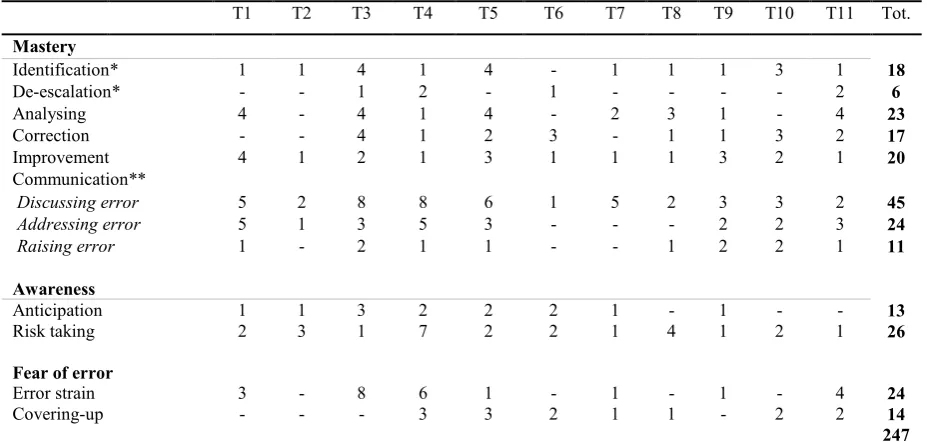
The second goal of the study was to identify the practical implications of the error handling strategies for learning from error. The qualitative data yielded 576 coded statements, 247 of these statements were related to the error handling strategies of teams, see Table 4. To gain further understanding the statements were quantified by indication of mention, presence and effect of the error handling strategy.
Mentions displays how often the strategy was mentioned during the interviews. When the interview did not yield relevant information regarding the application of the error handling strategy this was left vacant. The application provides insight in whether the strategy was applied by the team or not and the
Table 4
Frequencies
T1 T2 T3 T4 T5 T6 T7 T8 T9 T10 T11 Tot.
Mastery
Identification* 1 1 4 1 4 - 1 1 1 3 1 18
De-escalation* - - 1 2 - 1 - - - - 2 6
Analysing 4 - 4 1 4 - 2 3 1 - 4 23
Correction - - 4 1 2 3 - 1 1 3 2 17
Improvement 4 1 2 1 3 1 1 1 3 2 1 20
Communication**
Discussing error 5 2 8 8 6 1 5 2 3 3 2 45
Addressing error 5 1 3 5 3 - - - 2 2 3 24
Raising error 1 - 2 1 1 - - 1 2 2 1 11
Awareness
Anticipation 1 1 3 2 2 2 1 - 1 - - 13
Risk taking 2 3 1 7 2 2 1 4 1 2 1 26
Fear of error
Error strain 3 - 8 6 1 - 1 - 1 - 4 24
Covering-up - - - 3 3 2 1 1 - 2 2 14
247 Note: * identification and de-escalation were added as additional error handling strategies to the framework; ** communication was divided in three underlying strategies to increase understanding.
Mastery
Identification. Identification related to the recognition and the classification of error as such. Eighteen of the statements were coded as identifying among ten of the 11 teams, see Table 5. Among eight of the ten teams, the interviewees mentioned one or more instances were errors were identified. In all of the cases, except for one, the identification of the error was indicated as aiding in the process of learning. The case in which the identification of the error did not support the learning process related to a situation in which the identification was not followed-up by other error handling strategies. two interviewees mentioned that in their respective teams it was not self-evident to dwell upon error. The interviewee of team T3 ascribed this to the negative emotions errors evoke. Whereas, the interviewee of team T1 stated that reflection concerning work processes was generally absent in his team.
“At the start of a new round we don’t look back on what we did (red. in the previous round) and indicate the points for improvement” – T1
The teams seemed to differ in the manner in which they identify errors, at which time in the process and how they proceed. Three of the teams, T4, T8 and T11, actively identify such instances by the implementation of formal structures. Examples of these formal structures were test-cases1, escalation models2 and retrospectives3. These structures closely relate to the error management perspective, since they are implemented to support early detection and reduce the negative consequences. Three other
1 Test cases: set of test inputs to check whether the case functions according to the objectives
teams, T4, T10 and T11 mentioned that the identification and the addressing of errors of by the team leader was the most prevalent route. Meaning that in most cases the team leader brought up the error in personal contact or in team meetings. Moreover, all these teams also have regular team meetings in which they discuss what is going well and what needs attention. The common dominator among these teams seem to be an embedded practice in which a moment for reflection is created, whereas teams who have difficulties with identification as error handling strategy did not have such a practice in place.
Table 5
Mentions, application and implication of the error handling strategy identification
T1 T2 T3 T4 T5 T6 T7 T8 T9 T10 T11 Tot.
No. of mentions 1 1 4 1 4 - 1 1 1 3 1 18
Application Applied - 1 2 1 4 - 1 1 1 3 1
Notapplied 1 - 1 - - - -
Implication Aiding - 1 - 1 2 - 1 1 1 1 -
Hindering - - - -
Analysing errors. Analysing errors was defined as searching for as well as thinking about the cause of an error, also includes evaluation practices. 21 of the statements were attributed to analysing errors, among seven of the teams, see Table 6. The ability of the team to analyse errors was not always self-evident and seemed to differ per situation. Six of the teams referred to situations in which they analysed an error.
“In this case it regarded an error in our work process. In our analyses we first determined what our goal was, which steps we have taken and at which point(s) it did not go as we planned. By
looking back, it is easy to indicate where you can improve” – T11
All these situations were noted as aiding in the process of learning. However, four of the seven teams also referred to situations in which the error was not analysed. Furthermore, two teams mentioned that there is a structural lack of analysis prevalent in the team, both analysing successful and erroneous outcomes of their actions. The nature of the error seemed to matter in the ease to which an error is analysed. Slips, lapses and process-based errors were easier to analyse than errors which involve personal wrong doing or relationships. Moreover, two of the teams indicated that it is very helpful to analyse the error in the actual context (e.g. finished building or machine) in which the error occurred.
Table 6
Mentions, application and implication of the error handling strategy analysing errors
T1 T2 T3 T4 T5 T6 T7 T8 T9 T10 T11 Tot.
No. of mentions 4 - 4 1 4 - 2 3 1 - 4 23
Application Applied 1 - 3 - 1 - 2 3 1 - 4
Notapplied 2 - 1 1 3 - - - -
Implication Aiding 1 - 2 - - - 2 1 1 - 4
[image:20.595.70.533.693.767.2]Correction. Correction was defined as the correcting of the error as soon as possible. Seventeen statements were coded according to this definition among eight of the 11 teams, see Table 7. Seven of the teams mentioned at least one situation in which the error was corrected shortly after the error was identified. The other teams did not have a clear example of a situation in which an error was corrected. Characteristic for these situations was the quick error handling to error reduce of the negative consequences of the error.
“The baggage wasn’t evenly distributed on the whole plane. When we notice this we quickly corrected, by unloading and reloading the plane. That needs to happen to ensure safety.” – T10
[image:21.595.69.538.430.506.2]All situations were labelled as mistakes. Additionally, three situations were labelled as slips or lapses. Remarkable is that all these instances, except for the mistakes mentioned by T8 and T9, were not guided nor followed by an analysis of the cause of the error. Subsequently, these instances were also coded as single loop learning, meaning that the errors are corrected without paying attention to or stopping the underlying problem or cause. In these situations, the correction of the error was often experienced as helpful for the continuation of the process but did not foster structural changes or learning gains when it regarded mistakes.
Table 7
Mentions, application and implication of the error handling strategy correction
T1 T2 T3 T4 T5 T6 T7 T8 T9 T10 T11 Tot.
No. of mentions - - 4 1 2 3 - 1 1 3 2 17
Application Applied - - 4 - 2 3 - 1 1 3 2
Notapplied - - - 1 - - - -
Implication Aiding - - 2 - 2 3 - 1 1 3 1
Hindering - - 1 1 - - - -
Improvement. Improvement was defined as using errors to improve work, in the future, or tackle a problem in a new way. The importance of improving one’s work after an error was mentioned by all teams, see Table 8. Six of the teams also gave examples of situations in which they were able to improve their work after an error occurred. Analysing these situations, it became apparent that in four of the six situations the teams had come together to make agreements about how to proceed as well as how to ensure these errors would not repeat themselves in the future. Teams which faced difficulties in improving upon errors made statements such as:
“We already established this problem last year and said we wanted to do something differently, but it does not actually happen. We are only talking about the problem.” - T4
and
These statements showed that in these cases teams did not reach the point of making joint agreements about how to proceed. In other words, the ability of the team to improve upon errors seemed to be influenced by their ability to make agreements about how to proceed. Additionally, the combination of coding also revealed that statements that were coded as improving also were coded as identifying and analysing, as well as being coded as double loop learning. This indicated that in order for a team to improve upon an error the error had to be identified as well as being analysed. These actions also relate to double loop learning, as double loop learning is characterized by addressing the underlying variables after the occurrences of an error and the subsequent adaptation of behaviour and actions.
Table 8
Mentions, application and implication of the error handling strategy improvement
T1 T2 T3 T4 T5 T6 T7 T8 T9 T10 T11 Tot.
No. of mentions 4 1 2 1 3 1 1 1 3 2 1 20
Application Applied - 1 1 1 2 1 1 - - 1 -
Notapplied 3 - 1 - - - 1 - 1
Implication Aiding - 1 1 1 2 1 1 - - 1 -
Hindering - - 1 - - - -
Communication. Communication relates to discussing errors within a particular team. Communicating about errors is a frequently mentioned topic during the interviews, with a total of 79 statements. However, during the interviews it became evident that communication is not a singular topic. When interviewees were asked about the communication of errors they often referred to examples which were later categorized as discussing errors, addressing errors and raising error. These three distinction categories are critical for gaining a full understanding of their specific meaning.
Discussing errors. The definition of discussing errors closely relates to the original meaning of communicating. It was regarded as discussing errors within the team and also includes asking advice. In total, 45 statements were retrieved with regard to discussing errors, see Table 9. All teams mentioned one or more instances in which errors were discussed. Notably, all of the situations in which errors were discussed aided the process of learning from the error. These discussions were most fruitful for learning when they contributed to the clarification of the situation, team members were open-minded and willing to share as well as establish actions to proceed.
Table 9
Mentions, application and implication of the error handling sub-strategy discussing errors
T1 T2 T3 T4 T5 T6 T7 T8 T9 T10 T11 Tot.
No. of mentions 5 2 8 8 6 1 5 2 3 3 2 45
Application Applied 3 1 5 5 5 1 5 2 1 2 2
Notapplied 2 1 6 3 - - 1 - 1 1 -
Implication Aiding 3 - 2 4 4 - 4 1 1 - 2
Hindering - - - -
Addressing errors. This form of communication was regarded as addressing the errors of others and was mentioned 23 times during the interviews among eight of the teams, see Table 10. This notion was often brought up when the interviewer inquired into communicating about errors. The interviewees linked communicating about error with addressing the person in question or providing feedback. Or it was mentioned as being present or absent in the culture: ‘’we do not really have a culture of pointing out errors’’. In practice this meant that rather than discussing or conversing the act or error the teams in question the focus was on the initial ‘’pointing out’’ phase. In the cases where the process ended there, it did not contribute to learning. However, when this was seen as the initial step to further discussion and analysis it was a contributing factor to learning from error. Interesting to note is that all four teams from the education sector as well the 9th team from the private sector mentioned that they want to improve on addressing errors. The main complicating hurdle was the error strain and accompanying negative associations, such as: the feeling of it being construed as negative or a personal attack as well as a notions of futility.
Table 10
Mentions, application and implication of the error handling sub-strategy addressing errors
T1 T2 T3 T4 T5 T6 T7 T8 T9 T10 T11 Tot.
No. of mentions 5 1 3 5 3 - - - 2 2 3 24
Application Applied 1 1 2 5 3 - - - 1 2 2
Notapplied 4 1 1 1 - - - - 1 - -
Implication Aiding - - - - 1 - - - - 1 -
Hindering 1 - 1 3 - - - 1
Raising errors. As one can ‘raise the issue’ to bring forth a particular item, raising the errors referred to bringing forth the errors outside of the bounds of the team in the broader organisation. This notion was brought up 11 times during the interviews among eight teams, see Table 11.
“When we had to implement a new system in whole the organisation we discovered that the verification source for the system was not suitable. We raised this error and advised to stop
[image:23.595.69.531.507.580.2]Similar to addressing error, raising errors has a positive learning effect when it leads to a follow up action or conversation. These forms of learning show promise in contributing to learning processes when followed through upon yet falter when merely taken as an opportunity for singular action.
Table 11
Mentions, application and implication of the error handling sub-strategy raising errors
T1 T2 T3 T4 T5 T6 T7 T8 T9 T10 T11 Tot.
No. of mentions 1 - 2 1 1 - - 1 2 2 1 11
Application Applied 1 - 1 1 1 - - 1 1 2 1
Notapplied - - 1 - - - 1 - -
Implication Aiding - - - 1 1 - - 1 1 - -
Hindering 1 - 1 - 1 - - - -
De-escalation. Four teams brought up de-escalation as an important strategy when being confronted with error, see Table 12. In this context de-escalation was defined as: addressing the emotions the error invokes prior to transitioning to the phase of analysing and adjusting. Teams stressed the importance of de-escalating because they experienced that emotion, when disregarded, leave less room for an objective assessment and effective planning for improvements. In this regard awareness of emotions seemed to play a critical role in facilitating positive learning outcomes.
“In situations where the error causes a lot of negative emotions, you have to address this tension the error before you can even try to learn from it.”– T11
Awareness of emotions as a facilitating factor was said to require interaction and communication throughout the team. This to ensure that it was not an aspect or recognition of one individual but that the team was open to addressing emotions and circumstances involved with error. Moreover, an example of one of the teams showed that the absence of addressing the emotions resulted in a negative situation; there was substantial tension under the surface, a downward spiral of escalation rather than de-escalation, and limited learning gains.
Table 12
Mentions, application and implication of the error handling de-escalation
T1 T2 T3 T4 T5 T6 T7 T8 T9 T10 T11 Tot.
No. of mentions - - 1 2 - 1 - - - - 2 6
Application Applied - - - 2 - 1 - - - - 2
Notapplied - - 1 - - - -
Implication Aiding - - - 1 - - - 2
[image:24.595.70.537.616.691.2]Awareness
Anticipation. Anticipation was defined as foreseeing the possibility of error in future work endeavours. During the interviews anticipation was often omitted by the interviewees initially until being brought in by the researcher as part of the inquiry. The teams who brought up the factor anticipating were teams who experienced a sense of necessity to be aware of errors related to safety concerns due to the nature of their work or preceding occurrences. Moreover, anticipation as error handling strategy was underrepresented in the interviews, in comparison with the other strategies, with only 13 statements, see Table 13. Nonetheless, two levels of anticipating could be identified based on these statements: (1) anticipating and follow-up, (2) anticipating and no-follow up.
[image:25.595.69.533.481.554.2]The first level regards the teams, T4, T5 as well as T6 who anticipated on situations which were error prone and acted accordingly. These team state that it important to analyse situations beforehand to assess what could happen. Herein they form a series of scenarios which help them in addressing the situation at hand. As a result, they would either change their plans or identified errors more easily. The second level regards the teams T1 till 3 and T6 who described situations in which they were aware of situations which were error prone but did not act accordingly. For instance, one of the teams is rolling out new working manuals which demand a new way of working. Although the team was aware that there were a lot of resistance among their colleagues, the team did not do anything about the resistance during the process of developing the new manual. As a result, the manual got a lot of backlash and was not accepted as a new standard.
Table 13
Mentions, application and implication of the error handling strategy anticipation
T1 T2 T3 T4 T5 T6 T7 T8 T9 T10 T11 Tot.
No. of mentions 1 1 3 2 2 2 1 - 1 - - 13
Application Applied - - 2 1 - 1 - 1 - -
Notapplied 1 1 3 - - 1 - - - - -
Implication Aiding - - 2 1 - 1 - 1 - -
Hindering - - 1 - - 1 - - - - -
Risk taking. Risk taking refers to the manner in which teams create space for unexpected results and experimenting. In contrast with anticipating, risk taking was frequently mentioned during the interview with a total of 26 statements, see Table 14. All teams elaborated on the role of risk taking in their team. Four teams, T2, T5, 6 and 7 mentioned that they deliberately create room for risk taking and experimenting. The team of T2 organizes this by regularly taking part in pilot studies and the other teams by trying novel ways of working. The common denominator among these teams is that you have to recognize the risks before taking them.
“We definitely take risk, but only if you indicated them as such. Taking risks by just simply taking the actions for granted and not thinking about what you're doing, will not get through with us.
On the contrary there were also three teams, T8, T10 and T11, who indicated that there was no room for risk taking in their line of work due to the nature of their work to safeguard safety or follow laws and regulation. Which makes it challenging to construe a context for experimentation in such an environment of significant consequence, often requiring approval beforehand. As such experimenting is regarded as difficult, an area where experimentation does take place is experiments concerning how people work together i.e. team structures or teamwork. In addition, to risk taking on the team level it was found that the individual plays an important role in experimenting and risk taking. The team of T1 mentioned that they as a team take little risk and that the initiative lies with the individual rather than with the team. Whereas team T2 does indicate taking risks and experimenting, with some team members being more risk averse and cemented in their ways.
Table 14
Mentions, application and implication of the error handling strategy risk taking
T1 T2 T3 T4 T5 T6 T7 T8 T9 T10 T11 Tot.
No. of mentions 2 3 1 7 2 2 1 4 1 2 1 26
Application Applied 1 2 1 7 2 2 1 3 1 1 -
Notapplied 1 1 - 1 - - - 1 - 1 -
Implication Aiding 1 - 1 7 1 2 1 1 1 1 -
Hindering 1 - - 1 - - - -
Fear of error
Error strain. Error strain relates to emotional reactions which can be experienced when confronted with error, such as fear, shame as well as obstructive thoughts. Seven of the teams made statements in relation to the presence or absence of error strain, see Table 15. Herein four teams mentioned situations in which error strain was perceived. In these cases, the error strain hindered the process of learning from error.
Table 15
Mentions, application and implication of the error handling strategy error strain
T1 T2 T3 T4 T5 T6 T7 T8 T9 T10 T11 Tot.
No. of mentions 3 - 8 6 1 - 1 - 1 - 4 24
Application Applied 2 - 7 6 - - - 4
Notapplied - - 1 - 1 - 1 - 1 - -
Implication Aiding - - - -
Hindering 2 - 4 6 - - - 1
Covering up. Covering up errors refers to consciously concealing errors when they occur, instead of making them public or sharing them with others. In seven of the interviews statements were made about the presence or absence of covering up errors, see table 16. Four teams referred to a situation in which error was concealed. Reasons mentioned for concealing were the perceived error strain as well as the perception “what good would it do” if an error would be shared.
The error strain inhibited the sharing errors from one's own volition or even the denial of the error when confronted by the error by another team member or the team leader. In the latter case the denial of the error inhibited the process of learning. The perception that it would not do any good to share errors resulted, for one of the teams, in a situation in which the error was not shared with other team members, whereas in another team the error was not shared with stakeholders outside the bounds of the team. Remarkably, three of these four teams also mentioned instances in which the error was not concealed. In these situations, the perceived error strain was less prominent and the importance of sharing the error more prominent. The same held true for the other four teams who mentioned situations in which error was not concealed.
Table 16
Mentions, application and implication of the error handling strategy covering up
T1 T2 T3 T4 T5 T6 T7 T8 T9 T10 T11 Tot.
No. of mentions - - - 3 3 2 1 1 - 2 2 14
Application Applied - - - 1 - 1 - - - 1 1
Notapplied - - - 2 3 - 1 1 - 1 1
Implication Aiding - - - -
Hindering - - - 1 -
Conditions fostering the implementation of error handling strategies
[image:27.595.71.532.513.587.2]Attitude of team leader.According to seven teams their team leader had a strong impact on the attitude of the team towards error. The important aspect herein was that the tone was set by the team leader,
presenting a direction for the attitude of the team towards error. When the leader had an open attitude towards error and was able to show that he or she is fallible this had a positive influence on the attitude of the team. Examples of this kind of behaviour were showing vulnerability in team meetings as well as investing their own time to reflect upon errors or working alongside the team to solve an error. In situations where team leader portrayed a negative stance towards errors, was unwilling or unable to do something about the error the learning gains were limited. In such instances teams experiences a level of inaction from the team leader which created an atmosphere of apathy. Moreover, a negative attitude increased error strain and made team members less likely to open up about error due to not feeling safe or feeling insecure about discussing error. The team leader can also fulfil a part in de-escalating.
Time.Time seemed to be of essence in the ability of the team to apply the error handling strategies. The impact of time was mentioned 17 times in the interviews. Time could both aid or hinder learning depending on the volume. The former stemming from the relationship between the ability to schedule time for analysis as well as taking time to anticipate on errors. The latter revolving around the additional challenges brought by a shortage of time for analysis and anticipation due to taxing work schedules. Remarkably, all teams in working in the educational sector experienced all a lack of time to anticipate or master errors.
“There is way too little time. There is just enough time to establish that thing don’t work as they are supposed to work but that is it”. – T2
The lack of time for these activities hindered these teams in learning form error. Moreover, in some cases the organizational processes also hindered the ability of the team create time for these activities. For instance, one of the teams is not able to declare hours for consulting colleagues in other departments without having a project number for the project. However, when you want to investigate whether it would be worthwhile to start a project this is not facilitated. Furthermore, the lack of time for anticipation also increased the likelihood of errors. However, three of the teams structurally created time for activities which would either focus on error prevention or error management. They state that it is important to schedule and invest time for these activities because it will save time in the long run.
the responsibility of the follow-up was difficult due to the experienced error strain. Moreover, one of the teams described that his team works in a sector always point to each other:
“If you indicate I've done something wrong, you're the one who has to pay. So the first thing you say: It wasn’t me. And the second thing is: It is because of him”. – T11
When no one would take this (shared) accountability the likelihood of minimizing the negative consequences of an error and maximizing the positive outcomes is minimal.
Discussion
The aim of this study was to explore how the process of learning from error is put into practice in a team based setting. The study focused on teams in the public and private sector. Insight in the process of learning from error in the team is valuable to advance the understanding of the manner in which teams are able to generate new knowledge and working behaviour through error. In this chapter the results of the study are discussed, followed by the limitations of the present study, recommendations for future research as well as the practical implications.
Discussion of results
The first purpose of the study was to identify which error handling strategies teams apply when confronted with error and whether teams differ in the strategies they apply. Rybowiak et al. (1999) defined eight error handling strategies applied by individuals when confronted with error. Results show that these eight strategies are challenging to delineate on the team level. Nevertheless, the results did clearly indicate three overarching strategies: mastery, awareness and fear of error. These overarching strategies are in line with the findings of Van Dyck (2000) who distinguished the same overarching strategies with the same underlying error handling strategies at the organisational level. Consequently, when the unit of analysis moves away from the individual and towards the team or organisational level the scope of each of the eight strategies become more challenging to measure quantitatively and delineate individually.
The second purpose of the study was to identify the practical implications of the error handling strategies for learning from error. The results indicate that the applications of the error handling strategies are performed consecutively and the extent to which these sequences foster learning. The first step in transforming the error to a learning experience was found to be identification. By placing identification at the start of the error handling sequence the process gains in clarity. Since being able to determine whether teams recognize error is a key component in assessing further steps taken. Hence, this study finds the addition of identification valuable for the overall theory concerning error handling strategies. Furthermore, there are some important interactions of identification with anticipation and risk taking. The quickness with which teams identify error is strongly reliant on their proficiency with anticipation and risk taking. When teams are proficient in these strategies it fosters early error detection, since both strategies demand a certain level of awareness of the possibility of errors.
After the identification of the error the team follows one of two routes, see Figure 3. The first route being identification followed by addressing and/or correcting. The second route being identification, de-escalating, analysing & discussing and improving. In the first route the error is addressed and/or corrected as soon as it occurs but the team does not deploy a follow-up. Such error handling strategies are sufficient when dealing with slips and lapses but in the case of mistakes these strategies are not sufficient to substantiate learning. This is what Argyris and Schön (1978) indicate as single loop learning: the error is corrected without paying attention or stopping the underlying problem or cause. Consequently, no structural changes are carried through which increases the likelihood of a repetition of the same type of error.
Route 1
Route 2
Anticipation
Identification
Identification
Risk taking
Addressing
and/or
correction
De-escalation
Addressing and/or correction
Analysing and discussing
Improving
[image:32.595.71.526.69.440.2]Sustainable learning
Figure 3. Routes of error handling strategies to sustainable learning
In addition, the nature of the error seemed to matter in the ease to which it is discussed and analysed. Slips, lapses and process-based errors are easier to analyse and discuss than error which involve personal wrongdoing or relationships. This could be ascribed to the negative emotions the error evokes such as frustration, despair and the fear of losing face as described by Heimbeck et al., 2003. Furthermore, the error strain of these negative emotions hinder teams in learning from error as they increase the likelihood of covering the error up and hinder the application of error handling strategies (Van Dyck, 2000). These findings also question whether error strain should be indicated as an error handling strategy; the error strain cannot deliberately be deployed as a strategy nor is the strategy part of the process of learning from error. In this regard the error strain t is more likely and is not part of the framework of is the strain part of the they part of the process of learning from error. It could be argued that the error strain functions as a mediator which influences the extent to which is learned.
influence of the attitude of the team. Accountability attributes in a similar matter to a positive learning climate. Taking responsibility implies that one wants to learn from error. This increases the probability that the error handling strategies are deployed and time is invested to learn. Furthermore, a diversity in team roles could support the process of learning by offering different or fresh perspectives to the challenge as well as uncovering blind spots.
Limitations and future research
Despite the careful design of the study, there are some limitations of the research design. The first relates to the identification of the error handling strategies applied by teams by means of the questionnaire. Although the findings based on qualitative data retrieved by the questionnaire match the previous research by Van Dyck (2000), the triangulation of the quantitative data and the qualitative data within the study showed an inconsistent image concerning the application of the error handling strategies by teams. Where the quantitative data indicated that teams applied both error handling strategies mastery and awareness to some extent and the fear of error less frequent, the qualitative data revealed a more disperse image of the application of the strategies. This inconsistency may have occurred due to a general tendency of participants to answer towards the centre on a Likert-scale (Allen & Seaman, 2007). In addition, the items referred to the application of error handling strategies on errors in general. The latter notion makes it more likely that questions will be answered in the range of ‘sometimes’ or ‘sometimes not’. In future research it would be advised to ask participants to write down a situation in the past weeks in which the team deviated from the desired result prior to filling out the questionnaire. It is assumed that departing from a concrete example does not only a guide to answer the questions but also offers the researcher insights into which strategies participants had in mind. Furthermore, it would be recommended to add identification as an error handling strategy in the questionnaire.
The second limitation is that due to the explorative nature of the current study into the process of learning from error only one team member from each team participated in the interview. While this was appropriate given the exploratory scale, in future research it could be of additional benefit to expand upon this for further generalizability. Furthermore, gathering more information from teams themselves could provide further insights into team interactions.
on learning from error or to measure the relationship between error and the other positive error outcomes: performance and innovation.
Practical implications
The results of this study are worthwhile to translate to teams as the findings provide insight in the process of learning from error and how teams can foster learning from error.
Conclusion
Bibliography
Allen, I. E., & Seaman, C. A. (2007). Likert scales and data analyses. Quality progress, 40(7), 64. Argyris, C., & Schön, D. (1978). Organizational learning: A theory of action perspective. Reading, MA: Addison Wesley.
Barach, P., & Small, S. D. (2000). Reporting and preventing medical mishaps: lessons from non- medical near miss reporting systems. British Medical Journal, 320(7237), 759.
Baumard, P., & Starbuck, W. H. (2005). Learning from failures: Why it may not happen. Long Range Planning, 38(3), 281-298.
Bauer, J. & Mulder, R. H. (2008). Conceptualisation of learning through errors at work – a literature review. In S. Billett, C. Harteis & A. Eteläpelto (Eds.), Emerging perspectives on workplace learning (pp. 115-128). Rotterdam: Sense Publishers.
Cannon, M. D., & Edmondson, A. C. (2001). Confronting failure: Antecedents and consequences of shared beliefs about failure in organizational work groups. Journal of Organizational Behavior, 22(2), 161-177.
Cannon, M. D., & Edmondson, A. C. (2005). Failing to learn and learning to fail (intelligently): How great organizations put failure to work to innovate and improve. Long Range Planning, 38(3), 299-319.
DeVellis, R.F. (2012). Scale development: Theory and applications (Vol. 26). Thousand Oaks, CA: Sage publications.
Edmondson, A. C. (1996). Learning from mistakes is easier said than done: Group and organizational influences on the detection and correction of human error. The Journal of Applied Behavioral Science, 32(1), 5-28.
Endedijk, M. D., Brekelmans, M., Sleegers, P., & Vermunt, J. D. (2016). Measuring students’ self regulated learning in professional education: bridging the gap between event and aptitude measurements. Quality & quantity, 50(5), 2141-2164.
Field, A. (2013). Discovering statistics using IBM SPSS statistics. London: Sage publications.
Frese, M., & Keith, N. (2015). Action errors, error management, and learning in organizations. Annual review of psychology, 66, 661-687.
Frese,, M. & Zapf, D. (1994). Action as the core of work psychology: A German approach. In Harry C. Triandis, Marvin D. Dunette and Leatta M. Hough (Eds.),, Handbook of Industrial and Organizational Psychology, 4, 271-340. Paloo Alto: Consulting Psychologists Press.
Flanagan, J. C. (1954). The critical incident technique. Psychological bulletin, 51(4), 327.
Gelfand, M. J., Frese, M., & Salmon, E. (2011). Cultural influences on error prevention, detection, and management. Errors in organizations, 273-315.