Proceedings of the 49th Annual Meeting of the Association for Computational Linguistics, pages 835–845,
Binarized Forest to String Translation
Hao Zhang
Google Research
Licheng Fang
Computer Science Department University of Rochester
Peng Xu
Google Research
Xiaoyun Wu
Google Research
Abstract
Tree-to-string translation is syntax-aware and efficient but sensitive to parsing errors. Forest-to-string translation approaches mitigate the risk of propagating parser errors into transla-tion errors by considering a forest of alterna-tive trees, as generated by a source language parser. We propose an alternative approach to generating forests that is based on combining sub-trees within the first best parse through binarization. Provably, our binarization for-est can cover any non-consitituent phrases in a sentence but maintains the desirable prop-erty that for each span there is at most one nonterminal so that the grammar constant for decoding is relatively small. For the purpose of reducing search errors, we apply the syn-chronous binarization technique to forest-to-string decoding. Combining the two tech-niques, we show that using a fast shift-reduce parser we can achieve significant quality gains in NIST 2008 English-to-Chinese track (1.3 BLEU points over a phrase-based system, 0.8 BLEU points over a hierarchical phrase-based system). Consistent and significant gains are also shown in WMT 2010 in the English to German, French, Spanish and Czech tracks.
1 Introduction
In recent years, researchers have explored a wide spectrum of approaches to incorporate syntax and structure into machine translation models. The uni-fying framework for these models is synchronous grammars (Chiang, 2005) or tree transducers
(Graehl and Knight, 2004). Depending on whether or not monolingual parsing is carried out on the
source side or the target side for inference, there are four general categories within the framework:
• string-to-string (Chiang, 2005; Zollmann and Venugopal, 2006)
• string-to-tree(Galley et al., 2006; Shen et al., 2008)
• tree-to-string (Lin, 2004; Quirk et al., 2005; Liu et al., 2006; Huang et al., 2006; Mi et al., 2008)
• tree-to-tree(Eisner, 2003; Zhang et al., 2008)
We believe that structural variants which allow more source spans to be explored during translation are more important (DeNeefe et al., 2007), while syn-tactic variants might improve word sense disam-biguation but also introduce more spurious ambi-guities (Chiang, 2005) during decoding. To focus on structural variants, we propose a family of bina-rization algorithms to expand one single constituent tree into a packed forest of binary trees containing combinations of adjacent tree nodes. We control the freedom of tree node binary combination by restrict-ing the distance to the lowest common ancestor of two tree nodes. We show that the best results are achieved when the distance is two, i.e., when com-bining tree nodes sharing a common grand-parent. In contrast to conventional parser-produced-forest-to-string models, in our model:
• Forests are not generated by a parser but by combining sub-structures using a tree binarizer.
• Instead of using arbitary pruning parameters, we control forest size by an integer number that defines the degree of tree structure violation.
• There is at most one nonterminal per span so that the grammar constant is small.
Since GHKM rules (Galley et al., 2004) can cover multi-level tree fragments, a synchronous grammar extracted using the GHKM algorithm can have syn-chronous translation rules with more than two non-terminals regardless of the branching factor of the source trees. For the first time, we show that simi-lar to string-to-tree decoding, synchronous binariza-tion significantly reduces search errors and improves translation quality for forest-to-string decoding.
To summarize, the whole pipeline is as follows. First, a parser produces the highest-scored tree for an input sentence. Second, the parse tree is re-structured using our binarization algorithm, result-ing in a binary packed forest. Third, we apply the forest-based variant of the GHKM algorithm (Mi and Huang, 2008) on the new forest for rule extrac-tion. Fourth, on the translation forest generated by all applicable translation rules, which is not neces-sarily binary, we apply the synchronous binarization algorithm (Zhang et al., 2006) to generate a binary translation forest. Finally, we use a bottom-up
de-coding algorithm with intergrated LM intersection using the cube pruning technique (Chiang, 2005).
The rest of the paper is organized as follows. In Section 2, we give an overview of the forest-to-string models. In Section 2.1, we introduce a more efficient and flexible algorithm for extracting com-posed GHKM rules based on the same principle as cube pruning (Chiang, 2007). In Section 3, we in-troduce our source tree binarization algorithm for producing binarized forests. In Section 4, we ex-plain how to do synchronous rule factorization in a forest-to-string decoder. Experimental results are in Section 5.
2 Forest-to-string Translation
Forest-to-string models can be described as
e=Y( arg max
d∈D(T), T∈F(f)
P(d|T) ) (1)
wherefstands for a source string,estands for a tar-get string,F stands for a forest, Dstands for a set of synchronous derivations on a given tree T, and Y stands for the target side yield of a derivation. The search problem is finding the derivation with the highest probability in the space of all deriva-tions for all parse trees for an input sentence. The log probability of a derivation is normally a lin-ear combination of local features which enables dy-namic programming to find the optimal combination efficiently. In this paper, we focus on the models based on the Synchronous Tree Substitution Gram-mars (STSG) defined by Galley et al. (2004). In con-trast to a tree-to-string model, the introduction ofF
augments the search space systematically. When the first-best parse is wrong or no good translation rules are applicable to the first-best parse, the model can recover good translations from alternative parses.
VP
VBD
was
VP-C
.x1:VBN PP
P
by
.x2:NP-C
[image:3.612.86.292.75.200.2]→ bei被 x2x1
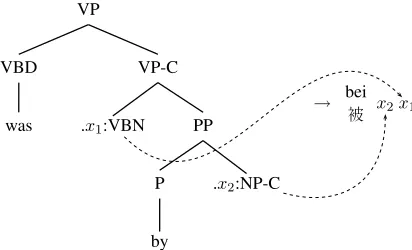
Figure 1: An example tree-to-string rule.
Forest-to-string translation has two stages. The first stage is rule extraction on word-aligned parallel texts with source forests. The second stage is rule enumeration and DP decoding on forests of input strings. In both stages, at each tree node, the task on the source side is to generate a list of tree fragments by composing the tree fragments of its children. We propose a cube-pruning style algorithm that is suit-able for both rule extraction during training and rule enumeration during decoding.
At the highest level, our algorithm involves three steps. In the first step, we label each node in the in-put forest by a boolean variable indicating whether it is a site of interest for tree fragment generation. If it is markedtrue, it is anadmissiblenode. In the case of rule extraction, a node is admissible if and only if it corresponds to a phrase pair according to the un-derlying word alignment. In the case of decoding, every node is admissible for the sake of complete-ness of search. An initial one-node tree fragment is placed at each admissible node for seeding the tree fragment generation process. In the second step, we do cube-pruning style bottom-up combinations to enumerate a pruned list of tree fragments at each tree node. In the third step, we extract or enumerate-and-match tree-to-string rules for the tree fragments at the admissible nodes.
2.1 A Cube-pruning-inspired Algorithm for Tree Fragment Composition
Galley et al. (2004) defined minimal tree-to-string rules. Galley et al. (2006) showed that tree-to-string rules made by composing smaller ones are impor-tant to translation. It can be understood by the anal-ogy of going from word-based models to
phrase-based models. We relate composed rule extraction to cube-pruning (Chiang, 2007). In cube-pruning, the process is to keep track of thek-best sorted lan-guage model states at each node and combine them bottom-up with the help of a priority queue. We can imagine substituting k-best LM states with k
composed rules at each node and composing them bottom-up. We can also borrow the cube pruning trick to compose multiple lists of rules using a pri-ority queue to lazily explore the space of combina-tions starting from the top-most element in the cube formed by the lists.
We need to define a ranking function for com-posed rules. To simulate the breadth-first expansion heuristics of Galley et al. (2006), we define the fig-ure of merit of a tree-to-string rule as a tuplem = (h, s, t), where h is the height of a tree fragment,
sis the number of frontier nodes, i.e., bottom-level nodes including both terminals and non-terminals, andtis the number of terminals in the set of frontier nodes. We define an additive operator+:
m1+m2
= ( max{h1, h2}+ 1, s1+s2, t1+t2 )
and aminoperator based on the order<:
m1 < m2 ⇐⇒
h1 < h2∨
h1 =h2 ∧ s1< s2 ∨
h1 =h2 ∧ s1=s2 ∧ t1 < t2
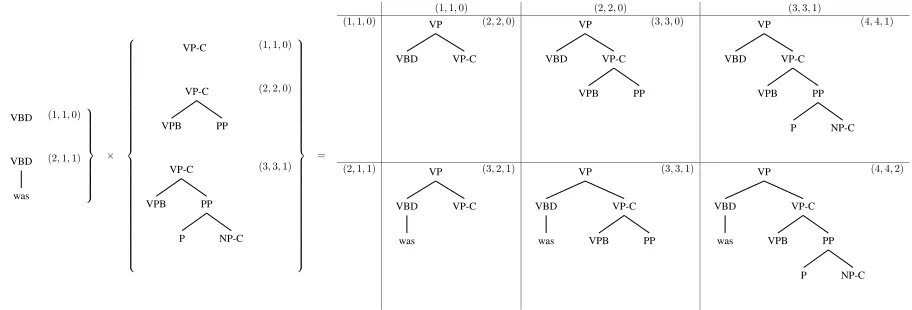
The + operator corresponds to rule compositions. The<operator corresponds to ranking rules by their sizes. A concrete example is shown in Figure 2, in which case the monotonicity property of (+, <) holds: ifma< mb,ma+mc < mb+mc. However,
this is not true in general for the operators in our def-inition, which implies that our algorithm is indeed like cube-pruning: an approximate k-shortest-path algorithm.
3 Source Tree Binarization
VBD (1,1,0)
VBD
was
(2,1,1)
×
VP-C (1,1,0)
VP-C
VPB PP
(2,2,0)
VP-C
VPB PP
P NP-C
(3,3,1)
=
(1,1,0) (2,2,0) (3,3,1)
(1,1,0) VP
VBD VP-C
(2,2,0) VP
VBD VP-C
VPB PP
(3,3,0) VP
VBD VP-C
VPB PP
P NP-C
(4,4,1)
(2,1,1) VP
VBD
was VP-C
(3,2,1) VP
VBD
was
VP-C
VPB PP
(3,3,1) VP
VBD
was
VP-C
VPB PP
P NP-C
[image:4.612.81.537.71.226.2](4,4,2)
Figure 2: Tree-to-string rule composition as cube-pruning. The left shows two lists of composed rules sorted by their geometric measures(height,#f rontiers,#f rontier terminals), under the gluing rule ofVP→VBD VP−C. The right part shows a cube view of the combination space. We explore the space from the top-left corner to the neighbors.
the commonality of subsequences can be discov-ered. For example, the simplest binarization meth-odsleft-to-right,right-to-left, andhead-outexplore sharing of prefixes or suffixes. Among exponentially many binarization choices, these algorithms pick a single bracketing structure for a sequence of sibling nodes. To explore all possible binarizations, we use a CYK algorithm to produce a packed forest of bi-nary trees for a given sibling sequence.
With CYK binarization, we can explore any span that is nested within the original tree structure, but still miss all cross-bracket spans. For example, translating from English to Chinese, The phrase “There is” should often be translated into one verb in Chinese. In a correct English parse tree, however, the subject-verb boundary is between “There” and “is”. As a result, tree-to-string translation based on constituent phrases misses the good translation rule. The CYK-nbinarization algorithm shown in Al-gorithm 1 is a parameterization of the basic CYK binarization algorithm we just outlined. The idea is that binarization can go beyond the scope of parent nodes to more distant ancestors. The CYK-n algo-rithm first annotates each node with its n nearest ancestors in the source tree, then generates a bina-rization forest that allows combining any two nodes with common ancestors. The ancestor chain labeled at each node licenses the node to only combine with nodes having common ancestors in the pastn gener-ations.
The algorithm creates new tree nodes on the fly.
New tree nodes need to have their own states in-dicated by a node label representing what is cov-ered internally by the node and an ancestor chain representing which nodes the node attaches to ex-ternally. Line 22 and Line 23 of Algorithm 1 up-date the label and ancestor annotations of new tree nodes. Using the parsing semiring notations (Good-man, 1999), the ancestor computation can be sum-marized by the (∩,∪) pair. ∩ produces the ances-tor chain of a hyper-edge. ∪produces the ancestor chain of a hyper-node. The node label computation can be summarized by the(concatenate,min)pair. concatenateproduces a concatenation of node la-bels. min yields the label with the shortest length. Atree-sequence(Liu et al., 2007) is a sequence of sub-trees covering adjacent spans. It can be proved that the final label of each new node in the forest corresponds to the tree sequence which has the min-imum length among all sequences covered by the node span. The ancestor chain of a new node is the common ancestors of the nodes in its minimum tree sequence.
For clarity, we do full CYK loops over allO(|w|2) spans andO(|w|3)potential hyper-edges, where|w|
is the length of a source string. In reality, only de-scendants under a shared ancestor can combine. If we assume trees have a bounded branching factor
b, the number of descendants afterngenerations is still bounded by a constantc=bn. The algorithm is
VP
VBD+VBN
VBD
was VBN
PP
P
by NP-C
VP
VBD
was
VP-C
VBN+P
VBN P
by NP-C
(a) (b)
VP
VBD+VBN+P
VBD+VBN
VBD
was VBN
P
by NP-C
VP
VBD+VBN+P
VBD
was
VBN+P
VBN P
by NP-C
(c) (d)
1 2 3 4
0 VBD VBD+VBN VBD+VBN+P VP
1 VBN VBN+P VP-C
2 P PP
[image:5.612.89.285.67.355.2]3 NP-C
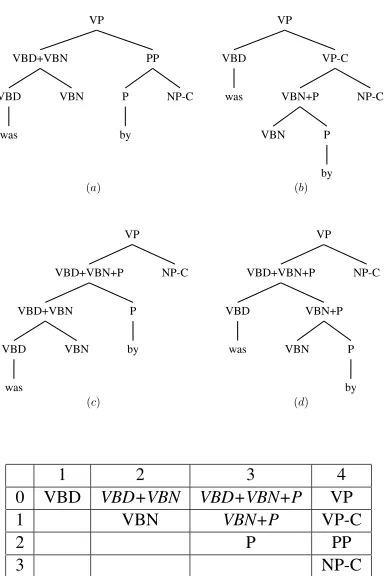
Figure 3: Alternative binary parses created for the origi-nal tree fragment in Figure 1 through CYK-2binarization (aandb) and CYK-3binarization (candd). In the chart representation at the bottom, cells with labels containing the concatenation symbol+hold nodes created through binarization.
Figure 3 shows some examples of alternative trees generated by the CYK-nalgorithm. In this example, standard CYK binarization will not create any new trees since the input is already binary. The CYK-2 and CYK-3 algorithms discover new trees with an increasing degree of freedom.
4 Synchronous Binarization for Forest-to-string Decoding
In this section, we deal with binarization of transla-tion forests, also known as translatransla-tion hypergraphs (Mi et al., 2008). A translation forest is a packed forest representation of all synchronous derivations composed of tree-to-string rules that match the source forest. Tree-to-string decoding algorithms work on a translation forest, rather than a source for-est. A binary source forest does not necessarily al-ways result in a binary translation forest. In the tree-to-string rule in Figure 4, the source tree is already
ADJP
RB+JJ
x0:RB JJ
responsible
PP
IN
for
NP-C
NPB
DT
the x1:NN
x2:PP → x0
fuze
负责 x2 de 的 x1
ADJP
RB+JJ
x0:RB JJ
responsible x1:PP
→ x0 fuze
负责 x1
PP
IN
for
NP-C
NPB
DT
the x0:NN
x1:PP
→ x1 de 的 x0
Figure 4: Synchronous binarization for a tree-to-string rule. The top rule can be binarized into two smaller rules.
binary with the help of source tree binarization, but the translation rule involves three variables in the set of frontier nodes. If we apply synchronous binariza-tion (Zhang et al., 2006), we can factorize it into two smaller translation rules each having two vari-ables. Obviously, the second rule, which is a com-mon pattern, is likely to be shared by many transla-tion rules in the derivatransla-tion forest. When beams are fixed, search goes deeper in a factorized translation forest.
The challenge of synchronous binarization for a forest-to-string system is that we need to first match large tree fragments in the input forest as the first step of decoding. Our solution is to do the matching using the original rules and then run synchronous binarization to break matching rules down to factor rules which can be shared in the derivation forest. This is different from the offline binarization scheme described in (Zhang et al., 2006), although the core algorithm stays the same.
5 Experiments
[image:5.612.313.520.68.335.2]Algorithm 1The CYK-nBinarization Algorithm 1: functionCYKBINARIZER(T, n)
2: foreach treenode∈T in bottom-up topological orderdo
3: Make a copy ofnodein the forest outputF 4: Ancestors[node] =the nearestnancestors ofnode
5: Label[node] =the label ofnodeinT 6: L←the length of the yield ofT 7: fork= 2...Ldo
8: fori= 0, ..., L−kdo
9: forj=i+ 1, ..., i+k−1do
10: lnode←N ode[i, j]; rnode←N ode[j, i+k]
11: ifAncestors[lnode]∩Ancestors[rnode]6=∅then
12: pnode←GETNODE(i, i+k)
13: ADDEDGE(pnode, lnode, rnode) returnF
14: functionGETNODE(begin, end) 15: ifNode[begin, end]∈/Fthen
16: Create a newnodefor the span(begin, end)
17: Ancestors[node] =∅
18: Label[node] =the sequence of terminals in the span(begin, end)inT 19:
returnNode[begin, end]
20: functionADDEDGE(pnode, lnode, rnode)
21: Add a hyper-edge fromlnodeandrnodetopnode
22: Ancestors[pnode] =Ancestors[pnode]∪(Ancestors[lnode]∩Ancestors[rnode])
23: Label[pnode] = min{Label[pnode], CONCATENATE(Label[lnode], Label[rnode])}
translation to evaluate our methods.
5.1 Setup
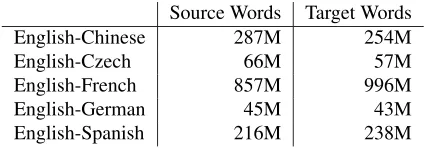
For English-to-Chinese translation, we used all the allowed training sets in the NIST 2008 constrained track. For English to the European languages, we used the training data sets for WMT 2010 (Callison-Burch et al., 2010). For NIST, we filtered out sen-tences exceeding80words in the parallel texts. For WMT, the filtering limit is60. There is no filtering on the test data set. Table 1 shows the corpus statis-tics of our bilingual training data sets.
Source Words Target Words
English-Chinese 287M 254M
English-Czech 66M 57M
English-French 857M 996M
English-German 45M 43M
[image:6.612.79.293.559.633.2]English-Spanish 216M 238M
Table 1: The Sizes of Parallel Texts.
At the word alignment step, we did 6 iterations of IBM Model-1 and 6 iterations of HMM. For English-Chinese, we ran2iterations of IBM Model-4 in addition to Model-1 and HMM. The word
align-ments are symmetrized using the “union” heuris-tics. Then, the standard phrase extraction heuristics (Koehn et al., 2003) were applied to extract phrase pairs with a length limit of 6. We ran the hierar-chical phrase extraction algorithm with the standard heuristics of Chiang (2005). The phrase-length limit is interpreted as the maximum number of symbols on either the source side or the target side of a given rule. On the same aligned data sets, we also ran the tree-to-string rule extraction algorithm described in Section 2.1 with a limit of16rules per tree node.
The default parser in the experiments is a shift-reduce dependency parser (Nivre and Scholz, 2004). It achieves 87.8% labelled attachment score and 88.8%unlabeled attachment score on the standard Penn Treebank test set. We convert dependency parses to constituent trees by propagating the part-of-speech tags of the head words to the correspond-ing phrase structures.
to spans longer than10. For the forest-to-string sys-tem, we do not have such length-based reordering constraints.
We trained two 5-gram language models with Kneser-Ney smoothing for each of the target lan-guages. One is trained on the target side of the par-allel text, the other is on a corpus provided by the evaluation: the Gigaword corpus for Chinese and news corpora for the others. Besides standard fea-tures (Och and Ney, 2004), the phrase-based decoder also uses a Maximum Entropy phrasal reordering model (Zens and Ney, 2006). Both the hierarchi-cal decoder and the forest-to-string decoder only use the standard features. For feature weight tuning, we do Minimum Error Rate Training (Och, 2003). To explore a largern-best list more efficiently in train-ing, we adopt the hypergraph-based MERT (Kumar et al., 2009).
To evaluate the translation results, we use BLEU (Papineni et al., 2002).
5.2 Translation Results
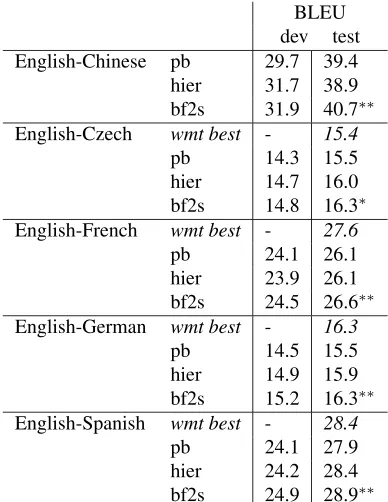
Table 2 shows the scores of our system with the best binarization scheme compared to the phrase-based system and the hierarchical phrase-phrase-based sys-tem. Our system is consistently better than the other two systems in all data sets. On the English-Chinese data set, the improvement over the phrase-based sys-tem is1.3BLEU points, and0.8over the hierarchi-cal phrase-based system. In the tasks of translat-ing to European languages, the improvements over the phrase-based baseline are in the range of0.5 to 1.0 BLEU points, and 0.3 to 0.5 over the hierar-chical phrase-based system. All improvements ex-cept the bf2s andhier difference in English-Czech are significant with confidence level above99% us-ing the bootstrap method (Koehn, 2004). To demon-strate the strength of our systems including the two baseline systems, we also show the reported best re-sults on these data sets from the 2010 WMT work-shop. Our forest-to-string system (bf2s) outperforms or ties with the best ones in three out of four lan-guage pairs.
5.3 Different Binarization Methods
The translation results for the bf2s system in Ta-ble 2 are based on the cyk binarization algorithm with bracket violation degree2. In this section, we
BLEU dev test English-Chinese pb 29.7 39.4 hier 31.7 38.9 bf2s 31.9 40.7∗∗
English-Czech wmt best - 15.4
pb 14.3 15.5 hier 14.7 16.0 bf2s 14.8 16.3∗
English-French wmt best - 27.6
pb 24.1 26.1 hier 23.9 26.1 bf2s 24.5 26.6∗∗
English-German wmt best - 16.3
pb 14.5 15.5 hier 14.9 15.9 bf2s 15.2 16.3∗∗
English-Spanish wmt best - 28.4
[image:7.612.329.523.71.322.2]pb 24.1 27.9 hier 24.2 28.4 bf2s 24.9 28.9∗∗
Table 2: Translation results comparing bf2s, the binarized-forest-to-string system, pb, the phrase-based system, andhier, the hierarchical phrase-based system. For comparison, the best scores from WMT 2010 are also shown. ∗∗indicates the result is significantly better than
bothpbandhier. ∗ indicates the result is significantly
better thanpbonly.
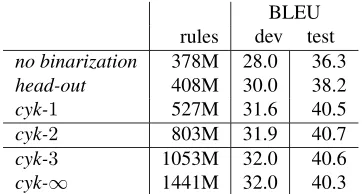
vary the degree to generate forests that are incremen-tally augmented from a single tree. Table 3 shows the scores of different tree binarization methods for the English-Chinese task.
It is clear from reading the table thatcyk-2is the optimal binarization parameter. We have verified this is true for other language pairs on non-standard data sets. We can explain it from two angles. At degree 2, we allow phrases crossing at most one bracket in the original tree. If the parser is reason-ably good, crossing just one bracket is likely to cover most interesting phrases that can be translation units. From another point of view, enlarging the forests entails more parameters in the resulting translation model, making over-fitting likely to happen.
5.4 Binarizer or Parser?
BLEU rules dev test
no binarization 378M 28.0 36.3
head-out 408M 30.0 38.2
cyk-1 527M 31.6 40.5
cyk-2 803M 31.9 40.7
cyk-3 1053M 32.0 40.6
[image:8.612.95.276.71.168.2]cyk-∞ 1441M 32.0 40.3
Table 3: Comparing different source tree binarization schemes for English-Chinese translation, showing both BLEU scores and model sizes. The rule counts include normal phrases which are used at the leaf level during decoding.
parser that can generate a packed forest. Our fast deterministic dependency parser does not generate a packed forest. Instead, we use a CRF constituent parser (Finkel et al., 2008) with state-of-the-art ac-curacy. On the standard Penn Treebank test set, it achieves an F-score of89.5%. It uses a CYK algo-rithm to do full dynamic programming inference, so is much slower. We modified the parser to do hyper-edge pruning based on posterior probabilities. The parser preprocesses the Penn Treebank training data through binarization. So the packed forest it pro-duces is also a binarized forest. We compare two systems: one is using thecyk-2binarizer to generate forests; the other is using the CRF parser with prun-ing thresholde−p, wherep= 2to generate forests.1
Although the parser outputs binary trees, we found cross-bracketcyk-2binarization is still helpful.
BLEU dev test
cyk-2 14.9 16.0
parser 14.7 15.7
Table 4: Binarized forests versus parser-generated forests for forest-to-string English-German translation.
Table 4 shows the comparison of binarization for-est and parser forfor-est on English-German translation. The results show thatcyk-2forest performs slightly
1
All hyper-edges with negative log posterior probability larger thanpare pruned. In Mi and Huang (2008), the thresh-old isp= 10. The difference is that they do the forest pruning on a forest generated by ak-best algorithm, while we do the forest-pruning on the full CYK chart. As a result, we need more aggressive pruning to control forest size.
better than the parser forest. We have not done full exploration of forest pruning parameters to fine-tune the parser-forest. The speed of the constituent parser is the efficiency bottleneck. This actually demon-strates the advantage of the binarizer plus forest-to-string scheme. It is flexible, and works with any parser that generates projective parses. It does not require hand-tuning of forest pruning parameters for training.
5.5 Synchronous Binarization
In this section, we demonstrate the effect of syn-chronous binarization for both tree-to-string and forest-to-string translation. The experiments are on the English-Chinese data set. The baseline systems usek-way cube pruning, where kis the branching factor, i.e., the maximum number of nonterminals on the right-hand side of any synchronous translation rule in an input grammar. The competing system does online synchronous binarization as described in Section 4 to transform the grammar intersected with the input sentence to the minimum branching factor
k′
(k′ < k
), and then appliesk′
-way cube pruning. Typically,k′
is2.
BLEU dev test
head-out cube pruning 29.2 37.0 + synch. binarization 30.0 38.2
[image:8.612.324.531.408.482.2]cyk-2 cube pruning 31.7 40.5 + synch. binarization 31.9 40.7
Table 5: The effect of synchronous binarization for tree-to-string and forest-tree-to-string systems, on the English-Chinese task.
Table 5 shows that synchronous binarization does help reduce search errors and find better translations consistently in all settings.
6 Related Work
al. (2009) is the closest to our work. But their goal was to augment ak-best forest. They did not bina-rize the tree sequences. They also did not put con-straint on the tree-sequence nodes according to how many brackets are crossed.
Wang et al. (2007) used target tree binarization to improve rule extraction for their string-to-tree sys-tem. Their binarization forest is equivalent to our
cyk-1 forest. In contrast to theirs, our binarization scheme affects decoding directly because we match tree-to-string rules on a binarized forest.
Different methods of translation rule binarization have been discussed in Huang (2007). Their argu-ment is that for tree-to-string decoding target side binarization is simpler than synchronous binariza-tion and works well because creating discontinous source spans does not explode the state space. The forest-to-string senario is more similar to string-to-tree decoding in which state-sharing is important. Our experiments show that synchronous binariza-tion helps significantly in the forest-to-string case.
7 Conclusion
We have presented a new approach to tree-to-string translation. It involves a source tree binarization step and a standard forest-to-string translation step. The method renders it unnecessary to have ak-best parser to generate a packed forest. We have demon-strated state-of-the-art results using a fast parser and a simple tree binarizer that allows crossing at most one bracket in each binarized node. We have also shown that reducing search errors is important for forest-to-string translation. We adapted the syn-chronous binarization technqiue to improve search and have shown significant gains. In addition, we also presented a new cube-pruning-style algorithm for rule extraction. In the new algorithm, it is easy to adjust the figure-of-merit of rules for extraction. In the future, we plan to improve the learning of trans-lation rules with binarized forests.
Acknowledgments
We would like to thank the members of the MT team at Google, especially Ashish Venugopal, Zhifei Li, John DeNero, and Franz Och, for their help and dis-cussions. We would also like to thank Daniel Gildea for his suggestions on improving the paper.
References
Chris Callison-Burch, Philipp Koehn, Christof Monz, Kay Peterson, Mark Przybocki, and Omar Zaidan. 2010. Findings of the 2010 joint workshop on statisti-cal machine translation and metrics for machine trans-lation. InProceedings of the Joint Fifth Workshop on Statistical Machine Translation and Metrics(MATR), pages 17–53, Uppsala, Sweden, July. Association for Computational Linguistics. Revised August 2010. David Chiang. 2005. A hierarchical phrase-based model
for statistical machine translation. InProceedings of the 43rd Annual Conference of the Association for Computational Linguistics (ACL-05), pages 263–270, Ann Arbor, MI.
David Chiang. 2007. Hierarchical phrase-based transla-tion.Computational Linguistics, 33(2):201–228. Steve DeNeefe, Kevin Knight, Wei Wang, and Daniel
Marcu. 2007. What can syntax-based MT learn from phrase-based MT? InProceedings of the 2007 Joint Conference on Empirical Methods in Natural guage Processing and Computational Natural Lan-guage Learning (EMNLP-CoNLL), pages 755–763, Prague, Czech Republic, June. Association for Com-putational Linguistics.
Jason Eisner. 2003. Learning non-isomorphic tree map-pings for machine translation. InProceedings of the 41st Meeting of the Association for Computational Linguistics, companion volume, pages 205–208, Sap-poro, Japan.
Jenny Rose Finkel, Alex Kleeman, and Christopher D. Manning. 2008. Efficient, feature-based, conditional random field parsing. In Proceedings of ACL-08: HLT, pages 959–967, Columbus, Ohio, June. Associa-tion for ComputaAssocia-tional Linguistics.
Michel Galley, Mark Hopkins, Kevin Knight, and Daniel Marcu. 2004. What’s in a translation rule? In Pro-ceedings of the 2004 Meeting of the North American chapter of the Association for Computational Linguis-tics (NAACL-04), pages 273–280.
Michel Galley, Jonathan Graehl, Kevin Knight, Daniel Marcu, Steve DeNeefe, Wei Wang, and Ignacio Thayer. 2006. Scalable inference and training of context-rich syntactic translation models. In Proceed-ings of the International Conference on Computational Linguistics/Association for Computational Linguistics (COLING/ACL-06), pages 961–968, July.
Joshua Goodman. 1999. Semiring parsing. Computa-tional Linguistics, 25(4):573–605.
Liang Huang, Kevin Knight, and Aravind Joshi. 2006. Statistical syntax-directed translation with extended domain of locality. InProceedings of the 7th Biennial Conference of the Association for Machine Translation in the Americas (AMTA), Boston, MA.
Liang Huang. 2007. Binarization, synchronous bina-rization, and target-side binarization. InProceedings of the NAACL/AMTA Workshop on Syntax and Struc-ture in Statistical Translation (SSST), pages 33–40, Rochester, NY.
Liang Huang. 2008. Forest reranking: Discriminative parsing with non-local features. InProceedings of the 46th Annual Conference of the Association for Compu-tational Linguistics: Human Language Technologies (ACL-08:HLT), Columbus, OH. ACL.
Philipp Koehn, Franz Josef Och, and Daniel Marcu. 2003. Statistical phrase-based translation. In Proceed-ings of the 2003 Meeting of the North American chap-ter of the Association for Computational Linguistics (NAACL-03), Edmonton, Alberta.
Philipp Koehn. 2004. Statistical significance tests for machine translation evaluation. In 2004 Conference on Empirical Methods in Natural Language Process-ing (EMNLP), pages 388–395, Barcelona, Spain, July.
Shankar Kumar, Wolfgang Macherey, Chris Dyer, and Franz Och. 2009. Efficient minimum error rate train-ing and minimum bayes-risk decodtrain-ing for translation hypergraphs and lattices. InProceedings of the Joint Conference of the 47th Annual Meeting of the ACL and the 4th International Joint Conference on Natural Lan-guage Processing of the AFNLP, pages 163–171, Sun-tec, Singapore, August. Association for Computational Linguistics.
Dekang Lin. 2004. A path-based transfer model for machine translation. In Proceedings of the 20th In-ternational Conference on Computational Linguistics (COLING-04), pages 625–630, Geneva, Switzerland.
Yang Liu, Qun Liu, and Shouxun Lin. 2006. Tree-to-string alignment template for statistical machine trans-lation. InProceedings of the International Conference on Computational Linguistics/Association for Compu-tational Linguistics (COLING/ACL-06), Sydney, Aus-tralia, July.
Yang Liu, Yun Huang, Qun Liu, and Shouxun Lin. 2007. Forest-to-string statistical translation rules. In Pro-ceedings of the 45th Annual Conference of the Associ-ation for ComputAssoci-ational Linguistics (ACL-07), Prague.
Haitao Mi and Liang Huang. 2008. Forest-based transla-tion rule extractransla-tion. InProceedings of the 2008 Con-ference on Empirical Methods in Natural Language Processing, pages 206–214, Honolulu, Hawaii, Octo-ber. Association for Computational Linguistics.
Haitao Mi, Liang Huang, and Qun Liu. 2008. Forest-based translation. In Proceedings of the 46th An-nual Conference of the Association for Computational Linguistics: Human Language Technologies (ACL-08:HLT), pages 192–199.
Joakim Nivre and Mario Scholz. 2004. Deterministic dependency parsing of English text. InProceedings of Coling 2004, pages 64–70, Geneva, Switzerland, Aug 23–Aug 27. COLING.
Franz Josef Och and Hermann Ney. 2004. The align-ment template approach to statistical machine transla-tion.Computational Linguistics, 30(4):417–449. Franz Josef Och. 2003. Minimum error rate training for
statistical machine translation. InProceedings of the 41th Annual Conference of the Association for Com-putational Linguistics (ACL-03).
Kishore Papineni, Salim Roukos, Todd Ward, and Wei-Jing Zhu. 2002. BLEU: A method for automatic eval-uation of machine translation. InProceedings of the 40th Annual Conference of the Association for Com-putational Linguistics (ACL-02).
Arjen Poutsma. 2000. Data-oriented translation. In
Proceedings of the 18th International Conference on Computational Linguistics (COLING-00).
Chris Quirk, Arul Menezes, and Colin Cherry. 2005. De-pendency treelet translation: Syntactically informed phrasal SMT. InProceedings of the 43rd Annual Con-ference of the Association for Computational Linguis-tics (ACL-05), pages 271–279, Ann Arbor, Michigan.
Libin Shen, Jinxi Xu, and Ralph Weischedel. 2008. A new string-to-dependency machine translation algo-rithm with a target dependency language model. In
Proceedings of the 46th Annual Conference of the As-sociation for Computational Linguistics: Human Lan-guage Technologies (ACL-08:HLT), Columbus, OH. ACL.
Wei Wang, Kevin Knight, and Daniel Marcu. 2007. Binarizing syntax trees to improve syntax-based ma-chine translation accuracy. In Proceedings of the 2007 Joint Conference on Empirical Methods in Nat-ural Language Processing and Computational Natu-ral Language Learning (EMNLP-CoNLL), pages 746– 754, Prague, Czech Republic, June. Association for Computational Linguistics.
Richard Zens and Hermann Ney. 2006. Discriminative reordering models for statistical machine translation. In Proceedings on the Workshop on Statistical Ma-chine Translation, pages 55–63, New York City, June. Association for Computational Linguistics.
North American chapter of the Association for Compu-tational Linguistics (NAACL-06), pages 256–263, New York, NY.
Min Zhang, Hongfei Jiang, Aiti Aw, Haizhou Li, Chew Lim Tan, and Sheng Li. 2008. A tree sequence alignment-based tree-to-tree translation model. In
Proceedings of ACL-08: HLT, pages 559–567, Colum-bus, Ohio, June. Association for Computational Lin-guistics.
Hui Zhang, Min Zhang, Haizhou Li, Aiti Aw, and Chew Lim Tan. 2009. Forest-based tree sequence to string translation model. In Proceedings of the Joint Conference of the 47th Annual Meeting of the ACL and the 4th International Joint Conference on Natural Language Processing of the AFNLP, pages 172–180, Suntec, Singapore, August. Association for Computa-tional Linguistics.
Andreas Zollmann and Ashish Venugopal. 2006. Syntax augmented machine translation via chart parsing. In