A D O P M o d e l for S e m a n t i c Interpretation*
R e m k o B o n n e m a , R e n s B o d a n d R e m k o S c h aI n s t i t u t e f o r L o g i c , L a n g u a g e a n d C o m p u t a t i o n U n i v e r s i t y o f A m s t e r d a m
S p u i s t r a a t 134, 1012 V B A m s t e r d a m Bonnema~mars. let. uva. nl
Rens. Bod@let. uva. nl
Remko. Scha@let. uva. nl
A b s t r a c t
In data-oriented language processing, an annotated language corpus is used as a stochastic grammar. The most probable analysis of a new sentence is constructed by combining fragments from the corpus in the most probable way. This approach has been successfully used for syntactic anal- ysis, using corpora with syntactic annota- tions such as the Penn Tree-bank. If a cor- pus with semantically annotated sentences is used, the same approach can also gen- erate the most probable semantic interpre- tation of an input sentence. The present paper explains this semantic interpretation method. A data-oriented semantic inter- pretation algorithm was tested on two se- mantically annotated corpora: the English ATIS corpus and the Dutch OVIS corpus. Experiments show an increase in seman- tic accuracy if larger corpus-fragments are taken into consideration.
1 I n t r o d u c t i o n
Data-oriented models of language processing em- body the assumption t h a t human language per- ception and production works with representations of concrete past language experiences, rather than with abstract g r a m m a r rules. Such models therefore maintain large corpora of linguistic representations of previously occurring utterances. When processing a new input utterance, analyses of this utterance are constructed by combining fragments from the cor- pus; the occurrence-frequencies of the fragments are used to estimate which analysis is the most probable one.
* This work was partially supported by NWO, the
Netherlands Organization for Scientific Research (Prior- ity Programme Language and Speech Technology).
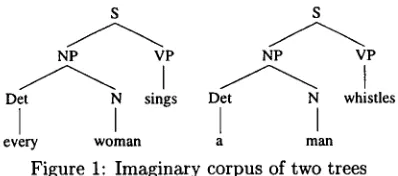
For the syntactic dimension of language, vari- ous instantiations of this data-oriented processing or "DOP" approach have been worked out (e.g. Bod (1992-1995); Charniak (1996); Tugwell (1995); Sima'an et al. (1994); Sima'an (1994; 1996a); G o o d m a n (1996); R a j m a n (1995ab); Kaplan (1996); Sekine and Grishman (1995)). A method for ex- tending it to the semantic domain was first intro- duced by van den Berg et al. (1994). In the present paper we discuss a computationally effective version of that method, and an implemented system that uses it. We first summarize the first fully instanti- ated D O P model as presented in Bod (1992-1993). Then we show how this method can be straightfor- wardly extended into a semantic analysis method, if corpora are created in which the trees are enriched with semantic annotations. Finally, we discuss an implementation and report on experiments with two semantically analyzed corpora (ATIS and OVIS). 2 D a t a - O r i e n t e d S y n t a c t i c A n a l y s i s So far, the data-oriented processing method has mainly been applied to corpora with simple syntac- tic annotations, consisting of labelled trees. Let us illustrate this with a very simple imaginary example. Suppose t h a t a corpus consists of only two trees:
S S
N P V P N P V P
Det N sings D e t N whistles
I
I
I
I
every w o m a n a m a n
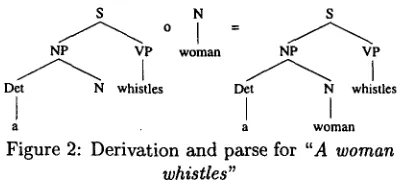
[image:1.612.317.516.496.584.2]nal leaf node of the first tree). A new input sentence like "A woman whistles" can now be parsed by com- bining subtrees from this corpus. For instance:
S N S
NP VP w o m ~ NP VP
Det N whistles Det N whistles
t
I
I
a a w o m a n
Figure 2: Derivation and parse for "A woman whistles"
Other derivations may yield the same parse tree; for instance I :
S NP Det VP
I
o
I
NP VP Det N a whistles
I
wonlaN
S
NP VP
Det N whistles
I
I
a woman
Figure 3: Different derivation generating the same parse for ".4 woman whistles"
o r
S Det N S
NP VP a woman NP VP
Det N whistles Det N whistles
I
I
a woman
Figure 4: Another derivation generating the same parse for "A woman whistles"
Thus, a parse tree can have many derivations in- volving different corpus-subtrees. DOP estimates the probability of substituting a subtree t on a spe- cific node as the probability of selecting t among all subtrees in the corpus that could be substituted on that node. This probability is equal to the number of occurrences of a subtree t, divided by the total num- ber of occurrences of subtrees t' with the same root node label as t : P ( t ) = Itl/~t':root(e)=roo~(t) It'l"
The probability of a derivation tl o ... o tn can be computed as the product of the probabilities of the subtrees this derivation consists of: P ( tl o . . . o t,~) = r L P(ti). The probability of a parse tree is equal to
1Here t o u o v o w should be read as ((t o u) o v) o w.
the probability that any of its distinct derivations is generated, which is the sum of the probabilities of all derivations of that parse tree. Let t ~ be the i-th sub- tree in the derivation d that yields tree T, then the probability of T is given by: P ( T ) = ~ d 1-Ii P(tid).
The DOP method differs from other statisti- cal approaches, such as Pereira and Schabes (1992), Black et al. (1993) and Briscoe (1994), in that it does not predefine or train a formal grammar; in- stead it takes subtrees directly from annotated sen- tences in a treebank with a probability propor- tional to the number of occurrences of these sub- trees in the treebank. Bod (1993b) shows that D O P can be implemented using context-free pars- ing techniques. To select the most probable parse, Bod (1993a) gives a Monte Carlo approximation al- gorithm. Sima'an (1995) gives an efficient polyno- mial algorithm for a sub-optimal solution.
The model was tested on the Air Travel In- formation System (ATIS) corpus as analyzed in the Penn Treebank (Marcus et al. (1993)), achiev- ing better test results than other stochastic grammars (cf. Bod (1996), Sima'an (1996a), Goodman (1996)). On Penn's Wall Street Jour- nal corpus, the data-oriented processing approach has been tested by Sekine and Grishman (1995) and by Charniak (1996). Though Charniak only uses corpus-subtrees smaller than depth 2 (which in our experience constitutes a less-than-optimal version of the data-oriented processing method), he reports that it "outperforms all other non-word-based sta- tistical parsers/grammars on this corpus". For an overview of data-oriented language processing, we refer to (Bod and Scha, 1996).
3 D a t a - O r i e n t e d S e m a n t i c A n a l y s i s
To use the DOP method not just for syntactic anal- ysis, but also for semantic interpretation, four steps must be taken:
1. decide on a formalism for representing the meanings of sentences and surface-constituents. 2. annotate the corpus-sentences and their surface-constituents with such semantic repre- sentations.
3. establish a method for deriving the mean- ing representations associated with arbitrary corpus-subtrees and with compositions of such subtrees.
4. reconsider the probability calculations. We now discuss these four steps.
3.1 S e m a n t i c f o r m a l i s m
[image:2.612.93.294.91.182.2] [image:2.612.83.299.219.482.2]S :Vx(woman(x)-*sing(x)) S'.qx(man(x)Awhistle(x))
NP: ~.YVx(woman(×)-*Y(x)) VP:sing NP: ;~.Y"'lx(man(x)AY(x)) VP:whistle
Det:kX~Y~(X(x)-*Y(x)) N:woman sings Det:XXXY3x(X(×)AY(x)) N:man whistles
I
I
I
every woman a man
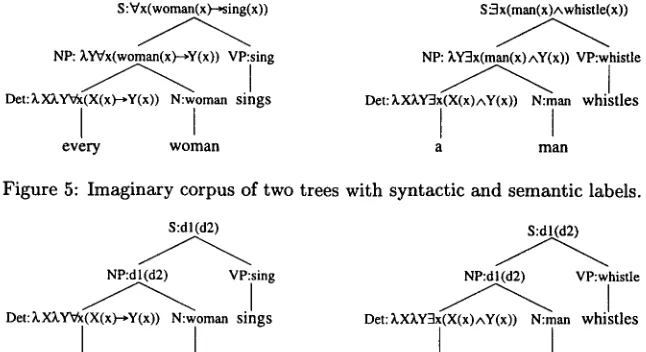
Figure 5: Imaginary corpus of two trees with syntactic and semantic labels.
S:dl(d2)
NP:d 1 (d2) VP:sing NP:dl(d2) VP:whistle
.i
L
Det:kXkY~(X(x)---~Y(x)) N:woman stags Det: ~,X~.Y3×(X(x)^Y(x)) N:man whi ties
I
I
every woman a man
Figure 6: Same imaginary corpus of two trees with syntactic and semantic labels using the daughter notation.
defined model-theory and is rich enough for repre- senting the meanings of sentences and constituents that are relevant for the intended application do- main. For our exposition in this paper we will use a wellknown standard formalism: extensional type theory (see Gamut (1991)), i.e., a higher-order logical language that combines lambda-abstraction with connectives and quantifiers. The first imple- mented system for data-oriented semantic interpre- tation, presented in Bonnema (1996), used a differ- ent logical language, however. And in many appli- cation contexts it probably makes sense to use an A.I.-style language which highlights domain struc- ture (frames, slots, and fillers), while limiting the use of quantification and negation (see section 5).
3 . 2 S e m a n t i c a n n o t a t i o n
We assume a corpus that is already syntactically annotated as before: with labelled trees that indi- cate surface constituent structure. Now the basic idea, taken from van den Berg et al. (1994), is to augment this syntactic annotation with a semantic one: to every meaningful syntactic node, we add a type-logical formula that expresses the meaning of the corresponding surface-constituent. H we would carry out this idea in a completely direct way, the toy corpus of Figure 1 might, for instance, turn into the toy corpus of Figure 5.
Van den Berg et al. indicate how a corpus of this sort may be used for data-oriented semantic inter- pretation. Their algorithm, however, requires a pro- cedure which can inspect the semantic formula of a node and determine the contribution of the seman- tics of a lower node, in order to be able to "fac-
tor out" that contribution. The details of this pro- cedure have not been specified. However, van den Berg et ai. also propose a simpler annotation con- vention which avoids the need for this procedure, and which is computationally more effective: an an- notation convention which indicates explicitly how the semantic formula for a node is built up on the basis of the semantic formulas of its daughter nodes. Using this convention, the semantic annotation of the corpus trees is indicated as follows:
• For every meaningful lexical node a type logical formula is specified that represents its meaning.
• For every meaningful non-lexical node a for- mula schema is specified which indicates how its meaning representation may be put together out of the formulas assigned to its daughter nodes.
[image:3.612.139.460.44.126.2] [image:3.612.137.460.46.222.2]This annotation convention obviously, assumes that the meaning representation of a surface- constituent c a n in fact always be composed out of the meaning representations of its subconstituents. This assumption is not unproblematic. To maintain it in the face of phenomena such as non-standard quantifier scope or discontinuous constituents cre- ates complications in the syntactic or semantic anal- yses assigned to certain sentences and their con- stituents. It is therefore not clear yet whether our current treatment ought to be viewed as com- pletely general, or whether a treatment in the vein of van den Berg et al. (1994) should be worked out.
3.3 T h e m e a n i n g s o f s u b t r e e s a n d t h e i r
c o m p o s i t i o n s
As in the purely syntactic version of DOP, we now want to compute the probability of a (semantic) analysis by considering the most probable way in which it can be generated by combining subtrees from the corpus. We can do this in virtually the same way. The only novelty is a slight modification in the process by which a corpus tree is decomposed into subtrees, and a corresponding modification in the composition operation which combines subtrees. If we extract a subtree out of a tree, we replace the semantics of the new leaf node with a unification variable of the same type. Correspondingly, when the composition operation substitutes a subtree at this node, this unification variable is unified with the semantic formula on the substituting tree. (It is required that the semantic type of this formula matches the semantic type of the unification vari- able.)
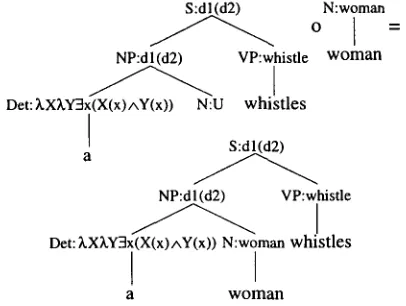
A simple example will make this clear. First, let us consider what subtrees the corpus makes avail- able now. As an example, Figure 7 shows one of the decompositions of the annotated corpus sentence "A m a n w h i s t l e s " . We see that by decomposing the tree into two subtrees, the semantics at the breakpoint- node N : m a n is replaced by a variable. Now an analysis for the sentence "A woman whistles" can, for instance, be generated in the way shown in Fig- ure 8.
3.4 T h e S t a t i s t i c a l M o d e l o f D a t a - O r i e n t e d
S e m a n t i c I n t e r p r e t a t i o n
We now define the probability of an interpretation of an input string.
Given a partially annotated corpus as defined above, the multiset of corpus subtrees consists of all subtrees with a well-defined top-node seman- tics, that are generated by applying to the trees of the corpus the decomposition mechanism described
NP:dl(d2) VP:whistle
w !t,os
Det: kX~.Y~x(X(x)^Y(x)) N:man
I
I
a m a i l
VP:whistle
Det: ~,XkY3x(X(x)AY(x)) N:U w h i s t l e s
I
a
N:man
m a n
Figure 7: Decomposing a tree into subtrees with uni- fication variables.
N:woman
o
L
NP:dl(d2) VP:whistle w o m a n
Det: kXkY--Jx(X(x) AY(x)) N:U w h i s t l e s
a
NP:d I (d2) VP:whistle
Dec kXkY3x(X(x)^Y(x)) N:woman w h i s t l e s
I
a woman
Figure 8: Generating an analysis for "A w o m a n w h i s t l e s " .
above. The probability of substituting a subtree t on a specific node is the probability of selecting t among all subtrees in the multiset that could be substituted on that node. This probability is equal to the num- ber of occurrences of a subtree t, divided by the total number of occurrences of subtrees t ' with the same root node label as t:
N
P ( t ) = Et':root(t')=root(t) Irl (1)
A derivation of a string is a tuple of subtrees, such that their composition results in a tree whose yield is the string. The probability of a derivation t l o . . . o tn is the product of the probabilities of these subtrees:
P ( t l o . . . o tn) = I I P ( t d
(2)
i
[image:4.612.329.532.44.217.2] [image:4.612.330.533.257.410.2]the probability that any of its derivations occurs; this is the sum of the probabilities of all its deriva- tions. Let
rid
be the i-th subtree in the derivation d that yields tree T, then the probability of T is given by:P(T) = E H P(t,d)
(3)d i
An interpretation of a string is a formula which is provably equivalent to the semantic annotation of the top node of a parse of this string. The proba- bility of an interpretation I of a string is the sum of the probabilities of the parses of this string with a top node annotated with a formula that is provably equivalent to I. Let
ti4p
be the i-th subtree in the derivation d that yields parse p with interpretation I, then the probability of I is given by:P(I) = E E H P(t,d,)
(4)p d i
We choose the most probable i n t e r p r e t a t i o n / . o f a string s as the most appropriate interpretation of s. In Bonnema (1996) a semantic extension of the DOP parser of Sima'an (1996a) is given. But in- stead of computing the most likely interpretation of a string, it computes the interpretation of the most likely combination of semantically annotated subtrees. As was shown in Sima'an (1996b), the most likely interpretation of a string cannot be com- puted in
deterministic
polynomial time. It is not yet known how often the most likely interpretation and the interpretation of the most likely combination of semantically enriched subtrees do actually coincide.4 I m p l e m e n t a t i o n s
The first implementation of a semantic DOP-model yielded rather encouraging preliminary results on a semantically enriched part of the ATIS-corpus. Im- plementation details and experimental results can be found in Bonnema (1996), and Bod et al. (1996). We repeat the most important observations:
* Data-oriented semantic interpretation seems to
be robust; of the sentences that could be parsed, a significantly higher percentage received a cor- rect semantic interpretation (88%), than an ex- actly correct syntactic analysis (62%).
* The coverage of the parser was rather low (72%), because of the sheer number of differ- ent semantic types and constructs in the trees.
• The parser was fast: on the average six times as fast as a parser trained on syntax alone.
The current implementation is again an extension of Sima'an (1996a), by Bonnema 2. In our experi- ments, we notice a robustness and speed-up compa- rable to our experience with the previous implemen- tation. Besides that, we observe higher accuracy,
and
higher coverage, due to a new method of orga- nizing the information in the tree-bank before it is used for building the actual parser.A semantically enriched tree-bank will generally contain a wealth of detail. This makes it hard for a probabilistic model to estimate all parameters. In sections 4.1 and 4.2, we discuss a way of generalizing over semantic information in the tree-bank,
be]ore a
DOP-parser is trained on the material. We automat- ically learn a simpler, less redundant representation of the same information. The method is employed in our current implementation.4.1 S i m p l i f y i n g t h e t r e e - b a n k
A tree-bank annotated in the manner described above, consists of tree-structures with syntactic and semantic attributes at every node. The semantic attributes are rules that indicate how the meaning- representation of the expression dominated by that node is built-up out of its parts. Every instance of a semantic rule at a node has a semantic type asso- ciated with it. These types usually depend on the lexical instantiations of a syntactic-semantic struc- ture.
If we decide to view subtrees as identical iff their syntactic structure, the semantic rule at each node,
and
the semantic type of each node is identical, any fine-grained type-system will cause a huge in- crease in different instantiations of subtrees. In the two tree-banks we tested on, there are many sub- trees that differ in semantic type, hut otherwise share the same syntactic/semantic structure. Disre- garding the semantic types completely, on the other hand, will cause syntactic constraints to govern both syntactic substitution and semantic unification. The semantic types of constituents often give rise to dif- ferences in semantic structure. If this type informa- tion is not available during parsing, important clues will be missing, and loss of accuracy will result.Apparently, we do need
some
of the information present in the types of semantic expressions. Ignor- ing semantic types will result in loss of accuracy, but distinguishing all different semantic types will result in loss of coverage and generalizing power. With these observations in mind, we decided to group the types, and relax the constraints on semantic unifi- cation. In this approach, every semantic expression,and every variable, has a set of types associated with it. In our semantic D O P model, we modify the con- straints on semantic unification as follows: A vari- able can be unified with an expression, if the inter- section of their respective sets of types is not empty.
T h e semantic types are classified into sets t h a t can be distinguished on the basis of their behavior in the tree-bank. We let the tree-bank d a t a decide which types can be grouped together, and which types should be distinguished. This way we can generalize over semantic types,
and
exploit relevant type-information in the parsing process at the same time. In learning the optimal grouping of types, we have two concerns: keeping the n u m b e r of different sets of types to a minimum, and increasing the se- mantic determinacy of syntactic structures enhanced with type-information. We say t h a t a subtree T, with type-information at every node, is semantically determinate, iff we can determine a unique, correct semantic rule for every C F G rule R 3 occurring in T. Semantic determinacy is very attractive from a com- putational point of view: if our processed tree-bank has semantic determinacy, we do not need to involve the semantic rules in the parsing process. Instead, the parser yields parses containing information re- garding syntax and semantic types, and the actual semantic rules can be determined on the basis of t h a t information. In the next section we will elabo- rate on how we learn the grouping of semantic types from the data.4.2 Classification o f s e m a n t i c t y p e s
T h e algorithm presented in this section proceeds by grouping semantic types occurring with the same syntactic label into mutually exclusive sets, and as- signing to every syntactic label an index t h a t indi- cates to which set of types its corresponding seman- tic type belongs. It is an iterative, greedy algorithm. In every iteration a tuple, consisting of a syntactic category and a set of types, is selected. Distinguish- ing this tuple in the tree bank, leads to the great- est increase in semantic d e t e r m i n a c y t h a t could be found. Iteration continues until the increase in se- mantic d e t e r m i n a c y is below a certain threshold.
Before giving the algorithm, we need some defini- tions:
3By "CFG rule", we mean a subtree of depth 1, with- out a specified root-node semantics, but
with
the features relevant for substitution, i.e. syntactic category and se- mantic type. Since the subtree of depth 1 is the smallest structural building block of our DOP model, semantic determinacy of every CFG rule in a subtree, means the whole subtree is semantically determinate.tuplesO
tuples(T)
is the set of all pairs (c, s) in a tree- b a n k T, where c is a s y n t a c t i c category, and s is the set of all semantic types t h a t a constituent of category c in T can have.apply()
if c is a category, s is a set of types, and T is a t r e e - b a n k
t h e n
apply((c, s),
T) yields a tree-bank T', by indexing each instance of c a t e g o r y c in T, such t h a t the c constituent is of semantic t y p e t E s, with a unique index i.ambO
if T is a tree-bank
t h e n
arab(T)
yields an n E N, such t h a t n is the sum of the frequencies of all C F G rules R t h a t occur in T with more t h a n one corresponding semantic rule.T h e algorithm starts with a t r e e - b a n k To; in To, the cardinality of
tuples(To)
equals the n u m b e r of different syntactic categories in To.1. Ti=o
repeat 2.
3.
4.
until
5. Ti-1
D((c, s)) =
amb(T/)-
amb( apply( (c, s), Ti) )
= {(c,s')13(c, s)
tuples(T~)& s' E
21sl)7-/= a r g m a x D ( r ' )
r'ET;
i : = i + 1
Ti := apply(ri, Ti-1)
D(T~-I) <-- 5
(5)
21sl is the powerset of s. In the implementation, a limit can be set to the cardinality of s' E 21sl, to avoid excessively long processing time. Obviously, the iteration will always end, if we require 5 to be > 0. W h e n the algorithm finishes, TO,... , Ti--1 con- tain the c a t e g o r y / s e t - o f - t y p e s pairs t h a t t o o k the largest steps towards semantic determinacy, and are therefore distinguished in the tree-bank. T h e se- mantic types not occurring in any of these pairs are grouped together, and t r e a t e d as equivalent.
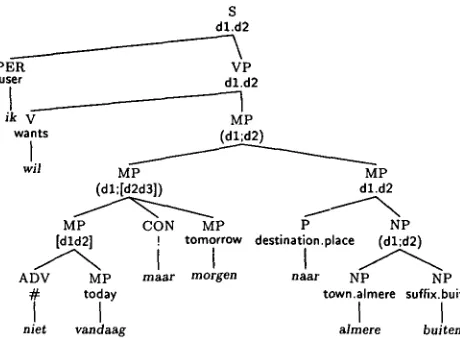
P E R
U S e r
I
ik V
wants
I
wi!
ADV MP
# today
I
I
niet vandaag
S dl.d2
V P dl.d2
M P
M P M P
dl.d2
M P C O N M P P N P
! tomorrow destinatlon.place
I
I
m a a r morgen n a a r N P N P
town.almere suffix.buiten
I
I
a l m e r e buiten
Figure 9: A tree from the OVIS tree-bank
of CFG-rules, that do not have any distinguishing features to account for their differing semantic rule. Now the resulting tree-bank embodies a function from CFG rules to semantic rules. We store this function in a table, and strip all semantic rules from the trees. As the experimental results in the next section show, using a tree-bank obtained in this way for data oriented semantic interpretation, results in high coverage, and good probability estimations.
5 E x p e r i m e n t s o n t h e O V I S t r e e - b a n k
The NWO 4 Priority Programme "Language and Speech Technology" is a five year research pro- gramme aiming at the development of advanced telephone-based information systems. Within this programme, the OVIS 5 tree-bank is created. Using a pilot version of the OVIS system, a large number of human-machine dialogs were collected and tran- scribed. Currently, 10.000 user utterances have re- ceived a full syntactic and semantic analysis. Re- grettably, the tree-bank is not available (yet) to the public. More information on the tree-bank can be found on h t t p :
~~grid.
l e t . r u g . nZ : 4321/. The se- mantic domain of all dialogs, is the Dutch railways schedule. The user utterances are mostly answers to questions, like: "From where to where do you want to travel?", "At what time do you want to arrive in Amsterdam?", "Could you please repeat your destination?". The annotation method is ro- bust and flexible, as we are dealing with real, spo- ken data, containing a lot of clearly ungrammatical utterances. For the annotation task, the annotation4Netherlands Organization for Scientific Research 5Public Transport Information System
workbench SEMTAGS is used. It is a graphical inter- face, written by Bonnema, offering all functionality needed for examining, evaluating, and editing syn- tactic and semantic analyses. SEMTAGS is mainly used for correcting the output of the DOP-parser. It incrementally builds a probabilistic model of cor- rected annotations, allowing it to quickly suggest al- ternative semantic analyses to the annotator. It took approximately 600 hours to annotate these 10.000 utterances (supervision included).
Syntactic annotation of the tree-bank is conven- tional. There are 40 different syntactic categories in the OVIS tree-bank, that appear to cover the syn- tactic domain quite well. No grammar is used to determine the correct annotation; there is a small set of guidelines, that has the degree of detail nec- essary to avoid an "anything goes"-attitude in the annotator, but leaves room for his/her perception of the structure of an utterance. There is no concep- tual division in the tree-bank between POS-tags and nonterminal categories.
Figure 9 shows an example tree from the tree- bank. It is an analysis of the Dutch sentence: "Ik(I)
wil( want ) niet( not ) vandaag( today) maar( but )
mor-gen(tomorrow)
naar(to) AlmereBuiten(Almere
Buiten)".
The analysis uses the formula schematadiscussed in section 3.2, but here the interpreta- tions of daughter-nodes are so-called "update" ex- pressions, conforming to a frame structure, that are combined into an update of an information state. The complete interpretation of this utterance
is:
user.wants.(([#today];[itomorrow]);destination.-
place.(town.almere;suffix.buiten)).
The semantic for-malism employed in the tree-bank is the topic of the next section.
5.1 T h e S e m a n t i c f o r m a l i s m
[image:7.612.68.298.46.215.2]Interpretation: Exact Match
95 %
85
,
,
,
1 2 3 4 5
Max. subtree depth Figure 10: Size of training set: 8500
S e m . / S y n t . Analysis: Exact Match
90 % 87.69
88.21
85.64
- -
88.66
85 8 3 . 0 8 - -
80" ,
I I I I1
2
3
4
5
Max. subtree depth Figure 11: Size of training set: 8500
is new information. Added to the semantic formal- ism are pragmatic operators, corresponding to de- nial, confirmation , correction and assertion 6 t h a t indicate the relation between the value in its scope, and the information state.
An update expression is a set of paths through the frame structure, enhanced with pragmatic operators that have scope over a certain part of a path. For the semantic D O P model, the semantic type of an expression ¢ is a pair of types (tz,t2). Given the type-lattice "/-of the frame structure, tl is the lowest upper bound in T of the paths in ¢, and t2 is the greatest lower bound in T o f the paths in ¢. 5.2 E x p e r i m e n t a l results
We performed a number of experiments, using a ran- dom division of the tree-bank d a t a into test- and training-set. No provisions were taken for unknown words. The results reported here, are obtained by randomly selecting 300 trees from the tree-bank. All utterances of length greater than one in this selection are used as testing material. We varied the size of the training-set, and the maximal depth of the sub- trees. The average length of the test-sentences was 4.74 words. There was a constraint on the extrac- tion of subtrees from the training-set trees: subtrees could have a m a x i m u m of two substitution-sites, and no more than three contiguous lexical nodes (Expe- rience has shown t h a t such limitations improve prob- 6In the example in figure 9, the pragmatic opera- tors # , denial, and !, correction, axe used
Interpretation: Exact Match
9 0 . 7 6 92.31
/0
8 8 . 2 1 ~
90
87.18
7 1 . 2 7
7 0 " , ' ,
1000 2500 40'00 5500 7000 85'00
Tralningset size Figure 12: Max. depth of subtrees = 4
S e m . / S y n t . A n a l y s i s : E x a c t Match
90 % 87.18 88.21
80 79 49
68
711
7 0 i , ,
1000 2500 40'00 5500 7000 8500
Tralningset size Figure 13: Max. depth of subtrees = 4
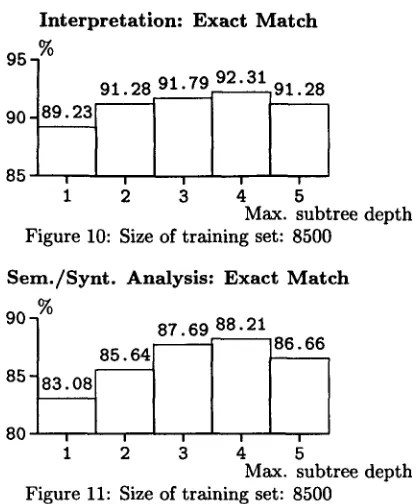
ability estimations, while retaining the full power of DOP). Figures 10 and 11 show results using a train- ing set size of 8500 trees. The maximal depth of sub- trees involved in the parsing process was varied from 1 to 5. Results in figure 11 concern a match with the total analysis in the test-set, whereas Figure 10 shows success on just the resulting interpretation. Only exact matches with the trees and interpreta- tions in the test-set were counted as successes. The experiments show t h a t involving larger fragments in the parsing process leads to higher accuracy. Appar- ently, for this domain fragments of depth 5 are too large, and deteriorate probability estimations 7. The results also confirm our earlier findings, t h a t seman- tic parsing is robust. Quite a few analysis trees t h a t did not exactly match with their counterparts in the test-set, yielded a semantic interpretation t h a t did match. Finally, figures 12 and 13 show results for differing training-set sizes, using subtrees of maxi- mal depth 4.
R e f e r e n c e s
M. van den Berg, R. Bod, and R. Scha. 1994. A Corpus-Based Approach to Semantic Interpre- tation. In Proceedings Ninth Amsterdam Collo-
quium. ILLC,University of Amsterdam.
[image:8.612.105.314.44.296.2]E. Black, R. Garside, and G. Leech. 1993.
Statistically-Driven Computer Grammars of En-
glish: The IBM/Lancaster Approach.
Rodopi, Amsterdam-Atlanta.R. Bod. 1992. A computational model of language performance: Data Oriented Parsing. In
Proceed-
ings COLING'92,
Nantes.R. Bod. 1993a. Monte Carlo Parsing. In Proceedings
Third International Workshop on Parsing Tech-
nologies, Tilburg/Durbuy.
R. Bod. 1993b. Using an Annotated Corpus as a Stochastic Grammar. In
Proceedings EACL'93,
Utrecht.R. Bod. 1 9 9 5 .
Enriching Linguistics with
Statistics:
Performance models of Natural
Language.
Phd-thesis, ILLC-dissertationseries 1995-14, University of Amsterdam. f t p : / / f t p . fwi. uva. n l / p u b / t h e o r y / i l l c / - d i s s e r t at ions/DS-95-14, t e x t . ps. gz
R Bod. 1996. Two Questions about Data-Oriented Parsing. In Proceedings Fourth Workshop on Very
Large Corpora,
Copenhagen, Denmark. (cmp- lg/9606022).R. Bod, R. Bonnema, and R. Scha. 1996. A data- oriented approach to semantic interpretation. In
Proceedings Workshop on Corpus-Oriented Se-
mantic Analysis, ECAI-96,
Budapest, Hungary. (cmp-lg/9606024).R. Bod and R. Scha. 1996. Data-oriented lan- guage processing, an overview. Technical Re- port LP-96-13, Institute for Logic, Language and Computation, University of Amsterdam. (cmp- lg/9611003).
R. Bonnema. 1996. Data oriented se- mantics. Master's thesis, Department of Computational Linguistics, University of Am- sterdam, http ://mars. let. uva. nl/remko_b/- dopsem/script ie. html
T. Briscoe. 1994. Prospects for practical parsing of unrestricted text: Robust statistical parsing tech- niques. In N. Oostdijk and P de Haan, editors,
Corpus-based Research into Language.
Rodopi, Amsterdam.E. Charniak. 1996. Tree-bank grammars. In
Pro-
ceedings AAAI'96,
Portland, Oregon.L. Gamut. 1991.
Logic, Language and Meaning.
Chicago University Press.J Goodman. 1996. Efficient Algorithms for Parsing the DOP Model. In
Proceedings Empirical Meth-
ods in Natural Language Processing,
Philadelphia, Pennsylvania.R. Kaplan. 1996. A probabilistic approach to Lexical-Functional Grammar. Keynote pa- per held at the LFG-workshop 1996, Greno- ble, France. f t p : / / f t p . p a r c . xerox, com/pub/-
nl/slides/grenoble96/kaplan-dopt alk .ps. M. Marcus, B. Santorini, and M. Marcinkiewicz.
1993. Building a Large Annotated Corpus of En-
glish: The Penn Treebank.
Computational Lin-
guistics,
19(2).F. Pereira and Y. Schabes. 1992. Inside-outside reestimation from partially bracketed corpora. In
Proceedings of the 30th Annual Meeting of the
ACL,
Newark, De.M. Rajman. 1995a. Apports d'une approche a base
de corpus aux techniques de traitement automa-
tique du langage naturel.
Ph.D. thesis, Ecole Na- tionale Superieure des Telecommunications, Paris. M. Rajman. 1995b. Approche probabiliste de l'analyse syntaxique.Traitement Automatique des
Langues,
36:1-2.S. Sekine and R. Grishman. 1995. A corpus- based probabilistic grammar with only two non-terminals. In
Proceedings Fourth Interna-
tional Workshop on Parsing Technologies,
Prague, Czech Republic.K. Sima'an, R. Bod, S. Krauwer, and R. Scha. 1994. Efficient Disambiguation by means of Stochastic Tree Substitution Grammars. In
Proceedings In-
ternational Conference on New Methods in Lan-
guage Processing.
CCL, UMIST, Manchester. K. Sima'an. 1995. An optimized algorithm for DataOriented Parsing. In
Proceedings International
Conference on Recent Advances in Natural Lan-
guage Processing.
Tzigov Chark, Bulgaria. K. Sima'an. 1996a. An optimized algorithm forData Oriented Parsing. In R. Mitkov and N. Ni- colov, editors,
Recent Advances in Natural Lan-
guage Processing 1995, volume 136 of Current Is-
sues in Linguistic Theory.
John Benjamins, Ams- terdam.K. Sima'an. 1996b. Computational Complexity of Probabilistic Disambiguation by means of Tree- Grammars. In
Proceedings COLING'96,
Copen- hagen, Denmark.D. Tugwell. 1995. A state-transition grammar for data-oriented parsing. In
Proceedings European
Chapter of the ACL'95,
Dublin, Ireland.G. Veldhuijzen van Zanten. 1 9 9 6 . Seman- tics of update expressions. NWO priority Programme Language and Speech Technology,