Modeling Human Inference Process for
Textual Entailment Recognition
Hen-Hsen Huang
Kai-Chun Chang
Hsin-Hsi Chen
Department of Computer Science and Information Engineering
National Taiwan University
No. 1, Sec. 4, Roosevelt Road, Taipei, 10617 Taiwan
{hhhuang, kcchang}@nlg.csie.ntu.edu.tw; [email protected]
Abstract
This paper aims at understanding what hu-man think in textual entailment (TE) recogni-tion process and modeling their thinking pro-cess to deal with this problem. We first ana-lyze a labeled RTE-5 test set and find that the negative entailment phenomena are very ef-fective features for TE recognition. Then, a method is proposed to extract this kind of phenomena from text-hypothesis pairs auto-matically. We evaluate the performance of using the negative entailment phenomena on both the English RTE-5 dataset and Chinese NTCIR-9 RITE dataset, and conclude the same findings.
1
Introduction
Textual Entailment (TE) is a directional relation-ship between pairs of text expressions, text (T) and hypothesis (H). If human would agree that the meaning of H can be inferred from the mean-ing of T, we say that T entails H (Dagan et al., 2006). The researches on textual entailment have attracted much attention in recent years due to its potential applications (Androutsopoulos and Ma-lakasiotis, 2010). Recognizing Textual Entail-ment (RTE) (Bentivogli, et al., 2011), a series of evaluations on the developments of English TE
recognition technologies, have been held seven times up to 2011. In the meanwhile, TE recogni-tion technologies in other languages are also un-derway (Shima, et al., 2011).
Sammons, et al., (2010) propose an evaluation metric to examine the characteristics of a TE
recognition system. They annotate text-hypothesis pairs selected from the RTE-5 test set with a series of linguistic phenomena required in the human inference process. The RTE systems are evaluated by the new indicators, such as how many T-H pairs annotated with a particular
phe-nomenon can be correctly recognized. The indi-cators can tell developers which systems are bet-ter to deal with T-H pairs with the appearance of which phenomenon. That would give developers a direction to enhance their RTE systems.
Such linguistic phenomena are thought as im-portant in the human inference process by anno-tators. In this paper, we use this valuable re-source from a different aspect. We aim at know-ing the ultimate performance of TE recognition systems which embody human knowledge in the inference process. The experiments show five negative entailment phenomena are strong fea-tures for TE recognition, and this finding con-firms the previous study of Vanderwende et al. (2006). We propose a method to acquire the lin-guistic phenomena automatically and use them in
TE recognition.
This paper is organized as follows. In Section 2, we introduce linguistic phenomena used by annotators in the inference process and point out five significant negative entailment phenomena. Section 3 proposes a method to extract them from T-H pairs automatically, and discuss their effects on TE recognition. In Section 4, we ex-tend the methodology to the BC (binary class subtask) dataset distributed by NTCIR-9 RITE task (Shima, et al., 2011) and discuss their ef-fects on TE recognition in Chinese. Section 5 concludes the remarks.
2
Human Inference Process in TE
We regard the human annotated phenomena as features in recognizing the binary entailment re-lation between the given T-H pairs, i.e., EN-TAILMENT and NO ENEN-TAILMENT. Total 210
T-H pairs are chosen from the RTE-5 test set by Sammons et al. (2010), and total 39 linguistic phenomena divided into the 5 aspects, including knowledge domains, hypothesis structures, infer-ence phenomena, negative entailment
na, and knowledge resources, are annotated on the selected dataset.
2.1 Five aspects as features
We train SVM classifiers to evaluate the perfor-mances of the five aspects of phenomena as fea-tures for TE recognition. LIBSVM RBF kernel (Chang and Lin, 2011) is adopted to develop classifiers with the parameters tuned by grid search. The experiments are done with 10-fold cross validation.
For the dataset of Sammons et al. (2010), two annotators are involved in labeling the above 39 linguistic phenomena on the T-H pairs. They may agree or disagree in the annotation. In the experiments, we consider the effects of their agreement. Table 1 shows the results. Five as-pects are first regarded as individual features, and are then merged together. Schemes “Annota-tor A” and “Annota“Annota-tor B” mean the phenomena labelled by annotator A and annotator B are used as features respectively. The “A AND B” scheme, a strict criterion, denotes a phenomenon exists in a T-H pair only if both annotators agree with its appearance. In contrast, the “A OR B” scheme, a looser criterion, denotes a phenome-non exists in a T-H pair if at least one annotator marks its appearance.
We can see that the aspect of negative entail-ment phenomena is the most significant feature among the five aspects. With only 9 phenomena in this aspect, the SVM classifier achieves accu-racy above 90% no matter which labeling schemes are adopted. Comparatively, the best accuracy in RTE-5 task is 73.5% (Iftene and Moruz, 2009). In negative entailment phenomena aspect, the “A OR B” scheme achieves the best accuracy. In the following experiments, we adopt this labeling scheme.
2.2 Negative entailment phenomena
There is a large gap between using negative en-tailment phenomena and using the second effec-tive features (i.e., inference phenomena). Moreo-ver, using the negative entailment phenomena as features only is even better than using all the 39 linguistic phenomena. We further analyze which negative entailment phenomena are more signifi-cant.
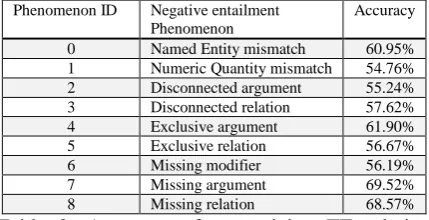
There are nine linguistic phenomena in the as-pect of negative entailment. We take each phe-nomenon as a single feature to do the two-way textual entailment recognition. The “A OR B” scheme is applied. Table 2 shows the
experi-Annotator A Annotator B A AND B A OR B Knowledge
Domains 50.95% 52.38% 52.38% 50.95% Hypothesis
Structures 50.95% 51.90% 50.95% 51.90% Inference
Phenomena 74.29% 72.38% 72.86% 74.76% Negative
Entailment Phenomena
97.14% 95.71% 92.38% 97.62%
Knowledge
[image:2.595.308.526.70.200.2]Resources 69.05% 69.52% 67.62% 69.52% ALL 97.14% 92.20% 90.48% 97.14%
Table 1: Accuracy of recognizing binary TE rela-tion with the five aspects as features.
Phenomenon ID Negative entailment Phenomenon
Accuracy
0 Named Entity mismatch 60.95% 1 Numeric Quantity mismatch 54.76% 2 Disconnected argument 55.24% 3 Disconnected relation 57.62% 4 Exclusive argument 61.90% 5 Exclusive relation 56.67% 6 Missing modifier 56.19% 7 Missing argument 69.52% 8 Missing relation 68.57%
Table 2: Accuracy of recognizing TE relation with individual negative entailment phenomena.
The 1st column is phenomenon ID, the 2nd col-umn is the phenomenon, and the 3rd column is the accuracy of using the phenomenon in the bi-nary classification. Comparing with the best ac-curacy 97.62% shown in Table 1, the highest accuracy in Table 2 is 69.52%, when missing argument is adopted. It shows that each phenom-enon is suitable for some T-H pairs, and merging all negative entailment phenomena together achieves the best performance.
We consider all possible combinations of these 9 negative entailment phenomena, i.e., +…+ =511 feature settings, and use each feature setting to do 2-way entailment relation recognition by LIBSVM. The notation de-notes a set of ( ) feature settings, each with
n features.
The model using all nine phenomena achieves the best accuracy of 97.62%. Examining the combination sets, we find phenomena IDs 3, 4, 5, 7 and 8 appear quite often in the top 4 feature settings of each combination set. In fact, this set-ting achieves an accuracy of 95.24%, which is the best performance in combination set. On the one hand, adding more phenomena into (3, 4, 5, 7, 8) setting does not have much performance difference.
[image:2.595.308.523.234.344.2]ulti-mate performance of TE recognition systems embodying human knowledge in the inference. The human knowledge in the inference cannot be captured by TE recognition systems fully correct-ly. In the later experiments, we explore the five critical features, (3, 4, 5, 7, 8), and examine how the performance is affected if they are extracted automatically.
3
Negative Entailment Phenomena
Ex-traction
The experimental results in Section 2.2 show that disconnected relation, exclusive argument, ex-clusive relation, missing argument, and missing relation are significant. We follow the definitions of Sammons et al. (2010) and show them as fol-lows.
(a) Disconnected Relation. The arguments and the relations in Hypothesis (H) are all matched by counterparts in Text (T). None of the argu-ments in T is connected to the matching relation.
(b) Exclusive Argument. There is a relation common to both the hypothesis and the text, but one argument is matched in a way that makes H
contradict T.
(c) Exclusive Relation. There are two or more arguments in the hypothesis that are also related in the text, but by a relation that means H contra-dicts T.
(d) Missing Argument. Entailment fails be-cause an argument in the Hypothesis is not pre-sent in the Text, either explicitly or implicitly.
(e) Missing Relation. Entailment fails because a relation in the Hypothesis is not present in the Text, either explicitly or implicitly.
To model the annotator’s inference process, we must first determine the arguments and the relations existing in T and H, and then align the arguments and relations in H to the related ones in T. It is easy for human to find the important parts in a text description in the inference process, but it is challenging for a machine to determine what words are important and what are not, and to detect the boundary of arguments and relations. Moreover, two arguments (relations) of strong semantic relatedness are not always literally identical.
In the following, a method is proposed to ex-tract the phenomena from T-H pairs automatical-ly. Before extraction, the English T-H pairs are pre-processed by numerical character transfor-mation, POS tagging, and dependency parsing with Stanford Parser (Marneffe, et al., 2006;
Levy and Manning, 2003), and stemming with NLTK (Bird, 2006).
3.1 A feature extraction method
Given a T-H pair, we first extract 4 sets of noun phrases based on their POS tags, including {noun in H}, {named entity (nnp) in H}, {compound noun (cnn) in T}, and {compound noun (cnn) in
H}. Then, we extract 2 sets of relations, includ-ing {relation in H} and {relation in T}, where each relation in the sets is in a form of Predi-cate(Argument1, Argument2). Some typical ex-amples of relations are verb(subject, object) for verb phrases, neg(A, B) for negations, num(Noun,
number) for numeric modifier, and tmod(C, tem-poral argument) for temporal modifier. A predi-cate has only 2 arguments in this representation. Thus, a di-transitive verb is in terms of two rela-tions.
Instead of measuring the relatedness of T-H
pairs by comparing T and H on the predicate-argument structure (Wang and Zhang, 2009), our method tries to find the five negative entailment phenomena based on the similar representation. Each of the five negative entailment phenomena is extracted as follows according to their defini-tions. To reduce the error propagation which may be arisen from the parsing errors, we directly match those nouns and named entities appearing in H to the text T. Furthermore, we introduce WordNet to align arguments in H to T.
(a) Disconnected Relation. If (1) for each a
{noun in H}{nnp in H}{cnn in H}, we can find a T too, and (2) for each r1=h(a1,a2)
{relation in H}, we can find a relation r2=h(a3,a4) {relation in T} with the same header h, but with different arguments, i.e., a3≠a1 and a4≠a2,
then we say the T-H pair has the “Disconnected Relation” phenomenon.
(b) Exclusive Argument. If there exist a rela-tion r1=h(a1,a2){relation in H}, and a relation
r2=h(a3,a4){relation in T} where both relations
have the same header h, but either the pair (a1,a3)
or the pair (a2,a4) is an antonym by looking up
WordNet, then we say the T-H pair has the “Ex-clusive Argument” phenomenon.
(c) Exclusive Relation. If there exist a relation
r1=h1(a1,a2){relation in T}, and a relation
r2=h2(a1,a2){relation in H} where both relations
have the same arguments, but h1 and h2 have the
(d) Missing Argument. For each argument a1 {noun in H}{nnp in H}{cnn in H}, if there does not exist an argument a2T such that a1=a2,
then we say that the T-H pair has “Missing Ar-gument” phenomenon.
(e) Missing Relation. For each relation
r1=h1(a1,a2){relation in H}, if there does not
exist a relation r2=h2(a3,a4){relation in T} such
that h1=h2, then we say that the T-H pair has
“Missing Relation” phenomenon.
3.2 Experiments and discussion
The following two datasets are used in English TE recognition experiments.
(a) 210 pairs from part of RTE-5 test set. The 210 T-H pairs are annotated with the linguistic phenomena by human annotators. They are se-lected from the 600 pairs in RTE-5 test set, in-cluding 51% ENTAILMENT and 49% NO EN-TAILMENT.
(b) 600 pairs of RTE-5 test set. The original RTE-5 test set, including 50% ENTAILMENT and 50% NO ENTAILMENT.
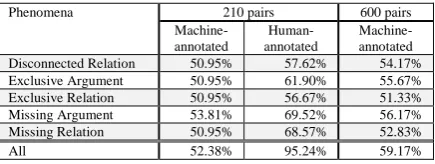
Table 3 shows the performances of TE recog-nition. The “Machine-annotated” and the “Hu-man-annotated” columns denote that the phe-nomena annotated by machine and human are used in the evaluation respectively. Using “Hu-man-annotated” phenomena can be seen as the upper-bound of the experiments. The perfor-mance of using machine-annotated features in 210-pair and 600-pair datasets is 52.38% and 59.17% respectively.
Though the performance of using the phenom-ena extracted automatically by machine is not comparable to that of using the human annotated ones, the accuracy achieved by using only 5 fea-tures (59.17%) is just a little lower than the aver-age accuracy of all runs in RTE-5 formal runs (60.36%) (Bentivogli, et al., 2009). It shows that the significant phenomena are really effective in dealing with entailment recognition. If we can improve the performance of the automatic phe-nomena extraction, it may make a great progress on the textual entailment.
Phenomena 210 pairs 600 pairs
Machine- annotated
Human- annotated
Machine- annotated Disconnected Relation 50.95% 57.62% 54.17% Exclusive Argument 50.95% 61.90% 55.67% Exclusive Relation 50.95% 56.67% 51.33% Missing Argument 53.81% 69.52% 56.17% Missing Relation 50.95% 68.57% 52.83%
[image:4.595.72.290.656.738.2]All 52.38% 95.24% 59.17%
Table 3: Accuracy of textual entailment recogni-tion using the extracted phenomena as features.
4
Negative Entailment Phenomena in
Chinese RITE Dataset
To make sure if negative entailment phenomena exist in other languages, we apply the methodol-ogies in Sections 2 and 3 to the RITE dataset in NTCIR-9. We annotate all the 9 negative entail-ment phenomena on Chinese T-H pairs according to the definitions by Sammons et al. (2010) and analyze the effects of various combinations of the phenomena on the new annotated Chinese data. The accuracy of using all the 9 phenomena as features (i.e., setting) is 91.11%. It shows the same tendency as the analyses on English data. The significant negative entailment phe-nomena on Chinese data, i.e., (3, 4, 5, 7, 8), are also identical to those on English data. The mod-el using only 5 phenomena achieves an accuracy of 90.78%, which is very close to the perfor-mance using all phenomena.
We also classify the entailment relation using the phenomena extracted automatically by the similar method shown in Section 3.1, and get a similar result. The accuracy achieved by using the five automatically extracted phenomena as features is 57.11%, and the average accuracy of all runs in NTCIR-9 RITE task is 59.36% (Shima, et al., 2011). Compared to the other methods us-ing a lot of features, only a small number of bi-nary features are used in our method. Those ob-servations establish what we can call a useful baseline for TE recognition.
5
Conclusion
In this paper we conclude that the negative en-tailment phenomena have a great effect in deal-ing with TE recognition. Systems with human annotated knowledge achieve very good perfor-mance. Experimental results show that not only can it be applied to the English TE problem, but also has the similar effect on the Chinese TE
recognition. Though the automatic extraction of the negative entailment phenomena still needs a lot of efforts, it gives us a new direction to deal with the TE problem.
The fundamental issues such as determining the boundary of the arguments and the relations, finding the implicit arguments and relations, ver-ifying the antonyms of arguments and relations, and determining their alignments need to be fur-ther examined to extract correct negative entail-ment phenomena. Besides, learning-based ap-proaches to extract phenomena and multi-class
Acknowledgments
This research was partially supported by Excel-lent Research Projects of National Taiwan Uni-versity under contract 102R890858 and 2012 Google Research Award.
References
Ion Androutsopoulos and Prodromos Malakasiotis. 2010. A Survey of Paraphrasing and Textual En-tailment Methods. Journal of Artificial Intelligence Research, 38:135-187.
Luisa Bentivogli, Peter Clark, Ido Dagan, Hoa Trang Dang, and Danilo Giampiccolo. 2011. The seventh PASCAL recognizing textual entailment challenge. In Proceedings of the 2011 Text Analysis Conference (TAC 2011), Gaithersburg, Maryland, USA..
Luisa Bentivogli, Ido Dagan, Hoa Trang Dang, Danilo Giampiccolo, and Bernardo Magnini. 2009. The fifth PASCAL recognizing textual entailment challenge. In Proceedings of the 2009 Text Analysis Conference (TAC 2009), Gaithersburg, Maryland, USA.
Steven Bird. 2006. NLTK: the natural language toolkit. In Proceedings of the 21st International Conference on Computational Linguistics and 44th Annual Meeting of the Association for Computa-tional Linguistics (COLING-ACL 2006), pages 69-72.
Chih-Chung Chang and Chih-Jen Lin. 2011. LIBSVM: a Library for Support Vector Machines. ACM Transactions on Intelligent Systems and Technolo-gy, 2:27:1-27:27. Software available at http://www.csie.ntu.edu.tw/~cjlin/libsvm.
Ido Dagan, Oren Glickman, and Bernardo Magnini. 2006. The PASCAL Recognising Textual Entail-ment Challenge. Lecture Notes in Computer Sci-ence, 3944:177-190.
Adrian Iftene and Mihai Alex Moruz. 2009. UAIC Participation at RTE5. In Proceedings of the 2009 Text Analysis Conference (TAC 2009), Gaithersburg, Maryland, USA.
Roger Levy and Christopher D. Manning. 2003. Is it harder to parse Chinese, or the Chinese Treebank? In Proceedings of the 41st Annual Meeting on As-sociation for Computational Linguistics (ACL 2003), pages 439-446.
Marie-Catherine de Marneffe, Bill MacCartney, and Christopher D. Manning. 2006. Generating typed dependency parses from phrase structure parses. In The Fifth International Conference on Language Resources and Evaluation (LREC 2006), pages 449-454.
Mark Sammons, V.G.Vinod Vydiswaran, and Dan Roth. 2010. Ask not what textual entailment can do for you... In Proceedings of the 48th Annual Meet-ing of the Association for Computational LMeet-inguis- Linguis-tics (ACL 2010), pages 1199-1208, Uppsala, Swe-den.
Hideki Shima, Hiroshi Kanayama, Cheng-Wei Lee, Chuan-Jie Lin, Teruko Mitamura, Yusuke Miyao, Shuming Shi, and Koichi Takeda. 2011. Overview of NTCIR-9 RITE: Recognizing inference in text. In Proceedings of the NTCIR-9 Workshop Meeting, Tokyo, Japan.
Lucy Vanderwende, Arul Menezes, and Rion Snow. 2006. Microsoft Research at RTE-2: Syntactic Contributions in the Entailment Task: an imple-mentation. In Proceedings of the Second PASCAL Challenges Workshop.