A Representation for Complex and Evolving Data Dependencies
in Generation
C M e l l i s h $, R E v a n s t, L C a h i l l t, C D o r a n t, D P a i v a t, M R e a p e $, D S c o t t t, N T i p p e r t t I n f o r m a t i o n T e c h n o l o g y R e s e a r c h I n s t i t u t e , University of B r i g h t o n , Lewes Rd, B r i g h t o n , U K
SDivision of I n f o r m a t i c s , University of E d i n b u r g h , 80 S o u t h Bridge, E d i n b u r g h , U K rags@itri, brighton, ac. uk
http :/www. itri. brighton, ac. uk/proj ect s/rags
A b s t r a c t
This paper introduces an approach to represent- ing the kinds of information that components in a natural language generation (NLG) sys- tem will need to communicate to one another. This information may be partial, may involve more than one level of analysis and may need to include information about the history of a derivation. We present a general representation scheme capable of handling these cases. In ad- dition, we make a proposal for organising inter- module communication in an NLG system by having a central server for this information. We have validated the approach by a reanalysis of an existing NLG system and through a full im- plementation of a runnable specification.
1 I n t r o d u c t i o n
One of the distinctive properties of natural lan- guage generation when compared with other language engineering applications is that it has to take seriously the full range of linguistic rep- resentation, from concepts to morphology, or even phonetics. Any processing system is only as sophisticated as its input allows, so while a natural language understanding system might be judged primarily by its syntactic prowess, even if its attention to semantics, pragmatics and underlying conceptual analysis is minimal, a generation system is only as good as its deep- est linguistic representations. Moreover, any at- t e m p t to abstract away from individual gener- ation systems to a more generic architectural specification faces an even greater challenge: not only are complex linguistic representations required, able to support the dynamic evolu- tionary development of data during the gener- * Now at the M I T R E Corporation, Bedford, MA, USA, cdoran@mitre, org.
ation process, but they must do so in a generic and flexible fashion.
This paper describes a representation devel- oped to meet these requirements. It offers a formally well-defined declarative representation language, which provides a framework for ex- pressing the complex and dynamic data require- ments of NLG systems. T h e approach supports different levels of representation, mixed repre- sentations that cut across levels, partial and shared structures and 'canned' representations, as well as dynamic relationships between data at different stages in processing. We are using the approach to develop a high level data model for NLG systems as part of a generic generation architecture called RAGS 1.
T h e framework has been implemented in the form of a database server for modular genera- tion systems. As proof of concept of the frame- work, we have reimplemented an existing NLG system. T h e system we chose was the Caption Generation System (CGS) (Mittal et al., 1995; Mittal et al., 1998). T h e reimplementation in- volved defining the interfaces to the modules of CGS in terms of the RAGS representations and then implementing modules that had the requi- site input and o u t p u t representations.
Generation systems, especially end-to-end, applied generation systems, have, unsurpris- ingly, many things in common. Reiter (1994) proposed an analysis of such systems in terms of a simple three stage pipeline. More recently, the RAGS project a t t e m p t e d to repeat the anal-
1This work is supported by ESPRC grants
GR/L77041 (Edinburgh) and GR/L77102 (Brighton),
RAGS: Reference Architecture for Generation Systems.
ysis (Cahill et al., 1999a), b u t found t h a t while most systems did implement a pipeline, t h e y did not implement the s a m e pipeline - different
functionalities occurred in different places and different orders in different systems. In order to a c c o m m o d a t e this result, we sought to de- velop an architecture t h a t is m o r e general t h a n a simple pipeline, and thus s u p p o r t s the range of pipelines observed, as well as o t h e r more com- plex control regimes (see (Cahill et al., 1999a; Cahill et al., 1999b)). In this paper, we argue t h a t supporting such an architecture requires careful consideration of the way d a t a represen- tations interact and develop. A n y formal frame- work for expressing t h e architecture must take account of this.
2 T h e r e p r e s e n t a t i o n a l r e q u i r e m e n t s o f g e n e r a t i o n s y s t e m s
We noted in the introduction t h a t generation systems have to deal with a range of linguis- tic information. It is natural, especially in the context of a generic architecture proposal, to model this b r e a d t h in terms of discrete layers of representation: (1999a) introduce layers such as conceptual, semantic, rhetorical, syntactic and d o c u m e n t structure, b u t t h e precise demar- cation is not as i m p o r t a n t here as the princi- ple. T h e different kinds of information are typi- cally represented differently, and built up sepa- rately. However t h e layers are far from indepen- dent: objects at one layer are directly related to those at others, forming chains of d e p e n d e n c y from conceptual t h r o u g h rhetorical and seman- tic s t r u c t u r e to final syntactic and d o c u m e n t re- alisation. This means t h a t d a t a resources, such as g r a m m a r s and lexicons, and processing mod- ules in t h e system, are often defined in terms of m i x e d data: structures t h a t include informa- tion in more t h a n one representation layer. So t h e ability to represent such mixed structures in a single formal framework is an i m p o r t a n t p r o p e r t y of a generic d a t a proposal.
In addition, it is largely s t a n d a r d in gener- ation as elsewhere in language applications, to make extensive use of p a r t i a l representations, often using a t y p e system to c a p t u r e grades of underspecification. An i m m e d i a t e corollary of providing support for partial structures is the notion t h a t t h e y m a y become f u r t h e r specified over time, t h a t d a t a structures e v o l v e . If the
framework seeks to avoid over-commitment to particular processing strategies it needs to pro- vide a way of representing such evolution ex- plicitly if required, r a t h e r t h a n relying on de- structive modification of a structure. Related to this, it should provide explicit s u p p o r t for representing a l t e r n a t i v e specifications at any point. Finally, to fully support efficient pro- cessing across t h e range of applications, from t h e simple to t h e most complex, t h e represen- tation must allow for c o m p a c t sharing of infor- m a t i o n in t a n g l e d structures (two structures which share components).
In addition to these direct requirements of t h e generation task itself, additional requirements arise from m o r e general methodological consid- erations: we desire a representation t h a t is for- mally w e l l d e f i n e d , allows for theoretical r e a - s o n i n g a b o u t t h e d a t a and p e r f o r m a n c e of sys- tems, and s u p p o r t s control regimes from simple deterministic pipelines to complex parallel ar- chitectures.
3 T h e R e p r e s e n t a t i o n S c h e m e
In this section, we present our proposal for a general representation scheme capable of cover- ing the above requirements. Our formulation is layered: t h e foundation is a simple, flexible, rig- orously defined graph representation formalism, on top of which we introduce notions of com- plex types and larger d a t a structures and rela- tionships between them. This much is sufficient to c a p t u r e t h e requirements just discussed. We suppose a yet higher level of specification could capture a m o r e constraining d a t a model b u t make no specific proposals about this here, how- ever the following sections use examples t h a t do conform to such a higher level d a t a model.
T h e lowest level of t h e representation scheme is:
• r e l a t i o n a l : t h e basic d a t a entity is x -~ y,
an a r r o w representing a relation from ob-
ject x to object y;
• t y p e d : objects and arrows have an asso- ciated t y p e system, so it is possible to de- fine classes and subclasses of objects and arrows.
how t h e y relate to each other. So a representa- tion allowed by t h e scheme consists of:
• a set of objects, organised into types;
• a set of b i n a r y relations, organised into types;
• a set of arrows, each indicating t h a t a rela- tion holds between one object a n d a n o t h e r object.
S e t s , s e q u e n c e s a n d f u n c t i o n s
For the next level, we introduce more struc- ture in the t y p e system to s u p p o r t sets, se- quences and functions. Objects are always atomic (though t h e y can be of t y p e set, se- quence or function) - it is not possible to make an object which actually is a set of two other objects (as you might with d a t a s t r u c t u r e s in a computer program). To create a set, we intro- duce a set
type
for the object, a n d a set mem- bership arrow t y p e(el),
t h a t links the set's el- ements to the set. Similarly, for a sequence, we introduce a sequence type a n d sequence mem- ber arrow types(1-el, 2-el, 3-el, ...
), a n d for a function, we have a complex t y p e which spec- ifies the types of the arrows t h a t make up the d o m a i n and t h e range of the function.SemRep
~
fun(Rol
e.SemRep)
7 V
show SemRep SemRep
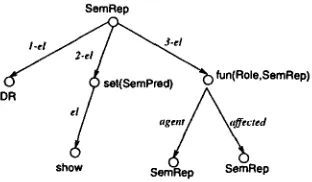
Figure 1: T h e partial semantic representation of "The second chart shows the n u m b e r of days on the market"
As an example, consider Figure 1, which shows a semantic representation
(SemRep)
from the CGS reimplementation. Here, the tree nodes correspond to objects, each labelled with its type. T h e root node is of t y p e SemRep, and although it is not an explicit sequence type, we can see t h a t it is a triple, as it has three sequence member arrows (with types1-el, 2-el
a n d3-el).
Its first arrow's target is an object of t y p e DR (Discourse Referent). Its second represents a set of SemPred (Semantic Predicate) objects, and in this case there's j u s t one, of type show. Its third
element is a (partial) function, from
Role
arrow types(agent
a n daffected
are b o t h subtypes of Role) to SemReps. (In this case, the SemReps have not yet been fully specified.)L o c a l a n d n o n - l o c a l a r r o w s
T h e second extension to the basic representa- tion scheme is to distinguish two different ab- stract kinds of arrows - local and non-local. F u n d a m e n t a l l y we are representing just a homo- geneous network of objects a n d relationships. In the example above we saw a network of arrows t h a t we might want to view as a single d a t a structure, a n d other m a j o r d a t a types might similarly appear as networks. Additionally, we want to be able to express relationships
between
these larger ' s t r u c t u r e s ' - between structures of the same t y p e (alternative solutions, or re- vised versions) or of different types (semantic and syntactic for example). To capture these distinctions a m o n g arrows, we classify our ar- row types as local or non-local (we could do this in the t y p e s y s t e m itself, or leave it as an informal distinction). Local arrows are used to build up networks t h a t we t h i n k of as single d a t a structures. Non-local arrows express rela- tionships between such d a t a structures.
All the arrow types we saw above were local. Examples of non-local arrows might include:
r e a l i s e s These arro~vs link something more ab- stract to s o m e t h i n g less abstract t h a t re- alises it. Chains of realises arrows might lead from the original conceptual input to the generator t h r o u g h rhetorical, seman- tic a n d syntactic structures to the actual words t h a t express t h e input.
r e v i s e s These arrows link a s t r u c t u r e to an- other one of t h e same type, which is con- sidered to be a ' b e t t e r ' solution - perhaps because it is more instantiated. It is impor- t a n t to note t h a t parts of larger structures can be revised w i t h o u t revising the entire structure.
[image:3.612.115.271.432.523.2]Notice t h a t the representation scheme does not enforce any kind of well-formedness with respect to local and non-local arrows. In fact, although it is natural to think of a 'structure' as being a maximal network of local arrows with a single root object, there's no reason w h y this should be so - networks with multiple roots rep- resent tangled structures (structures t h a t share content), networks t h a t include non-local links might be mixed representations, containing in- formation of more t h a n one sort. Such tech- niques might b e useful for improving generator efficiency, or representing canned text or tem- plates, cf. (Calder et al., 1999).
P a r t i a l a n d O p a q u e s t r u c t u r e s
Partial structures are essential when a m o d u l e needs to p r o d u c e a skeleton of a representa- tion t h a t it does not have the competence to completely fill out. For instance, lexical choice brings with it certain syntactic commitments, b u t in most N L G systems lexical choice occurs some time before a g r a m m a r is consulted to flesh out syntactic s t r u c t u r e in detail.
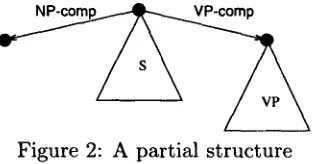
Figure 2: A partial s t r u c t u r e
By simply leaving out local arrows, we can represent a range of partial structures. Con- sider Fig. 2, where the triangles represent local structure, representing a sentence object and its component verb phrase. There is a link to a sub- ject noun phrase object, b u t none of the local arrows of the actual noun phrase are present. In subsequent processing this local structure might be filled in. This is possible as long as the noun phrase object has been declared to be of the right type.
An opaque s t r u c t u r e is one which has an in- complete derivational history - for example p a r t of a syntactic structure w i t h o u t any correspond- ing semantic structure. Three possible reasons for having such structures are (a) to allow struc- ture to be introduced t h a t the generator is not capable of producing directly, (b) to prevent the generator from interfering with the s t r u c t u r e thus built (for example, by trying to modify an
idiom in an inappropriate way), or (c) to im- prove generator efficiency by hiding detail t h a t m a y lead to wasteful processing. An opaque s t r u c t u r e is represented simply b y the failure to include a r e a l i s e s arrow to t h a t structure. Such structures provide the basis for a gener- alised approach to "canning".
4 I m p l e m e n t a t i o n
There are m a n y ways t h a t modules in an N L G s y s t e m could c o m m u n i c a t e information using the representation scheme j u s t outlined. Here we describe a particularly general model of inter-module communication, based around m o d u l e s communicating with a single cen- tralised repository of d a t a called the whiteboard
(Calder et al., 1999). A w h i t e b o a r d is a cumu- lative typed relational blackboard:
• t y p e d a n d r e l a t i o n a l : b e c a u s e it is based on using the above representation scheme; • a b l a c k b o a r d : a control architec- ture and d a t a store shared between processing modules; typically, modules a d d / c h a n g e / r e m o v e o b j e c t s in the d a t a store, examine its contents, a n d / o r ask to be notified of changes;
• c u m u l a t i v e : unlike s t a n d a r d blackboards, once d a t a is added, it can't b e changed or removed. So a s t r u c t u r e is built incremen- tally b y making successive copies of it (or of constituents of it) linked by r e v i s e s links (although actually, there's no constraint on the order in which t h e y are built).
A w h i t e b o a r d allows m o d u l e s to add ar- rows (typically forming networks through ar- rows sharing source or target objects), to in- spect the set of arrows looking for particular configurations of types, or to be informed when a particular t y p e of arrow (or group of arrows) is added.
T h e w h i t e b o a r d is an active d a t a b a s e server. This means that it runs as an independent pro- cess t h a t other modules connect to by appropri- ate means. There are essentially three kinds of interaction that a module might have with the w h i t e b o a r d server:
[image:4.612.136.293.381.463.2]• q u e r y - look for an arrow or arrows in the whiteboard;
• w a i t - register interest in an arrow or ar- rows appearing in the whiteboard.
In b o t h q u e r y and w a i t , arrows are specified by type, and with a hierarchical t y p e system on objects and relations, this a m o u n t s to a p a t t e r n that matches arrows of s u b t y p e s as well. The w a i t function allows the w h i t e b o a r d to take the initiative in processing - if a module w a i t s on a query then the w h i t e b o a r d waits until the query is satisfied, and then tells the module a b o u t it. So the m o d u l e does not have to continuously scan the w h i t e b o a r d for work to do, b u t can let the w h i t e b o a r d tell it as soon as anything interesting happens.
Typically a module will start up and regis- ter interest in the kind of arrow t h a t represents the module's input data. It will then wait for the w h i t e b o a r d to notify it of instances of t h a t d a t a (produced b y other modules), and when- ever anything turns up, it processes it, adding its own results to the whiteboard. All the mod- ules do this asynchronously, and processing con- tinues until no m o d u l e has any more work to do. This m a y sound like a recipe for confusion, b u t more s t a n d a r d pipelined behaviour is not much different. In fact, pipelining is exactly a data-based constraint - the second m o d u l e in a pipeline does not start until the first one pro- duces its o u t p u t .
However, to be a strict pipeline, the first mod- ule must p r o d u c e all of its o u t p u t before the sec- ond one starts. This can be achieved simply by making the first m o d u l e p r o d u c e all its o u t p u t at once, b u t sometimes t h a t is not ideal - for ex- ample if the module is recursive and wishes to react to its own o u t p u t . Alternative strategies include the use of markers in the whiteboard, so that modules can tell each other t h a t t h e y ' v e finished processing (by adding a marker), or extending the w h i t e b o a r d architecture itself so that modules can tell the w h i t e b o a r d that t h e y have finished processing, and other modules can wait for that to occur.
5 R e c o n s t r u c t i o n o f t h e C a p t i o n G e n e r a t i o n S y s t e m
In order to prove this representation scheme in practice, we have implemented the white-
b o a r d in Sicstus Prolog and used it to s u p p o r t d a t a communications between modules in a re- construction of the Caption Generation S y s t e m (Mittal et al., 1995). CGS is a system developed at the University of P i t t s b u r g h , which takes in- p u t from the S A G E graphics presentation sys- tem (Roth et al., 1994) and generates captions for the graphics SAGE produces. We selected it for this effort because it a p p e a r e d to b e a fairly simple pipelined system, with modules perform- ing clearly defined linguistic tasks. As such, we thought it would be a good test case for our w h i t e b o a r d specification.
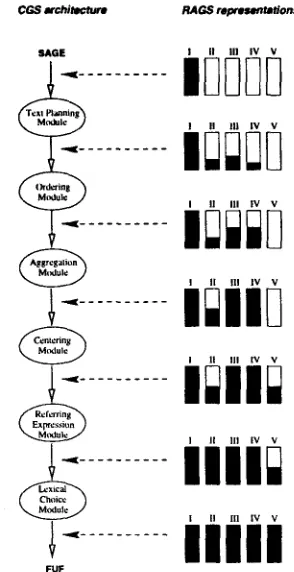
Although the CGS is organised as a pipeline, shown in Figure 3, the representations commu- nicated between the modules do not correspond to complete, separate instances of R A G S data- t y p e representations. Instead, the representa- tions at the various levels accumulate along the pipeline or are revised in a way that does not correspond exactly to module boundaries. Fig- ure 3 gives a simple picture of how the different levels of representation build up. T h e labels for the R A G S representations refer to the following:
• I = conceptual; • II -- semantic; • I I I = rhetorical; • IV = document; • V = syntactic.
AbsSemRep
I-el ~
~
...
SemRep--(~---~_set{KBPredl ~ fun(Role,set(KBId))
I-el ~ 3 - e l
. . . . / X . . .el agent affected . . . . DR fun(Role,set(SemRep))
~i/ ~ ...
~
el?set(SemPredi~t
A
~ . •
nresent set(KSld) 0 . . . v • ~--"-
... /
a g e n , / \ a ] J e c , e ael / \ el . . . " . . . ~ ¢J
/ "k~ present S~mRep SemRep
chart1 chart2
Figure 4: Combined Abstract Semantic Representation and Concrete Semantic Representation for the output: "These two charts present information about house sales from data-set ts-1740"
C G $ a r o h i t a , ~ l u ' e R A G S representat/on$
II I l l IV ~'
SAGE
- - . . .
tuning II
- ..........
I1 I11 i V
--' . . .
I[ I11 IV
. . . I ; 1 1 @
11 III I v v
. . .
II I11 IV V
. . . III1
II 111 IV V
l - - . . . I I I I I
F U F
Figure 3: A RAGS view of the CGS system
5.1 R e f e r r i n g E x p r e s s i o n G e n e r a t i o n
In many NLG systems, (nominal) referring ex- pression generation is an operation that is in- voked at a relatively late stage, after the struc- ture of individual sentences is fairly well speci- fied (at least semantically). However, referring expression generation needs to go right back to the original world model/knowledge base to se- lect appropriate semantic content to realise a particular conceptual item as an NP (whereas
all other content has been determined much ear- lier). In fact, there seems to be no place to put referring expression generation in a pipeline without there being some resulting awkward- ness.
In RAGS, pointers to conceptual items can be included inside the first, "abstract", level of semantic representation (AbsSemRep), which is intended to correspond to an initial bundling of conceptual material under semantic predicates. On the other hand, the final, "concrete", level of semantic representation (SemRep) is more like a fully-fledged logical form and it is no longer appropriate for conceptual material to be included there. In the CGS reimplementa- tion, it is necessary for the Aggregation mod- ule to reason about the final high-level semantic representation of sentences, which means that this module must have access to "concrete" se- mantic representations. The Referring Expres- sion generation module does not run until later, which means that these representations cannot be complete.
[image:6.612.101.558.72.225.2] [image:6.612.132.279.269.555.2]resulting mixed structure, it could tell exactly which conceptual entity needed to be referred to and where in the semantic structure the re- sulting semantic expression should be placed. Figure 4 shows the resulting arrangement for one example CGS sentence. The dashed lines indicate realises, i.e. non-local, arrows.
5.2 H a n d l i n g C e n t e r i n g I n f o r m a t i o n
The CGS Centering module reasons about the entities that will be referred to in each sentence and produces a representation which records the forward and backward-looking centers (Grosz et al., 1995). This representation is later used by the Referring Expression generation module in making pronominalisation decisions. This in- formation could potentially also be used in the Realisation module.
Since Centering is not directly producing re- ferring expressions, its results have to sit around until they can actually be used. This posed a possible problem for us, because the RAGS framework does not provide a specific level of representation for Centering information and therefore seems on first sight unable to account for this information being communicated be- tween modules. The solution to the problem came when we realised that Centering informa- tion is in fact a kind of abstract syntactic in- formation. Although one might not expect ab- stract syntactic structure to be determined until the Realisation module (or perhaps slightly ear- lier), the CGS system starts this computation in the Centering module.
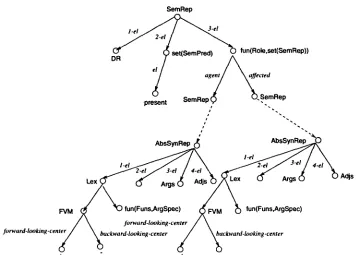
Thus in the reimplementation, the Centering module computes (very partial) abstract syn- tactic representations for the entities that will eventually be realised as NPs. These represen- tations basically just indicate the relevant Cen- tering statuses using syntactic features. Figure 5 shows an example of the semantics for a typi- cal output sentence and the two partial abstract syntactic representations computed by the Cen- tering module for what will be the two NPs in that sentence 2. As before, dashed lines indicate
realises arrows. Of course, given the discussion
of the last section, the semantic representation objects that are the source of these arrows are in fact themselves linked back to conceptual enti- ties by being the destination of realises arrows
2 F V M = F e a t u r e V a l u e M a t r i x .
from them.
When the Referring Expression generation module runs, it can recover the Centering infor- mation by inspecting the partial syntactic rep- resentations for the phrases it is supposed to generate. These partial representations are then further instantiated by, e.g., Lexical Choice at later stages of the pipeline.
6 C o n c l u s i o n
The representation scheme we have proposed here is designed specifically to support the re- quirements of the current state-of-the-art NLG systems, and our pilot implementation demon- strates the practical applicability of the pro- posal. Tangled, partial and mixed structures are of obvious utility to any system with a flex- ible control strategy and we have shown here how the proposed representation scheme sup- ports them. By recording the derivational his- tory of computations, it also supports decisions which partly depend on earlier stages of the generation process (e.g., possibly, lexical choice) and revision-based architectures which typically make use of such information. We have shown how the representation scheme might be the ba- sis for an inter-module communication model, the whiteboard, which supports a wide range of processing strategies that require the represen- tation of complex and evolving data dependem cies. The fact that the whiteboard is cumula- tive, or monotonic in a logical sense, means that the whiteboard also supports reasoning about the behaviour of NLG systems implemented in terms of it. This is something that we would like to exploit directly in the future.
SemRep
fun(Role,setlSemRep))
sl S " ' .
t t ~ .
2 AbsSynRep " ~
AbsSynRep _(:5 ~,
, ,
/ \
\
ckward-looking-cemer ckward.looking-cenler
+ +
Figure 5: Arrangement of centering information for the o u t p u t sentence above
The representation scheme is useful in situa- tions where modules need to be defined and im- plemented to work with other modules, possibly developed by different people. In such cases, the representation scheme we propose permits pre- cise definition of the interfaces of the modules, even where t h e y are not restricted to a single 'level' of representation. Even t h o u g h the con- trol structure of CGS is quite simple, we found that the use of a centralised w h i t e b o a r d was use- ful in helping us to agree on interfaces and on the exact contribution t h a t each m o d u l e should be making. Ultimately, it is h o p e d that the use of a scheme of this t y p e will permit much more widespread 'plug-and-play' among m e m b e r s of the N L G community.
R e f e r e n c e s
Lynne Cahill, Christy Doran, Roger Evans, Chris Mellish, Daniel Paiva, Mike Reape, Donia Scott, and Neil Tipper. 1999a. In Search of a Reference Architecture for NLG Systems. In Proceedings of the 7th European Workshop on Natural Language Generation, pages 77-85, Toulouse.
Lynne Cahill, Christy Doran, Roger Evans, Chris Mellish, Daniel Paiva, Mike Reape, Donia Scott, and Neil Tipper. 1999b. Towards a Reference Architecture for Natural Language Genera- tion Systems. Technical Report ITRI-99-14, Information Technology Research Institute
(ITRI), University of Brighton. Available at http://www, i t r i . b r i g h t o n . ac. u k / p r o j e c t s / r a g s . Jo Calder, Roger Evans, Chris Mellish, and Mike
Reape. 1999. "Free choice" and templates: how to get both at the same time. In "May I speak freely?" Between templates and free choice in nat- ural language generation, number D-99-01, pages 19-24. Saarbriicken.
B.J. Grosz, A.K. Joshi, and S. Weinstein. 1995. Centering: a framework for modelling the local co- herence of discourse. Computational Linguistics,
21 (2):203-226.
V. O. Mittal, S. Roth, J. D. Moore, J. Mattis, and G. Carenini. 1995. Generating explanatory cap- tions for information graphics. In Proceedings of the 15th International Joint Conference on Ar- tificial Intelligence (IJCAI'95), pages 1276-1283, Montreal, Canada, August.
V. O. Mittal, J. D. Moore, G. Carenini, and S. Roth. 1998. Describing complex charts in natural lan- guage: A caption generation system. Computa- tional Linguistics, 24(3):431-468.
Ehud Reiter. 1994. Has a consensus NL generation architecture appeared and is it psycholinguisti- cally plausible? In Proceedings of the Seventh In- ternational Workshop on Natural Language Gen- eration, pages 163-170, Kennebunkport, Maine. Steven F. Roth, John Kolojejchick, Joe Mattis, and
[image:8.612.156.513.77.332.2]