Me. ~Ireonn Annual Report 2002
Contents
Foreword
Mission Statement and Organisational Structure
Articles
EUMETSAT Conference and the Meteosat Second Generation Satellite System
Rainfall and Flooding in 2002
Programme News
Forecasting Programme
Observing and Technical Support Programme Climate Programme
Strategic Management
Other Activities
Appendices
I. Stoff Training and Development
II. Forecast Accuracy III. Publications
IV. Met Eireann Finances
Corporate Information
Glossary
2
3
4
7
9
12
15
17
21
23
24
27
28
29
Mel ~Iroann Annual Report 2002
Foreword
Met fireann has always considered that Its meteorological activities contribute very significantly to the care and monitoring of Ireland's natural environment. On 6th June 2002 this conviction was underscored by the
Taolseach's announcement that, as part of a wider tronsfer of functions between Government Departments, henceforth Met flreann was to be part of the Department of the Environment and Local Government. This move will provide us with an opportunity to forge closer links with the Department's environmental functions, and to locate our activities In a wider context. Met fireann's Community Climate Change Consortium for Ireland (C41) project, aimed at establishing a regional climate analysis and prediction centre for Ireland, is an example of the contribution we can make to the mission of the Department.
It is of course with some sadness that we part from our colleagues in the transport function, having been associated with that Department, and particulorly the aviation section, since the establishment of the Meteorological Service in 1936. As it hoppens, 2002 was a year In which aviation issues were very topical. Recent pressures have focused attention on the costs of all services to avialion, not excepting those provided by Met fireann. Following discussions with the Deportment of Transport, we are redoubling our efforts to make all our charges to the aviation sector as transparent as
possible and in line with best practice. At European Union level too, the future provision of meteorological services to aviation is under review and the new Single European Sky initiative could have significant implications for Met fireann.
The weather of 2002 was notable for above normal roinfall amounts which resulted in some serious ftooding - notably during November, when both Cork and Dublin were badly
-"
affected. Forecasts issued by Met flreann helped the local authorities to cope with the disruption and underlined our vital role in dealing with severe weather events.
In line with the recommendotions of the recent Value for Money study of Met fireann, corned out by the Comptroller and Auditor-General, the on'9oing measurement of forecast accuracy remained high on our agenda during 2002
I would like to record my thanks to all Met Eireann stoff for the important work done in 2002, and for the excellent results achieved in our mission to help protect life ond property, and contribute effectively to national prosperity.
Declan Murphy Director
"
Met Elreann ' Annual Report 2002 - "Mission Statement
Our Mission is to meet the national requirement for high-quality
weather forecasts and associated services
,
with opt
i
mum
efficiency and value for money
.
Orga n isationa I Structure
(December 2002)Director
-~
...
".
Met Elreann Annual Report 2002
EUMETSAT Conference and the
Meteosat Second Generation Satelnte
System
Introduction
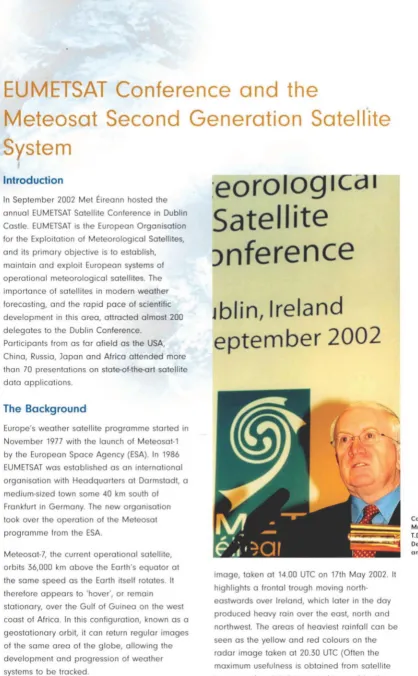
In September 2002 Met Eireann hosted the annual EUMETSAT Satellite Conference in Dublin Castle. EUMETSAT is the European Organisation for the Exploitation of Meteorological Satellites, and its primary obJeclive tS to establish,
maintain and exploit European systems of operational meteorological satellites. The
importance of satellites in modern weather
forecasting, and the rapid pace of scientific
development in this area, attracted almost 200 delegates to the Dublin Conference.
Participants from as far afield as the USA, China, Russia, Japan and Africa attended more than 70 presentations on state-of-the-ort satellite data applications.
The Background
Europe's weather satellite programme started in
November 1977 with the launch of Meteosat-1
by the European Space Agency (ESA). In 1986 EUMETSAT was established as an international organisation with Headquarters at Darmstadt, a
medium-sized town some 40 km south of Frankfurt in Germany. The new organisation took over the operation of the Meteosat programme from the ESA.
Meteosat-7, the current operational satellite, orbits 36,000 km above the Earth's equator at the same speed as the Earth itself rotates. It therefore appears to 'hover', or remain
stationary, over the Gulf of Guinea on the west
coast of Africa. In this configuration, known as a geostationary orbit, it can return regular images of the same area of the globe, allowing the development and progression of weather
systems to be tracked.
Figure 1 shows an example of a Meteosat-7
:
eorolog
lea
I
Satellite
)nference
J
bli n, I rela nd
eptember
2002
image, taken at 14.00 UTC on 17th May 2002. It highlights a frontal trough moving north
-eastwards over Ireland, which later in the day produced heavy rain over the east, north and
northwest. The areas of heaviest rainfall can be
seen as the yellow and red colours on the rodar image taken at 20.30 UTC (Often the maximum usefulness is obtained from satellite imagery when it is interpreted in combination
With other data).
Conloronco oponlng address by
Mr. Pat tho Cope Gallagher
[image:5.590.51.469.62.738.2]Flguro 1: Motoosat-7 and radar Imagos from 17lh
May 2002
Launch of MSG-1 Salol lito aboard Ariano-S.
The Second Generation
Scientific developments, ond the increasing
demands on weather forecasting systems, have created the need for more frequent and comprehensive observations from space. This
has led to the Meteosat Second Generation
(MSG) system, which will replace the Meteosat
series.
-,~
Mel tlreann Annual Report 2002
17/05/2002
The first of the new satellites - MSG-1 - was sent into orbit aboard the European Ariane-5 launcher on 28th August 2002. MSG-2 will follow
in 2005 and MSG-3 about five years later. The aim is to give a continuous MSG service for at
leost 12 years.
With the existing Meteosat system, an object such as a cloud has to cover at leost 2.5 x 2.5
km to be seen in visible light, but with MSG, objects of 1 square km can be seen In the High
Resolution Visible (HRV) channel. Also, while Meteosat-7 transmits images every 30 minutes,
MSG will operate at twice this frequency. These
improved spatial and temporal resolutions are Important - for example in forecasting
thunderstorms, which can grow rapidly to
dangerous proportions. The new MSG Imagery will also improve forecasts of hazards such as fog, snowfall, and rapidly deepening
depressions that often bring gale force winds.
MSG will be capable of delivering about 20 times more information than the existing
Meteosat system. To deal with the flood of new
data, a completely new ground processing
system is being developed. The central part of
Mol Eheann Annual Report 2002 __
MSG satellites will be monitored and controlled
and data will be received, processed and
retran$miUed to end-users.
The Satellite Application Facilities
(SAFs)
A novel feature of the MSG project is that
sections of the satellite ground system will be
distributed among several European
meteorological services. These will host Satellite Application Facilities (SAFs), where speCialised
expertise will interpret MSG data to produce
specific weather-related information. Different
SAFs will focus their attention on topics such as
ocean and sea ice, ozone concentrations and
climate monitoring, to nome Just a few.
Among the SAFs of particular interest to Met
Elreann is that dealing with Support to
Nowcasting and Very Short Range Forecasting,
based at the headquarters of the Instituto
Nacional de Meteorologla (INM) in Madrid.
Output from this SAF Is expected to improve
Met Eireann's overall lorecasting capability and
in particular help with the identification,
tracking and monitoring of rain-bearing cloud
systems.
As on example of the SAF's work, Figure 2
shows a Meteosat image overlaid with
computer-generated symbols representing
typical weather types associated with particular
cloud formations. These serve as a 'first-guess'
to guide the forecaster's interpretation of the
satellite images. The usefulness and reliability
of this guidance will Improve when Ihe higher
-resolution MSG images become available.
The Future
The successful launch of MSG-1, just days
before the opening of the Dublin Conference,
represented a major milestone in Europe's
weather satellite programme. Looking to the
future, the Conference also considered plans for
the EUMETSAT Polar System (EPS), a series of polar orbiting satellites the first of which is due
for launch in 2005. Polar orbiting satellites circle the Earth in an almost north-south orbit, passing
close to both poles, at on altitude (apprax. 800 km) which is much lower than the geostationary
satellites. The geostationary and polar systems
will together provide complementary data of
immense usefulness in operational weather
forecasting.
Figure 2:
Sample SAF OUlput
Some symbols:
w Warm Front Occlusion
Annual Porconlago of Normal Rainfall for 2002.
Monlhly Porconlagos of Normal Rainfall in 2002.
~~
Mel tJreann, Annual Reporl 2002
Rainfall and Flooding In 2002
Rainfall amounts in 2002 were above normal
throughout most of Ireland, and set new records in many parts of Leinster and Munster.
Particularly heavy falls occurred during the
months of February, May, October and
November. At Valentia Observatory the rainfall in 2002 amounted to 1923mm, the highest annual total since records began rn the area in
1892.
>140~
130· 140'9
120· 130\
110· 120\
100· 110\
Such exceptional rainfall resulted in several serious flooding incidents during the year, at times exacerbated by a combrnation of strong
winds and high tides.
Following several days of stormy weather rn late January, a deep depression of 930 hPa passed to the northwest of Ireland on 1st
February. Bands of heavy thundery rarn,
accompanied by south-westerly gales, affected most ports of the country throughout the day.
Most disruption, however, was caused by the
exceptionally high tides recorded around many
coasts, especially in the Irish Sea. The worst
affected area was Dublin; severe flooding occurred after the highest tide measured for
over eIghty years caused rivers and canals to
overflow in parts of the city.
The east, north and northwest of the country experienced heavy rainfall in mid-May. Falls of more than 25mm were recorded on the 17th as
a bond of thunderstorms merged over much of
Lernster and Ulster, and daily totals exceeded 50mm in some places.
Both October and November were among the
wellest months on record in the south and east.
A bond of heavy rain brought falls of over
25mm to many southern counties on 25th
October. At Rosslare, rain commenced in the
early afternoon and by midnight measured 80mm, over half of which fell in a 2·hour period between 15.00 and 17.00 UTC, including a 1·
hour fall of 31.5mm. This represented the highest midnight-to-midnight fall at Rosslare
since the station opened in 1956.
On 13th November on area of heavy rain
moved into eastern regions. associated with a
deep depression of 966 hPa which became
slow-moving over the Irish Sea. Rain continued for over 30 hours in the Dublin area and
Mel Elmann Annual Report 2002
caused severe flooding along the vafley of the
River Tolka. The river level rose to 2.42m at
Glasnevin (Botanic Gardens) In the early
morning of the 15th, corresponding to a flow
rate of 97 mils - the highest recorded in over 50 years of measurements, including a major
flooding event in December 1954. Dublin Airport's daily rainfall totol up to midnight on
the 14th was 75mm, the highest since records began there in 1941.
Heavy rainfall later in November also brought
flooding to the south and southwest, causing particular disruption in Cork city. Cork Airport
and Valentia Observatory measured over
120mm of rain in the eight-day period between
20th - 27th November, or the equivalent of the
normal total for the entire month.
The question Inevitably arises, whether the heavy rainfall of 2002 represents nothing more
than the normal variability of Irish weather from
one year to the next, or could perhaps be a manifestation of a definite change in climate In
2001, studies by the United Nation's
Intergovernmental Panel on Climate Change
(IPcq anticipated that global winter rainfall
would increase in future years. The studies also indicated that precipitation extremes would
probably Increase to a greater degree than
mean precipitation. However much research remains to be done, and at the moment it Is not possible to say if any individual
preCipitation event In Ireland is directly related
to global climate change.
Record high tides following a week of stormy weather causod
severo flooding in the Rlngsond oroa of Dublin on lSI Fobruary.
Rainfall amounts of ovor 50mm on 14th Novomber resultod In widespread flooding along Iho
valley of the River Tolka In Dublin.
Severe flooding in Blackpool.
Some reports from Irish weother stotiens. which are plotted each hour In the operationol lorecosl ollicos.
,
-Met ~Ireann Annual Reporl 2002
Forecasting Programme
The two Divisions most directly concerned with
delivering forecasts to end-users are the
General Forecasting Division and the Aviallon
Services DiVision. Of course, the work of these
Divisions relies heavily on support from other
sections of Met tlreonn - for example, in the areas of observing systems, instrumentation and
Information Technology. Especially important is
the computer-based guidance provided to the
operational meteorologists by the Research and
Applications Division.
General Forecasting
~~
Ii 9S.e. v •<fIb
/:120The General Forecasting Division supplies a
wide range of forecast services Ihrough the Central Analysis and Forecast Office (CAFO) and the RTt Weather Office. In excess of 1,500
forecasts per week were delivered routinely by
the DiviSion dUring 2002, a figure which does
not include gale warnings and warnings of
other severe weather conditions.
In addition to its essential tasks of providing
general weather forecasts and warnings, the
Division delivered specialised forecasts to the
marine and agriculture sectors, the Defence
Forces and the emergency services. Forecasts
of pollen count and sunburn index were issued
during the spring and summer months.
The Division also supplied customised weather
services 10 national and local media, energy utilities, the building industry, and several other business and commercial interests. In
collaboration with the National Roads Authority,
winter road maintenance forecasts were
provided for over 50 sites nationwide. The
Telephone Consultancy Service (which provides direct customer access to the operational
weather forecasters) continued to prove
popular with many industrial and commercial
clients. There was strong demand for premium
-rate telephone weather services.
In its ongoing efforts to improve efficiency and
deliver ever-beUer customer service, the Division
began an assessment of new workstation
systems designed to streamline the forecastrng
process and enhance delivery of output to end
-users.
Aviation Forecasting
The Aviation Services Division provides a wide
range of services to civil, military and general
aviation, in accordance with International Civil
Aviation Organisation (ICAO) standards and
national procedures. It comprises the Central
Aviation Office (CAO) at Shannon Airport, at
which the Head of the Division is normally
based, together with the meteorological offices at Dublin, Cork and Knock Airports and at
Casement Aerodrome. The Division is also
responsible for services to a number of
Regional Airports around the country.
During 2002 the Division Issued SIGMET
warnings for the Shannon Flight Information
Region (FIR), and Terminal Aerodrome
Forecasts (TAFs) for Shannon, Dublin, Cork and
M • • ".""
"""~,
, ... 2002~
Local Area Forecasts (LAFs) were provided for
the airports at Donegal, Sligo, Galway, Kerry
and Waterford. The Division also provided telephone briefings for private pilots and
support for Search and Rescue operations.
Aviation Services Division is the focal point for
liaison between Met ~ireann and the various International agencies involved in the regulation of aviation meteorology. Stoff from the Division
participated in meetings of the Meteorology
Group of ICAO's European Air Navigation
Planning Group (EANPG), and of the
Commission on Aeronoutical Meteorology
(CAeM) of the World Meteorological
Organisation (WMO).
-~
-A major refurbishment of the Aviation Services
Division's offices in Shannon began in May and
was completed later in the year.
Research and App
l
icat
i
ons
Numerical Weather Prediction
Theoretical work on the development of the
HIRLAM Numerical Weather Prediction (NWP) model continued during 2002. Progress was
Summary of services provided by the Aviation Services Division in 2002
Number of SIGMET Warnings for Shannon FIR 112
Number of Flight Folders provided 16140
Number of aerodrome and wind shear warnings 763
Number of telephone aviation briefings 9215 Number of Terminal Aerodrome Forecasts issued 16032
Number of Local Area Forecasts issued 5262
Number of Search and Rescue forecasts issued 184
Aircrall taxiing for take-off at
Mr. Pot tho Capo Gallaghor T.D., Mlnlstor of Stale 01 Iho Dopartment ef Iho Envirenment and local Government (conlre) visited Ihe Mot ~Ireann stand 01 the Notional Ploughing Chompionships in Ballacolla.
made on implementing a new finer-mesh model designed to run at hourly intervals (the finer
-mesh model has a horizontal resolution of 12
km and 40 vertical levels, compared to a
resalution of 15 km and 31 vertical levels in the
main HIRLAM model). Particular attention was paid to improving the accuracy of precipitation
and near-surface temperature forecasts.
Operaltonal resilience was enhanced through
the provision of a new backup computer, on
which a coarse-grid version of the HIRLAM
weather prediction model was installed.
An internal web site was developed to deliver
new model gUidance material to the
operaltonal meteorologists - including forecasts
of vertical stability and cross-sections of
temperature, wind and humidity.
Agricultural and Environmental Unit
Output from the Numerical Weather Prediction
models was incorporated directly into the
warning system for the occurrence of spells of
weather conducive to the spread of potato
blight. Blight warnings now include on indication of the duration of humid conditions,
and updates are Issued as required while these
conditions persist. Generally 2002 was a bad
year for potato blight - in all, a total of 11
blight warnings were issued.
Mr. Denis Fitzgerald, Head of the Research and Applications Division, continued as co-ordinator
of AGMET, the Joint Working Group on Applied
Agricultural Meteorology. On 14th November
AGMET launched the 'Agrometeorological
Needs Review and Analysis for Ireland' to an
invited audience from Government, the
Universities and Research Institutes. The launch was followed by a discussion on how the
various agencies might best meet the identified
needs for more observations, more localised
weatherforecasts, and improved modelling of
agricultural and environmental systems.
Marine Unit
In July the third in a planned network of five
weather buoys was deployed off the southwest
coast, as part of a joint Marine Institute / UK
Met Office / Department of the Marine and
Natural Resources / Met Eireann initiative.
Met Eireann's numerical wove prediction model
(WAM) was installed on a new server. Good progress was made on a project to automate
readings of sea temperatures at Malin Head
Pier. Training was provided to Irish Navy personnel in weather observations at sea.
In collaboration with General Forecasting
Division, the Marine Unit initiated a project to
monitor sea heights in Irish waters as an aid to
forecasting coastal flooding.
library & Information Services
Work continued on the implementation of the
Library's new automated cataloguing system.
Two issues of Met Eireann's staff magazine
Sp/onc were produced during the year. The librarian continued to serve as content
manager for Met Elreann's web site, and
coordinated the implementation of routine
changes and upgrades. Work was·campleted
on on internal web site to provide stoff with
-Mel ~Ir.onn Annual Reparl 2002
Observing and Technical Support
Programme
Synoptic Network
Met Eireann's network of synoptic weather
stations, at which hourly observations of
weather conditions are mode, comprises a mix
of manned and automatic sites. A full
programme of 24-hour observations was
maintained throughout the year at all stations.
The existing Automatic Weather Stations (AWSs)
do not prOVide adequate information on some
weather porameters - e.g., visibility and cloud
conditions. Sets of intelligent sensors capable of
monitoring these parameters are deployed at
the synoptic stations in Clones, Kilkenny and
Mullingar, for real-time assessment by
meteorologists in the Central Aviation Offlce_
The first operational unit of the new TUCSON
AutomatIC Weather Station was deployed in late
2002 at Mace Head (Co. Galway), a Global
Atmospheric Watch observatory operated by
the Notional University of Ireland, Galway.
Airports
A new anemometer and wind display system
was installed at Shannon Airport.
Meteorological Radar and Satellite
Receiving Systems
Met Eireann operates two networked weather
surveillance radars, located at Dublin and
Shannon Airports, and also maintains ground
station facilities for the reception of data from
meteorological satellites.
Both radar and satellite data continued to ploy
a central role in Met Eireann's forecasting
activities during 2002.
Valentia Observatory
Valentia Observatory continued its programme
of routine upper-oir soundings, entailing four
radiosonde ascents doily. Ozone and ultra-violet
levels were also measured at the station, and
IT Oporalions
dUring the winter special ascents to monitor the
verticol profile of ozone were carried out. The
Observatory participated in international and
notional atmospheric chemistry and
geomagnetic monitoring programmes.
Monitoring of worldwide seismic activity, carried
out with the cooperallon of the Dublin Institute
for Advanced Studies, continued during 2002.
The Observatory now has on uninterrupted
sequence of 40 years recording of seismic
events.
At year's end, work was well underway on
Phose 1 of a major refurbishment programme
at the Observatory.
Laboratory
The chemical composition of air and
precipitation samples at selected synoptic
stations was analysed as port of on-going
notional and International programmes. Some
sampling systems and analysis procedures
were changed, necessitating intercomparison of
datasets.
"
Mett
l
,eon
;;
.
Annual Report 2002_ 1
-Information Technology
In additian to the major task of providing
routine support and maintenance for existing
computer systems, the IT Division mode good
progress during 2002 on several high-priority
projects. Many of these involved a significant
level of cross-Divisional collaboration.
Among the Division's most significant areas of
work were:
Numerical Weather Prediction: The main
Numerical Weather Prediction server proved
generally reliable, although on three occasions
during the year hardware failures resulted in
processor replacements being required. A
number of outstanding installation tasks were
completed, and a range of software patches
installed. New hardware and software
maintenance contracts were agreed.
Telecommunications: Following problems with
network pocket losses, several server systems
were removed from the Thick-Wire Ethernet and
connected instead with UTP (unshielded twisted
pair) cabling. Work on the installation of a new
LAN at Valentia Observatory, and a new WAN
link to Cork Airport, was completed. In
December a Martis Node was purchased for
installation in Met Eireann HQ - this will
facilitate the management of existing and future
telecommunications circuits.
Desktop Services: The workload associated
with Desktop support and maintenance
continued to increase throughout the year.
Roll-out of PCs bought in 2001 was completed, while
a further botch of 51 desktop PCs and 4
laptops was delivered In December. Particularly
noteworthy was the Installallon of general
-purpose PCs in many of Met Eireann's
outstotions, so enabling stoff at these locations
to link to e-mail services, access the lnternet
Me! Elreonn Annual Repor! 2002
Internet Services: IT Division prepared a
document E-Mail and Inlernel Usage
Guidelines, which was approved by the
Management Committee and distributed to all
staff. An Internet e-mail filter was installed to protect against inappropriate content and, in conjunction with anti-virus software, has proved very successful in lessening the threat of
damage to the Desktop environment.
Other developments: The lost containers of
Holan gas were removed from the IT
Operations area and the new fire protection
system was fully commissioned. IT Division staff
mode detailed preparations to manage all
operational systems during the installation of a
new stand-by generator at Met Eireann's
Tho new Climote Dotoboso Servor.
Climate Programme
The Climatology & Observations Division
continued its main tasks of (1) maintaining the National Climate Database, (2) management /
quality-control of the observotional station networks and (3) operating the Climate Enquiries Office, which delivers climatological
data to customers and produces the Monthly Weather Bulletin.
During 2002 a selection of historical weather
station reports was made available on Met
Eireann's web site (www.mel.ie). to facilitate
clients who required access to these data.
Despite this the Climate Enquiries Office handled over two thousand client queries, on increase of 14% over 2001. Subscription
numbers for the Monthly Weather Bulletin showed a modest Increase.
,
Met ~Ireann ~Annuol Report 2002
The routine inspection of rainfali and climate
stations, which had been seriously curtailed in 2001 due to the Foot & Mouth crisis, resumed in 2002. A total of 210 rainfall stations and 40 climate stations were visited. Throughout the
year, good quality data was received Irom, on average, 550 stations. 13 new stations were opened and only 2 closed.
A new database server (Sun Fire V880) was installed to host the Climate Database.
Under the auspices of the British-Irish Council
work commenced on producing a gridded
baseline climatology for the island of Ireland as
port of the UK Climate Impacts Programme
(UKCIP) prOject.
The Weather of 2002
Rainfall totals for 2002 were above normal almost everywhere, and were the highest on
record at most stations in Leinster and Munster.
The wellest months relative to normal were
February, May, October and November, when
some serious flooding occurred in both rural and urban areas.
Annual mean temperatures were above the 1961-1990 normal for the ninth successive year. June, July and October were a little cooler than
average over most of the country, but mean
temperatures for January, February and
November were more than two degrees above
normal In places. Almost all stations recorded
their highest temperatures during late July or early August, when values of around 25°C were
measured. In most ports of the country the
lowest temperature of the year occurred on 1st January, when ground temperatures fell below _10°C at some inland locations.
Sunshine totals for the year were close to
normal almost everywhere. September and
Mot ~Iroann Annual Report 2002
normal, while the months of May, June ond July
were dull except in the north. Daily sunshine
durations of 15 hours or more were meosured
ot a few stations during early June.
The Weather of 2002
SHANNON AIRPORT 1068.9 lIS 35.6 210Cl
CORK AIRPORT 1538.1 127 34.6 21 Nov
DO - .
MALIN HEAD 1062.5 100 20.2 19 Feb
DUBLIN AIRPORT 1095.6 n/a 74.6 14 Nov
CASEMENT AERODROME 1014.8 143 52.5 14 Nov
CC f IY
YALENTIA OBSERYATORY 1922.7 134 41.3 20 Nov
KILKENNY 1046.7 129 30.1 8 Oct
ro
AVOBELMULLET 1318.3 115 33.8 20 Del
CONNAUGHT AIRPORT 1463.8 n/a 33.6 20 Del
Au
CLONES 1243.1 134 41.6 17 May
CO OFFAL1
BIRR 1029.9 128 26.0 23 Jan
, S
r
.
MULLINGAR II 1212.6 131 36.0 200cl
~ FOR
ROSSLARE 1241.1 142 80.0 240el
11.2
10.3
10.2
10.1 10.3
11.1
10.3
10.6 9.0
9.8
10.2
9.9
11.3
-Mean windspeeds for the year were below
normal everywhere; they ranged 7 -11 knots (8
-13 m.p.h.) at most stations, but reoched 13 -15
knots (15 -17 m.p.h.) at coastal stations in the
north and nor1hwest. The strongest winds of the
year were measured during late January and
late October. Malin Head recorded the highest
gust of the year, 86 knots (99 m.p.h.), on 28th
January.
+1.0 24.0 -3.8 3.47 100 13.8 4May
+0.8 23.2 ·0.9 3.73 98 13.9 4May
+0.8 22.2 -0.1 3.68 110 15.0 5 Jun
n/a 23.7 -6.6 3.64 93 12.7 5 Jun +1.0 23.2 ·5.5 3.54 96 12.5 26 Aug
+0.6 22.4 .1.4 3.39 101 15.4 6 Jun
+0.9 24.9 ·7.5 3.51 101 12.2 7 Apr
+0.9 23.1 ·3.1 3.67 105 13.4 Hug n/a 23.4 -4.6 3.27 n/a 13.2 5 Jul
+0.5 25.6 ·5.7 3.40 116 12.6 11 May
+0.8 24.9 ·7.0 3.19 96 11.9 4May
+0.9 25.0 ·8.0 3.51 101 12.8 21 Aug
+1.2 22.9 0.4 4.37 101 15.2 5 Jun
No. of days with:
238 14 23 65
258 110 89
251 36 180
247 18 36 83
216 17 10 17 80
269 3 15 92
246 n/a 27 .- n/a
_.
50277 39 19 144
273 12 14 16 168 81
225 nla 21 - n/a 47
247 n/a 22 _. n/a 45
260 Ria 24 - n/a
-
39Tho TUCSON Instollolion 01 Muilingor. Co. Wostmeolh ..
Met ~Ireonn Annual Report 2002
Strategic Management
High-Level Objectives
Met Elreann's High-Level Objectives, as
Identified in the Strategy Statement 1999-2001/
are
• To provide a comprehensive range of
high-quality meteorological services to the Irish
people and to all sectors of the Irish
economy.
• To ensure the long-term sustainability of
meteorological services in Ireland through
adequate infrastructural Investment.
• To help reduce public exchequer costs by
engaging in profitable commercial activities,
while maintaining a constructive relationship
with the private sector and always
conforming fully with competihon law.
• To obtain optimum benefit from
developments in meteorological science by
prudent utilisation of modern technology, by
a well-focused research programme and by
collaboration with relevant bodies.
• To utilise fully the talents and potential of all
staff by pursuing a humane and effective
human resource policy, and by according
high priority to training, communications
and participation.
• To examine the current clerical, technical
and professional grade structures with a
view to matching Individual skills to work
requirements, and to promoting overall
staffing flexibility.
Signific.ont progress was made In achieving
these objectives dUring 2002.
Meteorological Services
Met Eireann continued to fulfil its primary role
as Ireland's Notional Meteorological Service,
delivering a wide range of weather forecast
products to its principol user groups - the
general public, civil and private aviation,
Government Departments and Agencies and
many business and commercial customers.
Requests for climatological Information, which
have grown significantly in recent years, were
addressed with increased efficiency by means
of improved data-handling and delivery
systems.
Forecast quality was enhanced through on
-going development of Met Eireann's numerical
weather prediclion and wave prediction
models. Efforts continued to further improve
procedures for the verification of public weather
Met Elroann Annual Report 2002
Annual Revenue 1986
-
2002
1,500
o
o
o
1,2001
-0::::>
w
900
- 1 - - - -__ __
Q)
::J
c:
600i - - - -
-Q)
>
Q)
0::
300
+
-o
Meteorological Infrastructure
During 2002 good progress was made on The Unified Climate and Synoptic Observation Network (TUCSON) programme, a project to
design, develop, build and deploy a network of
logger-based Automatic Weather Stations (AWSs). By the end of the year TUCSON AWSs were installed at two locations - Mullingar, Co.
Westmeath and Mace Head, Co. Galway. Testing of a new Vaisala WD50 anemometer and wmd display system for airports was
completed in 2002. The new system was subsequently installed at Shannon Airport, as part of the Irish Aviation Authority's CAIRDE programme.
A new weather buoy (M3) was deployed
approximately 30 nautical miles off Mizen Head, the third in a planned network of five fixed buoys around the Irish coast.
Commercial Activities
As in previous years Met Eireann's principal commercial activities Included services to TV
and other media, the provision of premium-rate
Year
weather forecasts and supplying forecasts of severe weather (including winter road ice) to
the National Roads Authority and Local Authorities. Miscellaneous forecast services
were also provided to a wide range of commercial and mdustrial interests
(construction, marine, agriculture, energy utilities etc).
For the first time In several years overall revenues declined in 2002. While the reduction was small, It highlights the increasmgly competitive environment within which Met
Eireann pursues its commercial activities.
The Commercial Division co-ordinated Met
Elreann's participation in a number of Shows and Exhibitions throughout the year. Especially
noteworthy was attendance at the Notional
Ploughing Championships in Ballacollo, Co.
Laois, in late September. This 3-day event was
Zeiss nan.magnolic theodolite used 01 Valontlo Obsorvatary for making goomagnotic field
moasuromonts.
Science and Technology
During the year theoretical work focused on
further development of the HIRLAM Numerical
Weather Prediction model. Work on a
finer-mesh version of HIRLAM, intended to run at
hourly Intervals, continued with the testing of
new condensation and surface schemes aimed
at improving the accuracy of precipitation and
near-surface temperature forecasts.
The Marine Unit, in collaboration with Forbairt,
the Marine Institute, the Deportment of the
Morine, NUl Galway and the University of
Bangor (Wales) submitted on application to the
European Union's INTERREG Programme for
funding to develop and run on ocean model in
Ireland.
Work proceeded on establishing the Community
Climate Change Consortium for Ireland (C41), a
collaborative research project based around a
Regional Climate Analysis, Madelling and
Prediction Centre in Met Eireann.
At Valentia Observatory, a regional
geomagnetiC field model called SCHA2002 was
I,
..
Met ~Ireciiin Annual Report 2002
developed in association with the Hermanus
Magnetic Observatory, South Africa. The model
Is based on surface and satellite data -surface
data from Belgium, Britain, France and Ireland,
and magnetic field measurements taken by the
Danish-owned 0rsted satellite, which is located
in a low Earth Orbit of between 638 km and
849 km. SCHA2002 utilises the Spherical Cap
Harmonic Analysis (SCHA) technique and gives
a regional representation of the geomagnetic
fieid over an extensive area surraunding the
island of Ireland.
In the climatolagy area, work was initiated to
identify and correct any inhomogeneities in Met
Eireann's rainfall data records. Long-term series
of weather data may sometimes be affected by
a number of non-climatic factors, for example
weather station relocation or changes In
instrumentation. Such factors may (though not
always) couse data to be unrepresentative of
the true climatic variation.
Met Eireann supported a one-day Symposium
entitled 'Climate Change - Challenges for
Ireland', which was organised by the Royal Irish
Academy at the National Botanic Gardens,
Glasnevin, in June.
Staff and Human Resource
Management
While stoff numbers were close to full
complement during most of 2002, pressure of
work was such that Met Eireann continued to
engage some contract staff to help maintain
essential services.
The Partnership Council held eight meetings
during the year, including one at Valentia
Observatory. The Council also attended a
meeting with Aer Rianta stoff In April, to discuss
Mot Elroann Annual Report 2002
partnership issues. In September,
representatives fram the Partnership Council
attended a meeting organised by the
Department of the Environment and Local
Government (DoELG) to review overall
Partnership arrangements.
Among the principal topics addressed by the
Partnership Council in 2002 were Met Eireann's
move to DoELG, equality issues, the Staff Input
Scheme and cleaning/maintenance of office
accommodation. The Council also monitored
the progress of the Performance Management
and Development System (PMDS). In October,
the members of the PMDS Implementation
Group, Management Committee and
Partnership Council attended a '-day seminar
to consider the findings of a PMDS attitudinal
survey which had been conducted during the
summer by Precept Consulting. Towards the end
-of the year, a new Project Team to manage all
aspects of PMDS implementation was
established.
The Merit Awards Group approved awards for
5 individual staff members and 4 staff teams
-in all, 22 staff benefited from the scheme in
2002.
North
-
South Co-operation
Established cooperative arrangements between
Met Eireann and the Norlhern Ireland branch of
the UK Met Office continued in 2002. A
planned programme of exchange visits
involving staff from the two organisations was
launched in May, when a Met Eireann
meteorotoglst spent a very enjoyable and
informative week in Belfast.
-
-Other Activities
Change of Department
The Taoiseach's speech to the D6il on 6th June
signalled a momentous change for Met Eireann
-having been attached to the Transport function
since its foundation In 1936, Met Eireann would
in future be part of the Department of the
Environment and Local Government (DoELG).
AN ROINN COMHSHAOIL AGUS RIALTAIS AITlUIL
OEPARTMENT OF THE ENVIRONMENT
AND LOCAL GOVERNMENT
Shortly after the announcement, Mr. Niall Callan
(Secretary General, DoELG) and Ms. Gerafdlne
Tallon (Assistant Secretary, DoELG) visited Met
Eireann and met with the Director and the
Management Committee. Further meetings
ensued between personnel from Met Eireann
and their counterparts In the new parent
Department. All these encounters were very
positive -a high level of goodwill was evident
on all sides, along with a determination to
implement the Iransltion as smoothly as
possible. Most members of Met Elreann's Management Committee attended the
Department's Senior Managers Conference In
September.
The move to DoELG opens new opportunities
and challenges for Met Eireann - particularly in
such areas as air quality and environmental
monitoring, which are likely to grow in
Importance in the coming years.
"
,
M.t Elreann Annual Report 2002
Administration
The Euro conversion was achieved without any
major difficulties and was adjudged to have
been very successful.
Total expenditure in 2002 was within the
approved allocation.
A new 3-year Administrative Budget agreement
for 2002-2004 was concluded between Met
Elreann and the Department of Public
Enterprise. The status of this agreement was
somewhat uncertain following the transfer of
responsibility for Met Eireonn to DoELG. Invoice
payments and Met Eireann salary cheques
continued to issue from the former parent
Department, renamed the Department of
Transport, until late in the year when the DoELG
financial management system absorbed these
tasks.
Staff recruitment was at a considerably lower
level than in 2001; only three new
Meteorological Officers were employed.
However during the year there were two
reSignations, two transfers to other
Departments, three personnel commencing
career breaks and seven retirements. By the
year's end plans for a new recruitment
competltlan were well advanced.
A Steering Group was established to oversee
preparation of a new Mel Elreann Strategy
Statement, which is expected to be ready by
mid-2003.
International Affairs
Met Eireann maintained its active involvement
In the work of several International
organisations, including the World
Meteorological Organisation (,NMO), the
Met Elreonn Annual Report 2002
the Europeon Centre for Medium-Ronge
Weather Forecasts (ECMWF), the European
Organisation for the Exploitation of
Meteorological Satellites (EUMETSAT), the
Europeon Co-operation in Meteorology
grouping (ECOMET) and the European
Meteorological Network (EUMETNET). Met
Eireann also continued its participation In
HIRLAM, a co-operative project in Numerical
Weather Prediction between the Nordic
countries, Spain, the Netherlands and Ireland.
Met Eireann hosted the 2002 EUMETSAT Satellite
Conference In Dublin Castle in September. This
prestigious event was attended by almost 200
delegates from 31 countries and proved a
major success, helped by the flawless launch of
EUMETSAT's MSG-1 satellite just days before the
Conference opened.
Proposals emerging from the European
Commission, regarding the provision of
meteorological services to aviation, could have
significant implications for Met Eireann. The Commission's proposal for a Single European
Sky (SES) is an attempt to reform the
architecture of European air traffic control, and
has been prompted mainly by the steady rise in
delays to air traffic over recent years. The SES initiative also addresses issues of cost
-effectiveness, efficiency and reliability in the
provision of air navigation services - these
include meteorological information,
communications, navigation and surveillance
etc. Met Elreann's Aviation Services Division is
continuing to monitor the evolving situation.
Ms. Evelyn Murphy, Head of Marine
Meteorology in Met Eireann, was elected
Chairman of the European Group on Ocean
Stations (EGOS) at their December meeting in
Geneva.
Brigadier General (reL) John J Kelly, Jr.,
Director of the National Weather Service, U.S.A.,
paid a courtesy visit to Met Eireann in
November.
Young Scientist and Technology
Exhibition
Met Eireann sponsored a Special Award at the
Esat Young Scientist and Technology Exhibition,
held at the Royal Dublin Society in January. The
Award was for the best project with Irish
weather or climate as its central theme. Declan Murphy (Director, Met Eireann), presented the
prize to the winners - a group from SI. Gerard's
School, Bray, Co. Wicklow, for their project on
the relationship between air quality and lichen
Me. Elreann Annual Report 2002
Appendix I - Staff Training and
Development
General
During 2002, Met Eireonn stoff attended generat
training courses totalling 173 training days.
Three newly-appointed Meteorological Officers
completed their initial training at Casement
Aerodrome. A total of ten staff availed of the
Refund of 3rd Level Fees scheme.
At the end of the year there were the
equivalent of 230 staff posts filled in Met
Eireann (taking into account work sharing etc).
Performance Management and
Development System
As in 2001, preparations for the introduction of the Performance Management and
Development System (PMDS) were an important
focus of Met Eireann's training activities. Phase
2 training was completed by mid-February, and
Phase 3 (the final 1-day module) was presented
to most staff during April and May. In all, a
total of 423 PMDS training days were delivered
at venues in Dublin, Killarney and Carrick-an
-Shannon.
Learning Resource Centre (LRC)
Operating under the day·to-day management of
the librarian, the Learning Resource Centre
continued to prove popular with staff. The
range of learning/training materials was
enhanced, and the LRC maintained its
registration as a Testcentre for the European
Computer Driving Licence (ECDL).
ECDL training in Met Eireann operates largely
on a self-learning basis - the ECDL course material is made available on a self-study CD,
accompanied by a course manual. In 2002
several staff were engaged in mastering the
seven modules required for the award of the
ECDL qualification. During the year Met
Eireann's Testcentre implemented a new
Autotest feature, which considerably reduces
the time spent administering ECDL tests.
Candidates can now complete each test
interactively and obtain the results immediately
afterwards.
Met Eireann continued Its Involvement in
EUMETCAL, a EUMETNET project designed to
promote the joint development of computer
assisted learning (CAL) materials for
meteorology.
***
®
* *
*
EeDL
*
-Mel Elroonn Annual Reporl 2002
[image:25.578.29.493.24.579.2]Appendix II - Forecast Accuracy
Verification of Public Weather
Forecasts
During 2002, Met Eireann continued the routine
verification of predicted daily maximum
temperature, minimum temperature and rainfall
at four sites (Dublin, Cork, Birr and Belmullet),
based on the RTE 1 radio forecasts at 07.55.
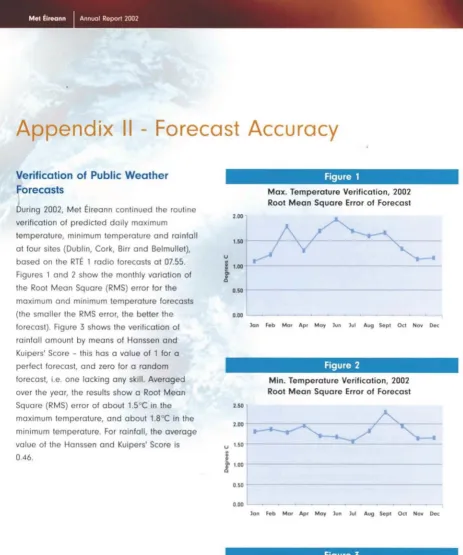
Figures 1 and 2 show the monthly variation of
the Root Mean Square (RMS) error for the
maximum and minimum temperature forecasts
(the smaller the RMS error, the beUer the
forecast). Figure 3 shows the verification of
rainfall amount by means of Hanssen and
Kuipers' Score - this has a value of 1 for a
perfect forecast, and zero for a random
forecast, i.e. one lacking any skill. Averaged
over the year, the results show a Root Mean
Square (RMS) error of about 1.5°C in the
maximum temperature, and about 1.8°C in the
minimum temperature. For rainfall, the average
value of the Hanssen and Kuipers' Score is
0.46.
2.00
1.SO
u
i
1.00r
0.50
Figure 1
Max. Temperature Verification, 2002 Root Mean Square Error of Forecast
0.00 "
-lan FGb Ma, Apr May ]un lui Aug SOp1 Od Nov Doc:
Figure 2
Min. Temperature Verification, 2002 Root Mean Square Error of Forecast
2.50
L
2.00u 1.50 S
--~~
e 8' 1.00
o
0.50
0.00
1.00
0.75
0.50
lan Feb Mar Apr May Jun lui Aug Sopt Oct NoY Doc
Figure 3
Rainfall Forecast Verification, 2002 Hanssen and Kuipers' Score
0.25
o
.
oo
L
Mel tlreann Annual Report 2002
An indication of the quality of the forecasts can be got by comparing these scores with the values
that would be obtained for a 'standard' forecast. In this case, we use persistence as a standard - i.e.,
a forecast that assumes that tomorrow's weather will be the same as today's.
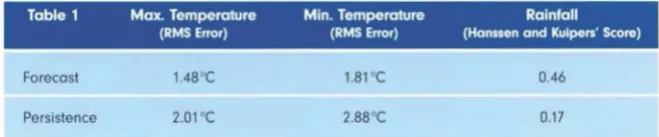
The comparative scores, averaged over the year, are shown in Table 1.
Table 1 Max. Temperature Min. Temperature Rainfall
(RMS Error) (RMS Error) (Hanssen and Kulpe,..· Score)
Forecast 1.48 'C 1.81"C 0.46
Persistence 2.01·C 2.88 C 017
As would be expected, in all cases the forecast scores are very substantially beller than those for
persistence.
The RMS forecast error for maximum temperature, and the Hanssen and Kuipers' score for rainfall, are
almost unchanged from the 2001 values. The RMS forecast error for minimum temperature shows a
small improvement on 2001.
Numerical Weather
Prediction
The evolution of the verification
scores for the HIRLAM forecasts of 2
-Metre Temperature and 10-Metre
Wind Speed, from 1997 to 2002, Is
shown in Figures 4 and 5.
Figure 4 gives the Root Mean Square
error scores of forecast 2-Metre
Temperature for 24 hrs and 48 hrs,
verified against actual temperature
reports from the network of Irish
observing stations. Both scores show
a small improvement in RMS error
compared with corresponding values
for 2001.
Figure 5 shows the Root Mean
Square error scores of forecast
10-Metre Wind Speed for 24 hrs and 48
hrs. For both timesteps the RMS
errors show a marginal Increase as
compared to the 2001 values.
Figure 4
HIRLAM Verification RMS Error of 2-Metre Temperature
2.5
24-hr Fareca$! 48-hr Forecast 2.0 "'___ : :
-u
; 1.5 ~ g> 1.0 o
0.5
0.0
3.0
2.5
'0
g
2.0 u:l: -;;;. 1.5
~
i 1.0 ~
0.5
0.0
1997
1997
1998 1999 2000 2001 2002
Figure 5
HIRLAM Verification RMS Error of lO-Metre Wind Speed
• 24-hr Forecast 48-hr Forecast
[image:26.582.164.494.275.343.2] [image:26.582.135.566.445.824.2]-••
Mol ~Iroann Annual Reporl 2002
Road Surface Temperature
Forecasts of road conditions are provided under contract to the National Roads Authority. Verification of the Road Surface Temperature (RST) minimum forecasts was carried out during the winter 2001/2002 season for the so-called critical nights (nights on which RSTs less than 5°C were observed) for all available siles. Table 2 shows the Hanssen and Kuipers' Score and the RMS error for the 2001/2002 farecasts, along with the corresponding values for the winter seasons 2000/2001 and 1999/2000.
Table 2 Hanssen and Kuipers' Score RMS Error
2001·2002
2000.2001
1999·2000
0.62
0.70
0.58
1.lC
17'C
17 C
The Hanssen and Kuipers' score for 2001/2002 is slightly less than the 2000/2001 value The RMS errors have remained almost unchanged over the three-year period.
Air Temperature Forecasts
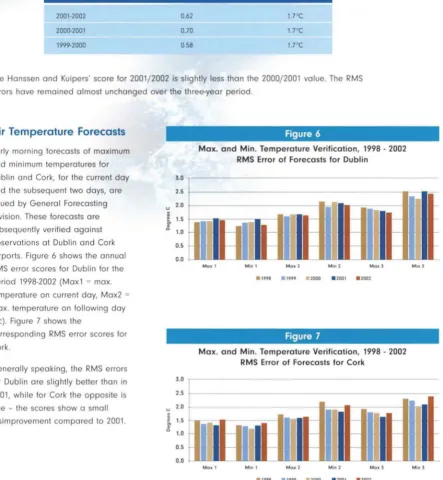
Early morning forecasts of maximum and minimum temperatures for Dublin and Cork, for the current day and the subsequent two days, are issued by General Forecasting Division. These forecasts ore subsequently verified against observations at Dublin and Cork Airports. Figure 6 shows the annual RMS error scores for Dublin far the period 1998·2002 (Maxl - max.
temperature on current day, Max2
-max. temperature on following day etc). Figure 7 shows the
corresponding RMS error scores for Cork.
Figure 6
Max. and Min. Temperature Verification, 1998 -2002 RMS Error of Forecasts for Dublin
3.0 ,
-2.5
1
-u 2.0
1
-;! 1.5
&
1.0O.S 0.0
3.0
MoJt , Min 1 Min 1 Mo. S
Figure 7
Max. and Min. Temperature Verification, 1998 -2002 RMS Error of Forecasts for Cork
Generally speaking, the RMS errors
for Dublin are slightly better than in 2001, while for Cork the opposite is true - the scores shaw a small
dislmprovement compared to 2001.
7.5
1
-u 2.0
; 1.5
&
1.00.5
0.0
[image:27.585.59.502.250.730.2]~
M., tlreonn Annual Report 2002
Appendix III - Publications
Fitzgerald, D. L. 2002: Trlcami and Kummer functions in occurrence, waiting time and
exceedance statistics. SERRA, 16, 3, 207-224,
Springer.
Fleming, G. e/ 0/2001: Weather on the Internet
and other New Technologies. WMOjTD No
1084, Geneva
Holm, D. D. and Lynch, P. 2002: Stepwise Precession of the Resonant Swinging Spring.
SIAM Journal on Applied Dynamical Systems, 1, 44 -64.
Klein Tonk, A.M.G., Wijngaard, ) B., Fitzgerald,
D e/ 01 2002: DOily Dataset of 20"-Century
Surface Air Temperature and Precipitation Series for the European Climate Assessment. Int. J Climatol. 22, 1441-1453.
Lynch, P. 2002: Resonant motions of the three-dimensional elastic pendulum. Inti. J. Nonlin.
Mech., 37, 345-367.
Lynch, P. 2002: The Swinging Spring: a Simple Model for Atmospheric Balance. Pp. 64-108 in
Lorge-Scale Atmosphere-Ocean Dynamics. Vol
II: Geometric Methods and Models. Ed. J. Norbury and I. Roulstone. Cambridge University Press.
McDonald, A. 2002: A step toward transparent boundary conditions for meteorological models.
Monthly Weather Review 130, 140-151.
McDonald, A. 2002: Well-posed boundaries;
progress report. HIRLAM newsletter 41, 109-113.
McDonald, A. 2002: Changes to the HIRLAM needed for finer grids. HIRLAM newsletter 42,
9-17.
McDonald, A. 2002: Testing transparent
boundary conditions for the shallow water equations in a nested environment. HIRLAM technical report 54, 31 pp.
Murphy, G. and Holden, N.M. 2001:
Agrameteorological Needs Review and Analysis for Ireland. AGMET Group Report.
Unden, P., Lynch, P., McDonald,A., McGrath, R., e/ 01 2002: HIRLAM-5 scientific documentation,
Met tlreann Annual Report 2002
Appendix IV -
Met Eireann Finances
The figures presented below are approximate and for information only. They do not form part of the official annual accounts of Met Elreann. All amounts are in Euro.
Income and Expenditure 2002
/
2001
Salaries and Related Expenses (A 1)
Other Operating Expenses Capital Expenditure
Contributions to International Organisations
Total
Receipts from Eurocontrol (Route Charges)
Receipts Irom Commercial & Cost Recovery Activities
Total Receipts
Net Cost of Operations
Some details of above
A1
Salaries Overtime
Payment to Observers Other Allowances
A2 (Travel & SubSistence)
A3 (Training/Library/Printing etc)
A4 (Communications & Post)
A5 (Computing -Capitol)
A5 (Computing -Non-Capital)
A6 (Maintenance/Energy)
A7 (Consultancy)
A8 (Instrumentation -Capital)
A8 (Instrumentation -Non-Capital)
Some details 01 commercial/ cost recovery receipts
Aviation
Climatological Information General Forecasting Miscellaneous
2002 {,ODD
6,984 1,444
8,428
27 171 1,219 27
2001 €,OOO
6,487 1,463
7,950
22
126
1,293 22
1,444 1,463
2002
€,OOO
12,323 2,614 930 2,286
18,153
9,725
11,660 518 97 48 243 404 241 423 572 553 70 507 531 2001 f,OOO 11,302 2,058
1,101
2,810
17,271
9,321
10,433 747 88 34 146 442 216 818 394 287 36 283 537
Met Breonn Annual Report 2002
Corporate Information
Met Eireann Headquarters
Glasnevm Hill
Dublin 9, Ireland
Tel: +353·1·8064200
Fox: +353·1·806 4247
e-mail: met.eireann meLie
web: www.meLie
General Forecasting
Tel: +353·1-806 4255
Fox: +353·1·806 4275
e-mail: [email protected]
Climatology and Observations
Tel: ~353-1-806 4260
Fox: +353-1-806 4216
e·mail: [email protected]
Commercial Division
Tel: +353·1-8064244
Fox: +353·1·806 4247
e-mail: marketinga.met.ie
Met Eireann
Valentia Observatory
Cahirciveen
Co. Kerry
Tel: +353·66-947 3460
Fax: +353-66-947 2442
Met Eireann Dublin Airport
Co. Dublin
Tel: +353·1-8120081
Fox: +353·1-844 4633
Met Eireann Shannon Airport
Co Clore
Tel: +353-61·712 950
Fox: +353-61·712 962
Met Eireann
Cork Airport
Cork
Tel: +353·21-491 7750
Fox: +353-21-431 7405
Met Eireann Connaught Airport
Knock
Co. Mayo
Tel: +353·94-67368
Mel Elreann Annual Report 2002
Glossary
AGMET AWS C41 CAeM CAFO CAIRDE CAL CAO EANPG ECDL ECMWF ECOMET EGOS ESA EUMETCAL EUMETNET EUMETSAT FIR HIRLAM HRV ICAO INTERREG IPCC IT LAF LAN LRC MSG NWP PMOSRMS Error
RST SAF SCHA SES SIGMET TAF TUCSON UKCIP UTP WAM WAN WMO
Joint Working Group on Applied Agflculturol Meteorology
Automolic Weather Station
Community Climate Change Consortium for Ireland
Commission for Aeronaullcal Meteorology
Cenl(al Analysis and Forccosi Office
Compuleflsed Air Trafhc Inlegroled Radar Display Equlpmenl
Computer Ass.sled Learning
Cenlral AVlohon OffICe
European Air Nov.gollon Planning Group
European Cam puler Driving Licence
European Cenlre for Medlum-Ronge Weolher Forecasts
European C<>operatlon In Meteorology
European Group on Ocean Stollons
European Spoce Agency
European Melearologlcal Computer Assisted Leornlng
Nelwork 01 European Meteorological Services
European Orgonlsallon for Ihe Exploltallon of Meleorologlcol SOlelllles Fllghl Information Region
High-Resolution limited Area Model
High Resolullon Visible
Inlerno\lonol Civil Avlallon Organisation
European Union programme to encourage cross-border partnerships and sllmulole regional developmenl Inlergovernmenlol Panel on Climate Change
Informal Ion Technology
Local Areo Forecast Local Area Network
Learning Resource Centre
Meleosol Second Generollon
Numerical Weather Predldlan
Performance Managemenl and Development System Rool Mean Square Error
Rood Surfoce Temperalure
SOlelllle Appllcallon Facilfly Spherical Cop Hormonlc AnalYSIS
Single European Sky
Informallon on occurrence of specified aViation wealher phenomena
Terminal Aerodrome Forecast
The Unofied Climale and Synoplic Observollon Nelwork
United Kingdom Climate Impacts Programme
Unshielded TWlsled Pall
Wove Forecasl Model
Wide Area Nelwork
World MeteorologICal Orgonlsohon
Acknowledgemenls and photo credits
Irish Times
Iflsh examiner
Aer Rionto
ECDl Ireland
EUMETSAT
---..,--,