Proceedings of NAACL-HLT 2018: Demonstrations, pages 36–40
DebugSL: An Interactive Tool for Debugging Sentiment Lexicons
Andrew T. Schneider, John N. Male, Saroja Bhogadhi, Eduard C. Dragut Temple University, Philadelphia, PA
Computer and Information Sciences Department
atschneider, john.male, tug63697, [email protected]
Abstract
We introduceDebugSL, a visual (Web) de-bugging tool for sentiment lexicons (SLs). Its core component implements our algorithms for the automatic detection of polarity incon-sistencies in SLs. An inconsistency is a set of words and/or word-senses whose polarity as-signments cannot all be simultaneously satis-fied. DebugSLfinds inconsistencies of small sizes in SLs and has a rich user interface which helps users in the correction process.
1 Introduction
The problem of Sentiment Analysis (SA) is that of identifying the polarity (positive,negative,
neu-tral) of the speaker towards the topic of a given
piece of text. SA techniques are facilitated by Sen-timent Lexicons (SLs), which are lists of words
or word-senses tagged with their a priori
polar-ity probabilpolar-ity values. A tag may be a single value, e.g.,positive, or it may be a distribution.The large number of SLs and methods to generate them
renders errors and disagreements inevitable (Liu,
2015; Feldman, 2013). Numerous works raise the issue of polarity disagreements between SLs
and its negative impact on SA tasks (Potts,2011;
Emerson and Declerck,2014;Liu,2015). Schnei-der and Dragut(2015) gives examples of SLs that disagree on up to 78% of their annotations and shows that the accuracy of an SA task can improve by 8.5% by correcting a modest number of incon-sistencies in an SL.
Dragut et al. (2012) introduces the Polarity Consistency Problem (PCP) which provides a framework for identifying inconsistent polarity annotations in SLs based on the interaction be-tween words and their underlying shared senses
(synsets). Dragut et al.(2015); Dragut and
Fell-baum(2014);Schneider and Dragut(2015) further developed the theoretical basis of the PCP.
In this work we presentDebugSL, an SL
con-sistency checker and debugger system that imple-ments the methods developed in those works for solving the PCP, in a user friendly environment.
Given an SL as input,DebugSLautomatically
de-tects entries with potentially incorrect polarity tags and displays these entries in a bipartite graph to
facilitate correction efforts. DebugSLinterfaces
with external sources, such as Dictionary.com, to assist in the debugging process.
2 Background
We give a brief overview of the PCP and our methods to solve it in this section. The
inter-ested reader is directed to Dragut et al. (2012,
2015); Dragut and Fellbaum (2014); Schneider and Dragut(2015) for full details.
2.1 Polarity Probability
Every word and synset is taken to have an
under-lying discrete probability distribution, called a
po-larity distribution, carrying thea priori probabil-ity it is used with a positive, negative, or neutral
sense, P+, P− andP0, respectively, with the
re-quirements that P+, P−, P0 ≥ 0 and PpPp =
1. For instance, the synset “worthy of reliance
or trust” of the adjective reliablehas P+ =
.375, P− = .0 and P0 = .625 in the SL
Senti-WordNet (Baccianella et al., 2010). The
polar-ity distribution of a word is a weighted sum over the polarity distributions of its senses. For word w: Pp(w) = Ps∈S(w)f(w, s) · Pp(s), where
Pp(s)is the polarity value of synsetswith polar-ityp∈ {+,−,0},S(w)is the set of all synsets of
w, andf(w, s) denotes the weight between word
w and sense s. The weights may be the word–
synset usage frequencies; they may also be drawn from uniform, Zipfian, or geometric distributions. In all cases the weights are normalized so that
P
s∈S(w)f(w, s) = 1for allw.
2.2 Word Polarity Value
Word SLs often only give a discrete annotation tag
for a word, one of the values: positive(+),
nega-tive(-), orneutral(0). We call this apolarity value. We determine polarity value for a word as follows:
polarity(w) =
+ ifP+> P−+P0,
− ifP−> P++P0,
0 otherwise
Schneider and Dragut(2015) discusses alterna-tives for these equations.
2.3 Polarity Consistency
In this context, the PCP amounts to the following question:
Given a set of words and polarity tags from an SL, does there exist an assignment of polarities to the word senses such that all of the word polarity values agree with the SL tags?
If the answer is yeswe say the SL in question
isconsistent. If the answer isnowe say the SL is
inconsistent.
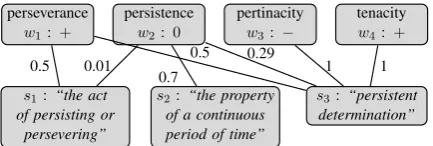
Figure1shows a network of 4 words with their
annotation tags from (Opinion Finder) OF (
Wil-son et al., 2005) and their related synsets which
comprise a connected component. w3 :
pertinac-ityandw4 : tenacityare tagged−and+,
respec-tively. Since both words share only one synset,s3,
there is no polarity distribution for s3 which can
simultaneously satisfy the polarity value demands
of both w3 andw4. Hence this component is
in-consistent.
2.4 Solving the PCP via Linear Programming Using the above definitions, the conversion to an LP problem follows a direct procedure. We
re-fer the interested reader toSchneider and Dragut
(2015) for the details.
DebugSL supports both discrete and continu-ous polarity distributions of the synsets. In the discrete case, the synset polarity distributions are restricted to the set{0,1}, i.e., exactly one ofP+,
P−, or P0 is 1 and the other two are 0, for each
synset; this corresponds to an integer LP problem.
For the continuous case, each of P+, P−, or P0
is in the range[0,1], which corresponds to a
gen-eral LP problem over real numbers. In the discrete case PCP is NP-complete, while for the contin-uous case the problem is solvable in polynomial
time (Dragut et al.,2012;Schneider and Dragut,
2015).
perseverance w1: +
persistence w2: 0
pertinacity w3: −
tenacity w4: +
s3: “persistent
determination”
s2: “the property
of a continuous period of time”
s1: “the act
of persisting or persevering”
0.5 0.29
1 1
0.5
[image:2.595.309.526.62.135.2]0.7 0.01
Figure 1: A network of 4 words and 3 synsets. Edges represent word–synset relations, weighted by frequency.
3 Supporting SL Debugging
A key capability of DebugSL is that of
isolat-ing a (small) subset of words/synsets that is po-larity inconsistent, but becomes consistent if one element is removed; we call this an Irreducible Polarity Inconsistent Subset (IPIS). Fixing an SL via IPIS isolation proceeds iteratively: (1) isolate an IPIS, (2) determine a repair for this IPIS, (3) if the model is still infeasible, return to step 1.
DebugSLcan deterministically identify an IPIS, but it cannot deterministically decide which incon-sistent words and/or senses to adjust as this is sim-ply not an objective decision. Much like a soft-ware debugger, which can identify a known pro-gramming error, say the use of an undefined vari-able,but cannot assign a value to the variable, our debugger can identify inconsistent components, but it does not decide which elements to adjust.
In Figure1, minimally one ofpertinacity(-)
andtenacity(+) must be adjusted, but the deci-sion as to which requires user feedback.
The example of Figure1belies the complexity
of the PCP.DebugSLemploys a divide and
con-quer approach, dividing an instance of PCP into the connected components of the bipartite word– synset graph, then solving for each component
separately. Running DebugSL on OF generates
1178 such components for adjectives alone; the largest component has 914 unique words and 1880 unique synsets. Manually checking such SLs is unrealistic.
4 System Overview
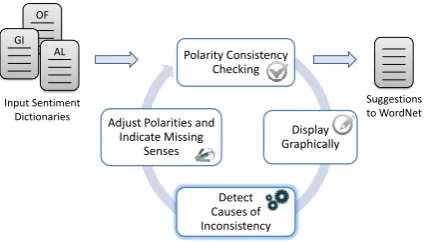
DebugSLfollows a four-step procedure to iden-tify and reduce lexicon inconsistency. (1) The user
uploads a formatted SL to theDebugSLsystem.
(2) A server-side program uses the lexical database
WordNet(WN) (Fellbaum,1998) to form the
Polarity Consistency Checking
Display Graphically
Detect Causes of Inconsistency Adjust Polarities and
Indicate Missing Senses
OF AL GI
Input Sentiment Dictionaries
[image:3.595.76.290.63.184.2]Suggestions to WordNet
Figure 2:DebugSLprocess flow
graphically for inspection. (4) The user dynami-cally interacts with the components, such as look-ing up information on the words/synsets and ad-justing their polarities. The user can repeat the process as desired.
1. Input. The user begins by uploading an SL toDebugSLand specifying various interface op-tions, such as the part of speech and the version of WN to use. After the lexicon has been success-fully uploaded, the user can download the (modi-fied) lexicon, or save it in the system.
2. Lexicon Inconsistency Checking. A server-side Java program builds the connected
compo-nents of word–synset linkage. DebugSLchecks
the consistency of each connected component. In-consistent components are returned to the client.
3. Component Display. A JavaScript
pro-cess receives the inconsistent components from the server and formats them to be understood by the graphing library SigmaJS which displays the inconsistent components to the user.
4. Interactive Viewing and User Analysis. The interactive viewing is essential to our tool be-cause it allows a user to focus on a small set of inconsistent words or synsets, make adjustments, and re-run the program to see the effects.
5 Software
DebugSL is developed using web technologies. Client side work is completed using HTML 5, CSS, and JavaScript. The graphs are structured using the open source JavaScript library SigmaJS. The client-side program is programmed in Java and is called through a Java Servlet. For linear
pro-gramming DebugSL employs the GUROBI LP
solver (www.gurobi.com). Apache Tomcat is
used as the local server.
5.1 Interactive Features
Customizable Polarity Display. DebugSL
dis-plays the word polarities from the uploaded SL on the word–synset graph. By default, the polarities are shown by node color: green, red, and grey for positive, negative, and neutral, respectively. These color choices are customizable. The user
can switch to display polarities by symbols:+,−,
and 0, instead, or use both symbols and colors.
Component and Word Selection.Inconsistent
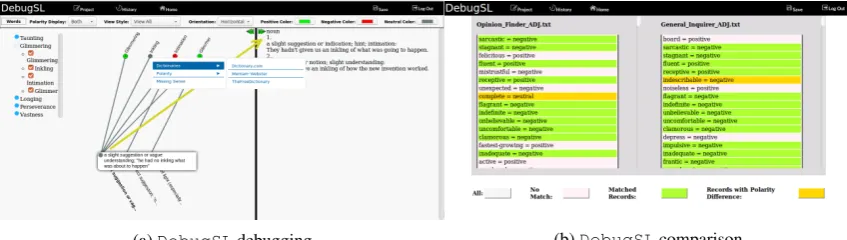
components are listed on the left represented by the first word of each component. An ellipsis in-dicates the presence of additional words. When a component is selected, its words are expanded into a sublist (Figure3aon the left).
All Viewing and Progressive Viewing. Two
modes of viewing the graph are available. InAll
Viewing mode all checked words and synsets are visible. Clicking on a word or synset hides any edges not associated with that word or synset.
Progressive Viewing mode allows the user to build the desired connected graph by progressively adding words. Clicking a word node hides other words and reveals its associated synsets. Clicking a revealed synset hides all but the associated words and edges. The user may use any selected word or synset as a base for building the graph. Holding shift allows words to be added progressively.
Dictionary Query. The user may look up
the senses of any word from an online
dictio-nary by right-clicking. This functionality is
currently implemented to interface with three
online dictionaries: Merriam-Webster (www.
merriam-webster.com), Dictionary.com (www.dictionary.com), and the Free
Dic-tionary (www.thefreedictionary.com).
The dictionary appears to the right of the graph window with the results of the word lookup. Right-clicking a new word, automatically updates the dictionary area.
5.2 Identifying Missing Senses in WordNet In some cases, when an inconsistency is identified, the user may decide that the polarity assignments are correct and the error is in fact due to a missing
sense in WN.DebugSLallows the user to check
for potentially missing senses in WN. As an ex-ample, the verbs “tantalize” and “taunt,” have pos-itive and negative polarities, respectively, in
Opin-ion Finder (Wilson et al., 2005). They also have
formula-(a)DebugSLdebugging (b)DebugSLcomparison
Figure 3:DebugSLscreenshots
tion, this leads to a contradiction. In this case the Free Dictionary gives a second sense of tantalize
that is missing from WN: “to be strongly
attrac-tive to. . . ”. This sense conveys a positive polar-ity. Hence, tantalize conveys a positive sentiment when used with this sense, and the inconsistency is not due to a mislabeling in the SL.
When the user utilizes the online dictionary lookup feature, the dictionary senses (definitions) of the word are automatically matched to their corresponding best matching synsets in the WN graph, using the Levenshtein edit distance and the Gale-Shapley stable marriage matching algorithm (Gale and Shapley,1962). If a relevant sense ap-pears to be missing from WN, the user can log a note of the missing synset with us and we can, in turn, provide this information to the WN team (Dragut and Fellbaum,2014).
6 Demonstration
We present two main scenarios to demonstrate
the practical usefulness ofDebugSL, screenshots
of which are shown in Figure 3. The source
code is available at https://github.com/
atschneid/DebugSL.
1. Iterative SL Debugging: This commences
with a user uploading an SL, L. The user must
turn a few knobs, e.g., select the part of speech,
weighting scheme, and WN version. DebugSL
displays the discovered sets of polarity
inconsis-tencies on the left side. LetI be an IPIS the user
has selected. This demo scenario has two paths: Debugging. The user attempts to correct
polar-ity values assigned to the entries inI. Most IPISs
consist of up to 4 words; very few have more than 8. This aids in holding the user’s focus. The user
can use the bipartite view inDebugSLto analyze
the words and their sense and determine if some
entries inI have wrong polarity tags. Upon
iden-tifying a mislabeled entry inI, the user can edit its
polarity value (see Figure3a), then repeat the
con-sistency check again on the revised SL, and ana-lyze any new or remaining IPISs. At any time, the user can save, revisit, and eventually download the
revised version ofL.
Missing Senses. If all the entries inIhave the correct polarity tags, there remains the possibility
that WN has incomplete information. DebugSL
allows the user to compare the synsets of a word
winIwith those ofwin several online
dictionar-ies (Figure3a, see the popup menu in the center).
The user selects a dictionary to reference and the
senses ofwfrom this dictionary will appear beside
the graph. DebugSL matches the WN synsets
with the dictionary senses (see Figure3). The user
can suggest viaDebugSLa sense present in
Dic-tionary.com forwthat is missing in WN. We store
all the suggestions.
2. Comparing Two SLs: This second demo
scenario uncovers the disagreement between two
SLs: typically one word annotating,Sw, (e.g., OF)
and one synset annotating, Ss, (e.g.,
SentiWord-Net). The formal procedure for this
functional-ity is described at length inSchneider and Dragut
(2015). The output is the collection of graphs
of components with inconsistencies. DebugSL
can also compare two word annotating SLs or two
sense annotating SLs wherein DebugSL checks
for agreement.
7 Conclusion
In this paper we have presented the system
DebugSL and described its usage. The project
source code is available athttps://github.
com/atschneid/DebugSL and a screencast
can be viewed at https://cis.temple.
References
Stefano Baccianella, Andrea Esuli, and Fabrizio Sebas-tiani. 2010. SentiWordNet 3.0: An Enhanced Lex-ical Resource for Sentiment Analysis and Opinion Mining. InLREC.
Eduard Dragut and Christiane Fellbaum. 2014. The role of adverbs in sentiment analysis. In Proceed-ings of Frame Semantics in NLP: A Workshop in Honor of Chuck Fillmore (1929-2014).
Eduard Dragut, Hong Wang, Prasad Sistla, Clement Yu, and Weiyi Meng. 2015. Polarity consistency checking for domain independent sentiment dictio-naries. IEEE TKDE, 27(3):838–851.
Eduard C. Dragut, Hong Wang, Clement Yu, Prasad Sistla, and Weiyi Meng. 2012. Polarity consistency checking for sentiment dictionaries. InACL.
Guy Emerson and Thierry Declerck. 2014. Sen-timerge: Combining sentiment lexicons in a bayesian framework. Inworkshop at COLING.
Ronen Feldman. 2013. Techniques and applications for sentiment analysis. Commun. ACM, 56(4).
Christiane Fellbaum. 1998.WordNet: An On-Line Lex-ical Database and Some of its Applications. MIT Press.
David Gale and Lloyd S. Shapley. 1962. College ad-missions and the stability of marriage. AMM, 69.
Bing Liu. 2015. Sentiment Analysis: Mining Opinions, Sentiments, and Emotions. Cambridge University Press.
Christopher Potts. 2011. Sentiment symposium tuto-rial: Lexicons.
Andrew T. Schneider and Eduard C. Dragut. 2015. To-wards debugging sentiment lexicons. InACL.