Sequential Short-Text Classification with
Recurrent and Convolutional Neural Networks
Ji Young Lee∗ MIT
Franck Dernoncourt∗
MIT
Abstract
Recent approaches based on artificial neural networks (ANNs) have shown promising re-sults for short-text classification. However, many short texts occur in sequences (e.g., sen-tences in a document or utterances in a dia-log), and most existing ANN-based systems do not leverage the preceding short texts when classifying a subsequent one. In this work, we present a model based on recurrent neural networks and convolutional neural networks that incorporates the preceding short texts. Our model achieves state-of-the-art results on three different datasets for dialog act predic-tion.
1 Introduction
Short-text classification is an important task in many areas of natural language processing, includ-ing sentiment analysis, question answerinclud-ing, or dia-log management. Many different approaches have been developed for short-text classification, such as using Support Vector Machines (SVMs) with rule-based features (Silva et al., 2011), combin-ing SVMs with naive Bayes (Wang and Manncombin-ing, 2012), and building dependency trees with Con-ditional Random Fields (Nakagawa et al., 2010). Several recent studies using ANNs have shown promising results, including convolutional neural networks (CNNs) (Kim, 2014; Blunsom et al., 2014; Kalchbrenner et al., 2014) and recursive neural net-works (Socher et al., 2012).
Most ANN systems classify short texts in iso-lation, i.e., without considering preceding short
∗ These authors contributed equally to this work.
texts. However, short texts usually appear in se-quence (e.g., sentences in a document or utter-ances in a dialog), and therefore using information from preceding short texts may improve the clas-sification accuracy. Previous works on sequential short-text classification are mostly based on non-ANN approaches, such as Hidden Markov Models (HMMs) (Reithinger and Klesen, 1997; Stolcke et al., 2000; Surendran and Levow, 2006), maximum entropy (Ang et al., 2005), naive Bayes (Lendvai and Geertzen, 2007), and conditional random fields (CRFs) (Kim et al., 2010; Quarteroni et al., 2011).
Inspired by the performance of ANN-based sys-tems for non-sequential short-text classification, we introduce a model based on recurrent neural net-works (RNNs) and CNNs for sequential short-text classification, and evaluate it on the dialog act classi-fication task. A dialog act characterizes an utterance in a dialog based on a combination of pragmatic, se-mantic, and syntactic criteria. Its accurate detection is useful for a range of applications, from speech recognition to automatic summarization (Stolcke et al., 2000). Our model achieves state-of-the-art re-sults on three different datasets.
2 Model
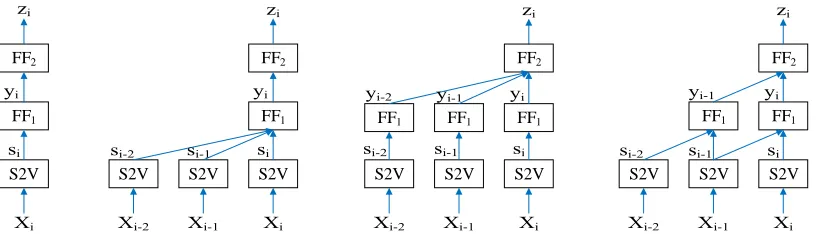
Our model comprises two parts. The first part gener-ates a vector representation for each short text using either the RNN or CNN architecture, as discussed in Section 2.1 and Figure 1. The second part classifies the current short text based on the vector representa-tions of the current as well as a few preceding short texts, as presented in Section 2.2 and Figure 2.
We denote scalars with italic lowercases (e.g.,
Pooling
RNN RNN
RNN RNN
Pooling
Conv Conv
[image:2.612.97.518.61.151.2]Conv Conv
Figure 1:RNN (left) and CNN (right) architectures for generating the vector representationsof a short textx1:`. For CNN, Conv
refers to convolution operations, and the filter heighth= 3is used in this figure.
FF1
S2V S2V
S2V
FF1
S2V S2V
S2V FF1 FF1
FF2
FF1
S2V S2V
S2V
FF1
FF2 FF2
FF1
S2V FF2
Figure 2:Four instances of the two-layer feedforward ANN used for predicting the probability distribution over the classeszifor
theithshort-textX
i. S2V stands for short text to vector, which is the RNN/CNN architecture that generatessifromXi. From left
to right, the history sizes(d1, d2)are(0,0),(2,0),(0,2)and(1,1).(0,0)corresponds to the non-sequential classification case.
k, bf), vectors with bold lowercases (e.g., s,xi), and matrices with italic uppercases (e.g.,Wf). We use the colon notationvi:jto denote the sequence of vectors(vi,vi+1, . . . ,vj).
2.1 Short-text representation
A given short text of length`is represented as the se-quence ofm-dimensional word vectorsx1:`,which is used by the RNN or CNN model to produce the n-dimensionalshort-text representations.
2.1.1 RNN-based short-text representation
We use a variant of RNN called Long Short Term Memory (LSTM) (Hochreiter and Schmidhuber, 1997). For thetth word in the short-text, an LSTM takes as input xt,ht−1,ct−1 and produces ht,ct based on the following formulas:
it=σ(Wixt+Uiht−1+bi)
ft=σ(Wfxt+Ufht−1+bf) ˜
ct=tanh(Wcxt+Ucht−1+bc)
ct=ftct−1+itc˜t
ot=σ(Woxt+Uoht−1+bo) ht=ottanh(ct)
whereWj ∈ Rn×m, Uj ∈Rn×nare weight matri-ces andbj ∈Rnare bias vectors, forj∈ {i, f, c, o}. The symbols σ(·) and tanh(·) refer to the element-wise sigmoid and hyperbolic tangent functions, and
is the element-wise multiplication.h0=c0=0.
In the pooling layer, the sequence of vectorsh1:` output from the RNN layer are combined into a sin-gle vectors ∈Rnthat represents the short-text, us-ing one of the followus-ing mechanisms: last, mean, and max pooling. Last pooling takes the last vector, i.e.,s =h`,mean pooling averages all vectors, i.e.,
s= 1
` P`
t=1ht,and max pooling takes the element-wise maximum ofh1:`.
2.1.2 CNN-based short-text representation
Using afilter Wf ∈ Rh×m of heighth,a convolu-tion operaconvolu-tion onh consecutive word vectors start-ing fromtthword outputs the scalarfeature
ct=ReLU(Wf•Xt:t+h−1+bf)
where Xt:t+h−1 ∈ Rh×m is the matrix whose ith
row isxi ∈Rm,andbf ∈Ris a bias. The symbol• refers to the dot product and ReLU(·)is the element-wise rectified linear unit function.
[image:2.612.103.511.188.305.2]ct ∈ Rn,each of whose dimensions comes from a distinct filter. Repeating the convolution operations for each window ofhconsecutive words in the short-text, we obtainc1:`−h+1.The short-text
representa-tion s ∈ Rnis computed in the max pooling layer, as the element-wise maximum ofc1:`−h+1.
2.2 Sequential short-text classification
Letsibe then-dimensional short-text representation given by the RNN or CNN architecture for the ith short text in the sequence. The sequencesi−d1−d2:i
is fed into a two-layer feedforward ANN that pre-dicts the class for theith short text. The hyperpa-rametersd1, d2 are the history sizes used in the first
and second layers, respectively.
The first layer takes as inputsi−d1−d2:i and
out-puts the sequenceyi−d2:idefined as
yj =tanh d1
X
d=0
W−dsj−d+b1
!
, ∀j∈[i−d2, i]
whereW0, W−1, W−2 ∈ Rk×n are the weight
ma-trices,b1 ∈ Rk is the bias vector, yj ∈ Rk is the
class representation, andkis the number of classes for the classification task.
Similarly, the second layer takes as input the se-quence of class representationsyi−d2:i and outputs zi ∈Rk:
zi =softmax Xd2
j=0
W−jyi−j+b2
whereU0, U−1, U−2 ∈ Rk×k andb2 ∈ Rk are the
weight matrices and bias vector.
The final outputzirepresents the probability dis-tribution over the set ofk classes for theith short-text: thejthelement ofzicorresponds to the proba-bility that theithshort-text belongs to thejthclass. 3 Datasets and Experimental Setup
3.1 Datasets
We evaluate our model on the dialog act classifica-tion task using the following datasets:
• DSTC 4: Dialog State Tracking Challenge 4 (Kim et al., 2015; Kim et al., 2016).
• MRDA: ICSI Meeting Recorder Dialog Act Cor-pus (Janin et al., 2003; Shriberg et al., 2004). The 5 classes are introduced in (Ang et al., 2005).
• SwDA: Switchboard Dialog Act Corpus (Jurafsky et al., 1997).
For MRDA, we use the train/validation/test splits provided with the datasets. For DSTC 4 and SwDA, only the train/test splits are provided.1 Table 1
presents statistics on the datasets.
Dataset |C| |V| Train Validation Test DSTC 4 89 6k 24 (21k) 5 (5k) 6 (6k) MRDA 5 12k 51 (78k) 11 (16k) 11 (15k) SwDA 43 20k 1003 (193k) 112 (23k) 19 (5k)
Table 1: Dataset overview. |C|is the number of classes,|V| the vocabulary size. For the train, validation and test sets, we indicate the number of dialogs (i.e., sequences) followed by the number of utterances (i.e., short texts) in parenthesis.
3.2 Training
The model is trained to minimize the negative log-likelihood of predicting the correct dialog acts of the utterances in the train set, using stochastic gradient descent with the Adadelta update rule (Zeiler, 2012). At each gradient descent step, weight matrices, bias vectors, and word vectors are updated. For regular-ization, dropout is applied after the pooling layer, and early stopping is used on the validation set with a patience of 10 epochs.
4 Results and Discussion
To find effective hyperparameters, we varied one hy-perparameter at a time while keeping the other ones fixed. Table 2 presents our hyperparameter choices.
Hyperparameter Choice Experiment Range
LSTM output dim.(n) 100 50 – 1000 LSTM pooling max max, mean, last LSTM direction unidir. unidir., bidir. CNN num. of filters(n) 500 50 – 1000 CNN filter height(h) 3 1 – 10
Dropout rate 0.5 0 – 1
Word vector dim.(m) 200, 300 25 – 300
Table 2:Experiments ranges and choices of hyperparameters. Unidir refers to the regular RNNs presented in Section 2.1.1, and bidir refers to bidirectional RNNs introduced in (Schuster and Paliwal, 1997).
We initialized the word vectors with the 300-dimensional word vectors pretrained with word2vec 1All train/validation/test splits can be found athttps://
d1
d2 LSTM CNN
0 1 2 0 1 2
DSTC4 01 63.1 (62.4, 63.6)65.8(65.5, 66.1) 65.7 (65.6, 65.7)65.7 (65.3, 66.1) 64.7 (63.9, 65.3)64.8 (64.6, 65.1) 64.1 (63.5, 65.2)65.3 (64.1, 65.9) 65.4 (64.7, 66.6)65.1 (62.1, 66.2) 65.1 (63.2, 65.9)64.9 (64.4, 65.6) 2 65.7 (65.0, 66.2) 65.5 (64.4, 66.1) 64.9 (64.6, 65.2) 65.7 (64.9, 66.3) 65.8(65.2, 66.1) 65.4 (64.5, 66.0)
MRDA
0 82.8 (82.4, 83.1) 83.2 (82.9, 83.4) 82.9 (82.4, 83.4) 83.2 (83.0, 83.4) 83.5 (82.9, 84.0) 83.8 (83.4, 84.2) 1 83.2 (82.6, 83.7) 83.8 (83.5, 84.4) 83.6 (83.2, 83.8) 84.6(84.5, 84.9) 84.6(84.4, 84.8) 84.1 (83.8, 84.4) 2 84.1(83.5, 84.4) 83.9 (83.4, 84.7) 83.3 (82.6, 84.2) 84.4 (84.1, 84.8) 84.6(84.5, 84.7) 84.4 (84.2, 84.7)
[image:4.612.74.538.61.200.2]SwDA 01 66.3 (65.1, 68.0)68.4 (67.8, 68.8) 67.9 (66.3, 68.6)67.8 (65.5, 68.9) 67.8 (66.7, 69.0)67.3 (65.5, 69.5) 67.0 (65.3, 68.7)69.9 (69.1, 70.9) 69.1 (68.5, 70.0)69.8 (69.3, 70.6) 69.7 (69.2, 70.9)69.9 (68.8, 70.6) 2 69.5(68.9, 70.2) 67.9 (66.5, 69.4) 67.7 (66.9, 68.9) 71.4(70.4, 73.1) 71.1 (70.2, 72.1) 70.9 (69.7, 71.7)
Table 3:Accuracy (%) on different architectures and history sizesd1, d2. For each setting, we report average (minimum, maximum) computed on 5 runs. Sequential classification (d1+d2 >0) outperforms non-sequential classification (d1 =d2 = 0). Overall, the CNN model outperformed the LSTM model for all datasets, albeit by a small margin except for SwDA. We also tried gated recurrent units (GRUs) (Cho et al., 2014) and the basic RNN, but the results were generally lower than LSTM.
on Google News (Mikolov et al., 2013a; Mikolov et al., 2013b) for DSTC 4, and the 200-dimensional word vectors pretrained with GloVe on Twit-ter (Pennington et al., 2014) for MRDA and SwDA, as these choices yielded the best results among all publicly available word2vec, GloVe, SENNA (Collobert, 2011; Collobert et al., 2011) and RNNLM (Mikolov et al., 2011) word vectors.
The effects of the history sizesd1 andd2 for the
short-text and the class representations, respectively, are presented in Table 3 for both the LSTM and CNN models. In both models, increasingd1 while
keepingd2 = 0improved the performances by
1.3-4.2 percentage points. Conversely, increasing d2
while keepingd1 = 0yielded better results, but the
performance increase was less pronounced: incor-porating sequential information at the short-text rep-resentation level was more effective than at the class representation level.
Using sequential information at both the short-text representation level and the class representa-tion level does not help in most cases and may even lower the performances. We hypothesize that short-text representations contain richer and more gen-eral information than class representations due to their larger dimension. Class representations may not convey any additional information over short-text representations, and are more likely to propa-gate errors from previous misclassifications.
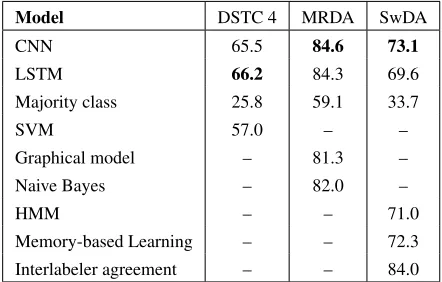
Table 4 compares our results with the state-of-the-art. Overall, our model shows competitive results, while requiring no human-engineered features.
Rig-orous comparisons are challenging to draw, as many important details such as text preprocessing and train/valid/test split may vary, and many studies fail to perform several runs despite the randomness in some parts of the training process, such as weight initialization.
Model DSTC 4 MRDA SwDA
CNN 65.5 84.6 73.1
LSTM 66.2 84.3 69.6
Majority class 25.8 59.1 33.7
SVM 57.0 – –
Graphical model – 81.3 –
Naive Bayes – 82.0 –
HMM – – 71.0
Memory-based Learning – – 72.3 Interlabeler agreement – – 84.0
Table 4:Accuracy (%) of our models and other methods from the literature. The majority class model predicts the most fre-quent class. SVM: (Dernoncourt et al., 2016). Graphical model: (Ji and Bilmes, 2006). Naive Bayes: (Lendvai and Geertzen, 2007). HMM: (Stolcke et al., 2000). Memory-based Learn-ing: (Rotaru, 2002). All five models use features derived from transcribed words, as well as previous predicted dialog acts ex-cept for Naive Bayes. The interlabeler agreement could not be obtained for MRDA, and DSTC 4 was labeled by a single an-notator. For the CNN and LSTM models, the presented results are the test set accuracy of the run with the highest accuracy on the validation set.
5 Conclusion
[image:4.612.316.537.356.497.2]im-proves the quality of the predictions, and the per-formance depends on what sequential information is used in the model. Our model achieves state-of-the-art results on three different datasets for dialog act prediction.
Acknowledgments
We warmly thank Regina Barzilay, Tommi Jaakkola and the anonymous reviewers for their helpful feed-back and suggestions.
References
[Ang et al.2005] Jeremy Ang, Yang Liu, and Elizabeth Shriberg. 2005. Automatic dialog act segmentation and classification in multiparty meetings. InICASSP (1), pages 1061–1064.
[Blunsom et al.2014] Phil Blunsom, Edward Grefenstette, Nal Kalchbrenner, et al. 2014. A convolutional neu-ral network for modelling sentences. InProceedings of the 52nd Annual Meeting of the Association for
Computational Linguistics. Proceedings of the 52nd
Annual Meeting of the Association for Computational Linguistics.
[Cho et al.2014] Kyunghyun Cho, Bart van Merri¨enboer, Dzmitry Bahdanau, and Yoshua Bengio. 2014. On the properties of neural machine translation: Encoder-decoder approaches. arXiv preprint arXiv:1409.1259. [Collobert et al.2011] Ronan Collobert, Jason Weston, L´eon Bottou, Michael Karlen, Koray Kavukcuoglu, and Pavel Kuksa. 2011. Natural language process-ing (almost) from scratch. The Journal of Machine
Learning Research, 12:2493–2537.
[Collobert2011] Ronan Collobert. 2011. Deep learn-ing for efficient discriminative parslearn-ing. In Interna-tional Conference on Artificial Intelligence and Statis-tics, number EPFL-CONF-192374.
[Dernoncourt et al.2016] Franck Dernoncourt, Ji Young Lee, Trung H. Bui, and Hung H. Bui. 2016. Adobe-MIT submission to the DSTC 4 Spoken Language Un-derstanding pilot task. In7th International Workshop
on Spoken Dialogue Systems (IWSDS).
[Hochreiter and Schmidhuber1997] Sepp Hochreiter and J¨urgen Schmidhuber. 1997. Long short-term memory.
Neural computation, 9(8):1735–1780.
[Janin et al.2003] Adam Janin, Don Baron, Jane Edwards, Dan Ellis, David Gelbart, Nelson Morgan, Barbara Pe-skin, Thilo Pfau, Elizabeth Shriberg, Andreas Stolcke, et al. 2003. The ICSI meeting corpus. In Acous-tics, Speech, and Signal Processing, 2003. Proceed-ings.(ICASSP’03). 2003 IEEE International Confer-ence on, volume 1, pages I–364. IEEE.
[Ji and Bilmes2006] Gang Ji and Jeff Bilmes. 2006. Backoff model training using partially observed data: application to dialog act tagging. In Proceedings of the main conference on Human Language Technol-ogy Conference of the North American Chapter of the Association of Computational Linguistics, pages 280– 287. Association for Computational Linguistics. [Jurafsky et al.1997] Dan Jurafsky, Elizabeth Shriberg,
and Debra Biasca. 1997. Switchboard SWBD-DAMSL shallow-discourse-function annotation coders manual. Institute of Cognitive Science Technical Report, pages 97–102.
[Kalchbrenner et al.2014] Nal Kalchbrenner, Edward Grefenstette, and Phil Blunsom. 2014. A convolu-tional neural network for modelling sentences. arXiv preprint arXiv:1404.2188.
[Kim et al.2010] Su Nam Kim, Lawrence Cavedon, and Timothy Baldwin. 2010. Classifying dialogue acts in one-on-one live chats. InProceedings of the 2010 Conference on Empirical Methods in Natural
Lan-guage Processing, pages 862–871. Association for
Computational Linguistics.
[Kim et al.2015] Seokhwan Kim, Luis Fernando D’Haro, Rafael E. Banchs, Jason Williams, and Matthew Hen-derson. 2015. Dialog State Tracking Challenge 4: Handbook.
[Kim et al.2016] Seokhwan Kim, Luis Fernando D’Haro, Rafael E. Banchs, Jason Williams, and Matthew Hen-derson. 2016. The Fourth Dialog State Tracking Chal-lenge. InProceedings of the 7th International
Work-shop on Spoken Dialogue Systems (IWSDS).
[Kim2014] Yoon Kim. 2014. Convolutional neural net-works for sentence classification. In Proceedings of the 2014 Conference on Empirical Methods in Natural
Language Processing, pages 1746–1751. Association
for Computational Linguistics.
[Lendvai and Geertzen2007] Piroska Lendvai and Jeroen Geertzen. 2007. Token-based chunking of turn-internal dialogue act sequences. InProceedings of the
8th SIGDIAL Workshop on Discourse and Dialogue,
pages 174–181.
[Mikolov et al.2011] Tomas Mikolov, Stefan Kombrink, Anoop Deoras, Lukar Burget, and Jan Cernocky. 2011. Rnnlm-recurrent neural network language mod-eling toolkit. InProc. of the 2011 ASRU Workshop, pages 196–201.
[Mikolov et al.2013a] Tomas Mikolov, Kai Chen, Greg Corrado, and Jeffrey Dean. 2013a. Efficient estima-tion of word representaestima-tions in vector space. arXiv preprint arXiv:1301.3781.
their compositionality. In Advances in neural
infor-mation processing systems, pages 3111–3119.
[Nakagawa et al.2010] Tetsuji Nakagawa, Kentaro Inui, and Sadao Kurohashi. 2010. Dependency tree-based sentiment classification using CRFs with hidden vari-ables. InHuman Language Technologies: The 2010 Annual Conference of the North American Chapter of the Association for Computational Linguistics, pages 786–794. Association for Computational Linguistics. [Pennington et al.2014] Jeffrey Pennington, Richard
Socher, and Christopher D Manning. 2014. GloVe: global vectors for word representation. Proceedings of the Empiricial Methods in Natural Language
Processing (EMNLP 2014), 12:1532–1543.
[Quarteroni et al.2011] Silvia Quarteroni, Alexei V Ivanov, and Giuseppe Riccardi. 2011. Simultaneous dialog act segmentation and classification from human-human spoken conversations. In Acoustics, Speech and Signal Processing (ICASSP), 2011 IEEE
International Conference on, pages 5596–5599. IEEE.
[Reithinger and Klesen1997] Norbert Reithinger and Martin Klesen. 1997. Dialogue act classification using language models. InEuroSpeech. Citeseer. [Rotaru2002] Mihai Rotaru. 2002. Dialog act tagging
us-ing memory-based learnus-ing. Term project, University of Pittsburgh, pages 255–276.
[Schuster and Paliwal1997] Mike Schuster and Kuldip K Paliwal. 1997. Bidirectional recurrent neural net-works. Signal Processing, IEEE Transactions on, 45(11):2673–2681.
[Shriberg et al.2004] Elizabeth Shriberg, Raj Dhillon, Sonali Bhagat, Jeremy Ang, and Hannah Carvey. 2004. The ICSI meeting recorder dialog act (MRDA) corpus. Technical report, DTIC Document.
[Silva et al.2011] Joao Silva, Lu´ısa Coheur, Ana Cristina Mendes, and Andreas Wichert. 2011. From symbolic to sub-symbolic information in question classification.
Artificial Intelligence Review, 35(2):137–154. [Socher et al.2012] Richard Socher, Brody Huval,
Christopher D Manning, and Andrew Y Ng. 2012. Semantic compositionality through recursive matrix-vector spaces. In Proceedings of the 2012 Joint Conference on Empirical Methods in Natural Language Processing and Computational Natural
Language Learning, pages 1201–1211. Association
for Computational Linguistics.
[Stolcke et al.2000] Andreas Stolcke, Klaus Ries, Noah Coccaro, Elizabeth Shriberg, Rebecca Bates, Daniel Jurafsky, Paul Taylor, Rachel Martin, Carol Van Ess-Dykema, and Marie Meteer. 2000. Dialogue act modeling for automatic tagging and recognition of conversational speech. Computational linguistics, 26(3):339–373.
[Surendran and Levow2006] Dinoj Surendran and Gina-Anne Levow. 2006. Dialog act tagging with support vector machines and hidden markov models. In
IN-TERSPEECH.
[Wang and Manning2012] Sida Wang and Christopher D Manning. 2012. Baselines and bigrams: Simple, good sentiment and topic classification. InProceedings of the 50th Annual Meeting of the Association for Com-putational Linguistics: Short Papers-Volume 2, pages 90–94. Association for Computational Linguistics. [Zeiler2012] Matthew D Zeiler. 2012. Adadelta: