Extractive Summarisation Based on Keyword Profile and Language Model
Han Xu Eric Martin Ashesh Mahidadia
School of Computer Science and Engineering UNSW, Sydney, NSW, Australia, 2052
hanx,emartin,[email protected]
Abstract
We present a statistical framework to extract information-rich citation sentences that sum-marise the main contributions of a scientific paper. In a first stage, we automatically dis-cover salient keywords from a paper’s citation summary, keywords that characterise its main contributions. In a second stage, exploiting the results of the first stage, we identify citation sentences that best capture the paper’s main contributions. Experimental results show that our approach using methods rooted in quan-titative statistics and information theory out-performs the current state-of-the-art systems in scientific paper summarisation.
1 Introduction and Motivation
Science is not an isolated endeavour, but benefits from and expands on the work of others, with more or less cross fertilisation between disciplines. The interdependent nature of research has naturally re-sulted in a network of scientific areas with dense in-terconnections between related fields. Though re-search is a highly specialised activity, rere-searchers find themselves constantly in need to explore the network further from the core of their research. Tools that can facilitate understanding the key con-tributions of papers in those parts of the network be-ing explored can only prove highly valuable.
As an example of such tools, we focus on an application that automatically extracts information-rich sentences describing the main contributions of a given paper. From which corpus the extraction could take place? A natural answer is the abstract of the paper. However, the contributions as perceived by the authors can significantly deviate from those judged extrospectively by the community over time (Mei and Zhai, 2008). Instead, we take as corpus the set of citing sentences to the paper (from other papers). Indeed, those sentences can arguably be deemed as a form of crowd-sourced review of the
paper’s main contributions. The set of citing sen-tences is referred to as thecitation summaryof the target paper. Elkiss et al. (2008) carried out a large-scale study and confirmed that citation summaries contain extra information that does not appear in pa-per abstracts. In addition, they found that the “self-cohesion”, measured as the average cosine similar-ity between sentences, is consistently higher in a pa-per’s citation summary than in its abstract: the for-mer is more focused than the latter in describing pa-pers’ main contributions. This work presents our ef-forts in advancing research along this direction.
Section 2 formally defines the problem we aim to solve: summarise scientific papers using the most informative and diversified part of their cita-tion summaries. It surveys several prominent related studies, and introduces the data used in our experi-ments and evaluations. In Section 3, we present our statistical framework built upon quantitative statis-tics and information theory. In Section 4, we eval-uate and compare the performance of our method with state-of-the-art systems. We conclude and point to future directions in Section 5.
2 Problem Statement
The problem we tackle in this paper is to generate anextractive summary(usually, we will simply say
summary) from its citation summary. More specifi-cally, we opt for a two stage approach. In the first stage, we automatically discover salient keywords from a paper’s citation summary, keywords that are essential in characterising the paper’s main contribu-tions. The second stage, exploiting the results of the first stage, identifies citation sentences (to the paper) that best capture the paper’s main contributions.
A word of caution: by utilising only citation sum-maries, one should not expect to obtain well formu-lated, readily consumable summaries of papers. In-deed, a citation sentence may be not all about the cited paper, but also talk about the citing paper and other co-cited papers, which disqualify citation
maries as a premium source of sentences for build-ing highly readable summaries (Siddharthan and Teufel, 2007). Moreover, a summary built from ing sentences that come for a pool of multiple cit-ing papers is bound to lack coherence. Therefore, it is more appropriate to consider that the output of such a system is to extrinsically gauge a system’s ef-fectiveness in indexing information-rich citing sen-tences containing keywords that facilitate rapidly grasping a paper’s important contributions, rather than be treated as a polished, readable summary for human consumption (Qazvinian et al., 2013). 2.1 Related Work
Qazvinian and Radev (2008) first experimented with citation summary based paper summarisations. They proposed a graph-based method, C-LexRank, that first generates a citation summary network for a paper by mapping citing sentences to vertices and creating edges from their lexical similarities. Clus-ters of sentences capturing the same contribution of the paper are then identified through link-based community detection. Finally, the most central sen-tence of each cluster is found using a weighted random walk and selected to form a paper sum-mary meant to comprehensively cover the paper’s main contributions. Mohammad et al. (2009) further adapted the C-LexRank to multi-document sum-marisation in an attempt to generate surveys for sci-entific paradigms.
In a later paper, Qazvinian et al. (2010) proposed a more computationally efficient summariser that does not require clustering citing sentences. As a first step, key phrases are automatically identified as significant n-grams with positive point-wise di-vergence (Tomokiyo, 2003) from a foreground lan-guage model estimated using the citation summary of a paper w.r.t. a background language model built from a large set of paper abstracts. A greedy algo-rithm is subsequently applied to select citing sen-tences and form a summary that maximises key phrase coverage.
Mei and Zhai (2008) presented a sophisticated generative approach that frames summarisation un-der an Information Retrieval (IR) context. Specifi-cally, an impact language model for a paper is first built as a mixture of a language model estimated from the paper’s own text, and a weighted citation language model based on its collective citation con-texts, using a compound coefficient reflecting both a sentence’s proximity to the citation label (anchor) in the citing paper and the citing paper’s authority
calculated from the citation network using PageR-ank (Brin and Page, 1998). Finally, documents (sen-tences in the target paper) that are closest to the query (the impact language model of the target pa-per) are extracted to form a summary using ad-hoc document retrieval. Note that Mei and Zhai (2008) utilised extra information (i.e., paper full texts and citation networks) to produce summaries that con-sist of sentences from papers’ own texts rather than their citation summaries, making their task related to but different to ours.
2.2 Data
The experiments and evaluations presented here have been based on Qazvinian’s single paper sum-marisation corpus1. The dataset consists of 25
highly cited papers in the ACL Anthology Network (AAN) (Radev et al., 2009) from 5 different do-mains: Dependency Parsing (DP), Phrase Based Machine Translation (PBMT), Text Summarisation (SUM), Question Answering (QA) and Textual En-tailment (TE). There are two files provided for each paper: a citation summary file containing all citing sentences to it, and a manually constructed key fact file containing its main contributions hand picked by human annotators after reading the citation sum-mary. The manual annotation has been performed independently by annotators, and a phrase needed to be marked by at least 2 annotators to be qualified as capturing a paper’s key fact (Qazvinian and Radev, 2008). This corpus represents a gold standard in re-search paper summarisation and it has been widely used in system evaluations (Qazvinian and Radev, 2008; Qazvinian et al., 2010).
3 Our Approach
In this section, we first introduce our quantitative statistical method to automatically construct a key-word profile of a paper and statistically capture a paper’s main contributions in terms of words from its citation summary. We then discuss how we con-struct akeyword profile language model. Finally, we elaborate on how we cast the task of sentence selec-tion from the citaselec-tion summary as language model divergence based IR in a probabilistic framework. 3.1 Paper Keyword Profile
As indicated in Section 1, the citation summary of a paper can be deemed a collective review of its con-tributions. Therefore, the main contributions of a
1http://www-personal.umich.edu/˜vahed/
paper are salient keywords, those keywords which are commonly used by its citers to refer to it and are statistically over-represented in the paper’s cita-tion summary w.r.t. the overall distribucita-tion of such words across other papers’ citation summaries. Put another way, the salience of a word in characteris-ing a paper’s main contributions is qualified along
over-representednessandexclusivenessdimensions. Clearly, a proper statistical model of words distribu-tion is required in order to measure words’ salience in a paper’s citation summary. Consider five papers,
D1, . . . ,D5with citation summariesCS1, . . . ,CS5.
We aim at identifying salient keywords from D1’s
citation summaryCS1, that map to D1’s main
con-tributions. To decide whether a wordW is a charac-terising keyword ofD1, we first collect allnciting
sentences containing W from CS1, . . . , CS5;
sup-pose there aren= 20of them. Then for each citing sentenceSamongst those 20, we perform the binary test: success iffSbelongs toCS1. Suppose that there
arek= 18successes and 2 failures. This represents a surprising observation: one would expect a word of no characterising power to appear in roughly the same number of sentences inCS1, . . . ,CS5,
assum-ing all citation summaries have the same number of sentences2. So one would heuristically conclude that
W is a good candidate keyword forD1, a keyword
that is likely to represent a main contribution. The previous process can be abstracted as sam-pling without replacement from a finite set whose elements can be classified into mutually exclusive binary categories, which itself follows a Hypergeo-metric distribution. Let N be the total number of citing sentences in citation summaries for papers be-longing to collection C, K be the number of sen-tences in paperD’s citation summary, nbe the to-tal number of citing sentences containing a certain word W, and X be the number of citing sentences containingW inD’s citation summary. The proba-bility of observing exactlykciting sentences inD’s citation summary containingW is:
H(X=k|N,K,n)=(Kk)((NN Kn k)
n) (1)
We can then calculate a p-value to the observed number of x citing sentences in D’s citation sum-mary that contain wordW using the Hypergeomet-ric test, which in turn is used to measure wordW’s salience in characterisingD’s main contributions:
S(W)def=P(X x)=1 Px 1
i=0H(X=i|N,K,n)) (2)
2This assumption is only made to simplify the discussion.
The smaller the value ofS(W), the more salientW
is. Also, words not appearing inD’s citation sum-mary have a maximum p-value of 1.0, and common words appearing in many papers’ citation summaries are expected to have larger p-values than words that are more exclusively used when citing paperD.
It is worth pointing out that the above formulation can be equivalently expressed as applying the one-tailed Fisher’s exact test to measure strengths of sta-tistical associations between words and paper’s ci-tation summaries at the sentence level. Our choice of this statistical procedure has been informed by (Moore, 2004). Prior to this work, Dunning (1993) was pointing out that some commonly used meth-ods such as the Pearson’s 2 test are inappropriate
for measuring textual associations due to the fact that the underlying normality assumption is usu-ally violated in textual data. He was subsequently introducing the log-likelihood ratio test (LLR) and showing that it can yield more reliable results. The LLR was then and has since been widely adopted in statistical NLP as a measure of strength of as-sociation (Moore, 2004). For instance, Lin and Hovy (2000) successfully applied LLR in mining “topic signatures” of pre-classified document col-lections. But to further verify LLR’s validity ap-plied to rare events, Moore (2004) performed an em-pirical study comparing results obtained using LLR and Fisher’s exact test on bilingual word association and found that albeit being a good approximation to Fisher’s exact test, LLR can still introduce a sub-stantial amount of error and the author went on to advocate the use of Fisher’s exact test where com-putationally feasible. Recall that we measured as-sociational strengths at the sentence level. This re-sulted in marginal frequencies in the order of only hundreds for Qazvinian’s small corpus. We there-fore followed this empirical advice and used the one-tailed Fisher’s exact test (i.e., Hypergeometric test) as our measure of textual association to perform key-word profiling of a scientific paper.
of citation summaries have been individually tested for their salience in a target paper’s citation sum-mary in succession. The significance level used to qualify a word as a keyword thus requires correction for multiple tests to reduce type I errors. However, we shall show that the rigid statistical significance is not crucial in our subsequent building of a keyword language model for a paper, and so we did not per-form multiple tests corrections, but simply used the raw p-values in subsequent analysis.
Another technicality is special handling of cita-tion anchors. Cited authors’ names, almost system-atically appearing in citing sentences, are bound to be identified as salient keywords. We thus substi-tuted all citation anchors appearing in a paper’s cita-tion summary with the pseudo token “targetanchor” if they refer to the target paper, and “otheranchor” if they refer to other co-cited papers.
Furthermore, our keyword profiling approach al-lows for a flexible control of the level of selective-ness in its statistical procedure through the choice of the benchmarking collection C. For example, we can choose to use a heterogeneous collection of papers covering multiple domains. Words that are salient in characterising a domain may then evalu-ate to a high salience for a paper in C on that do-main (e.g., word “parsing” for dodo-main Dependency Parsing (DP)). We can also chooseCto be a homo-geneous collection of papers from the same domain. Only words that are salient in characterising a sin-gle paper will then be evaluated to a high salience for that paper (e.g., if C is on DP, “parsing” will not show up as a salient word for any paper inC). Recall from Section 2.2 that we use as data papers from five domains. We exploited the homogeneity of this data and performed keyword profiling intra-domain. This effectively made the keyword profil-ing all the more selective that the keywords identi-fied for a paper only characterise itsunique contribu-tions w.r.t. its domain, using five highly cited papers. We shall show in the next section that it is this high selectiveness in keyword profiling that bestows our approach its high discriminative power.
For paper P05-1013, Table 2 lists the top 10 key-words identified from its citation summary using our method, while Table 1 lists the humanly se-lected gold standard key facts (Qazvinian and Radev, 2008). It can be seen that our method is highly ef-fective in identifying the paper’s main contributions which closely mirror those picked by human experts. We term our word list ranked by p-values the key-word profile of the paper; it statistically and
objec-tively captures words’ salience (measured along the dimensions of over-representedness and exclusive-ness) in characterising the paper’s main contribu-tions using the statistical surprise given by Hyper-geometric tests. While only unigram keywords were considered here, our method can be easily extended to cope with higher order n-gram “key phrases”. This is left for future work.
Fact id Fact Occurence Pyramidtier
1
non-projective 15
19 pseudo-projective 6
projectivizing 1
projective graphs 1 projectivization
transformation 1
4 czechswedish 65 8
2 data-driventraining data 42 6
5 maltparser 4 4
[image:4.612.315.546.166.323.2]3 nonterminal categoriesin constituency 1 1
Table 1: Gold standard key facts of P05-1013 (Qazvinian and Radev, 2008) ordered by importance. The pyramid tier might not be the sum of the occurrences of facts, as multiple facts can appear in the same sentence.
Salience rank Word P-value 1 non-projective 1.54e-08 2 pseudo-projective 5.61e-06 3 transformation 4.47e-05 4 transformations 1.26e-04
5 maltparser 3.48e-04
6 swedish 7.53e-04
7 danish 1.56e-03
8 following 2.64e-03
9 arcs 2.64e-03
10 dependencies 4.43e-03 Table 2: Extracted keywords for P05-1013, ranked by de-creasing Hypergeometric test significance.
3.2 Keyword Profile Language Model
[image:4.612.318.534.399.539.2]sec-tion that not all keywords are of equal importance, so a good summariser should favour sentences cov-ering the most important ones. Intuitively, the key-word profile of a paper containing valuable informa-tion on words’ salience in characterising the paper’s main contributions should be utilised to drive such a discriminative sentence selection process.
Based on the previous considerations, we use a paper’s keyword profile to build a discriminative un-igram language model that directly encodes words’ salience as pseudo generative probabilities to facili-tate the seamless incorporation of such information into a generic probabilistic framework. More specif-ically, we directly translate words’ salience (in the form of p-values) into a discriminative unigram lan-guage model of a paper that assigns high probabili-ties to its characterising keywords. The pseudo gen-erative probability of wordW according to a paper
D’s keyword profile language modelMkpis: P(W|Mkp)= Z1 log(S(W)) (3)
where S(W) denotes the salience of word W in
characterising paper Dcalculated using (2), andZ
is a normalisation factor. An intuitive interpreta-tion of (3) is to deem log(S(W)) a pseudo word
count ofW, where more salient words have higher pseudo counts; this makesZ the total length of the pseudo document generated from the paper’s key-word profile. We disregard actual key-word counts to make the keyword profile language model directly encode words’ salience. Also, in the previous step, keyword profiling had already implicitly taken such information into account, providing another justifi-cation for this design decision. Table 3 shows a miniature example to illustrate how a keyword pro-file language model is built. In this example, W5
is automatically eliminated from the resulting lan-guage model because it has lowest salience in char-acterising the imaginary document. Any word S
with salience value S(W) close to but strictly less than 1.0 would still have a tiny pseudo probability in the resulting keyword profile language model (e.g.,
W4). Words with low salience are not necessarily
stop words (e.g., W4 and W5), and neither is the
reverse true: a content word can possibly be used across the document collection and thus evaluate to a very low salience (and so have a nul or low pseudo generative probability in the resulting keyword pro-file language model) for the document under con-sideration. For example, “parsing” would have a low salience for any paper in a collection on Dependency Parsing. It can be seen that our method amounts to
a highly adaptive data driven term weighting frame-work. For brevity, from now on, we use KPLM to refer to keyword profile language model.
Word SalienceS(W) Pseudo countlog(S(W)) P(W|Mkp)
W1 0.01 4.61 0.605
W2 0.10 2.30 0.303
W3 0.50 0.69 0.091
W4 0.99 0.01 0.001
[image:5.612.324.528.105.181.2]W5 1.00 0.00 0.000
Table 3: Keyword profile language model built for an imaginary document consists of only 5 distinct words.
Although implicitly conveyed in the formulation of KPLM above, it should be made clear that the KPLM is a pseudo language model that encodes words’ salience in the form of pseudo generative probabilities, which functions as a language model, yet should not be interpreted as a true language model under the traditional definition. A traditional unigram language model is constructed using the actual term frequencies in the document, the re-sulting model capturing generative probabilities. In contrast, the KPLM of a document is built using pseudo term frequencies that directly encode words’ salience in characterising a document’s contents, measured using a sophisticated quantitative statisti-cal procedure. It can thus be interpreted as a proba-bilistic description of the document’s keywords with significantly boosted discriminative power. Having clarified the nature of KPLM, we treat it as a lan-guage model in the rest of the paper.
3.3 KPLM Based Summarisation 3.3.1 Sentence Selection
The KPLM of a paper is a discriminative gen-erative model that incorporates words’ salience in characterising a paper’s main contributions. It thus represents an effective language model from which a model citing sentence covering the paper’s main contributions could be sampled from3. So by
mea-suring the statistical surprise between the realistic language model estimated from each citing sentence with the KPLM of a paper, we can select the set of citing sentences that conform best to the optimal model given by the the KPLM and build a sum-mary that well captures keywords. More specifi-cally, we adopt the negative cross entropy retrieval model (Zhai, 2008), use the KPLM of a paper as the
3A pseudo citing sentence sampled from KPLM in this
sole document model, and measure the cross entropy of multiple query models from it (one for each citing sentence in that paper’s citation summary). Citing sentences whose Maximum Likelihood Estimation (MLE) language models are closest to the paper’s KPLM are taken as building blocks of the summary. Formally, let S be a citing sentence and let
c(W, S)denote the number of occurrences of word
W inS. The MLE language modelMmleofSis the
relative frequency of wordW inS:
P(W|Mmle)=c(W,S)|S| (4)
Subsequently, the score for a citing sentence S is given by its negative cross entropy with theMkp:
Score(S)= H(Mmle||Mkp)
=PW2VP(W|Mmle) log(P(W|Mkp)) (5)
The larger a citing sentence’s score, the closer it is to the cited paper’s KPLM, thus the higher the citing sentence would be ranked. To summarise a paper, one can just pick the topkranked citing sentences wherekis the imposed summary length limit.
We are not the first to cast the task of summarisa-tion as document retrieval. Mei and Zhai (2008) pi-oneered in utilising language models and divergence based IR to select sentences to build summaries. While similar in the fundamental methodology, our approach should be distinguished from this work. First, Mei and Zhai cast the task as ad-hoc retrieval, using the “impact language model” of a paper as sole query, while the paper’s sentences are treated as doc-uments whose Kullback-Leibler divergence (Kull-back and Leibler, 1951) with the query model is measured in turn. Estimating reliable language mod-els for short documents is challenging due to data sparseness and thus requires prudent smoothing. We purposefully reversed the roles of sentence model and document model, using the shorter sentences as queries and measuring their cross entropy with a sole document model (the KPLM)4. This
repre-sents a more natural formulation resulting in sim-pler language models that require fewer parame-ter estimations. Second, while the impact language model in (Mei and Zhai, 2008) is partially weighted
4Kullback-Leibler divergence, used in (Mei and Zhai, 2008),
is unsuitable to our task, as it is not formalised as ad-hoc re-trieval (i.e., single query, multiple documents). Instead we com-pare multiple query models (MLE’s of citing sentences) to a single document model (KPLM of the cited paper), making KL-divergence scores not comparable due to query specific entropy terms. See (Zhai, 2008) for a detailed analysis.
using citing paper authority and sentence proxim-ity to the citation anchor in the citing paper, it is still largely based on actual word occurrences. In contrast, KPLM directly models words’ salience in characterising a paper’s main contributions using its keyword profile, with expectedly more discrimina-tive power. Last, Mei and Zhai’s estimation of an impact language model for a paper assumes the reli-able estimation of its citing papers’ authority, which cannot always be guaranteed, for example when a paper receives citations from new papers that them-selves have not been cited enough. Furthermore, while a citation network can be unavailable, the es-timation of KPLM requires only the citation sum-maries of papers, which is arguably more robust. 3.3.2 Top Sentence Re-ranking
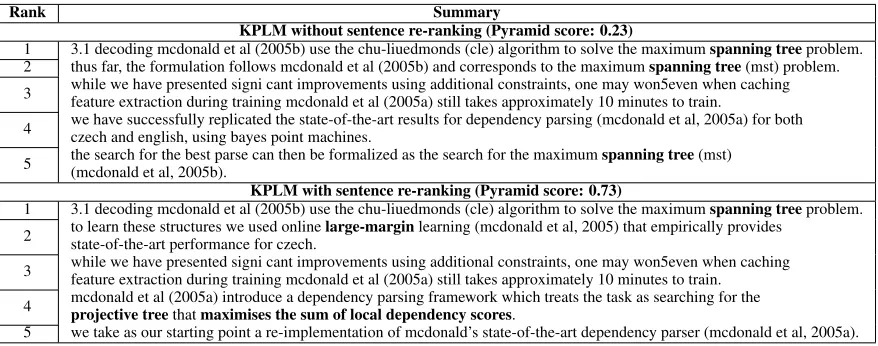
As discussed in Section 3.2, a good summary should capture the most salient keywords of a pa-per, but also cover as many non-redundant keywords as possible. A summary built using our method is likely to contain citing sentences that concentrate on and repetitively cover salient keywords of the target paper, which may fall short in keywords diversity. Indeed, we can see in the top part of Table 4 that the summary of paper P05-1012 repetitively covers a single keyword, “Minimum Spanning Tree”, while it fails to capture other key concepts.
language model construction to eliminate their noise in the cross entropy calculation. Experiments did support this design decision, and better results have been achieved with non-content words removed.
We perform Dirichlet Prior Smoothing (Zhai and Lafferty, 2001) to both the citing sentence MLE and the summary MLE using the KPLM of the paper as a background model using a Dirichlet Prior (DP) of 20. The choice of 20 has been based on the obser-vation that citing sentences are short (32 words on average) and a large DP is prone to generate overly smoothed language models that are dominated by the KPLM, thus lack discriminative power. Here we choose to use this empirically selected DP parameter without attempting to fine-tune it for best results.
In summary, we implement a top sentence re-ranking heuristic that iteratively selects the next sen-tence to be appended to the existing summary whose smoothed language model is with the largest cross entropy (so it contains most extra information) with a smoothed language mode built for the summary at its current stage. We shall demonstrate how our top sentence re-ranking method introduces a major performance boost in the next section. For a quick inspection of the effectiveness of this method, com-pare the summaries constructed for paper P05-1012 with and without sentence re-reranking in Table 4. It shows that the summary constructed with sen-tence re-ranking covers key facts more comprehen-sively. The pseudo code for our re-ranking strategy is shown in Algorithm 1. It adopts a straightforward re-ranking approach that simply uses the topk+5 re-trieved citing sentences in the previous step as the candidate pool; at each iteration, it selects the best sentence based on its cross entropy with the sum-mary at the current stage. A more sophisticated re-ranking method is to combine the two cross entropy scores in some way (e.g., Maximal Marginal Rele-vance (Carbonell and Goldstein, 1998)) so that the final score for a citing sentence reflects its value in capturing salient keywords that have not yet been in-cluded in the summary. We leave the study of a more sophisticated re-ranking scheme for future work.
4 Experimental Setup
4.1 Evaluation Method
Following Qazvinian et al. (2008; 2010), we use the pyramid method (Nenkova and Passonneau, 2004) at sentence level to evaluate our system’s perfor-mance. The pyramid score is a fact-based eval-uation method that has been especially popular in evaluating extractive summarisation systems. It has
Algorithm 1Top Sentence Re-ranking
1: functionTOPSENTENCERERANKER
2: k summary length limit 3: top sent top k plus 5 sents[0]
4: es top sent
5: cp top k plus 5 sents - top sent 6: fors incpdo
7: cp lms[s] DPSmoothed(s)
8: fori = 2tokdo
9: es lm DPSmoothed(es)
10: s argmaxs2cp(CE(cp lms||es lm))
11: es es+s
12: cp cp s
13: cp lms cp lms cp lms[s]
returnes
been widely adopted because it incorporates both fact coverage and fact importance into the scoring process, which resonates well with the goals of sum-marisation (Qazvinian et al., 2010). More specifi-cally, the pyramid method scores a summary using the ratio between the total facts weights of the facts it covers and that of an optimal summary. First a fact weights pyramid is built using some facts weighting method and each fact is subsequently put into its per-spective pyramid tier. Qazvinian et al. (2008; 2010) built a weights pyramid for each paper and assigned each humanly discovered fact into a tier according to the number of citing sentences the fact occurs in that paper’s citation summary. For example, factfi
appearing in|fi|citing sentences in the citation sum-mary of paperDis assigned to the tierT|fi|inD’s
fact weights pyramidPD. LetFi denotes the
num-ber of facts in the summaryES in tierTiofPD. The
total facts weightsES covers is calculated as:
W(ES)=Pn
i=1i·Fi (6)
where n is the highest tier of PD. Let ESoptimal
be the optimal summary for D w.r.t. the summary length limit (ESoptimalcan be found using
heuristic-driven exhaustive search). The pyramid score for
ES is finally calculated as:
Score(ES)=W(ES)/W(ESoptimal) (7)
Rank Summary
KPLM without sentence re-ranking (Pyramid score: 0.23)
1 3.1 decoding mcdonald et al (2005b) use the chu-liuedmonds (cle) algorithm to solve the maximumspanning treeproblem. 2 thus far, the formulation follows mcdonald et al (2005b) and corresponds to the maximumspanning tree(mst) problem. 3 while we have presented signi cant improvements using additional constraints, one may won5even when cachingfeature extraction during training mcdonald et al (2005a) still takes approximately 10 minutes to train. 4 we have successfully replicated the state-of-the-art results for dependency parsing (mcdonald et al, 2005a) for bothczech and english, using bayes point machines.
5 the search for the best parse can then be formalized as the search for the maximum(mcdonald et al, 2005b). spanning tree(mst)
KPLM with sentence re-ranking (Pyramid score: 0.73)
1 3.1 decoding mcdonald et al (2005b) use the chu-liuedmonds (cle) algorithm to solve the maximumspanning treeproblem. 2 to learn these structures we used onlinestate-of-the-art performance for czech. large-marginlearning (mcdonald et al, 2005) that empirically provides
3 while we have presented signi cant improvements using additional constraints, one may won5even when cachingfeature extraction during training mcdonald et al (2005a) still takes approximately 10 minutes to train.
4 mcdonald et al (2005a) introduce a dependency parsing framework which treats the task as searching for theprojective treethatmaximises the sum of local dependency scores.
[image:8.612.88.527.53.226.2]5 we take as our starting point a re-implementation of mcdonald’s state-of-the-art dependency parser (mcdonald et al, 2005a).
Table 4: Summaries of paper P05-1012 produced using KPLM. Key facts in citing sentences are highlighted and OCR and sentence segmentation errors have been retained as they originally appeared in the corpus.
and Radev, 2008; Qazvinian et al., 2010) for cross-referencing results from a broader set of systems. 4.2 Results and Discussion
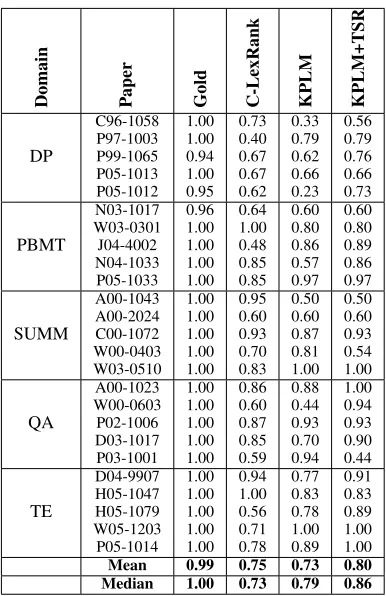
Table 5 shows the pyramid score evaluation re-sults for the 25 papers. To facilitate comparison and cross-referencing, the table has been format-ted as close as possible to Table 7 in (Qazvinian and Radev, 2008) with figures in the Gold and C-LexRank columns directly copied over. Note that a Gold pyramid score less than 1 suggests that there are more facts than can be covered using k sen-tences for that paper’s citation summary. It can be seen that KPLM based summarisation achieves quite comparable results (especially in terms of the median score) with C-LexRank, even without top sentence re-ranking. When the re-ranking is intro-duced, our system outperforms the current state-of-the-art C-LexRank by a measurable margin. Al-beit the perceived differences in the results, a one-tailed Wilcoxon signed-rank test indicated that our results are not statistically superior at significance level 0.05 (Z=-1.22, P=0.11). A power analysis re-veals that in order to achieve a statistically signif-icant result on this small sample of 25 papers, a system would need to score a medium to large ef-fect size (Cohen’s d>0.53), which is a challenging task considering C-LexRank’s strong baseline per-formance. We hope this analysis can inform future studies using Qazvinian’s 25 papers corpus. Never-theless, it should be pointed out that our approach is not only substantially simpler than C-LexRank, it also yields more interpretable results.
We know of a more recent set of results reported in (Qazvinian et al., 2013), which again confirmed
C-LexRank’s state-of-the-art status with a mean pyramid score of 0.799 (cf. Table 6 in (Qazvinian et al., 2013)). However those results are not com-parable with ours for the following reasons. First, Qazvinian et al. (2013) used a slightly different cor-pus with 30 papers (5 extra papers from the Condi-tional Random Field domain). Second, results were based on a summary length limit of 200 words, so roughly equivalent to 6.3 sentences per paper, giv-ing evaluations an extra edge. Both changes boosted system performance in those evaluations, as evi-denced by comparing Table 7 in (Qazvinian and Radev, 2008) and Table 6 in (Qazvinian et al., 2013).
cita-Domain Paper Gold C-LexRank KPLM KPLM+TSR DP C96-1058 P97-1003 P99-1065 P05-1013 P05-1012 1.00 1.00 0.94 1.00 0.95 0.73 0.40 0.67 0.67 0.62 0.33 0.79 0.62 0.66 0.23 0.56 0.79 0.76 0.66 0.73 PBMT N03-1017 W03-0301 J04-4002 N04-1033 P05-1033 0.96 1.00 1.00 1.00 1.00 0.64 1.00 0.48 0.85 0.85 0.60 0.80 0.86 0.57 0.97 0.60 0.80 0.89 0.86 0.97 SUMM A00-1043 A00-2024 C00-1072 W00-0403 W03-0510 1.00 1.00 1.00 1.00 1.00 0.95 0.60 0.93 0.70 0.83 0.50 0.60 0.87 0.81 1.00 0.50 0.60 0.93 0.54 1.00 QA A00-1023 W00-0603 P02-1006 D03-1017 P03-1001 1.00 1.00 1.00 1.00 1.00 0.86 0.60 0.87 0.85 0.59 0.88 0.44 0.93 0.70 0.94 1.00 0.94 0.93 0.90 0.44 TE D04-9907 H05-1047 H05-1079 W05-1203 P05-1014 1.00 1.00 1.00 1.00 1.00 0.94 1.00 0.56 0.71 0.78 0.77 0.83 0.78 1.00 0.89 0.91 0.83 0.89 1.00 1.00
Mean 0.99 0.75 0.73 0.80
[image:9.612.89.282.51.349.2]Median 1.00 0.73 0.79 0.86
Table 5: Summary pyramid score evaluation results with summary length limitk= 5.
tion summary. A desirable property of a good sum-mariser is thus the ability in maintaining its perfor-mance while the task becomes increasingly demand-ing. To further evaluate KPLM’s performance un-der increasingly more stringent summary length lim-its, we gathered the pyramid scores with summary length limitkdecreasing from 5 to 1 and visualised the results in Figure 1. We can see that KPLM’s performance decays quite gracefully as more strin-gent limits are imposed. Even under the harshest constraint with the summary length limit sets to 1, our system still managed a mean pyramid score of close to 0.6 across the 25 papers. Indeed, it can be seen that the variance in pyramid scores gradu-ally spreads wider (the dark band in the figure marks out 95% confidence interval of the mean scores), but this phenomenon is expected as the error margin also shrinks along with the summary length limit.
5 Conclusion and Future Work
We designed a statistical framework to summarise scientific papers, using methods rooted in quanti-tative statistics and information theory. We first built a keyword profile for a paper using a quan-titative statistical method that captures its
charac-● ● ● ● ● 0.4 0.5 0.6 0.7 0.8
5 4 3 2 1
Summary length limit
Pyr
[image:9.612.316.540.62.133.2]amid score
Figure 1: Pyramid scores of KPLM+TSR under different summary length limits.
terising keywords that are both overly represented and relatively exclusively used in the paper’s cita-tion summary. We then used the keyword profile of a paper to build a discriminative pseudo unigram language model that directly incorporates words’ salience in characterising a paper’s main contribu-tions into pseudo generative probabilities. Based on the fact that a paper’s KPLM represents an effec-tive language model from which pseudo citing sen-tences with good coverage of important keywords could be sampled, we cast the task of summarisa-tion as language model divergence based IR. Finally, we implemented an information-driven sentence re-ranking algorithm that can effectively leverage di-versity in keyword coverage in summaries produced. Experimental results show that our approach outper-forms the current state-of-the-art systems in scien-tific paper summarisation, which is also with good resilience to more stringent summary length limits.
In the future, we plan to extend our approach to higher order n-grams and see whether larger infor-mation units (phrases) would help boost summarisa-tion performance. We also plan to apply our method to the problem of multi-document summarisation. In particular, we are very interested to test our system’s performance on automatically generating a technical survey of a scientific paradigm, which thanks to the authors of (Mohammad et al., 2009; Qazvinian et al., 2013), has been established as a well-defined task with high-quality open data. Finally, while we have shown that our approach is effective in summarising a scientific paper’s major contributions using its cita-tion summary text, further experiments are required to test our method’s effectiveness on more generic summarisation tasks and texts genres.
Acknowledgement
References
Brin, Sergey and Page, Larry. 1998 The anatomy of a large-scale hypertextual web search engine. In Pro-ceedings of the 7th International Conference on World Wide Web, pp. 107–117.
Carbonell, Jaime and Goldstein, Jade. 1998 The use of MMR, diversity-based reranking for reordering docu-ments and producing summaries. In Proceedings of the SIGIR, pp. 335–336.
Elkiss, Aaron and Shen, Siwei and Fader, Anthony and Erkan, G¨unes¸ and States, David and Radev, Dragomir. 2008 Blind men and elephants: What do citation sum-maries tell us about a research article?. Journal of the American Society for Information Science and Tech-nology, vol. 59, no. 1, pp. 51–62.
Kullback, S. and Leibler, R. A. 1951 On information and sufficiency. The Annals of Mathematical Statis-tics, vol. 22, no. 1, pp. 79–86.
Mei, Qiaozhu and Zhai, Chengxiang. 2008 Generating impact-based summaries for scientific literature. In
Proceedings of the ACL, pp. 816–824.
Mohammad, Saif and Dorr, Bonnie and Egan, Melissa and Hassan, Ahmed and Muthukrishan, Pradeep and Qazvinian, Vahed and Radev, Dragomir and Zajic, David. 2009 Using citations to generate surveys of scientific paradigms. In Proceedings of the HLT-NAACL, pp. 584–592.
Nenkova, Ani and Passonneau, Rebecca. 2004 Evaluat-ing content selection in summarization: The pyramid method. InProceedings of the HLT-NAACL, pp. 145– 152.
Qazvinian, Vahed and Radev, Dragomir. 2008 Scien-tific paper summarization using citation summary net-works. InProceedings of the 22nd International Con-ference on Computational Linguistics, pp. 689–696. Qazvinian, Vahed and Radev, Dragomir and ¨Ozg¨ur,
Arzu-can. 2010 Citation summarization through keyphrase extraction. In Proceedings of the 23rd International Conference on Computational Linguistics, pp. 895– 903.
Dunning Ted. 1993 Accurate methods for the statistics of surprise and coincidence. Computational Linguis-tics, vol. 19, no. 1, pp. 61–74.
Lin, Chin-Yew and Hovy, Eduard. 2000 The automated acquisition of topic signatures for text summarization. In Proceedings of the 18th conference on Computa-tional Linguistics, pp. 495–501.
Moore. Robert C. 2004 On log-likelihood-ratios and the significance of rare events. InProceedings of EMNLP, pp. 333–340.
Qazvinian, Vahed and Radev, Dragomir and Mohammad, Saif and Dorr, Bonnie and Zajic, David and Whidby,
Michael and Moon, Taesun. 2013 Generating extrac-tive summaries of scientific paradigms.Journal of Ar-tificial Intelligence Research (JAIR), vol. 46, pp.165– 201.
Radev, Dragomir and Pradeep, Muthukrishnan and Qazvinian, Vahed. 2009 The ACL anthology network corpus. InProceedings of the ACL workshop on Nat-ural Language Processing and Information Retrieval for Digital Libraries, pp. 54–61.
Siddharthan, Advaith. and Teufel, Simone. 2007 Whose idea was this, and why does it matter? InProceedings of the NAACL/HLT, pp. 316–323.
Tomokiyo, Takashi and Hurst, Matthew. 2003 A lan-guage model approach to keyphrase extraction. In
Proceedings of the ACL’03 workshop on Multiword ex-pressions, pp. 33–40.
Zhai, Chengxiang. 2008 Statistical language models for information retrieval a critical review. Foundations and Trends in Information Retrieval, vol. 2, no. 3, pp. 137–213.