Measuring Competitiveness
J. PETER NEARY*
University College Dublin and CEPR
Abstract: This paper reviews alternative approaches to measuring an economy’s cost competitiveness and proposes some new measures inspired by the economic theory of index numbers. The indices provide a theoretical benchmark for estimated real effective exchange rates, but differ from standard measures in that they are based on marginal rather than average sectoral shares in GDP or employment. The use of the new indices is illustrated by some simple calculations which highlight the potential exposure of the Irish economy to fluctuations in the euro-sterling exchange rate.
I INTRODUCTION
C
ompetitiveness is an elusive concept, much studied by business theorists and much invoked by politicians and commentators, but frequently dismissed as irrelevant or unimportant by economists. Krugman (1994) famously called it a dangerous obsession in his critique of the first Clinton administration’s flirtation with industrial policy. By contrast, Michael Porter of Harvard Business School has highlighted competitive advantage as the key197
*An earlier version was presented at the Conference on Macroeconomic Perspectivesin Honour of Brendan M. Walsh, held at University College Dublin on 7 October, 2005. The ideas in this paper were first presented at a 1997 meeting of the Dublin Economics Workshop in University College Dublin. For helpful comments I am very grateful to participants on that occasion, as well as those at an IMF Conference on Trade and Developing Countriesin March 2005 and at the Conference on Macroeconomic Perspectives.The paper has also benefited from discussions with Jim Anderson, Erwin Diewert, John Fitz Gerald, Patrick Honohan, Stephen Tokarick and Brendan Walsh and from the comments of two anonymous referees. This research is part of the International Trade and Investment Programme of the Geary Institute at University College Dublin.
to superior performance by firms, industries and economies as a whole. (See Porter, 1990.) In part through his influence, many agencies now monitor national competitiveness, ranging from the World Economic Forum, which publishes an annual Global Competitiveness Report, to national bodies such as the US Council on Competitiveness (www.compete.org) and the Irish National Competitiveness Council (www.forfas.ie/ncc). These have produced much useful data and a great deal of helpful commentary, but mainstream economic theorists have for the most part paid little attention.1
Applied economists on the other hand have been only too aware of the importance of competitiveness as a determinant of macroeconomic performance, though they have tended to focus on the narrower concept of relative cost competitiveness. In Brendan Walsh’s work on the Irish economy this has been a recurring theme, extending from his membership of the 1981 Committee on Costs and Competitiveness, popularly known as the “Three Wise Men” (Baker, McAleese and Walsh, 1981), to his dissections of the spectacular growth performance of the “Celtic Tiger” era (Walsh 2000, Honohan and Walsh, 2002). Elsewhere the problems of measuring cost competitiveness have been extensively considered in central banks and especially in the International Monetary Fund, from the seminal work of Hirsch and Higgins (1970), Artus and Rhomberg (1973) and Rhomberg (1976), to more recent applications by Lipschitz and McDonald (1992) and Marsh and Tokarick (1996). A paper in this tradition of particular interest in the Irish context is that by Cerra, Soikkeli and Saxena (2003), who study the competitiveness of Irish manufacturing in the 1990s, and interpret periods when the employment-weighted real effective exchange rate (REER) depreciated by less than the output-weighted REER as implying that employment-intensive firms and sectors faced greater competitive pressure than the economy as a whole.
Despite the amount of work that has been done on the topic, there is no clear consensus on how to measure cost competitiveness. The theme of the present paper is that the ambiguities and controversies surrounding this issue can be illuminated, if not resolved, by applying some of the principles of the economic theory of index numbers.2 In Section II I review some of these principles in a relatively well-known context, that of measuring the true cost of living and the true rate of inflation. I then apply them in Section III to derive two true real effective exchange rate (REER) indices, using the same approach adopted in earlier work on true indices of trade policy restrictiveness and on international comparisons of real income.3 Section IV presents an 1For an attempt to rationalise competitive advantage in a model of oligopolistic competition in
general equilibrium, see Neary (2003). 2See Diewert (1981) for an introduction.
application of these indices in the context of a highly stylised model of the Irish economy, and uses it to throw light on an old policy debate concerning the wisdom of Ireland’s joining the European Monetary Union (EMU) while the UK remained outside. Section V concludes.
II MEASURING THE COST OF LIVING
The economic theory of index numbers proceeds first by requiring that an economically meaningful index number should provide an answer to some question of interest. Merely statistical indices, by contrast, provide only answers without questions in the words of Afriat (1977). Second, most interesting questions require taking account of behavioural responses, and this frequently implies allowing for substitution by economic agents in response to relative price changes. In this section I introduce these concepts in the context of measuring the cost of living, in order to set the scene for the later discussion of measuring competitiveness.
The starting point for measuring the price level is the consumer price index, usually taken as the ratio of the cost of purchasing a given basket of commodities at two sets of prices, the old or period-0 prices p0and the new or period-1 prices p1:
ipi1xi
I(p0, p1, x) = –––––– (1)
ipi0xi
In practice the basket in question is often taken to be that in period 0, x =x0, which yields the Laspeyres price index (as opposed to the Paasche index when the basket is that of period 1). This index is intended to measure the cost of living in period 1 relative to that in period 0. But whose life is it anyway? And would we not expect rational consumers to change their consumption patterns in response to the change in prices?
These objections are overcome by the true cost of living index due to Konüs. Unlike the consumer price index, which measures the relative cost of consuming the same commodity bundle in period 1 as in period 0, the Konüs index measures the relative cost of attaining the same level of utility.4The cost of utility, facing given prices, is measured in turn by the expenditure function e(p,u):
4As with the consumer price index in (1), the reference utility level is often taken to be that in
e(p1, u)
κ(p0, p1, u) = –––––– (2)
e(p0, u)
Like the numerator and denominator in (1), the expenditure function is also a sum of expenditures on individual goods, but now the quantities are those that would be chosen optimally by a consumer facing the appropriate prices and wishing to attain the given level of utility: e(p,u) =ipixi(p,u). Thus the Konüs index allows for intercommodity substitution by the consumer in response to price changes. It also answers a well-defined and economically interesting question: “How much would it cost the reference consumer to be as well-off at the new prices as at the old?”, where the reference consumer is the one whose tastes correspond to the particular expenditure function e(p,u).
The superiority in principle of the Konüs index over the consumer price index is now widely accepted by economists. Nevertheless, it is useful to rehearse some of the possible objections to it, since similar objections may be made to the measures of true competitiveness which I propose in the next section.
First is the argument that the Konüs index requires specifying an explicit behavioural model, whereas the consumer price index is apparently model-free. I say apparently advisedly, however, for it is well-known that the empirical index can only be rationalised in terms of an implicit model with a Leontief or fixed-coefficients utility function, implying that the reference consumer does not adjust their consumption bundle at all in response to relative price changes.
A more subtle objection is that the Konüs index is conceptually redundant, because, if the true model is known, then it could be used to calculate directly the change in utility or welfare between the two periods, which is the only variable of intrinsic economic interest. This is strictly correct, but it ignores the enormous informational economy which a price index confers, and the fact that the true model can never be known with certainty. Even if the true model were known exactly, the Konüs index would still be a useful summary measure. More generally it provides an unobservable benchmark against which empirical indices can be evaluated.
pi xi
κˆ =
ωi pi where: ωi= ––––––– (3)i h phxh
(A circumflex over a variable denotes a proportional change.) This is a weighted average of price changes, where for small changes the weights are the shares of each good in total expenditure in period 0. However, for large price changes the change in the consumer price index is not a good approximation to the change in the Konüs index. When the effects of small differences between the two are cumulated over time, they can make a large difference for many policy questions. The most famous demonstration of this is the report of the US Boskin Commission (1996). It showed that the US consumer price index overestimated the true change in the cost of living by 1.1 per cent per year, of which 0.4 per cent was due to the kind of substitution bias discussed here, and that this in turn implied increased spending of billions of dollars on index-linked social security payments.
A final objection is that the true cost-of-living index is unobservable, and no estimate of it commanding universal support is likely to be available. However, direct estimation of the Konüs index is only one empirical strategy available. Alternatives are to try and place bounds on the true index, or to seek empirical indices other than the Laspeyres index which approximate it better under specific assumptions.5 All these methods are sensitive to model specification, and in practice scarcity of data and/or research time may leave no alternative to using the consumer price index. Nevertheless, the Konüs index provides a theoretical ideal against which the performance of empirical indices such as the consumer price index should be evaluated.
III TRUE REAL EFFECTIVE EXCHANGE RATES
Consider next empirical measures of competitiveness or the real effective exchange rate. The standard approach to calculating them is to take a weighted average of bilateral competitiveness indices between the home country (indexed H) and its main trading partners. The weights may be export shares, or shares of exports plus imports, or they may also take account of competition from third countries, as in the most widely-used indices published by the IMF and the Bank of England.6Bilateral competitiveness in turn can be measured either by relative consumer prices, relative export unit values, or
5For examples of these approaches see Blundell, Browning and Crawford (2003) and Diewert
(1976) respectively. The latter approach was used by the Boskin Commission.
relative unit labour costs (wages corrected for labour productivity). Cerra, Soikkeli and Saxena (2003) survey the literature and conclude that the latter is the best single indicator, since it covers a greater share of trade than consumer prices and avoids the measurement and endogeneity problems associated with export unit values. This yields the following expression:
ULCH
ε=
θjej–––––– (4)j ULCj
Here θj is the share of country j in country H’s trade, and ej is the bilateral nominal exchange rate (the home price of a unit of foreign currency). In the context of Ireland in the 1990s, Honohan and Walsh (2002) argue that economy-wide measures of unit labour costs are seriously misleading, because the average is increased by the dramatic shift in sectoral composition towards less labour-intensive sectors, which would have raised measured competitiveness even if marginal or average labour productivity had not changed in any sector. They propose instead using the differential change in wage rates detrended by a constant, assuming a constant rate of differential marginal productivity growth between Ireland and its trading partners. Cerra, Soikkeli and Saxena adopt a different approach to the same problem. They point out that industries may differ in their exposure to competition from foreign countries, so they propose instead of Equation (4) the following:
ULCiH
ε=
ωiθijej–––––– (5)i j ULCij
This version of the REER index allows both trade shares and unit labour costs to vary across industries. As for the industry weights ωi, they may equal the share of industry iin either total output or employment. Cerra, Soikkeli and Saxena show that the growth in competitiveness of Irish industry in the second half of the 1990s was much less impressive when employment shares are used instead of output shares.
production sector, and in this paper I take a very simple reduced form approach to doing so, drawing on the duality approach to international trade. (See for example, Dixit and Norman (1980).) Hence, assume that the equilibrium level of nominal GDP can be written as a function of an exogenous vector of external prices p and an exogenous nominal wage rate w: G(p,w). (Both p and w are measured in domestic units.) Implicit in this formulation is the institutional structure of the economy, the degree of intersectoral factor mobility and the level of technology.
We can now define a true GDP-neutral REER index as follows. Suppose that prices and wages are initially equal to (p0,w0) and then change to (p1,w1). The true GDP-neutral REER index is the scalar deflator εG which when applied to all prices would restore the initial level of GDP:
εG: G(p1/εG, w1) = G(p0, w0) (6)
To see how this index can be interpreted, consider two particular types of change between periods 0 and 1. If the wage does not change but external prices rise, then G increases. A value of εGgreater than one would be needed to restore the initial level of GDP, indicating that competitiveness has increased. Alternatively, if external prices do not change but wages increase, then G falls. Now εGis less than one indicating a fall in competitiveness.
Alternatively, if we want to focus on total employment instead of GDP, we can write its equilibrium level as a function of the same exogenous variables as G, l(p, w), and, by analogy with Equation (6), define a true employment-neutral REER index as the scalar deflator εLwhich when applied to all prices would restore the initial level of employment:
εL: l(p1/εL, w1) = l(p0, w0) (7)
The interpretation of εLis similar to that of εG. In addition, we can use the fact that l is homogeneous of degree zero in all nominal variables (i.e., total employment is unaffected by a uniform change in all prices and wages) to rewrite Equation (7) as:
εL: l(p1, εL, w1) = l(p0, w0) (8)
simplicity I ignore this.) In the remainder of this section I discuss the properties of these indices, paralleling the discussion of the Konüs true cost-of-living index in the previous section.
Just as the Konüs index requires assuming explicit tastes for the reference consumer, so the true competitiveness indices require that an explicit model of the economy be specified. The particular forms specified above, G(p,w) and l(p,w), can be rationalised in a number of ways. One which is explored further in the Appendix, is a perfectly competitive price-taking economy. This is consistent with the empirical REER in Equation (4), provided we can match sectors with specific trading partners and hence with specific bilateral exchange rates. The index could also be rationalised in terms of a monopolistically competitive production sector as in Obstfeld and Rogoff (1995) and Lane (2001). This would be consistent with the empirical REER in Equation (5). But as we shall see, the true REER indices differ in all cases from the empirical indices in Equations (4) and (5).
One clear advantage of making explicit the underlying model of the economy is that it underlines the importance of taking account of developments in import-competing sectors as well as in exporting sectors in evaluating competitiveness. Both Equations (6) and (7) imply that the true competitiveness indices depend on the prices of all traded goods, not just on those of exports. This makes sense: if we are concerned with the effects of changes in competitiveness because of their implications for output or employment, then we should pay equal attention to all sectors exposed to foreign competition, whether they export or not. Of course, if we want to explain export performance specifically, as in Carlin, Glyn and van Reenan (2001) for example, then a different measure of competitiveness would be appropriate, and the prices of import-competing final goods would not be directly relevant. This underlines the general point that the appropriate measure of competitiveness depends on the question we wish to answer.
The GDP and employment functions used in defining the true REER indices above have a distinctly Keynesian, even old Keynesian, flavour, since the wage rate is assumed to be determined outside the production sector. However, they could be embedded in a more comprehensive model which endogenises nominal wage determination in a variety of frameworks: wage indexation, staggered wage setting, firm-union bargaining or efficiency wages. An exception is a competitive labour market, since if wages are perfectly flexible then cost competitiveness is endogenously determined and there is no reason for policy makers to take an interest in it.
∂G ––– pi
∂pi
εˆG=
ωi pˆi where: ωi= ––––––––– (9)∂G
i
h––– ph
∂ph
Once again, this is a weighted average of price changes. However, unlike the Konüs index, the weights depend on marginal rather than average output shares.7 This highlights a key deficiency of empirical indices such as Equations (4) and (5). To the extent that they purport to capture the implications of external price changes for output or employment, they fail to allow for differential supply responses across sectors. At best they can be interpreted as implying that all sectors have the same output supply elasticity, in which case the weights in Equation (9) reduce to average shares in GDP. The same point applies to the true employment-neutral REER index. Similar derivations show that the change in εLis:
∂l ––– pi
∂pi
εˆL=
ωi pˆi where: ωi= –––––––– (10)i ∂l
h––– ph
∂ph
which in the same way depends on marginal rather than average employment shares.
IV AN APPLICATION: THE IRISH ECONOMY’S EXPOSURE TO STERLING
To illustrate how the true indices introduced in the last section can be applied, consider their relevance to the debate which took place in Ireland in 1996 concerning the advisability of Ireland’s entering European Monetary Union (EMU) given that its main trading partner, the UK, had chosen to remain outside. A variety of arguments was brought to bear on both sides. (See, for example, Baker, Fitz Gerald and Honohan (1996), Barry (1997) and Neary and Thom (1997).) For present purposes, the most relevant aspect of the debate concerned the likely consequences for Irish output and employment of
7It might be thought that the derivatives ∂G/∂p
a sharp depreciation of sterling against the euro. On the one hand, it was pointed out that the UK share of Ireland’s trade had fallen steadily in previous decades, and was much less than 50 per cent. On the other hand, fears were expressed that, relative to foreign-owned firms, Irish firms exposed to competition from UK firms were disproportionally smaller, more labour-intensive, and more likely to compete on price rather than on product quality or as part of the integrated manufacturing processes of multinational corporations. (See Barry (1999) and Cerra, Soikkeli and Saxena (2003) for background on the evolution of Irish manufacturing structure in the last decades of the twentieth century.)
In the event the debate between economists was redundant both ex ante and ex post, since the decision to join EMU was taken largely on political and strategic grounds, and since the feared depreciation of sterling against the euro never materialised. (Though commentators such as Cassidy and O’Brien (2005) and Cerra, Soikkeli and Saxena (2003) continue to express concern about its likely consequences.) Nevertheless, it provides a context in which one potential use for the indices introduced earlier can be illustrated.
In order to operationalise the true indices introduced in the previous section, I assume that the production sector has a relatively simple structure, a multi-sector version of the specific-factors model of Jones (1971). In this case, the GDP function takes a particularly simple form: the output of each sector depends only on the price of that sector’s output and on the wage:8
G(p, w) =
pi yi (pi, w) (11) iAs shown in the Appendix, the weights in the expression for the change in the true GNP-neutral REER, Equation (9), can now be written as follows:
βi φi pi yi pi ∂yi
ωi= ––––––– where βi= –––– and φi= –– ––– (12)
h βh φh y yi ∂pi
Here βi is the share of sectori in GDP and φiis its price elasticity of supply. Hence, to the extent that sectors differ in their supply responses, the use of average GDP weights will give a misleading picture of the vulnerability of output to external price changes.
8It also implies that a change in foreign prices impinges directly on some sectors only. This
Analogous arguments apply to the employment-neutral REER index, which poses less measurement problems in the Irish case, because Ireland’s GDP figures are highly inflated by transfer pricing.9 For this index, we can make use of the fact that the level of employment in each sector depends on the price of that sector’s output and on the wage:
l(p, w) =
li (pi,w) (13)i
Similar derivations to the GDP-neutral case show that the weights in the expression for εˆL, Equation (10), are given by:
λi ηi li pi ∂li w ∂li
ωi= ––––––– where λi= –– and ηi= –– ––– = – –– ––– (14)
h λh ηh l li ∂pi li ∂w
Here λiis the share of sector i in total employment and ηi is its price elasticity of labour demand (equal by homogeneity to the absolute value of its wage elasticity of labour demand). Once again therefore, if sectors differ in their labour demand elasticities, weighting by average employment shares gives a misleading picture of the vulnerability of total employment to external price changes.
To see how this effect can matter with reasonable parameter values, I give some numerical calculations for a two-sector special case, which can be thought of as a back-of-the-envelope model of the production side of the Irish economy.10Let sector 1 be the sterling-exposed sector, assumed to be labour-intensive both on average and at the margin. Firms in sector 1 are assumed to compete primarily on price against foreign (i.e., UK) firms, mainly on the home and UK markets. By contrast, firms in sector 2 compete primarily on product quality with non-UK firms in third markets, and so their output supply is less responsive to price and their labour demand is less responsive to wages. We can parameterise the difference between the two sectors in terms of the ratio of their supply elasticities α, where φ1 = αφ2, with α ≥1.11 This 9See, for example, Honohan and Walsh (2002). A referee has pointed out a related but different
problem with both Irish GDP and employment data: with increased international integration of production processes, domestic inputs and outputs are not necessarily separable from those in other countries.
10Barry (1997) calibrates a similar model, augmented by a third sector producing a non-traded
good.
11Because of the formal similarity between Equations (12) and (14), all the discussion in the
implies that the true marginal weight of sector 1 in the GDP-neutral REER index is related to its output share as follows:
αβ1
ω1= –––––––––– (15)
αβ1+ 1 – β1
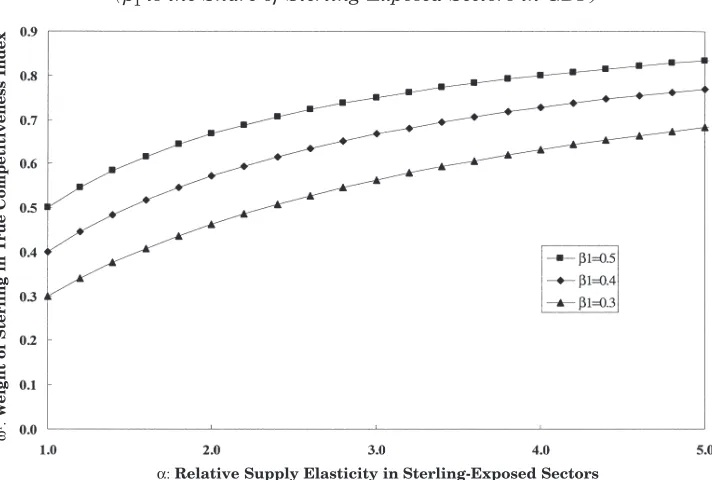
This shows that ω1 equals β1 when the two sectors have the same price elasticity of supply (α = 1). However, when sector 1 is more price-elastic, its true marginal weight exceeds its average weight. The true weight is strictly increasing in α, even when α equals one.12The relationship between ω
1 and
β1 is illustrated in Figure 1 for different values of α. It is clear that the true weight can easily be twice as much as the average share, suggesting that standard measures of competitiveness greatly underestimate the vulnerability of national output and employment to a change in the bilateral nominal exchange rate with sterling.
12∂ω
[image:12.499.77.433.321.561.2]1/∂αequals β1(1 –β1)/D2, where Ddenotes the denominator of ω1, which equals one when α equals one. Evaluated at α= 1, this derivative attains its maximum value of 0.25 when β1equals one-half.
Figure 1:Weight of Sterling in True Competitiveness Index (β1is the Share of Sterling-Exposed Sectors in GDP)
α: Relative Supply Elasticity in Sterling-Exposed Sectors
ω
1: W
eight of Sterling in T
V CONCLUSION
This paper has reviewed alternative approaches to measuring an economy’s cost competitiveness and proposed some new measures inspired by the economic theory of index numbers. It was shown that the indices provide a theoretical benchmark for estimated real effective exchange rates, but differ from standard measures in that they are based on marginal rather than on average sectoral shares in GDP or employment. Finally, the use of the new indices was illustrated by some simple calculations which highlight the potential exposure of the Irish economy to fluctuations in the euro-sterling exchange rate.
The IMF-based scholars who originated the concept of effective exchange rates were familiar with the central ideas of the economic theory of index numbers which have been emphasised here: first, a true index is the scalar equivalent of a multi-dimensional change, and should take account of optimising behaviour by economic agents; second, there is no unique true index, rather the choice of index depends on the economic question of interest; and third, estimating true indices should take account of marginal rather than average responses.13 However, the explicit relationship between effective exchange rates and the economic theory of index numbers was not highlighted in the early literature and appears to have been neglected subsequently. In part this may be because the early writers were exclusively concerned with the effects of exchange-rate changes on the trade balance, so the point about non-uniqueness of the true index got forgotten;14 and because the need for an explicit theoretical model (without which a true index cannot be defined) was inadequately distinguished from the widespread use of large-scale econometric models to measure effective exchange rates (only one of many ways to implement the concept, and one which has gone out of fashion in
13On the first, Artus and Rhomberg (1973, p. 606) define the (nominal) effective exchange rate of
a country as “… the change that would induce the same alteration in its trade balance expressed in the numeraire currency as that brought about by a given realignment of all exchange rates.” On the second, Rhomberg (1976, p. 89) states “The proper choice of weights depends, therefore, on the particular policy objective selected as the focal point of the index.” Hirsch and Higgins (1970, p. 455) make a similar point. Finally, the third feature was implicit in the use by Artus and Rhomberg (1973) of the IMF’s MERM (Multilateral Exchange Rate Model) econometric model to calculate effective exchange rates.
mainstream academia). As noted at the end of Section II, there are many ways in which the approach of this paper could be applied, some involving parametric econometric modelling and others not. There are also many practical issues of implementation which have not been considered here.15At the very least the paper has hopefully laid the foundations for bridge-building between the economic theory of index numbers and the careful insightful applied work which Brendan Walsh has exemplified.
APPENDIX
A.1Perfectly Competitive Foundations for the True Indices
The particular form of the general production model G(p,w) used here is that of a price-taking small open economy as in Dixit and Norman (1980), augmented to allow for a wage rate determined outside the production sector as in Neary (1985). The model can also be interpreted as one with non-traded goods in the background, as in Neary (1988), in which case the real exchange rate can alternatively be measured by the relative price of non-traded and traded goods rather than the relative price of home and domestic output as here.
With flexible wages, the equilibrium level of GDP is the maximum value of output conditional only on exogenous prices, technology and factor endowments:
g(p, l) = Max[p'y: F(y, l) ≤0] (16) y
where F(y, l) is the aggregate production constraint linking the vector of outputs to the labour endowment l. If the wage is exogenous, the economy maximises instead the return to fixed factors, giving rise to a constrained GDP function:
g˜(p, w) = Max[p'y– wl: F(y, l) ≤0] (17) y
Minus the wage derivative of this function gives the equilibrium level of employment:
l(p, w) = – g˜w(p, w) (18)
Finally, in the constrained economy, the actual level of GDP equals the returns to fixed factors and to labour:
G(p, w) = g[p, l(p, w)] = g˜(p, w) + wl(p, w) (19)
Whereas g˜is a maximal value function, G is not. Hence as noted in the text its derivatives with respect to p (unlike those of g and g˜) do not equal the levels of outputs but reflect instead marginal responses:
Gp= g˜p+ wlp (20)
For this reason, the weights in the expression for the change in the true GDP-neutral REER index in (9) depend on marginal rather than on average output shares.
A.2 Derivation of Equations (9) and (12)
Finally we sketch the derivation of the expressions for changes in the true GDP-neutral REER quoted in the text. Similar steps yield the corresponding properties of the true employment-neutral REER index. To derive Equation (9), totally differentiate (6) with p0and w0constant, which yields:
∂G 1 1 2
pi––– –– dpi– –– pi dεG= 0 (21)∂pi εG εG
Rearranging yields Equation (9). In the specific-factors case, differentiating the GDP function (11) yields:
∂G ∂yi y pi yi pi ∂yi y
–– = pi ––– = –– –––– –– –––– = –– βi φi (22)
∂pi ∂pi pi y yi ∂pi pi
REFERENCES
AFRIAT, SYDNEY N., 1977. The Price Index, Cambridge: Cambridge University Press. ANDERSON, JAMES E. and J. PETER NEARY, 1996. A new approach to evaluating
trade policy, Review of Economic Studies, Vol. 63, No. 1, January, pp. 107-125. ANDERSON, JAMES E. and J. PETER NEARY, 2005. Measuring the Restrictiveness of
International Trade Policy, Cambridge, Mass.: MIT Press.
ARTUS, JACQUES R. and RUDOLF R. RHOMBERG, 1973. A multilateral exchange rate model, International Monetary Fund Staff Papers, Vol. 20, No. 2, pp. 591-611.
BAKER, TERRY, DERMOT MCALEESE and BRENDAN M. WALSH, 1981. Report of
the Committee on Costs and Competitiveness, Dublin: Stationery Office.
BAKER, TERRY, JOHN FITZ GERALD and PATRICK HONOHAN (eds.), 1996.
Economic Implications for Ireland of EMU, Policy Research Series No. 28, Dublin: The Economic and Social Research Institute.
BARRY, FRANK, 1997. Dangers for Ireland of an EMU without the UK: Some calibration results, The Economic and Social Review, Vol. 28, No. 4, pp. 333-349. BARRY, FRANK (ed.), 1999. Understanding Ireland’s Economic Growth, London:
Macmillan.
BAYOUMI, TAMIM, JAEWOO LEE and SARMA JAYANTHI, 2005. New Rates from New Weights, Working Paper 05/99, Washington D.C.: International Monetary Fund.
BOSKIN COMMISSION (The Advisory Commission To Study The Consumer Price Index), 1996. Toward A More Accurate Measure Of The Cost Of Living, Final Report to the (U.S.) Senate Finance Committee, available at: http://www.ssa. gov/history/reports/boskinrpt.html.
BLUNDELL, RICHARD W., MARTIN BROWNING and IAN A. CRAWFORD, 2003. Nonparametric Engel curves and revealed preference, Econometrica, Vol. 71, No. 1, pp. 205-240.
CARLIN, WENDY, ANDREW GLYN and JOHN VAN REENAN, 2001. Export market performance of OECD countries: An empirical examination of the role of cost competitiveness, Economic Journal, Vol. 111, pp. 128-162.
CASSIDY, MARK, and DERRY O’BRIEN, 2005. Export performance and competitiveness of the Irish economy, Central Bank of Ireland Quarterly Bulletin, No. 3, pp. 75-95.
CERRA, VALERIE, JARKKO SOIKKELI and SWETA C. SAXENA, 2003. How competitive is Irish manufacturing?, The Economic and Social Review, Vol. 34, No. 2, Summer/Autumn, pp. 173-193.
CHINN, MENZIE, 2006. A primer on real effective exchange rates: Determinants, overvaluation, trade flows and competitive devaluation, Open Economies Review, Vol. 17, No. 1, January, pp. 115-143.
DIEWERT, W. ERWIN, 1976. Exact and superlative index numbers, Journal of Econometrics, Vol. 4, No. 2, pp. 115-145.
DIEWERT, W. ERWIN, 1981. The economic theory of index numbers: A survey, in A. Deaton (ed.), Essays in the Theory and Measurement of Consumer Behaviour in Honour of Sir Richard Stone, London: Cambridge University Press, pp. 163-208. DIXIT, AVINASH K. and VICTOR D. NORMAN, 1980. Theory of International Trade:
HIRSCH, FRED and ILSE HIGGINS, 1970. An indicator of effective exchange rates,
International Monetary Fund Staff Papers, Vol. 17, No. 1, March, pp. 453-487. HONOHAN, PATRICK and BRENDAN M. WALSH, 2002. Catching up with the
leaders: The Irish hare, Brookings Papers on Economic Activity, No. 1, pp. 1-77. JONES, RONALD W., 1971. A three-factor model in theory, trade and history, in J.N.
Bhagwati, R.W. Jones, R.A. Mundell and J. Vanek (eds.), Trade, Balance of Payments and Growth: Essays in Honor of Charles C. Kindleberger, Amsterdam: North-Holland, pp. 3-21.
KRUGMAN, PAUL, 1994. Competitiveness: A dangerous obsession, Foreign Affairs, pp. 28-44.
LANE, PHILIP R., 2001. The new open economy macroeconomics: A survey, Journal of International Economics, Vol. 54, No. 2, pp. 235-266.
LIPSCHITZ, LESLIE and DONOGH MCDONALD, 1992. Real exchange rates and competitiveness: A clarification of concepts, and some measurements for Europe,
Empirica, Vol. 19, No. 1, pp. 37-69.
LYNCH, BIRONE and SIMON WHITAKER, 2004. The New Sterling ERI, Bank of
England Quarterly Bulletin, Vol. 44, No. 4, Winter, pp. 429-441.
MARSH, IAN W. and STEPHEN P. TOKARICK, 1996. An assessment of three measures of competitiveness, Weltwirtschaftliches Archiv, Vol. 132, pp. 700-722. NEARY, J. PETER, 1985. International factor mobility, minimum wage rates and
factor-price equalization: A synthesis, Quarterly Journal of Economics, Vol. 100, No. 3, August, pp. 551-570.
NEARY, J. PETER, 1988. Determinants of the equilibrium real exchange rate,
American Economic Review, Vol. 78, No. 1, March, pp. 210-215.
NEARY, J. PETER, 2003. Competitive versus comparative advantage, The World Economy, Vol. 26, No. 4, April, pp. 457-470.
NEARY, J. PETER, 2004. Rationalising the Penn World Table: True multilateral indices for international comparisons of real incomes, American Economic Review, Vol. 94, No. 5, December, pp. 1411-1428.
NEARY, J. PETER and D. RODNEY THOM, 1997. Punts, pounds and euros: In search of an optimum currency area, IBAR: Journal of Irish Business and Administrative Research, Vol. 18, pp. 211-225.
OBSTFELD, MAURICE and KENNETH ROGOFF, 1995. Exchange rate dynamics redux, Journal of Political Economy, Vol. 103, No. 3, pp. 624-660.
PORTER, MICHAEL E., 1990. The Competitive Advantage of Nations, London: Macmillan.
RHOMBERG, RUDOLF R., 1976. Indices of effective exchange rates, International Monetary Fund Staff Papers, Vol. 23, No. 1, March, pp. 88-112.