134
Verb-second Effect on Quantifier Scope Interpretation
Asad Sayeed
Dept. of Philosophy, Linguistics, and Theory of Science University of Gothenburg, Sweden
Matthias Lindemann1, Vera Demberg1,2 1Dept. of Lang. Sci. and Tech.
2Dept. of Math. and CS
Saarland University, Germany [email protected] [email protected]
Abstract
Sentences likeEvery child climbed a treehave at least two interpretations depending on the precedence order of the universal quantifier and the indefinite. Previous experimental work explores the role that different mechanisms such as semantic reanalysis and world knowl-edge may have in enabling each interpreta-tion. This paper discusses a web-based task that uses the verb-second characteristic of Ger-man main clauses to estimate the influence of word order variation over world knowledge.
1 Introduction
In this paper, we present results from an online cloze (fill-in-the-blank) experiment in German de-signed to exploit the verb-second syntax of Ger-man main clauses in order to understand the re-lationship between factors involved in quantifier scope ambiguity resolution. An example of quan-tifier scope ambiguity in English is the sentence “Everybody loves somebody”, which has at least two readings: either that (a) every person in the universe of discourse loves some person, but there are possibly different people being loved (linear scope), or (b) that there is exactly one person who is loved by everyone in the universe of discourse1 (inverse scope).
Humans are both able to perceive scope am-biguities and resolve them in context with rela-tive ease—such that reading (a) is quickly pre-ferred, even though it is a seemingly “out-of-context” example. Potential ambiguities are actu-ally relatively common (Koller et al.,2010), even if example sentences used to understand their for-mal properties seem rather contrived. Indeed, the
1
Taken in a narrowly logical way, reading (b) permits (a) to be true. Pragmatically speaking, however, reading (a) suggests that there are likely multiple/different people being loved. SeeRad´o and Bott(2018) for an argument that the fine-grained logical implication is important from a process-ing point of view.
study of the formal properties of scope-ambiguous sentences has a long history in formal semantics (Ruys and Winter,2011), especially as it pertains to the conditions under which ambiguous readings are available. However, psycholinguistic mod-els of how scope ambiguities areresolved(as op-posed to merely being made formally available) is a much less developed area of research, but whose development is necessary for, e.g., better compu-tational models of language understanding.
The key issue is the integration of multiple fac-tors: local context, background world-knowledge, “classical” syntax-semantics interface constraints, and so on. For example, in the two readings of
Every child climbed a tree, common sense gener-ally suggests that the children are climbing mul-tiple trees, which may come from general overall experience of tree-climbing, the affordances ( Gib-son,1977) of trees, and so on. Nevertheless, sim-ilar sentences have more easily available inverse scope readings, such as Every jeweler appraised a diamond. When, if at all, does the human pro-cessor “activate” the knowledge that both readings are available (from formal syntactic and semantic structure), and how does this formal knowledge interact with lexical-pragmatic knowledge about trees or diamonds?
2 Background
read-(1) Jeder Every
Spion spyNOM
hat has
diesen/einen/diese this/a/these
Auftrag/Auftr¨age order(s)ACC
erhalten. received.
[Der/die [The
Auftrag/Auftr¨age order(s)
war(en)] was/were] gef¨ahrlich
dangerous und and
riskant. risky.
‘Every spy receivedthis/a/theseorder(s). [The order(s) was/were] dangerous and risky.’
(2) Diesen/Einen/Diese This/A/These
Auftrag/Auftr¨age order(s)ACC
hat has
jeder every
Spion spyNOM
erhalten. received.
[Der/die [The
Auftrag/Auftr¨age order(s)
war(en)] was/were] gef¨ahrlich
dangerous und and
riskant. risky.
‘Every spy receivedthis/a/theseorder(s). [The order(s) was/were] dangerous and risky.’
Figure 1: Stimulus example.
ing, and event-related potentials (ERP).
Kurtz-man and MacDonald(1993) performed a
founda-tional judgement study in English with a “context-continuation” experimental paradigm, where an ambiguously quantified (universal-existential or existential-universal) sentence (the “context”) is followed by another sentence (the “continuation”) that contains a singular or plural reference to the existentially quantified noun phrase in the context.
(3) Context:Every gardener watereda plant.
Continuation:The plantwas tall and sturdy.
Example (3) illustrates the context-continuation paradigm. In this case, the singular subject of the continuation requires an inverse scope interpreta-tion of the context.
Testing the acceptability of these sentence pairs is more sensitive to online processing than ask-ing for explicit interpretation outright, and Kurtz-man and MacDonald used judgement tasks of this nature and found no single principle under which a preference for particular interpretation could be identified. They tested swapping the linear or-der of quantifiers (e.g., “A gardener watered ev-ery plant”), and found no effect of linear order. One problem with such a study is that the quanti-fiers are swapped while keeping the semantic roles filled by the same nouns, so that it is not pos-sible to separate the effect of linear order from common-sense interpretation.
Filik et al. (2004) performed judgement and
eye-tracking studies on English sentences by us-ing double object constructions where the direct and indirect objects had ambiguous universal and existential quantifier scopes. It is possible to swap these in English. This is under a theory where a grammatical hierarchy of constituents (Ioup,
1975) conflicts with linear order. They found that
the linear order effect interacts with the grammati-cal hierarchy effects in both experimental modali-ties. However, double object constructions involve either an optional argument or one of a subset of verbs representing events that obligatorily require indirect objects, restricting the ability of this type of study to explore the role of world knowledge2.
Dwivedi(2013) performed a reading-time study based on stimuli similar to those of Kurtzman and MacDonald, with universal-existential order only for the context sentence and found no sig-nificant effects reflecting an online reanalysis pro-cess or a competition propro-cess in the manner of
Kurtzman and MacDonald (1993) or Filik et al.
(2004). On the contrary, in a question-answering task after each sentence pair, participants remem-bered and identified singular continuations at be-low chance level, being strongly guided by prag-matic intuitions. Dwivedi takes this to reflect a “heuristic first, algorithmic second” theory of scope processing—that the human processor may be able to reanalyze ambiguous quantifiers, but does not do so unless very strongly provoked to do so, and instead relies almost entirely on back-ground and contextual knowledge.
Subject-verb-object (SVO) transitive construc-tions present a greater opportunity to explore the role of semantic events and associated knowl-edge than double object constructions, but use of the English language presents some limitations. A better exploration of the roles of algorithmic knowledge, linear order, and reanalysis processes in quantifier scope ambiguity processing could be performed in a language that allows for variation of order of the quantifiers without a fundamen-tal change to the semantics of the situation
be-2SeeDwivedi(2013) for further discussion of Filik et al.’s
0.0 0.4 0.8 1.2
0.0 0.4 0.8 1.2
p(Plural|SVO)
p(Plur
al|O
VS) Article type
[image:3.595.135.460.65.263.2]Indefinite Plural definite Singular definite
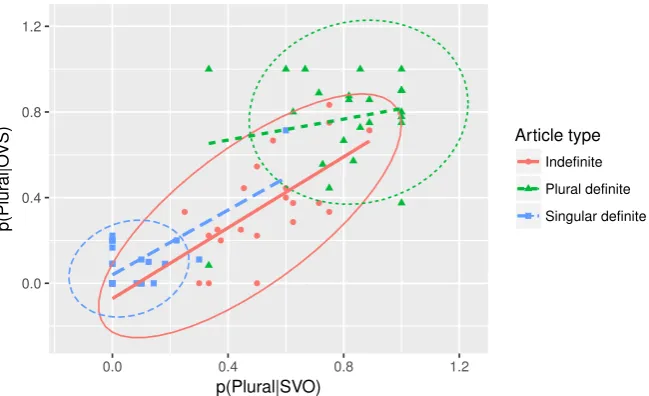
Figure 2: Correlation plot of the probability of plural interpretations given SVO order vs. OVS order, for indefinite, definite singular, and definite plural conditions. Data ellipses illustrate means and standard deviations for each condition in two dimensions (Friendly et al.,2013).
ing represented. Simply swapping object and sub-ject in simple declarative clauses is unacceptable in English, but much less so in verb-second, case-marking languages like German.
Rad´o and Bott (2018) investigate the role of quantifier distributivity relative to linear order us-ing a series of context-continuation judgement tasks in German. Part of their manipulation is main-clause SVO order vs OSV given Ger-man’s verb-second characteristic; in German main clauses, quantifier scope ambiguities are possible. However, they use visual aids to explicitly dis-ambiguate the intended interpretation of the sen-tence, so that the judgement task is about match-ing the appropriateness of the sentence to the im-age. Thus, world knowledge effects are factored out of their experiment.
In this work, we instead exploit the SVO/OVS flexibility of German main clauses to better char-acterise how linear order, formal semantic struc-ture, and world knowledge work together to produce interpretations. We hypothesize that Dwivedi’s manipulation yields her result for En-glish because EnEn-glish-speakers rarely, if ever, ex-pect to see linear order variation. The low ac-ceptability of an OVS order in declarative sen-tences in English means that English users have a much lower expectation of having to reverse the observed linear scope order in order to align their pragmatically-driven interpretation with the observed sentence. Correspondingly,
English-speakers only infrequently invoke “algorithmic” processing mechanisms. German-speakers find OVS order much more acceptable than English-speakers. This means that German-speakers are more likely to confront variation in word order, leading to mismatches between world knowledge and linear order. Since German-speakers expect to confront mismatches more often, syntactic and se-mantic structure, including word order, will have a more visible effect on number interpretation, providing more visible resistance to the influence of background knowledge. In order to test this, we make use of a web-based cloze task under the context-continuation paradigm, giving partic-ipants a free choice of interpretation.
3 Methods and Materials
We translated the English stimuli from Dwivedi
(2013) to German, making adjustments or replace-ments where the syntax or semantics did not work with normal German usage. For the German con-text sentences, we varied the word order from SVO to OVS order3 and we had three conditions for the object article: definite singular, indefinite, and definite plural, for six total conditions. The
3
b Std. Error z P r(>|z|)
Intercept -1.1176 0.3732 -2.994 0.00275 ** Linearity(SVO) 0.9260 0.2844 3.256 0.00113 **
[image:4.595.150.448.62.123.2]Signif. codes: 0 ‘***’ 0.001 ‘**’ 0.01 ‘*’ 0.05 ‘.’ 0.1 ‘ ’ 1
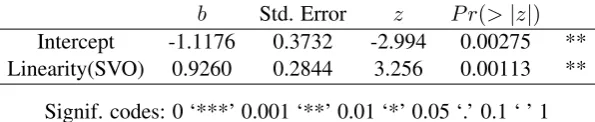
Table 1: Fitted mixed-effects model of word order on plural interpretation for objects with the indefinite article.
continuation sentences were supplied with a blank space for the subject and verb, with a final com-plement describing the targeted subject.
Examples (1)and (2) represent the stimuli we used. The italicized portions are the intended cloze fillers: participants are expected to fill in the subject and the verb, which would thereby reveal their intuitions about number.
The stimuli were randomized into six lists, and 24 fillers were created and added to each list. The stimuli were presented using Lingoturk4, a work-bench for developing and hosting web-based ex-periments (Pusse et al., 2016), one stimulus per screen, after two training exercises. A mix of par-ticipants were recruited, both native-speaker un-dergraduate students at a university in a German-speaking country and online via Prolific5, which permits selection by native language.
The collected data (filled blanks) were then coded by a native speaker for whether they repre-sented an unambiguously singular or plural judge-ment, were ambiguous (e.g., the participant substi-tuted a subject-verb combination that did not refer to the object of the context sentence), or were un-interpretable.
4 Results and Discussion
There were a total of 66 participants, of which 31 were students and 35 were Prolific participants. The student participants were collected first, upon which we discovered that two items had errors. We discarded the data for those items, corrected the errors, and ran the full set with the Prolific par-ticipants. This yielded 1546 responses, 1236 of which were unambiguous references to the object of the context sentence with interpretable num-ber6.
We expected from their semantic interpretations that singular and plural definite articles would pro-duce strong singular and plural interpretations
re-4
https://github.com/FlorianPusse/ Lingoturk
5
https://www.prolific.ac
6The data are available upon request to first author.
spectively, regardless of any underlying pragmatic bias of the item. We plotted the probability of plural interpretation per item given SVO order vs. OVS order (figure 2). It illustrated that singular and plural interpretations are, as expected, little affected by order when the determiner is definite: they tend to agree with the number of the deter-miner, and items in the plot cluster near zero prob-ability of plural interpretation for the singular def-inite condition and high probability of plural inter-pretation in the plural definite condition. With the indefinite article, however, we obtain nearly the full range of plural biases, with some items hav-ing low plural probability with either word order and some high.
We fitted a binomial logit regression model with mixed effects for the indefinite article condition under the hypothesis Plurality ∼ Linearity + (1|Item) + (1 +Linearity|Participant); that is, the plural response has a fixed effect of linearity with a random intercept per item (given variation in the overall semantic plural bias of the item) and a correlated random intercept and slope for linear-ity relative to participant, reflecting overall indi-vidual tendencies to give plural interpretations and individual effects of linear order. This was per-formed in R under thelme4package (Bates et al.,
2014). The fixed-effects model output is presented in table1. This model produces a significant ef-fect on plural interpretation in indefinite order sen-tences, with log-odds ratiob= 0.926in favour of a plural interpretation when the context sentence is in SVO order.
While the plurality of each item is highly pre-served in either order, OVS items are indeed less likely to be interpreted as plural, resulting in a slope of the fitted line for the indefinite condition in figure2that is visibly less than 1 and reflecting the outcome of the binomial logit regression.
Fronted objects (OVS) = fewer plural responses
TRUE FALSE
Plural responses highly correlated between
SVO and OVS
World-knowledge dominates
SVO/OVS correlation and significant OVS effect hold
mainly for indefinite
Syntactic/linear order effect
dominates TRUE
FALSE
TRUE FALSE
Syntax-mediated formal sem.-prag.
interaction
Syntax-pragmatics interaction
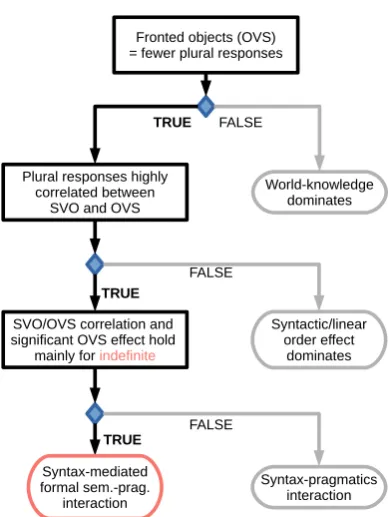
Figure 3: Possible outcomes of the experiment relative to hypothesis over dominant mechanisms of ambiguous quantifier scope processing.
challenge the centrality of background world and lexical knowledge, but instead, reflect a some-what stronger role for the “algorithmic” compo-nent of scope processing. Specifically, German speakers’ syntactic expectations admit OVS orders more naturally than English speakers, so that when an OVS order is encountered, it creates a “head-wind”, triggered by an initial indefinite article, that the powerful force of world knowledge must over-come. This mechanism is specifically invoked by the appearance of an indefinite object noun phrase in the initial position, while singular definite arti-cles totally override world knowledge regardless of order.
Dwivedi measured plural bias for her origi-nal 2013 stimuli using a forced choice singu-lar/plural interpretation task. We instead opted for a cloze task, which we believe has higher ecolog-ical validity—the task avoids forcing participants to choose among options when they may not feel that any of them are suitable or natural. A poten-tial disadvantage of free completions is that par-ticipants sometimes filled the subject/verb field in a manner that would not let us determine whether they intended a singular or a plural reference to the object phrase or with a nonsense response; these responses had to be discarded before analysis. In our case, this happened in 20% of the data, still
leaving us with a sufficient amount of interpretable data. The advantage of this approach in the in-vestigation of quantifier scope processing is that it does not explicitly call on participants to think about and judge plurality as a concept, but rather to come up with a phrase that makes sense to them in context.
5 Conclusions and Future Work
Figure3 provides a visual description of the hy-pothesis space we considered for this experiment. To the proposition that world knowledge is overly dominant, we found that our result pushes the needle back in the direction of competition-based hypotheses. The specific role of indefinite arti-cles triggering these ambiguities over word order points once again to a complex interaction at the interface between syntax, semantics, and pragmat-ics. We also demonstrated the experimental value of free(r) word order languages with case marking. Our cloze task illustrates an aspect of the role of syntactic variation in quantifier interpretation. In order to investigate its specific time course, the most immediate future work is to take our stimuli to other experimental modalities, including self-paced reading and eyetracking.
In the longer run, we plan to use corpus ( Say-eed,2017) and machine learning investigations to determine the empirical basis of plurality judge-ments in ambiguously scoped events.
Acknowledgements
This work was supported by funding from the Ger-man Research Foundation (DFG) for the Clus-ter of Excellence “Multimodal Computing and In-teraction” (EXC 284) and from the Swedish Re-search Council (VR) for the Center for Linguistic Theory and Studies in Probability (2014-39).
References
Douglas Bates, Martin M¨achler, Ben Bolker, and Steve Walker. 2014. Fitting linear mixed-effects models using lme4.arXiv preprint arXiv:1406.5823.
Veena D Dwivedi. 2013. Interpreting quantifier scope ambiguity: Evidence of heuristic first, algorithmic second processing. PloS one, 8(11):e81461.
[image:5.595.84.280.56.315.2]Janet Dean Fodor. 1982. The mental representation of quantifiers. InProcesses, beliefs, and questions, pages 129–164. Springer.
Michael Friendly, Georges Monette, and John Fox. 2013. Elliptical insights: Understanding statistical methods through elliptical geometry. Statist. Sci., 28(1):1–39.
James J. Gibson. 1977. The theory of affordances. In John Bransford Robert E Shaw, editor, Perceiving, acting, and knowing: toward an ecological psychol-ogy, pages pp.67–82. Hillsdale, N.J. : Lawrence Erl-baum Associates.
Georgette Ioup. 1975. Some universals for quantifier scope. Syntax and semantics, 4:37–58.
Alexander Koller, Stefan Thater, and Manfred Pinkal. 2010. Scope underspecification with tree descrip-tions: Theory and practice. In Matthew W. Crocker and Jrg Siekmann, editors,Resource-Adaptive Cog-nitive Processes, CogCog-nitive Technologies, pages 337–364. Springer.
Howard S Kurtzman and Maryellen C MacDonald. 1993. Resolution of quantifier scope ambiguities. Cognition, 48(3):243–279.
Florian Pusse, Asad Sayeed, and Vera Demberg. 2016. Lingoturk: managing crowdsourced tasks for psy-cholinguistics. InProceedings of the 2016 Confer-ence of the North American Chapter of the Asso-ciation for Computational Linguistics: Demonstra-tions, pages 57–61, San Diego, California. Associa-tion for ComputaAssocia-tional Linguistics.
Janina Rad´o and Oliver Bott. 2018. What do speaker judgments tell us about theories of quantifier scope in German? Glossa: a journal of general linguis-tics, 3(1).
EG Ruys and Yoad Winter. 2011. Quantifier scope in formal linguistics. In Handbook of philosophical logic, pages 159–225. Springer.