Capitalizing Machine Translation
Wei Wang and Kevin Knight and Daniel Marcu Language Weaver, Inc.
4640 Admiralty Way, Suite 1210 Marina del Rey, CA, 90292
{wwang, kknight, dmarcu}@languageweaver.com
Abstract
We present a probabilistic bilingual capi-talization model for capitalizing machine translation outputs using conditional ran-dom fields. Experiments carried out on three language pairs and a variety of ex-periment conditions show that our model significantly outperforms a strong mono-lingual capitalization model baseline, es-pecially when working with small datasets and/or European language pairs.
1 Introduction
Capitalization is the process of recovering case in-formation for texts in lowercase. It is also called truecasing (Lita et al., 2003). Usually, capitalization itself tries to improve the legibility of texts. It, how-ever, can affect the word choice or order when inter-acting with other models. In natural language pro-cessing, a good capitalization model has been shown useful for tasks like name entity recognition, auto-matic content extraction, speech recognition, mod-ern word processors, and machine translation (MT). Capitalization can be viewed as a sequence la-beling process. The input to this process is a sen-tence in lowercase. For each lowercased word in the input sentence, we have several available cap-italization tags: initial capital (IU), all uppercase (AU), all lowercase (AL), mixed case (MX), and all having no case (AN). The output of capital-ization is a capitalcapital-ization tag sequence. Associ-ating a tag in the output with the corresponding
lowercased word in the input results in a surface
form of the word. For example, we can tag the
input sentence “click ok to save your changes to /home/doc.” into “click IU ok AU to AL save AL your AL changes AL to AL /home/doc MX . AN”, getting the surface form “Click OK to save your changes to /home/DOC .”.
A capitalizer is a tagger that recovers the capi-talization tag for each input lowercased word, out-putting a well-capitalized sentence. Since each low-ercased word can have more than one tag, and as-sociating a tag with a lowercased word can result in more than one surface form (e.g., /home/doc MX can be either /home/DOC or /home/Doc), we need a capitalization model to solve the capitalization am-biguities. For example, Lita et al. (2003) use a tri-gram language model estimated from a corpus with case information; Chelba and Acero (2004) use a maximum entropy Markov model (MEMM) com-bining features involving words and their cases.
Capitalization models presented in most previ-ous approaches are monolingual because the models are estimated only from monolingual texts. How-ever, for capitalizing machine translation outputs, using only monolingual capitalization models is not enough. For example, if the sentence “click ok to save your changes to /home/doc .” in the above example is the translation of the French sentence “CLIQUEZ SUR OK POUR ENREGISTRER VOS MODIFI-CATIONS DANS /HOME/DOC.”, the correct capitaliza-tion result should probably be “CLICK OK TO SAVE YOUR CHANGES TO /HOME/DOC .”, where all words are in all upper-case. Without looking into the case
of the MT input, we can hardly get the correct capi-talization result.
Although monolingual capitalization models in previous work can apply to MT output, a bilingual model is more desirable. This is because MT out-puts usually strongly preserve case from the input, and because monolingual capitalization models do not always perform as well on badly translated text as on well-formed syntactic texts.
In this paper, we present a bilingual capitalization model for capitalizing machine translation outputs using conditional random fields (CRFs) (Lafferty et al., 2001). This model exploits case information from both the input sentence (source) and the out-put sentence (target) of the MT system. We define a series of feature functions to incorporate capitaliza-tion knowledge into the model.
Experimental results are shown in terms of BLEU scores of a phrase-based SMT system with the italization model incorporated, and in terms of cap-italization precision. Experiments are performed on both French and English targeted MT systems with large-scale training data. Our experimental re-sults show that the CRF-based bilingual capitaliza-tion model performs better than a strong baseline capitalizer that uses a trigram language model.
2 Related Work
A simple capitalizer is the1-gram tagger: the case of a word is always the most frequent one observed in training data, with the exception that the sentence-initial word is always capitalized. A1-gram capital-izer is usually used as a baseline for capitalization experiments (Lita et al., 2003; Kim and Woodland, 2004; Chelba and Acero, 2004).
Lita et al. (2003) view capitalization as a cal ambiguity resolution problem, where the lexi-cal choices for each lowercased word happen to be its different surface forms. For a lowercased sen-tencee, a trigram language model is used to find the best capitalization tag sequence T that maximizes p(T, e) = p(E), resulting in a case-sensitive sen-tence E. Besides local trigrams, sentence-level contexts like sentence-initial position are employed as well.
Chelba and Acero (2004) frame capitalization as a sequence labeling problem, where, for each
low-MT Decoder
Train Monolingual
Capitalization Model Monolingual Cap Model
Capitalization
Lower Case
Lower Case f
Lower Case
e Finput
Eoutput
Train Translation Model
Train Language Model
Translation Model
Languagel Model {F}
{E}
{f}
[image:2.612.315.546.57.184.2]{e}
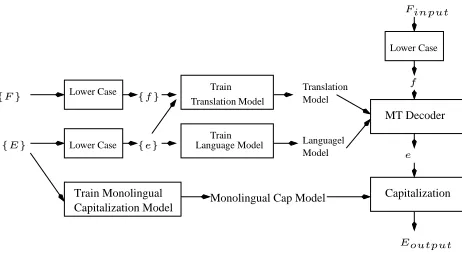
Figure 1: The monolingual capitalization scheme employed by most statistical MT systems.
ercased sentence e, they find the label sequence T that maximizes p(T|e). They use a maximum en-tropy Markov model (MEMM) to combine features of words, cases and context (i.e., tag transitions).
Gale et al. (1994) report good results on izing 100 words. Mikheev (1999) performs capital-ization using simple positional heuristics.
3 Monolingual Capitalization Scheme
Translation and capitalization are usually performed in two successive steps because removing case infor-mation from the training of translation models sub-stantially reduces both the source and target vocabu-lary sizes. Smaller vocabularies lead to a smaller translation model with fewer parameters to learn. For example, if we do not remove the case informa-tion, we will have to deal with at least nine prob-abilities for the English-French word pair (click, cliquez). This is because either “click” or “cliquez” can have at least three tags (IU, AL, AU), and thus three surface forms. A smaller translation model re-quires less training data, and can be estimated more accurately than otherwise from the same amount of training data. A smaller translation model also means less memory usage.
ap-HYDRAULIC HEADER TILT CYLINDER KIT Kit de v´erin d’inclinaison hydraulique de la plate-forme haut-parleur avant droit +
HAUT-PARLEUR AVANT DROIT + Seat Controls, Standard
COMMANDES DU SIGE, STANDARD loading a saved legend
[image:3.612.72.289.54.140.2]Chargement d’une l´egende sauvegarde
Table 1: Errors made by monolingual capitalization model. Each row contains a pair of MT input and MT output.
MT Decoder
Capitalization Bilingual
Cap Model Train Bilingual
Cap Model alignment Word/Phrase Aligner
f Lower Case
e Finput
Eoutput
{F}
[image:3.612.355.499.57.122.2]{E}
Figure 2:A bilingual capitalization scheme.
ply the capitalization model to recover the case of the decoding output.
The monolingual capitalization scheme makes
many errors as shown in Table 1. Each cell in
the table contains the MT-input and the MT-output. These errors are due to the capitalizer does not have access to the source sentence.
Regardless, estimating mixed-cased translation models, however, is a very interesting topic and worth future study.
4 Bilingual Capitalization Model
4.1 The Model
Our probabilistic bilingual capitalization model ex-ploits case information from both the input sentence to the MT system and the output sentence from the system (see Figure 2). An MT system translates a
capitalized sentenceF into a lowercased sentencee. A statistical MT system can also provide the align-mentA between the input F and the output e; for example, a statistical phrase-based MT system could provide the phrase boundaries inF and e, and also the alignment between the phrases.1
1
We shall explain our capitalization model within the phrase-based SMT framework, the model, however, could be
OK
Click OK Cliquez
E F
˜ Ei ˜ Fj
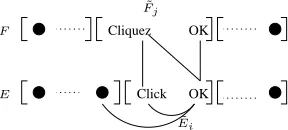
Figure 3: Alignment graph. Brackets mean phrase bound-aries.
The bilingual capitalization algorithm recovers the capitalized sentenceE frome, according to the input sentence F, and the alignment A. Formally, we look for the best capitalized sentence E∗ such that
E∗= arg maxE∈GEN(e)p(E|F, A) (1)
where GEN(e) is a function returning the set of
possible capitalized sentences consistent withe. No-tice thatedoes not appear inp(E|F, A)because we can uniquely obtainefromE.p(E|F, A)is the cap-italization model of concern in this paper.2
To further decompose the capitalization model p(E|F, A), we make some assumptions. As shown in Figure 3, input sentenceF, capitalized outputE, and their alignment can be viewed as a graph.
Ver-tices of the graph correspond to words in F and
E. An edge connecting a word in F and a word
in E corresponds to a word alignment. An edge
between two words inE represents the dependency between them captured by monolingualn-gram
lan-guage models. We also assume that both E and
F have phrase boundaries available (denoted by the square brackets), and thatAis the phrase alignment. In Figure 3,F˜j is thej-th phrase ofF,E˜iis thei-th phrase ofE, and they align to each other. We do not require a word alignment; instead we find it reason-able to think that a word inE˜ican be aligned to any
adapted to syntax-based machine translation, too. To this end, the translational correspondence is described within a transla-tion rule, i.e., (Galley et al., 2004) (or a synchronous produc-tion), rather than a translational phrase pair; and the training data will be derivation forests, instead of the phrase-aligned bilingual corpus.
2
[image:3.612.72.288.182.310.2]word in F˜j. A probabilistic model defined on this graph is a Conditional Random Field. Therefore, it is natural to formulate the bilingual capitalization model using CRFs:3
pλ(E|F, A) = 1
Z(F, A, λ)exp
I X
i=1
λifi(E, F, A) !
(2)
where
Z(F, A, λ) = X
E∈GEN(e)
exp
I X
i=1
λifi(E, F, A) !
(3)
fi(E, F, A), i = 1...I are the I features, and
λ= (λ1, ..., λI)is the feature weight vector. Based
on this capitalization model, the decoder in the cap-italizer looks for the bestE∗such that
E∗= arg maxE∈GEN(e,F) I
X
i=1
λifi(E, F, A) (4)
4.2 Parameter Estimation
Following Roark et al. (2004), Lafferty et al. (2001) and Chen and Rosenfeld (1999), we are looking for the set of feature weights λ maximizing the regu-larized log-likelihood LLR(λ) of the training data
{E(n), F(n), A(n), n= 1, ..., N}.
LLR(λ) = N X
n=1
logp“E(n)|F(n), A(n)”−||λ|| 2
2σ2 (5)
The second term at the right-hand side of For-mula 5 is a zero-mean Gaussian prior on the pa-rameters. σ is the variance of the Gaussian prior dictating the cost of feature weights moving away from the mean — a smaller value ofσkeeps feature
weights closer to the mean. σ can be determined
by linear search on development data.4 The use of the Gaussian prior term in the objective function has been found effective in avoiding overfitting, leading to consistently better results. The choice ofLLRas an objective function can be justified as maximum a-posteriori (MAP) training within a Bayesian ap-proach (Roark et al., 2004).
3We chose CRFs over other sequence labeling models (i.e. MEMM) because CRFs have no label bias and we do not need to compute the partition function during decoding.
4
In our experiment, we use an empirical valueσ= 0.5as in (Roark et al., 2004).
4.3 Feature Functions
We define features based on the alignment graph in Figure 3. Each feature function is defined on a word.
Monolingual language model feature. The
monolingual LM feature of word Ei is the
loga-rithm of the probability of the n-gram ending at Ei:
fLM(Ei, F, A) = logp(Ei|Ei−1, ..., Ei−n+1) (6)
p should be appropriately smoothed such that it
never returns zero.
Capitalized translation model feature.
Sup-pose E phrase “Click OK” is aligned to F
phrase “Cliquez OK”. The capitalized transla-tion model feature of “Click” is computed as
logp(Click|Cliquez) + logp(Click|OK). “Click” is assumed to be aligned to any word in theF phrase. The larger the probability that “Click” is translated from an F word, i.e., “Cliquez”, the more chances that “Click” preserves the case of “Cliquez”. For-mally, for word Ei, and an aligned phrase pair E˜l andF˜m, whereEi ∈ E˜l, the capitalized translation model feature ofEiis
fcap·t1(Ei, F, A) = log
|XF˜m|
k=1
p(Ei|F˜m,k) (7)
p(Ei|F˜m,k) is the capitalized translation table. It needs smoothing to avoid returning zero, and is esti-mated from a word-aligned bilingual corpus.
preserves case from that of “ok”. Formally, this fea-ture is defined as
fcap·tag·t1(Ei, F, A) =
log |f˜m| X
k=1
p(ei|f˜m,k)×p(τ(Ei)|τ( ˜Fm,k)) (8)
p(ei|f˜m,k)is the t-table over lowercased word pairs, which is the usual “t-table” in a SMT system. p(τ(Ei)|τ( ˜Fm,k))is the probability of a target cap-italization tag given a source capcap-italization tag and can be easily estimated from a word-aligned
bilin-gual corpus. This feature attempts to help when
fcap−t1 fails (i.e., the capitalized word pair is un-seen). Smoothing is also applied to bothp(ei|f˜m,k) and p(τ(Ei)|τ( ˜Fm,k)) to handle unseen words (or word pairs).
Upper-case translation feature. Word Ei is in all upper case if all words in the corresponding F phrase F˜m are in upper case. Although this fea-ture can also be capfea-tured by the capitalization tag translation feature in the case where an AU tag in the input sentence is most probably preserved in the output sentence, we still define it to emphasize its effect. This feature aims, for example, to translate “ABC XYZ” into “UUU VVV” even if all words are unseen.
Initial capitalization feature. AnE word is ini-tially capitalized if it is the first word that contains letters in theEsentence. For example, for sentence “• Please click the button” that starts with a bul-let, the initial capitalization feature value of word “please” is 1 because “•” does not contain a letter.
Punctuation feature template. AnEword is ini-tially capitalized if it follows a punctuation mark. Non-sentence-ending punctuation marks like com-mas will usually get negative weights.
As one can see, our features are “coarse-grained” (e.g., the language model feature). In contrast, Kim and Woodland (2004) and Roark et al. (2004) use “fine-grained” features. They treat each n-gram as a feature for, respectively, monolingual capitaliza-tion and language modeling. Feature weights tuned at a fine granularity may lead to better accuracy, but they require much more training data, and re-sult in much slower training speed, especially for
large-scale learning problems. Coarse-grained fea-tures enable us to efficiently get the feature values from a very large training corpus, and quickly tune the weights on small development sets. For exam-ple, we can train a bilingual capitalization model on a 70 million-word corpus in several hours with the coarse-grained features presented above, but in sev-eral days with fine-grainedn-gram count features.
4.4 The GEN Function
Function GEN generates the set of case-sensitive
candidates from a lowercased token. For
exam-ple GEN(mt) = {mt,mT,Mt,MT}. The follow-ing heuristics can be used to reduce the range of GEN. The returned set of GEN on a lower-cased to-kenwis the union of: (i){w, AU(w), IU(w)}, (ii)
{v|v is seen in training data and AL(v) = w},
and (iii){F˜m,k|AL( ˜Fm,k) = AL(w)}. The heuris-tic (iii) is designed to provide more candidates for w when it is translated from a very strange input wordF˜m,k in theF phraseF˜m that is aligned to the phrase thatwis in. This heuristic creates good capi-talization candidates for the translation of URLs, file names, and file paths.
5 Generating Phrase-Aligned Training Data
Training the bilingual capitalization model requires a bilingual corpus with phrase alignments, which are usually produced from a phrase aligner. In practice, the task of phrase alignment can be quite computa-tionally expensive as it requires to translate the en-tire training corpus; also a phrase aligner is not al-ways available. We therefore generate the training data using a na¨ıve phrase aligner (NPA) instead of resorting to a real one.
Entire Corpus (#W) Test-BLEU Languages Training Dev Test-Prec. (#sents)
E→F (IT) 62M 13K 15K 763
F→E (news) 144M 11K 22K 241
[image:6.612.72.307.56.113.2]C→E (news) 50M 8K 17K 919
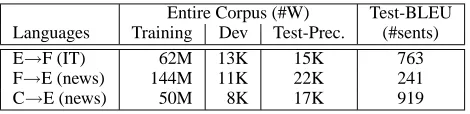
Table 2:Corpora used in experiments.
decoder on a small development set. The NPA has to retry if the current source phrase cannot find any consistent target phrase. Unaligned target words are attached to the left phrase. Heuristics are employed to prevent the NPA from not coming to a solution. Obviously, the NPA is a special case of the phrase extractor in (Och and Ney, 2004) in that it considers only one phrase alignment rather than all possible ones.
Unlike a real phrase aligner, the NPA need not wait for the training of the translation model to fin-ish, making it possible for parallelization of transla-tion model training and capitalizatransla-tion model train-ing. However, we believe that a real phrase aligner may make phrase alignment quality higher.
6 Experiments
6.1 Settings
We conducted capitalization experiments on three language pairs: English-to-French (E→F) with a bilingual corpus from the Information Technology (IT) domain; French-to-English (F→E) with a bilin-gual corpus from the general news domain; and Chinese-to-English (C→E) with a bilingual corpus from the general news domain as well. Each lan-guage pair comes with a training corpus, a develop-ment corpus and two test sets (see Table 2). Test-Precision is used to test the capitalization precision of the capitalizer on well-formed sentences drawn from genres similar to those used for training. Test-BLEU is used to assess the impact of our capitalizer on end-to-end translation performance; in this case, the capitalizer may operate on ungrammatical sen-tences. We chose to work with these three language pairs because we wanted to test our capitalization model on both English and French target MT sys-tems and in cases where the source language has no case information (such as in Chinese).
We estimated the feature functions, such as the log probabilities in the language model, from the
training set. Kneser-Ney smoothing (Kneser and
Ney, 1995) was applied to features fLM, fcap·t1, and fcap·tag·t1. We trained the feature weights of the CRF-based bilingual capitalization model using the development set. Since estimation of the feature weights requires the phrase alignment information, we efficiently applied the NPA on the development set.
We employed two LM-based capitalizers as base-lines for performance comparison: a unigram-based
capitalizer and a strong trigram-based one. The
unigram-based capitalizer is the usual baseline for capitalization experiments in previous work. The trigram-based baseline is similar to the one in (Lita et al., 2003) except that we used Kneser-Ney smoothing instead of a mixture.
A phrase-based SMT system (Marcu and Wong, 2002) was trained on the bitext. The capitalizer was incorporated into the MT system as a post-processing module — it capitalizes the lowercased MT output. The phrase boundaries and alignments needed by the capitalizer were automatically in-ferred as part of the decoding process.
6.2 BLEU and Precision
We measured the impact of our capitalization model in the context of an end-to-end MT system using BLEU (Papineni et al., 2001). In this context, the capitalizer operates on potentially ill-formed, MT-produced outputs.
To this end, we first integrated our bilingual capi-talizer into the phrase-based SMT system as a post-processing module. The decoder of the MT sys-tem was modified to provide the capitalizer with the case-preserved source sentence, the lowercased translation, and the phrase boundaries and their alignments. Based on this information, our bilin-gual capitalizer recovers the case information of the lowercased translation, outputting a capitalized tar-get sentence. The case-restored machine transla-tions were evaluated against the target test-BLEU set. For comparison, BLEU scores were also com-puted for an MT system that used the two LM-based baselines.
cor-rectly capitalized words produced by our capitalizer on well-formed, lowercased input
precision= #correctly capitalized words
#total words (9)
To obtain the capitalization precision, we im-plemented the capitalizer as a standalone program. The inputs to the capitalizer were triples of a case-preserved source sentence, a lowercased target sen-tence, and phrase alignments between them. The output was the case-restored version of the target sentence. In this evaluation scenario, the capitalizer output and the reference differ only in case infor-mation — word choices and word orders between them are the same. Testing was conducted on Test-Precision. We applied the NPA to the Test-Precision set to obtain the phrases and their alignments be-cause they were needed to trigger the features in testing. We used a Test-Precision set that was dif-ferent from the Test-BLEU set because word align-ments were by-products only of training of transla-tion models on the MT training data and we could not put the Test-BLEU set into the MT training data. Rather than implementing a standalone word aligner, we randomly divided the MT training data into three non-overlapping sets: Test-Precision set, CRF capitalizer training set and dev set.
6.3 Results
The performance comparisons between our CRF-based capitalizer and the two LM-CRF-based baselines are shown in Table 3 and Table 4. Table 3 shows the BLEU scores, and Table 4 shows the precision. The BLEU upper bounds indicate the ceilings that a perfect capitalizer can reach, and are computed by ignoring the case information in both the capitalizer outputs and the reference. Obviously, the precision upper bounds for all language pairs are100%.
The precision and end-to-end BLEU based com-parisons show that, for European language pairs, the CRF-based bilingual capitalization model outper-forms significantly the strong LM-based baseline. We got more than one BLEU point improvement on the MT translation between English and French, a 34% relative reduction in capitalization error rate for the French-to-English language pair, and a 42% rel-ative error rate reduction for the English-to-French
language pair. These results show that source lan-guage information provides significant help for cap-italizing machine translation outputs. The results also show that when the source language does not have case, as in Chinese, the bilingual model equals a monolingual one.
The BLEU difference between the CRF-based capitalizer and the trigram one were larger than the precision difference. This indicates that the CRF-based capitalizer performs much better on non-grammatical texts that are generated from an MT system due to the bilingual feature of the CRF capi-talizer.
6.4 Effect of Training Corpus Size
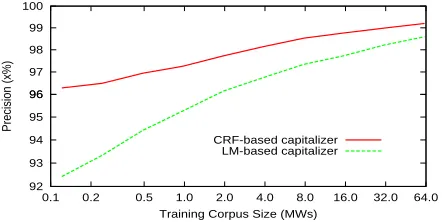
The experiments above were carried out on large data sets. We also conducted experiments to exam-ine the effect of the training corpus size on capital-ization precision. Figure 4 shows the effects. The experiment was performed on the E→F corpus. The bilingual capitalizer performed significantly better when the training corpus size was small (e.g., un-der 8 million words). This is common in many do-mains: when the training corpus size increases, the difference between the two capitalizers decreases.
7 Conclusions
In this paper, we have studied how to exploit bilin-gual information to improve capitalization perfor-mance on machine translation output, and evaluated the improvement over traditional methods that use only monolingual language models.
We first presented a probabilistic bilingual cap-italization model for capitalizing machine transla-tion outputs using conditransla-tional random fields. This model exploits bilingual capitalization knowledge as well as monolingual information. We defined a se-ries of feature functions to incorporate capitalization knowledge into the model.
We then evaluated our CRF-based bilingual capi-talization model both on well-formed texts in terms of capitalization precision, and on possibly ungram-matical end-to-end machine translation outputs in
terms of BLEU scores. Experiments were
cap-BLEU Scores Translation Unigram
Capitalizer
Trigram Capitalizer
CRF-based Capitalizer
Upper Bound
F→E 24.96 26.73 27.92 28.85
E→F 32.63 34.66 36.10 36.17
C→E 23.81 25.92 25.89
-Table 3:Impact of CRF-based capitalizer on end-to-end translation performance compared with two LM-based baselines.
Capitalization Precision (%) Translation Unigram
capitalizer
Trigram capitalizer
CRF-based capitalizer
F→E 94.03 98.79 99.20
E→F 91.52 98.47 99.11
C→E 90.77 96.40 96.76
Table 4:Impact of CRF-based capitalizer on capitalization precision compared with two LM-based baselines.
100 99 98 97 96 96 95 94 93 92
64.0 32.0 16.0 8.0 4.0 2.0 1.0 0.5 0.2 0.1
Precision (x%)
Training Corpus Size (MWs) CRF-based capitalizer
[image:8.612.160.456.57.122.2]LM-based capitalizer
Figure 4:Capitalization precision with respect to size of train-ing corpus. LM-based capitalizer refers to the trigram-based one. Results were on E→F corpus.
italization model performs significantly better than a strong baseline, monolingual capitalizer that uses a trigram language model.
In all experiments carried out at Language Weaver with customer (or domain specific) data, MT sys-tems trained on lowercased data coupled with the CRF bilingual capitalizer described in this paper consistently outperformed both MT systems trained on lowercased data coupled with a strong monolin-gual capitalizer and MT systems trained on mixed-cased data.
References
Ciprian Chelba and Alex Acero. 2004. Adaptation of maxi-mum entroy capitalizer: Little data can help a lot. In
Pro-ceedings of the 2004 Conference on Empirical Methods in Natural Language Processing (EMNLP), Barcelona, Spain.
Stanley Chen and Ronald Rosenfeld. 1999. A Gaussian prior for smoothing Maximum Entropy models. Technical Report CMUCS-99-108, Carnegie Mellon University.
William A. Gale, Kenneth W. Church, and David Yarowsky. 1994. Discrimination decisions for 100,000-dimensional
spaces. In Current issues in computational linguistics. M. Galley, M. Hopkins, K. Knight, and D. Marcu. 2004.
What’s in a Translation Rule? In Proceedings of the Human
Language Technology Conference and the North American Association for Computational Linguistics (HLT-NAACL),
Boston, Massachusetts.
Ji-Hwan Kim and Philip C. Woodland. 2004. Automatic capi-talization generation for speech input. Computer Speech and
Language, 18(1):67–90, January.
Reinhard Kneser and Hermann Ney. 1995. Improved backing-off for m-gram language modeling. In Proceedings of the
In-ternational Conference on Acoustics, Speech, and Signal Processing (ICASSP) 1995, pages 181–184, Detroit,
Michi-gan. IEEE.
John Lafferty, Andrew McCallum, and Fernando Pereira. 2001. Conditional random fields: Probabilistic models for segmen-tation and labeling sequence data.
Lucian Vlad Lita, Abe Ittycheriah, Salim Roukos, and Nanda Kambhatla. 2003. tRuEcasIng. In Proceedings of the 40th
Annual Meeting of the Association for Computational Lin-guistics (ACL), Sapporo, Japan, July.
Daniel Marcu and William Wong. 2002. A phrase-based, joint probability model for statistical machine translation. In
Pro-ceedings of the 2002 Conference on Empirical Methods in Natural Language Processing (EMNLP), Philadelphia, PA.
A. Mikheev. 1999. A knowledge-free method fro capitalized word disambiguation. In Proceedings of the 37th Annual
Meeting of the Association for Computational Linguistics (ACL), College Park, Maryland, June.
Franz Och and Hermann Ney. 2004. The alignment template approach to statistical machine translation. Computational
Linguistics, 30(4).
Kishore Papineni, Salim Roukos, Todd Ward, and Wei-Jing Zhu. 2001. BLEU: A method for automatic evaluation of Machine Translation. Technical Report RC22176, IBM, September.
Brian Roark, Murat Saraclar, Michael Collins, and Mark John-son. 2004. Discriminative language modeling with condi-tional random field and the perceptron algorithm. In
[image:8.612.75.296.265.376.2]