UHH Submission to the WMT17 Quality Estimation Shared Task
Melania Duma and Wolfgang Menzel
University of Hamburg Natural Language Systems Division
{duma, menzel}@informatik.uni-hamburg.de
Abstract
The field of Quality Estimation (QE) has the goal to provide automatic methods for the evaluation of Machine Translation (MT), that do not require reference transla-tions in their computation. We present our submission to the sentence level WMT17 Quality Estimation Shared Task. It com-bines tree and sequence kernels for pre-dicting the post-editing effort of the tar-get sentence. The kernels exploit both the source and target sentences, but also a back-translation of the candidate transla-tion. The evaluation results show that the kernel approach combined with the base-line features brings substantial improve-ment over the baseline system.
1 Introduction
The evaluation of Machine Translation (MT) out-put is a sub-field of MT research that has experi-enced a great amount of interest in the past years. The process of MT evaluation involves three fac-tors: an input segment in a source language, the candidate translation (also known as target sen-tence) which represents the output of a MT sys-tem when translating from the source language to the target language and a reference translation in the target language. The assessment of MT qual-ity can be divided into two categories depending on whether it requires the presence of a reference translation or not. The reference-based evaluation scores the candidate translation by comparing it to the reference translation.
On the other hand, the reference-free evalua-tion, also known as quality estimation (QE), pre-dicts the quality of a candidate translation based solely on the information contained in the source and target sentences. QE can be performed at
different levels of granularity: word, sentence or phrase and it involves classifying, ranking or pre-dicting scores for the candidate translations. A sentence-level QE system is conventionally con-structed based on a set of features encoding the in-formation contained in the source and target sen-tences, which are used for learning a prediction model. The features employed for this task can be of different types, like surface features, language model features or linguistic features. The positive influence of syntactic features on the performance of QE systems has been extensively studied, in-cluding inRubino et al.(2012),Avramidis(2012) or more recently in Kozlova et al.(2016). How-ever, the process of identifying the best perform-ing set of features, is a task that is both expensive and requires a considerable amount of engineering effort (Hardmeier,2011). On the other hand, ker-nel methods do not require the explicit definition of the features, and rely on the scalar product be-tween vectors for capturing the similarity shared by the sentence pairs.
In this paper we present our submission to the WMT17 Shared Task on sentence level Quality Estimation, that makes use of sequence and tree kernels in predicting a continuous score represent-ing the post-editrepresent-ing effort for the target sentence. The novel contribution of our system is the combi-nation of different types of kernels. Moreover, we use a back-translation of the target sentence into the source language as an additional data repre-sentation to be exploited by the kernels, together with the usual source and target sentences repre-sentations. Furthermore, we construct additional explicit features by applying the kernel functions directly on the pair of source and back-translation sentences, a method that to our knowledge has not been used before. The evaluation performed demonstrates that the combination of the kernel approach and the baseline together with the newly
This paper is organized as follows. The related work is presented in Section 2, while the methods employed and the implementation are described in Section 3. The experimental setup and the evalua-tion results are introduced in Secevalua-tion 4, while the last section summarizes our findings and presents future work ideas.
2 Related work
Kernel functions have been used in a variety of NLP tasks, including Textual Similarity (e.g. (Severyn et al., 2013)), Information Extraction (e.g. (Culotta and Sorensen, 2004)), Semantic Role Labeling (e.g. (Moschitti et al., 2008)) or Textual Entailment (e.g. (Wang and Neumann, 2007)).
An approach for QE based on syntactic tree ker-nels is introduced in (Hardmeier, 2011), where a binary SVM classifier is trained to make pre-dictions about the quality of the MT output. The datasets are syntactically analyzed using con-stituency and dependency parsers. The Subset Tree Kernel (Collins and Duffy, 2001) is used for the constituency trees, while the Partial Tree Kernel (Moschitti,2006a) (Moschitti,2006b) was judged as being more appropriate for the depen-dency trees. The evaluation shows that the combi-nation between baseline features and the tree ker-nels achieves the best performance. These findings are further validated in Hardmeier et al. (2012) where a QE system is proposed based on a set of 82 explicit features combined with syntactic tree kernels.
Syntactic tree kernels for QE are also explored inKaljahi et al.(2014), where a set of hand crafted constituency and dependency based features to-gether with subset tree kernels applied on the con-stituency and dependency tree representations are used. The evaluation results demonstrate that the source constituency trees perform better than the target sentence constituency trees. This work is further extended in Kaljahi (2015), where multi-ple QE systems based on syntactic and semantic features are introduced.
The work presented in this paper differs from previous kernel approaches for QE by the inno-vative use of sequence kernels in addition to the previously utilized tree kernels. We extend on the previous kernel QE research by also making
translations features have been previously utilized for QE (e.g.(Bechara et al.,2016)), their potential as an additional structural input representation for kernels has never been studied before. Further-more, we exploit the potential of the scores of the kernel functions applied on the source and back-translation sentences as additional hard-coded fea-tures.
3 Methods and implementation
In this section details about the methodology and the implementation will be presented. First, tree and sequence kernels will be introduced, followed by the description of the implementation of these kernels in the context of QE. Finally, the machine learning platform used for implementing the QE systems will be presented.
3.1 Kernels for Quality Estimation
A kernel function computes the similarity between two structural representations without requiring the identification of the entire feature space (Mos-chitti, 2006a). To achieve this, the scalar prod-uct between vectors of substrprod-ucture counts is com-puted in a vector space with a possibly infinite number of dimensions (Nguyen et al.,2009). Dif-ferent kernel functions, depending on the type of structural input data they require, have been pro-posed including sequence, tree or graphs kernels. Tree kernels make use of tree representations for their computation, while sequence kernels calcu-late the similarity between the input sequence rep-resentations based on the number of common sub-sequences they share.
In the case of tree kernels, a series of algo-rithms have been proposed, e.g. in Collins and Duffy(2001) or Moschitti(2006a), based on the type of tree fragments (e.g. subsets, subtrees or partial trees) they take into consideration in their computation. On the other hand, sequence kernels have also been extensively studied inBunescu and Mooney(2005) orNguyen et al.(2009).
pro-baseline features baseline+new features exact not exact exact not exact
System Pearson↑ MAE↓ Pearson↑ MAE↓ Pearson↑ MAE↓ Pearson↑ MAE↓
[image:3.595.76.527.214.334.2]SK src 0.408 0.145 0.416 0.143 0.413 0.144 0.422 0.143 SK src+mt 0.481 0.139 0.477 0.138 0.484 0.139 0.480 0.136 SK src+mt+mtbk 0.491 0.138 0.496 0.137 0.493 0.138 0.497 0.137 PTK src 0.449 0.137 0.452 0.138 0.459 0.137 0.463 0.137 PTK src+mt 0.495 0.133 0.499 0.133 0.50 0.133 0.505 0.132 PTK src+mt+mtbk 0.503 0.133 0.505 0.133 0.506 0.133 0.509 0.133 (PTK src+mt) + (SK src+mt) 0.488 0.137 0.487 0.136 0.490 0.137 0.488 0.136 (PTK src+mt+mtbk) + (SK src+mt+mtbk) 0.499 0.136 0.503 0.135 0.50 0.136 0.504 0.135 Baseline WMT 0.169 0.146
Table 1: Evaluation results for the DE-EN dev set.
baseline features baseline+new features exact not exact exact not exact
System Pearson↑ MAE↓ Pearson↑ MAE↓ Pearson↑ MAE↓ Pearson↑ MAE↓
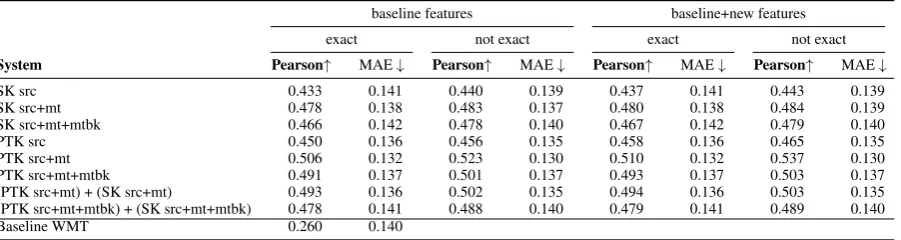
SK src 0.433 0.141 0.440 0.139 0.437 0.141 0.443 0.139 SK src+mt 0.478 0.138 0.483 0.137 0.480 0.138 0.484 0.139 SK src+mt+mtbk 0.466 0.142 0.478 0.140 0.467 0.142 0.479 0.140 PTK src 0.450 0.136 0.456 0.135 0.458 0.136 0.465 0.135 PTK src+mt 0.506 0.132 0.523 0.130 0.510 0.132 0.537 0.130 PTK src+mt+mtbk 0.491 0.137 0.501 0.137 0.493 0.137 0.503 0.137 (PTK src+mt) + (SK src+mt) 0.493 0.136 0.502 0.135 0.494 0.136 0.503 0.135 (PTK src+mt+mtbk) + (SK src+mt+mtbk) 0.478 0.141 0.488 0.140 0.479 0.141 0.489 0.140 Baseline WMT 0.260 0.140
Table 2: Evaluation results for the DE-EN test set.
gramming approach to determine the number of common patterns between the two input sentences. In our experiments, the patterns taken into account were composed of the lexical items.
In order to use the tree kernel functions, the source and the target sentences were parsed us-ing the Bohnet graph-based dependency parser (Bohnet,2010), which was chosen because of its high accuracy. The data was first preprocessed by performing lemmatization and pos-tagging. Pub-licly available1pre-trained models were used for analyzing the source, target and back-translation sentences.
For learning using the Partial Tree Kernel, a transformation of the dependency parse tree is required, as introduced in Croce et al. (2011). We followed the lexical-centered-tree approach, where the grammatical relation and the pos-tag are encoded as the rightmost children of a dependency tree node. In the case of sequence kernels, the only preprocessing step applied was the tokeniza-tion of the input sentences. In order to investigate if prior lemmatization of the input sentences influ-ences the results, we created two variants for each structural representation: an exact one containing the actual lexical items and a simplified non-exact
1 https://code.google.com/archive/p/mate-tools/downloads
one consisting of their corresponding lemmas. Furthermore, we incorporated a back-translation of the target sentence as an additional structural input representation for both the tree kernels and the sequence kernels. The back-translation was obtained using the free online Google Machine Translation system 2. We also exploited the full capability of the kernel functions by utilizing their explicit scores when applied on the source and back-translation sentences. We computed the scores for both the non-exact representations, and the exact ones. The scores were normalized using the formula from Croce et al.(2011)
score= p K(T1, T2)
K(T1, T1)? K(T2, T2)
withT1andT2denoting the structural represen-tations andKthe type of kernel function applied.
3.2 KeLP (Kernel-based Learning Platform)
In our implementation, we applied the Partial Tree Kernel3 and the Sequence Kernel4 together with the epsilon-regression SVM implementations made available in the KeLP package (Filice et al., 2015b) (Filice et al.,2015a). KeLP (Kernel-based
2https://translate.google.com 3based on (Moschitti,2006a)
System Pearson↑ MAE↓ Pearson↑ MAE↓ Pearson↑ MAE↓ Pearson↑ MAE↓
SK src 0.446 0.137 0.434 0.140 0.450 0.137 0.436 0.140 SK src+mt 0.496 0.133 0.491 0.134 0.499 0.133 0.493 0.134 SK src+mt+mtbk 0.508 0.131 0.497 0.134 0.499 0.133 0.499 0.137 PTK src 0.467 0.134 0.469 0.134 0.476 0.134 0.477 0.133 PTK src+mt 0.516 0.130 0.524 0.129 0.480 0.134 0.530 0.129 PTK src+mt+mtbk 0.520 0.130 0.523 0.130 0.524 0.130 0.526 0.130 (PTK src+mt) + (SK src+mt) 0.508 0.131 0.516 0.132 0.510 0.131 0.518 0.132 (PTK src+mt+mtbk) + (SK src+mt+mtbk) 0.515 0.131 0.515 0.132 0.516 0.131 0.516 0.132 Baseline WMT 0.359 0.140
Table 3: Evaluation results for the EN-DE dev set. The highlighted numbers correspond to the systems submitted to the shared task.
Learning Platform) is a Java Machine Learning library that provides the venue for implementing kernel based machine learning algorithms together with kernel functions. KeLP provides built-in sup-port for multiple vectorial or structured data rep-resentations, which can be leveraged at the same time by combining different kernels into a single model. The package has a series of advantages, among them platform-independence, flexibility of use and its modularity that makes it easily exten-sible. The training of the QE prediction models was performed using the Support Vector Machine epsilon-Regression implementation with default parameters from the KeLP package. For the base-line systems a radial basis function (rbf) kernel was chosen, while for the other implemented QE systems the linear combination between the base-line features rbf kernel and the additional struc-tural kernels was used.
4 Evaluation and results
4.1 Experimental setup
The evaluation was performed using the datasets released for the QE sentence-level shared task by the Second Conference On Machine Translation (WMT17)5. The data consists of tuples, contain-ing the source segment, the target sentence and a manually post-edited version of the target sen-tence, together with their associated post-editing score.
The WMT17 dataset is composed of both English-German and German-English tuples. The English-German dataset, pertaining to the IT do-main, consists of 23000 tuples for training, with additional 1000 instances for development. Two sets, comprised of 2000 units each, were made
5 http://www.statmt.org/wmt17/quality-estimation-task.html
available for testing. On the other hand, the German-English dataset provides 25000 tuples for training, 1000 units for development and a test set consisting of 2000 instances, with the gen-eral domain categorized as Pharmaceutical. The QE baseline systems used for evaluation are based on the sets of 17 baseline features made avail-able by the QE sentence-level shared task. They consist of surface features (e.g the number of to-kens/punctuation marks in the source sentence), language model features (e.g LM probability of the source/target sentences), but also n-gram based features (e.g percentage of unigrams in quartile 4 of frequency (higher frequency words) in a corpus of the source language).
4.2 Results
The systems were evaluated based on their pre-dicted scores using Pearson’s correlation coeffi-cient and the Mean Average Error (MAE), with the former being chosen as the primary method of evaluation for the WMT17 sentence-level QE task. We experimented with different model com-binations and the results of the evaluation are pre-sented in the tables that follow, where we have highlighted our submissions to the sentence level shared task. To better distinguish between models, the following QE system notation scheme was uti-lized: [Kernel[level]], whereKernelidentifies the type of kernel used: PTK or SK andlevel repre-sents the input type of sentence the kernel was ap-plied to: source (marked withsrc), target (marked withmt) and back-translated target (marked with
baseline features baseline+new features exact not exact exact not exact
System Pearson↑ MAE↓ Pearson↑ MAE↓ Pearson↑ MAE↓ Pearson↑ MAE↓
[image:5.595.76.527.214.333.2]SK src 0.448 0.131 0.443 0.132 0.456 0.131 0.451 0.132 SK src+mt 0.506 0.126 0.490 0.127 0.510 0.125 0.494 0.126 SK src+mt+mtbk 0.510 0.125 0.498 0.126 0.513 0.125 0.500 0.126 PTK src 0.461 0.129 0.439 0.130 0.474 0.128 0.452 0.129 PTK src+mt 0.508 0.124 0.500 0.124 0.515 0.124 0.508 0.123 PTK src+mt+mtbk 0.511 0.124 0.508 0.124 0.516 0.123 0.514 0.124 (PTK src+mt) + (SK src+mt) 0.517 0.125 0.508 0.125 0.520 0.126 0.511 0.125 (PTK src+mt+mtbk) + (SK src+mt+mtbk) 0.522 0.124 0.515 0.124 0.524 0.124 0.517 0.124 Baseline WMT 0.345 0.136
Table 4: Evaluation results for the EN-DE 2016 test set
baseline features baseline+new features exact not exact exact not exact
System Pearson↑ MAE↓ Pearson↑ MAE↓ Pearson↑ MAE↓ Pearson↑ MAE↓
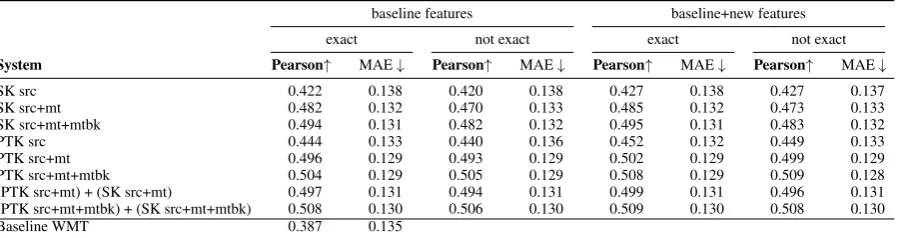
SK src 0.422 0.138 0.420 0.138 0.427 0.138 0.427 0.137 SK src+mt 0.482 0.132 0.470 0.133 0.485 0.132 0.473 0.133 SK src+mt+mtbk 0.494 0.131 0.482 0.132 0.495 0.131 0.483 0.132 PTK src 0.444 0.133 0.440 0.136 0.452 0.132 0.449 0.133 PTK src+mt 0.496 0.129 0.493 0.129 0.502 0.129 0.499 0.129 PTK src+mt+mtbk 0.504 0.129 0.505 0.129 0.508 0.129 0.509 0.128 (PTK src+mt) + (SK src+mt) 0.497 0.131 0.494 0.131 0.499 0.131 0.496 0.131 (PTK src+mt+mtbk) + (SK src+mt+mtbk) 0.508 0.130 0.506 0.130 0.509 0.130 0.508 0.130 Baseline WMT 0.387 0.135
Table 5: Evaluation results for the EN-DE 2017 test set.
features systems. The second criterion is
repre-sented by the presence of the lemmatization in the pre-processing pipeline of the input sentences, which partitions the systems intoexactandnot ex-actones.
A series of preliminary experiments was con-ducted which indicated that strictly structural ker-nel based methods could not capture all the rele-vant features for constructing a high performing QE system. Therefore, a combination between the baseline rbf kernel with additional structural kernels was implemented for the reported QE sys-tems.
We can notice that all the systems, correspond-ing to both language pairs outperformed the base-line systems in terms of Pearson correlation. Of particular interest are the systems making use of the new kernel features, which succeeded in sur-passing the corresponding systems that only used the baseline features.
The results also show that the addition of the back-translation as additional input data, proved on average beneficial for improving the correla-tion scores over systems that make use of only the source and target sentences as input data for the kernel functions.
In addition, we can observe that the sequence kernels based systems are highly performant in
terms of Pearson’s coefficient, albeit slightly worse on average than the tree kernels based im-plementations. This is a very important aspect, as the integration of sequence kernels into QE sys-tems does not require additional external tools and therefore makes them well suited for low-resource language pairs, that might lack high-quality syn-tactic tools like parsers or taggers. Moreover, by employing a sequence kernel, the parsing of MT output is effectively bypassed. This constitutes an advantage as the parsing of target sentences often represents a challenging task due to the ungram-maticality of the MT generated output.
5 Conclusions and future work
using constituency trees besides dependency trees for the computation of the tree kernels. We also plan to investigate if the choice of the MT system for the back-translation, affects the evaluation re-sults. Lastly, more combination schemes between the tree and sequence kernels will be explored to-gether with additional datasets and language pairs.
References
Eleftherios Avramidis. 2012. Comparative Quality Es-timation: Automatic sentence-level ranking of mul-tiple Machine Translation outputs. Proceedings of COLING 2012: Technical Paperspages 115–132. Hanna Bechara, Carla Parra Escartin, Constantin
Orasan, and Lucia Specia. 2016. Semantic Textual Similarity in Quality Estimation. Baltic J. Modern Computingpages 256–268.
Bernd Bohnet. 2010. Top accuracy and fast depen-dency parsing is not a contradiction. The 23rd Inter-national Conference on Computational Linguistics (COLING 2010).
Razvan Bunescu and Raymond Mooney. 2005. Sub-sequence kernels for Relation Extraction. Advances in Neural Information Processing Systems, Vol. 18: Proceedings of the 2005 Conference (NIPS). Michael Collins and Nigel Duffy. 2001. Convolution
kernels for natural language. Proceedings of NIPS 2001pages 625–632.
Danilo Croce, Alessandro Moschitti, and Roberto Basili. 2011. Structured lexical similarity via convo-lution kernels on dependency trees. Proceedings of the 2011 Conference on Empirical Methods in Nat-ural Language Processingpages 1034–1046. Aron Culotta and Jeffrey Sorensen. 2004. Dependency
tree kernels for Relation Extraction. Proceedings of the 42nd Annual Meeting on Association for Com-putational Linguistics.
Simone Filice, Giuseppe Castellucci, Roberto Basili, Giovanni Da San Martino, and Alessandro Mos-chitti. 2015a. KeLP: a Kernel-based Learning Plat-form in Java. The workshop on Machine Learning Open Source Software (MLOSS): Open Ecosystems .
Simone Filice, Giuseppe Castellucci, Danilo Croce, and Roberto Basili. 2015b. KeLP: a kernel-based learning platform for Natural Language Processing. Proceedings of ACL-IJCNLP 2015 System Demon-strationspages 19–24.
Christian Hardmeier. 2011. Improving Machine Trans-lation quality prediction with syntactic tree kernels. Proceedings of the 15th Conference of the European
Christian Hardmeier, Joakim Nivre, and Jorg Tiede-mann. 2012. Tree kernels for Machine Translation Quality Estimation. Proceedings of the 7th Work-shop on Statistical Machine Translationpages 109– 113.
Rasoul Kaljahi. 2015. The role of syntax and seman-tics in Machine Translation and Quality Estimation of machine-translated user-generated content. PhD Thesis.
Rasoul Kaljahi, Jennifer Foster, Raphael Rubino, and Johann Roturier. 2014. Quality Estimation of English-French Machine Translation: A detailed study of the role of syntax. Proceedings of COLING 2014, the 25th International Conference on Compu-tational Linguistics: Technical Paperspages 2052– 2063.
Anna Kozlova, Mariya Shmatova, and Anton Frolov. 2016. YSDA participation in the WMT16 Qual-ity Estimation shared task. Proceedings of the First Conference on Machine Translation, Volume 2: Shared Task Paperspages 793–799.
Alessandro Moschitti. 2006a. Efficient convolution kernels for dependency and constituent syntactic trees. Proceedings of the 17th European Conference on Machine Learning.
Alessandro Moschitti. 2006b. Making tree kernels practical for natural language learning.Proceedings of the Eleventh International Conference of the Eu-ropean Association for Computational Linguistics. Alessandro Moschitti, Daniele Pighin, and Roberto
Basili. 2008. Tree kernels for Semantic Role La-beling. Computational Linguistics34(2):193–224. Truc-Vien T. Nguyen, Alessandro Moschitti, and
Giuseppe Riccardi. 2009. Convolution kernels on constituent, dependency and sequential structures for Relation Extraction. Proceedings of the 2009 Conference on Empirical Methods in Natural Lan-guage Processingpages 1378–1387.
Raphael Rubino, Jennifer Foster, Joachim Wagne, Jo-hann Roturier, Rasul Samad Zadeh Kaljahi, and Fred Hollowood. 2012. DCU-Symantec submission for the WMT 2012 Quality Estimation task. Proceed-ings of the Seventh Workshop on Statistical Machine Translationpages 138–144.
Aliaksei Severyn, Massimo Nicosia, and Alessandro Moschitti. 2013. iKernels-Core: Tree kernel learn-ing for Textual Similarity. Second Joint Conference on Lexical and Computational Semantics (*SEM), Volume 1: Proceedings of the Main Conference and the Shared Taskpages 53–58.