Ontological Semantics for Distributing Contextual Knowledge
in Highly Distributed Autonomic Systems
John Keeney, David Lewis, Declan O’Sullivan
Centre for Telecommunications Value-chain Research and Knowledge and Data Engineering Group School of Computer Science and Statistics,
Trinity College Dublin, Dublin, Ireland.
{John.Keeney | Dave.Lewis | Declan.OSullivan }@cs.tcd.ie
Corresponding Author: Dr. John Keeney
School of Computer Science and Statistics Trinity College Dublin
College Green Dublin 2, Ireland
Email: [email protected]
ABSTRACT
Much recent research has focused on applying Autonomic Computing principles to achieve constrained
self-management in adaptive systems, through self-monitoring and analysis, strategy planning, and self adjustment.
However, in a highly distributed system, just monitoring current operation and context is a complex and largely
unsolved problem domain. This difficulty is particularly evident in the areas of network management, pervasive
computing, and autonomic communications. This paper presents a model for the filtered dissemination of
semantically enriched knowledge over a large loosely coupled network of distributed heterogeneous autonomic
agents, removing the need to bind explicitly to all of the potential sources of that knowledge. This paper presents an
implementation of such a knowledge delivery service, which enables the efficient routing of distributed
heterogeneous knowledge to, and only to, nodes that have expressed an interest in that knowledge. This gathered
knowledge can then be used as the operational or context information needed to analyze to the system’s behavior as
part of an autonomic control loop. As a case study this paper focuses on contextual knowledge distribution for
autonomic network management. A comparative evaluation of the performance of the knowledge delivery service is
also provided.
KEYWORDS
Highly distributed autonomic systems, semantically enriched knowledge distribution, content
based networking, semantic interoperability, knowledge delivery service.
RUNNING HEADER
Distributing Knowledge in Distributed Autonomic Systems
1.INTRODUCTION
Autonomic systems use knowledge of their operational state and operational context to
self-manage, i.e. to self-configure, self-heal, self-optimize and self-protect, by monitoring state and
context, planning and adapting. Though the need to self-manage was initially recognized as a
increasingly complex networked and distributed systems are also seen as needing to
self-manage. Applying autonomic approaches to networks, pervasive computing and other highly
distributed systems represents particular challenges in gathering operational knowledge from
across the system. Here operational network knowledge refers to operational state information
about the system, and is accompanied by its meta-data, e.g., expressed as a management
information model. The challenge arises because in a highly distributed autonomic system, the
system elements that possess this knowledge are widely distributed, are purchased from different
vendors, perform different functions, possess a wide range of knowledge meta-data and are
operated by different organizations. A range of distributed artificial intelligence techniques, e.g.
multi-agent systems, swarm intelligence, or cellular automata [2], are proposed for monitoring
and analyzing network conditions in order to drive the planning of optimization, protection or
corrective strategies [3]. These typically use explicit knowledge models at run time to
dynamically discover, handle and reason over dynamically changing operational context
information [4], and are predicated on a common means for expressing knowledge-rich
meta-data. This is now possible due the standardized approaches to expressing ontological knowledge,
e.g. the Web Ontology Language (OWL) [5], proposed by the Semantic Web initiative at the
World Wide Web Consortium [6]. Ontology-based semantics support encoding and mapping
between separately authored and thus heterogeneous sources of knowledge. This approach
promises loose semantic coupling between autonomic applications, which is vital as new waves
of applications increasingly rely on using the information and services offered by existing
heterogeneous distributed applications. A key platform technology for the practical transition to
autonomic management, therefore, is a service that enables the efficient delivery of distributed
for use as the context information needed to make appropriate adaptation to their behavior. The
trends for pushing more operational intelligence towards each self managing distributed element
to achieve more context-awareness in self-managing behavior often requires elements to gather
distributed knowledge without necessarily binding explicitly to all of the potential sources of that
knowledge. There has been some interest recently in developing middleware for accessing
operational knowledge as the context for adaptive or autonomic systems in an ontological form
[7][8]. To date, however, there has been no movement towards an inter-working consensus for
these technologies or on how the knowledge required to make autonomic decisions is gathered
from across a heterogeneous network, and particularly across administrative domains. We have
already argued the need for an autonomic knowledge delivery service (KDS) that can inherently
scale to the size of the system it supports, including to Internet scales [9]. To be a reliable
medium for the dissemination of the knowledge needed by autonomic functions the
implementation of a knowledge delivery service clearly needs to itself exhibit self-management.
In this paper we begin to address the challenge of establishing an Internet-scale knowledge
delivery service for distributed, autonomous autonomic systems. Meeting this challenge
demands we address both the extreme heterogeneity and rapid evolution of autonomic
applications and context information, in combination with the need for high throughput,
low-latency of messages between large, volatile populations of service clients. It should be clear
however that any software-based event forwarding algorithm will struggle to match the hardware
optimized performance of packet forwarding in IP routers.
We describe the introduction of ontological reasoning into a Publish-Subscribe content-based
routing approaches. Basing the forwarding algorithm on today’s ontological reasoners incurs a
heavy computational load. We do not attempt to develop optimized reasoners for a knowledge
delivery service, instead we aim to explore the performance of ontological reasoning to better
understand how it can effectively deployed in a knowledge delivery service (KDS). Ultimately
we believe this will guide the evolution of intelligent clustering in event routing algorithms that
are cognizant of the performance profiles of existing reasoners and of the semantics being
exchanged by client applications, and can thereby off-set the relatively poor forwarding
algorithm performance ontology access and reasoning [10].
2.STATE OF THE ART AND RELATED WORK
The Publish-Subscribe (Pub-Sub) model for communication lies firmly in the scope of
loosely-coupled, large-scale distributed systems [11]. In the domain of large scale loosely coupled
distributed systems, Pub-Sub has emerged as one of the more promising communications
models. The model consists of three basic elements; Subscribers, who express interest in
particular information by means of a subscription language, Publishers of information, who
publish information of interest, and an intermediary event notification service connecting the
two. Pub-Sub event systems are considered as the basis for the proposed knowledge delivery
service as they avoid close coupling between producers of events and one or more event
consumers that have expressed an interest in an event type. However, such Pub-Sub systems
require agreements on message types between producers and consumers that place severe
restrictions on the heterogeneity and dynamism of client applications.
Pub-Sub systems that route and filter events based on matching message contents and attributes
Networks (CBN), facilitates still looser coupling between producer and consumer applications.
Several CBN solutions and prototypes exist, e.g. Siena [12], Elvin [13], HERMES [14], XNET
[15] and Gryphon [16], however their scalability is not yet proven to Internet dimensions.
Widespread CBN deployments have been slow to emerge partly due to the difficulty in reaching
a general compromise between the expressiveness of the contents of the events and subscription
filters and the need of CBN nodes both to efficiently match these filters to events and to
efficiently maintain hierarchical forwarding tables by aggregating new subscriptions with any
existing ones that cover a superset of matching messages [17]. As a result current CBNs only
support a very limited range of data types and operators (typically integers, strings, booleans),
which falls well short of supporting the heterogeneity and flexibility that an autonomic
knowledge delivery service requires. Selecting a more expressive language involves a difficult
trade-off, since higher level features, e.g. set functions, introduce more complexity into a CBN
node, and may only be of use to a subset of applications. We must aim therefore to have a CBN
message and subscription language that can be expanded incrementally to meet the requirements
of specific autonomic application domains without placing unnecessary overheads on the
network as a whole.
A CBN based on publications and subscriptions containing semantic mark-up is potentially far
more flexible, open and reusable to new applications. We call such a semantic-based CBN a
Knowledge-Based Network (KBN), and we present this as the mechanism by which a
knowledge delivery service can be implemented. There has been little examination of the use of
ontology-based semantics in CBNs in the scientific literature. In [18], an extension to the
event/subscription matching function of this CBN to include class equivalence, ontological
sub-class and super-sub-class relationships (i.e. subsumption) and semantic mapping based relationships,
which is equivalent to the CBN extensions carried out in [19], [20] and in this paper. More
significantly, however, no report of an implementation or evaluation of this proposal has yet
emerged. In [19] and [9] previous versions of semantic Pub-Sub systems are presented, but they
are based on a centralized Pub-Sub bus implementation, the commercially available Elvin system
[13], which was thus limited in scalability. As Elvin is a closed-source system, semantic
matching and semantic interoperability functions were implemented in client-based wrapper in
those systems.
3.SUBSUMPTIVE EXTENSION TO THE SIENA CBN
Here we address how operational knowledge needed to perform autonomic functions can be
distributed and gathered efficiently highly distributed systems whose end-to-end message route
spans many heterogeneous elements. In this scenario the KBN enables distributed elements to
publish messages and for autonomic functions to subscribe to them. The approach taken was to
extend the routing and subscription matching algorithms of the open source, Siena CBN [12] to
use ontology-based subscriptions, hence using ontologically reasoned knowledge for matching
and filtering messages inside the network [20].
In Siena, a notification is a set of simply typed attributes. A subscription filter is constructed
from a set of filtering constraints which are each applied to these contents of each notification.
Where multiple constraints exist in a single filter they are evaluated as a conjunction. An event
or notification is delivered to an interested party if it has submitted a subscription filter that
in f are more general than all of the individual constraints in f′,and so all of the notifications that
would be covered by f′ would also be covered by f, i.e.f is more general than f′.
By exploiting these covering relationships in Siena, efficiency in routing can be gained through
subscription aggregation and merging, where routes to subscribing clients are multiplexed with
ones with covering subscriptions, i.e. broader subscriptions that will match all the event
messages that would match the covered subscription. As such, subscriptions covered by
previously forwarded subscriptions are pruned and network traffic is kept to a minimum.
The main change to the subscription language was the addition of three new ontological
operators for ontological subsumption and equivalence [20]. The subsumption relationship
describes how an ontological entity is more general than another ontological entity. For example,
as seen in the Wine ontology [21], the ontological type “wine” subsumes the type “white wine”, or
“white wine” is subsumed by “wine” since “wine” is less specific than “white wine”. These operators
are: EQU (equivalent to); MORESPEC (more specific than, or is subsumed by); and LESSSPEC
(less specific than, or subsumes). Equivalence refers to the relationship between two ontological
types that refer to the same type of entity yet may be different ontological classes.
If an event consumer was interested in receiving events about some ontological entity E,
equivalent classes, or entities more specific than E, this can be easily achieved by creating a
filtering constraint such that the entity described in a field x of the message is subsumed by E,
i.e., ( x MORESPEC E ).
While this may seem to make the subscription specification more difficult for simple
subscriptions, the advantages become apparent for more extensive queries and ontologies. The
filters to be defined using only basic data types, and then only as a conjunction of filters. Filter
constraints are combined using the boolean AND operator and so the failure of one constraint in
a filter results a match failure for that filter. To specify subscriptions using ontological classes
without these new operators would entail the specification of multiple individual subscriptions to
match for each class type specified as a string comparison. Additionally, the use of ontological
reasoning supports the consideration of equivalent and disjoint classes within the class hierarchy.
The main consideration behind enabling ontology based subscriptions in such a manner is the
preservation of the covering relation between filters. In particular, the efficiencies gained from
these covering relationships must be maintained. In order to accomplish this we must define a
covering relation between our enhanced subscriptions.
Consider two ontological filtering constraints A and B, such that A is given as (xopa), and B is given by (xopb), where op is one of EQU (equivalent to), MORESPEC (more specific than, or is subsumed by), or LESSSPEC (less specific than, or subsumes). The variable x is the variable for
the field in each notification to be compared to the constant ontology class names a or b, given
in the filter specification. Table 1 describes when filter constraint A covers filter constraint B,
i.e., when the set of possible notifications matching filter constraint A is a superset of the set of
notifications matching filter constraint B.
It should be noted that ( x MORESPEC y ) is equivalent to ( y LESSSPEC x ). In this design a
constraint does not cover itself or an equivalent constraint. The covering relationships for the
other Siena operators are given in [12][22], and remain completely unaffected by the addition of
the three new operators described here. These covering relationships of filters (containing both
normal and ontological constraints) maintain the efficiencies gained by subscription aggregation
within Siena.
4.EVALUATION AND DISCUSSION
In order to demonstrate the effects of adding support for ontological operators to the Siena
subscription language a number of factors were evaluated. These include: the time taken to load,
parse, and reason over a number of ontologies; the effect on scalability and end-to-end time of
incorporating ontological lookups in the notification forwarding algorithm; and comparing a
sample ontological subscription to an equivalent subscription which only operates on class
names using basic string comparison operations.
We envisage that our initial distributed autonomic system will rely on the same management
information bases that network and enterprise management system use currently. Therefore, we
have used the Distributed Management Task Force’s (DMTF) Common Information Model CIM
[24] as a standardized example of management knowledge. In CIM, when a management event
occurs, its occurrence is signaled to a registered set of interested parties by the creation and
dispatch of “indication” objects defined in the CIM Managed Object Format (MOF).
For these experiments, a new indication class (JK_SampleEvent) that is inherited from the
standard indication type CIM_AlertIndication, an indication type used to describe error or alert type
events. Tools and research from the Universidad Politécnica de Madrid demonstrates the value
of modeling management information models in the OWL ontological format to support
interoperability between models in different management information languages [23]. By
(JK_SampleEvent ontology) was generated that includes CIM Core Model and the CIM Event
Model.
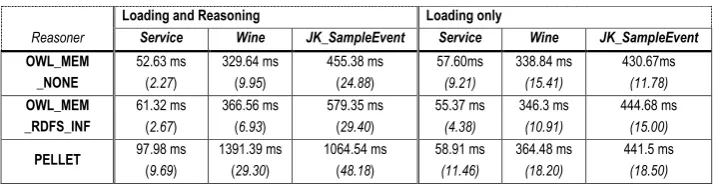
For the purposes of evaluating the overhead involved in the load time parsing and inference of an
ontology, three ontologies were compared with three levels of reasoning. Firstly the very simple
OWL-S Service ontology [25], with only four classes and no individuals; next the complex Wine
ontology [21], with 138 classes, and 206 individuals; and finally the large but relatively simple
JK_SampleEvent ontology based on the CIM ontology discussed above, with 147 classes and 563
individuals. These ontologies were loaded, parsed, and reasoned over using the Jena framework
[26] with three different levels of reasoning. The first reasoner, “OWL_MEM_NONE”, supplied
with Jena, performed no reasoning. The second “OWL_MEM_RDFS_INF”, also supplied with Jena,
performs RDFS entailment reasoning. The third reasoner, Pellet [27] performs full OWL DL
reasoning. The results of these comparisons are given in Table II.
As can be seen from these results, and further experiments [10], the operations to load an
ontology, and especially reason over its contents, are expensive operations. However, in the case
where the set of ontologies to be used are known a priori, the loading and reasoning can be
performed at initialization time rather than during the operation of the system [10]. When the set
of ontologies used changes during runtime, and so need to be reloaded, such changes must be
minimized to maintain satisfactory performance. In addition to the size of an ontology, the time
to reason over an ontology is dependent on the level of reasoning required for correct
interpretation of the ontology, which can be dependent on the complexity of the particular
ontology. For a complex ontology, such as the Wine ontology, a more functional reasoner like
the full support of Pellet is not required to obtain a correct class hierarchy and can be provided
by the less functional OWL_MEM_RDFS_INF reasoner, with a substantial time saving. For this
reason it is necessary to carefully tune the specific level of reasoning required to each specific
ontology on an application by application and a case by case basis [28]. Further information on
the comparative performance of a number of reasoners is available from [29] and [10].
To further evaluate the impact of adding ontological operations to the subscription matching and
notification forwarding algorithms in each Siena node, it was necessary to determine how such
operations affect the scalability of the Siena network and end-to-end time taken for notifications
to be delivered.
For this experiment an open source CIM object manager (CIMOM) [30] was extended to
additionally publish a standard Siena notification each time an event occurred. This notification
message included the ontological class name of the particular CIM event indication instance
created to signify the occurrence of the event. This Siena notification was then published to a
testbed network of extended Siena nodes. The ontology used was the extended JK_SampleEvent
CIMontology. A notification subscriber with a specific interest in CIM event indications was
then connected at varying locations within the Siena network in a manner to force the Siena
notification to traverse a specific number of Siena router hops.
Firstly a single subscription filter, with one constraint, was created to subscribe to all CIM event
indications where the ontological class name of the event was more specific (MORESPEC) than
CIM_Indication, since all CIM event indications are more specific than this class. This subscription
requires that at every Siena node, for every message describing a CIM event indication, the
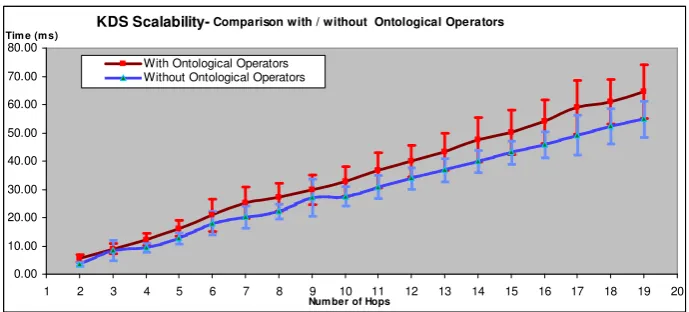
JK_SampleEvent ontology is queried by the routing algorithm. The end-to-end time for
notification delivery and the scalability consequences of these operations are presented in Figure
1. As expected the end-to-end delivery time scales linearly.
Secondly, in order to duplicate the same experiment without the use of ontological operators, a
number of equivalent string based subscriptions were formed. Since multiple filter constraints in
a single subscription filter are joined by conjunction (using the boolean AND operator), a
disjunction of constraints (using the boolean OR operator) can only be specified using multiple
distinct subscriptions. This requires that in order to subscribe to notifications containing names
of any of the 16 subclasses of CIM_Indication, 17 distinct subscriptions are required, each causing
subscription churn within the Siena network. The end-to-end delivery times of the same CIM
event notifications, to a similar client, subscribing using these 17 subscription filters instead of
the single ontological subscription, are also given in Figure 1 as a comparison to the use of
equivalent ontological operations in the subscription and forwarding algorithm, and are shown to
be similar.
Furthermore, when not using ontological operators, if a new subclass of CIM_Indication is added at
runtime, instead of simply modifying the ontology at each Siena router node, the subscription
code for each subscriber application would need to be changed to explicitly subscribe to that new
class, rather than allowing it to be automatically categorized for the ontological operators.
5.CONCLUSION
This paper gives an initial evaluation of the performance impact of introducing ontological
operators into an existing decentralized CBN. The performance decrease observed can be seen as
acceptable when offset against the increased flexibility of the system, particularly over a short
number of hops. Our future work will involve a developing a control plane mechanism for
clustering KBN nodes by semantic closeness in order to minimize the number of ontologies
needed at any one node and to maximize the likelihood of covering relationships to minimize the
forwarding table size as outlined in [10], which we will evaluate against the KBN benchmarking
systems we are developing [19] [31]. By supporting arbitrary semantics in the structuring of
messages and the construction of consumer subscriptions, any such KBN would provide a stable
basis for the long term evolution of new autonomic solutions for highly distributed systems.
6.ACKNOWLEDGEMENTS
This work was partially funded by the EU under the ACCA project, by Science Foundation
Ireland under the CTVR project, and by the Irish Higher Education Authority under the M-Zones
program.
7.REFERENCES
1. Kephart, J., Chess D., “The vision of autonomic computing,” IEEE Computer, vol. 36, no. 1, pp. 41–50, 2003. 2. Mullany, F., Ho, L., Samuel, L., Claussen, H., “Self-Deployment, Self Configuration: Critical Future
Paradigms for Wireless Access Networks”, International Workshop on Autonomic Communications, Berlin, Germany, Oct 2004
3. Smirnov, M.: “Autonomic Communication: Research Agenda for a New Communication Paradigm”, in Fraunhofer FOKUS White Paper, November 2004,
http://www.autonomic-communication.org/publications/doc/WP_v02.pdf
4. Clark, D., Partridge. C., Ramming, J.C., Wroclawski, J.T. “A Knowledge Plane for the Internet”, SIGCOMM’03, 25-29 August 2003, Karlsruhe, Germany.
5. OWL Web Ontology Language Reference, available at: http://www.w3.org/TR/owl-ref/. 6. Berners-Lee, T., Hendler, J., Lassila, O., “The Semantic Web”, Scientific American, May 2001
8. Stevenson, G., Nixon, P., Dobson, S, “Towards reliable wide-area infrastructure for context-based self-management of communications”, International Workshop on Autonomic Communications, Athens Greece, Oct 2005
9. Lewis, D. O’Sullivan, D. Power, R. Keeney, J. “Semantic Interoperability for an Autonomic Knowledge Delivery Service”, International Workshop on Autonomic Communications, Athens Greece, Oct 2005 10. Lewis, D., Keeney, J., O'Sullivan, D., Guo, S., "Towards a Managed Extensible Control Plane for
Knowledge-Based Networking", to appear, International Workshop on Distributed Systems: Operations and Management Large Scale Management, (DSOM 2006), Dublin, Ireland, 23-25 October 2006
11. Meier, R., Cahill, V., “Taxonomy of Distributed Event-Based Programming Systems“, The Computer Journal, vol 48, no 5, pp 602-626, 2005
12. Carzaniga, A., Rosenblum, D. S., and Wolf, A. L., “The Design and Evaluation of a Wide-Area Event Notification Service”, ACM Transactions on Computer Systems, vol 19, no 3, August 2001
13. Segall, B., Arnold, D., Boot, J., Henderson, M., Phelps, T., “Content-Based Routing in Elvin4”, In Proceedings AUUG2K, Canberra 2000.
14. Pietzuch, P., Bacon, J., "Peer-to-Peer Overlay Broker Networks in an Event-Based Middleware". International Workshop on Distributed Event-Based Systems (DEBS'03). San Diego, California, June 2003
15. Chand, R., Felber, P.A., “A Scalable Protocol for Content-Based Routing in Overlay Networks”, Second IEEE International Symposium on Network Computing and Applications , Cambridge, MA, April 2003
16. Strom, R., Banavar, G., Chandra, T., Kaplan, M., Miller, K., Mukherjee, B., Sturman, D., Ward M., “Gryphon: An Information Flow Based Approach to Message Brokering“, International Symposium on Software Reliability Engineering, 1998
17. Carzaniga, A., Rosenblum, D., Wolf, A.L., “Challenges for Distributed Event Services: Scalability vs. Expressiveness” Engineering Distributed Objects (EDO '99), ICSE 99 Workshop, Los Angeles CA. May 1999 18. Petrovic, M., Burceaa, I., Jacobsen, H.A. “S-ToPSS – a semantic publish/subscribe system”, Very Large
19. Keeney, J., Lewis, D., O’Sullivan, D., Roelens, A., Boran, A., Richardson, R., “Runtime Semantic Interoperability for Gathering Ontology-based Network Context”, IEEE/IFIP Network Operations and Management Symposium (NOMS 2006), Vancouver, Canada, April 2006
20. Lynch, D., Keeney, J., Lewis, D., O'Sullivan, D., "A Proactive approach to Semantically Oriented Service Discovery", Workshop on Innovations in Web Infrastructure (IWI 2006), Edinburgh, Scotland. May 2006. 21. W3C: The Wine Ontology, http://www.w3.org/TR/owl-guide/wine.rdf
22. Covering relationships in Siena,
http://serl.cs.colorado.edu/~carzanig/Siena/forwarding/ssimp/namespaceSiena.html#a1
23. López de Vergara, J.E., Villagrá, V.A., Berrocal, J, “Semantic Management: advantages of using an ontology-based management information meta-model”, Proceedings of the HP Openview University Association Ninth Plenary Workshop (HP-OVUA'2002), distributed videoconference, 11-13 June 2002
24. Common Information Model v 2.10.1, DMTF 2005: http://www.dmtf.org/standards/cim/cim_schema_v2101 25. Service Ontology, Part of “OWL-S: Semantic Markup for Web Services”, The DAML Service Coalition,
http://www.daml.org/services/, October 2002, http://www.daml.org/services/owl-s/1.1/Service.owl
26. Carroll, J., Dickinson, I., Dollin, C., “Jena: Implementing the Semantic Web Recommendations”, World Wide Web Conference 2004, 17-22, New York, NY, May 2004. http://jena.sourceforge.net/.
27. MINDSWAP. Pellet: An OWL Reasoner. http://www.mindswap.org/pellet
28. Keeney, J., Lewis, D., O’Sullivan, D., “Benchmarking Knowledge-based Context Delivery System”, International Conference on Autonomic and Autonomous Systems (ICAS'06), Silicon Valley, USA, July 2006 29. “Pellet Performance”, http://www.mindswap.org/2003/pellet/performance.shtml
30. WBEM Services, http://wbemservices.sourceforge.net
SHORT BIOS
John Keeney holds a BAI degree in Computer Engineering and a PhD in Computer Science from Trinity College Dublin. His primary interests focus on controlling autonomic adaptable systems, particularly when those systems are distributed.
David Lewis graduated in Electronics Engineering from the University of Southampton and gained his PhD in Computer Science from University College London. His areas of interest include integrated network and service management, distributed system engineering, adaptive and autonomic systems, semantic services and pervasive computing.
TABLE 1, MIDDLE OF PAGE 9
A covers B Condition
1 x EQU a x EQU b never
2 x MORESPEC a x EQU b if ( a LESSSPEC b )
3 x LESSSPEC a x EQU b if ( a MORESPEC b )
4 x EQU a x MORESPEC b never
5 x MORESPEC a x MORESPEC b if ( a LESSSPEC b )
6 x LESSSPEC a x MORESPEC b never
7 x EQU a x LESSSPEC b never
8 x MORESPEC a x LESSSPEC b never
9 x LESSSPEC a x LESSSPEC b if ( a MORESPEC b)
TABLE 2, BOTTOM OF PAGE 12
Loading and Reasoning Loading only
Reasoner Service Wine JK_SampleEvent Service Wine JK_SampleEvent
OWL_MEM _NONE
52.63 ms (2.27)
329.64 ms (9.95)
455.38 ms (24.88)
57.60ms (9.21) 338.84 ms (15.41) 430.67ms (11.78) OWL_MEM _RDFS_INF 61.32 ms (2.67)
366.56 ms (6.93)
579.35 ms (29.40)
55.37 ms (4.38) 346.3 ms (10.91) 444.68 ms (15.00)
PELLET 97.98 ms (9.69)
1391.39 ms (29.30)
1064.54 ms (48.18)
58.91 ms (11.46) 364.48 ms (18.20) 441.5 ms (18.50)
FIGURE 1, BOTTOM PAGE 13
KDS Scalability- Comparison with / without Ontological Operators
0.00 10.00 20.00 30.00 40.00 50.00 60.00 70.00 80.00
1 2 3 4 5 6 7 8 9 10 11 12 13 14 15 16 17 18 19 20
Num ber of Hops Tim e (m s)
With Ontological Operators Without Ontological Operators
TABLES
TABLE I: Covering relationships between new Siena ontological operators
TABLE II: Time in ms. to load, parse and reason over three ontologies (std. dev. in parenthesis)
FIGURES