DigitalCommons@University of Nebraska - Lincoln
DigitalCommons@University of Nebraska - Lincoln
Educational Administration: Theses,Dissertations, and Student Research Educational Administration, Department of Spring 4-2012
Chancellor’s Scholars Program: Exploring the Transitional
Chancellor’s Scholars Program: Exploring the Transitional
Influence on Freshmen College Students
Influence on Freshmen College Students
Alison P. TePoelUniversity of Nebraska-Lincoln, [email protected]
Follow this and additional works at: https://digitalcommons.unl.edu/cehsedaddiss
Part of the Higher Education Administration Commons
TePoel, Alison P., "Chancellor’s Scholars Program: Exploring the Transitional Influence on Freshmen College Students" (2012). Educational Administration: Theses, Dissertations, and Student Research. 86.
https://digitalcommons.unl.edu/cehsedaddiss/86
This Article is brought to you for free and open access by the Educational Administration, Department of at
DigitalCommons@University of Nebraska - Lincoln. It has been accepted for inclusion in Educational Administration: Theses, Dissertations, and Student Research by an authorized administrator of DigitalCommons@University of Nebraska - Lincoln.
Chancellor’s Scholars Program: Exploring the Transitional Influence on Freshmen College Students
by
Alison TePoel
A THESIS
Presented to the Faculty of
The Graduate College at the University of Nebraska In Partial Fulfillment of Requirements
For the Degree of Master of Arts
Major: Educational Administration
Under the Supervision of Professor Richard E. Hoover
Lincoln, NE May, 2012
Chancellor’s Scholars Program: Exploring the Transitional Influence on Freshmen College Students
Alison TePoel, M.A. University of Nebraska, 2012 Advisor: Richard E. Hoover
The purpose of this study was to explore the fears and situations of Hispanic freshmen students enrolled at a large Midwestern University who had received the Chancellor’s Scholarship and were participating in the 2011-2012 Chancellor’s Scholars Program through the Office of Academic Success and Intercultural Services at this University. How participation in the Chancellor’s Scholars Program aided them in the transition process was also determined. Schlossberg’s Transition Theory (1981) presented factors that influenced a person’s ability to cope with a transition: situation, self, support, and strategies, which are also known as the 4 S’s. These four categories were viewed in relation to the transition process for the Chancellor’s Scholars and to evaluate how participation in the program aided each student’s transition into college.
The University’s Chancellor’s Scholars Program was a retention program designed to assist freshmen National Hispanic Scholars, awarded the Chancellor’s Scholarship transition smoothly from high school to college. The program specifically served Chancellor’s Scholarship recipients who were recognized as National Hispanic Scholars, meaning the student achieved a 3.0 grade point average or higher the end of their junior year of high school and were of at least one-quarter Hispanic/Latino decent. The Chancellor’s Scholars Program provided academic and personal support to the
students through a series of academic workshops, peer mentoring, cultural enhancement activities, social programs, and academic counseling. Six participants were interviewed in order to describe their individual experiences in the 2011-2012 Chancellor’s Scholars Program.
As these first-year students transitioned into college each of their individual experiences was unique and different. Therefore, it was important to understand the transition process as experienced by individual students and how a transition program may have affected their transition process. Participants’ academic and social transitions were defined through the lens of Schlossberg’s Transition Theory, which viewed each student’s situation, self, support and strategies both pre-college and during college. This study showed that the 2011-2012 Chancellor’s Scholars Program positively influenced the transition of participants from high school to college at a large Midwestern
University. The results of this study may be helpful to the University to improve transitional programs for new Hispanic students, aid in retention efforts, and help the institution understand how it can better assist Hispanic students in a successful first year of college.
Acknowledgements
Thank you to Dr. Hoover for your support and guidance throughout my entire graduate school experience! Your expertise and dedication to me over the past two years has been wonderful and has highly impacted my academic endeavors.
Thank you to all the professors in the Department of Educational Administration, thanks to you and your expertise, I feel prepared to pursue my career goals.
Thank you to my assistantship supervisors and other student affairs professionals that I have had the privilege to work with on campus. You have taught me how to apply my strengths in the field of student affairs and have served as great role models that I look up to on a daily basis. I know that I can come to each and every one of you for advice/guidance in the future.
Thank you to my cohort (Kelly, Sammi, Torrey, Lorena, Sara, and Chris) as well as the cohort members a class above and below me! You have made the last two years very fun and have served as a constant positive force in my life!
Thank you to Dr. Franco and Dr. Alvarez for investing your time in order to help make me the best professional I can be! Your constant encouragement and willingness to share your expertise has been amazing over the past two years and will continue to impact me in my professional career.
Thank you to my sister, Mackenzie! Having you as a sister and roommate has been the best thing ever. You are always there when I need you and get me like no other person does. Thanks for putting up with me! You always have the ability to make me laugh and help make every day a good day! I love you so much!!!
Thank you to my Mom and Dad! I am so fortunate to have such loving and supportive parents. Thanks for always encouraging me to follow my dreams and helping me pursue my goals. Through my good and bad days you have always been there with constant loving support and the ability to make me smile. I love you both so much!!
Table of Contents
Chapter 1-Introduction ... 1
Chancellor’s Scholars Program ... 2
Purpose Statement ... 4 Research Questions ... 4 Subquestions ... 4 Research Design... 5 Definition of Terms... 6 Significance... 7 Delimitations ... 8 Limitations ... 9 Assumptions ... 9 Conclusion ... 10
Chapter 2-Literature Review ... 12
Purpose Statement ... 12
Introduction ... 12
Transition Programs ... 13
Student Motivation and Success ... 15
Astin’s Theory of Student Involvement ... 17
Schlossberg’s Transition Theory ... 19
Situation ... 20
Self ... 21
Support ... 21
Strategies ... 22
Chapter 3-Methodology ... 24
Purpose Statement ... 24
Research Questions ... 24
Subquestions ... 24
Research Design... 25
Institutional Review Board Approval ... 27
Research Site ... 28
Participants ... 29
Data Collection ... 31
Data Analysis ... 32
Validations and Reliability of Findings ... 33
Conclusion ... 34 Chapter 4-Findings... 35 Purpose Statement ... 35 Description of Participants ... 35 Research Questions ... 38 Subquestions ... 39
Overview of Themes and Subthemes ... 39
Themes and Subthemes... 42
Situation: Pre-College ... 42
Theme: High school was easy as pie, I am uncertain about college ... 42
Subtheme: I took honors and advanced placement courses, I got all A’s ... 43
Subtheme: I was involved in high school ... 44
Situation: During College ... 45
Theme: College is good, but I am still getting adjusted ... 45
Subtheme: I like classes, but they are different from high school ... 46
Subtheme: Not a lot of time for involvement ... 47
Subtheme: College is not as bad as I thought, apprehensions were uncalled for ... 48
Subtheme: I’m still worried about my GPA ... 48
Self: Pre-College ... 48
Theme: I think I can handle college, I am smart... 48
Subtheme: Procrastination is my weakness ... 49
Self: During College ... 49
Theme: I have gained skills, but still figuring this whole college thing out ... 49
Subtheme: New strengths, some weaknesses remain ... 50
Support: Pre-College ... 50
Theme: My support system included a variety of people ... 50
Subtheme: Academic support came mostly from my peers and teachers ... 51
Support: During College ... 52
Theme: My support system has shifted ... 52
Subtheme: The Chancellor’s Scholars Program has led me to academic resources on campus or at least made me aware of them ... 52
Subtheme: The Chancellor’s Scholars Program has not really helped mesocially or with meeting new friends ... 53
Subtheme: The Chancellor’s Scholars Program has encouraged me to get nvolved or has sparked my interest in certain activities ... 53
Subtheme: Meeting with a Chancellor’s Scholars staff
member regularlyhas kept me on track ... 54
Strategies: Pre-College... 54
Theme: In high school I took things as they came... 54
Subtheme: I didn’t study that much in high school ... 55
Strategies: During College ... 55
Theme: My time management and study habits have changed since I started college ... 55
Subtheme: The Chancellor’s Scholars Program has aided in my transition process from high school to college ... 56
Subtheme: I have not thought or considered leaving the University ... 57
Subtheme: I wish I could have met other Chancellor’s Scholars ... 58 Conclusion ... 58 Chapter 5-Discussion ... 59 Purpose Statement ... 59 Research Questions ... 59 Subquestions ... 59 Summary of Findings ... 60 Discussion ... 60 Research Question 1 ... 61 Research Question 2 ... 63 Research Question 3 ... 65 Research Question 4 ... 67 Research Question 5 ... 68 Implications... 69
Future Research ... 73
Conclusion ... 75
References ... 76
List of Tables
Table 1 Astin’s Five Basic Postulates ... 18
Table 2 Important Factors in Situation ... 21
Table 3 Participants ... 30
List of Appendices
Appendix A IRB Approved Informed Consent Form ... 80
Appendix B OASIS Director Consent Letter ... 83
Appendix C Age Waiver Request ... 85
Appendix D Welcome Recruitment Email ... 88
Appendix E Reminder Recruitment Email ... 90
Appendix F Confirmation Email ... 92
Appendix G Thank You Email ... 94
Appendix H Interview Script ... 96
Appendix I Interview Questions ... 98
Appendix J Transcriptionist Confidentiality Statement ... 103
Chapter 1 Introduction
For first-year students, starting college is a challenging and new experience. Each student that starts college must go through a transition in which they adjust and adapt to their new environment. For first-year students, the transition into college life will be unique and different for each individual. According to previous research, “the most important factor in student learning and personal development during college is student engagement, or the quality of effort students themselves devote to educationally
purposeful activities that contribute directly to desired outcomes” (Hu & Kuh, 2002). How do students make a successful transition from high school to college? What can institutions of higher education do to help facilitate this transition? What kinds of programs and support should colleges offer to their first-year students?
For many first-year students an added pressure in the transition process is the adjustment to college-level course work. Especially, if students are expected to maintain a specific grade point average in order to retain a scholarship or other educational award. “Merit-based financial aid for college stands as the best known public policy instrument available for motivating students through direct, financial incentives” (Henry and
Rubenstein, 2002, p. 93). However, is a financial incentive enough to motivate and help students adjust to college life and become successful students? According to Astin (1985), “students learn by becoming involved” (p. 133). With this in mind, transition programs in higher education are essential to help students adjust to college life and learn to the best of their ability.
In this qualitative research study, first-year Hispanic students who participated in the 2011-2012 Chancellor’s Scholars Program at a large Midwestern University were studied in order to explore the program’s effectiveness on a student’s transition into college. The students that participated in this study received the Chancellor’s
Scholarship from the University, which is a renewable scholarship that covers full-tuition as long as the student maintains a 3.5 cumulative grade point average or above at the end of each academic school year. The students participating in the Chancellor’s Scholars Program are encouraged to become involved both socially and academically on campus. The Chancellor’s Scholars Program was intended to aid in the transition process for first-year students will be analyzed in regards to Nancy Schlossberg’s Transition Theory. Looking at student participants’ high school experience and transition into the first semester of college will be explored through this theory in order to determine the effectiveness of the program and implications for future college transition programs.
Chancellor’s Scholars Program
The Chancellor’s Scholars Program is a retention program designed to assist Hispanic freshmen awarded the Chancellor’s Scholarship transition smoothly from high school to college. All of the students that participated in the program were also
previously recognized as National Hispanic Scholars, which meant that the National Hispanic Recognition Program (NHRP) identified them as an academically outstanding Hispanic/Latino high school student.
The Chancellor’s Scholars staff provides academic and personal support to students through a series of academic workshops, peer mentoring, cultural enhancement activities, social programs, and academic counseling. As part of the program, the
Chancellor’s Scholars staff coordinates programs specifically designed to assist students in gaining the tools and tips necessary for a successful college career. The ultimate goal of the program is to help all Chancellor’s Scholars build a strong academic and social foundation by providing them with the resources to connect, engage, and balance the demands of higher education (Aguirre, 2011). The Chancellor’s Scholars Program is offered by the Office of Academic Success and Intercultural Services at the University and is open to first-year students awarded the Chancellor’s Scholarship and who were also selected as National Hispanic Scholars. Below are the requirements of the Chancellor’s Scholars Program that students must follow:
Activity Goals (Requirements)
• Meet regularly with assigned Chancellor’s Scholars staff
• Attend at least three (3) Chancellor’s Scholars Workshops each semester • Attend at least two (2) cultural events per semester
• Attend three (3) study sessions with the Academic Success Lab per month
Or accumulate a total of 6 hours per month • Participate in at least two (2) volunteer projects per year
• Participate with the Mid-Semester Grade Check Program (Aguirre, 2011) Academic Goals (Requirements)
• Maintain a 3.5 cumulative GPA; evaluated at the end of each spring term • Enroll full-time each semester (12 credit hours)
• Successfully complete 24 credit hours per year
Including successful completion of 9 graded hours per semester (Aguirre, 2011)
Purpose Statement
The purpose of this study was to explore the fears and situations of freshmen Hispanic students enrolled at a large Midwestern University who have received the Chancellor’s Scholarship and were participating in the Chancellor’s Scholars Program through the Office of Academic Success and Intercultural Services at the University. How participation in the Chancellor’s Scholars Program has aided them in the transition process will also be determined. Nancy Schlossberg’s Transition Theory has laid out factors that influence a person’s ability to cope with a transition: situation, self, support, and strategies, which are also known as the 4 S’s. These four categories will be looked at in relation to the moving in phase of the transition process for the Chancellor’s Scholars and to evaluate how participation in the program has aided each student’s transition into college. The results of this study may be helpful to the University to improve transitional programs for new students, aid in retention efforts, and help the institution understand how it can better assist students in a successful first year of college.
Research Questions
The following grand tour question was studied: How did participants in the 2011-2012 Chancellor’s Scholars Program view the program in regards to aiding them in their transition from high school to college?
Subquestions.
1. How did participants view their high school experience (both academically and socially)?
2. How did participants view their collegiate experience so far (both academically and socially)?
3. What role did the Chancellor’s Scholars Program play in the participants’ transition into college?
4. How did participants perceive the Chancellor’s Scholars Program in regards to how it impacted them both academically and socially?
5. What do participants perceive as their future collegiate experience?
Research Design
This qualitative research study was conducted at a large Midwestern University. Six participants were interviewed in order to explore their individual experiences in the transition process from high school to college and how the 2011-2012 Chancellor’s Scholars Program has played a role in that transition process. Qualitative research was chosen for this study because the researcher was interested in how individual students’ transition into college was affected by the 2011-2012 Chancellor’s Scholars Program. The researcher also chose a qualitative method in order to collect in-depth data which detailed a student’s collegiate experience in regards to academic and social adjustment. According to Creswell (2012), “qualitative research is best suited to address a research problem in which you do not know the variables and need to explore” (p. 16). In this study, “exploring a problem and developing a detailed understanding of a central
phenomenon” (Creswell, 2012, p. 16) was key to understanding the transition process for the Chancellor’s Scholars students.
Participants for this study were chosen through purposeful and convenience sampling. “Purposeful sampling is based on the assumption that the investigator wants to discover, understand, and gain insight and therefore must select a sample from which the most can be learned” (Merriam, 2009, p. 77). Convenience sampling, as implied by the
term, is when selection of the sample is “based on time, money, location, availability of sites or respondents, and so on” (p. 77). The Chancellor’s Scholars sample selected for this research study was chosen based on convenience and ease of access to schedule interviews and because of the students’ participation in the 2011-2012 Chancellor’s Scholars Program. The primary researcher selected three male and three female students participating in the Chancellor’s Scholarship Program and contacted them via email, inviting them to participate in the study. Schlossberg’s Transition Theory, regarding the moving in phase, was analyzed in regards to the data collected. The findings from this research will be presented through the discussion of themes in Chapter 4.
Definition of Terms
Transition—Any event, or non-event that results in changed relationships, routines, assumptions, or roles (Goodman, Schlossberg, & Anderson, 2006, p. 33).
Adaptation—“Adaptation to transition is a process during which an individual moves from being totally preoccupied with the transition to integrating the transition into his or her daily life” (Schlossberg, 1981, p. 7).
First-year student—A student enrolled in college for the first-time following their graduation from high school.
Involvement—“refers to the amount of physical and psychological energy that the student devotes to the academic experience” (Astin, 1999, p. 518).
Strengths—“Individual characteristics, also called internal assets or personal competencies, associated with healthy development and life success” (Benard, 2004, p. 13).
Weakness—“a particular part or quality of someone or something that is not good or effective” (Cambridge University Press, 2011).
Support System—A group or individual that provides an individual with
information, advice, protection, and reinforces the individual’s self-worth (Schlossberg, 1981).
Campus resources—Services offered on a University campus that help facilitate students’ academic, social, and physical well-being.
Situation—“Examines the features of a transition and how they may influence its significance to the individual” (Bailey-Taylor, 2009).
Self—This “variable is composed of a person's outlook on life, as influenced by personal characteristics (including demographics, such as socioeconomic status) and psychological resources” (Bailey-Taylor, 2009).
Strategies—“Actions that individuals take in response to transitions” (Bailey-Taylor, 2009).
Support—“refers to the resources available to people” (Bailey-Taylor, 2009) Moving In, Moving Through, Moving Out—A series of phases in an
individual‘s transition process (Schlossberg, 1989).
Significance
The significance of this study was to explore the transition process from high school to college for those students participating in the 2011-2012 Chancellor’s Scholars Program. Realizing that each student is unique this study explored how students’
transitions may be different than their peers. This study could have substantial
first-year student transition process. This study explored participants perceptions of their “situations, self, support, and strategies” prior to college and then after their first few months of college. The results of this study could be helpful to the University to improve transitional programs for new students, aid in retention efforts, and help the institution understand how it can better aid students in a successful first year of college.
Delimitations
Delimitations are those characteristics selected by the researcher to define the boundaries of the study. The researcher makes conscious exclusionary and inclusionary decisions regarding the sample (including such information as geographic location), the variables studied, the theoretical perspectives, the instruments, and the generalizability. (Dusick, 2011)
Delimitations existed in this study due to the demographic characteristics of the chosen participants. Participation in this study was delimited to the use of Hispanic students who had the following characteristics: students must have been first-year students at the large Midwestern University, enrolled as a full-time student, a recipient of the 2011-2012 Chancellor’s Scholarship, participant in the 2011-2012 Chancellor’s Scholars Program, and were recognized as a National Hispanic Scholar. These specific characteristics excluded a large portion of the student body along with the exclusion of Chancellor’s Scholar recipients who were not participating in the program. The study only used participants from one large Midwestern University and therefore did not focus on other institutions. The study also only consisted of six participants from a possible nine that met all of the requirements. The results of this study will not be generalizable to past Chancellor’s Scholarship recipients.
Limitations
Limitations of this study include that the participants were chosen with purposeful and convenience sampling. Students were chosen because of ease of access and because they were participating in the Chancellor’s Scholars Program through the Office of Academic Success and Intercultural Services. The primary researcher had access to this particular group’s contact information and therefore chose this population to study. All six students were recognized as National Hispanic Scholars and therefore were of Hispanic descent; their experiences may have been different and cannot speak or be generalized to students from other ethnic backgrounds. The sample was truly a convenience sample in that even though the students participating in the Chancellor’s Scholars Program were of at least one-quarter Hispanic/Latino decent, the researcher put no focus on race or ethnicity in regards to this study. The study was conducted on the basis of learning about the transition process of first-year students and these students of Hispanic decent were treated like any other student at a predominately white institution. Therefore, no literature review or focus on race, ethnicity, culture, or cultural capital was taken into consideration. The researcher chose to consciously ignore race and ethnicity, and conduct the study focusing only on the fact that this easy to access population included all first-year students. The study results come from one large Midwestern University; therefore, results may not be the same as at other institutions based on size, location, or type. More generalizable results could culminate from a multi-institutional study regarding transition programs.
Assumptions
We all like to think that we are objective scholars who judge people based entirely on their experience and achievements, but copious research shows that every one
of us brings a lifetime of experience and cultural history that shapes the review process. The results from controlled studies in which people were asked to make judgments about subjects demonstrate the potentially prejudicial nature of the many implicit or unconscious assumptions we can make. (WISELI, 2011) The primary researcher was a main staff contact for the 2011-2012 Chancellor’s Scholars Program and therefore had some basic assumptions prior to beginning the research. One assumption made by the researcher was that the Chancellor’s Scholars Program had some influence on the students that participated. The researcher also knowing that a majority of the students were from out-of-state, expected there to be a large adjustment process regarding the students ability to get acquainted to a new environment. Along with this, the researcher assumed that even though the participants were of at least one-quarter Hispanic/Latino decent, that their experience would be similar to that of other first-year students. Also assumed, was that the program activity and academic requirements would have some type of impact on student grades and involvement. The researcher mostly assumed that the program would have a constructive influence on the participants and that the requirements of the program would help
students move more easily through the transition process from high school to college.
Conclusion
Students beginning college must adjust to their new environment academically, socially, and physically. As students move out of high school and move in to college they go through a transition process. This transition process is different for each student, as each student has a unique self, situations, support, and strategies to help them adapt. As part of the Chancellor’s Scholarship Program, students were given certain
requirements that are aimed to help ease the transition process and allow them to connect to campus. By exploring the fears, questions, and adjustment process for students,
institutions can hope to better facilitate students’ transitions, making them more successful and to increase student retention.
In Chapter 2, a review of literature will be presented. Much research has been done in regards to life transitions and student transition programs. Looking at past studies and the importance of transition programs, there is definite evidence supporting student involvement in relation to student success. Schlossberg’s Transition Theory will be used to further explore and explain how students in the Chancellor’s Scholars Program view their experiences, adaption, and transition into life as a college student.
Chapter 2 Literature Review Purpose Statement
The purpose of this study was to explore the fears and situations of freshmen Hispanic students enrolled in a large Midwestern University who had received the Chancellor’s Scholarship and were participating in the Chancellor’s Scholars Program through the Office of Academic Success and Intercultural Services at the University. How participation in the Chancellor’s Scholars Program had aided them in the transition process will also be determined. Nancy Schlossberg’s Transition Theory has laid out factors that influence a person’s ability to cope with a transition: situation, self, support, and strategies, which are also known as the 4 S’s. These four categories will be studied in relation to the transition process for the Chancellor’s Scholars and to evaluate how
participation in the program has aided each student’s transition into college.
Introduction
The purpose of this literature review was to provide background information related to transition programs and to review theories related to the importance of student success in higher education. In particular, Nancy Schlossberg’s Transition Theory will be explained, as her theory iterated the transition process which can be applied to the participants in this research study. Peer-reviewed journal articles, books, and online resources were used to accumulate a strong body of previous research that not only supported but enhanced this study. Many search terms were utilized in the process, some of these included, “transition programs,” “scholarships and student motivation,” “college transitions,” “student involvement,” and “college student success.” Information in this
literature review was chosen because of its relevance to the overall research topic but does not exhaust the amount of literature that is available. The literature chosen creates a sound base for this research study and provides grounding on which to analyze the data collected by the researcher.
Transition Programs
The college transition may pose a challenge to students’ learning dispositions. Students have to adjust to a new social and academic environment at a time when college staff and parents expect them to be more autonomous in managing their academic and personal life than before. (Larose, Bernier, & Tarabulsy, 2005, p. 282)
Students must take on more “responsibility than they did in high school for managing their academic progress (registration, changing programs, etc.), showing self-discipline in their studies, taking the initiative to meet their teachers when problems arise, and making decisions about their future” (Larose et al., 2005, p. 282). The tasks mentioned often pose a challenge for first-year students and may affect their learning disposition
regardless of their disposition in high school. With so many new challenges facing new college students, institutions must realize that support and guidance may be the best way to help students adapt. One method institutions use to aid this process is through the use of transition programs.
Transition programs are used by most institutions of higher education, but the layout and format of programs differ from institution to institution. A study conducted by Larose et al. (2005) “suggested that the learning dispositions of insecure students are more negatively affected by the college transition than those of autonomous students” (p. 288). With this aspect in mind, support of the student, and their attachment and support from home and high school play a role in their transition process. Institutions of higher
education aim to provide support by offering campus programming and activities, academic resources, developmental services, and through interaction with students by faculty, staff, and student affairs personnel (Astin, 1999).
A study conducted by Karen Kurotsuchi Inkelas and Jennifer L. Weisman (2003) examined student outcomes among students participating in three types of living-learning programs (p. 335). This study, in particular, focused on three types of programs:
Transition Program goal: to facilitate a smooth academic transition for first-year students; Academic Honors Program goal: to support students in their pursuit and enjoyment of challenging academic endeavors; Curriculum-Based Program goal: to provide stimuli that broaden students' social and cultural perspectives and horizons. (Inkelas & Weisman, 2003, pp. 336-337)
In this study, the researchers found that “Transition and Academic Honors Program participants more often used critical thinking skills in class assignments, met socially with a faculty member outside of class, and discussed sociocultural issues outside of class” (Inkelas & Weisman, 2003, p. 344). This study also interestingly found that students in Transition and Academic Honors Programs tended to go to different sources for academic advice. The researchers found that students in transition programs tended to seek academic advice from faculty members outside of the classroom, while Academic Honors Program students sought help from peers outside the classroom (p. 344).
Living-learning participants, more often than their control group counterparts, enjoyed: (a) a smooth transition to college during their first year; (b) challenging academic pursuits; and (c) learning new or different perspectives. In addition, the students in the programs with objectives that mirror the outcomes in this study were generally found to exhibit the highest outcomes among their classmates. For example, participants in Transition Programs were the most likely to perceive a smooth transition to college, and significantly more so than Academic Honors Program participants and the control group students. (Inkelas & Weisman, 2003, p. 345)
The study involving living-learning programs provided evidence that those participating in a transition program often view their transition into their first year of college more smoothly than other students not participating in a transition program.
Student Motivation and Success
“Institutions vary in terms of mission and educational goals; students themselves differ in terms of what they want from college” (Hu & Kuh, 2003, p. 198). Shouping Hu and George Kuh (2003) tested a learning productivity model to explore what influences the productivity of undergraduate students on college campuses.
The findings from this study indicate that high quality relations among different groups positively affect the amount of effort students put forth. That is, students tend to expend more effort when they perceive that their relations with other students are friendly and supportive, faculty members are approachable and encouraging, and administrators are helpful and considerate. (Hu & Kuh, 2003, p. 199)
Part of the Chancellor’s Scholars program is centered around getting students to interact with other students and to encourage student, faculty, and staff interactions; hoping to increase the effort that students put forth to purposeful and positive activities. “Attempts to improve learning productivity must take into account the in-class and out-of-class activities and experiences that contribute directly to student learning as well as students’ perceptions of the college environment” (p. 200).
Student engagement has long been a factor in determining student success. Astin’s (1999) Theory of Student Involvement, which will be described later in this chapter, has championed this idea of encouraging students to be active participants in purposeful activities throughout their collegiate experience. George Kuh, along with Cruce, Shoup, Kinzie, and Gonyea (2008) recently studied the effects of student engagement on first-year students’ grades and persistence. In their study two main
conclusions were discovered. First, “student engagement in educationally purposeful activities is positively related to academic outcomes as represented by first-year student grades and by persistence between the first and second year of college” (p. 555). Second, “engagement has a compensatory effect on first-year grades and persistence to the second year of college at the same institution” (p. 555). Grades and persistence being a major measure of college student success then indicates that encouraging engagement in educationally purposeful activities is a key factor in helping facilitate success.
Much research discussing the topic of scholarships affect on student motivation and success is related to student athletes and athletic scholarships rather than on
institutional scholarships rewarded because of academic excellence. There is also much literature discussing the distribution of scholarships and controversy between merit-aid and need-based aid. “Although previous research shows that merit-based aid, like traditional financial aid, can increase college enrollments, the scant evidence on
outcomes beyondinitial enrollment has been mixed” (Scott-Clayton, 2011, pp. 615-616). A research study conducted by Scott-Clayton (2011) analyzed the West Virginia
PROMISE Scholarship Program. The West Virginia PROMISE Scholarship is detailed below.
This scholarship covers full tuition and required fees for up to four years for eligible first-time freshmen who enroll full-time at a West Virginia public two- or four-year institution, or an “equivalent amount” at an eligible West Virginia private institution. Full-time enrollment is defined as a minimum of 12 credit-hours per semester. To renew the scholarship, undergraduates must successfully complete at least 30 credits per year and maintain a 3.0 cumulative GPA, although they are allowed a 2.75 GPA in their first year. Those who fail to meet renewal requirements once cannot later regain the scholarship. (Scott-Clayton, 2011, p. 617)
Scott-Clayton (2011) found that the program appeared to have substantial impacts on cumulative GPA and total credits earned in the students’ first year as well as moderate impacts on these outcomes after four years. He also found that the program seemed to have large effects on the percentage of students meeting key achievement benchmarks and increasing 4-year graduation rates (p. 623). Viewing results of the West Virginia PROMISE Scholarship study showed that scholarships that require certain benchmarks to be met in order to retain a scholarship seem to have ample impact on student success.
Astin’s Theory of Student Involvement
As students enter college they face not only academic but social adjustment. Being successful during college is often more than obtaining just good grades, but also meeting new people, gaining new experiences, and finding purposeful activities and organizations to be a part of. Transition programs often contain many of the elements listed above by encouraging and helping students get involved and connecting them with resources, people, and organizations that will aid in their success (McDonough, 2004).
Alexander Astin was a theorist in the student development field that studied the importance of student involvement. Astin described involvement as “the amount of physical and psychological energy that the student devotes to the academic experience” (Astin, 1999, p. 518). Therefore, by the definition set forth by Astin, involvement is a framework that involves numerous parts.
Thus, a highly involved student is one who, for example, devotes considerable energy to studying, spends much time on campus, participates actively in student organizations, and interacts frequently with faculty members and other students. Conversely, a typical uninvolved student neglects studies, spends little time on campus, abstains from extracurricular activities, and has infrequent contact with faculty members or other students. (Astin, 1999, p. 518)
Astin’s theory included five basic postulates, shown in Table 1, that help to better summarize his theory.
Table 1
Astin’s Five Basic Postulates
Postulate Description
1 Involvement refers to the investment of physical and psychological energy in various objects. The objects may be highly generalized (the student experience) or highly specific (preparing for a chemistry examination).
2 Regardless of its object, involvement occurs along a continuum; that is, different students manifest different degrees of involvement in a given object, and the same student manifests different degrees of involvement in different objects at different times. 3 Involvement has both quantitative and qualitative features. The extent of a student’s
involvement in academic work, for instance, can be measured quantitatively (how many hours the student spends studying) and qualitatively (whether the student reviews and comprehends reading assignments or simply stares at the textbook and daydreams). 4 The amount of student learning and personal development associated with any
educational program is directly proportional to the quality and quantity of student involvement in that program.
5 The effectiveness of any educational policy or practice is directly related to the capacity of that policy or practice to increase student involvement.
Source: Astin (1999, p. 519)
With the postulates set forth in Table 1, Astin focused on factors to help facilitate the development of students. Factors include variables such as a student’s place of residence, honors program involvement, academic involvement, student faculty
interaction, athletic involvement, and involvement in student government (1999, pp. 524-526).
According to the theory, the greater the student’s involvement in college, the greater will be the amount of student learning and personal development. Front the standpoint of the educator, the most important hypothesis in the theory is that
the effectiveness of any educational policy or practice is directly related to the capacity of that policy or practice to increase student involvement. (Austin, 1999, pp. 528-529)
Facilitating student development through transition programs is a gateway or tunnel to focus on getting students involved. By directing “attention away from subject matter and technique and toward the motivation and behavior of the student” (Austin, 1999, p. 529), student affairs professionals should “view student time and energy as institutional
resources,” (p. 529) which they can aim to use efficiently and wisely. Involvement facilitates the development of the student in a positive manner (p. 523), possibly aiding in their success and easing their collegiate transition and acts as a hallmark of most
transition programs.
Schlossberg’s Transition Theory
Every individual, young or old, goes through transitions during their lifetime. The transition from high school to college is often one of the major milestones and transitions for young adults (Evans, Forney, Guido, Patton, & Renn, 2010, pp. 212-213). “Transitions provide opportunities for growth and development, but a positive outcome cannot be assumed” (p.213). Since positive outcomes cannot be assumed, supporting students during the transition process may aid in the probability of having a positive outcome.
In Schlossberg’s Transition Theory, a transition is defined as “any event, or non-event that results in changed relationships, routines, assumptions, or roles” (Goodman et al., 2006, p. 33). To better understand what a certain transition means to a certain individual requires considering the type, context, and impact of the transition (Evans et al., 2010, p. 215). Three types of transitions are noted:
• anticipated transition-occur predictably,
• unanticipated transition-not predictable or scheduled,
• nonevents—an event that is expected to occur but does not (Goodman et al., 2006, p. 34).
Context refers to one’s relationship to the transition and to the arena or setting in which the transition takes place. Impact is determined by the degree to which a transition alters ones daily life (pp. 36-37).
A transition, whether it be an event or nonevent, triggers the transition process. The transition process is thought to consist of three phases, “moving in, moving through, and moving out” (Goodman et al., 2006, p. 50). As a student begins the process and “moves in” they must began to deal and cope with the transition at hand. One’s ability to cope with a transition is influenced by four major factors that Schlossberg calls the 4 S’s. The 4 S’s are: situation, self, support and strategies (p. 55). The 4 S’s which are
necessary for individuals to cope are laid out below in more detail. An individual “employs a ratio of assets to liabilities and allows for changes in the ratio as an
individual’s situation changes,” (Schlossberg, Waters, & Goodman, 1995, p. 49) meaning that an individual’s assets and liabilities in each area shape the transition process
(Goodman et al., 2006).
Situation—“Examines the features of a transition and how they may influence its significance to the individual” (Bailey-Taylor, 2009). The factors that are considered important are shown in Table 2.
Table 2
Important Factors in Situation
Factor Description
Trigger What precipitated the transition?
Timing Is the transition considered “on time” or “off time” in terms of one’s social clock, and is the transition viewed as
happening at a “good” time or “bad” time?
Control What does the individual perceive as being within his or her control (for example, the transition itself, his or her reaction to it)?
Role Change Is a role change involved, and if so, is it viewed as a gain or a loss?
Duration Is it seen as permanent, temporary, or uncertain? Previous experience with
a similar transition
How effectively did one cope, and what are implications for the current transition?
Assessment Who or what is seen as responsible for the transition, and how is the individual’s behavior affected by this perception? Source: Evans et al. (2010, pp. 216-217)
Self—This “variable is composed of a person's outlook on life, as influenced by personal characteristics (including demographics, such as socioeconomic status) and psychological resources” (Bailey-Taylor, 2009). Looking at self, “issues of identity, autonomy, meaning-making, and self-efficacy” are explored (Schlossberg et al., 1995, p. 91). Both the personal and demographic characteristics and psychological resources are important factors in relation to self.
Support—“refers to the resources available to people” (Bailey-Taylor, 2009). “The importance of social support is often said to be the key to handling stress. Support,
however, needs to be defined operationally because it comes in many sizes and shapes, and can be for better or for worse” (Schlossberg et al., 1995, p. 67). There are different types, functions, and measurements of support.
• Types: intimate, family, friends, institutional • Functions: affect, affirmation, aid, honest feedback • easurement: stable and changing supports (pp. 67-69)
The support or resources that students have available to them affects how they move through the transition. The resource most often referred to in the support category is social support, or the backing/assistance that one receives from others.
Strategies—“Actions that individuals take in response to transitions” (Bailey-Taylor, 2009). Strategies fall into one of three categories. There are those strategies “that modify the situation and are aimed at altering the source of strain” (Schlossberg et al, 1995, p. 72), there are “responses that control the meaning of the problem in order to cognitively neutralize the threat” (p. 73), and lastly, there are “responses that help the individual manage stress after it has occurred to help accommodate to existing stress without being overwhelmed by it” (p. 73). There are also four coping modes involved with strategies which include: “information seeking, direct action, inhibition of action, and intrapsychic behavior” (Evans et al., 2010, p. 217). Goodman et al. (2006)
emphasized that individuals who use multiple strategies and methods are better able to cope with the situation they go through.
“Research based on Schlossberg’s theory is largely absent from the student affairs literature” (Evans et al., 2010, p. 221). However, the application of her theory has been applied to work with adult learners and to traditional college age students (p. 213).
Schlossberg’s Transition Theory serves as a good assessment technique for working with individuals and provides a sound framework for viewing how individuals transition. Using this theory as a guide for a student’s transition from high school to college can help student affairs professionals better understand how students cope with this specific life transition.
Conclusion
This chapter provided a rich foundation of literature that supports the need for supporting students during major life transitions, such as the transition from high school to college. Transition programs have been a part of higher education and aim to aid students in the best way possible. With each student being unique it is imperative to view the literature that helps us learn what motivates students to succeed. Astin’s Theory of Student Involvement is a primary theory in getting students involved in educationally purposeful activities to facilitate their success. The transition that each student goes through can be applied to Nancy Schlossberg’s Transition Theory, which can help
practitioners learn how students make this transition from high school to college and how they might be able to better assist their students. This study of the Chancellor’s Scholars Program will add more depth to the existing body of literature and help fill some of the gaps that exist particularly in the application of Schlossberg’s Theory to higher education settings.
Chapter 3 provides a description of the methodology of this study. The research process, participants, and data analysis will be fully explained to better define the layout and how research was conducted. The methodology of chapter 3 will help to illustrate a clear picture of the study in its entirety.
Chapter 3 Methodology Purpose Statement
The purpose of this study was to explore the fears and situations of freshmen Hispanic students enrolled at a large Midwestern University who have received the Chancellor’s Scholarship and are participating in the Chancellor’s Scholars Program through the Office of Academic Success and Intercultural Services at the University. How participation in the Chancellor’s Scholars Program has aided them in the transition process will also be determined. Nancy Schlossberg’s Transition Theory has laid out factors that influence a person’s ability to cope with a transition: situation, self, support, and strategies, which are also known as the 4 S’s. These four categories will be looked at in relation to the moving in phase of the transition process for the Chancellor’s Scholars and to evaluate how participation in the program has aided each student’s transition into college.
Research Questions
The following grand tour question was studied: How did participants in the 2011-2012 Chancellor’s Scholars Program view the program in regards to aiding them in their transition from high school to college?
Subquestions.
1. How did participants view their high school experience (both academically and socially)?
2. How did participants view their collegiate experience so far (both academically and socially)?
3. What role did the Chancellor’s Scholars Program play in the participants’ transition into college?
4. How did participants perceive the Chancellor’s Scholarship Program requirements in regards to how it impacted them both academically and socially?
5. What do participants perceive as their future collegiate experience?
Research Design
This study was conducted as a qualitative research study. “Qualitative research is best suited to address a research problem in which you do not know the variables and need to explore” (Creswell, 2012, p. 16). For this particular study, qualitative research worked well in that variables were not known and the purpose was to explore each participant’s individual transitional experience from high school to college. In addition, the Chancellor’s Scholars Program had been reformatted from previous years and was in its pilot year with the new changes in place. Therefore, by receiving insight about the program from the students, future adjustments can be made to continuously improve the program.
One-on-one interviews were used to collect data for this qualitative research study. One-on-one interviews allowed participants to provide answers to questions and to expand upon their thoughts in an open and descriptive manner. Six students were invited to participate in the study and received a welcome email (Appendix D). All six contacted confirmed their willingness to participate in the interview process and
interview dates and times were arranged via email. In the confirmation email (Appendix F) for their interview, students received an informed consent form (Appendix A) to
review their rights as a participant. The primary investigator reviewed the informed consent form with all participants prior to beginning the interview. All participants signed the informed consent form agreeing to be interviewed and audio recorded. Interviews were conducted by the primary investigator and transcribed by a professional transcriptionist. The professional transcriptionist signed a confidentiality agreement (Appendix J) to help ensure the protection of the participants. After transcriptions were completed the data were thoroughly analyzed and themes were developed.
Interviews enabled the researcher to “probe for further information, elaboration, and clarification of responses, while maintaining a feeling of openness to the participants’ responses” (Creswell, 2012, p. 18). “One-on-one interviews are ideal for interviewing participants who are not hesitant to speak, who are articulate, and who can share ideas comfortably,” (p. 218) which was the case for those participating in this study.
Interviews were chosen rather than a survey, because this method allowed participants to expand upon their thoughts and reflect on their individual experiences. The researcher was also able to gather data by asking questions that would allow participants to elaborate upon their transition into college and how the 2011-2012 Chancellor’s Scholars Program either aided or hindered this process. Qualitative research was used in order to “obtain a deep understanding” (Creswell, 2012, p. 19) of the central phenomenon.
A case study qualitative approach was used as, “case studies have proven
particularly useful for studying education innovation, evaluating programs, and informing policy” (Merriam, 2009, p. 51). Using a case study approach was useful since the central issue being studied was related to one place, a large Midwestern University; and also specifically to one group of students who are participating in one specific program,
2011-2012 Chancellor’s Scholars Program. Student participants were also all first-year
students and on a specific scholarship, making this a specific “case” to be explored. “The case study offers a means of investigating complex social units consisting of multiple variables of potential importance in understanding the phenomenon” (Merriam, 2009, p. 50). This was essential in understanding the multiple variables that affected each participant’s college transition and analyzing them individually to get a better picture of the whole. A case study approach also aided in the creation of rich themes to help better understand the fears, pressures, and support needed to help students become more capable and confident in their transition process.
Institutional Review Board Approval
Before research began the primary researcher completed the Consortium for IRB Training Initiative in Human Subjects Protections (CITI) training. This training is
required for research that includes human subjects. Prior to the beginning of this research study approval to conduct the study was requested by the researcher and granted by the University’s Institutional Review Board.
The purpose of the Human Subjects Protection Program at the University is to provide appropriate protection to all volunteer subjects enrolled in research. This goal is met by providing review and approval by the Institutional Review Board (IRB) of all research involving human subjects before projects are initiated, as well as continuing review and monitoring of approved studies. (University of Nebraska-Lincoln, 2012)
A research proposal was submitted by the primary researcher and approved by the Institutional Review Board. An age waiver form (Appendix C), which allows the inclusion of 18 year olds, was also submitted to IRB and approved so that all students participating in the 2011-2012 Chancellor’s Scholars Program could be selected to participate. Contact information of possible participants was provided by the Office of
Academic Success and Intercultural Services Director (Appendix B), who also served as the primary contact for 2011-2012 Chancellor’s Scholars Program. From this list, a purposeful and convenient sample of students was selected by the primary investigator and an email was sent inviting those selected to participate in the study.
All six students contacted agreed to participate, had a student not responded within seven days of the welcome email, a reminder phone call (Appendix E) would have been completed to ask the student to participate. Participants in the study reviewed and signed an informed consent form (Appendix A) prior to the beginning of the interviews. The student’s signature was an authorization of their own personal consent to participate and for the interview to be audio-recorded. Following completion of the interviews, participants’ received a thank-you email for their participation (Appendix G).
Through the informed consent form participants were informed that all
information in this study would be kept confidential and participants were assigned an alias following completion of the interview process. This alias was used for the rest of the research study. During review of the informed consent form, participants were also informed that the information they provided would be used to write a master‘s thesis, and possibly published in an educational journal or presented at an educational conference.
Research Site
This research study was conducted at a large Midwestern University, with a total enrollment of 24,593 students for the 2011-2012 fall semester (University of Nebraska-Lincoln, 2011, p. 44). Breaking down total enrollment for the fall semester this
students (University of Nebraska-Lincoln, 2011, p. 45). Of the undergraduate population, 4,093 were first-time freshmen students (University of Nebraska-Lincoln, 2011, p. 49).
The 2011-2012 Chancellor’s Scholars Program included nine students who met all criteria for the sample, of which six were chosen as participants. All interviews were held on campus. Interviews were conducted in private interview rooms reserved at the University’s multicultural center. Private interview rooms were chosen because they provided a quiet atmosphere so that interviews could be audio-taped without interruption.
Participants
Participants for this study were chosen through purposeful and convenience sampling. The participants were all students currently participating in the UNL
Chancellor’s Scholars Program for the 2011-2012 school year. The primary researcher selected participants from the overall list of students participating in the program, in which the primary researcher had access to on behalf of the Director of the Office of Academic Success and Intercultural Services at the University. The Chancellor’s
Scholars were all 18 or 19 years of age. The primary researcher purposefully chose three males and three females to participate. All participants in the Chancellor’s Scholars Program had the following characteristics: first-year student, received the Chancellor’s Scholarship for the 2011-2012 school year, and are a National Hispanic Scholar. The convenience sample gathered all Hispanic first-year students, however, the fact that the participants were Hispanic did not derive them any benefit and they were treated as any other first-year student at the large Midwestern University. The student participants are all currently active in the Chancellor’s Scholars Program offered by the University’s
Office of Academic Success and Intercultural Services and meet regularly with a Chancellor’s Scholars staff member.
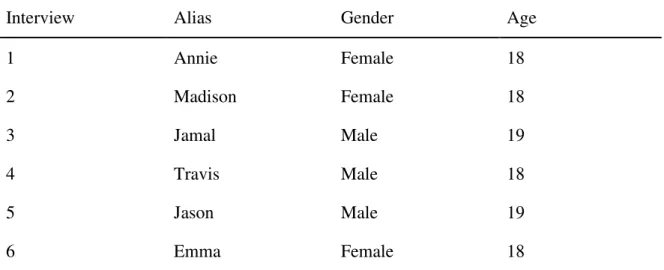
Participants were given an alias in order to keep their identity confidential. Table 3 outlines the participants.
Table 3 Participants
Interview Alias Gender Age
1 Annie Female 18 2 Madison Female 18 3 Jamal Male 19 4 Travis Male 18 5 Jason Male 19 6 Emma Female 18
The participants’ interviews were audio-taped and interview protocol (Appendix H) was followed. Participants were asked 32 interview questions (Appendix I) in which they were given a chance to respond. This group of participants was chosen because they were currently participating in the program and would have the most recent recollection of their experiences in high school as well as the first part of their collegiate experience. All participants responded to all questions presented.
Data Collection
Data collection for this research study began after approval was gained from the Intuitional Review Board. Permission was also gained from the Director of the Office of Academic Success and Intercultural Services (Appendix B) for the primary researcher to have access to basic contact information of the participants and to hold interviews in the quiet interview rooms located in the multicultural center.
Interviews were held in quiet interview rooms in the Office of Academic Success and Intercultural Services and were audio-taped. Participants were asked 32 questions (Appendix I). Interviews were semi-structured “allowing the researcher to respond to the situation at hand, to the emerging worldview of the respondent, and to new ideas on the topic” (Merriam, 2009, p. 90). The semi-structured format also allowed the researcher to probe further or ask follow-up questions to get more specific and in-depth responses from participants. Although the interviews were semi-structured, all thirty-two interview questions were asked in the same order and with the same wording for all participants.
Interview protocol “is a form designed by the researcher that contains instructions for the process of the interview, the questions to be asked, and space to take notes of responses from interviewee” (Creswell, 2012, p. 225). The interview protocol for this study included an interview script (Appendix H) and the interview questions (Appendix I). Participants had the right to answer questions how they wished, while also having the right to give no response or withdraw from the interview at any time. Data were
collected through the use of an audio-recorder and the data was later transcribed for further analysis. “Participant confidentiality was of utmost importance” (p. 232) and therefore participants were given an alias following their interview. “The lives and
experiences of participants should be told, but individuals from which the research was gleaned must be concealed” (p. 232). Upon completion of the six interviews, all data for this study were collected and ready for analysis.
Data Analysis
Audio-taped interviews were transcribed verbatim by a professional
transcriptionist. The transcriptions were done in word documents, which were then read three times through by the primary researcher. The first read and second read were to gain familiarity with the text. On the third read common wording was jotted in margins to gain an idea of similarities within the interviews.
“The object of the coding process is to make sense out of the text data, divide it into text or image segments, label segments with codes, examine codes for overlap and redundancy, and collapse these codes into broad themes” (Creswell, 2012, p. 243). The coding process was used to help make sense of the interview data collected. Specifically, in vivo codes were used by the primary researcher. The primary researcher expressed codes using both the participants’ actual words and her own language. Lean coding was used when first applying codes to the text. By inserting only a few codes the first time through the manuscript, the researcher was able to reduce a smaller number of codes to broad themes rather than working with an unwieldy set of codes at the outset (Creswell, 2012). Similar codes were grouped and more codes were added where needed. Specific quotes that supported codes were highlighted. Codes that were similar were condensed to create themes (Appendix K). “Themes are similar codes aggregated together to form a major idea in the database” (Creswell, 2012, p. 245).
From the themes that arose from the data, a description was applied to each theme to help further explain its meaning. Participant quotes that supported the theme and its description were also used to help provide detail and a realistic image to each theme. Quotes “provide emphasis and realism” (Creswell, 2012, p. 248) to the phenomenon being explored. Multiple perspectives were also valued in this research study as no two students’ transitional experiences were exactly the same. Multiple perspectives allowed the primary researcher to “provide several viewpoints from different individuals and sources of data as evidence for a theme” (p. 250).
Validation and Reliability of Findings
“To check the accuracy of their research, qualitative inquirers often employ validation procedures” (Creswell, 2012, p. 262) to ensure the accuracy of information and findings in the qualitative report. In this study three validation procedures were used to help increase credibility and ensure the validation and reliability of the findings. Adequate engagement was taken by the primary researcher during data collection to ensure that the data and emerging findings felt complete, that is the primary researcher began to hear or see repetition in the data and no new information was surfacing
(Merriam, 2009). Through the six interviews much repetition was found and very little new information was surfacing, giving the primary researcher evidence that the data emerging was fairly well-rounded and contained valuable information for analysis. Researcher position or researcher reflexivity was also taken into account. The primary researcher served as a graduate assistant in the Office of Academic Success and Intercultural Services and was considered a primary contact for students in the
familiarity with the student participants. With the position held by the primary researcher, student participants were more likely to view that their responses were understood and recognizable to the researcher. The primary researcher took special care to ensure that responses were taken verbatim and that findings were gained purely from student responses rather than from what the researcher already knew about the
Chancellor’s Scholars Program and the students. Lastly, peer examination of the results was completed by two of the primary researcher’s colleagues to ensure validation of the findings. The primary researcher’s academic advisor along with an outside reader examined the research material and findings to ensure extreme care and accuracy was taken in this research study.
Conclusion
Methodology of the research study was discussed in this chapter. The study was designed in a qualitative manner in order to provide a rich description and picture of the Chancellor’s Scholars Program and the effect is has on the transition process for first-year Hispanic students. Approval from the Institutional Review Board and from the Director of the Chancellor’s Scholars Program was received prior to the study. Upon approval participants were recruited via email and interviews were conducted. Interviews were audio-taped, transcribed, and analyzed to provide emerging themes. The findings from this research study will be presented in Chapter 4 by discussing the themes that emerged from the data analysis.
Chapter 4 Findings Purpose Statement
The purpose of this study was to explore the fears and situations of freshmen Hispanic students enrolled at a large Midwestern University who had received the Chancellor’s Scholarship and are participating in the Chancellor’s Scholars Program through the Office of Academic Success and Intercultural Services at the University. How participation in the Chancellor’s Scholars Program has aided them in the moving in phase of the transition process will also be determined. Nancy Schlossberg’s Transition Theory laid out factors that influence a person’s ability to cope with a transition: situation, self, support, and strategies, which are also known as the 4 S’s. These four categories were looked at in relation to the transition process for the Chancellor’s Scholars and to evaluate how participation in the program has aided each student’s transition into college.
Description of Participants
Six students participated in this study and met the following criteria: recipient of the 2011-2012 Chancellor’s Scholarship, participant in the 2011-2012 Chancellor’s Scholars Program, 18-19 years of age, first-year college student, and recognized as a National Hispanic Scholar. Six students were targeted, three male and three female, with emails welcoming them to participate in this study and all six agreed to participate. Each student was a current participant in the Chancellor’s Scholars Program, which meant they were required to meet certain activity and academic requirements (see page 3) and were also meeting regularly with a Chancellor’s Scholars staff member. Each student having