Early Text Classification using Multi-Resolution Concept Representations
A. Pastor L´opez-Monroy?, Fabio A. Gonz´alez†, Manuel Montes-y-G´omez‡§,Hugo Jair Escalante‡andThamar Solorio?
? Department of Computer Science, University of Houston,Texas USA
†Systems and Computer Engineering Department, Universidad Nacional de Colombia ‡Instituto Nacional de Astrof´ısica, ´Optica y Electr´onica, Puebla M´exico
§PRHLT Research Center, Universitat Polit`ecnica de Val`encia, Spain [email protected], [email protected], {mmontesg, hugojair}@ccc.inaoep.mx, [email protected]
Abstract
This paper proposes a novel document repre-sentation, called Multi-Resolution Represen-tation (MulR), to improve the early detection of risks in social media sources. The goal is to effectively identify the potential risk us-ing as little evidence as possible and with as much anticipation as possible. MulR al-lows us to generate multiple “views” of the text. These views capture different semantic meanings for words and documents at differ-ent levels of granularity, which is very use-ful in early scenarios to model the variable amounts of evidence. The experimental eval-uation shows that MulR using low resolution is better suited for modeling short documents (very early stages), whereas large documents (medium/late stages) are better modeled with higher resolutions. We evaluate the proposed ideas in two different tasks where anticipation is critical: sexual predator detection and de-pression detection. The experimental evalua-tion for these early tasks revealed that the pro-posed approach outperforms previous method-ologies by a considerable margin.
1 Introduction
Everyday there is a huge amount of people in-teracting in many social media sites. Unfortu-nately this immense cyber-world has been misused by cyber-criminals, who hide in the depths of the web. For this reason, the social media informa-tion has been increasingly studied in the context of applications related to security, forensics and e-commerce. Recently the early prediction sce-narios have attracted the attention of the scientific community (Losada et al., 2017), which aims to prevent major threats in a number of practical situ-ations by analyzing the text as evidence (e.g., sex-ual harassment, cyberbullying, etc).
In Natural Language Processing this emerging field is called early text classification and the goal
is to identify risky-target categories by using as few text as possible and with as much anticipa-tion as possible. In real scenarios the amount of evidence available from users under analysis is continuously growing. Consider for instance chat rooms, or posts and comments in social net-works, these text sources comprise cumulative evi-dence for early prediction that can be used to better capture the phenomenon under study (Escalante et al., 2017;Losada et al., 2017). This scenario has challenging particularities. For example, in early stages where 10% or 20% of the informa-tion is available it is necessary to model very short length documents, which tend to produce sparse and low discriminative representations. On the other hand late stages require to exploit as much evidence as possible to make accurate predictions. This dynamism between the document length and classification stages makes necessary an adequate representation, that naturally copes with the dy-namic amount of evidence in short and long texts generated by users at each stage. Traditional tex-tual representations, such as Bag-of-Words (BoW) (Joachims,1998), have problems dealing with so-cial media short texts since they cause the repre-sentation to be high dimensional and very sparse. Moreover, in the particular case of early risk pre-diction, class unbalance and noisy text also repre-sent a challenge.
In this paper we propose a representation that deals with these challenges by taking advantage of word vectors into a novel methodology for repre-senting documents. This representation generates high-level features, that we called meta-words, which capture concepts at different resolution lev-els. A meta-word is a primitive construction rep-resented by a vector that summarizes the informa-tion of semantically related words. Our methodol-ogy associates words with similar semantic mean-ing to the same meta-words. These meta-words
are obtained by applying clustering techniques to word representations, where the resultant “cen-troids” comprise the meta-words. Documents are then represented by a Bag-of-Centroids (BoC), that is, a histogram accounting for the occurrence of coarse thematic/semantic primitives, i.e., the meta-words. This part of the work is inspired by the Bag-of-Visual-Words (BoVW), which is widely used in computer vision to represent im-ages (Sivic and Zisserman,2004;Lazebnik et al., 2006).
The key aspect for early scenarios is that the number and size of meta-words, allow us to ma-nipulate the level of granularity or the resolution
of the representation. This property is very use-ful to capture discriminative information along the growing amount of available evidence at each early stage. We thus propose a multi-resolution approach, in which primitives at different reso-lutions are combined to capture feature concepts at multiple levels of detail. The contributions of this paper are twofold: (i) a new Multi-Resolution (MulR) document representation, a generaliza-tion to represent documents by exploiting word-vectors at different levels of resolutions; (ii) an empirical validation of the usefulness of multiple resolution levels for early risk detection on social media documents. Our experimental results show that this approach is a promising alternative for early text classification scenarios, where there is a need to make predictions as soon as possible, with little evidence, while at the same time, being ro-bust to incorporate more evidence as it becomes available. We recorded experimental results of an extensive evaluation of our proposed techniques over two benchmarks for early scenarios: sexual predator detection and depression detection. Re-sults showed that in all cases our methodology out-performs state-of-the-art methodologies.
Interestingly, document representations based on partitioning the word-embedding space, like ours, are somewhat similar to topic modeling based representations. In the experimental section we also compare the performance of our method to different topic-based representations like La-tent Semantic Analysis (LSA) (Deerwester et al., 1990) and Latent Dirichlet Allocation (LDA) (Blei et al.,2003). Experimental results showed that our method outperformed the reference techniques. We elaborate on the benefits and limitations of our proposed techniques later in this paper.
2 Related Work
The Early Text Categorization problem is an emerging research topic with scant work ( Dulac-Arnold et al.,2011;Escalante et al.,2016,2017). Recently, the relevance of the problem has moti-vated specialized forums such as eRisk-CLEF17 (Losada et al.,2017). One of the first attempts is based on processing documents in a sentence-level basis (Dulac-Arnold et al.,2011). At every timet,
the method reads a sentence and attempts to deter-mine the class of the document. The key aspect of the work is a Markov Decision Process (MDP), where each sentence is modeled in a TFIDF vec-tor. More recently, (Escalante et al., 2016) pro-posed a straightforward solution for early detec-tion scenarios by using the na¨ıve Bayes classifier. The idea consists in training with full documents, but when partial information has to be classified, the maximum a posteriori probability was esti-mated over the available text. Using this simple yet effective approach, the authors obtained com-petitive performance with the method in ( Dulac-Arnold et al.,2011). Furthermore, results reported in (Escalante et al.,2016) were the first evaluation on early sexual predator detection.
In (Escalante et al.,2017) the authors propose methods to exploit Profile Based Representations (PBR’s) for words (L´opez-Monroy et al., 2015). PBRs are Distributional Term Representations of terms in the vocabulary. Similar to word embed-dings these representations build a vector for each word, which aim to extract/learn concepts from simple occurrence statistics of terms in the tar-get classes. PBRs capture discriminative infor-mation in a very low dimensional and non-sparse space suitable for early text classification prob-lems. In other work, (Errecalde et al.,2017) suc-cessfully adapted a version of PBR’s for the prob-lem of early depression detection in the context of the eRisk-CLEF17 shared task. The evidence about PBRs suggests that this representation can naturally cope with missing information and ob-tain discriminative representations for incomplete documents. Nevertheless, just as the vast ma-jority of word embeddings in the literature for standard text classification, there is no consensus about how to exploit these term vectors to repre-sent entire phrases or documents (e.g., the most common strategy is to average the term vectors in documents).
meta-words to represent documents. Clustering meta-words into meaningful groups based on some measure of similarity to represent text is not a new concept. One of the classic approaches is term clustering in anunsupervisedmanner that was first investigated by (Lewis,1992). He called his method recipro-cal nearest neighbor clustering. His method con-sists of joining words that are similar according to a measure of similarity. In other work,Brown et al.(1992) explored the idea of discovering sim-ilarities between words to obtain clusters at dif-ferent levels. One key difference with our pro-posal is that in (Brown et al., 1992), terms are deterministically/probabilistically associated with a discrete class, where terms that are in the same class are similar in some aspect. However in our proposed strategy, we exploit word vectors instead of a discrete random deterministic variable (e.g., soft/hard partitions of word sets). This makes pos-sible to discover different clusters and meta-words if we change the word representation. Thus, the proposed strategy is highly adaptable to other do-mains, where the specialization would be achieved by changing the word representation for the prob-lem. In other work,Li and Jain(1998) found that term grouping helps to reduce the feature dimen-sionality, and at the same time, overcomes the gen-eralization problem of feature selection. The evi-dence has showed that the performance of the clas-sifier is, at least maintained (Li and Jain, 1998; Slonim and Tishby,2001). Finally, other authors have also studied the problem of term clustering under a supervised scheme. For example, Baker and McCallum (1998) used asupervised scheme to cluster similar words. They carried out exper-iments using a Naive Bayes classifier and found results improvement by using a single word repre-sentation.
The methods proposed in this research work follow a line of thinking focused on the docu-ment representation rather than term representa-tion. Hence, the proposed method takes advan-tage of specialized vector representation of words (e.g., PBR), but several extensions can be envi-sioned using other word embeddings in the liter-ature. The benefits of our approach are that it is model independent, easy to implement, and com-putes lower dimensional and less-sparse represen-tations than traditional BoW. More important, our method improves over state of the art methods, outperforming the methods in (Errecalde et al.,
2017;Escalante et al.,2017) that in turn, outper-form that in (Dulac-Arnold et al.,2011;Escalante et al.,2016).
3 Multi-Resolution Document Representation
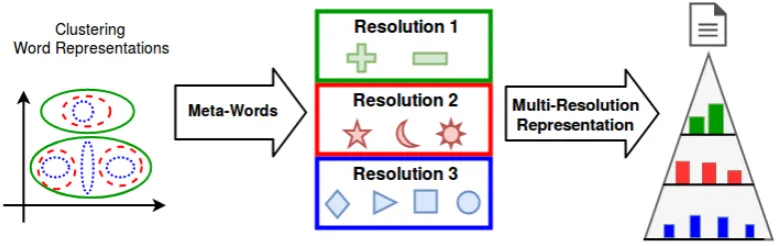
We propose a multi resolution representation that allows to generate multiple “views” of the ana-lyzed document. The intuition behind the pro-posal of a multi-resolution representation is that words will activate differently each view accord-ing to the amount of available text. We assume that having different resolution levels will allow to effectively represent the content of short and large texts as needed along different early stages. The proposed multi-resolution framework is depicted in Figure1. The idea consists in associating words with similar meaning to the same meta-words in each resolution space. Documents are then repre-sented by multiple Bag-of-Centroids (BoC), that is, multiple histograms accounting for the occur-rence of coarse concepts. Hence, this representa-tion can be seen as multiple BoW representarepresenta-tions that incorporate multiple semantic resolutions. In Section3.1we describe the process to build a Bag-of-Centroids at a single resolution, then in Section 3.2we formally present the Multi-Resolution vari-ant.
3.1 Single Resolution: Bag of Centroids LetD={(d1, y1), . . . ,(dh, yh)}be a training set of h-pairs of documents di and class labels yi. Also letV ={w1, . . . , wr}denote the vocabulary of terms (in our case words). In order to create the Bag of Centroids (BoC) representation of each document, we first compute the vector representa-tion vi of each word wi in the vocabulary of the collection. Note that our framework is agnostic to the underlying process for learning word represen-tations and therefore any word vector representa-tion can be used, for example word embeddings (Mikolov et al.,2013) or distributional term repre-sentations (Lavelli et al.,2004).
Figure 1: Algorithm to represent documents as meta-words using three hypothetical resolutions. The document is represented using the “meta-words” defined by the clustering of the vector representations of the vocabulary.
algorithm. For this purpose a variety of cluster-ing approaches can be used. In our experimen-tal evaluation, we explored different algorithms and found out that k-means offers a good
trade-off between performance and speed. We applied
k-means to the W representation to find the
cen-ter of the cluscen-ters C = {c1, c2, . . . , ck}, with k being the number of selected centroids. Then, based on these cluster centers and usingl1-norm,
we found a one-to-one association of each word to the closestcluster center in the word embedding space. In other words, for each wordvi, we can find an associated cluster center or meta-wordcu withu ∈ {1,2, . . . , k}. We denote this mapping bycu=closest(vi, C), whereclosestreturns the centroid inCwith the minimum distance tovi. Fi-nally, theBoCkrepresentation for each document
dj corresponds to BoCk(dj) = {(c`, n`)}`=1...k where c` corresponds to each of the k centroids andn` = |{vi|∀vi ∈ dj, c` = closest(vi, C)}|. In other words, BoCk(dj) corresponds to a his-togram of centroid frequencies, where each pair (c`, n`) represents a centroid (meta-word) and its corresponding frequency in the document.
The BoC algorithm depends on one parameter: the number of clusters used to represent each doc-ument. This parameter is associated with the level of semantic coarseness used in the representation. In this regard, coarseness refers to the level of meta-word inclusivity: the more words associated with a single meta-word, the coarser the represen-tation. Conversely, with fewer words, the repre-sentation becomes more granular. Note that this representation has well known parallels in the ex-treme cases. When each word becomes a cen-troid, the resulting representation is equivalent to the typical BoW representation, whereas a coarser representation, with only one meta word, will be
equivalent to having the average meta-word of the entire collection.
3.2 Multi-Resolution BoC
The above proposed framework is particularly suitable for incorporating multi-resolution pro-cessing, given that the main parameter is related to the granularity or coarseness of the representation. As we will show in our analysis, this property is useful for early scenarios, since few/coarse meta-words allow to better encode documents with little text, whereas many/granular meta-words are use-ful when more text become available. We propose to exploit this multi-resolution version of theBoC representation. In this extension of the basic al-gorithm, we use a partition of the word embed-ding space at multiple levels and concatenate them into a new representation. Combining the different granularities into a single representation results in a more robust document model that can help to capture different amounts of text as needed. Intu-itively, the coarser levels sufficiently classify doc-uments in early stages, while the more granular levels exploit the additional evidence from longer documents on late stages. We present quantita-tive and qualitaquantita-tive experiments that support this claim in two datasets: Sexual Predator Detection and Depression Detection.
We call this variation of the BoC represen-tation Multi-Resolution-BoC (MulR). Formally: MulR(dj) = {BoCk1(dj)∪BoCk2(dj)∪. . .∪
meta-words depicted with ’blue’ represent the more granular clusters, and those depicted with ’green’ represent the less granular clusters. The multi-resolution BoC variation improves the per-formance by combining the information present at various levels of granularity. Moreover, when doc-uments are closely related, more fine grained fea-tures allow to capture finer details and therefore produces better text classification results. This multi-resolution approach combines the advan-tages of both approaches to create an overall more effective classification method.
4 Data collections
For experiments we considered the two data sets described in Table2. The tasks are Sexual Preda-tor Detection (SPD) and Depression Detection, where clearly early detection is crucial. For the former we used the only publicly available data set for sexual predator detection (Inches and Crestani, 2012). This data set was released in the context of the sexual predator identification task at PAN-CLEF’12 and comprises a large number of chat conversations that include real sexual predators. Thus, the task approached is that of identifying those conversations that potentially include a sex-ual predator, as in (Villatoro-Tello et al., 2012; Escalante et al., 2013, 2016). For the depres-sion detection task we use the dataset presented in (Losada et al.,2017). In this dataset, each instance has the post history for a user, and depressed users were self-identified as having been diagnosed with depression.
5 Evaluation Framework
For our experiments, we lower case the text in doc-uments and use words and punctuation marks as terms1. The representation obtained for each
doc-ument is then processed by a Support Vector Ma-chine (SVM) with a linear kernel.
For the evaluation of theearlinessperformance, we report the performance of the different meth-ods when using increasing amounts of textual ev-idence (chunk by chunk evaluation). This eval-uation allows to quantify prediction performance when using partial information in documents, and it is a strategy that has been used to evaluate early classification (Escalante et al., 2016; Er-recalde et al., 2017; Losada et al., 2017). For
1We used terms with frequency higher than 10 in the
train-ing datasets.
the evaluation of performance we used thef1 = 2×precision×recall
precision+recall measure. This decision was made in agreement with previous work that reports this metric for the positive class (Errecalde et al., 2017). Please note that, contrary to other mea-sures, such as accuracy, f1 measure accounts for
the class imbalance problem when only the posi-tive class is analyzed. This is desirable for the data sets we consider as they are highly unbalanced.
Word-vector representations: As previously mentioned, the proposed MulR representation generalizes word-vector representations and thus can extend any representation that models each term in the vocabulary using a vector. For this purpose a wide variety of word embeddings or distributional term representations could be used. Both of them exploit the distributional hypothesis to build word vectors, nonetheless they differ in the strategy to capture the relevant information. In this work we use the widely used word2vec, but also other representations that have been used in recent works for these collections. In Table1we describe each of the word vector representations considered for this work2.
Baselines: The main baselines in this work are methods based on the idea of topic modeling for text classification. Topic-based representations group words into topics defined by a set of related words3. Given the strong relation to our method
we compare our proposal against Latent Seman-tic Analysis (LSA) and Latent Dirichlet Alloca-tion (LDA). Furthermore, we also compare with Bag-of-Words using Term Frequency Inverse Doc-ument Frequency, since it is a traditional baseline in text categorization tasks.
6 Experimental Results
In this section we report the experimental results for the MulR representation and the selected ap-proaches from the state-of-the-art. In all the exper-iments we trained the reference classifier (SVM) using full-length documents in the training dataset. In the testing phase, each approach uses all the available information in each of the ten chunks (each chunk increases the available text in 10%). More specifically, we generate document repre-sentations starting with the first chunk, and then incrementally adding one chunk at a time. The
2For distributional representations we used the framework
at https://github.com/lopez-monroy/FeatureSpaceTree
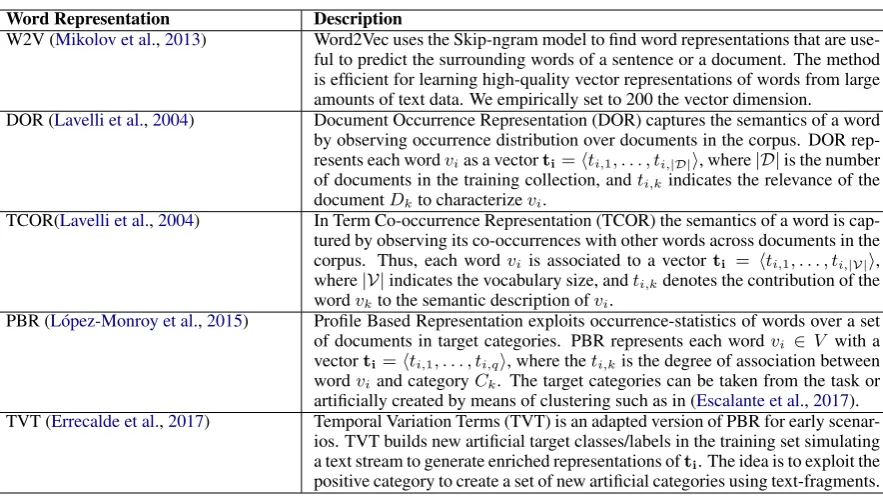
Word Representation Description
W2V (Mikolov et al.,2013) Word2Vec uses the Skip-ngram model to find word representations that are use-ful to predict the surrounding words of a sentence or a document. The method is efficient for learning high-quality vector representations of words from large amounts of text data. We empirically set to 200 the vector dimension.
DOR (Lavelli et al.,2004) Document Occurrence Representation (DOR) captures the semantics of a word by observing occurrence distribution over documents in the corpus. DOR rep-resents each wordvias a vectorti=hti,1, . . . , ti,|D|i, where|D|is the number
of documents in the training collection, andti,kindicates the relevance of the documentDkto characterizevi.
TCOR(Lavelli et al.,2004) In Term Co-occurrence Representation (TCOR) the semantics of a word is cap-tured by observing its co-occurrences with other words across documents in the corpus. Thus, each wordviis associated to a vector ti = hti,1, . . . , ti,|V|i,
where|V|indicates the vocabulary size, andti,kdenotes the contribution of the wordvkto the semantic description ofvi.
PBR (L´opez-Monroy et al.,2015) Profile Based Representation exploits occurrence-statistics of words over a set of documents in target categories. PBR represents each wordvi ∈ V with a vectorti=hti,1, . . . , ti,qi, where theti,kis the degree of association between wordviand categoryCk. The target categories can be taken from the task or artificially created by means of clustering such as in (Escalante et al.,2017). TVT (Errecalde et al.,2017) Temporal Variation Terms (TVT) is an adapted version of PBR for early
scenar-ios. TVT builds new artificial target classes/labels in the training set simulating a text stream to generate enriched representations ofti. The idea is to exploit the
positive category to create a set of new artificial categories using text-fragments. Table 1: Word vector representations for early experimentation.
Task Data set Training Test
[image:6.595.77.519.58.307.2]Sexual predator det. PAN’12 6588 15329 Depression det. eRisk’17 486 401 Table 2: Data sets considered for early experimenta-tion. There are only two classes in each dataset.
models will then make predictions incrementally as well. We report f1 performance when using
different amounts of text from test documents. For the proposed MulR representation, we build 5 dif-ferent resolutions: 10, 50, 100, 500, and 1000. The goal was to generate meta-words at different levels of granularity, and we plan to further explore the impact of these resolutions in our future research.
In the following experiments, we used the word representations in Table 1 to build our proposed MulR document representation. For comparison purposes we also generate an alternative document representation by averaging (Avg) term-vectors of words in each document, which is a popular strat-egy to build document representations. Finally, we also compare against several traditional baselines such as the Bag-of-Words, LSA, and specialized methods in each collection (Escalante et al.,2017; Errecalde et al., 2017). We evaluate the useful-ness of all these different representations in the two early classification tasks mentioned earlier.
6.1 Sexual Predators Detection
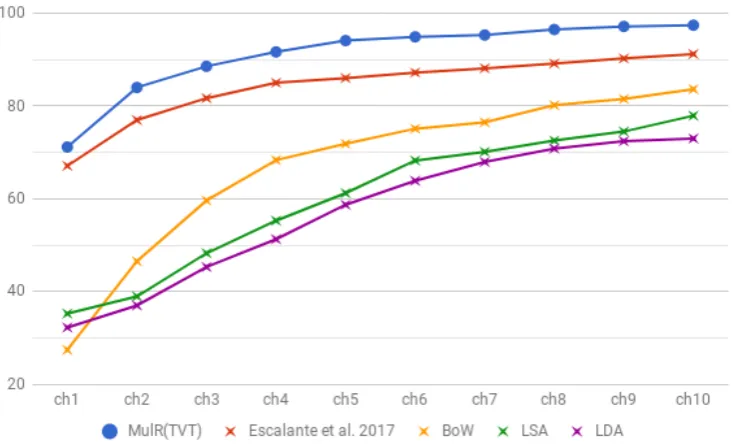
In this section we evaluate the performance of the proposed MulR and other reference
method-ologies for the SPD early detection task (Figure 2). We also show results for MulR and differ-ent word represdiffer-entations in Table 3, where sev-eral findings can be outlined. First of all, results obtained in early stages (chunk 1 to 4) using the proposed MulR are clearly superior to those ob-tained averaging word vectors. This is an interest-ing outcome, since the MulR representation seems to be useful for early scenarios independently of the word vector representation. In the particu-lar case of MulR(TVT), the representation obtains an outstanding performance when having little in-formation (e.g., performance between≈71% and
≈90% before reading 50% of the text). More
im-portant, performance improves as more evidence is available (i.e., see the steady improvement up to
≈97%). These results show that MulR is a robust
representation, even in the presence of different amounts of textual evidence, with a clear advan-tage for early classification sadvan-tages.
Figure 2:F1scores for the chunk by chunk evaluation of the reference methodologies in Sexual Predator Detection.
Method ch1 ch2 ch3 ch4 ch5 ch6 ch7 ch8 ch9 ch10
BoW-TFIDF 27.40 46.51 59.62 68.33 71.84 75.11 76.49 80.19 81.51 83.63
LSA 35.22 38.93 48.25 55.27 61.21 68.24 70.12 72.54 74.49 77.91
LDA 32.22 36.98 45.27 51.27 58.70 63.87 67.94 70.81 72.41 72.98
Avg(W2V) 55.74 63.87 70.11 82.53 87.24 88.97 88.01 87.45 84.71 83.12 MulR(W2V) 58.97 65.78 71.97 83.09 85.49 87.21 88.46 89.00 89.15 89.49 Avg(DOR) 66.71 76.54 81.01 91.14 92.23 93.91 95.19 95.87 96.47 96.59 MulR(DOR) 68.24 78.77 87.14 92.07 94.18 94.04 94.84 95.24 95.46 95.97 Avg(TCOR) 60.17 67.97 74.41 78.51 81.24 82.71 83.97 82.51 82.90 82.27 MulR(TCOR) 61.51 69.12 75.43 78.89 80.26 79.97 81.01 81.59 82.14 83.01 Avg(PBR) 67.10 76.97 81.69 85.00 86.03 87.21 88.14 89.16 90.25 91.21 MulR(PBR) 69.16 77.41 83.01 87.05 88.07 89.27 90.14 91.51 92.01 92.41 Avg(TVT) 65.74 80.24 86.19 90.25 92.02 93.13 94.39 95.23 95.89 96.58 MulR(TVT) 71.15 84.00 88.56 91.66 94.11 94.92 95.31 96.50 97.16 97.43
(Escalante et al.,2017) 67.10 76.97 81.69 85.00 86.03 87.21 88.14 89.16 90.25 91.21
Table 3: F1results for the chunk by chunk evaluation of different approaches in Sexual Predator Detection. The proposed MulR is evaluated using different word vector representations in the literature.
following interesting findings:
1. The most useful word vector representation is TVT (Errecalde et al.,2017). This is not sur-prising, since TVT is a specialized distribu-tion term representadistribu-tion for early predicdistribu-tion scenarios.
2. Word2Vec4representations obtained
moder-ate performance in all experiments. We infer that much more data of these specific social media domains are needed in order to build suitable models.
4Embeddings were trained in each dataset. We tested
pre-trained word embeddings for wikipedia/twitter, but the per-formance was worse.
3. MulR representation is an effective solution for all early chunks, but as more text is avail-able, the other methodologies significantly increase their discriminative power, as seen in results for later chunks. In fact, some representations such as Avg(DOR) can out-perform MulR(DOR) representation in late stages. However, even under these conditions MulR(TVT) and MulR(DOR) outperform all reference methodologies.
6.2 Depression Detection
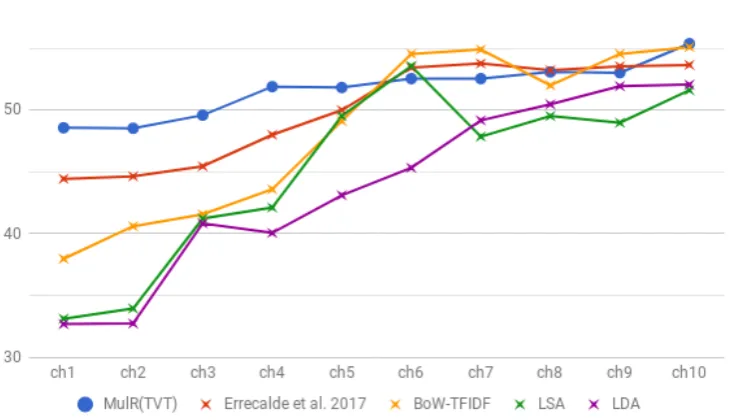
[image:7.595.89.511.335.493.2]Figure 3:F1scores for the chunk by chunk evaluation of the reference methodologies in Depression Detection.
Method ch1 ch2 ch3 ch4 ch5 ch6 ch7 ch8 ch9 ch10
BoW-TFIDF 37.97 40.60 41.56 43.59 49.12 54.55 54.90 52.00 54.55 55.10
LSA 33.12 33.94 41.22 42.11 49.52 53.57 47.86 49.52 48.98 51.61
LDA 32.68 32.73 40.83 40.06 43.11 45.33 49.17 50.47 51.94 52.06
Avg(W2V) 35.86 41.03 47.06 48.25 44.93 51.80 54.38 56.14 55.28 55.14 MulR(W2V) 41.34 43.79 47.20 48.44 47.67 52.00 53.91 54.18 54.29 54.39 Avg(DOR) 46.06 47.23 48.02 50.54 54.26 58.27 57.81 58.73 59.84 66.12
MulR(DOR) 47.55 48.12 48.38 51.83 55.56 58.49 52.43 53.06 57.73 54.35 Avg(TCOR) 37.42 44.44 44.60 48.64 49.64 53.33 52.94 53.44 52.46 58.32 MulR(TCOR) 44.76 47.95 46.81 48.32 51.47 52.11 54.01 54.55 56.30 57.06 Avg(PBR) 36.70 45.71 44.00 47.83 46.67 51.61 51.69 52.27 49.41 51.76 MulR(PBR) 40.98 46.15 44.83 48.70 50.00 53.10 57.39 54.55 54.55 55.86 Avg(TVT) 39.18 44.21 45.83 46.94 48.42 51.02 48.94 46.15 48.35 51.11 MulR(TVT) 48.57 48.53 49.59 51.90 51.83 52.55 52.55 53.09 53.03 55.38
(Errecalde et al.,2017) 44.44 44.64 45.45 48.00 50.00 53.44 53.77 53.23 53.55 53.66
Table 4: F1 results for the chunk by chunk evaluation of different approaches in Depression Detection. The proposed MulR is evaluated using different word vector representations in the literature.
out several interesting findings. The first one is that for this collection, results obtained by the pro-posal are clearly superior to others in early stages. In general, we can observe the following:
1. The most useful representation in early stages was MulR(TVT), which have considerable improvements between ≈5% and ≈2% in
chunks 1 to 4.
2. Word Embeddings and DOR showed a simi-lar behavior than in SPD. But in late stages, the best representation was Avg(DOR).
3. Depression Detection problem is a much harder problem than SPD. The F1 measure
is under≈60% in most of the results. This
could be due to the highly unbalanced dataset in two ways: i) the number of instances in each class, and ii) the amount of text con-tained in documents.
6.3 The Relevance of Individual Resolutions In this section we aim to study the role of the dif-ferent resolutions in early scenarios.5The purpose
of the first analysis is to observe the performance of each individual resolution in MulR. In Table5 we show the results of MulR(TVT) under each of the five resolutions (R1 = 10, R2 = 50, R3 =
100, R4 = 500, R5 = 1000) and each chunk.
5The number and size of resolutions, could improve the
[image:8.595.84.512.341.494.2]Sexual Predator Detection
Method ch1 ch2 ch3 ch4 ch5 ch6 ch7 ch8 ch9 ch10
[image:9.595.97.498.62.146.2]MulR(TVT)-R1 59.88 74.71 82.17 85.82 89.19 90.19 91.51 92.61 92.42 92.51 MulR(TVT)-R2 70.03 83.03 88.04 90.49 93.00 94.01 94.85 94.70 94.90 95.02 MulR(TVT)-R3 67.87 82.41 87.23 90.17 92.07 92.88 93.91 94.89 95.49 96.20 MulR(TVT)-R4 66.10 80.33 85.89 88.76 90.48 91.86 93.14 93.85 94.73 95.38 MulR(TVT)-R5 62.34 77.73 83.05 86.72 88.64 90.32 92.16 93.04 93.00 93.76 MulR(TVT) 71.15 84.00 88.56 91.66 94.11 94.92 95.31 96.50 97.16 97.43
Table 5: F1results for the chunk by chunk evaluation of different approaches in Sexual Predator Detection. The best MulR(TVT) is separately evaluated under each resolution.
For early SPD the evidence is clear; as the resolu-tion increases the performance in early stages de-crease.6 Also note that the higher the resolution,
the more chunks needed to outperform the result of the previous resolution. For example, resolu-tionR3outperformsR2in chunk 8. Also note that
R4 andR5 needed more chunks to obtain
compa-rable performance thanR2. Our experimental
re-sults excluding one resolution at the time showed worse performance, therefore all of them are es-sential in the overall classification. Clearly, this evidence shows that the MulR representation is in fact very useful.
Sexual Predator Detection
Test set R1 R2 R3 R4 R5
chunk-1 4 3 2 1 0
chunk-2 3 2 3 2 0
chunk-3 3 2 2 2 1
chunk-4 3 2 3 1 1
chunk-5 3 2 3 1 1
chunk-6 3 1 4 1 1
chunk-7 3 1 3 2 1
chunk-8 2 2 1 2 3
chunk-9 3 1 1 2 3
chunk-10 3 0 2 2 3
Table 6: Post-analysis in test dataset. Distribution of the top ten meta-words according to each resolutionRi
at different chunks. We used Information Gain (Hall et al.,2009) to rank meta-words in MulR(TVT).
In Table6we provide further evidence about the role of different resolutions. In this complemen-tary analysis we study each chunk at test data. For this we use the MulR learned in training to repre-sent test documents, then we compute the Infor-mation Gain using Weka (Hall et al.,2009) at each test chunk. In Table6we show the number of fea-tures in each resolutionRi that are present in the top ten meta-words of the MulR(TVT). The anal-ysis complements the evidence, lower resolutions have higher IG at early chunks, whereas higher
6The only exception to this isR
1, which has the lowest
overall performance. This is somewhat expected since this space only has 10 features to represent documents.
resolutions are more necessary in late chunks.
7 Conclusions
In this paper we proposed a multi resolution repre-sentation that allows to generate multiple “views” of the document. Intuitively these views expose different semantic meanings for words and doc-uments along different resolutions. The differ-ent resolutions allow to effectively represdiffer-ent the content of short and large texts at different early stages. The MulR obtained the best results re-ported so far on the early Sexual Predator Detec-tion task dataset (Inches and Crestani,2012). For Depression Detection the chunk by chunk evalu-ation shows promising results for MulR in early stages. What is more, it was shown that the MulR further improves the early recognition per-formance in the two tasks using different word representations. The relevance of the resolutions in these results is a key factor to understand the proposed MulR and future extensions. These re-sults provide solid evidence to further research on this topic and encourage researchers to apply and evaluate the usefulness of multi-resolution fea-tures for other relatedearlytasks.
Acknowledgments
This research was partially supported by CONACYT-M´exico (project FC-2016/2410).
References
Douglas Baker and Andrew Kachites McCallum. 1998. Distributional Clustering of Words for Text Classi-fication. InProceedings of the 21st ACM Interna-tional Conference on Research and Development in Information Retrieval. pages 96–103.
David M. Blei, Andrew Y. Ng, and Michael I. Jordan. 2003. Latent Dirichlet Allocation. Journal of Ma-chine Learning Research3:993–1022.
[image:9.595.112.252.383.510.2]1992. Class-based n-gram models of natural lan-guage. Comput. Linguist.18(4):467–479.
S. Deerwester, S. Dumais, T. Landauer, G. Furnas, and R. Harshman. 1990. Indexing by Latent Semantic Analysis. Journal of the American Society of Infor-mation Science41(6):391–407.
G. Dulac-Arnold, L. Denoyer, and P. Gallinari. 2011. Text classification: A sequential reading approach. InAdvances in Information Retrieval, Proc. of 33rd European Conference on IR Research, (ECIR’11). Springers, volume 6611 ofLNCS, pages 411–423.
Marcelo L. Errecalde, Ma. Paula Villegas, Dario G. Funez, Ma. Jos´e Garciarena Ucelay, and Leticia C. Cagnina. 2017. Temporal variation of terms as con-cept space for early risk prediction. InCLEF (Work-ing Notes).
H. J. Escalante, A. Juarez, E. Villatoro, M. Montes-y-G´omez, and L. Villasenor. 2013. Sexual preda-tor detection in chats with chained classifiers. In Proceedings of NAACL-HLT 2013, 4th Workshop on Computational Approaches to Subjectivity, Sen-timent and Social Media Analysis. page 46.
H. J. Escalante, M. Montes-y-G´omez, L. Villasenor, and M. L. Errecalde. 2016. Early text classification: a naive solution. In Proceedings of NAACL-HLT 2016, 7th Workshop on Computational Approaches to Subjectivity, Sentiment and Social Media Analy-sis. pages 91–99.
H. J. Escalante, E. Villatoro-Tello, S. E. Garza, A. P. L´opez-Monroy, M. Montes-y-G´omez, and L. Vil-lase˜nor-Pineda. 2017. Early detection of deception and aggressiveness using profile-based representa-tions. Expert Systems with Applications 89(Supple-ment C):99 – 111.
M. Hall, E. Frank, G. Holmes, B. Pfahringer, P Reute-mann, and I. Witten. 2009. The weka data mining software: An update.SIGKDD Explorations11.
G. Inches and F. Crestani. 2012. Overview of the in-ternational sexual predator identification competi-tion at pan-2012. InCEUR Workshop Proceedings, Working Notes for CLEF 2012 Conference. CEUR, volume 1178.
Thorsten Joachims. 1998. Text categorization with support vector machines: Learning with many rel-evant features. In Claire N´edellec and C´eline Rouveirol, editors, Machine Learning: ECML-98, Springer Berlin Heidelberg, volume 1398 ofLecture Notes in Computer Science, pages 137–142.
Alberto Lavelli, Fabrizio Sebastiani, and Roberto Zanoli. 2004. Distributional term representations: an experimental comparison. InCIKM. ACM, pages 615–624.
Svetlana Lazebnik, Cordelia Schmid, and Jean Ponce. 2006. Beyond Bags of Features: Spatial Pyra-mid Matching for Recognizing Natural Scene Cat-egories. InProceedings of the IEEE Computer So-ciety Conference on Computer Vision and Pattern Recognition. volume 2, pages 2169–2178.
David D. Lewis. 1992. An Evaluation of Phrasal and Clustered Representations on a Text Categoriza-tion Task. InProceedings of the 15th International ACM/SIGIR Conference on Research & Develop-ment in Information Retrieval. June, pages 37–50.
Yong Li and Anil Jain. 1998. Classification of Text Documents. The Computer Journal41(8):537 –546.
A. Pastor L´opez-Monroy, Manuel Montes-y-G´omez, Hugo Jair Escalante, Luis Villasenor-Pineda, and Efstathios Stamatatos. 2015. Discriminative subprofile-specific representations for author pro-filing in social media. Knowledge-based Systems 89:134–147.
David E. Losada, Fabio Crestani, and Javier Para-par. 2017. eRISK 2017: CLEF Lab on Early Risk Prediction on the Internet: Experimental Foun-dations, Springer International Publishing, Cham, pages 346–360.
Tomas Mikolov, Kai Chen, Greg Corrado, and Jeffrey Dean. 2013. Distributed Representations of Words and Phrases and their Compositionality. In Proceed-ings of Advances in Neural Information Processing Systems 26 (NIPS 2013). pages 1–9.
J. Sivic and A. Zisserman. 2004. Video data mining using configurations of viewpoint invariant regions. InCVPR. IEEE, volume 1, pages I–488.
Noam Slonim and Naftali Tishby. 2001. The Power of Word Clusters for Text Classification. In Proceed-ings of the 23rd European Colloquium on Informa-tion Retrieval Research. volume 1, pages 1–12.