ULISBOA at SemEval-2017 Task 12: Extraction and classification of
temporal expressions and events
Andre Lamurias∗1, Diana Sousa1, Sofia Pereira1, Luka A. Clarke2 and Francisco M. Couto1 1LaSIGE, Faculdade de Ciˆencias, Universidade de Lisboa, Portugal
2BioISI: Biosystems & Integrative Sciences Institute, Faculdade de Ciˆencias, Universidade de Lisboa, Portugal
Abstract
This paper presents our approach to partic-ipate in the SemEval 2017 Task 12: Clin-ical TempEval challenge, specifClin-ically in the event and time expressions span and attribute identification subtasks (ES, EA, TS, TA). Our approach consisted in train-ing Conditional Random Fields (CRF) classifiers using the provided annotations, and in creating manually curated rules to classify the attributes of each event and time expression. We used a set of com-mon features for the event and time CRF classifiers, and a set of features specific to each type of entity, based on domain knowledge. Training only on the source domain data, our best F-scores were 0.683 and 0.485 for event and time span iden-tification subtasks. When adding target domain annotations to the training data, the best F-scores obtained were 0.729 and 0.554, for the same subtasks. We ob-tained the second highest F-score of the challenge on the event polarity subtask (0.708). The source code of our system, Clinical Timeline Annotation (CiTA), is available at https://github.com/ lasigeBioTM/CiTA.
1 Introduction
This paper presents our system CiTA (Clinical Timeline Annotation) to participate in the Se-mEval 2017 Task 12: Clinical TempEval chal-lenge. Our team participated in the subtasks cor-responding to the identification of the following
∗
properties: time expression spans, event expres-sion spans, time expresexpres-sion attributes, event ex-pression attributes. Time exex-pressions had only one attribute, type, which could be DATE, TIME, DU-RATION, QUANTIFIER, PREPOSTEXP or SET. Event attribute identification consisted of four at-tributes: type (N/A, ASPECTUAL or EVIDEN-TIAL), polarity (POS or NEG), degree (N/A, most or little) and modality (ACTUAL, HEDGED, HY-POTHETICAL or GENERIC).
For this challenge, we developed a sys-tem, named Clinical Timeline Annotation CiTA1,
which uses IBEnt (Lamurias et al.,2015) to iden-tify the text spans of time and event entities based on machine learning and semantic techniques. CiTA also incorporates hand-crafted rules to as-sign the attributes to each entity. We trained one classifier for each entity type using Conditional Random Fields (CRF) and developed a set of rules for each attribute, based on the training data avail-able at each phase. This paper describes the fea-tures and resources used for each subtask, presents our results and discusses the main issues found. CiTA is publicly available in a GitHub reposi-tory2.
2 Methods
A corpus of clinical, pathology and radiology notes from the Mayo Clinic was available to the participants. This corpus contained notes for the source domain (colon cancer) and for the target domain (brain cancer). Each document was man-ually annotated with time and event expressions, as well as their attributes. The annotators and ad-judicators followed a set of guidelines which were also available to the participants. During Phase 1 only annotated colon cancer reports were
avail-1http://labs.fc.ul.pt/cita/
2https://github.com/lasigeBioTM/CiTA
able, and in Phase 2 thirty annotated brain cancer documents were also released.
The colon cancer dataset was partitioned in 3 sets: train, development and test. We trained the system with the train and development set, and op-timized with the test set. In Phase 2, we enhanced the classifiers by adding the brain cancer annotated documents. We ignored sections of the colon can-cer documents that were not annotated due to the guidelines.
2.1 Event / Time Entity Span Identification For both ES and TS subtasks we trained CRF classifiers on the training data annotations. We trained a CRF classifier for events and another for time expressions, using CRFSuite (Okazaki,
2007). These classifiers identified only the spans of the entities so that we can evaluate and improve the results of this subtask before classifying the entity attributes. This is justified in the context of the competition since the attribute classifica-tion subtasks are dependent on the span identifica-tion subtasks, and a poor performance on the span identification subtasks would affect the other sub-tasks.
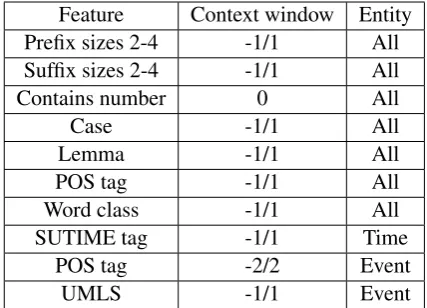
We used a set of common features for time and event expressions, based on previous experiments, that explored linguistic, orthographic, morpholog-ical and contextual properties of the tokens (Table
1). For most features, we considered a contextual window of size one, i.e., the value of the same fea-ture for the previous and next token. Lemma and Part-of-Speech tags were obtained using Stanford CoreNLP (Manning et al.,2014).
Furthermore, we selected specific features for time and event expressions. For time expressions, we used the NER tags given by SUTime (Chang and Manning, 2012), part of Stanford CoreNLP. SUTime is able to detect general time and date pressions, which is the case of some of the time ex-pressions in the gold standard. For the event clas-sifier, we matched each word in the gold standard to a Unified Medical Language System (UMLS) concept and used it as a feature if the confidence level was higher than 0.8. The matching was per-formed using LDPMAP (Ren et al.,2014). Many words were matched to UMLS since it is large vo-cabulary. However, by applying a high threshold, we ensure that only high quality matches are con-sidered.
During Phase 2, we analyzed some errors made
Feature Context window Entity Prefix sizes 2-4 -1/1 All Suffix sizes 2-4 -1/1 All Contains number 0 All
Case -1/1 All
Lemma -1/1 All
POS tag -1/1 All
Word class -1/1 All
SUTIME tag -1/1 Time
POS tag -2/2 Event
[image:2.595.309.523.62.216.2]UMLS -1/1 Event
Table 1: Features used for TS and ES subtasks.
by the colon cancer classifiers on the brain cancer training set. To overcome these errors, we auto-matically created a list of common false positives and false negatives for time and event expressions. We applied the false positives list to the output of the CRF classifiers as a filter, and performed a dic-tionary search with the false negatives list to iden-tify missed entities. We used these lists only on Run 2 of our Phase 2 submission.
2.2 Event / Time Entity Attribute Classification
Each event and time entity identified by CiTA was then classified according to the attributes defined by the task. To this end, we established a set of rules for each attribute using regular expressions. These rules were developed according to the anno-tation guidelines and training data. The rules de-veloped for modality and polarity attributes were based on the context windows of each event. Fur-thermore, we chose the default values of each at-tribute based on the frequency of each value on the brain cancer annotations.
We found that several expressions used in the context window of the event affected its modal-ity and polarmodal-ity. For polarmodal-ity, avoid, absent and
notindicated a negative polarity. If the context of the event did not include any of the expressions of our list, we classified it as positive (95.9% of the cases). For modality, we selectedACTUALas the default value (84.9% of the cases), since it is the most frequent value.
context windows would not include the relevant expressions. We fixed the window size of 5 for both polarity and modality. If the conjunctions
butorwithwere found in the context window, we cut the window at that point. These conjunctions change the subject of the sentence from the respec-tive event, and all words afterwards were ignored. Furthermore, we ignored any expressions that af-fected the polarity of an event if there was another event between the expression and that event. For example, if the expression notappears in the left context window of event A, but event B also ap-peared in the same window, betweennotand event A, then event A was classified as positive.
For the other attributes (event type and time type) we chose a different approach. Although we tried to formulate rules based on the context windows of each event and time entity we realized that it was more efficient to make a direct match between the attribute and the event or time entity. To classify type of events, as it was said on the set of the guidelines available to the participants, we realized that specific groups of verbs indicated a certain modality, for example, evidence (EVI-DENTIAL) or starting (ASPECTUAL), making it easy to recognize which verbs belong to this class. We developed rules based on each modality class, except for the default value (N/A) (94.7% of the cases). The rules used to classify the type of time expressions were slightly different. We had to identify which of the six attributes was the default or the one that included the widest ampli-tude of expressions. We started by making rules for each attribute by identifying the patterns in the gold standard, quickly realizing that the default at-tribute was DATE (59.3% of the cases). So we focused our attention on the definition of the other five attributes (PREPOSEXP, SET, TIME, DURA-TION and QUANTIFIER) by matching the differ-ent type of time expressions and possible varia-tions to each appropriated attribute.
3 Results
We submitted one run during Phase 1 and two runs during Phase 2. While during Phase 1 we only had access to source domain annotations, some target domain annotations were released for Phase 2. Hence, we were able to improve the perfor-mance of CiTA in relation to the target domain during Phase 2. Table2shows the official results for Phase 1 and Phase 2 Run 1 and 2. For each
run, we present the precision, recall and F1-score obtained in each subtask.
Compared to the results of Phase 2, Phase 1 re-sults were lower, particularly for Time span iden-tification (∆ = 0.069). The false positive filter applied on Phase 2 Run 2 improved the precision of the time span subtask, although at the expense of a lower recall. On the event span subtask it re-sults in a lower precision, with almost no effect on recall. In both phases, the results for time expres-sions were lower than for events.
The results of the time and event attributes are shown in combination with the span identification. This means that an entity is considered positive if both the span and attribute are found in the gold standard. Hence, we can evaluate the effect of the rules on the test set by comparing the scores of each attribute to the span identification score. Fur-thermore, we evaluated the accuracy of the rules on the colon cancer and brain cancer train sets (Ta-ble 3). We assumed that the attribute value was correct if it matched the gold standard. Table 3
shows the results obtained using the rules devel-oped for the second phase, which were tuned for the brain cancer data sets.
4 Discussion
The main challenge of this task was to adapt a system developed for a specific source domain to a different target domain. Systems trained on a specific domain, either using hand-crafted rules or machine learning, are biased for that domain. In real world scenarios, information extraction sys-tems need to be able to perform well in multiple domains. Although at first it seemed like the only difference between the source and target domains was the type of cancer, we observed that the re-ports and annotations were also different in terms of form of the documents and terms used. These differences contributed to lower scores obtained on the target domain test set, when compared to the source domain test set used in the previous edi-tion of this task (Bethard et al.,2016). Even using the brain cancer train set available during Phase 2, our best F1 score on the event span subtask was 0.16 lower than on the colon cancer test set.
Phase 1 Phase 2 Run 1 Phase 2 Run 2 Phase 2 Top F1
P R F1 P R F1 P R F1 P R F1
[image:4.595.77.523.61.154.2]Event span 0.618 0.765 0.683 0.649 0.831 0.729 0.637 0.830 0.721 0.69 0.85 0.76 Event modality 0.548 0.679 0.607 0.571 0.731 0.641 0.561 0.730 0.634 0.63 0.78 0.69 Event degree 0.610 0.756 0.675 0.642 0.821 0.720 0.630 0.820 0.713 0.68 0.84 0.75 Event polarity 0.600 0.744 0.664 0.630 0.807 0.708 0.619 0.806 0.700 0.68 0.83 0.75 Event type 0.598 0.741 0.662 0.629 0.805 0.706 0.617 0.804 0.698 0.68 0.83 0.75 Time span 0.441 0.538 0.485 0.517 0.598 0.554 0.520 0.588 0.552 0.57 0.62 0.59 Time type 0.393 0.479 0.432 0.483 0.559 0.518 0.485 0.548 0.515 0.54 0.59 0.56
Table 2: Results of our submission and for each task the results from the top F1 score submission of Phase 2. Notice thatTime typerepresentsTime span + Classcolumn of the results table published by the organizers.
Gold standard Colon Brain Event modality 0.914 0.891 Event degree 0.995 0.993 Event polarity 0.969 0.968 Event type 0.972 0.962 Time type 0.890 0.971
Table 3: Accuracy obtained using the rules devel-oped for each attribute, on the colon cancer and brain cancer train sets.
place on the Event polarity subtask, maintaining the third place on all the other event subtasks, ex-cept modality. In time span and type we are in third place in terms of recall.
4.1 Error Analysis
Some of the more persistent errors while classi-fying the type of time entities were that some of the time expressions presented in the gold stan-dard had double attribution. For example, time
sometimes appeared classified as TIME and in others as DURATION, and daily was classified as DATE, SET and QUANTIFIER. Although ini-tially we tried to introduce context windows of each time expression to help us solving this sys-tematic error, we realized that there was no explicit difference in the context of most of these words, so introducing context windows only harmed our efforts to achieve better results.
Some event attributes were incorrectly classi-fied due to the developed context window rules. For example, innot limited to loss of appetite, ap-petitewas incorrectly classified with negative po-larity since it had not in its left context window, and no event in-between. In some cases, the rule we implemented to ignore negation expressions between events resulted in incorrect positive po-larities. In the expression no second lesion seen in the brain, no did not affect seen because
an-other event, lesion appeared in its context win-dow. Howeverseenwas supposed to be classified as negative.
One limitation of a rule-based approach is that it is necessary to take into account every expres-sion that might affect an attribute. Since we had a limited amount of target domain training data, we missed some cases where more complex rules could have been applied. We had a rule that as-signed the modality of an event as HYPOTHET-ICAL if the expression mayappeared in the con-text window. This resulted in some errors, for ex-ample,with and there may be increased cerebral blood volume, the modality ofvolume should be HEDGED instead of HYPOTHETICAL.
5 Conclusions and Future Work
We obtained the second best F1 score on the event polarity subtask and third best on the event span and other event attributes subtasks. We made pub-licly available the source code of CiTA including the rules created to produce our results. The rules to classify event and time attributes were efficient, on the other hand the list of common false posi-tive and negaposi-tive created for Run 2 did not make a significant difference.
[image:4.595.104.259.220.305.2]Acknowledgments
This work was supported by the Por-tuguese Fundac¸˜ao para a Ciˆencia e Tecnolo-gia (https://www.fct.mctes.pt/) through the PhD Grant ref. PD/BD/106083/2015 and UID/CEC/00408/2013 (LaSIGE). We thank Mayo Clinic for providing THYME corpus and Sebasti˜ao Almeida for his contributions to our participation.
References
Marcia Barros, Francisco M Couto, et al. 2016. Knowledge representation and management: a linked data perspective. IMIA Yearbookpages 178– 183.
Steven Bethard, Wei-te Chen, James Pustejovsky, Leon Derczynski, and Marc Verhagen. 2016. SemEval-2016 Task 12 : Clinical TempEval pages 1052– 1062.
Angel X Chang and Christopher D Manning. 2012. SUTime: A library for recognizing and normalizing time expressions.Lrec(iii):3735–3740.
Francisco M Couto and H Sofia Pinto. 2013. The next generation of similarity measures that fully ex-plore the semantics in biomedical ontologies. Jour-nal of bioinformatics and computatioJour-nal biology
11(05):1371001.
Andre Lamurias, Luka A Clarke, and Francisco M Couto. 2017. Extracting MicroRNA-gene relations from biomedical literature using distant supervision.
PLoS ONE.
Andre Lamurias, Jo˜ao D Ferreira, and Francisco M. Couto. 2015. Improving chemical entity recognition through h-index based semantic similarity. Journal of Cheminformatics7(Suppl 1):S13.
Christopher D Manning, John Bauer, Jenny Finkel, Steven J Bethard, Mihai Surdeanu, and David Mc-Closky. 2014. The Stanford CoreNLP Natural Lan-guage Processing Toolkit. Proceedings of 52nd An-nual Meeting of the Association for Computational Linguistics: System Demonstrationspages 55–60. Naoaki Okazaki. 2007. Crfsuite: a fast implementation
of conditional random fields (crfs).