Proceedings of the 12th International Workshop on Semantic Evaluation (SemEval-2018), pages 793–797
UC3M-NII Team at SemEval-2018 Task 7: Semantic Relation
Classification in Scientific Papers via Convolutional Neural Network
V´ıctor Su´arez-Paniagua, Isabel Segura-Bedmar Computer Science Department
Universidad Carlos III de Madrid Legan´es 28911, Madrid, Spain
vspaniag,[email protected]
Akiko Aizawa
National Institute of Informatics 2-1-2 Hitotsubashi, Chiyoda-ku
Tokyo, Japan
Abstract
This paper reports our participation for SemEval-2018 Task 7 on extraction and clas-sification of relationships between entities in scientific papers. Our approach is based on the use of a Convolutional Neural Network (CNN) trained on 350 abstract with manually anno-tated entities and relations. Our hypothesis is that this deep learning model can be applied to extract and classify relations between en-tities for scientific papers at the same time. We use the Part-of-Speech and the distances to the target entities as part of the embedding for each word and we blind all the entities by marker names. In addition, we use sampling techniques to overcome the imbalance issues of this dataset. Our architecture obtained an F1-score of 35.4% for the relation extraction task and 18.5% for the relation classification task with a basic configuration of the one step CNN.
1 Introduction
Nowadays, there is a high increase in the publica-tion of scientific articles every year, which demon-strates that we are living in an emerging knowl-edge era. Experts cannot deal with this explo-sion of information and it is very hard to be up to date about the state-of-the-art techniques in a given field. This arduous task could be reduced if we automatically identify concepts from scien-tific articles and recognize the semantic relations between them with Natural Language Processing (NLP) techniques.
The Semantic Relation Extraction and Classifi-cation in Scientific Papers task at SemEval-2018 task 7 (G´abor et al.,2018) provides a framework for measuring the automatic annotation perfor-mance by models which are trained on scientific publications abstracts. The task defines six cate-gories of relations between concepts and two tasks
are proposed: (1) the classification of the relations between two entities in the predefined categories, which is divided in two scenarios according to the data used: clean or noisy; and (2) the extraction of the relations given the entities from the clean data, which also could involve their subsequent classifi-cation.
In this paper, we describe our participation for SemEval-2018 Task 7 on the extraction of rela-tionships between entities in scientific papers and also the subsequent classification in the predefined classes of this relations with one step classifier. The model is based on the Convolutional Neural Network (CNN) proposed in (Kim, 2014), which was the first work to exploit this architecture for the task of sentence classification. CNN is a ro-bust deep-learning architecture which has exhib-ited good performance in others NLP tasks such as semantic clustering (Wang et al.,2016), senti-ment analysis (Dos Santos and Gatti, 2014) and event detection (Nguyen and Grishman, 2015). The model uses as the input of each instance the transformation into real value vectors of the words of the sentence, the distances to the target entities of each word and the Part-of-Speech types. Fur-thermore, we carry out a sampling technique to al-leviate the imbalance issues of the dataset equaliz-ing the number of the instances for all the classes.
2 Dataset
An annotated corpus for training and testing the participating systems was provided in the SemEval-2018 Task 7. The dataset contains 350 and 150 abstract from scientific articles for train-ing and testtrain-ing set, respectively.
The relation instances are divided into the fol-lowing classes:USAGE,RESULT,MODEL,PART WHOLE,TOPICandCOMPARISON. All of them are asymmetrical except COMPARISON, where
both entities are involved in the same bidirectional relation. A detailed description and analysis of the corpus and its methodology used to collect and process the scientific abstracts can be found in (G´abor et al.,2018).
2.1 Pre-processing phase
The relations between scientific concepts are an-notated pair by pair in the abstracts. All anan-notated relations span within one sentence, thus, we split the paragraphs of the abstracts into sentences with NLTK tool1to generate all the possible instances in the corpus.
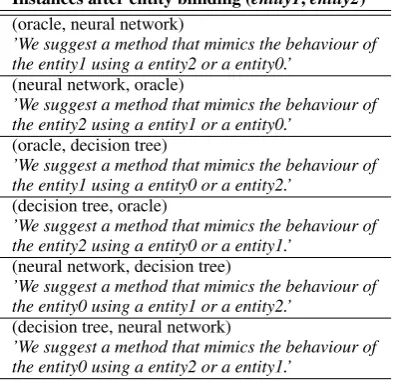
After that, each instance was tokenized, all words were converted to lower-case and special character were removed in order to clean the sen-tences as the approach described in (Kim,2014). In addition, we used entity blinding for each rela-tion to generalize the model, in which the two tar-get entities of the relations were replaced by en-tity markers as ”enen-tity1” and ”enen-tity2”, and ”en-tity0” for the remaining entities. Since relations can be asymmetrical, we considered both direc-tions. In other words, for each pair of candidates entities, we generated two different instances. For theCOMPARISON class, which is a bidirectional relationship, we annotated both instances with the same class label. For example, the sentence: ’We suggest a method that mimics the behaviour of the oracle using a neural network or a decision tree.’ should be transformed to the relation in-stances showed in Table1.
Instances after entity blinding (entity1,entity2)
(oracle, neural network)
’We suggest a method that mimics the behaviour of the entity1 using a entity2 or a entity0.’
(neural network, oracle)
’We suggest a method that mimics the behaviour of the entity2 using a entity1 or a entity0.’
(oracle, decision tree)
’We suggest a method that mimics the behaviour of the entity1 using a entity0 or a entity2.’
(decision tree, oracle)
’We suggest a method that mimics the behaviour of the entity2 using a entity0 or a entity1.’
(neural network, decision tree)
’We suggest a method that mimics the behaviour of the entity0 using a entity1 or a entity2.’
(decision tree, neural network)
[image:2.595.348.481.303.400.2]’We suggest a method that mimics the behaviour of the entity0 using a entity2 or a entity1.’
Table 1: Instances of a sentence in the corpus after ap-plying the pre-processing phase with entity blinding.
1http://www.nltk.org
Table2 shows the number of the instances ex-tracted in the training set per each class. TheNone class represents the number of pairs of entities that are not related (negative instances). The number of positive instances is very low compared to the neg-ative ones, 1323 over 19210 (around 7%), mainly because most classes are unidirectional and we an-notated the reverse instance asNone.
We followed a similar sampling technique de-scribed in (Wang et al.,2017) to adjust the same numbers of instances per each class. Therefore, we randomly discard 60% of the negative in-stances and we duplicate the inin-stances in each class until having the same number as the more representative class, 483 corresponding to US-AGE. Thus, we try to solve possible issues asso-ciated with the imbalanced dataset.
Classes Instances
COMPARE 190
MODEL-FEATURE 326
PART WHOLE 234
RESULT 72
TOPIC 18
USAGE 483
None 17887
Total 19210
Table 2: Number of instances in the dataset.
3 Method
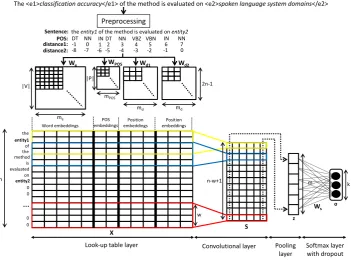
In this section, we present a CNN model to detect and classify relationships between scientific con-cepts. Figure1shows the whole process from its input, which is a sentence with blinded entities, until the output, which is the classification of the instance into one of the relation types defined by the task.
3.1 Word table layer
Firstly, we determinednas the maximum sentence length in the training dataset. Those sentences with lengths shorter than n are padded with an auxiliary token ”0”. After that, we assigned a ran-domly initialized vector for each different word, creating thus a word embedding matrix: We ∈
R|V|×me where V is the vocabulary size andm
e
is the word embedding dimension. Finally, we ob-tained a matrix x = [x1;x2;...;xn] for each
in-stance where the words are represented by their corresponding word embedding vectors.
[image:2.595.82.281.520.711.2]Position embeddings POS
embeddings
We
on
mPOS
Wd2
Wd1
Position embeddings Word embeddings
Convolutional layer Pooling
layer Softmax layerwith dropout Look-up table layer
The <e1>classification accuracy</e1> of the method is evaluated on <e2>spoken language system domains</e2>
Preprocessing
me
md md
entity2
… the
entity1
of the method is evaluated
0 0 0
w
n-w+1 m
|V| 2n-1
n
X S
z Ws
k
o WPOS
|P|
0
theentity1of the method is evaluated onentity2
DT NN INDT NN VBZ VBN IN NN
POS: Sentence:
distance1:
[image:3.595.124.476.64.324.2]distance2:-1-8 -70 -61 -52 -43 -34 -25 -16 07
Figure 1: CNN model for the semantic relation classification in scientific papers of SemEval-2018 Task 7.
maps the distances of each word with respect to the two candidate entities into a real value vec-tor using two position embedding matricesWd1∈
R(2n−1)×mdandW
d2 ∈R(2n−1)×md wheremdis
the position embedding dimension. Moreover, we extracted the Part-of-Speech (POS) feature of each word (entities are marked as common nouns) and create a POS embedding matrix as (Zhao et al., 2016)WP OS ∈ R|P|×mP OS whereP is the POS
types vocabulary size and mP OS is the POS
em-bedding dimension.
Finally, we created an input matrix X ∈
Rn×(me+mP OS+2md) which is represented by the concatenation of the word embedding, the POS embedding and the two position embeddings for each word in the instance.
3.2 Convolutional layer
Once we obtained the input matrix, we applied the convolutional operation with a context window of sizewto create higher level features. For each fil-ter inf= [f1;f2;...;fw], we created a score matrix
for the whole sentence as
si =g( w
X
j=1
fjxTi+j−1+b)
wherebis a bias term andg is a non-linear func-tion (such as tangent or sigmoid) ofmnumber of filters.
3.3 Pooling layer
We extracted the most relevant features of each filter using the max function, which produces a single value in each filter as zf = max{s} =
max{s1;s2;...;sn−w+1}. Thus, we created a
vec-tor z = [z1, z2, ..., zm], whose dimension is the
total number of filtersmrepresenting the relation instance. In the end, we concatenated the output values of the different filters in this layer.
3.4 Softmax layer
In this layer, we performed a dropout to pre-vent over-fitting obtaining a reduced vectorzd
ran-domly dropping elements inz. After that, we fed this vector into a fully connected softmax layer with weightsWs ∈ Rm×k to compute the output
prediction values for the classification as
o=zdWs+d
wheredis a bias term. At test time, the vectorzof a new instance is directly classified by the softmax layer without a dropout.
3.5 Learning
We defined the CNN parameter set to be learned in the training phase asθ= (We,WP OS,Wd1,Wd2, Ws,Fm), whereFmare all of themfiltersf. For
of a relationr obtained by the softmax operation as
p(r|x, θ) = Pkexp(or)
l=1exp(ol)
to minimize the cross-entropy function for all in-stances (xi,yi) in the training setT as follows
J(θ) =
T
X
i=1
logp(yi|xi, θ)
In addition, we minimized the objective function by using stochastic gradient descent over shuffled mini-batches and the Adam update rule (Kingma and Ba,2014) to learn the parameters.
4 Results and Discussion
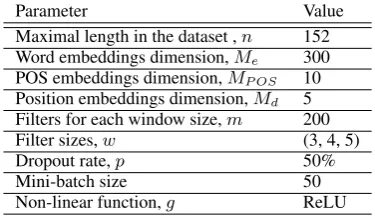
We define the CNN parameters for the experi-ments using the values described in Table3. The number of epochs was fine-tuned in the validation set using the stopping criteria.
Parameter Value
Maximal length in the dataset ,n 152 Word embeddings dimension,Me 300
POS embeddings dimension,MP OS 10
Position embeddings dimension,Md 5
Filters for each window size,m 200
Filter sizes,w (3, 4, 5)
Dropout rate,p 50%
Mini-batch size 50
[image:4.595.306.534.125.206.2]Non-linear function,g ReLU
Table 3: The CNN model parameters and their values used for the results.
Our CNN system obtained an F1-score of 35.4% for the relation extraction task in which only the detection of relation is taken into consid-eration. The official results obtained for the rela-tion classificarela-tion task are showed in Table4. Our model reaches an F1-score in Macro-average of 18.5% with one step classifier, which means that the extraction and classification are considered at the same time. This performance was expected be-cause we reached the similar results with a valida-tion set created from the training set. Furthermore, we correctly predicted 147 instances with correct directionality over 367 (i.e. 40.05% in coverage).
The main problem is the high number of FP in the majority of classes, which are the None in-stances classified as a class. In some classes such asPART WHOLEandUSAGEwe have also a high number of FN compared to the total number of in-stances. We consider that the main reason is that
the representation of the two directions of each re-lation is very similar, only the position distances and the target entity names are inverted, and the CNN cannot distinguish between them.
Classes TP FP FN P R F1
COMPARE 8 116 11 6.45% 42.11% 11.19%
MODEL-FEATURE 36 185 37 16.29% 49.32% 24.49%
PART WHOLE 22 66 60 25% 26.83% 25.88%
RESULT 2 21 14 8.7% 12.5% 10.26%
TOPIC 0 0 3 0% 0% 0%
USAGE 41 96 133 29.93% 23.56% 26.37%
Micro-averaged - - - 18.38% 29.7% 22.71%
[image:4.595.86.274.358.466.2]Macro-averaged - - - 14.39% 25.72% 18.46%
Table 4: Results over the dataset using a CNN model measured by True Positives, False Positives, False Neg-atives, Precision, Recall and F1-measure, respectively.
5 Conclusions and Future work
A CNN model is used for the Relation Classifica-tion task of SemEval 2018 by UC3M-NII Team. Moreover, we balanced the dataset using sampling techniques, blinded the entities in the sentence and aggregated position embedding and POS embed-ding to the word embedembed-ding of each word to have more representation of each instance. This archi-tecture obtained an F1-score of 35.4% and 18.5% for the relation extraction and classification task, respectively.
As future work, we proposed to use a two steps model to overcome the extraction of the rela-tionships between two concepts and subsequently classify them in the different semantic classes. In addition, we also plan to rule out the reverse in-stances of each class as None in order to avoid having very similar representation with different labels. We plan to tackle the directionality prob-lem with post-processing rules after the classifica-tion. Furthermore, we will train a CNN with dif-ferent pre-trained word embedding models instead of using a random initialization.
Funding
This work was supported by the Research Program of the Ministry of Economy and Competitive-ness - Government of Spain, (DeepEMR project TIN2017-87548-C2-1-R) and the TEAM project (Erasmus Mundus Action 2-Strand 2 Programme) funded by the European Commission.
Acknowledgments
References
C.N. Dos Santos and M. Gatti. 2014. Deep convo-lutional neural networks for sentiment analysis of short texts. InProceedings of the 25th International Conference on Computational Linguistics, (COL-ING 2014), Technical Papers, pages 69–78.
Kata G´abor, Davide Buscaldi, Anne-Kathrin Schu-mann, Behrang QasemiZadeh, Ha¨ıfa Zargayouna, and Thierry Charnois. 2018. Semeval-2018 Task 7: Semantic relation extraction and classification in scientific papers. In Proceedings of International Workshop on Semantic Evaluation (SemEval-2018), New Orleans, LA, USA.
Y. Kim. 2014. Convolutional neural networks for sen-tence classification. In Proceedings of the 2014 Conference on Empirical Methods in Natural Lan-guage Processing (EMNLP), pages 1746–1751.
Diederik P. Kingma and Jimmy Ba. 2014. Adam: A method for stochastic optimization. CoRR, abs/1412.6980.
Thien Huu Nguyen and Ralph Grishman. 2015. Event detection and domain adaptation with convolutional neural networks. In ACL-IJCNLP 2015 - 53rd Annual Meeting of the Association for Computa-tional Linguistics and the 7th InternaComputa-tional Joint Conference on Natural Language Processing of the Asian Federation of Natural Language Processing, Proceedings of the Conference, volume 2, pages 365–371. Association for Computational Linguistics (ACL).
Peng Wang, Bo Xu, Jiaming Xu, Guanhua Tian, Cheng-Lin Liu, and Hongwei Hao. 2016. Se-mantic expansion using word embedding cluster-ing and convolutional neural network for improvcluster-ing short text classification. Neurocomputing, 174, Part B:806 – 814.
Wei Wang, Xi Yang, Canqun Yang, Xiaowei Guo, Xi-ang ZhXi-ang, and Chengkun Wu. 2017. Dependency-based long short term memory network for drug-drug interaction extraction. BMC Bioinformatics, 18(16):578.
Daojian Zeng, Kang Liu, Siwei Lai, Guangyou Zhou, and Jun Zhao. 2014. Relation classification via con-volutional deep neural network. In Proceedings of the 25th International Conference on Computa-tional Linguistics (COLING 2014), Technical Pa-pers, pages 2335–2344, Dublin, Ireland. Dublin City University and Association for Computational Lin-guistics.