Its About Time: Link Streams as Continuous Metadata
Kevin R. Page, Don Cruickshank and David De Roure
Intelligence, Agents, Multimedia, Department of Electronics & Computer Science
University of Southampton, SO17 1BJ, UK
krp,dgc,dder
@ecs.soton.ac.uk
ABSTRACT
As enabling technologies become available there is an in-creasing use of temporal media streams, such as audio and video, within a hypertext context. In this paper we present the rationale and requirements for delivering continuous metadata alongside the media stream, and focus on linking as our case study. We consider the mechanism for delivery of the metadata across a distributed system, the format and content of the metadata flow itself, and the presentation of the media and augmenting metadata to the user. Two initial proof of concept applications have been developed to demon-strate these concepts, which we describe. Finally we propose a framework for highly distributed delivery and processing of multicast continuous metadata, as a part of the infrastructure necessary to provide a more complete multimedia environ-ment for hypermedia systems.
KEYWORDS: metadata, streamed media, open
hyperme-dia, temporal linking
INTRODUCTION
As hypermedia systems have grown, they have developed into rich multimedia environments incorporating many for-mats other than text and still images into the user’s expe-rience. Increasingly prevalent (and attractive to the user) amongst these formats are streamed media such as audio and video. Such streaming applications normally take one of three forms: pre-stored media (presentational media-on-demand); live broadcast media; and live interactive media (video-conferencing). The transmission mechanism can be one-to-one (unicast) or one-to-many (multicast).
How well can current solutions deliver such content? Adcock
et al. [Adc93] identify four resources required to support
distributed multimedia applications:
1. Explicit support for streamed (or temporal) media 2. The ability to specify and reserve a required Quality of
Service (QoS)
3. Synchronisation within and between multimedia ele-ments
4. Presentation and communication to and between groups of collaborating users
While no complete system or underlying network (mainly In-ternet) infrastructure yet fully meets these criteria, the pieces are beginning to fall into place: RTP [Sch96] and RTCP [Sch98] enable transport and control of streamed media; IPv6 [Dee98] brings promise of support for QoS architec-tures (such as IntServ [Bra94] and DiffServ [Bla98b]); mul-ticast routing will be expanded to encompass the entire In-ternet (again, enabled by IPv6), facilitated by application-level routing; the Amsterdam Hypermedia Model [Har94] brings the notion of temporal presentation to hypertext sys-tems; many of the ideas within it have become the basis for current and future versions of SMIL [Bug98]; and the many issues involved in synchronising communications have long been an important area of research within the multimedia community [Geo96].
In this paper we describe a further missing link—the process-ing and delivery of metadata accompanyprocess-ing the streamed me-dia. This metadata is intended to convey all types of informa-tion relevant to the associated media, and in the next secinforma-tion we present the case for distributing the metadata separately from the media and on a continuous basis. We then describe two ‘proof of concept’ systems in which the metadata takes the form of links: firstly our experimental ‘Temporal Linking Service’, and secondly a development of this built within an agent environment and implementing FOHM [Mil00]. We generalise this work to present a distributed framework for continuous metadata, which is then extended to encompass multicast. Finally we illustrate the application of continuous metadata through a number of scenarios.
CONTINUOUS METADATA
We can view a hyperstructure as metadata associated with a set of documents, a relationship explored in [Grø00]. In the multimedia context, we should expect to associate the hy-perstructure with multimedia documents including streamed temporal media [Bou99]. It is this latter case which is our focus here, with the hyperstructure itself having a temporal dimension; for example, a link might be valid only for a given time interval in an audio stream.
By considering where we might use it, we can categorise the metadata on two axes with regard to the associated temporal media data: when it is transmitted, and how it is transmitted.
Stored multimedia data, such as an audio or video record-ing, is a persistent entity which can be described by its as-sociated metadata in exactly the same way as any document, but with a temporal element. In a media-on-demand context, the metadata might be used to assist in finding, delivering and navigating the multimedia material; for example, the cre-ation of movies by assembling video clips (‘sharable video’, see [Pan00]) requires and creates metadata. The quantity of meta-information is likely to be small in comparison to the size of the original material. There may be little justifica-tion for streaming the metadata, which can be processed in advance of streaming the multimedia information, unless the metadata must be streamed due to sheer volume of data.
With live media, the metadata describing the structure of the content might not be available in advance, but instead becomes available during the generation of the multimedia stream (or streams). For example, this metadata could in-clude information about camera positions, or decisions the producer is making on-the-fly; live interactions might gen-erate links [Pim00]. It could also result from real-time pro-cessing of the stream, such as some form of classification, segmentation or annotation. It is sometimes acceptable to in-troduce a delay in such live media, which can give time for a pipeline of intermediate processes. An analogous situation can arise if the multimedia data takes a long time to present: a first viewer of a presentation lasting several hours may pro-vide useful annotations for a second viewer who accesses the presentation before the first has completed authoring -if metadata were preloaded at the start of the presentation the second user would not benefit from the information provided by the first (although the media stream is not live the meta-data is). In both cases the metameta-data cannot be guaranteed to be prepared in advance, and must be streamed at the same time as the multimedia content. In some other situations the streaming of pre-existing metadata could be necessitated by the absence of any other form of metadata transport; for ex-ample, a receive-only device joining a live radio or TV broad-cast at an arbitrary point in time.
Live media that connects two or more parties in real-time, such as video-conferencing, is the most demanding scenario. Session and party metadata may be available in advance, but content metadata is created on-the-fly and there is little
op-portunity for any pre-processing as there are tight time con-straints on this style of synchronous interaction. By way of example, the anchor generation system in OvalTine [Smi00] was designed with video-conferencing in mind. Collabora-tive virtual environments also impose real-time aspects, to-gether with the prospect of a wealth of metadata associated with the objects as well as the people.
The evolution of multimedia technologies and standards also promotes the capture of metadata ‘upstream’ in the produc-tion process; e.g. shots, script, storyboard. The MPEG stan-dards are evolving (through MPEG-7 [Nac99]) to accommo-date this, and associated metadata, within a combined data stream. While there are advantages to transmitting and stor-ing multimedia data with the metadata embedded in this way, we believe there are also situations where metadata should be handled separately and delivered synchronously.
A flow of metadata which is distinct from the multimedia data flow not only follows the open hypermedia convention of separation of links [Dav95] (where links are metadata for a document), but also allows for a much more flexible framework of distributed delivery, processing and presenta-tion; metadata can originate and be used in different places to the multimedia content, indeed they may reach the user through different mediums. For instance, while an audio-video stream might reach the user through a traditional tele-vision broadcast (e.g. cable or satellite) the metadata may arrive through an Internet connection.
In any of the above scenarios the multimedia data flow may be unicast or multicast, and this also applies to the live meta-data; however, it might not be the case that every party needs to receive identical metadata flows, and metadata processing nodes may not require the multimedia stream at all, thus a separate metadata flow is preferable.
Although the metadata we refer to is streamed, it may be
better to think of it as continuous metadata. The word
‘stream’ has become closely associated with real-time audio and video, and often (incorrectly) implies a non-stop flow of relatively high bandwidth data. Continuous metadata need not be high volume, and there may be significant lulls be-tween bursts of data (although the transporting connection is kept open); but the transmission timing of the metadata does have significance, and it will normally be augmenting contin-uous, streamed, media - henceforth known as ‘mediadata’.
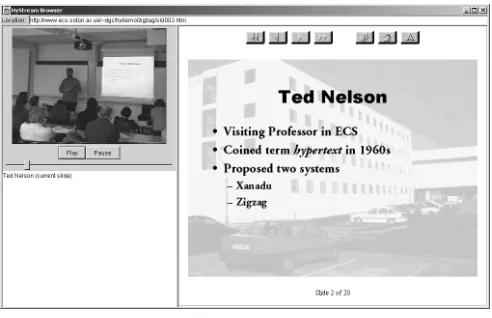
Figure 1: The TLS Client. Links from the semi-nar video resolve to the presentation slides in this simple scenario
THE TEMPORAL LINKING SERVICE
Our first experience of temporal linking (without streams) was the Microcosm SoundViewer [Goo95], which was sub-sequently extended to use RTSP in order to work with streamed media. This was used in conjunction with a number of other tools that were described in [DR98]. These tools, which were designed for media-on-demand scenarios, used time intervals in the temporal media stream as anchors; in-tervals could also be used to identify fragments of content from which features could be extracted for ’content-based navigation’.
Building on this experience and to demonstrate the con-cepts outlined in the previous section, the Temporal Linking Service (TLS) was developed to deliver continuous linking information (metadata) to hypermedia clients. Client and server applications have been developed in Java using the Java Media Framework (JMF) to stream the mediadata us-ing RTP (a screenshot of the client is shown in figure 1). While this enables provision of applet based clients, it also limits the system to streaming formats supported by JMF. TLS metadata takes the form of links relevant to the me-dia which the client can resolve through its associated web browser. The server retrieves the metadata from its ‘linkbase’ (i.e. link database) and uses XML markup to deliver it to the client. We have designed our own HTTP-like protocol to explore synchronisation issues between TLS servers and clients.
On-time delivery of metadata from the client to the server is preferred over delayed, but guaranteed, delivery. Our pro-tocol must enable each component in the system to deter-mine the local transmission deadline of each item of tem-poral metadata; we anticipate situations in which late meta-data should be dropped before entering the metameta-data stream to increase the chances of other metadata reaching the client within time.
Protocol
The Temporal Linking Service allows a connected client to select a continuous metadata flow via some kind of descriptor (i.e. URI), and to receive a ‘never-ending’ linkbase relevant to that descriptor. In this paper, we do not describe how the server arranges or discerns the linkbase, but the actual proto-col between a TLS aware browser and the TLS server. The Temporal Linking Transfer Protocol (TLTP) is derived from HTTP/1.1, and sends commands via a TCP socket connec-tion; the metadata flow is maintained for the duration of the connection. A summary of commands is shown in table 1; a more extensive description of the protocol operation can be found in [Cru01].
The metadata payload (i.e. link data) is augmented with timing constraints, so that the client browser can display the links with temporal relevance. It was decided to use XML to markup this data, which led to a number of possi-bilities for delivering this data within the TLTP flow. For longer and more complicated quantities of metadata (and payload) it would seem sensible to use a succession of sep-arate XML documents, which would also maintain docu-ment form and integrity should the flow be broken midway through. To maintain simplicity, however, we use multiple elements within a single XML document (a technique also used by SXML [Rog00]).
Delivery of a particular link is delayed up until a certain point which is specified by the client via the BIAS command. Tem-poral navigation (i.e. fast forward and rewind) within the me-dia causes the client to issue successive BIAS commands to maintain coherency between the browser and the TLS server.
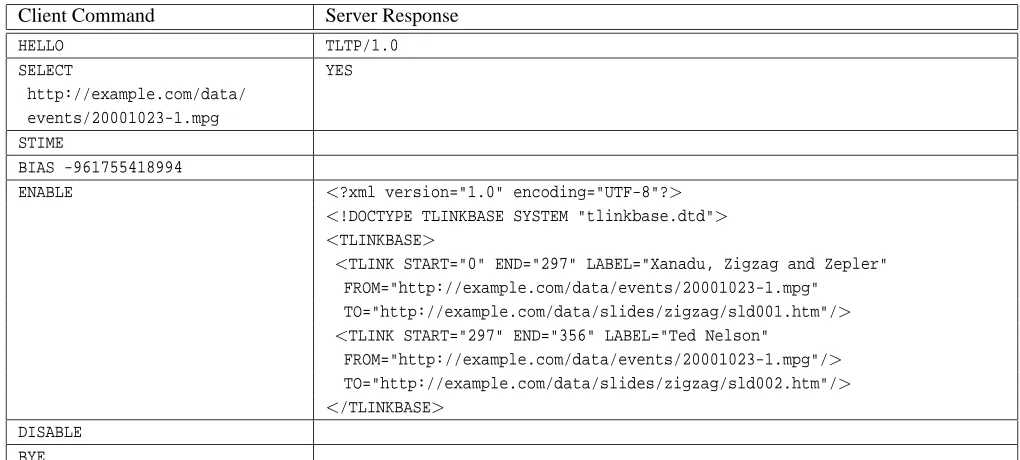
Table 2 shows an example session transcript of a client re-ceiving metadata about a seminar presentation.
In this implementation, we note that our TLS Client is able to receive metadata flows in dynamic network environments by analysing the lateness of each link as they it is received. If no link has been received during certain period, the client issues an STIME command to ensure synchronisation with the server.
This initial TLS prototype stores metadata as simple uni-directional links on the server. In the following section, we describe an implementation where links are stored and com-municated using the Fundamental Open Hypermedia Model.
FOHM IMPLEMENTATION
Command Description
HELLO The server responds with ”TLTP/1.0” to indicate that this server is capable of conversing the TLTP protocol.
BYE InvokingBYEtells the server to close the connection.
SELECT
URI
This command is used to select the media stream that the TLS server server delivers links about. The server
responds withYESorNOto tell the client if it knows of any metadata about the selected media stream.
STIME TheSTIMEcommand requests that the server return the value of the server’s local clock. The result is used
by the client to determine a suitable value for theBIAScommand.
BIAS
n TheBIAScommand informs the server of the time difference between the server clock and the client clock.
ENABLE Tells the server to start metadata delivery of the temporal linkbase. It is important to note that the XML
doc-ument is not delivered immediately; rather each
tlink element is delivered shortly before its deadline.
DISABLE Tells the server to stop metadata delivery. If an XML document is in the process of delivery, the document is finished to ensure that well formed XML is produced.
Table 1: Summary of client to server TLTP commands
data from an agent that conforms to the Fundamental Open Hypermedia Model [Mil00]. In this system, the TLS server agent in effect becomes a client agent for a FOHM server agent. Link data is inserted into the FOHM server agent’s knowledge base, and is extracted in temporal order.
Temporal link information is stored within the FOHM model by extending items within the knowledge base with time
Loc-Specs. The FOHM client agent receives links with their
as-sociated LocSpecs. In a non-live scenario, we can simply perform a single query to the FOHM server agent, requesting all link information about a particular media flow. The live scenario, however, requires a more demanding conversation between the two agents. The knowledge base of the FOHM server agent is continuously expanded, thus the FOHM client agent is required to periodically query for link data that lies within a specified time range. In a finely tuned system, the FOHM server delivers a block of link information just before it is to be delivered as a continuous link flow to a TLS client.
The SoFAR framework performs a match-making service be-tween agents: a FOHM client queries the SoFAR registry for FOHM server agents. Thus when a FOHM server agent is started within the SoFAR environment, it needs to register its ability to serve FOHM linkbases with the SoFAR reg-istry. During this process the server agent can restrict the nodes within the network to which it will advertise services, so limiting the possibility of overloading. The matching ser-vice of SoFAR also allows an agent to specify the particular media flow a server delivers. So a FOHM server would only be matched with FOHM clients that asked for the advertised media flow, allowing us to add extra agents dynamically for a particular media flow when demand for that flow is high.
In contrast to the first TLS prototype, we note two features gained from integrating the Temporal Linking Service with FOHM and the SoFAR framework: firstly, the FOHM model allows us to add a temporal dimension to existing FOHM metadata by way of the LocSpec mechanism; secondly, the match-making service of SoFAR gives the TLS client a ser-vice discovery ability. In the first prototype the TLS client
needs to know exactly which metadata server to access, as it requires the internet address and port number of the metadata server. The SoFAR registry enables TLS Servers to advertise their services, so that the TLS clients can ask the SoFAR framework directly about media flows instead of servers.
A DISTRIBUTED FRAMEWORK FOR CONTINUOUS
METADATA
The Temporal Linking Service and FOHM implementation demonstrate the usefulness of continuous metadata. In this section we will develop these ideas within a more general conceptual framework for the delivery of continuous meta-data in a distributed environment (such as the Internet). The greatest strength of the WWW as a hypertext system is its highly distributed nature; we see a framework such as this as a first step to providing a corresponding architecture for multimedia data and associated metadata.
Mediadata and Metadata
As with the TLS, the framework will deal with mediadata and metadata, where a separate and distinct continuous metadata flow carries additional data about a corresponding mediadata flow. Although the framework caters for a more general sce-nario, we would normally expect the mediadata to take the form of a multimedia stream, such as audio or video, which can be characterised as a continually evolving flow of data— one frame of a video generally has a direct relationship with the previous. Metadata, on the other hand, will be split into discrete chunks of information within the continuous meta-data flow.
Client Command Server Response
HELLO TLTP/1.0
SELECT YES
http://example.com/data/ events/20001023-1.mpg STIME
BIAS -961755418994
ENABLE ?xml version="1.0" encoding="UTF-8"?
!DOCTYPE TLINKBASE SYSTEM "tlinkbase.dtd" TLINKBASE
TLINK START="0" END="297" LABEL="Xanadu, Zigzag and Zepler"
FROM="http://example.com/data/events/20001023-1.mpg" TO="http://example.com/data/slides/zigzag/sld001.htm"/
TLINK START="297" END="356" LABEL="Ted Nelson"
FROM="http://example.com/data/events/20001023-1.mpg"/
TO="http://example.com/data/slides/zigzag/sld002.htm"/
/TLINKBASE
[image:5.595.51.561.88.318.2]DISABLE BYE
Table 2: Example TLTP transcript
most cases it is desirable to designate the mediadata flow as that which carries the high volume multimedia information (since it will have the greatest amount of associated meta-data).
We should also note that just because a metadata flow may develop a derivative metadata flow “about” it, this does not make the derivative flow “meta-meta”-data, nor does it imply the original metadata should become a mediadata flow. The derivative flow merely becomes another metadata flow based on the original mediadata, albeit one with a more complex relationship with other metadata.
Firstly, we will consider how the framework should han-dle point-to-point media and metadata flows by introducing the various elements which make up a simple version of the framework.
Sources and Flows
There must be a point at which the mediadata enters the framework, and we refer to this point as the mediadata
source. For simplicity, we initially presume that each
me-diadata flow is derived from a single source; with a more complex implementation there is no reason why a mediadata flow cannot enter the framework in a distributed manner. The method by which the content of the mediadata is transported through the framework should be suitable for that data type, e.g. RTP for audio or video. The framework should be rel-atively agnostic with regard to the method of transport, al-though the protocol used should ensure timely delivery and
must be able to provide identity and timing information to the
framework (for presentation and synchronisation purposes, discussed later).
The metadata source is the point at which a continuous
meta-data flow enters the framework. This may be at the same point as the mediadata source or it may be distributed at a dif-ferent point: for a live news feed a provider might construct a metadata flow of relevant links at the same broadcast point as the mediadata; while viewing a video of a pre-recorded lec-ture a user may wish to receive metadata annotations from a source other than that of the original lecture.
The metadata source must always output information in a temporally relevant manner, and to do so it may require a flow of mediadata from the appropriate source. If we pre-sume that the mediadata flow will be a continuous stream, then in a recorded broadcast scenario pre-compiled metadata can either be sent along the appropriate metadata stream to arrive ahead of the relevant mediadata, or held back to be transmitted in near synchronisation with the mediastream. In the first case the receiving end of the metadata flow must buffer the data, in the second the source buffers instead. Al-ternatively, in a live broadcast scenario the metadata would normally be created as the mediadata is sent, so there will al-ways be a processing delay which causes the metadata to lag behind. Here either the mediadata source must be buffered awaiting the readiness of the metadata, or the receiving end of the metadata must buffer the mediadata instead. Of course, in a live two-way conversational situation the scope for delay and buffering is greatly reduced; otherwise the system would become unusable.
re-placed through interpolation. So the transport mechanism for metadata flows must be real-time and reliable - although RTP could be used over a reliable transport its whole design is tai-lored to an unreliable scenario, hence is it unsuitable. (At best, a contrived transport could be designed to assign one atomic ‘chunk’ of metadata to each transport level packet so that if one packet were lost or out of order it would not in-validate other chunks; we do not see this as a very feasible solution). In the future we expect QoS enabled networks will allow guaranteed delivery of the type required to occur.
To encode the metadata flow above the transport layer, a derivative of the TLS XML markup would seem suitable, and if the metadata carried in its payload is also encoded using XML, the namespace [Bra99] mechanism could be usefully employed.
Presentation
We will refer to the point at which a user views and uses a combination of media and metadata flows as a presenta-tion point. (This is a deliberate avoidance of client / server terminology since it will become apparent that within this framework a ‘client’ to one ‘server’ can be a ‘server’ to an-other.) There is no reason why a presentation point should only be the convergence of a single mediadata and metadata flow; it should pull together and synchronise as many meta-data flows as the user requests. Since a mediameta-data flow is the timer against which other flows are synchronised, any metadata flow used at a presentation point must have been derived from that mediadata at some point. Multiple presen-tation points for multiple mediadata flows can exist on one machine, for one user, at the same time, but they should be dealt with as separate entities within the framework.
The presentation mechanism also starts to place requirements on the information the framework must encode in the meta-data flow (in addition to the metameta-data itself):
1. The metadata must have an identifying code. When mul-tiple flows are combined at a presentation point an identifier is needed to deal with packets from a particular flow in a con-sistent manner; the identifier should also allow derivation of the mediadata flow with which it must be synchronised. 2. To synchronise the media and metadata, each packet of metadata must have a pair of validity timestamps bounding when the metadata is true in relation to the mediadata and the timing information embedded within it.
3. For user presentation there should be another pair of timestamps bounding a extension around the valid time, dur-ing which it is suggested that the metadata is displayed (al-though this could be overridden by user presentation prefer-ences).
4. To present the metadata in a suitable manner there must be a code to describe the content type of the payload the meta-data packet is carrying. Although the content code needs to be standardised within the framework, the format of the con-tent itself need not be.
Recorded lecture: video (mediadata) & associated lecturer’s notes
(metadata) Mediadata
Source MetadataSource
Presentation Point Mediadata flow (RTP)
If the metadata is derived from real-time analysis of the lecture it requires a mediadata flow
Local preference and context filter Student’sMachine
Metadata flows
Specialist node adds relevant information to the flow
To other students’ filter chains
(b) (a)
Presentation Point Mediadata Source
RTP Server
Metadata Source TLS Server
TLS Client Mediadata flow (RTP)
[image:6.595.319.567.101.258.2]Metadata flow (TCP / TLTP)
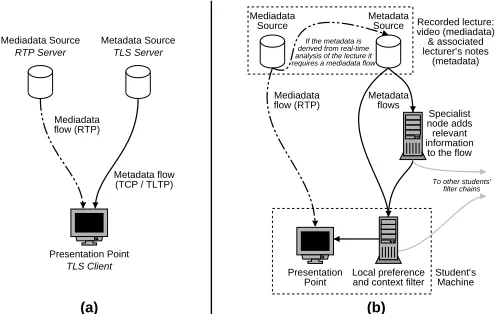
Figure 2: Simple framework configurations: (a) The Temporal Linking Service; (b) A unicast im-plementation of the recorded lecture presentation scenario
Once the mediadata and metadata have been delivered by the framework to a presentation point, it is expected that actual display of the information to a user would take place in coop-eration with a mechanism suited to the purpose, e.g. a SMIL [Bug98] enabled browser.
At this point we can use the features of the framework to describe the TLS system developed in the previous section (figure 2(a)).
Filters
While the ability to select different metadata sources for a particular mediadata flow is useful, the real flexibility of the framework is through the introduction of processing nodes between the metadata source and the presentation point.
These filter nodes are distributed throughout the framework, taking one metadata flow as their input, modifying the meta-data in some way, and then outputting a new metameta-data flow. The output of one node can be linked to the input of another so that the end result of metadata processing between source and presentation is formed from a series of simpler, more specialised, processing steps within the framework, thus ex-tending the concept of filter chains introduced in the Micro-cosm Open Hypermedia System [Dav92]. Each filter is ex-pected to perform a relatively specific form of processing, and by doing so it can be located at a point where the re-sources it may require are best available. As a result of this, individual metadata flows within the framework should carry specific types of metadata payloads to allow maximum flexi-bility between filters. A filter should not have to de-multiplex a metadata flow so it can select only relevant data. Separation of the metadata from the mediadata flow means that many fil-ter nodes will not need to receive the original mediadata flow, conserving network resources.
metadata from source to presentation point. In minimising this delay we clarify the question of buffering presented ear-lier: to give the filters as much processing time as possible, metadata should leave the source as soon as it can, which would normally require mediadata buffering at the presenta-tion point.
The end effect of a filter should be to either add or subtract metadata from that which a user receives at a presentation point. To add data, the filter output flow can be synchronised with the original metadata flow at the presentation point. To remove, or truly filter, the metadata, the filter output should be the only flow accepted at the presentation point: the origi-nal flow must be dropped. To accommodate this, metadata flow identities must incorporate the notion of derivatives, such that the history of a flow can be traced back through fil-ters to the original metadata source identity. Suggested pre-sentation relationships (flow x must be presented with flow
y, but should not be presented with flow z) also need to be
encoded in the metadata flow.
Control
Even with buffering at the presentation point, network con-gestion could delay metadata flows which need to be hard synchronised with others; in this situation the stalled flow can either be dropped, or the remaining flows must be paused
while waiting for resumption. Other pauses or temporal
movements may be user controlled, since the metadata flows must be paused once the mediadata is. To provide such func-tionality within the framework there must be control chan-nels between the presentation point and the various filters and sources that feed it; these might use a suitable control protocol such as RTSP [Sch98].
There are two general approaches to propagating the control messages: Send the control message from the presentation point to the media and metadata sources, then propagate the message to the next filter in the chain; or send the control message to all the filters one hop ”upstream” of the presen-tation point, then propagate the message up through the filter chains to the sources.
DEVELOPING THE FRAMEWORK FOR MULTICAST
FLOWS
To fulfil the fourth requirement for distributed multimedia applications the framework must also support multicast con-nections. But the introduction of multicast capabilities also vastly increases the functionality and flexibility the frame-work can provide through its flows and filters.
Sources, Flows, and Presentation Points
Although media and metadata sources remain largely un-changed, they now transmit data across the framework us-ing multicast flows. A source will send a particular media or metadata flow to any number of filter nodes or presentation points in a multicast group. This approach is most advanta-geous in a live broadcast or group presentation environment
since all the nodes receiving a flow can receive the same (me-dia or meta) data in the same temporal moment.
In the case of a single presentation point requesting a flow there is no advantage in using a multicast connection rather than point-to-point, although even in this scenario communi-cation between filter nodes may be better served by multicast.
Filters
To receive a metadata flow from another filter or source, a filter node only has to join the multicast group to which that flow is being sent. In turn the filter can easily transmit its output to many other filters or presentation points using the same mechanism. This use of multicast can create a much more sophisticated web of interrelated filter chains available to presentation points.
Multicasting filters also increases the scalability of the pro-cessing service offered by each node. For example, in a live video broadcast a hypermedia server may identify relevant sections of the picture using image processing techniques. It would be an inefficient use of both the hypermedia server and network resources for the many clients who receive the video stream to query the server individually; using the framework the hypermedia server only processes the video once, then the results are multicast through a metadata flow to as many presentation points as requested.
Control
In many ways expanding the distribution of framework flows (from one-to-one to one-to-many) is simplified through the use of multicast. To receive a flow (from a source or filter) a presentation point or filter can just join the multicast group on which the flow is being transmitted; a much more elegant solution than maintaining state about multiple point-to-point links.
Other facets of control inevitably become more complex with the introduction of group communication. A single source or filter can be expected to control flows to many other nodes, and any control messages to or from these nodes regarding flow must be dealt with, raising several important questions: How large a temporal discrepancy is needed for a source or filter to launch a new (time offset) flow of the same output, rather than relying on buffering within the framework? If one downstream node of many pauses its flow should the other flows continue whilst the paused flow is forked? Should the data be buffered for as long as resources allow before re-questing another forked flow from the upstream node?
SCENARIOS
Having described the framework it is useful to present some motivating scenarios.
Live News Broadcast
A television news programme could be augmented by the
broadcaster using metadata. The audio-video stream of
broadcast to many users with multicast. Classifications of prospective news items and clips might be conveyed in ad-vance but as a broadcast is compiled on-the-fly so the meta-data must also be generated while the broadcast occurs.
Subtitles, although traditionally embedded within the video stream, could be transmitted within a metadata flow and merged back with the mediadata at presentation points sub-scribed to the multicast group. Specialised filter nodes would also receive the flow via multicast and translate it into other languages which would in turn be multicast to presentation points requesting that particular language. In this way a sin-gle language broadcast can be viewed with subtitles in any language for which there is a translation node; each trans-lating node can process multiple subtitle flows for different broadcasts.
Specialised metadata sources may provide compute intensive analysis of the video stream and create metadata. This is particularly valuable when the broadcast includes live mate-rial which does not have associated metadata, or when other material without appropriate metadata is used. Techniques include scene segmentation and face recognition. Metadata might also be generated based on existing metadata streams -for example, in-formation about the sources of material might be expanded to information about permissions to reuse ma-terial.
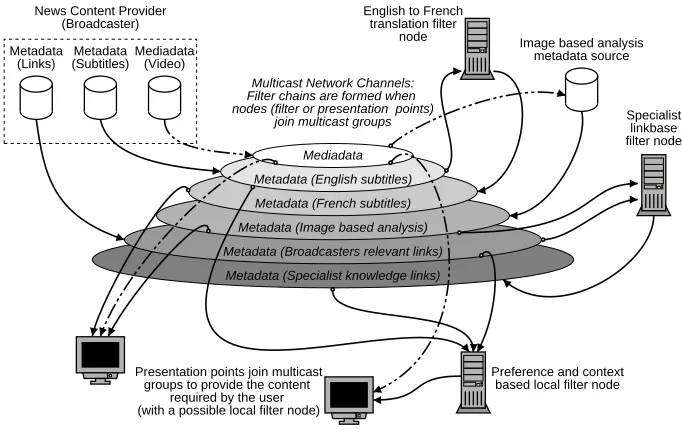
Links to related material can be provided by the originat-ing broadcaster and from other sources such as the image analysis node suggested above. Since they are transmitted as multicast metadata flows, a user can receive links both directly from the broadcaster and from nominated interme-diate filters. These filters would take links from the original flow (optionally resolve the links) and multicast a new flow of links derived from a specialist linkbase. If more local to the presentation point, such a filter might provide a linkbase built upon a user’s previous interests or current context. See figure 3.
Music Performance
While rehearsing, a musician might transmit a stream of their music to a specialist node (either remote or local in relation to the musician) which transcribes the audio into a MIDI metadata flow (a MIDI enabled instrument could provide the metadata at source).
This metadata flow could then be processed by a filter node which would analyse the melody and return a match from its database. Using a combination of the match from the database and the original MIDI metadata flow for tempo, a second filter node could use a remote music library to output a flow of additional MIDI data for the matched tune. This could provide suggestions for related music or even an ac-companiment for the melody, which the rehearsing musician could receive and play along to. We have exercised this sce-nario through our tools for content-based navigation of music
based on melodic pitch contours [Bla98a].
Lecture Presentation
A lecturer may annotate a class by providing links to the rel-evant point in the slides or online notes as a metadata stream. This could be used directly by students with presentation points in the same physical space as the lecturer, or accompa-nying a mediadata broadcast of the lecture for distance learn-ing. Whatever the location of the presentation point, it would display the parts of the notes to coincide with that temporal space in the lecture.
The framework can also accommodate any branching in the presentation: to give further explanation of a particular sub-ject the lecturer can refer back to an earlier point in the pre-sentation or even to a previous lecture. The media and meta-data streams will be reset accordingly, enabling the lecturer to include both live and pre-recorded material in the same class.
The lecturer might also suggest that students utilise a spe-cialist linkbase for that particular subject area. The linkbase would interact with the framework though a filter node, re-ceiving the metadata flow of the lecturers’ notes and trans-mitting a further metadata flow of links based on its process-ing of the original notes.
Closer to the presentation point, a student may have an extra linkbase of personal preferences, built up from their previous browsing history. This too would interact through a filter node, adding (or removing!) links to external information tailored to that individual.
An enterprising student might then wish to share their per-sonal linkbase with the rest of the class, a mechanism the student could also use to distribute any insights or annota-tions they have added during the lecture. Once given, the entire lecture including metadata annotations can be stored for replay to both individuals and groups of students.
A unicast realisation of this scenario is shown in figure 2(b).
CONCLUSIONS
In this paper we have presented the case for continuous meta-data, and proposed a framework with the following features:
1. Metadata is continuous and traverses the framework in a temporally significant manner.
2. The framework contains three types of node: sources, fil-ters, and presentation points.
3. Mediadata is the flow against which other metadata flows are synchronised. It would normally be the temporal multi-media stream the metadata is derived from.
Mediadata
Metadata (English subtitles)
Metadata (French subtitles)
Metadata (Image based analysis)
Metadata (Broadcasters relevant links)
Metadata (Specialist knowledge links)
Mediadata (Video) Metadata (Subtitles) Metadata
(Links)
News Content Provider (Broadcaster)
Multicast Network Channels: Filter chains are formed when nodes (filter or presentation points)
join multicast groups
English to French translation filter
node Image based analysis metadata source
Specialist linkbase filter node
Presentation points join multicast groups to provide the content
required by the user (with a possible local filter node)
[image:9.595.135.476.88.305.2]Preference and context based local filter node
Figure 3: A framework configuration for the live news broadcast scenario
5. Transmission of media and metadata between nodes should be multicast where possible.
6. Metadata flows must be carried by a reliable transport. 7. The metadata carried within the flow (its payload) can be in any recognised metadata format, but must encode infor-mation to synchronise and present the payload data.
8. Filter nodes perform processing on an incoming metadata flow and output the results in another (amending the identify-ing and derivative codes appropriately). The output from one filter node can be chained to the input of another (or many other) filter nodes to create a filter chain.
9. Control channels between nodes must manage the rate of transmission and buffering of the temporal flows.
We have explored the requirement for streams of links to ac-company multimedia streams, and for these to be synchro-nised when some part of the link delivery must be in real-time. Two experimental systems have illustrated these ideas, the second in particular demonstrating this work in the con-text of open hypermedia through use of the Fundamental Open Hypermedia Model (FOHM). Since we regard links as metadata, and we believe the linking scenarios extend nat-urally to other forms of synchronised metadata, our study makes a case for continuous metadata in general. We have presented a general distributed model for working with con-tinuous metadata, and discussed the implications of extend-ing this to multicast.
In the same way as open hypermedia promotes separable hy-perstructure, we are promoting separable metadata. Many of the arguments in favour of open hypermedia are applicable here. At first sight it may appear that multimedia formats do not usually support embedded links, but we note that the
emerging MPEG standards effectively promote embedded metadata and we anticipate that Web developers will instinc-tively embed URLs in media streams. In many applications there is a case for transporting digital media in a compos-ite form including metadata, just as HTML with embedded links is an effective transport and delivery format. However, when we have multiple streams, described by one or more metadata flows, operating in a real-time scenario, there is a compelling case for handling the metadata separately.
Our future work is to realise the distributed metadata machin-ery using multicast and to evaluate the approach. The ex-isting experimental systems will also be extended to further explore integration with other OHS components, particularly content-based navigation and application of ontologies. The distributed architecture raises systems infrastructure issues, especially with respect to timely delivery when working with mediadata and metadata streams together.
ACKNOWLEDGEMENTS
This research was supported by the UK Engineering and Physical Sciences Research Council through a stu-dentship and is partially supported by project HyStream (GR/M84077, with Wendy Hall and Luc Moreau, in collabo-ration with BT Laboratories) and EQUATOR (GR/N15986). We are grateful to our colleagues in the IAM research group, especially Luc Moreau for his development of SoFAR, Dave Millard for insights and help with FOHM, and Neil Ridg-way and others who have participated in our early prototype systems for streaming links.
REFERENCES
Adc93. P. Adcock, N. Davies, and G. Blair. “Supporting
Architectures”. Lecture Notes in Computer
Sci-ence, vol. 731:pp. 179–191, Oct. 1993.
Bla98a. S. G. Blackburn and D. C. De Roure. “A tool for
content based navigation of music”. In “Multime-dia ’98”, pp. 361–368. ACM SIGMULTIMEDIA, 1998.
Bla98b. S. Blake, D. Black, M. Carlson, et al..
“An Architecture for Differentiated Services”,
Dec. 1998. URL http://www.ietf.org/rfc/
rfc2475.txt.
Bou99. N. O. Bouvin and R. Schade. “Integrating
Tem-poral Media and Open Hypermedia on the World
Wide Web”. In “WWW8”, pp. 375–378. May
1999.
Bra94. R. Braden, D. Clark, and S. Shenker.
“Inte-grated Services in the Internet Architecture: an
Overview”, Jun. 1994. URLhttp://www.ietf.
org/rfc/rfc1633.txt.
Bra99. T. Bray, D. Hollander, and A. Layman.
“Names-paces in XML”, Jan. 1999. URLhttp://www.w3.
org/TR/REC-xml-names/.
Bug98. S. Bugaj, D. Bulterman, B. Butterfield, et al..
“Synchronized Multimedia Integration Language
(SMIL) 1.0 Specification”, Jun. 1998. URLhttp:
//www.w3.org/TR/REC-smil/.
Cru01. D. Cruickshank, L. Moreau, and D. De Roure.
“Ar-chitectural Design of a Multi-Agent System for Handling Metadata Streams”. In “The Fifth Int’l Conf. on Autonomous Agents”, May 2001.
Dav92. H. C. Davis, W. Hall, I. Heath, et al.. “Towards
an Integrated Information Environment with Open Hypermedia Systems”. In “Proceedings, ACM Eu-ropean Conference on Hypertext ECHT’92”, pp. 181–190. ACM SIGLINK/SIGWEB, Nov. 1992.
Dav95. H. C. Davis. “To Embed or Not to Embed”.
Com-munications of the ACM, vol. 38(6):pp. 108–109,
Aug. 1995.
Dee98. S. Deering and R. Hinden. “Internet Protocol,
Ver-sion 6 (IPv6) Specification”, Dec. 1998. URL
http://www.ietf.org/rfc/rfc2460.txt.
DR98. D. De Roure, S. Blackburn, L. Oades, et al..
“Ap-plying Open Hypermedia to Audio”. In “Hypertext ’98”, pp. 285–286. ACM SIGLINK, 1998.
Geo96. N. D. Georganas, R. Steinmetz, and T. Nakagawa,
eds. Synchronization Issues in Multimedia
Com-munications, vol. 14 of IEEE Journal on Selected Areas in Communications. IEEE, 1996.
Goo95. S. Goose and W. Hall. “The Development of a
Sound Viewer for an Open Hypermedia System”.
The New Review of Hypermedia and Multimedia,
vol. 1:pp. 213–231, 1995.
Grø00. K. Grønbæk, L. Sloth, and N. O. Bouvin. “Open
Hypermedia as User Controlled Meta Data for the Web”. In “WWW9”, pp. 554–566. May 2000.
Har94. L. Hardman, D. C. A. Bulterman, and G. v.
Rossum. “The Amsterdam Hypermedia Model:
Adding Time and Context to the Dexter Model”.
Communications of the ACM, vol. 37(2):pp. 50–
62, Feb. 1994.
Mil00. D. Millard, L. Moreau, H. Davis, and S. Reich.
“FOHM: A Fundamental Open Hypertext Model for Investigating Interoperability between Hyper-text Domains”. In “HyperHyper-text 2000”, pp. 93–102. ACM, May 2000.
Mor00. L. Moreau, N. Gibbins, D. De Roure, et al..
“So-FAR with DIM Agents: An Agent Framework for Distributed Information Management”. In “The Fifth Int’l Conference and Exhibition on The Prac-tical Application of Intelligent Agents and Multi-Agents”, pp. 369–388. Apr. 2000.
Nac99. F. Nack and A. T. Lindsay. “Everything You
Wanted to Know About MPEG-7”. IEEE
Multi-media, vol. 6(3):pp. 65–77, Sep. 1999.
Pan00. P. Pan and G. Davenport. “I-Views: A
Community-oriented System for Sharing Stream-ing Video on the Internet”. In “WWW9”, pp. 567– 582. May 2000.
Pim00. M. Pimental, G. Abowd, and Y. Ishiguro. “Linking
by Interacting: A Paradigm for Authoring Hyper-text and Hypermedia”. In “HyperHyper-text 2000”, pp. 39–48. ACM, May 2000.
Rog00. B. Rogge, R. Van de Walle, I. L. Lemahieu, and
W. R. Philips. “Introducing Streaming XML
(SXML)”. In “Proceedings of SPIE Vol. 4210”, pp. 4210–4254. SPIE, Nov. 2000.
Sch96. H. Schulzrinne, S. Casner, R. Frederick, and V.
Ja-cobson. “RTP: A Transport Protocol for
Real-Time Applications”, Jan. 1996. URL http://
www.ietf.org/rfc/rfc1889.txt.
Sch98. H. Schulzrinne, A. Rao, and R. Lanphier. “Real
Time
Streaming Protocol (RTSP)”, Apr. 1998. URL
http://www.ietf.org/rfc/rfc2326.txt.
Smi00. J. W. Smith, D. Stotts, and S.-U. Kum. “An