Abstract—In this paper the friction conditions between the
rolls and the workpiece of a hot skew roll piercing mill are studied. For that purpose a modified model of the process without the inner plug has been simulated, using the Finite Element Method (FEM) and validated with experimental data of the process. Three friction laws have been considered for the simulation of the friction effect: Coulomb, Tresca and Norton, and their performance have been evaluated in terms of velocity and power consumption.
The inappropriateness of Coulomb law for this type of processes has been demonstrated and between Tresca and Norton laws, some differences are appreciable. Tresca law reproduces correctly the velocity of the process, but Norton law is more accurate regarding the estimation of power consumption. As hot rolling is a process with high energy consumption, Norton results to be the more complete law for the simulation of rolling processes.
Index Terms—FEM, Friction law, Friction modelling, Rolling process
I. INTRODUCTION
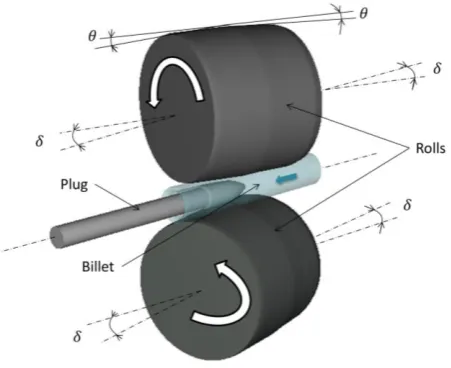
OT-rolled steel seamless tubes are demanded by petrochemical, power generation, mechanical and construction industries [1]. They are produced through the skew-roll piercing, which is the most established method and thus considered in this study. Skew-roll piercing is the first step in the seamless tube forming process, the hollow part of the billet is generated in a mill that can be set up with different dispositions. There are mills with two or three director rolls, but in general two roll mills are more common in the industry [2]. The architecture considered is presented in Fig. 1. It counts with two rolls, oriented with a feed angle δ, which determines the performance of the process. Their geometry is defined with the cross angle θ, which influences the conformation and final geometry of the tube. In addition, it includes the plug that creates the hollow part of the tube and two lateral Diescher discs, which contain the lateral deformation (not included in Fig. 1).
The present study belongs to a line of research of the
Manuscript received February 22, 2017; revised March 29, 2017. This work was supported by the University of Deusto. Authors would like to thank Tubos Reunidos Industrial Plc, for sharing internal technical information and the experimental data used for the adjustment of the simulations.
A. Murillo-Marrodán is with the Department of Industrial Technologies, University of Deusto, Bilbao, Spain. (E-mail: alberto.murillo@ deusto.es).
E. García is with the Department of Industrial Technologies, University of Deusto, Bilbao, Spain. (E-mail: e.garcia@ deusto.es).
F. Cortés is with the Department of Industrial Technologies, University of Deusto, Bilbao, Spain. (E-mail: fernando.cortes@ deusto.es).
authors [3] about this industrial process and, according to the experiments and previous simulations, the contact between the rolls and the billet is responsible for almost the total energy consumed during the piercing process. This way, important process parameters such as the billet advance velocity and power consumed are strongly related to friction conditions in the contact region. Despite this fact, most of the skew-roll piercing studies hardly pay attention to the correct simulation of friction, which can lead to imprecisions.
Fig 1Skew-roll piercing mill set up.
The inherent complexity of the process hinders the required analysis of the friction phenomenon. In order to model the friction correctly the mill is simplified by removing the plug and discs, taking only into account the roll-billet interface. In this paper, some widely extended friction laws like Coulomb or Tresca are studied through their application to the aforementioned process. In addition, Norton law is considered. It is a specific friction law valid for processes with visco-plastic material behaviour.
The friction laws considered for the simulation of the skew rolling process are the following:
Coulomb’s friction approach [4] is determined by a friction coefficient 𝜇(0 < 𝜇 < 1), which multiplies the normal stress
n , giving as a resultn
.
(1)Zhao et al. [5] use this friction law for the deformation analysis of the piercing process.
Tresca friction model is used for shear stresses exceeding the shear flow stress of the material [6], thereby the shear stress is given by
Friction Modelling of a Hot Rolling Process by
means of the Finite Element Method
Alberto Murillo-Marrodán, Eduardo García, and Fernando Cortés
[image:1.595.318.544.309.493.2],
m k
(2)where m stands for the friction factor with a value ranging between 0 and 1. The material shear yield strength k is dependent on the equivalent stress
eq and according to Von Mises is defined aseq
.
3
k
(3)Komori et al. [7], [8] use this friction law for the piercing process whereas Ghiotti et al. [9] for the rolling of the billet (without piercing) with coefficients m that range between 0.8 and 1 for the friction between the rolls and billet.
Norton’s or viscoplastic friction law assumes a viscous behaviour of the billet material close to the contact with the tool. A comparison between this friction law and the aforementioned showed better results in terms of torque and force for hot rolling [10]. The shear stress is given by
1 rel rel
( )
v
K v
pfv
,
(4)where α is the viscoplastic friction coefficient (0 < α < 1),
v
rel is the relative velocity at the interface, K is the material consistency and pf the sensitivity to sliding velocity. The term pf is given the same value as the strain rate sensitivity index of the rheology law, generally around 0.15 for hot steel forming [11]. The material consistency K is dependent on both temperature T and equivalent strain
. It yields
0 0
exp
n
K
K
T
, (5)where n is the sensitivity of strain hardening and
K
0 , 0
and β are constant terms. The main contribution of this friction law is considering the existence of a thin viscoplastic interface layer making the friction forces dependent on the relative sliding velocity.II. NUMERICAL MODEL
In this section, the numerical model of the simplified skew-rolling mill is explained. It has been developed with the FEM software Forge, the principal elements of the model are the rolls and the billet but besides, it incorporates a guide and a simple press to replace the thrust bench action. The architecture is maintained as depicted in Fig. 1, the feed angle is set to 12º and the cross angle is 2º in agreement with the configuration used during the experimental tests.
is initially moved at a rate of 100 mm/s until it is gripped by the rolls. The material of the billet is a low-carbon steel (0.12 - 0.17% of C) at an initial temperature of 1250 ºC, considering the heat transfer by means of conduction and convection heat transfer coefficients HTC of 10,000 and 10 W/m2K respectively. The behaviour of the material is assumed visco-plastic, omitting the elastic regime as deformation occurs under high temperature conditions. Hansel-Spittel law is used for the yield stress calculation, making it dependent on the temperature, deformation and strain rate.
The described model is used to test the three friction laws presented in the introductory section. For each law two friction coefficients have been considered, they are adjusted for each friction law for reproducing accurately the real velocity leading to a total of six study cases.
III. EXPERIMENTAL TESTS
The tests performed for the acquisition of the experimental data are described in this section. A total number of 6 industrial tests have been performed where the power consumption and the process time have been measured.
The tests consist of the rolling of steel bars of 0.6 m length and 0.2 m of diameter showing an average duration of 0.92 s when the bar exits the mill. The process presents three different regimes: at the beginning the consumption increases (transient) until stabilizing, then it shows a stable value (stable phase) until the final part of the rolling (transient again), when the consumption decreases until the end of the process. The average power consumed during the stable phase results in 2467 kW.
In order to compare the simulated and real velocities of the billet, only the stable regime of the process is analysed. The value is obtained from the experimental data, giving an average result of 928.7 mm/s. In Table 1, the numerical and experimental results are compared in terms of velocity, while in Table 2 the comparison is based on average power consumptions.
IV. RESULTS AND DISCUSSION
In this section, the recorded experimental results of power consumption and velocity are compared to the results obtained from the numerical model presented in section 2.
First, before analysing the process parameters, the friction laws are tested in terms of the contact conditions of the process according to the simulated results.
A. Contact conditions
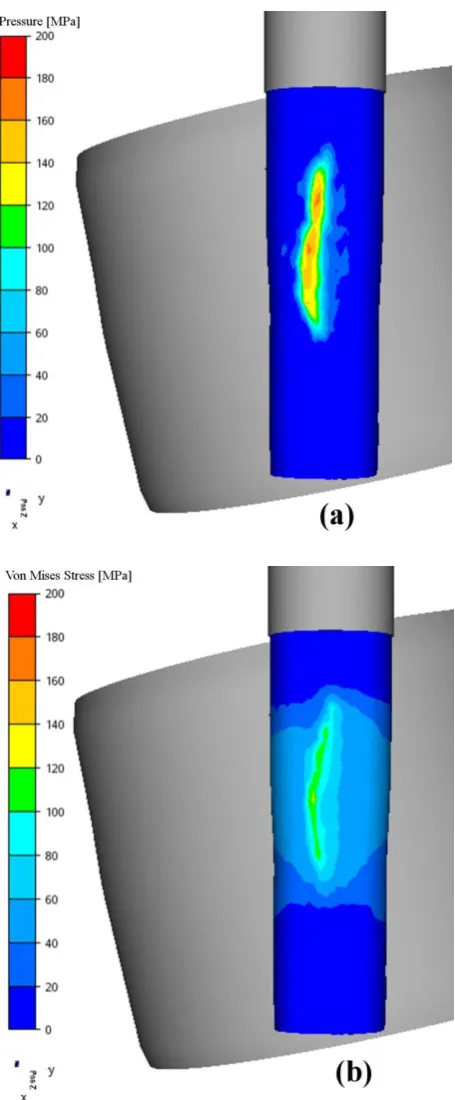
Fig 2 Pressure (a) and equivalent stress (b) at the interface with Coulomb friction law.
According to the literature, Coulomb friction model is only valid when the mean contact pressure between the two contact bodies lies below the flow stress of the softer body, while Tresca is valid under these conditions [6]. Regarding Norton law, it is valid for these specific contact conditions as is particularly oriented for materials under a plastic regime. Therefore it would be more advisable to use Tresca or Norton instead of Coulomb friction law. Then, the three friction laws are compared in terms of operational process variables.
B. Process parameters: Power and advance velocity
In this section, two process parameters are compared between the models and the real process namely power and advance velocity. As it has been explained, for each friction law those coefficients that show a lower deviation from the experimental velocity have been selected and gathered in Table 1.
Hence, as it was expected, there are not noticeable differences in terms of working piece advance velocity between the simulated and real cases.
Therefore, the next step for evaluating the validity of friction laws is to study the power consumption. Table 2 shows that once velocity has been adjusted, the mean power consumptions depend mainly on the friction law used than the variation of the friction coefficient. This way, the deviation of the mean power with Coulomb is up to 8.8%, while in the cases of Tresca and Norton up to 7.2% and 2.2% respectively.
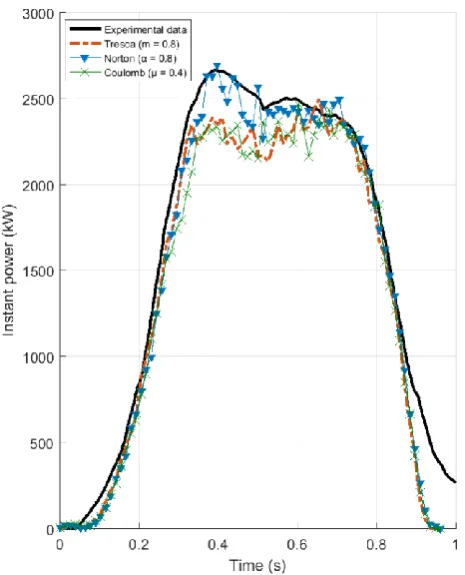
All cases show a good correlation with the measured power values according to the graphs shown in Fig. 3, fitting the experimental value in a correct way. During the final transient part of the process, the motor rotating at no-load explains the differences between real and simulated cases. However, the slope of the simulated curves must fit the real case.
TABLEI
VELOCITIES OF THE SKEW ROLLING PROCESS SIMULATIONS
Case number
Friction law
Coefficient value (μ,m,α)
Velocity (mm/s)
Deviation (%) 1 Coulomb 0.3 903.1 -2.8 2 Coulomb 0.4 931.7 0.3 3 Tresca 0.7 925.2 -0.4 4 Tresca 0.8 931.3 0.3 5 Norton 0.7 917.1 -1.2 6 Norton 0.8 931.8 0.3
TABLEII
POWER CONSUMPTION OF THE SKEW ROLLING PROCESS SIMULATIONS
Case number
Friction law
Coefficient value (μ,m,α)
Power consumed
(kW)
[image:3.595.307.548.203.336.2]Fig 3 Instant power evolution of the simulations in contrast with the experimental test.
The process velocity is almost similar in the three cases considered and thus they finish at the same time. However, as it can be observed in Fig. 3, power values are lower in the case of Coulomb and Tresca friction laws. Both show a similar evolution, with slightly better results in the case of Tresca. On the other hand, Norton friction law presents a lower deviation in terms of absolute power values and shape of the graph, mainly at the initial transient stage, where the higher differences are shown.
As Coulomb shows the less precise values in terms of power and is not advisable for the contact conditions of the process, only Tresca and Viscoplastic laws are further analysed. The main difference between both friction laws resides in the parameters that each law considers. Tresca is dependent on the shear strength of the material, while Norton law considers the material consistency and the sliding velocity. This last parameter presents a high influence on the power results and the differences between both laws are shown in Fig. 4.
According to the results of Fig. 4, there is a clear relation between considering the sliding velocity and the higher accuracy for the instant and average power value given by Norton law over Tresca’s approach.
The advance velocity is similar in both cases, but nevertheless there is a slightly higher value of sliding velocity when Norton friction law is applied. As the strain rate value at the contact region is similar in both simulations, the power consumption increment corresponds to a loss in terms of frictional sliding. Therefore, Norton friction law is clearly more realistic.
Fig 4 Sliding velocity at the interface with Tresca (a) and Norton (b) friction laws
V. CONCLUSIONS
In the present paper the problem of friction characterization of high temperature contacts (over 1250 ºC) has been analysed applied to a skew rolling process. The specific aim is the evaluation of the effect of the friction law over the process performance and consumption. Coulomb, Tresca and Norton friction laws have been considered and after their analysis, it is concluded that
Coulomb friction law is not valid for the process because the pressure value at the interface overcomes the flow stress of the material.
[image:4.595.58.291.52.340.2] Norton law results are correct for both velocity and power consumed, with a slightly better accuracy on the power consumed. This is caused by the visco-plastic behaviour of the material and because of the consideration of a higher power loss at the interface through sliding velocity.
In short, despite the relatively low percentage difference between Tresca and Norton laws power consumption predictions, in terms of absolute values there is a considerable difference considering that rolling is a high energy consuming process.
REFERENCES
[1] Tubos Reunidos Industrial Plc, Internal techical report.
[2] H. Li, H. Yang, Z. Zhang. Hot Tube-Forming. Comprehensive Materials Processing, 2014. ISSN/ISBN: 9780080965338
[3] Murillo-Marrodán A, García E, Cortés F. A study of friction law influence on a hot skew rolling simulation compared to experimental process data. International Journal of Mechanical Sciences 2017. (Submitted for publication)
[4] Coulomb, Charles Augustin. Théorie des machines simples en ayant égard au frottement de leurs parties et à la roideur des cordages. Bachelier, 1821.
[5] Zhao Y, Yu E, Yan T. Deformation analysis of seamless steel tube in cross rolling piercing process. 2010 International Conference On Computer Design and Applications, vol. 3, 2010, p. V3-320-V3-323. doi:10.1109/ICCDA.2010.5541258.
[6] Valberg HS. Applied Metal Forming: Including FEM Analysis. Cambridge University Press, 2010.
[7] Komori K, Suzuki M. Simulation of deformation and temperature in press roll piercing. Journal of Materials Processing Technology 2005;169:249–57. doi:10.1016/j.jmatprotec.2005.03.017.
[8] Komori K. Simulation of Mannesmann piercing process by the three-dimensional rigid-plastic finite-element method. International Journal of Mechanical Sciences 2005;47:1838–53. doi:10.1016/j.ijmecsci.2005.07.009.
[9] Ghiotti A, Fanini S, Bruschi S, Bariani PF. Modelling of the Mannesmann effect. CIRP Annals - Manufacturing Technology 2009;58:255–8. doi:10.1016/j.cirp.2009.03.099.
[10] Duan X, Sheppard T. Three dimensional thermal mechanical coupled simulation during hot rolling of aluminium alloy 3003. International Journal of Mechanical Sciences 2002;44:2155–72. doi:10.1016/S0020-7403(02)00164-9.