CLIVAR Initial Implementation Plan
WCRP-103
WMO/TD No.869
ICPO No. 14
June 1998
CLIVAR INITIAL IMPLEMENTATION PLAN
TABLE OF CONTENTS
PREFACE
I OVERVIEW
1.
INTRODUCTION AND PURPOSE
2.
CLIVAR SCOPE AND APPROACH
3.
THE CLIVAR PRINCIPAL RESEARCH AREAS
4.
CONSIDERATIONS IN DEVELOPING PRIORITIES
5.
CLIVAR IMPLEMENTATION
II
UNIFYING THEMES AND APPROACHES
1.
GLOBAL FRAMEWORK FOR CLIVAR
2.
GLOBAL MODELLING AND PREDICTION
2.1 Organisation of Modelling within CLIVAR and the WCRP
2.2 Climate Modelling on Seasonal to Interannual Time Scales
2.2.1 Current projects of NEG-1
2.3 Global Modelling on Seasonal to Century Time Scales
2.3.1 Current projects of WGCM
2.4 Paleoclimate Modelling
2.5 Downscaling
2.6 Computational requirements for the CLIVAR Numerical
Experimen-tation Programme
3.
GLOBAL-SCALE EMPIRICAL, ANALYTICAL AND
DIAGNOS-TIC STUDIES
4.
GLOBAL SUSTAINED OBSERVATIONS
4.1 General Considerations
4.2 Requirements and Potential Contributions
4.2.1 Ocean observing systems
4.2.2 Elements of the ocean observing system for CLIVAR
4.2.3 Atmosphere and land surface observing system
4.3 Implementation and Oversight Mechanisms
4.4 Concluding Remarks
5.
DATA SET DEVELOPMENT, POLICY AND MANAGEMENT
5.1 Historical Data
5.2 Reanalyses
5.3 Paleoclimatic Data Sets
5.4 Data Management Policy
5.5 The Global Ocean Data Assimilation Experiment (GODAE)
III
THE CLIVAR PRINCIPAL RESEARCH AREAS
III (i) CLIVAR GOALS
1.
ENSO: EXTENDING AND IMPROVING PREDICTIONS (G1)
1.1 Scientific Rationale
1.2 Analyses, Modelling and Prediction
1.2.1 Analyses and model initialisation
1.2.2 Modelling and prediction in the tropics
1.2.3 Prediction of the extra-tropical atmospheric circulation
1.2.4 Prediction and assessment
1.2.5 Current projects
1.3 Observing Needs
1.4 Focused Research Projects
1.4.1 Observing system evaluation
1.4.2 The 1997-98 ENSO event
1.5 Data Set Development, Diagnostics and Empirical Studies
1.6 Linkages with other Elements and Programmes
1.7 References
2.
VARIABILITY OF THE ASIAN-AUSTRALIAN MONSOON
SYSTEM (G2)
2.1 Introduction
2.2 Scientific Rationale
2.2.1 The annual cycle
2.2.2 Intraseasonal oscillations (ISO)
2.2.3 ENSO-monsoon coupling
2.2.4 The tropospheric biennial oscillation (TBO)
2.2.5 Oceanic processes
2.2.6 Land surface processes
2.2.7 Tropical-extratropical interaction
2.3 Programme Objectives
2.4 Modelling and Prediction
2.4.1 Experiments with AGCMs
2.4.1.1 Atmospheric model intercomparison projects
2.4.1.2 Monsoon predictability
2.4.1.3 Intraseasonal variability
2.4.1.4 Role of SST anomalies in influencing the monsoon
2.4.2 Experiments with OGCMs
2.4.2.1 Ocean process modelling and intercomparison
2.4.2.2 Evaluation of observed surface fluxes
2.4.3 Experiments with CGCMs
2.5 Process Studies Including Field Campaigns
2.5.1 Diagnostic studies
2.5.1.1 Seasonal variations
2.5.1.2 Intraseasonal variations
2.5.1.3 Monsoon-ENSO coupling
2.5.1.4 Tropospheric biennial oscillation
2.5.1.5 Heat balance of the Indian ocean
2.5.2 Parameterisation of physical processes
2.5.3 Special observations and enhanced monitoring
2.6 Observation System Requirements
2.6.1 Meteorological variables
2.6.2 Oceanic Variables
2.6.2.1 The TRITON array
2.6.3 Land variables
2.7 Data Set and Prediction System Development
2.7.1 Data set development and related studies
2.7.2 Monsoon prediction system
2.8 Programme Linkages
2.9 References
3.
VARIABILITY OF AMERICAN MONSOON SYSTEMS (VAMOS)
(G3)
3.1 Scientific Rationale
3.1.1 The American monsoon systems
3.1.1.1 The monsoon system in the Northern Hemisphere
3.1.1.2 The monsoon system in the Southern Hemisphere
3.1.2 The importance of ocean processes
3.1.3 The importance of orography and land surface processes
3.2 VAMOS: Programme Definition
3.3 Modelling and Prediction
3.3.1 Atmospheric General Circulation Models (AGCMs)
3.3.2 Oceanic General Circulation Models (OGCMs)
3.3.3 Coupled Atmosphere Ocean-Land GCMs (coupled GCMs)
3.3.4 Mesoscale atmospheric models
3.3.5 Predictability
3.3.6 Prediction
3.4 Special Observing Needs
3.4.1 Enhanced monitoring in the eastern tropical Pacific region
3.4.2 Surface fluxes over the oceans
3.4.3 Atmosphere-ocean interaction in the stratus deck region
3.4.4 High resolution sea surface temperature
3.4.5 Soil moisture
3.4.6 Precipitation
3.4.7 Vertical structure of the atmosphere
3.5 Field Studies
3.5.1 Atmospheric PBL structure above the cold tongue
3.5.2 Structure and intensity of ITCZ rainfall
3.5.3 Air-sea fluxes in the cold tongue-ITCZ-complex
3.5.4 Vertical current profiles in the equatorial cold tongue
3.5.5 Tropical Rainfall Measuring Mission (TRMM)
3.6 Diagnostics and Empirical Studies
3.6.1 Diagnostic studies
3.6.2 Empirical studies
3.7 Data Set Development
3.7.1 Existing sources of data
3.7.2 Historic data sets / data archaeology
3.7.3 The VAMOS data base
3.8 Linkages
3.8.1 Within CLIVAR
3.8.2 Within WCRP
3.8.2.1 Global Energy and Water Cycle Experiment
(GEWEX)
3.8.3 With other programmes
3.8.3.1 The Pan American Climate Studies (PACS)
3.8.3.2 The PIlot moored Research Array in the Tropical
Atlantic (PIRATA)
3.8.3.3 The Inter American Institute for Global Change
Re-search (IAI)
3.8.3.4 International Research Institute (IRI)
3.9 References
3.10 Table 1: Preliminary list of data available for VAMOS research
4.
AFRICAN CLIMATE VARIABILITY (G4)
4.1 Introduction
4.2 Scientific Rationale
4.2.1 Past studies
4.2.2 ENSO influence
4.2.3 Influence of Indian monsoon and Indian Ocean SSTs
4.2.4 Numerical modelling studies
4.2.5 Extra-tropical influences
4.2.6 Atlantic influences
4.2.7 Influence of land-surface processes
4.2.8 Role of CLIVAR-Africa
4.3 Programme Objectives
4.4 Observational Requirements
4.4.1 Atmospheric needs
4.4.2 Oceanographic measurements
4.4.3 Land-based observations
4.5 Data Bases, Analysis and Prediction
4.6 Diagnostic and Process Studies
4.6.1 Atmospheric circulation and convection
4.6.2 Ocean forcing and monsoons
4.6.3 Oceanographic measurements
4.6.4 A terrestrial focus
4.7 Numerical Modelling
4.8 Training Efforts and Programme Linkages
4.9 References
III (ii) CLIVAR DecCen
5.
THE NORTH ATLANTIC OSCILLATION (D1)
5.1 Scientific Rationale
5.1.1 Introduction: Characteristics of the NAO
5.1.2 The NAO and global change
5.1.3 Decadal changes in the NAO index
5.2 Modelling and Prediction
5.2.1 Uncoupled variability
5.2.2 Coupled variability
5.2.3 The role of transients
5.3 Diagnostics and Empirical Studies
5.3.1 Optimizing the NAO index
5.3.2 Detailed study of storm-surface interactions
5.3.3 Data archaeology
5.4 Special Observing Needs
5.4.2 Variability of North Atlantic heat fluxes and storage
5.4.2 A DecCen ‘NAO Array’
5.4.3 Water mass conversion processes in the subpolar North
At-lantic: A Lagrangian process study
5.4.4 Repeat CTD-tracer sections
5.4.5 Inventories of deep and intermediate watermass changes
5.4.6 The Greenland Sea and its overflows
5.4.7 The Arctic response to NAO forcing
5.5 Linkages with other Elements and Programmes
5.5.1 Other elements of CLIVAR
5.5.2 Other WCRP programmes
5.5.3 European Union (EU) projects
5.5.4 Other ongoing or planned national programmes
5.6 References
6.
TROPICAL ATLANTIC VARIABILITY (D2)
6.1 Scientific Rationale
6.2 Modelling and Prediction
6.3 Special Observing Needs
6.4 Focused Research Projects
6.5 Data Set Development, Diagnostics and Empirical Studies
6.6 Linkages with other Elements and Programmes
6.7 References
7.
ATLANTIC THERMOHALINE CIRCULATION (D3)
7.1 Scientific Rationale
7.1.1 Sudden changes
7.1.2 Internal oceanic variability
7.1.3 Coupled modes
7.1.4 Atmospheric forcing
7.1.5 Links to other oceans
7.1.6 Overarching objectives
7.2 Modelling and Prediction
7.2.1 Sudden transitions
7.2.2 Multiple equilibrium states
7.2.3 Sensitivity to atmospheric fluxes
7.3 Observing Needs
7.3.1 Watermass and current sections at crucial latitudes
7.3.2 Northern ice and freshwater import
7.3.3 NADW export array
7.3.4 Inventories of deep and intermediate water changes
7.3.5 Inventories of intermediate and subtropical mode water
changes
7.3.6 Flux fields
7.3.7 Documentation of climate change response
7.4 Focused Research Projects
7.4.1 Water mass transformation and relation to thermohaline
cir-culation variability
7.4.2 Role of equatorial zone in interhemispheric communication
of thermohaline circulation variability
7.4.3 Deep to surface layer water mass modifications
7.4.4 Subgrid-scale processes for improved parameterisation
7.4.5 Interbasin exchange
7.5 Data Set Development, Diagnostics and Empirical Studies
7.5.1 Data sets on water mass and thermohaline circulation
varia-bility
7.5.2 Reanalysis of the instrumental record
7.5.3 Model analysis
7.5.4 The paleoclimatic record
7.6 Linkages with other Elements and Programmes
7.6.1 Other elements of CLIVAR
7.6.2 Other WCRP programmes
7.6.3 IGBP programmes
7.6.4 Other ongoing or planned programmes
7.6.5 The Global Ocean Observing System (GOOS)
7.7 References
8.
PACIFIC AND INDIAN OCEAN DECADAL VARIABILITY (D4)
8.1 Scientific Rationale
8.1.1 The Pacific and Indian Ocean: general considerations
8.1.2 Observed variability in the Pacific and Indian Oceans
8.1.2.1 Large-scale variability
8.1.2.2 Pacific Ocean variability
8.1.2.3 Indian Ocean variability
8.1.2.4 Western boundary currents
8.1.2.5 Indonesian throughflow
8.1.3 Possible mechanisms
8.1.4 Science questions
8.1.5 Approach
8.2 Modelling and Prediction Studies Required
8.3 Observing Needs
8.3.1 Broad-scale and ongoing routine observations
8.3.2 Proxy records of decadal and centennial variability
8.4 Focused Research Projects
8.4.1.1 A Pacific basin-wide extended climate study
8.4.1.2 Mixing in the mixed layer and upper thermocline
8.4.1.3 Interaction of the upper thermocline with the
sur-face layer: subduction
8.4.1.4 Direct observations of circulation
8.4.1.5 Enhanced surface meteorology
8.4.1.6 Enhanced salinity measurements
8.4.1.7 Subpolar North Pacific study
8.4.2 Southern Hemisphere subduction
8.4.3 Monsoon variability
8.4.4 Effects of western boundary currents on regional climate
8.4.5 Indonesian throughflow
8.5 Data Set Development, Diagnostics and Model-Assimilated Data
8.5.1 Data set development and studies based on existing data
8.5.2 Diagnostics
8.5.3 Model-assimilated data
8.6 Linkages with other Elements and Programmes
8.7 References
9.
SOUTHERN OCEAN CLIMATE VARIABILITY (D5)
9.1 Scientific Rationale
9.1.1 Antarctic Circumpolar Current
9.1.2 Meridional fluxes and intermediate water ventilation
9.1.3 Deep and bottom water ventilation
9.1.4 Sensitivity of climate models to Southern Ocean sea ice
9.1.5 Sensitivity of climate models to heat storage and overturning
in Southern Ocean
9.1.6 Coherent climate patterns and variability in the Southern
Hemisphere
9.1.7 Unique Southern Ocean paleoclimate information
9.1.8 Scientific rationale summary
9.2 Scientific Foci of Southern Ocean CLIVAR
9.2.1 Variability in the Antarctic Circumpolar Current
9.2.2 Variability of Subantarctic Mode Water and Antarctic
Inter-mediate Water
9.2.3 Coupled variability of deep water formation, sea ice and the
atmosphere
9.2.4 Formation mechanism of Antarctic bottom water
9.3 Modelling and Prediction
9.3.1 Global circulation model studies
9.3.2 Regional model studies
9.3.3 Local process models
9.3.4 Modelling strategy
9.4 Observational Strategy
9.4.1 Chokepoints: Flux monitoring associated with the Antarctic
Circumpolar Current between the three ocean basins
9.4.2 Mid-latitude zonal sections
9.4.3 Periodic (~5-year) repeats of selected additional deep
hydro-graphic lines
9.4.4 Additional VOS sampling where practical
9.4.5 Salinity sampling; PALACE floats to monitor T(z), S(z) and
the circulation
9.4.6 Surface drifters (including drifters in the sea ice zone)
9.4.7 Deep boundary current measurements
9.4.8 Satellite monitoring of SST, sea level, winds and sea ice
9.4.9 Ice and snow thickness
9.4.10 Monitoring of fast ice thickness at key sites
9.4.11 Combination of moored measurements and ‘rapid response’
cruises
9.5 Linkages with other CLIVAR Components and Programmes
9.5.1 Other elements of CLIVAR
9.5.2 Other WCRP programmes
9.5.3 Programmes outside of WCRP
9.6 References
III (iii) CLIVAR ACC
Reference
10.
CLIMATE CHANGE PREDICTION (A1)
10.1 Scientific Rationale
10.1.1 What is known now
10.1.2 What is being done now
10.1.3 Among the questions remaining are
10.1.4 Where CLIVAR can help
10.2 Input Required
10.2.1 Improvements in the representation of physical, chemical
and biological processes in models
10.3 Modelling and Prediction
10.3.1 Model improvement
10.3.2 Model evaluation
10.3.3 Idealised studies
10.3.4 Predictions
10.3.5 Multi-century simulations
10.3.6 Regional modelling
10.4 Computing Requirements
10.5 Special Focused Research Projects
10.5.1 Idealised sensitivity studies
10.5.2 Calibration of simple models
10.5.3 Standardised forcing scenarios
10.5.4 Coupled Model Intercomparison (CMIP)
10.6 Linkages
10.7 References
11.
CLIMATE CHANGE DETECTION AND ATTRIBUTION (A2)
11.1 Scientific Rationale
11.2 Modelling and Prediction
11.3 Observing Needs
11.4 Focused Research Projects
11.4.1 Developing indicators and indices for climate extremes
11.4.2 Development of historical global temperature series from
paleoclimatic data
11.4.3 Development of standard set of historical climate forcings
(natural and human-induced)
11.4.4 Improved statistical methods for climate change detection
and attribution
11.5 Data Set Development, Diagnostics and Empirical Studies
11.6 Linkages
11.7 References
12.
ASSESSMENT OF CURRENT STATUS OF PRINCIPAL
RESEARCH AREAS
IV
APPENDIX
A.1
ACKNOWLEDGEMENTS
A.2
LIST OF MEETINGS
A.3
PROGRAMMATIC INFRASTRUCTURE AND ORGANISATION
3.1 Implementation and Oversight Structures
3.2 Resource Planning and Co-ordination
3.3 References
A.4
IMPLEMENTING A CLIVAR DATA RESOURCE
MANAGE-MENT
4.1 Preface
4.1.1 Purpose
4.1.2 “CLIVAR data”
4.1.3 “CLIVAR data” resources
4.2 Existing Structures
4.2.1 TOGA data management concept
4.2.2 WOCE data management concept
4.2.3 The GCOS programme
4.2.4 World Data Center system
4.3 General Data Management Requirements
4.4 References
A.5
LINKAGES
5.1 Linkages within the World Climate Research Programme (WCRP)
5.1.1 Global Energy and Water Cycle Experiment (GEWEX)
5.1.2 World Ocean Circulation Experiment (WOCE)
5.1.3 Arctic Climate System Study (ACSYS)
5.1.4 Stratospheric Processes and their Role in Climate (SPARC)
5.2 The International Geosphere Biosphere Programme (IGBP)
5.3 Intergovernmental Panel on Climate Change (IPCC)
5.4 “Climate” Observations Programmes
5.4.1 The Global Climate Observing System (GCOS)
5.4.2 The Global Ocean Observing System (GOOS)
5.5 International Human Dimensions of Global Environmental Change
Programme (IHDP)
A.6
ACRONYMS
Page no.
A-31
A-31
A-32
A-32
PREFACE
1997 was marked with an unprecedented level of interest in issues relating to the Earth's climate, its variability and climate change. The Third meeting of the Parties to the UN Framework Convention on Cli-mate Change in Kyoto in December 1997 focused the world's attention on how human activities may influ-ence global climate. While the meeting established emission targets, it also asked nations to continue their efforts in climate research in areas on which this CLIVAR1 Initial Implementation Plan focuses. The be-haviour of the climate system itself has been a major news event as the 1997-98 El Niño has emerged as the biggest on record by some measures. Moreover, CLIVAR scientists forecast the event. The full TOGA/ CLIVAR Pacific observing system has documented its development, providing a wonderful natural exper-iment for CLIVAR scientists to watch unfold. Many of the effects felt around the world were foreseen, but some were not, and the experience will provide valuable lessons for CLIVAR.
Throughout 1997 scientists around the world have focused on the formulation of an Initial Implemen-tation Plan for CLIVAR. The plan was developed in a series of international workshops, regional and na-tional meetings and then refined through the work of the CLIVAR Scientific Steering Group, its panels and working groups and through the efforts of writing teams.
The Initial Implementation Plan is the work of many. We are grateful to, and thank the scientists who have stepped forward and participated in this process, especially the chairpersons and organisers of the working groups, workshops and writing groups. On behalf of the SSG, we express our appreciation to all those who have contributed. A complete listing of authors and contributors is given in Appendix 1; special recognition is also due to the staff at the International CLIVAR Project Office. We now need the ideas and support of the scientists and agencies to move from plan to programme and let the implementation plan evolve to reflect changing scientific insight and emerging interests and priorities among participating na-tional agencies.
CLIVAR focuses on the role of the coupled ocean and atmosphere within the overall climate system, with emphasis on variability, especially within the oceans, on seasonal to centennial time scales. CLIVAR intends to explore predictability and how to improve predictions of climate variability and climate change using existing, re-analysed, and new global observations, enhanced coupled ocean-atmosphere-land-ice models, and paleoclimate records. CLIVAR will promote the development of skilful regional and global predictive models that will enable a more accurate detection of anthropogenic modification of natural cli-mate. CLIVAR strongly supports the design and implementation of global ocean and atmosphere observing systems for long-term climate research and will specifically address the variability of regional coupled ocean-atmosphere systems such as monsoons in relation to global patterns such as ENSO.
Accordingly, the plan describes CLIVAR’s requirements for global observations, dataset develop-ment, empirical studies, model development and numerical experimentation, and process studies. The chal-lenge has been to find the critical areas in which co-ordination and international infrastructure can make the research endeavours more effective and focused. The broad scope of the programme is focused initially on eleven principal research areas.
The Initial Implementation Plan is detailed where programmes are currently well defined and it iden-tifies the directions that the development of focused programmes are expected to take over the next 5-10 years. In many respects it is more a strategic plan of action because implementation will depend on the in-terests of countries, their own needs and priorities, as well as the assessments of scientists as to how ready certain scientific questions are for substantive progress to occur. Updates to this plan will be issued at irreg-ular intervals as focused programmes are developed and as the global programmes evolve. The name “Initial” Implementation Plan recognises the iterative nature of the process we are engaged in. A key step is the CLIVAR Science Conference in Paris at UNESCO 1-4 December 1998. This Conference will seek expressions of interest and commitments from nations. It will also identify national priorities and prospects for international collaboration and co-ordination and will guide the CLIVAR Scientific Steering Group on
where emphases should be placed.
CLIVAR is undoubtedly the biggest and most diverse project yet undertaken by the World Climate Research Programme. The intellectual and material resources required are enormous, as can be seen from this volume. CLIVAR will bring together communities of meteorologists, atmospheric scientists, oceanographers and paleoclimatologists who may not have worked closely together in the past. It is exciting that there is a large community of researchers working on the analysis and modelling of climate variability ready to go forward and meet the challenges posed in the plan. We hope you will join us.
Kevin Trenberth, Allyn Clarke
I.
OVERVIEW
1.
INTRODUCTION AND PURPOSE
This document, the CLIVAR Initial Implementation Plan, continues the development of CLIVAR and provides a necessary step towards its implementation. It is based on the foundation provided by the CLIVAR Science Plan (WCRP, 1995) and the subsequent organisation of the programme by the CLIVAR Scientific Steering Group, including many scientific workshops and meetings which have been held in the interim (see Appendix 2). The vision of the programme presented here represents the current state of know-ledge and planning. It is most detailed where programmes are currently well defined and identifies the direc-tions that its sub-elements are expected to take over the next 5-10 years. Updates to the Implementation Plan will be issued at irregular intervals as the various parts of the programme are developed and as the global components evolve in response to new insights, scientific advances and technological developments.
The CLIVAR Science Plan was published in August 1995 and builds upon the heritage of the Trop-ical Ocean Global Atmosphere programme (TOGA), progress in the World Ocean Circulation Experiment (WOCE), and needs expressed by the Intergovernmental Panel on Climate Change (IPCC) Scientific Assessment Reports. CLIVAR's scientific goals are directed towards the description, analysis, modelling and prediction of climate variability with time scales from seasonal to a century. The primary focus of CLIVAR is on the atmosphere and the ocean and their interactions, which recognises the complementary role with regards to other parts of the World Climate Research Programme (WCRP) such as GEWEX, and the International Geosphere Biosphere Programme (IGBP).
The overall scientific objectives of CLIVAR, as stated in the Science Plan, are to:
• Describe and understand the physical processes responsible for climate variability and predict-ability on seasonal, interannual, decadal, and centennial time scales, through the collection and analysis of observations and the development and application of models of the coupled climate system, in co-operation with other relevant climate research and observing programmes;
• Extend the record of climate variability over the time scales of interest through the assembly of quality-controlled paleoclimatic and instrumental data sets;
• Extend the range and accuracy of seasonal to interannual climate prediction through the devel-opment of global coupled predictive models;
• Understand and predict the response of the climate system to increases of radiatively active gas-es and aerosols and to compare thgas-ese predictions to the observed climate record in order to detect the anthropogenic modification of the natural climate signal.
Since the publication of the Science Plan, the international scientific community has been engaged by CLIVAR in exploring how best to proceed in addressing the scientific questions and in developing a strategy for implementing observations, data set development, empirical studies, model development and numerical experimentation, and process studies. The challenge has been to find the critical areas in which co-ordination and international infrastructure could make the research endeavours more effective and focused.
The proposals and plans presented in this document reflect the scientific communities’ assessment of the major outstanding scientific questions, the state of knowledge, the prospects for advances, the technical feasibility and costs of proposed projects, probabilities for multiple pay-offs, possible collaboration with other programmes, an effective balance of activities, and importance of the projects’ success for society.
I. Overview
This document synthesises the results of the many international workshops sponsored by CLIVAR, as well as through more regional and national workshops and meetings. The CLIVAR Scientific Steering Group (SSG) has also established a number of panels and working groups to provide continued direction in particular areas. These panels, working groups and ad hoc writing teams, along with the CLIVAR SSG, developed the material for the Implementation Plan. A list of meetings that has led to the publication of this CLIVAR Initial Implementation Plan is given in Appendix 2. It is important to realise the depth of involve-ment of the scientific community in pursuing the CLIVAR impleinvolve-mentation plan developinvolve-ment, and this will continue as nations respond to this initial plan.
2.
CLIVAR SCOPE AND APPROACH
CLIVAR is a big programme by any standards. It not only deals with variability and predictability on the global domain and covers all timescales from seasonal to centennial but also includes anthropogenic climate change detection and prediction. In contrast, TOGA, which has been a very successful WCRP pro-gramme and therefore perhaps one worth emulating, ended up focusing on the variability and predictability in just the tropical Pacific Ocean associated with ENSO. CLIVAR encompasses the domain of TOGA and extends to the other tropical oceans as well as to the extra-tropics of both hemispheres. In addition it extends the time domain from seasonal-to-interannual up to centennial. It has been stated that CLIVAR is maybe ten TOGAs in terms of its scope, implementation and planning needs. The initial TOGA plan was to deal with all the tropical oceans. This did not happen in part because of the dominance and importance of the ENSO phenomenon in tropical variability, but also because of funding, resource and personnel limitations. These limitations still exist and must be recognised, so that a phased approach is essential for focused projects within CLIVAR, called the Principal Research Areas (PRAs).
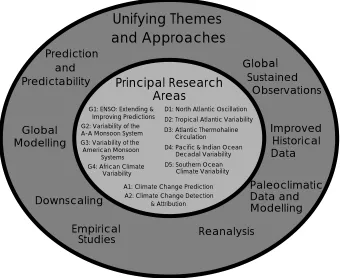
In August 1997, CLIVAR published a summary of this Initial Implementation Plan “CLIVAR: A Research Programme on Climate Variability and Predictability for the 21st Century” (WCRP, 1997). It pro-vides some elaboration of the objectives and requirements of the three streams of CLIVAR, the Global Ocean Atmosphere Land System (GOALS), Decadal to Centennial Climate Variability (DecCen) and Anthropogenic Climate Change (ACC), all closely linked across geographical regions and with overlapping time scales. It also identifies and discusses common themes and approaches of global analysis and model-ling activities that provide the unifying framework through which CLIVAR will be implemented.
These include
• Predictability and prediction
• Global modelling
• Downscaling
• Global sustained observations
• Improved historical data
• Paleoclimate data and modelling
• Reanalysis
• Empirical studies.
Fig. 1: Elements of the CLIVAR programme.
3.
THE CLIVAR PRINCIPAL RESEARCH AREAS
The SSG has approved the choice of nine principal research areas with “natural” phenomena at their respective cores and two directed anthropogenic climate change that have been identified to facilitate the implementation of CLIVAR. Each principal research area is distinct, in its aims, phenomenological base, geographical region of interest, and even scientific approach required. The advantages of considering phe-nomena as the primary foci of CLIVAR research are considerable, including providing a high potential for strong interaction among the components of CLIVAR and a clear route to removing the distinction between the time scales that was introduced at the beginning of CLIVAR to facilitate its early growth from its foun-dation programmes. As stated in the Science Plan, the ultimate goal of CLIVAR is to develop a comprehen-sive and cohecomprehen-sive programme which spans all the scales of interest.
Much of this Implementation Plan addresses these principal research areas, their scientific rationale, analysis and modelling needs, observational requirements and focused areas of research as well as their linkages to each other, CLIVAR in general and the rest of the WCRP.
GOALS
The four principal research areas that have been identified in the GOALS component of CLIVAR are:
• ENSO: Extending and Improving Predictions (G1):
Advancing understanding and observations of climate variability associated with El Niño - Southern Oscillation (ENSO) and global teleconnections to improve prediction and applica-tions.
• Variability of the Asian - Australian Monsoon (G2):
Developing better understanding of the mechanisms of interannual and interseasonal variations
Principal Research
Areas
G1: ENSO: Extending &
Unifying Themes
and Approaches
Global Modelling Global Sustained Observations Improving PredictionsG2: Variability of the A-A Monsoon System G3: Variability of the
American Monsoon
G4: African Climate Variability
D1: North Atlantic Oscillation
D2: Tropical Atlantic Variability
D3: Atlantic Thermohaline Circulation
D4: Pacific & Indian Ocean Decadal Variability
D5: Southern Ocean Climate Variability
A1: Climate Change Prediction A2: Climate Change Detection
& Attribution Empirical Studies Prediction and Predictability Downscaling Improved Historical Reanalysis Data Paleoclimatic Data and Modelling Systems
I. Overview
of the Asian-Australian monsoon and to improve their prediction.
• Variability of the American Monsoon Systems (G3):
Developing better understanding of the Pan American monsoon, its interannual variations, and its origin and links to the Pacific and Atlantic.
• African Climate Variability (G4):
Initiating studies of the interannual variability and predictability of the African climate and the dependence on SST changes to improve predictions of African climate.
DecCen
The five principal research areas identified for the DecCen component of CLIVAR are:
• The North Atlantic Oscillation (D1):
Improving the description and understanding of decadal ocean and atmosphere variability in the North Atlantic region involving the North Atlantic Oscillation.
• Tropical Atlantic Variability (D2):
Improving the description and understanding of the patterns of decadal variability originating in the tropical Atlantic.
• Atlantic Thermohaline Circulation (D3):
Improving the description and understanding of decadal to centennial variability and the possi-bilities of rapid climate change associated with the Atlantic thermohaline circulation.
• Pacific and Indian Ocean Decadal Variability (D4):
Improving the description and understanding of the decadal variability and its predictability in the Pacific and Indian Ocean basins, and its relationship with ENSO and teleconnections.
• Southern Ocean Climate Variability (D5):
Improving the description and understanding of the variability of the Antarctic Circumpolar Current, ocean overturning and water mass transformations in the Southern Oceans.
ACC
The two principal research areas identified for the ACC component of CLIVAR are:
• Climate Change Prediction (A1):
Improving prediction through the use of coupled climate models of the likely climate change in response to scenarios of effects of future human activities.
• Climate Change Detection and Attribution (A2):
Detecting and attributing anthropogenic climate change in the presence of the natural variabil-ity of the climate system.
bet-ter characbet-terisation of their influence will help ENSO prediction. All three, in turn, must be taken into con-sideration in the detection and attribution of climate change (A2). A better characterisation and understanding of variability is essential in order to detect the anthropogenic signal over the “noise” of nat-ural climatic variability. The Principal Research Areas are discussed more fully in Section III.
Fig.2: The CLIVAR Principal Research Areas
To integrate these focused activities, CLIVAR will maintain healthy cross-cutting programmes of global modelling, empirical, analytical and diagnostic studies and will develop project-oriented data sets (Section II). The ability to work within the larger framework will be critical to an effective implementation of the principal research areas.
4.
CONSIDERATIONS IN DEVELOPING PRIORITIES
The CLIVAR Scientific and CLIVAR Initial Implementation Plans have been written by scientists. They have used their understanding of both the science of climate variability and predictability and the tech-nical feasibility of various proposed approaches to make choices and to arrive at the existing plan. CLIVAR is proposing tasks that require international co-operation to achieve objectives that would be difficult for an individual nation to accomplish through its own resources. Now it is the opportunity for nations to decide where they are prepared to invest their resources in support of CLIVAR activities. The International CLI-VAR Conference at UNESCO, Paris, 1-4 December 1998, will collect expressions of interest from nations. On the basis of these national contributions, the CLIVAR SSG and its subsidiary panels will begin to imple-ment CLIVAR. This section outlines the factors that have been and will be considered in developing prior-ities for CLIVAR implementation.
Priorities mean different things to different people, a point which must be recognised. Often priorities are expressed in terms of needs, such as the societal need to have information on climate change at local and regional scales. But whether this is feasible or not must also be a key consideration. Realistic priorities
Monsoons Tropical Modes Extra-Tropical Modes Thermohaline Circulations Anthropogenic Climate Change
ACC
GOALS
DecCen
G2 Variability of the Asian-Australian
Monsoon System G1 ENSO: Extending &
Improving
Predictions D2 Tropical Atlantic Variability
D3 Atlantic Thermohaline
Circulation
D5 Southern Ocean Climate Variability D1 North
Atlantic Oscillation
D4 Pacific & Indian Ocean Decadal Variability A2 Climate Change Detection & Attribution G3 Variability of the American Monsoon Systems G4 African Climate Variability A1 Climate Change Prediction
I. Overview
must take into account the readiness and feasibility of the possibilities. Even then, priorities may differ depending upon whether they refer to the most important topic, the area where there is most activity, or the area where there is the greatest need for international co-ordination and collaboration.
In setting priorities, assumptions are always involved and should be stated as explicitly as possible. A change in these underlying assumptions can completely change priorities. The assumptions include broad statements about funds available, people and ships available, remoteness and logistical aspects, whether sat-ellites will be launched and succeed, collaboration among countries, whether one can rely and on the avail-ability of basic observations under a GCOS or from the World Weather Watch network for weather prediction and build from there, access to and use of data archive facilities, and so on.
The SSG adopted guidelines to assist CLIVAR implementation workshops and panels to contribute to the development of the CLIVAR Initial Implementation Plan:
(i) The aim is to go beyond the Science Plan by making concrete proposals for observations, process studies and modelling.
(ii) A “wish list” of possible projects is not sufficient. Workshop recommendations must aim to contribute towards formulation of a realistic overall programme by:
• defining project foci
• setting priorities
• recommending appropriate timetables and sequence of requirements.
(iii) In setting priorities, the workshops should take into account:
• scientific justification and rationale which must related to the CLIVAR objectives as stated in the Science Plan
• readiness
• feasibility - including technical and cost aspects
• probabilities for multiple “pay-offs”, i.e. formulate hypotheses to provide focus, but design pro-grammes so that even if these are not supported, there are substantial gains, for instance, in ad-vancement in understanding, improved models, etc.
• collaboration with other programmes
• balance of activities (field programmes, background observations, modelling, empirical studies)
• contributions to more than one CLIVAR sub-programme (GOALS, DecCen and ACC).
The SSG also agreed that, wherever possible, CLIVAR would use existing mechanisms to co-ordi-nate its observational and data collection, distribution and archiving programmes. The CLIVAR SSG wants GCOS/GOOS to play a major role in the implementation and operation of these components of the CLIVAR programme.
In drafting each section of the Implementation Plan, the authors were asked to consider:
1. What is now being done (that can be built upon)?
3. What is really quite new?
• What kind of resources would be needed to bring this about?
• Consider specifically people, ship time, and funding resources.
• And thus give some sense of feasibility.
• If priorities can be set among various options within a project area, then that should be done.
These questions, if addressed, would help to bring certain things to the fore. They provide a basis for setting priorities. A key thing to recognise is that each Principal Research Area is at a somewhat different stage, some play off of activities such as TOGA and WOCE that exist, others are starting almost from scratch. We must recognise this up front and not make expectations unrealistic for all sections. Also, it is not clear that agencies and countries will want a frontal attack on all problems at once.
The following principles, as agreed to by the SSG, are put forward:
• For CLIVAR a phased or staged approach is the only practical way to proceed.
• Some level of activity is desirable in all areas, so that they can mature and become a fully active subsequently.
• Certain projects should receive more attention for focused activity at various times.
It is important to realise that the Principal Research Areas are focused projects and they are not intended to be exclusionary. Moreover, they take place in the context of the global modelling, empirical and diagnostic studies, observations, and dataset development (Section II). Consideration of the points raised above should make the priorities more apparent. Assigning priorities is not yet done, although it comes partly out of readiness. An assessment of the status of the CLIVAR Principal Research Areas as of mid-1998 is given in subsection 12 of Section III.
5.
CLIVAR IMPLEMENTATION
This full CLIVAR Initial Implementation Plan lays out aspects related to implementation. However, in many respects it is more a strategic plan of action rather than a detailed implementation plan, in part because the WCRP and CLIVAR do not have funds to implement anything. That has to be done by partic-ipating countries, as noted above.
The name “Initial” Implementation Plan recognises the iterative nature of the process we are engaged in. A key step is the International CLIVAR Conference in Paris at UNESCO 1-4 December 1998. Many scientists have been involved in developing the plan but it is only as the CLIVAR Initial Implementation Plan is circulated that the plan as a whole is available for review and comment by the entire community. The Implementation Plan will be updated as required, as nations undertake to carry out parts of the plan and as scientific advances and new knowledge and understanding lead to modifications. It is anticipated that throughout the next few years, separate implementation plans will be produced for many of the principal research areas. Where these involve field studies, further detailed action plans will be required.
It is expected that major CLIVAR scientific conferences will be held at approximately five year inter-vals to review progress to date and to set new directions and fresh priorities.
The development of CLIVAR is the responsibility of the CLIVAR Scientific Steering Group (SSG) which is appointed by the WMO/ICSU/IOC Joint Scientific Committee of the World Climate Research Pro-gramme and to which it reports. The SSG is supported by a permanent International Project Office. To
I. Overview
ther its work the SSG has a number of subcommittees and panels addressing various aspects of the programme. A more detailed description of the organisational structure of CLIVAR is given in Appendix 3.
The following section (Section II) of this document addresses a number of the common integrating themes and approaches, the sustained observations required for CLIVAR research, and the infrastructure needed for CLIVAR implementation and management. This is followed in Section III by descriptions of the principal research areas with their implementation requirements. That some are presented in more detail than others is an indication of their current state of development within CLIVAR. The final subsection pro-vides a brief assessment of the current (mid-1998) status of the CLIVAR Principal Research Areas in terms of their feasibility and readiness as a basis for helping to set priorities.
II.
UNIFYING THEMES AND APPROACHES
1.
GLOBAL FRAMEWORK FOR CLIVAR
The World Climate Research Programme (WCRP) at the 14th session (March 1993) of the Joint Sci-entific Committee established the 15 year CLIVAR programme to focus on the variability of the “slow” cli-mate system. Accordingly, it is the primary WCRP programme for the study of the role of the ocean in the coupled climate system. It builds on the successes of TOGA on interannual timescales and WOCE on longer timescales, and as the response by the WCRP to the scientific assessment for the study of Anthropogenic Climate Change (ACC) of the IPCC.
The understanding of seasonal and interannual variations in climate has made enormous strides over the past decade or so, largely because of the TOGA programme. TOGA led to the development of a new capability for observing the surface and upper ocean and atmosphere in real time, methods of analysis and diagnosis, publication of various kinds of ongoing assessments in bulletins and various media, and the de-velopment of models that can replicate El Niño-Southern Oscillation (ENSO) with varying degrees of ver-isimilitude and which can be used for prediction along with various statistical techniques. A new depth of understanding of the ENSO phenomenon has been achieved. One key result from TOGA has been the dem-onstration that the coupled tropical Pacific is predictable up to at least a year in advance. Thus TOGA ini-tiated experimental predictions of ENSO fluctuations. The scientific challenge is to capitalise on our understanding of ENSO and make seasonal predictions of the mean and variability of temperature and rain-fall and how the risk of extremes changes. The heritage of TOGA provides an incentive for building infra-structure to capitalise on these beginnings because of the great potential for socio-economic benefits in many countries.
The Earth's climate record is a convolution of both natural variability and anthropogenic change. In that sense the CLIVAR-DecCen and ACC components are opposite sides of the same coin. CLIVAR-Dec-Cen will focus on understanding of the physics of decadal and longer variability of the coupled climate sys-tem. Because ocean processes are very important on these time-scales, and because so little is known about their role, DecCen will initially make a special effort to explore the role of the ocean in determining climate variability on the time-scales of interest and thereby build on the WOCE Programme. CLIVAR-ACC will co-ordinate data analysis and climate modelling studies directed at the detection, attribution, and prediction of climate change due to human activity, and thereby build upon the IPCC second assessment report, while providing a solid research framework for future assessments.
CLIVAR is a programme with a projected life of 15 years. Accordingly, after CLIVAR is over there will at most be a 15 year extension of the climate record and, in places where new observations have begun, this will be the maximum record length possible.
On seasonal-to-interannual timescales, each additional year builds the experience base for short-term climate forecasts. The 1997-98 El Niño event has clearly demonstrated the huge variety of nature and em-phasised that every El Niño is different from every other one. The observational record is not as long as desirable, especially for empirical or statistical forecasts, but also as an experience base for improving and testing forecasts based on dynamical models. It emphasises the need to exploit all the data available on past events by building databases and reanalysing data into global fields.
II. Unifying Themes and Approaches
Clearly, all CLIVAR components require strong efforts in data archaeology and paleoclimatic activ-ities to extend the climate record to the past, support and extend climate data collection programmes to con-tinue the records into the future, and data analysis and modelling studies to describe, simulate, and predict climate variability on decadal to century time scales.
Moreover, the only viable strategy for dealing with decadal and longer time-scale variations and cli-mate change is to analyse observations to improve understanding of processes sufficiently that we can build global climate models in which there is enough confidence in their ability to replicate the physical climate system in all of its manifestations, including means, variability and extremes. These models can then be used to explore the full range of natural variability in the absence of external forcings as well as the response to perturbations from changes in solar output, volcanic eruptions, and human influences such as from changes in land use and atmospheric composition. Such models can potentially be used for predictions and planning purposes.
Embedded within the climate variability are natural modes of coupled climate system behaviour such as ENSO and patterns of behaviour, such as the North Atlantic Oscillation. The latter may be primarily an atmospheric mode or it may have aspects of behaviour that depend on interactions of the atmosphere with the ocean and/or land surface. Because there are reasons to suspect that the climate system response to ex-ternal perturbations may occur through these natural modes, it is important to further our understanding and improve our ability to model them. Because variations in these modes often have associated with them ma-jor changes in surface temperature, precipitation and storms, they are also of importance to society in their own right.
2.
GLOBAL MODELLING AND PREDICTION
In addition to providing an integrating modelling framework within the programme, CLIVAR's glo-bal modelling programme will work together with other modelling efforts within the WCRP and IGBP to-wards the construction of more comprehensive and efficient climate models that will in time provide more accurate predictions, more realistic simulations of past climates and ultimately, more confident scenarios of future climates.
2.1
ORGANISATION OF MODELLING WITHIN CLIVAR AND THE WCRP
The development of global climate models is the main unifying component in the WCRP, building on the scientific and technical advances in the discipline-oriented activities. The output from such models are the fundamental “deliverables” from the whole WCRP, providing the basis for the understanding and prediction of (natural) climate variations on time scales from a season or two to a century or more and for projections of climate change that could result from either natural or anthropogenic causes. Models also of-fer the essential means of exploiting and synthesizing in a synergistic manner all relevant atmospheric, oce-anographic, cryospheric and land observations collected in the WCRP and other programmes.
Modelling activities in the WCRP as a whole are organised around two main groups, namely the joint JSC/CAS Working Group on Numerical Experimentation (WGNE) and the joint JSC/CLIVAR Working Group on Coupled Modelling (WGCM). WGNE has the central responsibility for the development of the atmospheric component of climate models and works in close conjunction with the modelling and predic-tion thrust of GEWEX in the development of atmospheric model parameterisapredic-tions, and maintains an over-view of the development of model stratospheric simulations in SPARC. WGCM plays a fundamental role in CLIVAR (and the WCRP) in overseeing the development of the fully coupled atmosphere/ocean/land/ cryosphere models needed for long-term climate simulations, studying climate variation on time scales from several years to a century and in providing projections of anthropogenic climate change. WGCM also keeps a broad overview of and co-ordinates other modelling activities within WCRP, important in the develop-ment of the full global coupled models and ensures the essential interface with the IPCC Scientific Assess-ment Working Group and the International Geosphere-Biosphere Programme (IGPB) Global Analysis Interpretation and Modelling (GAIM) element in the quest to develop fully comprehensive climate models (i.e. including representations of bio-geochemical processes as well as the physical climate system). Mod-elling activities in CLIVAR are also supported by a specific CLIVAR Numerical Experimentation Group (CLIVAR NEG-1) for dealing with questions of prediction and predictability on seasonal to interannual time scales. Although the models used in studying climate variability at different time scales are becoming increasingly similar, there is still a fundamental difference in the work of CLIVAR NEG-1 and WGCM. Notwithstanding, the CLIVAR strategy is to develop a common approach to climate problems across all time scales, and the intention is to gradually eliminate the distinction between the Groups and to form a sin-gle coherent modelling effort.
II. Unifying Themes and Approaches
2.2
CLIMATE MODELLING ON SEASONAL TO INTERANNUAL TIME SCALES
The primary objective of the activities in this area undertaken by CLIVAR NEG-1 is to formulate and promote a programme of numerical experimentation using coupled ocean-atmosphere models for seasonal to interannual prediction and predictability studies and model validation in support of all the CLIVAR GOALS sub-elements, including ENSO prediction and studies of the monsoon. The development of data assimilation procedures for the initialisation of coupled models and assessing the adequacy of the CLIVAR observing system in support of CLIVAR-GOALS will also be concern of the Group.
As yet, much of the work simulating and predicting the seasonal to interannual climate variations as-sociated with ENSO has focused on regional models of the equatorial Pacific. Increasingly, however, the need for global models is being recognised. Thus the influence of the Indian Ocean and the Asian-Australian monsoon on ENSO needs to be included in comprehensive numerical models, and models capable of in-cluding these effects are being developed. Eventually, models for simulating and predicting ENSO and its global impacts will need to be global, and very similar to the models used for climate change experiments. At the end of the TOGA programme, despite the definite improvements in modelling and prediction of sea-sonal climate anomalies, many questions, whose answers impact on the skill of seasea-sonal to interannual pre-dictions, remained unanswered. For example:
• What are the limits of ENSO-predictability?
• What are the underlying dynamics of the ENSO system. Is it a stochastically driven linear sys-tem or a low order non-linear syssys-tem?
• What are the reasons for the variations in predictive skill over the annual cycle and from one decade to the next?
• What is a suitable ensemble prediction strategy?
• How do we extract information on a regional scale from the global models to make best use of the predictions?
To address these and other related questions, and to provide the integrating framework for the mod-elling initiatives to be conducted within the principal research area initiatives, NEG-1 is initially undertak-ing the followundertak-ing projects:
2.2.1 Current projects of NEG-1
1. Intercomparison of ENSO simulations in coupled models (ENSIP)
This project will dovetail with the WGCM Coupled Model Intercomparison Project (CMIP) (see below), and will investigate the realism of simulations of ENSO events in both global regional domain coupled models.
2. Dynamical seasonal prediction
2. Global Modelling and Prediction
3. An intercomparison of simulations of monsoon variability and predictability or Seasonal Monsoon Intercomparison Project (SMIP)
based on firstly an analysis of the summer ensemble cases in the dynamical seasonal prediction project from the perspective of the prediction and treatment of monsoon circulations, secondly an AMIP diagnostic sub-project on the representation of monsoonal circulations and their variability in the AMIP integrations, and thirdly a study of monsoons in integrations in the WGCM Coupled Model Intercomparison Project (CMIP) (see below).
4. Improvement of initialisations and analyses for climate predictions
This project will lead to more skilful forecasts on multi-seasonal time scales using coupled mod-els. The strategy is to improve the ocean initial conditions and, in turn, the ocean analyses as a basis for validating and refining the ocean models used in the forecast process.
5. Intercomparisons of specific predictions and estimates of predictability
Various sea surface temperature anomaly hindcasts and predictions produced in operational, and experimental modes will be intercompared in order to assess the current level of skill and to pro-vide a benchmark for the assessments of future progress.
6. Intercomparison of ocean model simulations forced by wind stress products from reanalyses
This project will compare the performance of tropical ocean models using wind-stress products of the reanalyses, and evaluate their capabilities using a variety of data sets for verification.
7. Study of tropical oceans in climate models (STOIC)
Tropical ocean behaviour in coupled ocean-atmosphere models will be compared on seasonal and interannual time scales, focusing on the Atlantic and Indian regions and investigating relationships with the Pacific region. In addition, in view of the global-scale of monsoon interactions, consider-able emphasis will be placed on the simulation of monsoon variability and predictability as part of the CLIVAR global modelling integration strategy and in conjunction with the specific modelling proposals embodied within the individual monsoon programmes outlined above.
2.3
GLOBAL MODELLING ON SEASONAL TO CENTURY TIME SCALES
under-II. Unifying Themes and Approaches
take specific investigations on how to express such features in terms of large-scale parameters.
WGCM has the responsibility for trying to resolve these outstanding questions and problems and is defining a long-term strategy for the development of the appropriate coupled models to be used for, firstly, prediction of climate variability and, secondly, simulation of climate change resulting from natural or an-thropogenic forcing. The Group will work to identify model shortcomings and quantify their influence on model simulations. Co-ordinated experimentation and studies will be organised to evaluate the climate re-sponse to internal, external and anthropogenic forcing separately or in combination. WGCM will also ex-amine what other steps should be taken to assist in improving or validating climate models and predictions/ simulations using these. This would involve improving access to additional data, especially paleo-data and development of new data sets (including better information on forcing). Other fundamental questions to be tackled are coupled model data assimilation and the detection and attribution of climate change (based on appropriate joint observational/modelling studies). WGCM will liaise with IPCC Working Group I as nec-essary, and, as the complexity of coupled models grows and additional processes are included, to explore and consider suitable joint efforts/studies with the Global Analysis, Interpretation and Modelling (GAIM) element of IGBP.
2.3.1
Current projects of WGCM
1. Coupled Model Intercomparison Project (CMIP)
The first phase of CMIP (CMIP1), which began in 1996, is an intercomparison of the simulations of present climate from the control runs of coupled models, and includes specifically:
• a systematic documentation of errors in the control simulations of global coupled climate mod-els (atmospheric, oceanic and cryospheric components);
• quantifying to the extent possible the effects of flux adjustment on simulations of mean climate and climate variability;
• documentation of simulated features of climate variability on a variety of time and space scales.
The second phase of CMIP (CMIP2), an intercomparison of global coupled model experiments of 80 years in length with atmospheric CO2 increasing at a compound rate of 1% per year (i.e. CO2 doubling at around year 70) has just begun. The goals of CMIP2 are:
• documentation of the mean response of the dynamically coupled climate system to a transient increase of CO2 as simulated in models near the time of CO2 doubling;
• documentation of features of the time evolution of the model-simulated response to gradually increasing CO2.
• quantifying to the extent possible the effects of flux adjustment on the model-simulated climate sensitivity;
2. Idealised sensitivity experiments
2. Global Modelling and Prediction
3. Standardised forcing scenarios
In order to compare the model dependence of different projections of anthropogenic climate change, standardised experiments are required. WGCM keeps under review data sets of forcing parameters (CO2, sulphate aerosols, ozone, solar variations, volcanic dust) as produced from vari-ous sources and agrees on the most realistic scenarios to be used in standardised experiments. Rec-ommendations in this area are considered in consultation with IPCC to ensure their acceptability and appropriateness in this context.
4. Initialisation of coupled models for use in climate studies
WGCM keeps under review the initialisations of coupled models as used by various groups: the challenge is to provide appropriate initial conditions so that the climate drift is minimised, the ini-tial atmospheric and oceanic conditions are as realistic as possible, and that the iniini-tialisation scheme is not prohibitively expensive in terms of computer resources. Research to provide a more satisfactory basis for consistent initialisation of coupled models is needed. Initialisation and run-ning models without flux adjustments in order to assess climate drift in these circumstances is being encouraged. (The use of flux adjustments acts to conceal climate drift and thus may conceal model errors contributing to the problems).
5. Ocean model development and intercomparisons
The shortcomings in the ocean component of coupled climate models are being investigated. The lack of realism in the representation of various ocean processes in the current generation of coarse resolution ocean components may well affect the capability of simulating the dynamics of the cou-pled ocean-atmosphere system on interannual to interdecadal time scales.
Specific objectives are to:
• assess how well different aspects of ocean dynamics need to be represented in order to achieve realistic simulations of the ocean’s role in climate variability on decadal time scales;
• to develop benchmark data sets for quantitative model tests.
Long-term integrations with high resolution coupled models are also needed and the results and detailed simulation of the ocean and its variability compared with results from a coarse resolution model to identify discrepancies in the main parameters (ocean transports, eddy activity, etc.). Additionally, observations of time-dependent penetration into the ocean of bomb carbon and of chloro-fluoro carbons will be used as a means of evaluating the representation of ocean-only and coupled model mixing processes in the ocean.
6. Detection and attribution of climate change
WGCM will promote the use of modelling results as a means of identifying potential signals of climate change. Long-term (multi-century) integrations of climate models are needed to provide estimates of natural variability (since length of the instrumental record is too short and contami-nated by natural and human factors). However, simulations of decadal and longer time scale varia-bility have to be improved if confidence is to be placed in model estimates of this variavaria-bility as a basis for detecting and attributing variations in the observed record to climate change.
7. Paleoclimatic modelling
II. Unifying Themes and Approaches
simulations need to be investigated. In particular, abrupt events such as the 8000 year BP and Younger-Dryas oscillations could throw significant light on mechanisms of decadal variability and the role of the thermohaline circulation. Paleoclimatic modelling also provides an important link between CLIVAR and the study of past climatic changes under PAGES, helping both improve our knowledge of the mechanisms of natural variability on the decadal to centennial time scale and to evaluate the capabilities of climate models to reproduce climate conditions different from today.
8. Atmosphere-ocean predictability on decadal time scales
Co-ordinated studies of predictability of the coupled atmosphere-ocean system on decadal time scales as may be apparent in model simulations will be undertaken using ‘potential predictability’ or classical ‘perfect model’ approaches (in conjunction with CLIVAR NEG-1).
9. Development of comprehensive models of the full climate system
Comprehensive models of the full climate system (including the biosphere and atmospheric chem-istry) will certainly be needed to improve estimates of anthropogenic climate change, and several groups are already taking steps in this direction. In co-operation with IGBP/GAIM, attention will be given to the incorporation of appropriate biogeochemical processes into the constructs of the Earth’s physical climate system. Simple aerosol models are already being used in a number of cli-mate change assessment studies. A priority requirement is to include the carbon cycle in clicli-mate change integrations, in particular to evaluate the maintenance and stability of the higher level of CO2 equilibrium concentrations foreseen in the future.
In addition to providing an integrating modelling framework within the programme, CLIVAR's glo-bal modelling programme will work together with other modelling efforts within the WCRP and IGBP to-wards the construction of more comprehensive and efficient climate models that will in time provide more accurate predictions, more realistic simulations of past climates and ultimately, more confident scenarios of future climates.
2.4
PALEOCLIMATE MODELLING
Paleoclimate modelling provides an important link between CLIVAR and the study of past climatic changes under PAGES. This approach both helps to improve our knowledge of the mechanisms of natural variability on the decadal to centennial time scale and to evaluate the capabilities of climate models to re-produce climate conditions different from today. Note that WGCM includes paleoclimate activities as noted above. Three areas will act to focus the modelling on paleoclimatic time scales over the next few years under CLIVAR
1. The climate of the last millennium
2. Global Modelling and Prediction
2. The simulation of significantly different equilibrium climate states
This is an important way of evaluating climate models under different climates, such as the mid-Holocene (6000 years BP) and the last glacial maximum (21000 years BP), and such work has been conducted under the Paleoclimate Modelling Intercomparison Project (e.g. Fig. 3). In the coming years this methodology, which is restricted to a few key periods, will be extended to cou-pled atmosphere-ocean models and will complement the evaluation of such models. This evalua-tion requires the development of data syntheses under the PAGES/CLIVAR initiatives using multi-proxy approaches (see Section 5.3). Information on the past 10-100 year variability during such extreme events, for example using fossil corals, ice cores or tree-rings, will also help to evaluate the decadal to centennial variability of the past. On this time scale, biospheric changes are impor-tant. Coupled atmosphere-biosphere models under development will also complement the use of coupled atmosphere-ocean models and will help to improve our understanding of the feedbacks associated with major hydrological changes, e.g. during the mid-Holocene. This effort will strongly benefit from the reconstruction of biomes undergone within IGBP/GAIM (Biome 6000 project).
3. Abrupt events of the glacial and Holocene climates.
[image:30.595.104.506.423.673.2]Abrupt events during the Holocene and glacial climates, such as the 8000 year BP, the Younger Dryas/glacial oscillations and Heinrich events, are important for understanding the transient response of the coupled system on the decadal to centennial time scale and, more especially the role of the thermohaline circulation. However, in a first step, modelling studies will be restricted to process studies using a hierarchy of climate models. Indeed, realistic simulations of individual events using coupled atmosphere-ocean models will first require a better knowledge of the forcing and initial conditions.
Fig. 3: Annual averaged difference in surface air temperature simulated for the climatic conditions of the Last Glacial Maximum, 21000 years before present, by seven climate models participating to the Paleoclimate Mod-elling Intercomparison Project (PMIP). The seven models have been run under the same identical changes in boundary conditions, i.e. glacial ice sheets, CO2,changes in sea surface temperature and sea ice extent estimat-ed from proxy data as well as small changes in the Earth’s orbital parameters. Results from the seven models have been averaged on a common coarse grid (from Joussaume and Taylor, 1995).
180 150W 120W 90W 60W 30W 0 30E 60E 90E 120E 150E 180 90S
70S 50S 30S 10S 10N 30N 50N 70N 90N
-30
-25
-20
-15
-10 -5
-2
0
2
II. Unifying Themes and Approaches
2.5 DOWNSCALING
A general problem facing climate modelling is that, although models will become more comprehen-sive in their coverage of spatial and temporal scales through the CLIVAR programme, their utility in pre-dicting climate variations and change at the highly-detailed spatial scales required to predict impacts on society will remain constrained by computing power.
Although computing power will continue to improve, the need to incorporate more complex physical interactions (e.g. with the land surface) in the global models will continue to preclude running these models at the very high resolution needed for impact studies. So, there will be a continuing requirement for methods to “downscale” the model predictions from the relatively coarse grids of the global models, to the high spa-tial resolution required for impacts studies. This requirement is well understood for climate change experi-ments, but also exists for ENSO prediction and shorter time scales.
So, for the foreseeable future methods will be needed to “downscale” from the broad-scale climate predictions to the detailed spatial scales required by users of the predictions. Two approaches have been used in such “downscaling”. The first nests a high-resolution atmospheric model within the broader-scale coupled model. The nested model can run at higher resolution, forced by the broad-scale predictions from the broader-scale model, and provide a physically based interpolation to the spatial scales required by users, although at considerable expense. Alternatively, statistical schemes relating high-resolution climate varia-tions to the broader predicvaria-tions from the coupled model can be developed. Such approaches have been com-monplace in weather prediction models in recent decades. They require extensive integrations of the model under current climate conditions, along with high-quality and high-resolution climate observations. As well, their use requires assumptions about whether climate variables in the future will be related similarly to cur-rent circumstances. They are, however, cheaper than the use of nested models.
Downscaling, by either of these methods or by a combination approach, will be required for predic-tions at all time scales, from the seasonal to climate change, and is a common problem over the range of CLIVAR time scales, streams, and principal research areas.
2.6