ADAPTIVE OFDM TECHNIQUES FOR WIRELESS ATM AND UMTS
SYSTEMS:
BLIND MODEM MODE DETECTION AND TURBO CODING
T. Keller,
J.P
Woodard,
L.
Hanzo
Dcpt.
of
Electronics and
Computer
Science,
University of
Southampton,
SO17 IBJ, UI<.
Tel: +44-703-593
125,
F a : +44-703-594 508
Email:lhQecs.soton.ac.uk
http://www-mobile.ecs.soton.ac.uk
A B S T R A C T
S u b - b a n d a d a p t i v e O F D M m o d e m s are p r o p o s e d and t h e i r p e r f o r m a n c e i s i n v e s t i g a t e d u s i n g b l i n d m o d e m m o d e d e t e c t i o n and t u r b o c o d i n g . V i r t u - a l l y e r r o r - f r e e m o d e m m o d e d e t e c t i o n is a c h i e v e d o v e r G a u s s i a n c h a n n e l s f o r S i g n a l - t o - N o i s e R a t i o s ( S N R ) i n e x c e s s o f a b o u t l O d B u p o n u s i n g o n e o f f o u r r n o d e m m o d e s , n a m e l y 0 , 1, 2 a n d 4 b i t s
/
s y m b o l i n e a c h o f t h e 1 6 s u b b a n d s e m p l o y e d . T h e s y s t e m c a n b e c o n f i g u r e d f o r m a i n t a i n i n g a r b i t r a r y t a r g e t B E R s , i n c l u d i n g v i r t u a l l y e r r o r - f r e e c o m m u - n i c a t i o n s , w h e n a d j u s t i n g t h e t a r g e t n u m b e r o f b i t s/
s y m b o l t r a n s m i t t e d .1. A D A P T I V E O F D M M O D E M S
.4daptive i r l o d u l a t i o ~ ~ was first suggested by Steele e t a1 11,
21 for exploitiiig tlic time-variant Shanllonian chanliel ca- pacity of fadiug narrowbaild cliaiiiels. Furtlier research was
coiiductcd oil t h e topic for example a t Osaka University and t11e Millistry of Post ill Japaii by Sainpei e t al [3], who in- voked various channel coding and equalisatioli scliemes, in orclcr to optimise tlie systenl's performance. This work also led to t h e colistructioii of a real-time test-bed. At CalTech
-
ill the USA Cliua aiid Goldsniitl~ [4] proposed tlie concomi-taiit variation of both tlie niodulation sclieme and the trans- ~ i i i t t e d power. A range of practical problems were solved by Torralice e t a1 a t Southampton University [ 5 , 61, etc. Adaptive modulatioii was also incorporated in Ortllogonal F'recluei~cy Division Multiplex (OFDhl) ~ ~ i o d e m s , in order t,o adjust the iiuinbcr of iliodulatio~i levels ill accordallce witli tlic cllaliiiel's freque~icy-domain tralisfcr function, as
it l ~ a s beell suggested by Czylwik e t a1 [7], Cliow e t a1 [8], Rolili~lg e t al, I<ammeycr e t a1 a n d others [9].
T h e most straightforward framework for a n adaptive O F D M s d ~ e m e is a Time Division Duplex (TDD) system in a slowly varying reciprocal channel. Both t h e base a n d lnobile stations translilit a n O F D M symbol in turn, a n d a t each station, tlie last received symbol is used for cl~annel es- t.imatio11 in order to decide upon t h e inodulation scheme to be adopted for tlie iiext transmitted O F D h l symbol. T h e
O F D M FACIITAGUNG, BRAUNSCWGIG, GERMANY,
29-30 SEPT. 1908
diannel estimation can be performed for example by us ing t h e known pilots in Pilot Symbol Assisted Modulatior (PSAM). Here we initially assumed perfect knowledge o the channel transfer function during the received timeslot. T h e modem mode of a given sub-baud can be decidec for example by comparing the average cliergy of tlie sub- bands to the fixed thresholds of Reference (101, which were optimised for serial modenls in order to lnaiiltai~l a givei target Bit Error R a t e (BER). Initially we employed thi: regime, a,llile deciding for tlie lnodeln inbde t o be used 01
the basis of the lowest-quality subcarricr of a given sub- band. Tliis resulted in a soniewhat coliscrvative estima tion of the sub-band quality a n d modem mode, ulti~natelj yielding a lower BER than the original targct value. Specifi cally, the Signal-to-Noise Ratio (SNR) tllresllolds for a give1 long-term target B E R were determined by Po\vellls optilni sation [lo], assuming two uncoded target bit error rates: 1% for a high d a t a rate "speech" systein, a n d for a highe: intergrity, lolver d a t a rate "data" systeln. Tlie resultins SNR thresholds 1 0 . . . 1 4 for applying a given m o d u l a t i o ~
sclieme Af, in a slowly Rayleigll fading chailncl for botl the above 'speech' a n d 'data' systems are give11 in Table 1 T h e modulation scheme M , is selected, if the ilistantancou:
Table 1: Optimised switching levels for irdaptivc inodula tion over Rayleigh fading channels for the "speecli" ant "data" system, shown in instantaiicous c l ~ a i i ~ l e l S N R [dB (from [lo]).
channel S N R exceeds the switching level I,.
An alternative scheme taking illto account tlie 11011-
constant S N R values 7, across the N, subcarriers of a givei sub-band can be devised by calculating t h e expected overd bit error probability for t h e given sub-band by averagiul the individual carrier SNRs for all legitinlate modulatioi schemes
M,,
yielding p.(hf,) = 1/N,C,
p,(r,, Af,). T h , scheme with the highest Bits per S y ~ n b o l (BPS) through put, whose estimated B E R is lower than t h e required valul was then chosen. This algorithm allows tlic direct adjust meiit of t h e desired maximum BER, b u t tlie long-term bispeech system d a t a system
l o -cu
-a
14
11.61 16.76 I1
3.31
7.98
12
[image:1.525.312.504.430.463.2]error rate will be lower than the given threshold. The system performance for the sub-band BER estimator al- gorithm is portrayed along with our turbo channel coded results in Section 3.
However, the receiver requires the knowledge of the mo- tle~ll niode used in all frequeilcy bands. The higher tlie num- ber of frequency sub-bands, tlie more the system beliefits fro111 its adaptive nature, but a higher number of sub-baud ~iiodcln rliodcs lias to be signalled to the receiver. In case of a liigll liu~nbcr of sub-bands tlie number of modem mode signalling bits rliay ill fact preclude tlie employment of such
;L regime, if explicit side-information is transmitted for sub-
band modem mode signalling. Hence ill Reference [9] we ilivoked a blind modcm mode detection technique, which did not require explicit mode signalling and operated on the basis of estimating the SNR in all sub-bands.
By contrast, in this treatise we coiltribute in two areas, focusing our attention 011 an improved algoritllm related
t,o tlie I~lind detcctio~l of modcrn lnodes and on the effect of error correctio~l coding on the adaptive OFDM modcrn pcrfor~nance.
Tlie impulse response 147,
t )
for our experiments wasr- generated oil the basis of the symbol-spaced impulse re- spouse sliown in Figure l ( a ) by fading each of tlie impulses with a Rayleigh clia~i~lel of a normalised m&mal Doppler frequcucy of
f:
= 1.235 - which corresl>onds to the clialulel experienced by a modem trausrnitting at a carrier frequency of 60 GHz with a sampling rate of 225 hiHz a i da veliicular velocity of 50 km/li. Explicitly, this channel
was that of a 310 Mbit/s half-rate cl~anrlel coded Wireless
Asy~iclirorlous Transfer Mode (IVATM) system. The fre- quency domain cha~inel transfer function
H n
corresponding to tlic unfaded impulse response is shown ill Figure l(b). Let us continue our discourse by considering our blind mo- tleni mode detection algoritllms in the next Section.2. B L I N D D E T E C T I O N A L G O R I T H M S
Our blii~d detection algoritlirns aim to estimate the em- 1)loyed l~lodulation sclieme directly from tlie received data symbols, therefore avoiding tlie loss of tlata capacity due to sig~ialliiig the modcrn modes. Two algorithms have bee11 ilivestigated, one based on geometrical SNR estimation, and
f- aiiotlier one i~lcorporating convolutional error correction cod-
ing.
2.1. B l i n d d e t e c t i o n by S N R e s t i m a t i o n
Accortli~~g to tliis blind dctectiori technique the receiver es- t,iinates the sub-band ~uodem mod: by tluantising the de- ft~tletl received tlata symbols Rn/H,, in the block to the closest legitimate rliodulation sy~nbol R,,,,, for all possible ~liodulatio~l sche~iies A,{,,, for each subcarrier index 7z in the
c u r r c ~ ~ t sub-barid. The error energy em between tlie re- ceived symbol and the cluailtised sy~nbol is evaluateti for each legitimate ~liodulation mode, as follows:
illid the ~r~otlulation mode hf,, which ~niniinises e m is cho- sen for tlie derliodulatioil of the block.
T l ~ c modelri mode detectioli error ratio (DER) of this I ~ l i ~ l t l detection sclicnle was evaluated for a 512 subcarrier
106
0 5 10 15 20 25 30 35 40
-n
-
a v e r a g e channelS N R
[dB]Figure 2: Probability of erroneous blind ~liodulation scheme detection for systems employing (Illo, All) as well as for (h.lo,IlIl, hlz,A&) for different block lengths in AIVGN channel.
OFDM modem in an AWGN channel, wliicl~ is depicted in Figure 2. If the four modulatiou scliemcs hio-h13 are cm- ployed, then reliable detection of the motlulation scheme is only guaranteed for SNR values in excess of 15-18 dB, de- pending on the number of sub-bands per OFDM symbol. If, liowvever, only two modem modes, n x ~ i e l y A40 aiid 1\11 arc employed, then the DER is significa~itlp i~nl>roved. In this case, SNR values ill excess of about 5-7 tlB are sufficient to guarantee virtually errro-free detectioii. Let us now con- sider a higher-complexity, but more reliable blind-detection scheme.
2.2. B l i n d d e t e c t i o n by multi-level trellis d e c o d e r
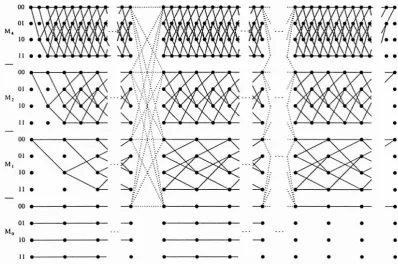
If error correction coding is employed in the system, then the cl~annel decoder can be invoked in ortler to estimate the most likely modulation scheme in each sub-band. As the number of bits per OFDhl symbol is varying in this adaptive scheme, and the error correctioli encoder's block length therefore is not constant, for our proof of concept wve have chosen a convolutional, rather than a block or turbo encoder a t the transmitter. Howvever, the same principle is applicable to the more complex a i d more powerful family of iterative turbo codecs. Once tlie modulatio~i schemes to be employed in the various sub-bands are decided upon a t the transmitter, the convolutional encoder is invoked, in order to generate a terminated convolutio~lal code word of the length of the OFDM symbol's cap;lcity expressed iu terms of bits. This OFDM codeword is lilodulatcd on the OFDM subcarriers according to the differc~lt ~ ~ ~ o d u l a t i o n schemes for the different sub-bands, and tra~isruitted over tlie channel.
lises, whose inputs are generated independently by the four deinodulators of the legitimate modulation schemes. The iiumber of trmsitious in each of the trellises depends on the iiunlber of output bits from the different demodulators, and,
as expected, the 16QAM (hf4) trellis contains four times
as inally transitions, as the BPSIC and "no transmission" trellises. Since in case of "no trmsmission" no coded bits ,are transmitted, the state of the encoder does not change. Therefore the legitimate transitions for this case are only tlie horizontal ones.
At sub-band boundaries trmsitions are allowed between the same state of all the parallel trellises. This is not a trnrlsitioii due to a received bit, and therefore preserves the mctric of the originating state. Note that in the Figure the ~)ossible allowed trailsitioils are drawn only for the state 00; all otlicr states geilerate the equivalent set of transitions. The i~iitial state a t tlie f i s t block is 00 for all inodulation schemes, and, as the code is terminated by 00, the last I~lock's termiilating states are also 00.
[image:3.508.285.475.6.136.2] [image:3.508.31.219.9.145.2]Tlle receiver's decoder calculates the metrics for the trailsitions in the ~ ~ a r a l l e l trellises, a d , once all data sym- bols liave been processed, it traces back t h o u g h the parallel trellis aloiig the survivirig patli. This back-tracing com- illelices a t tlie most likely 00 state a t tlie end of the last sub-band. If no termiliation was used a t the decoder, then tlie back-tracing would commence a t the most likely one of all the final states of tlie last block.
Figure 4 sllows tlie probability of erroneous ~nodula- tioii inode cstiiilatiorl for tllc parallel trellis decoder in an AWGN channel for 16 and 8 sub-bands, if a convolutional code of col~straint leilgtli 7 is used. Colnparisoll with Figure
2 sllows collsiderable iinl~roveinellts relative to the SNR- estiinatioli bnsed blilid detection scheine of Referelice [9],
110th for 16 as well as for 8 sub-bnrids. Higher sub-band widtlis improve the cstiliiation accuracy by a greater de- gree, tliall it has been observed for tlie SNR-estimation based blind detection algorithm of Reference [9]. A mo- deli1 illode detection crror probability of less than is observed for all SNR value of 6 and 15dB, respectively. The use of stroliger error correction codes could further improve the estimation accuracy, a t tlie cost of higher complexity. Lastly, we note that the spikes in tlie Figure around G and l l t l B are due to opting for a higher-order co~istellation upon
lo0
'
(%M,.M,.M3
$6 subbards
I
:
lo-'
-
10-2 -
a: w
lo4-
0
lo4
-10.5 -
106 8
increasing the channel SNR, which then results in a slight increase of the DER. Let us now consider the overall coded
L 4
10'
3 10-2
5
10. 2 v) am m
1 o4
1
1 (r
10a 0
0 5 10 15 20 25 30 35 40
system performance in the next Section.
0 5 10 15 20 25 30 35 40 m r . > # m l
-
average channel S N R [dB]~ . * 2 . a 7 ,.I .-s average channel S N R [dB]
Figure 5: BER perfromance of OFDM modern in fading Figure 4: Probability of erroneous bliiid modulation scheme time-dispersive channel for both uncoded m d turbo-coded detection using the proposed parallel trellis algorithm with transmission. 8-iteration turbo decoder, 1000 bit random a I< = 7 convolutional code over a n AWGN channel. interleaver, co~lstraint length 3.
3. SUB-BAND ADAPTIVE OFDM AND TURBO CODING
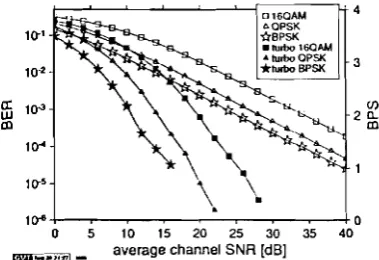
The main advantage of the proposed coded OFDM scheme is that the modem BER can be 'fine-tuned' to a value, where the full power of the error correction codec is exploited, but not overloaded. Specifically, the employinent of adaptive OFDM moduIation can reduce the mode~n's BER to a level, where channel decoders can perform reliably, since they are not overloaded by the plethora of chanilel errors. Figure 5 shows both the uncoded and coded BER ~~erformance of a 512 subcarrier OFDM modein in the fadiiig wideband channel of Figure 1, assuming perfect cllanilel estimation. The channel coding employed in this set of experiments is a turbo coder [ l l ] having an interleaved data block lengtli of 1000 bits, employing a random interleaver and 8 decoder iterations. The constituent recursive systematic convolu- tional
(RSC)
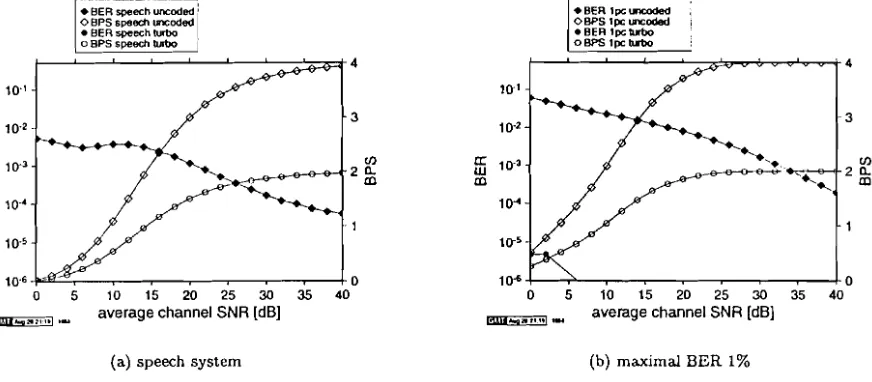
encoders are of constraint length 3, with octal generator polynomials of ( 7 , 5 ) .By contrast, Figure 6(b) depicts the BER arid Bits per Symbol (BPS) t h o u g h p u t performance of this turbo de- coder employed in conjunction with the adaptive modem for different adaptation algorithms. Figure G(a) shows the performance for the "speech" system eml)loyil~g tlie switch- ing levels listed in Table 1. It cau be seen tliat the channel coding results in a halved throughput compared to the un- coded case, but achieves error free tralisillission over the channel for SNR values near OdB.
. - -
I ; ~ ~ w , . ~ u I -
Sample index
Subcarrier
index
n
[image:4.580.50.496.12.183.2] [image:4.580.71.470.285.549.2])c
Figure 1: Wideband channel (a)
-
unfaded symbol spaced impulse response (b) - corresponding frequency domain channel transfer functionFigure 3: Schematic plot of the parallel trellis for blind modulation scheme detection. In this example, a four-state 00-
BER speech uncoded '
0 BPS speech moded
0 5 10 15 20 25 30 35 40
average channel SNR [dB]
(a) speech system
C 0
0 5 10 15 20 25 30 35 40
average channel SNR [dB]
(b) maximal BER 1%
-_
Figure 6: BER and throughput of 16-subband adaptive turbo coded and uncoded OFDM illodeill employing (Mo, M i , Mz, A44) for (a)-
speech type switching levels of Table 1 and (b) - a maximal estimated sub-baud BER of 1 %uilder 3dB, and no recorded error events for SNR values above GdB. 111 closirlg we uote that the norlllaliscd Doppler freque~~cy plays an importarit role in determining the per- formance of tlie adaptive OFDM modem, an issue, which
was demonstrated in Reference [9].
4. CONCLUSIONS AND FURTHER WORK
An OFDM transmission scheme employing subband-adaptive i~lodulation scliemes for transmission over slowly fading time dispersive cliaii~lels has bee11 proposed. Two blind modula- ti011 sclle~rle detection algorithnls have bee11 compared and
[3] H. Matsuoka, S. Sampei, N. hlorinaga, iuid
Y.
I<amio, "Adaptive modulation system with variable codirig rate concatenated code for high quality multi-niedia commu- nications systems," in 461h Vehicular Technology Con- ference, pp. 478491, IEEE, 1996.1:4] S.-G. Chua and A. Goldsmith, "Variable-rate variable- power MQAM for fading cliannels," in 461h Vehicular
Technology Conference, pp. 815-819, IEEE, 1996. [5] J .
M.
Torrance and L. Hanzo, "Latency and networkingaspects of adaptive modems over slow illdoors rayleigh fading channels." to appear i11 IEEE Tr. on Veh. Techn., 1998.
the effect of turbo coding 011 the system's BER and BPS
performa~ice was quaitified, co~lfirming the advantages of [G] J . M. Torrance, L. Hanzo, and T. I<eller, "Interference tlie proposed adaptive scllemes. aspects of adaptive modems over slow rayleigh fading
channels." To appear in IEEE
Tr.
011 Veh. Teclin.5. ACKNOWLEDGEMENT [7] A. Czylwili, "Adaptive OFDhI for witleband radio chan- nels," in Globewm, (London), pp. 713--718, IEEE, 1996.
Tlie f i i i a ~ c i d support of Motorola ECID, Swindon, uI< and (81 P. S- Cllow, J. M. Ciofi, J . A. C. Billgllain, "A prac- tliat of the Europea~l Co~n~llissiou in t l ~ e framework of the tical discrete multitone trausceiver loadiug algorithm Media11 project is gratefully ackrlowledged. Sincere tliauks for data transmission over sl~ectrally sliaped clia~inels," are also due to the EPSRC, UI< and tlie Mobile Virtual IEEE 7kans. on Communications, vol. 48, pp. 772-775, Centre of Excclle~lce, UI<. Tlie autliors arc indebted fur- 1995.
tller~~iore t o tlie Median Europea11 Consortiurn partners for [9] T. I<ellcr aud L, Hmzo: Adaptive Ortllogollal fie-
fruitful discussio~is OII a ralige of associated topics. quency Division IvIultiplexing Sclieines, .4CTS198,
Rho-
dos, Grece, June 1998, pp 794-799
6. REFERENCES [lo] J . Torrance and L. Hanzo, " O p t i ~ n i s a t i o ~ ~ of switching levels for adaptive modulation in slon~ rayleigh fading," [l] R. Steele and W. Webb, "Variable rate Q.4M for data Electr. Letters, vol. 32, pp. 1167-1169, 20tli June 1996.
t r a ~ l s ~ i ~ i s s i o ~ i over Rayleigh fading cliannels," in Wire- [ill C. B ~A. ~~ l ~~aIld p, ~ h i ~ i ~ ~ ~ j ~ h i ~ ~ ~ , ~~ i ~ ~ ,~ ~u ~ e a r , less, (Calgary, Alberta), pp. 1-14, IEEE, 1991. Shannon Limit Error-Correcting Codi~ig and Decoding:
[2] W.T. Webb, L. Hanzo: Modern quadrature ampli- Turbo-Codes", Proc. ICC 1993, pp. 1064-1070 tutle ~nodulation: Principles axid applications for fixed
[image:5.573.61.497.8.199.2]![Table 1: Optimised switching levels for irdaptivc inodula tion over Rayleigh fading channels for the "speecli" ant "data" system, shown in instantaiicous cl~aii~lel SNR [dB (from [lo])](https://thumb-us.123doks.com/thumbv2/123dok_us/1052411.621241/1.525.312.504.430.463/optimised-switching-irdaptivc-inodula-rayleigh-channels-speecli-instantaiicous.webp)