© 2019, IRJET | Impact Factor value: 7.211 | ISO 9001:2008 Certified Journal
| Page 4993
IMPROVEMENT OF ENGINEERING PROPERTIES OF SOIL USING CHIR
PINE NEEDLES
Pooja Rani
1, Er. Tripti Goyal
21
M. Tech
Student, Modern Institute of Engineering & Technology, Mohri (Haryana)
2
Head of Department, Civil Engineering, Modern Institute of Engineering & Technology, Mohri (Haryana)
---***---Abstract:- Environmental concerns caused by the
extraction of raw materials and CO2 emissions in the production of Portland cement led to pressures to reduce the consumption of this constituent of concrete, combined with the need to increase its durability. The cement is the most costly and energy intensive component of concrete. The unit cost of concrete can be reduced as much as possible by partial replacement of cement with other waste pozzolanic materials. Certain materials of mineral origin are also added to concrete to enhance their strength and durability properties of concrete materials such as chir pine needles and other byproduct like fly ash. There is increase in OMC and decrease in MDD with addition of chir pine needles but the value of CBR gets increased with addition of 1% and 3 cm long chir pine needles. Therefore, the strength at this combination is not decreased with the decreased in MDD as compared to virgin soil. UCS increased with chir pine needles has 22.75%, 7% and 0.65% with respect to UCS test results of virgin soil. CBR for soaked soil of the virgin soil is 2.14% which have been increased to 2.17%, 2.66% and 2.14 by addition of chir pine needles.
Key Words: - Soil, chir pine needles, Maximum dry density,
Optimum moisture content, Unconfined compressive strength (UCS),California bearing ratio(CBR)
1. INTRODUCTION
Soil is a natural material and the property of soil varies not only from one place to other but also at the place with depth and with a change in the environmental, loading and drainage conditions. The properties of soil depend not only on its type but also on the conditions under which it exists. In comparison to other construction materials such as concrete or steel, it is not economically feasible to transport the soils from one place to other, because a huge quantity of soil is involved and it is not opened to inspect at greater depth for foundations of different structures.
Soil stabilization is the route of improving the engineering performance of soil. Stabilization is constrained to the routes which modify the soil material itself for upgrading its properties. The existing soil at construction site may not always be totally suitable for supporting structures, for example, granular soil may be very loose and indicate large elastic settlement so, the soil needs to be identified to increase its unit weight and thus shear strength. Various
materials are used to stabilize the soil like cementing materials or chemical etc. Stabilization is used to condense the permeability and compressibility of the soil and to increase the shear strength. Soil stabilization is required to increase the bearing capacity of foundation soil by using controlled compaction, proportioning and the addition of suitable admixtures and stabilizers.
Sometimes, engineers are forced to construct structure at site selected for reasons other than soil conditions. Thus it is increasingly important for the engineer to know the degree to which the engineering properties of the soil may improve or other alternatives that can be thought off for the construction of intended structure at the stipulated site. If unsuitable site conditions are encountered at the site of a proposed structure, unsuitable soil can be bypassed by means of deep foundation extended to a suitable bearing material, poor material can be removed and replaced by a suitable material, or soil in place can be treated by using any suitable ground improvement methods (soil stabilization) to improve its engineering properties.
So, to work at the selected site, we need to have proper knowledge about their properties and factors which affect their behavior. Hence, from the beginning of the construction work, the necessity of enhancing the soil properties has come to the light and the process of soil stabilization helps us to achieve the required properties in a soil needed for the construction work.
Site feasibility study for geotechnical projects is of far most beneficial before a project can take off. Site survey usually takes place before the design process begins in order to understand the characteristics of subsoil upon which the decision on location of the project can be made. The following geotechnical design criteria have to be considered during site selection-
i) Design load and function of the structure. ii) Type of foundation to be used.
iii) Bearing capacity of subsoil.
© 2019, IRJET | Impact Factor value: 7.211 | ISO 9001:2008 Certified Journal
| Page 4994
locally materials including local soils for the constructionof lower layers of pavement, for the construction of retaining walls, for the stabilization of the soil. So, in this research work, soil stabilization is to be carried out with local material i.e. Chir Pine Needles which is available in abandon and free of cost.
2. OBJECTIVES: The objective of present study is to explore the possibility of utilization of Chir pine needles for improvement of engineering properties of soil.
i) To study engineering properties of clayey soil. ii) To study the variation in Engineering Properties of
clayey soil mixed with Chir Pine Needles
iii) To determine the compressibility (OMC & MDD) of clayey soil sample mixed with Chir Pine Needles in variation of length and different percentage of Chir Pine needles.
iv) To determine the unconfined compressive strength of clayey soil sample mixed with Chir pine needles in variation of length and different percentage of Chir pine needles.
v) To determine the California Bearing Ratio (CBR) of clayey soil sample mixed with Chir pine needles in variation of length and different percentage of Chir pine
vi) Analysis and interpretation of results.
3.EXPERIMENTAL STUDY
3.1 MATERIALS
Following are the materials which are used for stabilization of Clay soil:
a)
Chir pine needles: - The pines are coniferous, evergreen, resinous trees belonging to the genus Pinus of the family Pinaceae, native to the northern hemisphere. They are also found in south-Asia and the Himalayan region of India. Chir pine (Pine roxburghi) is predominant in coniferous forest of the Himalayan regions of Uttrakhand and Himachal Pradesh. The needle shaped green colored adult pine leaves found in clusters are known as pine needles. Under the present work, pine needles were used as raw material for making particle boards. Pine needle in its natural form is difficult to process and bond with conventional resin polymer into panel product. The nonporous surface of the needle is difficult to wet by resin. These problems were solved by cutting the needle into smaller sizes and bonding was improved by using specially made cardanol-phenol-formaldehyde resin. Glued and dried pine needles were drawn into mat and hot pressed to get panel products for various end uses. Process parameters varied to optimize strength properties of the products. Particle board made out of pine needles conforms to all properties of wood Particle Board as per IS: 3087. Ceiling tiles of various designs were developed from glued pine needle as well as pulverized pine needle powder. Pine needle particle board (plain and design) was used as panel door infill and small tea-poy top to demonstrate the application potential (Figure 1.).Fig.1:Chir Pine needles
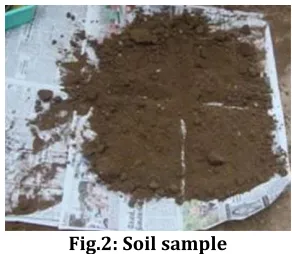
[image:2.595.367.497.61.179.2]b) Clay soil:- In order to study the behavior of clayey soil with chin pine needle and recron-3s, a sample of soil is collected from village- Mullanpur, Chandigarh as shown in figure 2. The soil shows expansive properties when came in contact with water. The clayey soil is light brown in colour. According to IS soil classification system, the soil was classified as Plastic clay(CI).The index properties of soil are determined as per Indian standard test procedure and tabulated in Table 1.
[image:2.595.359.505.320.447.2]Fig.2: Soil sample
Table 1: Properties of soil used in study
Sr.
No. Characteristics Value
1 Specific gravity 1.94
2 Atterbergs limits: a) Liquid limit (%) b) Plastic limit (%) c) Plasticity index (%)
28.10 16.26 11.84
3 Colour Brown
4 Type of soil as per IS: 1498 CL 5 Standard Proctor compaction
test result:- Optimum moisture content
(%)
Maximum dry density(g/cc) 12.5 1.99 6 Unconfined compressive
strength(KN/cm2)
4.57
7 California bearing ratio at 2.5 mm penetration
at 5 mm penetration 2.14% 1.84%
3.2 EXPERIMENTAL INVESTIGATION
The following were tests performed for the present study in laboratory:-
[image:2.595.330.534.474.728.2]© 2019, IRJET | Impact Factor value: 7.211 | ISO 9001:2008 Certified Journal
| Page 4995
2. Standard Proctor Test for determination of O.M.Cand MDD
3. Unconfined Compression Test.
4. California Bearing Ratio Test
In this research work an attempt has been made through extensive laboratory experimentation to utilize the Chir pine needles for stabilization of clayey soil. The soil samples were tested to examine their physical properties like Liquid Limit and Plastic Limit. The Maximum Dry Density and Optimum Moisture Content of the soil were obtained using Modified Proctor’s Compaction Test. After examining the physical properties of clayey soil, the soil was mixed with different percentages of Chir pine needles and then CBR and UCS values are determined. The main focus of the present investigation was to conduct systematic research work on the effect of Chir pine needles in stabilization of clayey soil, so that new method of application can be evolved.
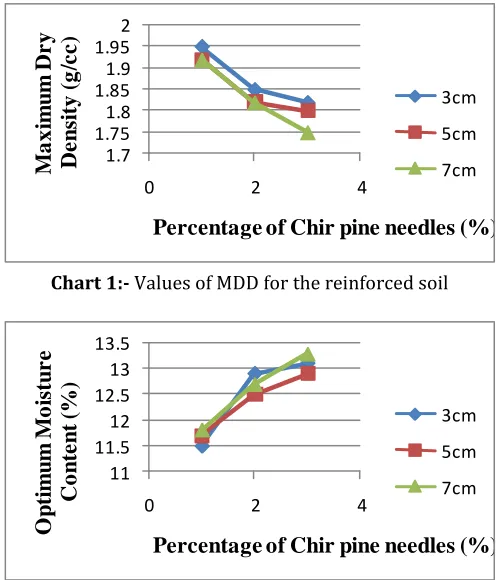
[image:3.595.308.557.66.356.2]3.2.1 OPTIMUM MOISTURE CONTENT AND MAXIMUM DRY DENSITY: - The clayey soil samples reinforced with Chir pine needles have been tested by using Modified Proctor Test at varied values of moisture content for the analysis of MDD and OMC. The results are illustrated as below.
Table 2:- Values of MDD and OMC for the reinforced soil
S.No.
Percentage of Chir pine needles = 1%
Percentage of Chir pine needles = 2%
Percentage of Chir pine needles = 3%
MDD (γd)
g/cc
OMC, w
%
MDD (γd)
g/cc
OMC, w
%
MDD (γd)
g/cc
OMC, w
%
Length of Chir pine needles 3cm
1. 1.95 11.5 1.85 12.9 1.82 13.1
Length of Chir pine needles 5cm
2. 1.92 11.7 1.82 12.5 1.80 12.9
Length of Chir pine needles 7cm
3. 1.92 11.8 1.82 12.7 1.75 13.3
1.7 1.75 1.8 1.85 1.9 1.95 2
0 2 4
M
a
x
im
u
m
D
r
y
D
e
n
si
ty
(g
/c
c
)
Percentage of Chir pine needles (%)
3cm
5cm
7cm
Chart 1:- Values of MDD for the reinforced soil
11 11.5 12 12.5 13 13.5
0 2 4
O
p
ti
m
u
m
M
o
is
tu
r
e
C
o
n
te
n
t
(%
)
Percentage of Chir pine needles (%)
3cm
5cm
7cm
Chart 2:- Values of OMC for the reinforced soil
[image:3.595.302.557.501.752.2]3.2.2 UNCONFINED COMPRESSIVE STRENGTH OF THE REINFORCED SOIL: - The clayey soil samples reinforced with Chir pine needles has been tested for Unconfined Compressive Strength (UCS) at the maximum dry density and optimum moisture content as determined in the laboratory on reinforced soil at different combinations. The results thus obtained have been shown in Table 3 and chart 3.
Table 3:- UCS values of reinforced soil
S.No.
Percentage of Chir
pine needles
Length of Chir pine needles
3cm 5cm 7cm
UCS of reinforced soil, (kg/cm2)
1. 1% 5.61 4.89 4.60
2. 2% 4.60 4.11 2.68
3. 3% 3.46 3.93 2.66
0
2
4
6
0
2
4
U
ncon
fi
ned
Com
pres
si
ve
Str
engt
h
(K
g/
cm
2)
Percentage of Chir pine needles (%)
3cm
5cm
7cm
© 2019, IRJET | Impact Factor value: 7.211 | ISO 9001:2008 Certified Journal
| Page 4996
3.2.3 CALIFORNIA BEARING RATIO FOR THEREINFORCED SOIL
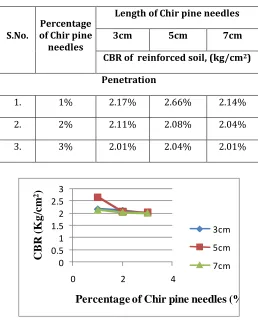
[image:4.595.32.290.193.514.2]The clayey soil samples reinforced with Chir pine needles are tested by using CBR at the maximum dry density and optimum moisture content as determined in the laboratory on reinforced soil at different combinations. The test results calculated at different combinations are given below in Table 4 and chart 4.
Table 4:- CBR values of reinforced soil
S.No. of Chir pine Percentage needles
Length of Chir pine needles
3cm 5cm 7cm
CBR of reinforced soil, (kg/cm2)
Penetration
1. 1% 2.17% 2.66% 2.14%
2. 2% 2.11% 2.08% 2.04%
3. 3% 2.01% 2.04% 2.01%
0 0.5 1 1.5 2 2.5 3
0 2 4
C
BR
(K
g
/c
m
2
)
Percentage of Chir pine needles (%)
3cm
5cm
7cm
Chart 4:- CBR values of reinforced soil
4. CONCLUSIONS
4.1 COMPRESSIBILITY OF SOIL
There is increase in OMC and decrease in MDD with addition of Chir pine needles but the value of CBR gets increased with addition of 1% and 3 cm long Chir pine needles. Therefore, the strength at this combination is not decreased with the decrease in MDD as compared to virgin soil.
4.2UNCONFINED COMPRESSIVE STRENGTH OF SOIL
i)
The UCS of the soil reinforced with Chir pine
needles has increased by 22.75%, 7% and 0.65% with respect to the UCS test results of the virgin soil, when 1% chir pine needles are mixed with 3cm, 5cm and 7cm length respectively. Further. It has also been observed that UCS values increases to 0.65% at 3cm length with 2% weight of chir pine needles of dry soil sample.
ii) From the laboratory tests conducted for UCS
values, it is concluded that the optimized value of
UCS is 5.61 kg/cm2 which is 22.75% higher than the virgin soil and is obtained when mixed with chir pine needles of 3cm length with 1% by weight of dry soil sample.
4.3CALIFORNIA BEARING RATIO OF SOIL
i) The Soaked CBR of the virgin soil is 2.14% which has been increased to 2.17%, 2.66% and 2.14% by adding 1% chir pine needles to 3cm, 5cm and 7cm length respectively.
ii) From the tests conducted for Soaked CBR value, it is concluded that the optimum value of Chir pine needles is 1% with 5 cm length which has
5. FUTURE SCOPE
The present research work is confined to improve the engineering properties of clayey soil (CL) by using Chir pine needles as reinforcement for Compressibility (MDD), unconfined compressive strength (UCS) and California bearing ratio (CBR) of soil. There is substantial scope of carrying out future research in this area. The possible research idea for future work is as follows:
i) A study can be conducted on other types of soils to investigate the effects of adding Chir pine needles on engineering properties of the soil.
ii)
The other engineering properties of the soil like
Direct Shear Strength can be evaluated using chir pine needles.iii) A study can be carried out with addition of other types of waste materials in addition to the waste of Chir pine needles to improve the engineering properties of the soil.
iv)
In this study dry Chir pine needles were used but one can also use green Chir pine needles for the improvement of soil properties.REFERENCES
Akinmushuru,J.O. and Akinbolade, “Stability of loaded footings on reinforced soil” Journal, Geo Tech Engg. Div., ASCE, Vol. 107, No– 6,pp819-827, 1981.
Ayyar T.S.R., Joseph J., and Beena K. S., “Bearing Capacity of Sand Reinforced with Coir Rope”, First Indian Geotextile Conferenceon Reinforced soils and Geotextiles, Bombay, All - Al6, 1988.
Banerjee, P.K., “Development of new geosynthetic products through blends of natural fibers,” Proceedings of the International Seminar and Technomeet on Environment Geotechnology with geosynthetics, New Delhi, 1966.
Cammack, “A role for coir fiber geofabrics in soil stabilization and erosion control”, Proceedings of the 11th workshop on coir geogrids and geofabrics in Civil Engineering Practice, Coimbatore, India, pp 28 -31, 1988.
© 2019, IRJET | Impact Factor value: 7.211 | ISO 9001:2008 Certified Journal
| Page 4997
railway stations in Delhi” PariveshBhawan,CBD-cum-Office Complex, East Arjun Nagar, Delhi-110032, India, 2009.
Chaosheng Tang, Bin Shi, Wei Gao, Fengjun Chen, Yi Cai, “Strength and mechanical behaviour of short polypropylene fibre reinforced andcement stabilized clayey soil” Geotextiles and Geomembranes, pp 194 – 202, 2006.
Consoli, N.C., Prietto, P.D.M. and Ulbrich, L.A., “The behaviour of fibre- renforced cemented soil” Ground Improvement, London, 3(1), pp 21-30, 1999.
Giroud, J.P. and Noiray, L., “Geotextile reinforced unpaved road design”, Journal of Geotechnical Engineering Division, ASCE:107, pp 1233 - 1254, 1981.
International Journal on Theoretical and Applied Research in Mechanical Engineering ISSN (Print): 2319-3182, Volume-3, Issue-1, “Study on heave characteristics of black cotton soils using copper slag with cement as admixture” pp 1-70, 2014.
Kumar, A. Wallia, B.S., and Bajaj, A., “Influence of fly ash, lime and polyester fibers on compaction and strength properties of expansive soil,” Journal of Materials in Civil Engineering, ASCE, Vol.19, No.3, pp 242-248, 2007.
Miss Apurva J Chavan, “Use of plastic waste in Flexible pavements” International Journal of
Applicati3on or Innovation in
Engineering&Management (IJAIEM.) Volume 2, Issue 4, ISSN 2319 – 4847, pp 540-552, 2013.
Pramod S. Patil, J.R. Mali, Ganesh V. Tapkire, H. R. Kumavat,“Innovative techniques of waste plastic used in concrete mixture” International Journal of Research in Engineering and Technology, Volume-03, Special Issue : 09, NCETCE-2014, pp 29-32, 2014.
Science for environment policy, DG Environment news alert services (in-depth report), “Plastic Waste: Ecological and Human Health
Impacts”, pp 1-41, 2011
VaishaliSahu, “Sustainable reuse of stabilized and fiber reinforced fly ash-lime sludge (FALS) as pavement sub-base material,” Proceeding of Indian Geotechnical Conference, Roorkee, pp 1-8, 2013.
Venkata Koteswara Rao Pasupuleti, Satish Kumar Kolluru, Blessingstone T., “Effect of Fiber on Fly-Ash Stabilized Sub Grade Layer Thickness” ISSN 0975-4024, Vol-4 No-3, pp140-147, 2012.