AGENT-BASED MODELLING OF SOCIAL RISK
AMPLIFICATION DURING PRODUCT CRISES
Yun Liu
Supervisors: Jerry Busby, Stephan Onggo
Department of Management Science
Management School
Lancaster University
Submitted in partial fulfilment of the requirements for the degree of
Doctor of Philosophy
DECLARATION
This thesis is my own work, and it has not been submitted for the award of a higher degree elsewhere.
ACKNOWLEDGEMENTS
I would like to thank my supervisors, Dr. Jerry Busby and Dr. Stephan Onggo, for their tremendous support, patient guidance, and encouragement throughout my PhD study. I have been extremely lucky to have two supervisors who have serious and rigorous attitudes toward academic research, who were committed to meeting me weekly, who always gave very detailed comments on my work, and who constantly trained me to think logically and critically. Their incisive suggestions and insights helped me at each stage of my research. I really appreciate all their contributions of time and effort to make my PhD an amazing experience.
My sincere gratitude goes to members of my review panel: Prof. John Boylan, Prof. Konstantinos Zografos, and Dr. Roger Brooks, from whom I received particularly helpful feedback. I would also like to thank my viva voce examiners, Dr. Edmund Chattoe-Brown and Dr. Roger Brooks, for their time, interest, and insightful questions.
I am indebted to my friends who participated in the pre-test of my survey questionnaire and helped improve it. Thanks also go to those who made time to complete the survey online.
Special mention goes to our PhD Programme Coordinator, Ms Gay Bentinck, who provided administrative support and was always ready to help.
ABSTRACT
Public response to risk is socially shaped in a way that often over- or under-estimates expert risk assessments. One of the main theoretical tools to examine public risk perception is the social amplification of risk framework (SARF). This framework proposes a mechanism through which risk responses arise from interactions among various social actors, but past empirical work has been mainly concerned with correlations between structural variables rather than the mechanism of amplification and the process over time by which it develops. And more importantly, there has been quite limited modelling of risk amplification to date. This study aims to discover a way of formalising social risk amplification, to find out what are the necessary assumptions for modelling risk amplification, and to work out what consequences this modelling would predict. It is an attempt to model collective response to risks that are significant at a societal level but which materialise in a distributed way across a population. The natural heterogeneity of individual risk perceivers, the emergence of behaviour through interactions of social actors, and the complex feedback loops linking risk perception with risk related behaviour point to using an agent-based model as a modelling medium.
The study is developed in the context of product contamination scandals such as the recent cases in China of contaminated milk products. One of the important features of contamination crises is that product recall has become an increasingly inevitable part and is often a key element in risk communication during such crises. Yet recalls send ambiguous signals about the misconduct of the organization in question: they clearly indicate some kind of failure, and possibly negligence, in the product that are associated with a risk of significant harm; but they also suggest that the organization is concerned with consumers’ welfare.
The model that was developed is based on the principle that risk perceivers have to assimilate risk through the risk beliefs of others, their direct experience of a risk, and communications about the risk from organizations (including their product recall decisions) and the media. And it is based on the principle that, as well as discovering the nature of a risk, risk perceivers also make judgments about wrongfulness (which Freudenburg called recreancy) – and this also shapes the strength of risk responses.
initial conditions, objective risk level, duration of contamination, and variation of recreancy perception are the most significant influences on the degree of social amplification. This knowledge helps prioritize data collection for future research and identify important aspects that particularly require managerial attention.
The main contribution of this study is to develop a process of modelling social risk amplification that consists of three steps of increasing contextualisation. The first step involves a basic model that captures social risk amplification as a general theory relative to all kinds of risk event. The second step contextualises this model specifically for product recall crises. It involves extracting agent decision rules from the literature on product recall, based on statistical associations found in empirical work on recall crises. And the third step contextualises the model for a specific population. It involves calibrating the relative importance of different information sources for the heterogeneous agent population using a survey of Chinese consumers responding to a milk contamination crisis. One important insight from the process of modelling risk amplification is that SARF is not sufficient for modelling particular crises. It seems essential that modelling of SARF should involve a clearly defined context in which risk responses arise.
CONTENTS
1 INTRODUCTION... 1
1.1 Research problem ... 1
1.2 Theoretical foundation ... 2
1.3 Research context ... 3
1.4 Research objective... 4
1.5 Layout of thesis ... 5
2 LITERATURE SURVEY ... 6
2.1 Theoretical background of risk amplification ... 6
2.2 Empirical evidence of risk amplification ... 8
2.2.1 The actors in risk amplification ... 9
2.2.2 Contributory effects ... 14
2.2.3 The different contexts in risk amplification ... 16
2.2.4 The different methodologies by which risk amplification has been studied ... 19
2.3 Modelling of risk amplification... 22
2.4 Conclusions ... 24
3 RESEARCH CONTEXT... 27
3.1 2008 Chinese milk scandal ... 28
3.2 Nongfu Spring water event ... 31
3.3 Gutter oil scandal ... 33
3.4 Summary ... 39
4 RESEARCH DESIGN ... 41
4.1 Research questions and objectives ... 41
4.2 Process and methods of modelling ... 42
4.2.1 Choice of agent-based modelling ... 42
4.2.3 Validation procedures ... 46
5 AGENT-BASED MODELLING AND SIMULATION ... 48
5.1 Conceptual model underlying both agent models ... 48
5.2 A perfect mixing model... 49
5.2.1 Model development ... 49
5.2.1.1 Basic model ... 49
5.2.1.2 Adding contamination ... 50
5.2.1.3 Adding product recall ... 52
5.2.1.4 Adding recreancy ... 54
5.2.1.5 Adding broadcast media ... 56
5.2.2 Simulation results ... 57
5.3 A small-world network model... 70
6 CALIBRATING SURVEY ... 81
6.1 Aims of the survey ... 81
6.2 Design of the survey ... 81
6.2.1 Context ... 81
6.2.2 Structure ... 82
6.3 Sampling and administration ... 84
6.4 Pilot ... 85
6.5 Sample characteristics ... 85
6.6 Survey results ... 88
6.6.1 Information sources ... 88
6.6.2 Relative importance ... 89
6.7 Model calibration ... 94
6.8 Simulation results of calibrated models ... 103
7.1 Sensitivity analysis ... 111
7.1.1 Method of sensitivity analysis ... 111
7.1.2 Results of sensitivity analysis ... 116
7.1.3 Conclusion to sensitivity analysis... 133
7.2 Model validity ... 134
7.2.1 Brief literature review on agent model validation ... 134
7.2.2 Validity of the recall model ... 140
8 GENERAL DISCUSSION ... 152
8.1 Connections with SARF ... 152
8.1.1 Elements seen in SARF ... 153
8.1.2 Elements absent in SARF ... 159
8.2 Contextual specificity ... 161
8.2.1 What is general in the model ... 161
8.2.2 What is specific in the model ... 165
8.3 Response to research questions ... 166
9 CONCLUSION ... 173
9.1 Intended contributions ... 173
9.2 Practical implications ... 175
9.3 Limitations and future work ... 176
TABLE OF SYMBOLS ... 180
REFERENCES ... 185
APPENDIX ... 207
A Extraction of decision rules ... 207
B Survey instrument ... 219
1 INTRODUCTION
This chapter gives an introduction to this study in five aspects – the research problem that it tackles, the theoretical approach that it is based on, the context in which it is conducted, the objective that it attempts to achieve, and the layout of the thesis.
1.1 Research problem
Risk perception appears to hold a central position in the social and organizational agenda and is crucial for the understanding of social processing of uncertainty (Rogers, 1997). Management and communication of risks have become a dominant concern of many organizations, government agencies, and scientific research groups in modern society. It has long been accepted that public perceptions of risk are socially shaped (Muter et al., 2013; Scherer and Cho, 2003). Specifically, how people perceive and respond to risks is a reflection of social context they find themselves in (Sjöberg, 2000). An individual’s reaction to risk is often accompanied by communicating with others, processing related risk information, and modifying risk behaviour accordingly. Thus the judgments that people make about risks or risk events are more a question of social interaction and observation than of merely anticipated physical consequences (McComas, 2003; Mitchell, 1995).
1.2 Theoretical foundation
One of the main approaches for explaining public risk perception is the social amplification of risk framework (SARF) (Kasperson et al., 1988). SARF aims to explain how risks or risk events that are considered minor by technical experts produce strong public concern and substantial social and economic consequences. A risk event is portrayed through risk signals that interact with psychological, social, institutional, and cultural processes in ways that can heighten or downplay public perceptions of risk and related risk behaviour. The notion is that risk signals are created, transferred, and interpreted by a variety of social actors that are seen as ‘amplification stations’, such as individuals, news media, social groups, government agencies, scientific institutions, and so on. The term ‘amplification stations’ were proposed in the original article of SARF (Kasperson et al., 1988) to represent social actors that experience a risk event and generate, transmit, and process information about the risk. Amplification here refers to a difference between subjective and objective assessments of risk and includes both overestimation and underestimation of risks. Risks will become amplified if the subjective risk beliefs of the public are higher than the objective risk but attenuated otherwise.
The social processing of risk signals is accompanied by behavioural responses that are likely to evoke secondary impacts, such as loss of trust in institutions, loss of sales, demand for regulatory constraints, litigation, changes in physical risk, community alienation, and stigmatization of product, that spread far beyond the initial impact of risk events (Kasperson, 2012; Kasperson et al., 1988; Renn et al., 1992).
In accordance with SARF, social experience of risk is not merely an experience of health and safety impacts, but rather the result of the process by which individuals and social groups learn to analyse the nature and effects of risky events by gathering and processing relevant risk information from the physical world and the social world (Burns et al., 1993; Kasperson and Kasperson, 1996). The concept of social risk amplification provides a theoretical base for explaining individuals’ perceptions of risk as well as an analytic framework for exploring the social processes by which risk responses are made.
responses have received little attention. One is organizational misconduct, which is termed ‘recreancy’ and defined as the belief that the producer has betrayed the public trust and fails to fulfill its obligations (Freudenburg, 1993). Freudenburg (2003) has argued that recreancy is probably the most important contributor to social risk amplification. This combines with but does not replace direct experience in the formation of risk responses. Direct experience obviously serves as a source of information by providing feedback on the nature and controllability of hazardous events (Kasperson, 2012; Kasperson et al., 1988). But as Rogers (1997) pointed out, although direct experience can lead to learned perception and is an important basis of public risk estimates, it may be very limited in many contexts for many of the more contentious, societal-level risks.
1.3 Research context
Product contamination crises have been one of the most pressing problems faced by organizations (Siomkos and Kurzbard, 1994). They are seen as well-publicized occurrences wherein products are found to be contaminated with a biological, chemical, or physical agent and could cause adverse health effects. Factors such as the increasing complexity of products, customers being more demanding (Dawar and Pillutla, 2000; Laufer and Coombs, 2006), and increasingly advanced and, at the same time, vulnerable technology (Standop, 2006) have made contamination incidents even more frequent. Moreover, as indicated by such cases as the milk contamination incident in Oahu, Hawaii, in 1982 (Liu et al., 1998) and contaminated pet food in the United States (Feng et al., 2010), product contamination incidents often dominate media space and elicit extensive public concern, creating great challenges for the organizations’ handling of associated risks.
demonstrating that the producer is seeking to solve the problems and to protect consumers from being harmed by products in question. As a consequence, the context for this study is a specific product contamination crisis in which the organization involved makes a product recall, with the Sanlu milk scandal as the prototype case.
1.4 Research objective
The objective of this research is to investigate the process of modelling risk amplification. This includes:
1) identifying the key elements of SARF that need to be incorporated in a model of risk amplification mechanisms;
2) identifying the main assumptions that need to be made in the construction of this model; 3) determining what kind of decisions are required when the model is applied to product contamination crises;
4) finding a suitable process of calibration;
5) assessing what insights can be gained from simulating the model and performing sensitivity analysis on the results.
The inherent heterogeneity of individual risk perceivers (Sjöberg, 2000), the emergence of behaviour through interactions of social actors (Binder et al., 2011; Smith et al., 2013), and the complex feedback loops linking risk perception with risk related behaviour (Burns and Slovic, 2007; Busby and Onggo, 2013; Busby et al., 2016) point to using an agent-based model as a modelling medium. As discussed earlier, such a model is developed in the context of product contamination scandals such as the recent cases in China of contaminated milk products.
In the model there are a relatively large number of public agents (typically 1,000), a single producer agent, and a media agent. The conceptualisation of an individual agent forming risk perceptions during a recall event is composed of three primary elements. The model separates individuals’ responses into a risk discovery element that integrates prior beliefs, beliefs of social neighbours, direct experience, and producer announcements and a recreancy judgment element that is assessed by the timing and voluntariness of recalls. It is also an important step to combine narrowcast and broadcast information channels among a population of public actors interacting in a fixed social network. Public agents use very simple linear rules to update their risk beliefs. The model is partially calibrated by a consumer survey to achieve a certain level of micro-validity and to further contextualise social risk amplification.
contextualisation – involving the extraction of agent decision rules from the literature and calibrating agent priorities from a survey. The second is to show with the model which are the aspects to which risk amplification is most sensitive. The main practical value of the study is to show policymakers and risk managers who need to deal with public risk responses how to reason about the problem of how such responses are formed. Perhaps most significantly, the model helps managers reason about the effects of early or late product recalls, and helps them deal with the dilemma that product recalls can be both harmful and beneficial to a producer’s reputation. And thinking about the role of the media as leaders or followers of public responses has been shown to make an important difference.
1.5 Layout of thesis
2 LITERATURE SURVEY
This survey attempts to organize, describe, and evaluate the current literature on social risk amplification. The findings will be used in Chapter 5 for the development of decision rules behind social risk amplification in the conceptual agent model. This review is structured as follows. The first section deals with theoretical background of risk amplification. The second section outlines and critically comments on empirical work in terms of actors (media and non-media actors), contributory effects, contexts, and methodologies. The third section surveys the existing modelling of social risk amplification. This review ends with a brief discussion and conclusion.
2.1 Theoretical background of risk amplification
The social amplification of risk framework (SARF) (Kasperson et al., 1988) was originally proposed to portray why and how certain risks attract public concern and become either heightened (through an amplification process) or lessened (through an attenuation process). In other words, SARF is regarded as an integrative framework that can be used to conceptualise and understand the dynamic complexity of risk perception within a social system (Duckett and Busby, 2013; Renn et al., 1992). SARF draws upon the notions that there is a serious disjuncture between expert assessment of risk and public perceptions of risk, and that an adequate conceptual framework is essential to provide guidelines on how to model and measure the functional relationships among various factors related to specific risk events (Kasperson et al., 1988).
According to SARF, the social amplification of risk is the ‘the phenomenon by which information processes, institutional structures, social-group behaviour, and individual responses shape the social experience of risk, thereby contributing to risk consequences (Kasperson et al., 1988). Risk amplification occurs at multiple stages, including dissemination of risk information and related exaggeration, underestimation or otherwise distortion of risk perception, as well as subsequent societal response mechanisms. It should be noted that direct experience can sometimes serve as a risk amplifier or attenuator by providing feedback on the nature and controllability of hazardous events in reality. But to a large extent, awareness and knowledge of a risk is not acquired through direct experience. Specifically, mass media, interpersonal communication, and social interaction play pivotal roles in not only transmitting risk information but also framing and interpreting risk issues (Chung, 2011; Kasperson and Kasperson, 1996; Smith et al., 2013).
In particular, the media that are usually represented by television, newspaper, radio, and increasingly, the Internet, occupy a vitally important and often conflicting role in shaping public perceptions, attitudes, and reactions to risk. Extensive media coverage on controversial natural, social, or technological risks can evoke strong social attention or public concern (Frewer et al., 2002; Koné and Mullet, 1994). It is generally held that media coverage is the mirror of risk perception, since the media are likely to allocate coverage disproportionately to rare or dramatic risks or risk events (Combs and Slovic, 1979; Kasperson et al., 1988). But this is not necessarily the whole story especially when potential contributors to risk perception are taken into account in the particular context to which the risk is specifically sensitive.
Interpersonal communication, which involves the linkage with friends, neighbours, colleagues, and relatives, can also act as an agent of risk amplification in the way that people tend to neglect risk issues in isolation from views of their peers and share preference points or seemingly biased opinions with each other (Kasperson, 2012; Kasperson et al., 1988; Stanciugelu, 2013).
With respect to social interaction, risk perceptions and risk-related responses are situated within a broader context where most risks are conceptualised, measured, and manipulated by social groups and institutions. The behaviour and interactions of institutions and organizations largely reflect their rules, functions, interests, and expectations that affect their predispositions in terms of risk interpretation and risk control (Renn et al., 1992).
symbolic connotations may entail the tendency to intensify or downplay related risks or risk events.
There have been some criticisms of SARF, although it has become a standard lens that is widely used by researchers, risk managers, and policymakers. Rayner (1988) argued that the metaphor of amplification assumes risk signals to exist externally and objectively. Rayner (1988) held that risks do not exist outside the social system but relate closely to social actors that contribute and are subject to social processes. Correspondingly, risks are not ‘things’ independent of perceivers, but complex relationships of human and nonhuman components. Rip (1988) similarly stated that ‘a hazard signal is not just information-to-be-processed, but includes a (subculturally determined) action precept, or just a general call for action without prescribing any yet’. Rip’s criticism is also that analysis and evaluation of effects of social responses are markedly absent in SARF, and that the discussion concentrates on the individual in light of information communication and response mechanism and neglects the processes of social aggregation.
The starting point of SARF is that there is a divergence between expert assessment and lay risk judgments. But Duckett and Busby (2013) argued that the authors of SARF do not explicitly point out whether expert assessment denotes a baseline risk from which social amplification is regarded as an unfavourable distortion. SARF fails to address the idea that ‘commonsense judgments about other people’s risk behaviour often involve attributions of disproportionality’ (Duckett and Busby, 2013). Thus risk issues that seem overblown for one group are generally not being exaggerated by other groups. As Duckett and Busby (2013) suggested, additional layers of complexity exist among experts and the lay public. Besides, competing discourses are involved in the debates about the proportionality of risk response. Thus it is difficult and challenging to make objective comparison between expert risk assessments and lay judgments. Yet, in spite of the above critique, SARF has proved and continues to be successful and influential as an integrative and heuristic framework in the risk management arena.
2.2 Empirical evidence of risk amplification
2.2.1 The actors in risk amplification
There are two types of actor clearly differentiated in the literature: media and non-media (e.g. the public, government, NGO, organizations, etc.). This section reviews how the two types of actors contribute to social risk amplification, respectively.
Media in risk amplification
It has been argued that a number of attributes of information about a risk event are responsible for social risk amplification (Kasperson et al., 1988). The news media, serving as an important channel of information flow, have received extensive scientific attention for their critical role in communicating risk and shaping public risk perception.
Current empirical work has paid close attention to the effect of media coverage on public perceptions of risk. It is noted that negative media coverage and positive media coverage produce asymmetrical effects on perceived risk for milk contamination in Oahu, Hawaii (Liu et al., 1998). Negative media coverage has immediate effects on individual behavioural responses due to consumers’ dislike of adverse health effects, while positive news reports do not have a quick impact because it takes some time for consumers to slowly adjust their perceptions to their perceived risks before the contamination is revealed.
Kasperson and Kasperson (1996) pointed out that the news media generally cover risks selectively. For example, the media tends to downplay commonplace but more serious risks yet emphasize those that are rare or dramatic. However, in some countries, the media actively pursues aggressive risk intensification or risk attenuation for the interest of social institutions or governmental agencies. In China, for example, the news media have to accept the Communist Party’s guiding ideology and comply with the Party’s press policies, and the media have to design their coverage to support the Party’s guidance in political and social life (Zhao, 1998).
Frewer et al. (2002) examined how media reporting about the risks associated with genetically modified foods affects public attitudes toward the technology, and concluded that there was consistency between the pattern of reporting and the changes in risk perception. In other words, individuals who perceived media reports as more alarming showed greater increases in risk perceptions compared to those who were less alarmed by the reports.
humans, since television is more likely to intensify perceived risk of wildlife by presenting vivid images, dramatic plots, and negative emotional content. By contrast, Yeo et al. (2014) noted that television news, newspaper stories, and online media coverage could mediate risk perception toward nuclear power within the American public before and after the Fukushima Daiichi disaster in Japan. Individuals who paid comparably higher level of attention to news saw larger decrease in risk perceptions after the disaster and vice versa.
Media use also played a vital role in determining the risk evaluations of ideological groups. For example, the less attention conservatives paid to media the smaller drops in risk perception they experienced (Yeo et al., 2014). Moreover, Chung (2011) has investigated the dynamic process of risk amplification in the Internet environment through an examination of public concern for environmental risk associated with a tunnel construction. It is suggested that the intensity of public concern does not necessarily correspond with the amount of press coverage or the number of news articles. What can be concluded from this position is that the public is quite active in appreciating risk-related information, in responding to media reporting, and in becoming involved in the adjustment process of their perceptions (Chung, 2011). In the same way, an empirical study that puts emphasis on wildfire risk perceptions among homeowners residing in a wildland-urban interface demonstrates that information provided by the media is not significantly correlated with risk perception (Smith et al., 2013). This result could probably be explained by the location of the study, where wildfire programs are actively implemented.
associated with environmental, technological, and social risks can spawn considerable effects at the level of risk management, such as new regulations and policy decisions, and proactive risk communication strategies. These effects may restrict or enable what the media does (follow the pace of risk experts or regulatory agencies, or actively anchor public opinion), where the media obtains risk information (for example from whistleblowers or experts), what the media presents (accurate information or distorted portrayal), and what language of risk the media uses (the extent of dramatization and the symbolic connotations of information). Moreover, if the media notices that the risk of a hazardous event is socially amplified, in most cases it would frequently publish news stories referring to the event in order to cater to the interest of regulators and the public. This situation will probably increase individuals’ ability to recall the risk and heighten their perception of the likelihood of the hazard occurring, resulting in a reinforcing feedback loop of risk amplification. How risk amplification affects media is quite important for modelling the role of media in shaping public understanding of risks or risk events and merits further investigation.
Non-media actors in risk amplification
The media, in isolation, is unlikely to account for risk amplification (Chung, 2011; Frewer et al., 2002). The argument that risk perception is a mirror of media coverage cannot be always justified (Renn et al., 1992), because there are other non-media agents within the social amplification of risk framework that can affect public concern. For instance, the public, government agencies, commercial organizations, and NGO (non-governmental organisation) might operate as amplification stations to exert a strong influence on risk perception.
Interpersonal communication has received relatively little attention in the research on risk amplification. Binder et al. (2011) investigated the influence of interpersonal discussion on individual perceptions of risks on the basis of a public opinion survey of residents living in potential locations for a new biological research facility in the United States. The results showed that discussion frequency functioned as both an amplifier and an attenuator of risk judgments in relation to the facility, with a small positive influence on supporters and a significant negative influence on opponents. Researchers also investigated the potential influence of public meetings on risk perception by examining individuals’ predisposition toward a local environmental hazard. The findings suggested that attendees perceived greater risks than did nonattendees, and that risk perception increased with the number of meetings attended (McComas, 2003). Moreover, individuals’ online posts and comments to certain risk could generate amplifying ripples of public concern (Chung, 2011).
attenuation of risks from fishing even if they were in the face of consumption warnings – the risks the public perceived were much lower than the risk estimates of the scientists and regulators (Burger, 2000). Mixed and conflicting messages concerning fish consumption and fishing, and economic benefits from fishing for both the public and governmental agencies enabled the public to discount the warnings, thereby fostering the deamplification (i.e. attenuation) of risk.
Arguably, the interactive dynamics between the public and elements in the social networks play a role in influencing the general public’s perception of risk. The Canadian public showed attenuated perception of risk after BSE (bovine spongiform encephalopathy), a fatal, transmissible neurodegenerative disease that affects the central nervous system of cattle, was detected in Canada, primarily due to the relatively infrequent media reporting of BSE compared to concurrent news stories of other events such as SARS, WNV (West Nile virus), and U.S.-Iraq war (Lewis and Tyshenko, 2009). By contrast, Boyd and Jardine (2011) concluded that the risk of BSE in Canada was neither socially heightened nor attenuated through the social process. Local and social context gave rise to a public understanding of BSE related risk that indicated actual health and economic outcomes. This disparity between these two studies may be attributable to the fact that the former focused solely on the comparison of press coverage of BSE in Canada and other countries, while the latter incorporated various elements (e.g. media, cultural context, and trust) into its analytical structure.
of neglecting the role of salamanders as a symbol representing endangered species in that area, which aroused public concern and triggered legal and social controversies. The third signal placed a political burden on the President by way of connecting environmental protection with public trust in political leaders. As for the last signal, Jiyul, a leading activist in the fight against the tunnel construction, conducted a hunger strike lasting 100 days, which magnified public concern for the issue. These signals suggested an amplification process in which public concern spread out from local to national levels and perception of risk associated with the tunnel construction was heightened progressively with the sequential order of four risk signals.
Experts are also key actors in putting risk issues on the road to amplification or attenuation. Scientists at the Ramazzini Foundation over-stated their research result that aspartame, an artificial sweetener can cause cancer to human beings (Lofstedt, 2008). The Ramazzini research group generated great publicity and made aspartame an amplifiable topic mainly through active manipulation of press coverage, and ripple effects produced in this process prolonged the controversy unexpectedly. Among expert groups, general practitioners (GPs) are also thought to have a role in the social amplification process. According to Raude et al. (2004), French GPs’ risk perception related to BSE tended to be amplified in their practice and to be attenuated in their own private circle. In other words, they were risk amplifiers for their patients and risk attenuators for members of their family. Furthermore, GPs were more proactive in advising their patients than they were to their family, given that precautionary advice provided by GPs to their patients was slightly more correlated to risk estimates, whereas their reported behaviours toward family members were better related to the degree of their expressed concern about BSE linked risks. This discrepancy can be explained from two aspects. First, the data that were collected for the study indicated reported, not observed, behaviours of GPs. Therefore, there was a good chance that respondents over-reported recommendations made to their patients and underreported those provided to family members. Second, as Kasperson (1992) argued, ‘Individuals in groups and institutions do not react merely in their roles as private persons, but rather according to the role specification associated with their positions. Amplification may therefore differ among individuals in their roles as private citizens and in their roles as employees or member of social groups or organizations’. Thus, GPs acted more ‘scientifically’ with their patients and more ‘parentally’ with their family.
various variables, but not necessarily the causality of observed phenomena (Binder et al., 2011; Loewenstein and Mather, 1990; Smith et al., 2013; Yeo et al., 2014). The analytic focus of one study usually far outweighs potential concerns about other research questions, so some critical features of the phenomena may not be taken into account when researchers are committed to look at a single issue at a single point (Binder et al., 2011), making it unlikely it can examine other important hypotheses (Burns et al., 1993).
2.2.2 Contributory effects
Research on risk amplification provides evidence that multiple sources of information and interactions affect the way individuals think about, and respond to, risks. Apart from media and non-media actors, other factors can also serve to trigger public attention to a particular risk and increase risk perceptions.
Kasperson (2012) pointed out that social trust is an important element of the dynamics of social amplification. Some research results provide support for the notion that trust in how regulatory institutions cope with a risk event influences risk perceptions. Boyd and Jardine (2011) showed that the general public indicated a high level of trust in government after BSE was detected in Canada. This trust was fostered by Canadian news media, which provided accurate depictions of risks associated with BSE and enhanced the public’s confidence in the safety of beef products. This was one of the major factors that affected the general public’s perceptions and contributed to the lack of amplification or attenuation of BSE related risks. But unlike the viewpoint of Boyd and Jardine (2011), the research by Frewer et al. (2002) proved that the media had no impact on individuals’ trust in risk regulators with regard to the risks of GM food in the United Kingdom. A potential explanation is that trust in institutions was too low to decline further; in other words, a “floor effect” occurred. Trust and perceived risk independently influenced people’s attitudes toward GM food. Higher levels of trust in regulators were interrelated with more risks and negative effects perceived by the lay public. Vila and Font (2008) found that loss of trust in the media in UK society made people more critical about information on genetically modified (GM) foods, impairing the role that the media played in shaping public risk perception. However, no conclusive evidence has been found that there is a direct cause-and-effect relationship between media specific biases and distrust in the media. Therefore, trust in the media does not appear to be an influencing factor of risk perception of GM food.
illustrated that risk perceptions were shaped by place-bound attachment as well as complex cultural worldviews regarding how people were affiliated to place. Individuals (mainly residents) who had a strong sense of belonging and strong emotional attachment to local community saw industrial encroachment possibly brought by the AIH proposal as a threat to their livelihoods. They regarded the region as a safe place to live and thereby perceived high risks surrounding the AIH proposal. Individuals (mainly non-residents, such as officials and industrial representatives) who acted to promote the AIH proposal believed that the region was suitable for industry and industrial development that would serve the interests of all residents. They viewed industrial development as an opportunity to boost the local economy (for example, create job opportunities and business spinoffs) and discounted the intrinsic dangers and uncertainties associated with the AIH proposal. Similarly, Cantrill (2011) presented the sense of self-in-place framework in the context of wildlife conservation, and suggested that place attachment to the environment could engender an amplification of the perceived impacts of conservation initiatives designed to protect and restore wildlife populations. A sense of self-in-place is used to clarify the relationship between identity and place, and a person’s sense of self-in-place refers to two overlapping sets of cognitions (Cantrill and Senecah, 2001). One of these components deals with the connection between people and geographic venues (i.e., specific locations), and another involves an embedding of one’s identity in larger, more general environment that emphasizes individual perceptions of and interaction with surroundings. In wildlife management context, for long-term residents of a target region, the sense of self-in-place bestowed a premium upon the use of landscape for social activities and outweighed the value of ecosystem services provided by biodiversity. Therefore, the public were likely to perceive wildlife conservation practice as threats to their long-standing lifestyles, resulting in heightened perceptions of risk about conservation projects.
It has also been found that exposure to risk is a fairly good predictor for individual responses to hazardous events (Renn et al., 1992). Data analysis indicated that exposure to risk was strongly related to perceived risk of hazards, and was more influential in shaping people’s perceptions than were actual casualties or magnitude of property damage. As a consequence, an exposure of many people that brings about minor injuries or only a small number of casualties is more influential in shaping risk perception than that of a few people leading to several casualties (Renn et al., 1992).
wildfire, while those who had not received wildfire information from any source were likely to attenuate the probability that a wildfire would occur. Among a variety of interactions between community members, homeowners and their neighbours, and other social contacts, talking with neighbours about wildfire exerted the strongest positive impact on perceived probability of experiencing a fire, followed by attending a fire-specific event.
There are other theories that can help broaden the understanding of the mechanism by which amplification or attenuation occurs in the social arena. Of special significance are
social resonance theory and common pool theory. Renn (2011) has applied these two analytical concepts to investigate the mechanism of amplification and attenuation in the climate change debate. Resonance theory states that subsections of society provide vital services to society as a whole through four major subsystems: economy, politics, the social sphere, and the cultural sphere (Parsons, 1951). Communication within a system is generally correlated to the resonance medium that it deals with. Communication between systems depends on successful transformation of messages from one dominant resonance medium to another. Resonance reflects the extent to which a sense of common understanding or concern is produced in the communication process within a system or between different systems (Renn, 2011). With respect to the threat of climate change, the impacts of global climate change resonate with concerns of each subsystem of society and urge these subsystems to work on solutions in terms of their own function. Resonance makes climate change a top issue in societal debates, attracting extensive public attention and intensifying the perception of risks of climate change.
Common pool resources are considered as open access resources for each individual (person or state), but unlimited access can cause overuse of resources (Paterson, 2009). It is argued that behaviour is not only partially driven by attitudes and motivations but also by social feedback such as someone else’s comments on one’s contribution. Moreover, common pool resources introduce free riders who take advantage of resources without paying the price. In the context of climate change, neither states nor individual persons have an incentive for taking proactive actions when they perceive others using resources without constraints or perceive the effectiveness of their actions as marginal (Renn, 2011). Furthermore, free riders may obtain benefits at the cost of those who take effective actions. This dilemma makes actors downplay the significance of their actions and leads to an attenuation of the climate change risks.
2.2.3 The different contexts in risk amplification
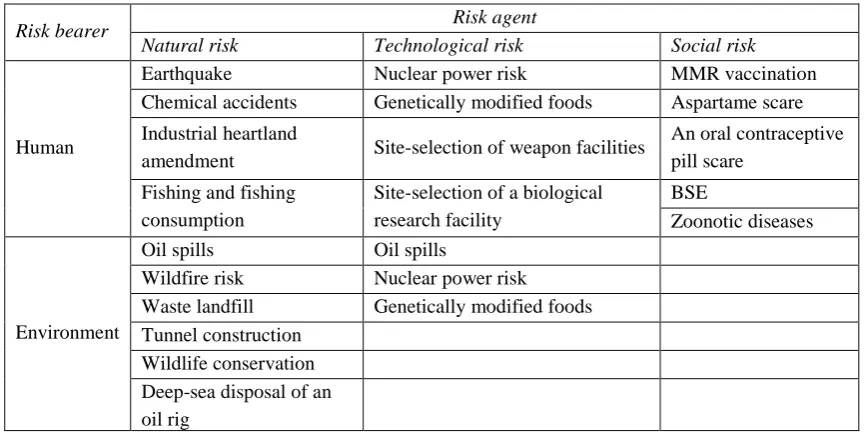
risk bearer and risk agent, as shown in Table 2.1. Risk bearers refer to human and
environment. Risk agents include natural risk, technological risk, and social risk. Specifically,
natural risk involves tunnel construction (Chung, 2011), waste landfill (McComas, 2003), wildfire risk (Smith et al., 2013), deep-sea disposal of an oil rig (Bakir, 2005), oil spills (Leschine, 2002), wildlife conservation (Cantrill, 2011; Hart et al., 2011), chemical accidents (Souza Porto and Freitas, 1996), industrial heartland amendment (Masuda and Garvin, 2006), fishing and fish consumption (Burger, 2000), and earthquake (Stanciugelu, 2013).
[image:25.595.100.534.434.652.2]Technological risk refers to site-selection of a biological research facility (Binder et al., 2011), site-selection of nuclear weapons facilities (Metz, 1996), nuclear power risk (Yeo et al., 2014), oil spills (Leschine, 2002), and genetically modified foods (Frewer et al., 2002; Vila and Font, 2008). And social risk concerns MMR (measles, mumps and rubella) vaccination (Petts and Niemeyer, 2004), an oral contraceptive pill scare (Barnett and Breakwell, 2003), aspartame scare (Lofstedt, 2008), BSE (Boyd and Jardine, 2011; Lewis and Tyshenko, 2009; Raude et al., 2004), and zoonotic diseases (Busby and Duckett, 2012). Based on SARF, these studies largely review the dynamic process in which risks are either amplified or attenuated by different groups, and the divergence between expert judgment and the lay public’s beliefs about the magnitude and the controllability of risks.
Table 2.1 Classification of risk events in two dimensions
Risk bearer Risk agent
Natural risk Technological risk Social risk
Human
Earthquake Nuclear power risk MMR vaccination
Chemical accidents Genetically modified foods Aspartame scare
Industrial heartland
amendment Site-selection of weapon facilities
An oral contraceptive pill scare
Fishing and fishing consumption
Site-selection of a biological research facility
BSE
Zoonotic diseases
Environment
Oil spills Oil spills
Wildfire risk Nuclear power risk
Waste landfill Genetically modified foods
Tunnel construction Wildlife conservation Deep-sea disposal of an oil rig
2011), and this provided an ideal context for examining the role that interpersonal discussion played in influencing individual judgments of risks. As another example, an eco-industrial development proposal in Alberta, Canada (Masuda and Garvin, 2006) brought industrial risks into public view and clashed with residents’ sentiments that the target region was a safe place to live, making place attachment the primary influencing factor for risk amplification. With respect to other risks, especially natural disasters such as earthquake (Stanciugelu, 2013) and some threats to life such as BSE (Boyd and Jardine, 2011; Lewis and Tyshenko, 2009) and genetically modified foods (Frewer et al., 2002; Vila and Font, 2008), media coverage was the most influential on people’s overall evaluation of risks and therefore received widespread attention.
In principle, there are two possible explanations for why risk amplification varies so much between particular contexts. First, as risks are situated within the social experiences and interactions between individuals and social groups (Scherer and Cho, 2003), the social context in which risks are embedded and the ways in which risks are communicated contribute to shaping risk perceptions, leading to unique findings about patterns of risk amplification from risk to risk. According to SARF (Kasperson et al., 1988), the social, institutional, and cultural contexts in which the risk information is appreciated and diffused endow the information with specific meanings and values that only make sense within the socio-cultural contexts. Thus, how the general public or social groups interpret and react to information about risks or risk events depends largely on the roles they occupy, the experience they have, the beliefs or rules they comply with, and the extent to which their judgments are affected by various social stations in the particular social settings in which risks or risk events occur.
A role is also played by whether risks are seen as natural or man-made. It may be that natural processes cannot be improved by cautious and proactive actions, so once a natural accident occurs, people conclude it is in fact inevitable (Leschine, 2002), while people usually believe that manmade damage could have been avoided by more prudent behaviour, or by better knowledge and experience about the risk (Schmidt, 2004). At present, there is actually no strong evidence to support the hypothesis that people are more apt to amplify human caused risks, but this is definitely an important question that merits comprehensive investigation in future research.
Finally, there is an obvious difference in the risks of accidental or chance hazards and those of deliberate harm like terrorism. Terrorism is a criminal act that produces widespread fear and panic among the public beyond the immediate victims and has become increasingly common throughout the world. The general public, victims, the government, the media, and other organizations are normally involved in terrorism, and their responses are broad in scope. There have been some studies on risk perceptions about terrorism (Lee and Lemyre, 2009; Lemyre et al., 2006; Lerner et al., 2003; Rogers et al., 2007; Sönmez and Graefe, 1998), but few within the social amplification of risk framework.
2.2.4 The different methodologies by which risk amplification has
been studied
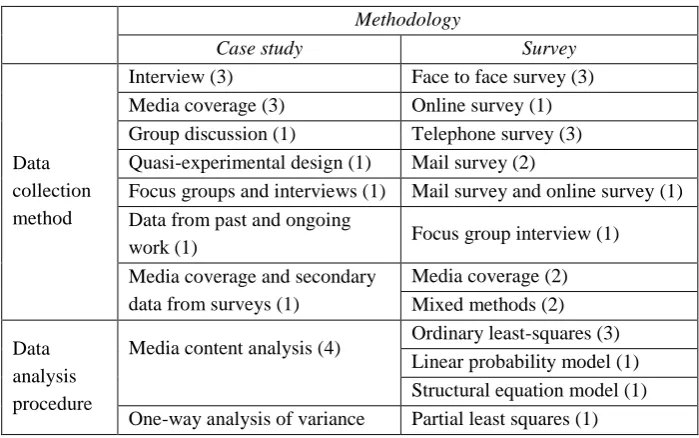
[image:27.595.141.491.549.768.2]In general, there are two main methodologies applied to empirical work on social risk amplification: case study and survey. Table 2.2 shows the two methodologies in terms of data collection method and data analysis procedure.
Table 2.2 Methodologies used in empirical work
Methodology
Case study Survey
Data collection method
Interview (3) Face to face survey (3)
Media coverage (3) Online survey (1)
Group discussion (1) Telephone survey (3)
Quasi-experimental design (1) Mail survey (2)
Focus groups and interviews (1) Mail survey and online survey (1)
Data from past and ongoing
work (1) Focus group interview (1)
Media coverage and secondary data from surveys (1)
Media coverage (2) Mixed methods (2)
Data analysis procedure
Media content analysis (4) Ordinary least-squares (3) Linear probability model (1)
(1) Covariance structure analysis (3) Principal components analysis (2)
Media content analysis (2)
Note:figures in brackets indicate the number of articles using that method.
Case study
Most case studies are qualitative in essence, applying SARF to analyse the reaction mode of different social stations by means of interviews (Barnett and Breakwell, 2003; Lofstedt, 2008; Masuda and Garvin, 2006), group discussions (Petts and Niemeyer, 2004), media content analysis (Barnett and Breakwell, 2003; Chung, 2011; Lofstedt, 2008), focus groups and individual interviews (Busby and Duckett, 2012), and media content analysis and secondary data from surveys (Vila and Font, 2008). For example, Chung (2011) used the volume of readers’ comments on online newspaper articles and the number of visits to message board posts as indexes to demonstrate the level of public concern for environmental risks from a high-speed railway tunnel construction project in South Korea. Petts and Niemeyer (2004) employed two-phase interactive discussion groups (at the first meeting groups examined preferred sources of health information, and at the second meeting groups focused on perceptions of the information) to observe lay talk about risk issues of MMR (measles, mumps, and rubella) and to explore how experience, mediated knowledge, and social context influence public perceptions of risk. A study on risk perception of eating fish derived data from four published studies and one ongoing study and conducted a meta-analysis to gather in-depth information (Burger, 2000). Vila and Font (2008) used both media coverage and data from Eurobarometer surveys to examine the relationships between the content and intensity of press media and risk perceptions of new genetically modified (GM) foods between 1999 and 2004 in Spain and the United Kingdom. These qualitative studies have suggested how practical knowledge, experience, and personal context of individuals affect their attitudes toward a risk issue, and how particular actors such as scientists, environmentalists, experts, governmental agencies, and NGO take advantage of mass media to voice their opinions and to affect the public’s perceptions of risk.
Survey
The survey strategy has also gained broad popularity in the field of risk research, and the forms of survey have been wide-ranging: face to face survey (Burns et al., 1993; Frewer et al., 2002; Renn et al., 1992), online survey (Yeo et al., 2014), telephone survey (Boyd and Jardine, 2011; Hart et al., 2011; Stanciugelu, 2013), mail survey (Binder et al., 2011; Raude et al., 2004), and an exception of combining both mail survey and online survey (Smith et al., 2013). As expected, questionnaire was the most widely used approach to collect data by survey strategy, but focus group interview (Petts et al., 2000), where standard questions are asked of all interviewees (Saunders et al., 2003), and content analysis of media reporting related to risky subjects (Lewis and Tyshenko, 2009; Petts et al., 2000), also fell into this strategy.
Data collection sometimes needs to rely on not simply one method, but a series of methods, especially for some of the more complicated studies aimed at shedding new light on the causal relationships among various dimensions of a risk event. For example, both Renn et al. (1992) and Burns et al. (1993) adopted a mixture of public survey, expert rating, individual rating, news coverage search, and iterative Delphi procedure to gather data regarding five dimensions that were believed to contribute to risk amplification: physical consequence, risk perceptions, media coverage, public responses, and societal impacts. Since each dimension was measured by different variables, different approaches were required to operationalize them. More specifically, physical consequences were estimated by expert rating, risk perceptions and risk responses by surveying university students and individual rating, media coverage by keyword search, and societal impacts by Delphi panel. The use of multiple, but independent methods to obtain data provides more perspectives on the research problems being investigated and improves the credibility and generalizability of results (Smith et al., 2012).
Generally speaking, selection of statistical tools is subject to what particular results are expected to get out of the analytic framework. Specifically, OLS was used to regress risk perceptions against expected correlates, such as demographic differences, information sources, social interactions, personal characteristics, benefit perception, predispositions, and news media attention, so as to determine their explanatory power to risk perceptions. It is worth mentioning that two studies performed principal components analysis (PCA) to create subscales of variables indicating the changes in risk perception and facilitate subsequent analyses. For example, Frewer et al. (2002) extracted three subscales (risks and negative effects, trust and choice, and benefits) from 53 attitude items, with each subscale composed of representative items. Smith et al. (2013) used PCA to compress variables into perceived probability and perceived consequence based on the hypothesis that social amplification has different impacts on these two dimensions of risk perception.
Summary
As suggested above, empirical work on risk amplification has presented comprehensive evidence that risk perceptions are often distorted by comparison with expert judgments, and that public response is usually stimulated and modified to an unexpected degree, because a number of influencing factors including social stations and other factors exaggerate or weaken public concern for risk. These distortions, to some extent, reflect the influence of interpersonal communication on the individual level and the nature of social interaction on the social level.
By and large these studies seek to identify the causal relationships and fundamental laws that can interpret regularities in risk amplification, but they fail to probe into the mechanism for amplifying or attenuating risk, which is normally considered the core of risk amplification and also essential for modelling risk amplification. They are mostly concerned with what factors are correlated with amplification, rather than with the processes that produce amplification. Another limitation is that little effort has been made to explore variations in public behaviours especially across different regions or risk contexts. The effort involved in investigating risk amplification in any particular context makes it hard to carry out comparative studies across different contexts, so it can be unclear what is general and what is particular in each study.
2.3 Modelling of risk amplification
capture factors critical to forecasting public response to a terrorist attack. The diffusion of fear within a community was modelled and simulated in the context of three hypothetical disaster scenarios (anthrax attack, bomb blast, and propane tank explosion) to illustrate how risk perceptions and behavioural responses shifted with factors such as characteristics of hazardous events, media coverage, word of mouth, and community intervention. Busby and Onggo (2013) developed a system dynamics model to examine whether risk perceptions of different social actors would diverge in the context of zoonotic disease outbreaks. Their model was based on the notion that social risk amplification is a subjective attribution and incorporated three attributional elements: confusion, distrust, and perceptions of the significance of behaviour change. Both Busby et al. (2016) and Onggo et al. (2014) have used an agent-based model to explore the mechanisms of social risk amplification. Busby et al.’s (2016) model focused in particular on some central characteristics of risk responses: the way actors anticipate each other’s biases, the way actors change their beliefs as the prevalence of a risk perception varies, and the way risk communications are fashioned on the basis of responses to previous communications. Onggo et al. (2014) modelled both narrowcast communication through social networks and broadcast communication through media to look at how they contribute to the formation of public risk perception. In addition, Bleda and Shackley (2012) used simulation modelling as an analytical tool for appreciating the formation of perceptions of risk associated with BSE. They modelled two types of risk amplification: amplification caused by media coverage and amplification caused by other forms of social communication such as the communication in the social networks and the official public communication of new scientific discoveries.
There seem to be two main reasons why more progress has not been made in modelling SARF. First, the definition of risk amplification is still vague. It is normally assumed that risk amplification should be a gap between different risk judgments, but there is considerable controversy about what gap social risk amplification refers to. Is it the gap between expert and public assessment of risk, or between objective (real) and subjective (perceived) risk? It seems hard to determine the baseline risk and the deviation of risk perception due to ambiguous definition of social risk amplification, making it more complex and debatable to model risk amplification.
Second, data required for modelling is often difficult to collect. Given that social risk amplification involves internal feedback loops linking risk responses with behaviours that in turn modify risk perception, system dynamics is deemed a natural choice to show the dynamics and reflective nature of social behaviour following a risk event. Nevertheless, system dynamics relies heavily on quantitative or qualitative data to establish and simulate feedback models, and it draws upon a much broader set of data than do traditional statistical analytic tools (Luna-Reyes and Andersen, 2003).
2.4 Conclusions
This survey leads to several points that can be drawn from the social risk amplification literature.
First, although there have been some criticisms of SARF, such criticisms have not stopped SARF being an influential framework employed by academics, risk managers, and policymakers. The original article (Kasperson et al., 1988) explicitly pointed out that ‘there is no such thing as “true” (absolute) and “distorted” (socially determined) risk’. The authors acknowledge that amplification is exclusively linked to negative impacts, and the degree of amplification or attenuation influences the extent to which the ripple effects are created by social responses (Kasperson and Kasperson, 1996). The relationship between physical consequences of risk events, press coverage, public responses, individual layperson perceptions, and societal impacts is still ambiguous, even conflicting across studies (Busby and Duckett, 2012). But this problem does not undermine the basic role of SARF to provide a general terminology and framework for social risk responses that will need adapting to particular contexts. The notion that there is a risk that becomes distorted socially makes SARF attractive at both theoretical and practical level (Duckett and Busby, 2013; Renn et al., 1992).
indicates that the media can serve as an amplifier, an attenuator, or an impersonal narrator of risk (Boyd and Jardine, 2011). To some extent, this may be explained by the specific social and cultural context in which risks or risk events occur. As far as non-media actors (for example experts, NGO, and scientific institutions) are concerned, the ways by which they trigger public concern and shape risk perception are significantly different. In certain circumstances, factors such as trust, place attachment, information sources, and social interaction play a role in accounting for exaggerated or diminished perceptions of risk.
Third, risks of different contexts become amplified or attenuated in markedly different ways. One reason lies in the social context in which risks are embedded and the way in which risk information is transmitted. Another reason is that agents entering into different contexts are apparently different and tend to act on their own positions and interests in accordance with the particular context.
Fourth, the methods used in empirical studies are wide-ranging, and generally these studies have been concerned with the causal relationships between elements within the social amplification of risk framework. The findings suggest predictors of behavioural intentions of individuals but say little about the dynamics underlying the risk amplification process in various situations.
Fifth, the modelling of risk amplification has been quite limited to date, because the definition of risk amplification is far from clear and there is a lack of access to necessary data. But correspondingly these are also reasons to do much more modelling. The vagueness about definition is something that models force us to resolve, and the process of modelling helps us realise where definitions and specifications of amplification mechanisms are vague. And the absence of data may only become apparent when building models reveals a need for data that we do not have.
Sixth, the question about which risks are more likely to be amplified by the general public is currently unknown. It seems that events caused by nature such as earthquake and wildfire risk are more acceptable than those by human such as environmental risk, technological risk, and threats to human life. Until now, there is actually no strong evidence to support the hypothesis that people are more apt to amplify human caused risks, but this is definitely an important question that merits investigation in future research. In addition, empirical evidence presented in the literature demonstrates that SARF is applicable to a broad range of risk events, but there may be certain risks of other domains that have not been probed into by scholars, such as counterfeiting and terrorism.
social level, decision making of the organization involved in a risk event is relatively downplayed, or even neglected. For example, within studies on risks such as BSE, aspartame scare, contraceptive pill scare, and genetically modified foods, there are almost no discussions about the reaction of the organizations, how they make decisions to affect public perception, and how they interact with the public and the media.
3 RESEARCH CONTEXT
3.1 2008 Chinese milk scandal
In September 2008, an adulterated milk scandal was unfolded in China. It was discovered that Sanlu Group, a major player in the dairy industry in China, was adding melamine to artificially enhance the protein readings in baby milk powder (Xinhua News Agency, 2008a). Melamine is a colourless crystalline chemical used in making plastics. It could cause infants to develop kidney stones and other renal and urinary failure. The chemical was also found in baby formula products produced by 21 other companies (Yardley and Barboza, 2008). By November 2008, China reported an estimated 300,000 victims (Branigan, 2008), with six infants dying from kidney stones and other kidney damage and about 54,000 babies hospitalised (McDonald, 2008). The melamine milk crisis was called by the World Health Organization one of the largest food safety events it had to deal with in recent years (Schlein, 2008).
New Zealand dairy cooperative Fonterra, which owned a 43% share in Sanlu, said it was alerted to melamine contamination on 2 August (Ramzy and Yang, 2008). Fonterra immediately urged a full public recall of the milk powder, but Chinese authorities refused. On 11 September, Sanlu launched a recall of all of its milk powder products made before 6 August (Ramzy and Yang, 2008; Xinhua News Agency, 2008b). And the following day, on 12 September, China’s Ministry of Health announced a nationwide investigation into the milk scandal. On 15 September, the company issued a public apology for the tainted milk powder (Li, 2008). During the crisis, Sanlu attempted to cover up the contamination. A memo leaked by a Sanlu staff member on 12 September said that Sanlu paid Baidu, China’s leading search engine, 3 million yuan ($640,000) for screening all negative news from search results (Welford, 2008).
Ever since the tainted milk affair broke, the central government had ordered the media not to report any negative news disturbing the Beijing Olympics (Morillon, 2008; Spencer and Foster, 2008). Censorship was imposed to suppress bad news about the contaminated milk scandal – the media was ordered to adhere to the official line provided by state news organizations such as Xinhua News Agency and the People’s Daily (Mooney, 2008). Moreover, blogs were blocked, and sensitive subjects and keywords related to the milk scandal were forbidden on the Internet (Morillon, 2008). Jiang Weisuo, who exposed milk contamination in 2006, died from knife wounds on 12 November 2012 (Zhuang, 2012).