© 2019, IRJET | Impact Factor value: 7.211 | ISO 9001:2008 Certified Journal | Page 3333
STUDY ON BEHAVIOR OF CFST COLUMNS UNDER AXIAL COMPRESSION
AND ANALYSIS BY ABAQUS
VISHWESHWARAYYA1 , Mr. S BHAVANISHANKAR2 1, 2, Dept. of civil Engineering UVCE Bangalore University Bangalore.
---***---Abstract -This study intended to develop a suitable
constitutive experimental study of behavior of CFST’s. Composite steel tubes with SCC as infill for M30 grade concrete for different thickness and lengths and are tested under for ultimate load carrying capacity under axial load. And also FEA analysis of the same is done through ABAQUS 6.10.1.
Thispaper focuses on study on testing and modeling of CFST column under axial loading.
Key Words: axial loading, Nonlinear Analysis, self compacting Concrete, Concrete Filled Steel Tubes, Abaqus.6.10.1
1. INTRODUCTION
CFST element utilizes the advantages of both steel and concrete. Utilization of CFST idea can prompt more % of aggregate sparing in contrast with an auxiliary steel framework solid center upgrades higher compressive quality, firmness, damping and elasticity by external steel tube. In addition, high quality CFST segments require a less c /s to withstand load. In cutting edge days, building plan underlines on improving adaptability of the floor space by diminishing the cross area of segment size. CFST’s are utilized for both unbraced and propped assembling structures. A CFST segment comprises of steel tube and solid center inside it. The steel tube go about as a perpetual structure work consequently work cost, time utilization is diminished.
1.1Benefits of Using CFST Column over Reinforced Column
Composite segment joins the benefits of both basic steel and cement, to be specific the pace of development, quality, and light weight steel, and the characteristic mass, firmness, damping, and economy of cement. The steel outline serves as the erection casing to finish the development of whatever remains of the structure. In this way enhancing pliability. Furlong reasons that the solid infill delays the
neighborhood clasping of the steel tube. Notwithstanding, no expansion in solid quality because of repression by steel tube was watched.
1.2Brief Description of Materials Used
CFST columns of two different lengths and two different thicknesses are used andSCC M30
Mortar, and casted and tested after 28days curing, tested under UTM for axial loading.
1.3Brief Description of Software Used
Finite element method considers being the best tool for analyzing the structures lately, many software's uses this technique for analyzing and creating. For finite factor evaluation and computer aided design field one of the program is suitable i. e. Abaqus. The 3D hollow and concrete filled steel conduit columns are created in Hypermesh-11. 0 software and then exported to ABAQUS. Because creating model is difficult in ABAQUS.
1.4Finite Element Modeling
Self weight concrete filled in the CFST column are accurately model in finite element software ABAQUS 6.10.1 and verified with experimental results and codes of practice. The above figure shows on cross section of CFST columns.
II. MATERIAL PROPERTIES AND
CONSTITUTIVE MODELS
2.1Steel
© 2019, IRJET | Impact Factor value: 7.211 | ISO 9001:2008 Certified Journal | Page 3334
density and young’s modulus are taken as μ=0.3, fs=7860kg/m3 and Es=210000MPa, respectively.
2.2 Self compacting concrete
A rational mix design method of self compacting concrete using a variety of materials is necessary. Coarse aggregate, fine aggregate content in concrete is fixed at 50% & 40% percent of the mortar volume
[image:2.595.322.558.269.432.2]2.3Material casting of CFST
Fig 2.3.1 CASTING of CFST columns
2.4Design criteria for CFST – for various codes
2.5Material Model of Concrete
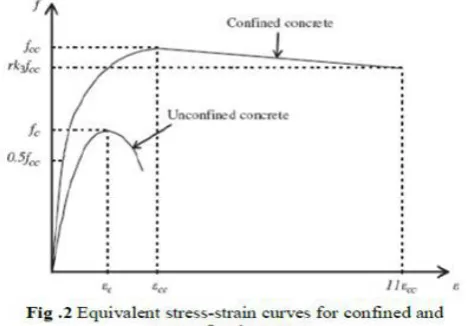
In order to understand concrete behavior in the finite element model, a nonlinear stress-strain diagram for confined concrete should be establish. The equivalent stress-strain curve for confined and unconfined concrete under compressive loading. This is used in proposed FE model.
The properties of material shown in figure 2 are used to define the nonlinear behavior of concrete under confinement. This is defined as follows:
The stress-strain curve is divided into 3 parts namely elastic part (Linear), Elasto-Plastic part and Perfectly Plastic (non linear).
© 2019, IRJET | Impact Factor value: 7.211 | ISO 9001:2008 Certified Journal | Page 3335
The poisson’s ratio of unconfined concrete is assumed to be
μ
cc=0.2. The second part is elasto-plastic which is nonlinear whose origin starts from the end of first part that is 0.5fcc and ends at confined concrete strength fcc as shown in fig 2. This non linear part can be determined from the following equations, proposed by Saenz [5]2.6Properties of Materials
III. MODELING AND MESHING
3.1Load Application
A compressive load is uniformly distributed over the top surface of column nodes as shown in figure 4. The load is applied in Z-direction and is allow to move freely in Z-direction but restrained in X and Y-direction.
fig 3.1 Application of load
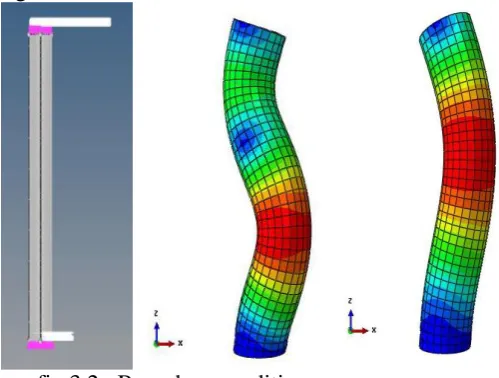
3.2Boundary Conditions
[image:3.595.308.558.382.571.2]Bottom end of the column is fixed in all directions that is Δx=0, Δy=0, Δz=0. Top surface of the column is restrained in X and Y-direction (Δx=0, Δy=0) and allowing displacement in Z-direction as shown in figure.
fig 3.2 . Boundary conditions.
IV. SOLUTION PROCEDURE
First static analysis is performed and then procedure is changed to linear buckling analysis, which gives Eigen values. The first Eigen value is considered as Buckling load factor or critical load for linear analysis. First Eigen value because the column will break at first load and there are less chance to go second critical load. But a material reaches to nonlinearity action so therefore nonlinear analysis is performed. There are several nonlinear methods are available in ABAQUS. Now job is created and submitted to run the analysis.
PROPERTIES
OF MATERIAL density
poisons ratio
young modulus (E )
Kg / m3 MPa
STEEL 7860 0.3 310000
CONCRETE
© 2019, IRJET | Impact Factor value: 7.211 | ISO 9001:2008 Certified Journal | Page 3336
4.1 Analytical Study by using Euro code 4
EC4 [3] is the most recently completed international standard code for composite construction. It covers CFST columns with or without reinforcement. EC4 consider the confinement effect for composite column when relative slenderness ratio(λ) has value less than 0.5. the ultimate axial force for square column is given by
P
u=A
cf
c+ A
sf
sWhere ; Ac=Area of concrete As= Area of steel, and fc and fs are the yield strength of concrete and steel respectively.
V. VERIFICATION OF FINITE
ELEMENT MODEL
5.1Experimental Results
In order to check the accuracy of the finite element model, the modeling results were compared with experimental tests results which is carried out by using Universal Testing Machine (UTM). The Ultimate loads obtained from finite element analysis is PFE and that for experimental test is Pexpt. CFST columns obtained Experimentally and numerically using the FEM. It was found that the non linear finite element simulations are in a good agreement with the experimental results
VI.TEST RESULTS:
FOR RECTANGULAR SECTION
size t L
Pu (ABA)
Pu (expt)
Pu (EC4)
mm mm KN KN KN
50.8x50.8 1.2 400 108.5 102.5 104.2
50.8x50.8 1.6 400 128.5 118 116.2
50.8x50.8 1.2 600 115 108.5 110.5
50.8x50.8 1.6 600 135.2 128 125.3
FOR CIRCULAR SECTION
size t L
Pu (ABA)
Pu (expt)
Pu (EC4)
mm mm mm KN KN KN
38.1 1.2 400 90.6 88.5 84.2
38.1 1.6 400 94.3 92.5 90.5
38.1 1.2 600 118.5 114.5 112.8
38.1 1.6 600 120.3 110.5 112.5
size t L
Pu (ABA)
Pu (expt)
Pu (EC4)
mm mm mm KN KN KN
50.8 1.2 400 108.5 106 102.5
50.8 1.6 400 125.12 110.5 118.23
50.8 1.2 600 112 108 108.6
50.8 1.6 600 130.5 120 128.76
Graphical Representation
FOR RECTANGULAR SECTION
size t L
Pu (ABA)
Pu (expt)
Pu (EC4)
mm mm KN KN KN
38.1x38.1 1.2 400 94.5 90.5 92.5
38.1x38.1 1.6 400 94.5 92 90.5
38.1x38.1 1.2 600 120.3 113.5 115.4
© 2019, IRJET | Impact Factor value: 7.211 | ISO 9001:2008 Certified Journal | Page 3337 FOR CIRCULAR SECTION
VII.STATICAL ANALYSIS
STANDARD DEVIATION
OF ALL RESULTS:
FOR RECTANGULAR SECTION :
size t L
Pu (ABA)
Pu (expt)
Pu (EC4)
mm mm mm
38.1x38.1 1.2 400 1.414 1.414 0
38.1x38.1 1.2 600 1.58 1.59 0.02
38.1x38.1 1.6 400 2.75 2.05 0.707
38.1x38.1 1.6 600 4.29 4.26 0.021
50.8x50.8 1.2 400 2.42 1.81 0.613
50.8x50.8 1.2 600 5.37 2.05 3.32
50.8x50.8 1.6 400 2.59 2 0.586
50.8x50.8 1.6 600 4.03 1.06 2.96
FOR CIRCULAR SECTION :
size t L
Pu (ABA)
Pu (expt)
Pu (EC4)
mm mm mm
38.1 1.2 400 2 0.52 2.51
38.1 1.2 600 1.32 0.049 1.36
38.1 1.6 400 2.29 0.53 1.73
38.1 1.6 600 3.67 3.25 0.424
50.8 1.2 400 2 0.24 2.23
50.8 1.2 600 5.06 5.26 0.197
50.8 1.6 400 1.74 1.08 0.65
50.8 1.6 600 2.88 4.53 1.65
VIII.CONCLUSIONS
A nonlinear finite element analysis was also carried out to study the effects of cross-sectional shape and stiffener on axial stress distribution at a typical cross section. Several interesting points were noted:
© 2019, IRJET | Impact Factor value: 7.211 | ISO 9001:2008 Certified Journal | Page 3338
3. Ultimate load obtained from ABAQUS non-linear Modelling varied by 4% to 8% when compared with experimental values.
4.Ultimate load values obtain, eurocode-4 varied by 2% to 9% when compared with ABAQUS values.
5.Finite element model results are obtained from ABAQUS 6.10-1 and compare with Experimental results of hollow and composite column with different grade, thickness and number of stiffeners results in predicting the column behaviour.
6.As concrete strength is increase, the stiffness of column increases but column fails due to crushing of concrete which shows brittle failure behaviour when filled with high grade of concrete.
REFERENCES
ASTM. 1991,ASTM standards in building codes: specifications, test methods,
practices, classifications, terminology,‟‟ Philadelphia.
British Standards Institution ~BST1994. Design of composite steel and concrete structures.
Euro code 4, ENV 1994-1-1, London.
Elwi, A. A., and Murray, D. W. ~1979. A 3D hypo elastic concrete constitutive relationship. J. Eng. Mech. Div., Am. Soc. Civ. Eng.,
Cheng Hongtao, Dissertation of the doctoral degree in engineering(D), Harbin Institute of Technology, Harbin 2001.
Zhong Shantong, Concrete Filled Steel Tubular Structures (M), Heilongjiang Science- Technical Publishing House, Harbin, 1995.
Design Regulation of Composite Structures(S), DL/T 5085-1999.
Design Regulation of Composite Structures - Square CFST Members(S), GJB4142-2000. 8.Bazant Z.P. and Kim S.S. Plastic-Fracturing Theory for Concrete.(J), Journal of Engineering Mechanics Division. 1979, 105(EM3).
REFERENCE FOR SOFTWARE ANALYSIS
[1] American Concrete Institute (ACI), Building code requirements for structural concrete and commentary, ACI 318-95 .
[2] ABAQUS Documentation. Version 6.10-1
[3] EC4. Design of composite steel and concrete structures. Part 1.1, General rules and rules for buildings (with UK national application document).
[4] IJRET: International Journal of Research in Engineering and Technology Nonlinear Analysis of Axially Loaded Concrete-Filled Tube Columns with Confinement Effect.
[5] Hu HT, Huang CS Wu MH, Wu YM. “Nonlinear analysis of axially loaded concrete-filled tube columns with confinement effect”, Journal of structural Engineering, ASCE 2003;129(10):1322-9.
[6] Journal Behaviour Of Composite Circular Steel Column Infilled With Fibre Reinforced Concrete Subjected to Monotonic Loading
[7] IJRET: International Journal of Research in Engineering and Technology Dynamic Behavior Of Composite Filled Circular Steel Tubes With Light Weight Concrete As Infill .