warwick.ac.uk/lib-publications
Original citation:Sinclair, Jane and Aho, Anne-Maria. (2017) Experts on super innovators : understanding staff adoption of learning management systems. Higher Education Research and Development . pp. 1-15.
Permanent WRAP URL:
http://wrap.warwick.ac.uk/92347
Copyright and reuse:
The Warwick Research Archive Portal (WRAP) makes this work by researchers of the University of Warwick available open access under the following conditions. Copyright © and all moral rights to the version of the paper presented here belong to the individual author(s) and/or other copyright owners. To the extent reasonable and practicable the material made available in WRAP has been checked for eligibility before being made available.
Copies of full items can be used for personal research or study, educational, or not-for-profit purposes without prior permission or charge. Provided that the authors, title and full
bibliographic details are credited, a hyperlink and/or URL is given for the original metadata page and the content is not changed in any way.
Publisher’s statement:
“This is an Accepted Manuscript of an article published by Taylor & Francis in Higher Education Research and Development on 12/07/2017, available
online: http://www.tandfonline.com/10.1080/07294360.2017.1342609.” A note on versions:
The version presented here may differ from the published version or, version of record, if you wish to cite this item you are advised to consult the publisher’s version. Please see the ‘permanent WRAP URL’ above for details on accessing the published version and note that access may require a subscription.
Experts on super innovators: understanding staff
adoption of learning management systems
Jane Sinclair (corresponding author) Department of Computer Science
University of Warwick, Coventry, CV4 7AL, UK. Phone: +44 24 7652 3986
Email: [email protected]
Anne-Maria Aho
School of Business and Culture Seinäjoki University of Applied Sciences,
FI-60320, Seinäjoki, Finland. Phone: +358 40 830 4173 Email:[email protected]
Abstract
paper reports findings from a research study which gathered rich, qualitative data from LMS administrators to investigate the development of LMS usage and explore, from their perspective, the attitudes of the many teaching staff they support. These experts are well-placed to observe actual LMS use across hundreds of courses and to report the beliefs and concerns expressed by the many teaching staff they support. In-depth interviews were conducted in two institutions and the transcripts coded using thematic analysis. Our results partly support previous research indicating lack of development in LMS use and pedagogy by most teaching staff, and confirm that barriers such as fear of the technology and apprehension concerning negative effects of adoption are still widespread. However, unlike previous findings, the minority of teachers developing innovative pedagogy (the ‘super innovators’) did not conform to an age stereotype but were distinguished by personal characteristics. We identify a commonly-occurring (although not represented in current models) state of inertia in LMS adoption and explore underlying causes linking to technology, but to disruption of pedagogy and, ultimately, to conceptions of teaching. It is important to understand these issues in order to meet the concerns of teaching staff and tackle conceptual barriers which conventional LMS training fails to address.
Keywords: learning management systems; educational technology adoption; higher education; barriers to pedagogic innovation; conceptions of teaching.
Introduction
The use of learning management systems (LMSs) is widespread in higher education institutions, providing an integrated platform to present resources, facilitate administration and
with other digital learning systems, thus acting as a gateway to a wide range of technologies and innovative approaches. Some universities mandate LMS use, whereas others allow adoption decisions to be made by individual departments or instructors when they choose to explore the benefits. Even where adoption is mandatory, levels of usage vary, with different courses
implemented in varying ways and exploiting differing functionality. Thus, to say that an LMS is ‘used’ covers a wide range of motivations, activities and pedagogic approaches.
Teaching staff are instrumental in successful implementation of LMS-based courses (Bolliger & Wasilik, 2009). Many factors influence their decisions on whether or not to adopt educational technologies (Sugar, Crawley & Fine, 2004) and a number of models exist relating to adoption and diffusion of educational technology. Although such models are widely used, they are unable to provide a deeper understanding of users’ experiences or the extent to which
Previous work
Many studies have explored technology use in higher education, but fewer have considered the role of LMSs specifically. The focus has been predominantly on the technology, using variants of general technology adoption models.
Models of technology adoption
Variations of the Technology Acceptance Model (TAM) (Davis, 1989) specifying causal relationships between perceived usefulness, ease of use and actual usage have been widely used to establish the key determinants of teachers’ attitudes towards computer use and LMS adoption (De Smet et al., 2012). Al-Busaidi and Al-Shihi (2010) identify critical influences on the TAM factors relating to LMS adoption, categorizing them as personal, organizational and
technological. Despite their widespread use, TAM variants are problematic with conflicting results often reported (Rienties et al., 2014). A lack of qualitative data can make it difficult to interpret the reported findings and explain variations. Van Raaij and Schepers (2008) argue that, because LMSs are now widely used, there is no need to investigate intentions to use. However, this overlooks the fundamental issue that many instructors are still not adopting their local LMS. Even for those who do, much of the functionality afforded is ignored.
Models of developing use
stage model: presence, information interaction, consultative interaction, communicational interactivity and transactional interaction. They find that after two years of Moodle adoption, 89% of use was ‘informational’ (first three stages) and 11% ‘communicational’ (stages four and five). Such studies give a broad categorization of LMS adoption, suggesting that pedagogic development of usage, even over decades, is extremely limited. While it may be true that LMS introduction ‘has changed the methods and modes of curriculum delivery and communication’ (Park, 2014, p992), the same does not apply to use of teaching functionality and the development of LMS pedagogy.
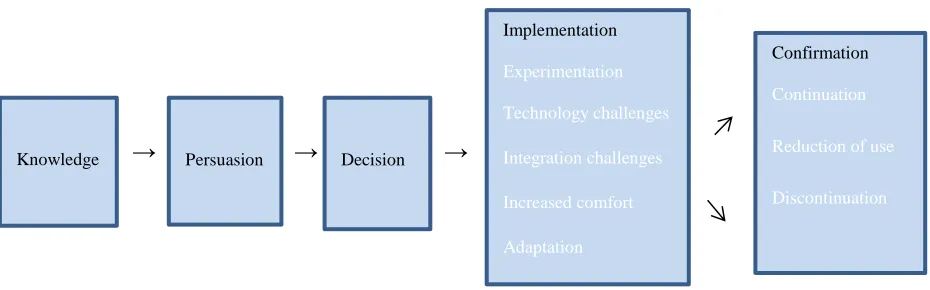
West, Waddoups and Graham (2007) propose a model of LMS adoption based on Rogers’ widely-used Diffusion of Innovation (Rogers, 2003). The basic diffusion model incorporates five successive stages of adoption: knowledge, persuasion, decision,
implementation and confirmation. The extended version (Figure 1) elaborates the last two stages to reflect LMS practice. Implementation incorporates sub-stages acknowledging practical challenges and the way these are overcome. At the confirmation stage, a user may continue to one of three possible outcomes: continuation, reduction of use or discontinuation in favour of an alternative online approach.
→ → →
[image:6.612.72.537.528.673.2]→ → →
Figure 1: West, Waddoups and Graham’s (2007) extended model of educational technology diffusion. Persuasion
Knowledge Decision
Implementation
Experimentation
Technology challenges
Integration challenges
Increased comfort
Adaptation
Confirmation
Continuation
Reduction of use
The extended diffusion model identifies a number of subtle stages in the adoption process. Although presented in linear fashion, it could be taken to represent a cyclical process in which different features of the technology are the focus of successive rounds. However, it is based on a purposeful sampling methodology with users selected to cover different approaches to technology use. Non-users are not represented and the model as it stands suggests that
knowledge is the main initial barrier. Further, as with a number of other studies, the sampling approach and the encapsulation of results as a neat sequential model may present a more favourable and seamless picture of use and progression than is actually the case. There are considerable barriers to starting and progressing, and still much to be learned about the transitions to and from each stage which, for many staff, fail to happen.
Teachers’ perspectives
Repeated studies (such as Hamuy and Galaz (2010)) indicate that although there is widespread institutional LMS adoption, most staff use them only for very basic functions of resource
provision. There is little indication that pedagogy develops significantly even over many years of institutional adoption (Rienties et al., 2014). Investigating teachers’ motivations for LMS
considerations leads instructors to rethink their approach to teaching. However, little is known about the extent to which this happens or about the experiences of instructors at different points in the spectrum of development.
Focus on TAM factors leads some authors to view technology issues (perceived ease of use and usefulness) as the main reason for lack of progression (Rienties et al., 2014), while other studies have also raised the problem of integration challenges, that is, the barriers encountered in harnessing the offered technology to achieve desired goals. Examples of barriers cited, such as lack of training in forum moderation (West, Waddoups & Graham, 2007), again indicate a technology-level approach. These issues are fundamentally practical and could be remedied by training and information provision. Yet, despite the many years over which institutions have provided training, the position is little changed.
Much existing work on LMS adoption relies on teachers’ self-reported evaluations of their usage, intention and motivation. Morgan (2003) found that although instructors classified their motivation for LMS usage as ‘pedagogic’, this most often translated to management benefit such as ease of providing lecture notes. This raises questions about instructors’ self-reported evaluations, about the semantic interpretation of terms used and hence about the validity of conclusions drawn from such data (Kane, Sandretto & Heath, 2002).
Instructors’ conceptions of teaching and their beliefs about pedagogy are fundamental to the adoption process, yet there is still very limited understanding of how these impact on
do in practice (Norton et al., 2005; Price & Kirkwood, 2014; Englund et al., 2016) yet most work exploring LMS adoption does not address this. The current research seeks to better understand the observed LMS-related behaviour of teaching staff and to place these observations of transitional development in the context of subjective and affective issues presenting barriers to progress.
Method
To investigate the experiences and understanding of participants a qualitative approach was adopted, with data gathered using in-depth, semi-structured interviews. Data collection was conducted by the authors and the subjects of study were ‘expert witnesses’ in the form of
university LMS administrators who have a deep knowledge of how the LMS is being used across many courses and by a variety of teachers. Further, they train, support and encourage teachers in LMS use on a daily basis, thus gaining insight into many different perspectives, opinions, beliefs and concerns which can suggest explanations for why particular behaviours occur. This is
therefore a study of the subjective observations of the experts based on their interactions with teachers.
implementation of a ‘digital campus’ approach to diversify pedagogic approaches. The British university is a major research institution with nearly 25,000 students and 2,500 teaching staff. Its goals include harnessing the untapped educational potential of technological innovation. Both have a wide international range of students and staff and offer a broad curriculum of degree subjects.
In each institution, the main Moodle administrator was approached and agreed to participate (representing purposeful selection of the most senior person in each case). Semi-structured interviews lasting roughly 90 minutes each were held with these expert witnesses and were conducted by the authors. A Sloose framework for the interviews was provided by themes derived from the literature, and the interviewees were asked to discuss the following with reference to their own institution: institutional motivation, support and technology issues, development of usage, challenges to adoption and future directions. The interviews were
transcribed and then subjected to thematic analysis by each author independently (Braun, Clarke & Terry, 2012). Initial codes were derived from West, Waddoups and Graham’s (2007) adoption
Maxwell (1992) identifies five dimensions of validity for qualitative research. Using established methods of collection, analysis, theoretical framework and evaluation as described above supports those four dimensions. The fifth, generalizability, can be problematic for qualitative research which does not aim to achieve, for example, statistical significance for a representative sample, but rather that the results ‘may be useful in making sense of similar persons or situations’ (ibid., p293). Participants must have sufficient expertise on the phenomena so that an understanding of the phenomena and the development of related theory are likely to emerge. An ‘expert witness’ approach has the advantage of reporting a wide range of observed perspectives contextualized by their broad knowledge of the area. Internal validity is addressed by comparing and aligning the views of two independent researchers.
Results
This section presents results from the deductive analysis aligned to the initial codes (adoption stages) indicating how the data to some extent confirms these stages, but also suggest different patterns. Quotes from the expert witnesses are denoted E (English) and F (Finnish).
Decision to adopt
Observed motivations for LMS adoption include word of mouth, seeing a colleague use it, wanting to meet students’ expectations and attendance at events promoting innovative teaching. A small number of enthusiasts often spread the word and motivate colleagues to try the system. In departments where LMS usage is more widespread:
‘usually that’s been prompted by one or two people in the department who’ve shown …
The influence of enthusiastic colleagues was raised by both interviewees as the strongest factor in prompting others to make a start. Even if an instructor hears about the system and is interested in its features, most still require a positive, local example. The enthusiasts provided successful exemplars of innovative practice, received good feedback from students and also challenged their colleagues’ concerns:
‘He said that some of his colleagues were sceptical. They thought it was going to take up a huge
amount of his time. But he said the reverse was true because rather than having lots of individual
email conversations with students, the students seeing him active on their forum would mean that
they would post questions there.’ (E)
The motivational effect of enthusiastic colleagues has been noted in previous studies, however, the interviewees observed that, despite the initial effect, continued transfer of good practice from keen users to colleagues was not occurring: ‘that doesn’t happen … sharing is not happening’ (F). The elements of good practice being developed by the enthusiasts did not transfer, with most
colleagues not following deeper into innovative use. Most teachers were observed to start with the basic functions and never progress:
‘I would say most of the teachers put their material – use the assignment, that their students return
the assignment in there. They can use discussion boards and some use exams. And that’s not even
half of the potential Moodle has.’ (F)
Both interviewees noted that staff often stated pedagogic, student-focused reasons for using the LMS to: ‘try interesting things with students that might engage them more’ (F) and ‘to try different forms of delivery, different forms of pedagogy’ (E). However, this contrasts with
what was observed in practice, both through the evidence of the many, very basic, course implementations on Moodle and through teachers’ lack of inclination to explore beyond the information level. Thus there is a discrepancy between stated motivations and what happens in
practice. Even with the many motivations and pressures to adopt the LMS, an estimated 50% of
teaching staff (after 3 years) and 15-20% (after 10 years) were not using the system at all, even for purely informational purposes.
Implementation
In the adoption phase it has been suggested that staff initially ‘experiment with individual
features that they feel directly address an instructional or organizational need, or goal that they
have’ (West, Waddoups & Graham, 2007, p14) with the LMS viewed as ‘a collection of many
features that can be individually adopted or rejected’ (ibid., p21). A degree of experimentation is
certainly likely to be needed with new technology, and the motivation to try new things is noted by our interviewees. However, the quotations above suggest a process of considered decision-making based on a motivating need that inspires adoption. This might be questioned in the light of our (and previous) findings that:
‘most of the people … only put their material in Moodle and then they think ok that’s it I can stop
here’ (F).
If the experimentation-driven model is correct, either most users’ initial goals are purely
them. However, for many teachers motivations may not relate to addressing a particular need or improving practice at all, but because it is seen as the ‘latest thing to do’, and which will possibly gain local approval and better acceptance from students:
‘some people think it’s the latest bit of technology, it’s the latest web technology. I must use it
because, well, because … that’s the thing that we do.’ (E)
This indicates usage, not in the spirit of trial and experimentation, but to conform to a perceived status quo. This may reduce openness to genuinely trialling and judging LMS features and making an informed choice concerning continuation and progression.
For staff who do explore, technology challenges are confirmed as the major initial barrier:
‘I think it’s complexity because it’s a very powerful tool there’s a huge number of options. By its
very nature that you can use it for many different things’ (E).
However, a more nuanced picture emerges as it may often be an expectation of technological challenge rather than the experience of it which is problematic, with many staff not getting to the stage of trying and encountering problems:
‘They’re scared of technology and that’s their threshold. That’s why they can’t get over – it’s too
big and it’s getting bigger every day. Because we get new things every day and maybe they didn’t
bother to learn.’ (F).
Hence for staff not using the LMS, the problem grows as the system develops and they feel further left behind, with a widening gap between users and non-users.
Confirmation
Confirmation refers to the point where instructors decide whether to continue with the
technology or not. The existing model acknowledges three options: continuation, in which ‘they strengthen their dependence on the tool through experimenting with and implementing more … features’ (West, Waddoups and Graham, 2007, p20); reduction, where they pull back on usage; or discontinuation, where the platform is abandoned. Our data indicates an important difference: many staff do not develop usage beyond resource provision, however, this does not mean they remove or reduce resources. Hence, an additional, widely-observed position is one of inertia in which usage is static, but still in evidence. Conversely, discontinuation was not observed.
Discussion of emergent themes
The second stage of inductive thematic analysis was performed in order to establish emergent themes. These are not constrained to fall within the classifications of the original deductive analysis and hence the approach allows new aspects to be identified and, potentially, supports different interpretations of phenomena observed. This analysis resulted in the identification of recurring issues relating to observations of, firstly, ‘what teachers do’ (patterns of observed behaviour) and, secondly, ‘why’ (motivations, concerns and beliefs expressed by teaching staff).
Adopter behaviour
Across both institutions, distinct patterns of adoption behaviour emerged. A small proportion of users need little encouragement. A further group follows willingly; others, less so:
‘There’s people who benefit from people at the cutting edge who won’t go first but when
they see people make the first step they follow behind … and then there’s the reluctant people that
A fourth category contains non-adopters:
‘we still have teachers here in our school who aren’t using Moodle even though we have
had it for 10 years’ (F).
In terms of technology adoption, the general shape of these observations aligns with existing models, such as Rogers (2003). However, it was also observed that staff who innovate pedagogically are not necessarily the first to adopt, but continue to develop their teaching practice within the technology. Hence pedagogic innovation does not necessarily align with the concepts of ‘innovation’ and ‘early adoption’ from technology adoption models. Discussing a specific case F notes:
‘She’s been everywhere and she’s been trying and ok this says I can make an exam here – let’s
try. And she knows how to look for training videos or material online and she can find new things
and she’s interested in how would I do things. But most of the teachers are not’. (F)
The main characteristics of pedagogic innovators were described as willingness to explore, openness to experiment and acceptance of risk: characteristics seen as lacking in most users. Some technical competence is necessary, but not sufficient (staff in some technical departments were more likely to be non-adopters). Openness to experimentation was stressed as the crucial factor. Studies which attempt to classify level of educational interaction based on functionality used, such as identifying ‘forum use’ with high educational interaction (Hamuy and Galaz, 2010), fail to take account of the fact that the feature may be employed in different ways, many of which may represent basic communication only. Our richer data supports a more realistic alignment to dimensions of interaction. Most users are observed to be (and remain) at level one:
‘most of the people when they only put their material in Moodle and then they think ok that’s it I
‘they would just use it as a place to put slides and perhaps Word documents and pdfs, it was just
a sort of a file dumping ground’ (E).
Very few staff interact at the highest level, but there are striking examples. F describes a session where participants worked from home, with a mixture of instructor-led tuition and small-group collaborative tasks all enabled by supporting technology. Similarly, E notes a teacher who:
‘was getting students to look in the media for examples of stories related to the course,
encourage them to post the link to that material and then would prompt a discussion in Moodle
that related to that. And he would interact with them as well.’
Again, this points to a concept of pedagogic ‘super innovators’ not necessarily aligned with early technology adoption. They may come later to the technology, and indeed may have concerns about using it. However, their openness and willingness to explore extends to innovation in pedagogical approach and their focus on improving teaching and learning outweighs the element of risk involved. Conversely, an instructor depositing materials early on may be an ‘innovator’ according to adoption model terminology, while failing to develop towards more progressive pedagogy.
Intrinsic barriers
The previous theme addressed observed behaviour. Here, we consider why such patterns occur and discuss barriers and concerns raised. Firstly, the interviewees both view pedagogic barriers as the most challenging:
‘You can get over the technological problem fairly easily and it’s trying to always make sure that
it goes back to the pedagogical ... and sometimes it can be a very difficult conversation.’ (E)
practice which concentrate on external factors affecting staff progress (such as training and staff time). While these are undoubtedly important, the experts viewed pedagogical and conceptual issues as more fundamental inhibitors of progress. The following sections explore these issues.
Self-perception
Both experts raised the issue of teachers’ own perspectives on their LMS usage. F notes of one teacher:
‘she thinks she’s a really big user of Moodle because all her courses are there, all her materials are
there and the students return their assignments there’.
However, in reality, this user barely scratches the surface of Moodle possibilities. This is common:
‘Most of them who use it think that they can utilize it well. But they can’t.’ (F).
For many teaching staff, effective LMS use means providing course materials from all their modules. Those believing they have already achieved a good level of usage are unlikely to seek additional features or to develop their pedagogy.
These observations raise several issues. Firstly, users may not be well-placed to judge the level of their own usage or provide accurate reports of how they use the system. This relates to previous findings that some staff who class their motives and LMS usage as ‘pedagogic’ were really using it for administrative benefit (Morgan, 2003) and the issue of unreliability affecting educational research based purely on teachers’ self-reporting (Kane, Sandretto & Heath, 2002).
Secondly, unrealistic perceived use may be seen as related to the knowledge stage of LMS adoption. Greater knowledge of, for example, platform functionality, might allow users to see potential for development. However, reaching this point may require a different approach to existing LMS training which those who already consider themselves proficient are unlikely to attend.
Fear of technology and the consequences of adoption
Although practical present initial barriers, more fundamental, affective and often
unacknowledged issues inhibit teachers’ openness to exploration and help-seeking. Firstly, many
are afraid of technology:
‘I would say the first problem is the fear of technology. They’re scared of technology and that’s
their threshold.’ (E)
‘People say it’s really scary.’ (F)
Discussion of technology acceptance often characterizes older people as being less familiar with technology and slower to use it. While this may be true in general, the experts noted that fear was not solely an issue for older staff. Familiarity with certain types of technology in particular contexts does not necessarily translate to confidence in exploring different technologies in other contexts.
‘That’s the very prominent feeling that’s still here. I’m the teacher, I need to know. And if
I don’t know I fail.’ (F).
Some staff are happy to experiment, but many are not:
‘They think I can try and I can fail and it doesn’t matter. I’m trying and if it didn’t work I try
something else. And I will tell the students that I’m trying. And they’re not too scared of making a
mistake. But most of the teachers are afraid of making a mistake.’ (F)
Hence fear of technology becomes, for many, fear of perceived failure and a threat to professional standing.
There may also be serious, tangible consequences if teaching is not well-received. Although the teacher-centric conception of education is now challenged by more interactive, constructivist approaches, the teacher still has a fundamental leadership role and technology problems may undermine the teacher’s own confidence and the students’ confidence in them. Further, student dissatisfaction may be reflected in a very visible form: innovation involves risk and may reduce student ratings, at least temporarily (Walder, 2015). Walder gives a stark warning that ‘use of the student questionnaire for evaluating professorial teaching provision can
not only prove to be an important deterrent to pedagogical innovation, but also, can unjustifiably wreck an entire career’ (ibid, p14). With student feedback surveys now firmly established within higher education and often influencing decisions on pay and promotion, the dual innovation (technological and pedagogical) may be seen as introducing a high level of risk. Hence, while fear of technology is an affective inhibitor of LMS-based innovation, the feared possible consequences may well be very real.
One specific example of a widespread concern relating to consequences was cited:
‘There’s a fear that students are going to stop attending the lectures because we’re providing the
have to turn up to see the performance of a lecture because they have access to all the
information in other ways. And I think this is a fear that I’ve seen repeated quite a lot’ (E).
The non-attendance issue has been widely discussed. Research indicates that students do not necessarily stop attending and the relationship between availability of recordings and attendance is a complicated one (Van Konsky, 2009). However, simply repeating what is available on-line is unlikely to provide value to students: some degree of disruption is inevitable. The fear of non-attendance and poor teaching evaluations is still a major barrier for many who consequently avoid possible disruptive consequences of adding even such commonplace features as lecture recordings to their LMS presence.
Conceptions of teaching
A willingness to embrace pedagogic change lies at the heart of innovative LMS use. Some instructors hold beliefs about the way they should teach which are in direct opposition to more innovative approaches:
‘I think the teachers’ mindset is – it’s an ideological thing. Teachers, you think, I’m a teacher I
need to know. I’m the one who pours the information on the students’ heads’ (F).
Teaching and learning activities which might alter the relationship between staff and students (such as student-led and social constructivist approaches) were seen as particularly problematic. It is not simply a reluctance to try, but a belief that it is not an appropriate way to teach. Englund et al. (2016) suggest that university instructors’ conceptions of teaching are slow to change, and
for some there is no movement towards, for example, a more student-centric stance. Without conceptual change it is unlikely that teachers will voluntarily alter their pedagogy.
outstanding practice in LMS innovation, both experts recounted cases relating to teaching staff of mature years. This does not contradict Englund et al.’s (2016) finding that experienced staff are less likely to become more student-centred in their conception of teaching but it does suggest that where these staff do become involved in LMS-based innovation, their greater experience can allow them to implement exciting approaches which offer exemplars of effective technology-enhanced learning. There has already been extensive debate over assumptions about students and their relationship with technology as ‘digital natives’ (Bennett, Maton & Kervin, 2008).
Similarly, our findings suggest the need to investigate a more subtle relationship between staff and technology. Secondly, in talking about lack of adoption in some areas of the university E states:
‘I’m reluctant to comment on what I think is the right thing because I’m fully aware that in some
disciplines it is – you need to have students in a room to show something in a way that technology
is nowhere near close to doing.’
Thus, a teacher using non-LMS-based approaches for aspects of their teaching may be acting, not from a conceptually limited standpoint, but having taken a clear decision based on good
understanding of current technological capability and from a progressive conceptual perspective. Indeed, an understanding of how the division between online and in-class teaching may be used most effectively is crucial to the on-going success of university teaching. Hence, in addition to the phenomenon of a traditional conception of teaching limiting LMS innovation, it is possible that some staff with a more student-centric belief may equally draw back from an
Institutional responsibility
Current institutional support for staff is often based around training courses, online resources and some individual support. However:
‘We have just noticed that the training sessions that we have organised, it’s not a good
idea. Nobody comes and nobody learns anything.’ (F)
Better understanding of the reasons behind the lack of progression and an approach to staff development which helps teachers understand and confront their conceptual barriers is needed. Although this has previously been raised in the context of e-learning (Elgort, 2005) little has changed and solutions are still seen as technological.
Institutions should consider what they want to achieve in their LMS usage and the influence that policy and institutional ethos has on staff:
‘It’s quite interesting to see the effect that the idea of what a university should be and
how it should work has on what kind of things people are willing to try or consider or their
attitude to things when they have tried something.’ (E)
One practical example is the timetable and teaching locations:
‘lectures are seen somehow as the sacred thing that must continue and everything else must to
some extent bend around it’. (F)
‘Lecturers’, ‘lecture theatres’ and ‘lecture slots’ timetabled for hundreds of students still shape
teaching structure in many universities.
Finally, institutions can acknowledge the widespread fear of the various risks posed by innovation. Staff should not bear this burden alone and indeed cannot change the criteria against which they are judged. Suggestions such as adapting student questionnaires to be more
Conclusions
All qualitative research necessarily involves a degree of subjectivity from both respondents and researchers. In this work we have attempted to increase replicability and dependability by applying accepted methodology to both data collection and analysis, using independent deductive and inductive coding.
Models which approach educational technology adoption from a purely technical perspective cannot capture the many subtle variations of usage which are evidenced in practice. Although most teaching staff in the institutions studied ‘use’ Moodle, in practice, this is mainly at the basic level of resource provision and has not altered significantly in a decade. Simplistic models address neither the relationship of technology adoption to pedagogy nor the conflict between educational innovation and instructors’ conceptions of what teaching is and how they should be seen to act. Even models which acknowledge a role for pedagogy often view the barriers to be overcome as largely knowledge-based. Models and findings based on staff self-report are likely to be inaccurate in assessing the level and character of usage.
training provision encompass. Institutions have a responsibility to recognize the real and perceived risks innovation brings and explore ways to reduce the ‘double whammy’ of technological and pedagogic innovation.
Finally, an LMS ‘super innovator’ is characterized, not necessarily as a young,
tech-savvy, early adopter, but as someone open to experimentation, with the confidence to appear unsure and with a perspective on teaching which embraces change and new pedagogy. Although older teachers may be more likely to resist technology adoption and conceptual change,
outstanding innovative practice was observed in mature staff who were open to exploration. These ‘super innovators’ have a wealth of experience which, in combination with the willingness
to explore technologically and pedagogically, provided the most successful examples of teaching innovation. This is a surprising outcome and will be investigated in future work.
References
Al-Busaidi, K. A., & Al-Shihi, H. (2010). Instructors' Acceptance of Learning Management
Systems: A Theoretical Framework. Communications of the IBIMA, 2010, 2010.
Bennett, S., Maton, K., & Kervin, L. (2008). The ‘digital natives’ debate: A critical review of the evidence. British journal of educational technology, 39(5), 775-786.
Bolliger, D. U., & Wasilik, O. (2009). Factors influencing faculty satisfaction with online
teaching and learning in higher education. Distance Education, 30(1), 103-116.
Braun, V., Clarke, V., & Terry, G. (2012). Thematic analysis. In Cooper, H. (Ed.), The
Handbook of Research Methods in Psychology (pp. 95-114). American Psychological
Coates, H., James, R., & Baldwin, G. (2005). A critical examination of the effects of learning
management systems on university teaching and learning. Tertiary education and
management, 11, 19-36.
Costello, E. (2013). Opening up to open source: looking at how Moodle was adopted in higher education. Open Learning: The Journal of Open, Distance and e-Learning, 28(3), 187-200.
Davis, F. D. (1989). Perceived usefulness, perceived ease of use, and user acceptance of
information technology. MIS quarterly, 319-340.
De Smet, C., Bourgonjon, J., De Wever, B., Schellens, T., & Valcke, M. (2012). Researching
instructional use and the technology acceptation of learning management systems by
secondary school teachers. Computers & Education, 58(2), 688-696.
Elgort, I. (2005, December). E-learning adoption: Bridging the chasm. In Proceedings of
ASCILITE (pp. 181-185).
Englund, C., Olofsson, A. D., & Price, L. (2016). Teaching with technology in higher education:
understanding conceptual change and development in practice. Higher Education Research &
Development, 1-15.
Fereday, J., & Muir-Cochrane, E. (2006). Demonstrating rigor using thematic analysis: A hybrid of inductive and deductive coding and theme development. International journal of
qualitative methods, 5(1), 80-92.
Hamuy, E., & Galaz, M. (2010). Information versus communication in course management
system participation. Computers & Education, 54(1), 169-177.
Kane, R., Sandretto, S., & Heath, C. (2002). Telling half the story: A critical review of research
on the teaching beliefs and practices of university academics. Review of educational research,
Lonn, S., & Teasley, S. D. (2009). Saving time or innovating practice: Investigating perceptions
and uses of Learning Management Systems. Computers & Education, 53(3), 686-694.
Maxwell, J. A., 1992, Understanding and validity in qualitative research. In A. M. Huberman &
M. B. Miles (Eds.), The qualitative researcher’s companion, (pp. 37-64). Thousands Oaks,
CA: Sage Publications
Morgan, G. (2003). Faculty use of course management systems (Vol. 2). ECAR, EDUCAUSE
Center for Applied Research.
Norton, L., Richardson, T. E., Hartley, J., Newstead, S., & Mayes, J. (2005). Teachers’ beliefs
and intentions concerning teaching in higher education. Higher education, 50(4), 537-571.
Park, J. Y. (2014). Course evaluation: reconfigurations for learning with learning management
systems. Higher Education Research & Development, 33(5), 992-1006.
Price, L., & Kirkwood, A. (2014). Using technology for teaching and learning in higher
education: A critical review of the role of evidence in informing practice. Higher Education
Research & Development, 33(3), 549-564.
Rienties, B., Giesbers, B., Lygo-Baker, S., Ma, H. W. S., & Rees, R. (2014). Why some teachers
easily learn to use a new Virtual Learning Environment: a Technology Acceptance
perspective. Interactive Learning Environments, 1-14.
Rogers, E. M. (2003). Diffusion of innovations, 5th edition. New York, NY: Free Press.
Sugar, W., Crawley, F., & Fine, B. (2004). Examining teachers' decisions to adopt new
technology. Journal of Educational Technology & Society, 7(4), 201-213.
Van Raaij, E. M., & Schepers, J. J. (2008). The acceptance and use of a virtual learning
Von Konsky, B. R., Ivins, J., & Gribble, S. J. (2009). Lecture attendance and web based lecture
technologies: A comparison of student perceptions and usage patterns. Australasian Journal
of Educational Technology, 25(4), 581-595.
West, R. E., Waddoups, G., & Graham, C. R. (2007). Understanding the experiences of
instructors as they adopt a course management system. Educational Technology Research and